
Economy
2026 dubbed ‘most critical’ year for Türkiye’s economic blueprint

Next year will be the “most critical” one when it comes to the Turkish government’s medium-term economic program, Vice President Cevdet Yılmaz said on Monday, reaffirming the aim to maintain stability and the downward trend in inflation.
The remarks came as Yılmaz kicked off what is expected to be a two-week-long debate on the government’s 2026 budget bill at the Parliament in the capital Ankara.
“Our budget aims for a permanent increase in social welfare in an environment where economic growth continues with stability, and the inflation rate is falling,” he told lawmakers.
Annual inflation surprised in November as it cooled more than expected to 31.07%. The figure, which had peaked at about 75% in May 2024, is now at its lowest level since November 2021.
“The year 2026 is the most critical year of our Medium-Term Program (MTP),” Yılmaz said. “It will be the year when the outcomes of our policy measures become evident and when our reforms bear fruit. The budget has been prepared with exactly this understanding.”
He said they expect external conditions next year to exhibit a more supportive outlook, which he believes would contribute relatively more to Türkiye’s disinflation process and to its investment, employment, production and export targets.
The government expects 2026 budget revenues to increase by 30.5% from projected 2025 realizations, reaching TL 16.27 trillion (about $390 billion), with tax revenues rising 28.9% to TL 13.83 trillion.
Expenditures have primarily focused on rebuilding the southeastern region that was devastated by the early 2023 earthquakes. Total spending in the budget is estimated to reach TL 18.98 trillion in 2026, compared to estimated TL 14.67 trillion for 2025.
Yılmaz said interest expenditures are expected to be at around 3.5% of gross domestic product (GDP), and the government estimates a primary surplus of TL 29 billion next year.
The government expects to end 2025 with a budget deficit of about TL 2.21 trillion and a primary deficit of TL 156 billion, the vice president said.
‘Clear’ priority
On inflation, Yılmaz said the downward process has become more visible as of the second half of this year.
“Annual consumer inflation decreased to 31.1% as of November 2025, with core goods inflation falling to 18.6%. The inflation outlook for December is also maintaining a positive trajectory,” he said.
“Our priority is clear and explicit,” Yılmaz noted. “We will resolutely continue disinflation through a holistic approach encompassing monetary, fiscal, and income policies, as well as structural transformation steps.”
Inflation is expected to drop to about 16% in 2026 and return to single digits from 2027, according to the MTP.
“We aim for inflation to fall below 20% in 2026, for the stickiness in pricing behavior to be permanently broken, and for inflation to be reduced back to single-digit levels starting from 2027,” Yılmaz said.
Disinflation regained momentum after higher-than-expected inflation in August and September prompted the Turkish central bank to slow its easing cycle.
Markets are closely monitoring the Central Bank of the Republic of Türkiye’s (CBRT) final Monetary Policy Committee (MPC) meeting of the year for signals on the pace of future interest rate cuts.
The bank slowed its easing cycle in October with a 100-basis-point rate cut that brought its policy rate to 39.5%. Surveys expect a cut of the same size this Thursday.
The bank’s end-2025 inflation target stands at 24%, with its forecast range at 31%-33%. It sees inflation easing to about 16% in 2026.
Labor market
On the labor market, Yılmaz recalled that unemployment stood at 8.5% in October and has remained in single digits for 30 consecutive months.
The rate could end the year slightly below that level, which has been projected in the government’s program, he added.
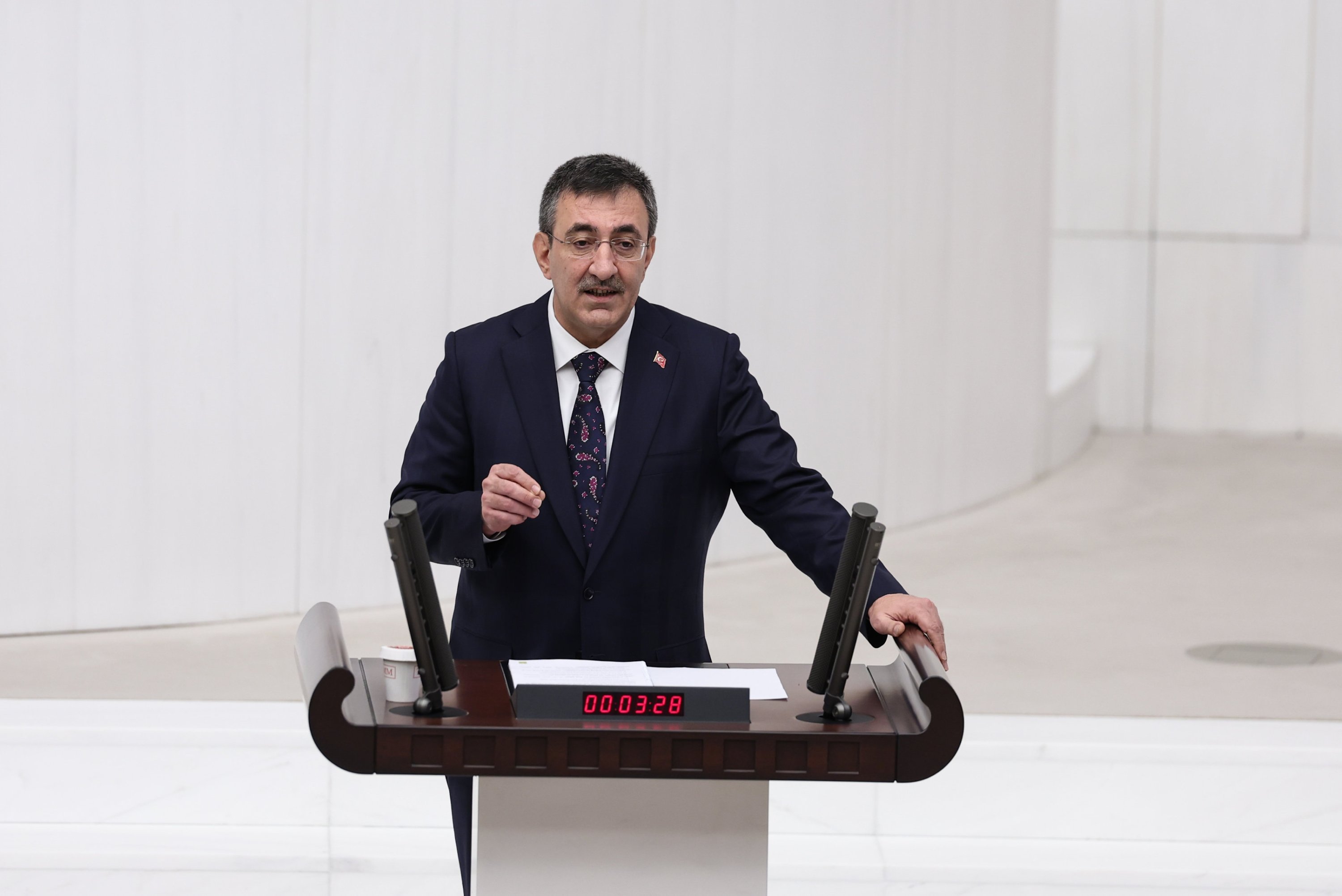
“As our capabilities increase, we will continue to improve the conditions of all segments [of the population] in a way that ensures a permanent increase in prosperity in an environment where inflation is falling,” the vice president said.
“We will continue to raise the welfare of our people on a realistic basis, not with a populist, deceiving approach.”
Yılmaz stated that while striving to reduce unemployment, they also plan to implement a multifaceted policy set aimed at integrating idle labor into production.
“Employment is expected to increase by an annual average of 842,000 people in the coming years, and the unemployment rate is expected to gradually fall to 7.8% by 2028,” he added.
Post-2023 quake rebuilding
Yılmaz said Türkiye has moved from the lower-middle-income group to the upper-middle-income category in a lasting way and is now preparing to join the ranks of high-income countries.
He said the draft budget supports structural reforms, accelerates the transition to a green and digital economy, and includes measures to enhance food and energy security as well as preparations for a new social housing initiative.
The recovery from the February 2023 earthquakes that devastated the southeastern region remains a top priority, according to Yılmaz. He said the aim is to fully heal the wounds, build more resilient cities and establish a new standard of living safety.
About $90 billion has been allocated from the central budget to rebuild the southeastern region over the last three years, said the vice president.
“Strengthening physical infrastructure, developing human capital, and increasing our production capacity are the main axes of our budget, in line with our Development Plan and our Medium-Term Program,” he noted.
Growth outlook
Yılmaz said Türkiye continues to outperform global averages. While the world economy grew 15.1% between 2020 and 2024, Türkiye’s output expanded 30.3% in the same period, he said.
The country’s economy expanded by 3.7% in the third quarter of this year, according to last week’s official data, the same pace at which it grew in the first nine months.
That capped an uninterrupted growth for 21 consecutive quarters, despite what Yılmaz said were unfavorable global and regional conjunctures.
Türkiye’s nominal gross domestic product (GDP) exceeded $1 trillion for the first time in 2023. It reached nearly $1.54 trillion as of this July-September period, the vice president said.
Per capita income is expected to reach $17,748 by the end of 2025, Yılmaz noted, pushing Türkiye for the first time above the World Bank’s high-income threshold.
As of 2024, Türkiye is the 17th largest economy in the world in nominal dollar terms and the 12th largest economy based on purchasing power parity.
“If projections for 2025 materialize, the Türkiye economy will be the 16th largest in the world in nominal dollar terms and the 11th largest according to purchasing power parity,” said Yılmaz.
“We thus expect to surpass Italy’s economic volume and become the fourth largest economy in Europe.”
Trade, investment
Yılmaz went on to highlight improvements in foreign trade and investment.
He said exports reached $247.2 billion in the first 11 months of the year, with annualized shipments at $270.6 billion. Total goods and services exports are estimated to exceed $390 billion in 2025.
Exports are projected to reach $282 billion next year, according to Yılmaz.
The current account deficit to national income ratio is projected to end this year at around 1.4%, in parallel to the forecasts in the MTP, he noted.
Foreign direct investment (FDI) rose 46% year-over-year in January-September to $11.4 billion, he noted. Annualized FDI reached $15.3 billion.
Yılmaz also underscored a sharp decline in foreign exchange-protected deposits (KKM), which fell to just 0.1% of total deposits, while the share of Turkish lira deposits rose to 62.1%.
The value of KKM deposits has shrunk to $600 million from a peak of $140 billion in August 2023.
The reserves of the Central Bank of the Republic of Türkiye (CBRT) reached $183.2 billion as of Nov. 28, marking an increase of $25.5 billion from last year, Yılmaz said.
U.S. President Donald Trump is vowing to increase economic pressure on Iran and Treasury Secretary Scott Bessent has said Washington would introduce measures against Tehran “never been seen” as early as this week.
The United States, United Nations and European Union have applied sanctions, implemented trade embargos and frozen assets since the late 1970s over Iran’s nuclear program, human rights violations and support for militant groups.
Since the Iran war began in February, Washington has levied additional maritime, energy and financial sanctions and started a naval blockade.
Data from the U.S. Treasury Department’s Office of Foreign Assets Control (OFAC) shows the agency has imposed sanctions on more than 1,000 people, vessels and aircraft since Trump began his second term.
Recent measures have targeted Iran’s shadow oil fleet; shipping insurers; entities and people enabling Iran’s acquisition of weapons; and digital exchanges, freezing an estimated $500 billion in Iran-linked cryptocurrency.
Experts say the Trump administration also could try these options.
Sanctions on Chinese ‘teapot’ refiners
Chinese independent refineries known as “teapots” account for a quarter of Chinese refinery capacity. They operate with narrow and sometimes negative profit margins.
China buys more than 80% of Iran’s shipped oil, according to 2025 data from analytics firm Kpler. Independent refiners absorb much of this trade, exposing them to so-called secondary measures that penalize entities helping a primary sanctions target.
Past U.S. sanctions have deterred larger independent refiners from buying Iranian oil. But the independent refineries are somewhat immune since they have little exposure to the U.S. financial system, sanctions experts say.
Sanctions on Chinese banks
OFAC has imposed secondary sanctions on smaller China- and Hong Kong-based entities accused of processing billions of dollars in Iranian oil and helping to fund weapons procurement.
Treasury has warned two larger Chinese banks they could face secondary sanctions if Iranian funds were found moving through their systems, but has stopped short of designating them.
Hitting those two banks, which U.S. officials have not publicly identified, or imposing other sanctions could have a chilling effect on bigger financial institutions, sanctions experts said, although they warned it could also trigger retaliatory actions by Beijing.
Trump administration officials have sought to play down tensions between Washington and Beijing ahead of an expected meeting between Trump and President Xi Jinping later this year.
They worry that China could curtail exports of critical minerals that are essential to advanced technology production at a time when the U.S. and Western allies are still trying to develop their own supplies.
‘Whack-a-mole’
The United States could continue targeting Iranian individuals and entities, as well as others in China and the Gulf, that are helping Tehran evade sanctions to collect revenues for its war effort.
Treasury recently issued sanctions against firms that are springing up to facilitate Iran’s trading of oil revenue for imports. But such measures amount to a “whack-a-mole” approach that has not altered Iran’s behavior, said Brett Erickson, managing principal of Obsidian Risk Advisors, noting that Tehran simply creates new entities to replace them.
Miad Maleki, a sanctions expert with the Foundation for Defense of Democracies, said Bessent was likely signaling a sharpened enforcement push against oil shippers, purchasers and currency exchangers who help Iran pay for its imports.
Further aviation sanctions were also possible, aimed at degrading Iran’s ability to move trade now that the U.S. has blockaded shipping via the Strait of Hormuz, he added.
Land blockade
Some U.S. and Israeli officials have floated the prospect of a land blockade, which would require assistance from Iran’s neighbors: Iraq, Türkiye, Pakistan, Afghanistan, Turkmenistan, Azerbaijan and Armenia.
The Trump administration has varying degrees of closeness with all those countries except Afghanistan, but that border is mountainous and extremely difficult to patrol anyway.
A land blockade could increase pressure on the Iranian people by halting their imports of food, energy and textiles, but experts say such a move would be difficult to execute and might not result in protests or internal pressure.
Secondary tariffs
Trump has repeatedly threatened tariffs on goods from countries that do business with Iran, although the Supreme Court struck down the legal basis for such taxes.
The Senate passed a sweeping Russia sanctions bill last week that included new Iran sanctions and would give Trump new tariff powers that he could potentially use against countries that aid Iran’s commerce and weapons procurement.
That legislation must still pass the U.S. House of Representatives, which could prove challenging given widespread concerns among Democrats and some Republicans about the tariff measures.

Istanbul Airport has set new records for daily flights and passenger traffic, Transport and Infrastructure Minister Abdulkadir Uraloğlu said Monday.
Türkiye’s largest airport and one of the biggest civil aviation hubs in the world handled 1,739 flights and 290,287 passengers on Sunday.
The figures marked the highest number of daily flights and passengers ever recorded at an airport in Türkiye and Europe, Uraloğlu said in a statement.
The passenger count renews Istanbul Airport’s previous peak of 289,732 reported on the same day a week ago.
The new records further strengthen Istanbul Airport’s position as a major international aviation hub, Uraloğlu said.
“Istanbul Airport is among the world’s leading airports with its capacity, strong infrastructure and quality of service,” he noted.
“These new records once again demonstrate that our airport is further strengthening its position as a global transfer hub.”
The gleaming glass-and-steel structure along the Black Sea coast turned into one of the most important transit centers in aviation since it became fully operational in April 2019.
The hub can handle 90 million passengers a year in the current phase. The figure is nothing compared to its potential capacity to serve 200 million after completing all phases.
Istanbul Airport served record-breaking 84.4 million passengers in 2025, making it the second-busiest airport in Europe after Heathrow Airport and the eighth-busiest worldwide. It seeks to reach the 90 million mark this year.
Sabiha Gökçen also sets passenger record
Across the city, Türkiye’s second-largest airport also recorded its highest-ever daily passenger traffic on the same day.
Sabiha Gökçen International Airport said it had handled 180,914 passengers across 958 flights on Sunday.
It said it saw new daily records for international arriving and departing passengers, domestic passenger traffic, total international flights and international departures.
The airport additionally set a record for aircraft served through Passenger Boarding Bridges (PBBs). A total of 218 aircraft used the boarding bridges on Sunday, surpassing the previous daily record of 212.
Hanita Ahmad, executive director of Sabiha Gökçen, said passenger traffic had surpassed 180,000 for the first time, reflecting both strong demand for the airport and its operational capacity.
“As Sabiha Gökçen, we will continue focusing on continuously improving the passenger experience and sustainable growth in line with our vision of becoming a regional transfer hub,” Ahmad said.
Türkiye’s central government budget swung to a deficit in July, but Treasury and Finance Minister Mehmet Şimşek said the government remains on track with its fiscal targets despite the impact of geopolitical developments.
The budget recorded a TL 378.1 billion ($7.89 billion) deficit last month, according to data from the Treasury and Finance Ministry. That follows a TL 114.2 billion surplus in June.
Budget expenditures totaled TL 1.79 trillion, while revenues reached TL 1.41 trillion in July. The primary balance posted a deficit of TL 51.3 billion, while interest payments amounted to TL 326.8 billion.
Despite the monthly deficit, Şimşek said the government was maintaining fiscal discipline and progressing in line with its budget goals.
For the January-July period, the budget registered a deficit of TL 1.32 trillion. Expenditures reached TL 10.52 trillion, compared with revenues of TL 9.20 trillion.
The government recorded a TL 470.1 billion primary surplus during the first seven months of the year, as primary expenditures totaled TL 8.73 trillion.
The primary surplus, an important indicator of the government’s fiscal position excluding interest payments, increased by TL 228 billion from the same period a year earlier, Şimşek said.
Tax revenues also continued to rise. Tax collections increased 30% year-over-year in July to TL nearly 1.24 trillion, while other non-tax general budget revenues rose 18.9% to TL 145.6 billion.
Fiscal policy to support disinflation
Şimşek said fiscal policy was being implemented with the broader disinflation program in mind.
He noted that the government had forgone a significant amount of tax revenue through the sliding-scale tax mechanism on fuel prices to help support the disinflation process. He also said the ongoing rebalancing of domestic demand had affected revenue performance.
“Despite the significant tax revenue forgone under the sliding-scale mechanism to support disinflation and the impact of the rebalancing in domestic demand on revenue performance, we are progressing in line with our budget targets,” Şimşek said.
The minister added that the government had kept its domestic debt rollover ratio at around 87%, taking financing conditions into account.
He said stronger revenue collection and tighter spending discipline had created fiscal space that would be directed toward priority areas while continuing to support the disinflation process.
“With increased effectiveness in our revenue policies and stronger spending discipline, we will continue directing the fiscal space we have created toward priority areas and supporting the disinflation process,” Şimşek said.
Türkiye’s automotive production fell 8% year-over-year in the first seven months of 2026, while exports by volume declined 14%, as weaker passenger car output and fewer working days weighed on the sector, data showed Monday.
But industry officials said the decline partly reflects preparations by automakers to introduce new models and expand capacity, with the impact of those investments expected to become more visible in the final quarter and particularly in 2027.
Automotive Industry Association (OSD) Chair Cengiz Eroldu said some of their members were preparing their production lines for new models and capacity investments.
“When a new product is introduced to a production line, the existing production pace has to be reduced for a certain period. We consider the production loss to be a normal consequence of the transition to new investments,” Eroldu said.
Hyundai, Opel and Peugeot just recently announced new investments and launches of production of new models in Türkiye.
Hyundai on Friday started mass production of its new all-electric IONIQ 3 model at a factory in Türkiye’s northwestern Kocaeli province.
Earlier this month, Opel said it was moving production of its light commercial vehicle model Combo to Türkiye from the third quarter of this year.
In late July, Peugeot announced it would begin producing its Rifter light commercial vehicle in Türkiye beginning in the third quarter.
Production falls as passenger car output weakens
Eroldu, meanwhile, said the sector also lost around five to six working days in the first seven months compared with the same period last year because of public holidays and administrative leave.
Total automotive production reached 767,216 vehicles in January-July, down 8% from a year earlier, the OSD data showed. Passenger car production declined 19% to 424,667 units.
Commercial vehicle production, however, remained more resilient, rising 9%. Within the segment, production increased 16% for midibuses, 15% for light trucks, 8% for buses and 1% for trucks, while minibus production fell 9%.
The industry’s overall capacity utilization rate stood at 62%, with utilization at 63% for light vehicles, 69% for buses and midibuses, 57% for trucks and just 28% for tractors.
Eroldu said the differing performance across vehicle categories was significant.
“Production declines were concentrated mainly on the passenger car side, while we are seeing a more positive trend in light commercial and heavy commercial vehicles,” he said, adding that the sharp decline in tractor production and the more than 50% contraction in the domestic tractor market warranted attention.
New investments expected to lift local production
Despite the production decline, Eroldu said new investments were already beginning to support the share of locally produced vehicles in the domestic market.
The share of domestically produced vehicles in the passenger car market rose to 35% from 29% a year earlier. Locally produced passenger car sales increased 4%, while imported sales fell 19%.
In the light commercial vehicle market, locally produced vehicle sales rose 13%, lifting their share to 23%, while imported sales fell 9%.
Eroldu said the increase in the domestic share was an early indication of the impact of new investments and that the contribution should become more pronounced as production of new models ramps up.
“The positive impact of new models entering production and export programs will become apparent in the final quarter of the year and, more significantly, in 2027,” he said.
Export volumes decline, but revenue remains resilient
Automotive exports fell 14% by volume to 542,401 vehicles during the first seven months, according to the OSD data. About 71% of total production was exported.
Passenger car exports dropped 29% to 255,679 units, while commercial vehicle exports increased 8%. Tractor exports rose 20% to 7,792 units.
Despite the decline in unit exports, export revenue continued to increase. According to Türkiye Exporters Assembly (TIM) data, total automotive exports rose by around 2%-2.6% in dollar terms to approximately $24 billion.
Uludağ Automotive Industry Exporters’ Association data showed passenger car export revenue fell 9% to $6.3 billion, while exports by main manufacturers increased 0.1% and those by suppliers rose 4.5%.
Automotive remained Türkiye’s leading export sector, accounting for 17% of total exports.
Domestic market contracts, but local share increases
The total automotive market shrank 11% year-over-year to 661,249 vehicles in January-July. Passenger-car sales fell 12% to 502,712, while the commercial vehicle market contracted 5%.
Heavy commercial vehicle sales declined 8%, but bus sales rose 23% and midibus sales increased 14%.
Eroldu noted that despite the market contraction, the sector remained significantly above its long-term averages. Compared with the previous 10-year average, the total market was 31% higher, the passenger car market 32% higher, the light commercial market 30% higher and the heavy commercial market 22% higher.
Europe remains key to industry’s outlook
Eroldu said the performance of the domestic market, demand and competitive conditions in Europe, and the implementation of new models would be critical for the remainder of the year.
He expects full-year production and exports to remain somewhat below 2025 levels but relatively close to last year’s performance.
Looking ahead to 2027, the sector will focus on domestic demand, global vehicle demand, China’s competitive pressure, cost pressures, excess capacity and the European Union’s proposed Industrial Acceleration Act (IAA).
Europe accounts for around 70% of Türkiye’s automotive exports, making the outcome of the IAA negotiations particularly important for Turkish manufacturers and suppliers.
“We expect the negotiation process to extend into 2027,” Eroldu said, stressing that Türkiye’s automotive industry is deeply integrated with Europe’s manufacturing, investment and supply chains.
He said the industry wants Türkiye to be treated within the EU framework as a customs union partner and an integral part of the European automotive value chain, covering both vehicle manufacturers and suppliers.
Eroldu also said that reducing cost pressures caused by the gap between exchange rates and inflation, improving exporters’ access to finance and maintaining predictability in the investment environment would be crucial to the industry’s competitiveness in 2027.
Japan’s economy lost momentum in the second quarter and fell short of market forecasts, as subdued household and business spending highlighted the fragility of the recovery as the war in the Middle East darkens the outlook.
However, long-term bond yields hit a three-decade high as investors brushed aside the soft reading as reflecting one-off factors, and focused more on mounting inflationary risks that could prod the Bank of Japan (BOJ) to raise interest rates next month.
Gross domestic product (GDP) rose 1.1% in annualized terms, government data showed on Monday, missing a median market estimate of 2% and below an upwardly revised 1.9% expansion in the previous quarter.
While the data revealed some temporary soft patches in demand, analysts say robust underlying momentum and persistent price pressures are likely to keep the case for imminent interest rate hikes intact.
“Today’s GDP data was a bit weak but the economy is likely to continue recovering moderately,” said Naoki Hattori, chief Japan economist at Mizuho Research Institute. “Given risks of underlying inflation overshooting its target, the BOJ is likely to proceed with a rate hike next month.”
The BOJ is expected to raise rates as soon as September and is said to be considering hiking more aggressively thereafter to avoid being behind the curve on inflation.
The benchmark 10-year Japanese government bond (JGB) yield rose for a sixth straight session on Monday to hit a 30-year high of 2.925%, as investors continued to price in BOJ rate hikes sooner and faster than earlier expected.
Private consumption was the biggest disappointment in the GDP data, falling 0.02% versus market expectations for a 0.5% increase, the first drop in eight quarters.
Analysts said the weakness was due in part to lower school fees households paid thanks to subsidies, which pushed down headline private consumption but lifted government spending.
Capital spending, a key driver of private demand, fell 1.2% in the second quarter, confounding market forecasts for a 0.4% increase. However, capital expenditure, as well as overall preliminary GDP, tend to be revised higher with updated figures.
Exports remained resilient thanks to solid U.S. demand for Japanese hybrid vehicles and sustained global investment in artificial intelligence that supported shipments of semiconductor-related equipment and components.
Net external demand, or exports minus imports, added 0.5 percentage point to growth, largely because imports fell sharply after temporary disruptions to crude oil shipments through the Strait of Hormuz.
“I don’t think the BOJ would be too worried about today’s GDP data as the economy is showing remarkable resilience to headwinds from the Iran war,” said Yoshiki Shinke, senior executive economist at Daiichi Life Research Institute.
The government maintained its sanguine view on the economy.
“The economy remains on a moderate recovery path, with export-driven growth offsetting weakness in domestic demand,” Economy Minister Minoru Kiuchi said in a statement.
Outlook murky
Looking ahead, analysts cautioned that rising import costs and mounting upstream price pressures could eventually feed through to consumers, posing a risk to spending later this year.
Aside from rising fuel costs from the Middle East conflict, a weak yen has lifted import prices and broader cost-of-living for households, posing a headache for policymakers.
Such price pressures have led to a flurry of hawkish comments from BOJ policymakers that bolstered the case for an early rate hike.
The government has sought to cushion the blow to households from rising living costs with subsidies, though rising bond yields may prevent it from ramping up fiscal spending any further, some analysts say.
That spells trouble for consumption, which is mostly holding up so far as a tight job market prods firms to offer higher pay.
“Government subsidies have helped contain consumer inflation so far, but a weaker yen and higher crude oil import costs raise the likelihood of broader price hikes from the autumn onward,” said Takeshi Minami, chief economist at Norinchukin Research Institute.
A survey this month by the Japan Center for Economic Research showed 37 economists forecast annualized GDP growth to slow to an average 0.05% in the July-September quarter.
“The boost to consumption from policy measures is already fading, and inflation will increase in H2 as firms will pass on increased costs, deteriorating consumers’ purchasing power,” Oxford Economics wrote in a research note.
“Although AI-related goods exports will continue to stay robust in the near term, sluggish non-AI related global economic activities will limit overall export gains.”
German companies’ investments in the U.S. have dropped to a three-year low in the first half of 2026, as Trump administration policies continue to raise uncertainty and pose risk for trade between the key trans-Atlantic partners, data shows.
First-half direct investments plunged by nearly two-thirds year-over-year to 4.3 billion euros ($5 billion), the lowest level since 2023, according to calculations by the German Economic Institute (IW), seen by Reuters.
Compared with the same period in 2024, that represents a drop of nearly 80%, said the report, which is based on data from Germany’s central bank.
“This continues the downward trend that has been evident since the start of Donald Trump’s second term in January 2025,” IW researcher Samina Sultan told Reuters.
Since returning to office, Trump has threatened most of the United States’ international trading partners with import tariffs in an attempt to secure concessions favourable to Washington.
In a bid to avoid heavy duties on its exports to the U.S., for example, the European Union agreed a deal last year that included a $600 billion investment pledge.
In the five years before the COVID-19 pandemic, first-half investments by German companies in the U.S. averaged 15.8 billion euros, the data showed, almost four times the 2026 level.
That said, the 2020 to 2023 period was shaped by the “exceptional circumstance” of the pandemic, Sultan said, with some years marked by net investment outflows.
The researchers also examined the composition of investment flows over 2025 and found that both direct-investment loans and reinvested earnings were exceptionally high, while equity capital in the narrower sense – the balance of new investments and liquidations – remained below average.
“Companies that are already active in the United States are therefore continuing to reinvest the profits they earn there in the country,” Sultan said.
“This suggests that the U.S. remains an attractive market overall.”
However, companies were hesitant to commit new capital, she said.


-

 Sports2 days ago
Ferran Torres joins PSG from Barcelona on contract through 2031
-

 Politics3 days ago
AK Party marks 25 years as Türkiye’s dominant political force
-

 Politics3 days ago
TRNC leaders commemorate Turkish Cypriots killed in 1974
-

 Economy3 days ago
Pakistani consul general calls for stronger business ties with Türkiye
-

 Sports2 days ago
Every Ballon d’Or winner: Football holy grail from 1956-present
-

 Economy1 day ago
Europe’s heat waves empty cafes, expose insurance gaps
-
 Economy3 days ago
From buyer to builder: 25 years that changed Türkiye’s defense industry
-

 Sports2 days ago
Lukaku trains with Fenerbahçe for 1st time ahead of Süper Lig debut