
Politics
Parallel SDF structure in Aleppo must be dismantled: FM Fidan

Foreign Minister Hakan Fidan said Türkiye expects the parallel structure linked to the terrorist YPG/PKK’s Syrian offshoot Syrian Democratic Forces (SDF) in Aleppo, to be eliminated, voicing confidence that the city will soon be governed solely by Syria’s central state institutions.
Earlier on Friday, Fidan said Türkiye expects the SDF to adhere to the March 10 agreement in Syria and fully meet its obligations.
Speaking in a televised interview with TRT Haber, Fidan said the process that began in Aleppo would conclude with the dismantling of what he described as a parallel authority, allowing a single state to provide services to all citizens.
“I believe the process that started in Aleppo will soon be completed and that the parallel structure there will be removed, with one state serving all its citizens through a single set of institutions,” Fidan said. “This is how it should be. State services must be unified, while citizenship must be inclusive.”
Fidan said Türkiye has consistently conveyed this position through its intelligence, diplomatic and military channels to all relevant parties, including the SDF, which Ankara considers an extension of the PKK terrorist organization.
He argued that the SDF has shown little willingness to pursue genuine dialogue, relying instead on international propaganda while shifting its stance only under pressure. “They are an actor that changes position only when faced with force or the threat of force,” Fidan said, adding that ignoring this reality would be futile.
The foreign minister said developments in Aleppo were in line with Türkiye’s long-standing assessments and warned that the continuation of parallel governance structures would undermine stability and state authority in Syria.
Fidan’s remarks came as he outlined Türkiye’s broader foreign policy outlook, saying the region was entering a period of heightened uncertainty and overlapping crises, requiring active diplomacy and firm security policies. He said Ankara would continue to pursue stability in Syria while safeguarding its national security interests.
Speaking at a Türkiye-Indonesia joint foreign and defense ministers meeting in the capital Ankara, Fidan also stressed that ensuring public order in Syria is extremely important for public peace and welfare, and that the fight against terrorism must continue in the most effective manner.
“We are closely monitoring where things stand at the latest stage and what is being done,” he said, adding that he held talks earlier in the day with Syrian Foreign Minister Asaad Hassan al-Shaibani.
Turkish Defense Minister Yaşar Güler said Türkiye views Syria’s security as its own and continues to support Syria’s fight against terrorist organizations, its unity and territorial integrity.
On March 10, 2025, the Syrian presidency announced the signing of an agreement for the SDF’s integration into state institutions, reaffirming the country’s territorial unity and rejecting any attempts at division.
Authorities said in the months since, the SDF has not shown any efforts to meet the terms of the agreement.
The government has intensified efforts to maintain security across the country since the ouster of the Assad regime in December 2024, after 24 years in power.
Türkiye-Indonesia strategic cooperation
Fidan said Türkiye and Indonesia reviewed all aspects of their strategic cooperation following the meeting hosted with Güler, alongside Indonesian Foreign Minister Sugiono and Defense Minister Sjafrie Sjamsoeddin.
The talks reaffirmed a shared vision on bilateral, regional, and global issues, he added, describing Indonesia as “a strong partner” and stressing that Türkiye would “continue to deepen political and security cooperation with a comprehensive approach.”
Fidan emphasized that Türkiye and Indonesia are determined to raise bilateral trade volume to $10 billion, saying: “In this context, we aim to deepen our strategic cooperation in contracting, energy, health, and halal food sectors.”
He added that Türkiye is strengthening its engagement in the Asia-Pacific under the “Asia Anew” initiative, reaffirming its commitment to elevating relations with the Association of Southeast Asian Nations (ASEAN) to dialogue partnership level.
The Turkish foreign minister recalled Turkish President Recep Tayyip Erdoğan’s February visit to Jakarta and Indonesian President Prabowo Subianto’s April visit to Türkiye, saying leaders instructed their respective sides to advance ties to the highest level.
Fidan also extended condolences to Indonesia over last month’s landslides and floods in the country’s Sumatra region.
The Turkish defense minister also said that Türkiye and Indonesia agreed to further strengthen cooperation in defense and defense industries through concrete projects and long-term partnerships.
Fidan said the ministers also exchanged views on developments in Palestine, Yemen, Somalia, Sudan, and Syria.
He said the issue of Palestine and Gaza was a top priority, noting that Türkiye and Indonesia are among the eight members of the OIC-Arab League contact group on Gaza and have worked closely together over the past two years, with Indonesia contributing to all outcomes achieved so far.
Fidan stressed that the experience showed Islamic countries can make real progress when they demonstrate initiative, courage, effort, and sincerity in addressing issues affecting their own regions.

Foreign Minister Hakan Fidan will be joined by National Defense Minister Yaşar Güler and Chief of General Staff Selçuk Bayraktaroğlu on a visit to Saudi Arabia’s Riyadh on Monday.
They will attend a meeting of the Strategic Political and Defense Committee of the historic Mecca Joint Defense Alliance, formed by Türkiye, Saudi Arabia and Pakistan in August. The meeting comes amid rising threats to Saudi Arabia by the Houthis in Yemen.
Foreign Ministry sources said on Sunday that Fidan would reaffirm Türkiye’s strong solidarity with and support for Saudi Arabia in the face of Houthi attacks and underline that provocative acts targeting sacred sites are unacceptable. Saudi Arabia is the birthplace of Islam and home to its most sacred site, the Kaaba, located in Mecca. Mecca has recently come under fire from the Houthis.
The Houthi group said on Saturday that it targeted Saudi oil company Aramco in Riyadh with ballistic missiles and drones in response to attacks on the Yemeni capital, Sanaa.
The operation “successfully achieved its objective,” causing fires at the targeted sites, Houthi military spokesperson Yahya Saree said in a televised statement.
Saree added that Sanaa and other provinces had been subjected to 60 airstrikes over the last 24 hours, bringing the total number of strikes to 1,420. He attributed the attacks to Saudi Arabia.
The spokesperson warned that the group would respond to “blockade with blockade, and escalation with escalation.”
Meanwhile, Turki al-Maliki, spokesperson for the Saudi-led coalition supporting Yemen’s government, said in remarks carried by Saudi media, including Asharq Al-Awsat, that Houthi claims of targeting Riyadh on Saturday were “misleading.”
He added that the Houthis were trying to “divert attention from the scale of their losses and growing public anger over the militias’ conduct and their ties to foreign agendas that have brought chaos and destruction to Yemen.”
Since March 2015, Saudi Arabia has led a military coalition supporting Yemen’s internationally recognized government against Houthi forces, which have controlled Sanaa and several other governorates since September 2014.
In July this year, the Houthis announced a naval blockade on Saudi Arabia, saying the move was in response to a Saudi naval and air siege on areas under their control in Yemen. The group has since targeted energy infrastructure in the kingdom.
President Recep Tayyip Erdoğan, Pakistani Prime Minister Muhammad Shahbaz Sharif and Saudi Crown Prince and Prime Minister Mohammed bin Salman Al Saud signed the Mecca agreement for joint defense in Mecca on Aug. 7, 2026. The agreement aims to bolster the security of Türkiye, Pakistan and Saudi Arabia through joint deterrence and defense, and reflects the three countries’ commitment to developing regional solutions to regional issues and their shared strategic vision centered on regional security and stability.
A Strategic Political and Defense Committee, comprising the foreign and defense ministers and chiefs of general staff of the three countries, was established to guide activities under the agreement. The committee held its inaugural meeting in Istanbul on Aug. 31, 2026. At the meeting, foundational decisions were adopted, and technical work toward institutionalizing the alliance was reviewed. Accordingly, the alliance’s secretariat is expected to be established in Riyadh as soon as possible. Retired Pakistani Lt. Gen. Nauman Mahmood has been nominated to serve as its first secretary-general.
The foreign ministers of the three countries held a meeting in New York on Sept. 24, 2026, on the sidelines of the High-Level Week of the 81st United Nations General Assembly. Regional developments were discussed at the meeting. In a joint statement issued afterward, the three countries condemned attacks targeting the holy city of Mecca and Saudi Arabia’s civilian and economic infrastructure. The chiefs of general staff of the three countries met in Riyadh on Sept. 25, 2026.
Turkish sources said Fidan would convey Türkiye’s views on the next steps for the alliance and its institutionalization process. He will also offer Türkiye’s assessment of threats to peace and stability in the Middle East and views on regional developments related to the joint security of the allies. He is also expected to highlight how the alliance’s progress in a short time has proved valuable for the prospects of lasting stability in the region, as well as the importance of the alliance both in building capacity for a joint and efficient response to existing threats and in preventing regional crises.
Fidan is also expected to underline the prioritization of peaceful means to resolve conflicts in the region and the need to avoid steps that may escalate tensions. He will also stress the importance of ensuring the freedom and security of navigation on international trade routes and discuss how Israel has continued to undermine efforts for regional peace and stability.
In an interview last month, Fidan said the alliance had reached an advanced stage, with efforts underway to establish its headquarters and assign personnel, describing the initiative as a “very game-changing platform.” Fidan also implied that Türkiye stood ready to provide technical assistance to Saudi Arabia amid an escalating conflict with the Houthis in Yemen.
Fidan stated that there is “a very strong will” behind the alliance and that Ankara is working to turn that political will into action.
“The Mecca alliance is really at a good stage. There’s a very strong will that has been put forward. We’re working with all our strength to put this will into action,” Fidan told broadcaster NTV last month.
He said steps toward institutionalizing the alliance are underway, particularly work to establish a secretariat envisaged under the agreement and a military headquarters affiliated with it. He added that detailed preparations for both structures have “almost been completed” and that the three countries have reached a common understanding of how they will operate.
“There are steps currently being taken toward institutionalization. In particular, the work on establishing the secretariat mentioned in the agreement and bringing an affiliated military headquarters into operation is almost complete. We have reached a common understanding. From now on, the remaining stage is to send personnel and make the headquarters operational. I am pleased with the process on this issue,” Fidan said.
He said that once institutionalization steps are completed, talks could be held with the other two founding countries on admitting new members.
“There is such a principle decision because our president said this from the beginning. If this does not grow, then it would not be an alliance area. We would have created a bloc. Our regional vision is for as many countries in the region as possible to come together and establish a common defense area.
“This defense area is not against outsiders; it is about solving problems within the region better through regional ownership and creating an environment of trust that has not existed before, in order to prevent new crises from emerging. The basic point of departure for all of this is the search for regional solutions to regional problems,” Fidan said.
He stressed that the alliance was not intended to create a new regional bloc against other countries but to establish a common defense framework based on regional ownership.
“It is an alliance open to the countries of the region,” he said.
Vice President Cevdet Yılmaz was among the dignitaries attending the International Bediüzzaman Symposium, held under the theme “Quranic Solutions to Global Crises,” in Istanbul on Sunday. The occasion was also a remembrance of prominent 20th-century Muslim scholar Said Nursi, who also carried the honorific Bediüzzaman, or “wonder of the age.”
Speaking at the symposium, Yılmaz explained how the Gülenist Terror Group (FETÖ) sought to portray itself as followers of Nursi and how the scholar fought against imperialist forces during his lifetime.
The two-day event hosts scholars from across the world. Along with Yılmaz, Mohammed Abu al-Khair Shukri, Syria’s minister of Awqaf, or Endowments, in charge of managing religious affairs; Safi Arpaguş, head of Türkiye’s Presidency of Religious Affairs; and Necmettin Bilal Erdoğan, head of the board of trustees at Türkiye’s Foundation for Dissemination of Knowledge, attended Sunday’s symposium.
Nursi, who passed away in 1960, was a Kurdish scholar best known for his Risale-i Nur collection of writings on the Quran. Early in his life, he was instrumental in the fight against the Russian occupation of eastern Türkiye, where Nursi originated. He was also a staunch opponent of Western powers invading present-day Türkiye in the last days of the Ottoman Empire. Nursi inspired several movements that came to be known as “Nurcular.” FETÖ also claimed to follow Nursi’s teachings but evolved into what it is known today: a terrorist group that tried to seize power in 2016 through its military infiltrators.
In his speech at the symposium, Yılmaz delved into FETÖ’s scheme to brainwash people into doing its bidding. “Unfortunately, we confronted a network exploiting the name of Bediüzzaman and his writings, a network that stirred up strife in our country. FETÖ is a terrorist network serving international powers and intelligence agencies. It is also a structure treating its members as slaves who do not question the leader. The Quran teaches us to use our minds. FETÖ held people’s minds hostage,” Yılmaz said.
Yılmaz, who also heads a board overseeing the terror-free Türkiye initiative, spoke at length about the process that aims for the full dissolution of the terrorist group PKK. The PKK, exploiting disillusioned Kurds deprived of their rights, carried out a campaign of violence since the 1980s that killed tens of thousands of people across Türkiye. In 2024, Türkiye launched the initiative by highlighting the need to strengthen unity between Turks and Kurds against external threats. Yılmaz said they wanted to remove terrorism from Türkiye’s and the wider region’s agenda permanently.
He lamented that, for a long time, the very imperialist powers Nursi fought against sought to pit people against each other in the region.
“As the Republic of Türkiye, we have to end those conflicts, this ethnic and sectarian strife, and act in unison. We have to create a region where terrorism is no longer an issue, where foreign powers are not able to exploit our resources,” he said.
“Bediüzzaman Said Nursi was a man of these lands. He fought against imperialists. He did not flee to another country to incite strife in Türkiye as certain people did,” he said, referring to Fethullah Gülen, who died in Pennsylvania, United States, where he spent his last years in a self-styled “exile” while facing multiple arrest warrants issued by Türkiye for his role in the 2016 coup attempt.
The Turkish Parliament will begin its weekly session on Tuesday, following the inauguration of the new legislative year last Thursday. Parliament’s General Assembly will debate a new bill on the Turkish Red Crescent, while the Planning and Budget Committee will hear from Central Bank Governor Fatih Karahan.
The bill on the Turkish Red Crescent would make the Turkish Red Crescent, the International Federation of Red Cross and Red Crescent Societies, the International Committee of the Red Cross, and the national Red Crescent and Red Cross societies of other countries the sole authorized entities for receiving and using in-kind and cash assistance sent to Türkiye during ordinary or extraordinary circumstances. Cash compensation will also be paid to personnel of the Turkish Red Crescent who are actively serving in the field to carry out the organization’s activities during extraordinary periods and times of disasters, war and conflict. In provinces and districts where Red Crescent branches and representative offices are located, the heads of the provincial and district Red Crescent branches will also become members of the boards of trustees of the Foundations for Social Assistance and Solidarity, the state entities overseeing social aid schemes for disadvantaged individuals.
On Tuesday, Central Bank Governor Fatih Karahan will make a presentation to the Parliamentary Planning and Budget Committee. Karahan is expected to deliver a comprehensive presentation on global developments, the Turkish economy, inflation and the monetary policy framework at the meeting.
The Parliamentary Public Works, Reconstruction, Transport and Tourism Commission will also convene to discuss the bill on Foreign Digital Accommodation Platforms.
On Tuesday and Wednesday, parliamentary group meetings of the political parties represented in Parliament will be held.
Cemil Tugay, the independent mayor of Türkiye’s third-largest province, Izmir, who resigned from the opposition Republican People’s Party (CHP), will join the ruling Justice and Development Party (AK Party) this week, media outlets reported Sunday. Tugay met President Recep Tayyip Erdoğan at the Presidential Complex on Sept. 30, fueling rumors about the switch. Tugay and Erdoğan reportedly met to discuss the needs of Izmir, but media outlets said the mayor later met officials at the AK Party’s Izmir branch, leading to further speculation about the switch.
Erdoğan will officially welcome him to the party at the AK Party’s parliamentary group meeting on Oct. 7. Along with Tugay, the mayors of two district municipalities in Izmir are expected to join the AK Party, media reports said. Pro-opposition Sözcü newspaper reported that Tugay canceled all appearances after meeting with Erdoğan and has not returned calls from journalists.
If the switch takes place, it will be the first time the AK Party has taken over a municipality in Izmir, a longstanding CHP stronghold. The CHP is already in tatters after former Chair Özgür Özel founded the New Party (YP) in July, taking dozens of lawmakers from the CHP with him. The YP is now the main opposition party thanks to the sheer number of its lawmakers in Parliament, while several mayors have signaled that they would join the party soon.
The number of mayors elected under the CHP banner who have since joined the AK Party has risen to 44.
The latest switches include the mayors of the Çerkezköy, Çiğli, Elmalı, Şenkaya and Marmara districts, continuing a series of defections from the CHP since the 2024 local elections.
President Erdoğan presented party badges to the nine mayors during the party’s Expanded Provincial Chairs Meeting in Ankara last month and wished them success in their work.
The CHP won 420 municipalities across Türkiye in the 2024 elections. With 44 mayors having since resigned from the party and joined the AK Party, the figure represents roughly one in every 10 mayors elected on the CHP ticket, according to the figures.
Turkish security forces detained 52 irregular migrants in separate operations across four provinces, while four suspected migrant smugglers were arrested, authorities said Monday.
Security forces detained 10 foreign nationals in the northwestern province of Edirne after determining they had entered Türkiye through illegal routes. Another seven irregular migrants were detained in neighboring Kırklareli.
The migrants were transferred to provincial migration authorities and a repatriation center following processing.
In the western province of Izmir, gendarmerie teams stopped a minibus near the Karaburun toll booths on the Çeşme highway on Oct. 1 as part of an operation targeting migrant smuggling.
Authorities found 16 irregular migrants inside the vehicle, including one Nigerian, three Chadian, 10 Ethiopian and two Sudanese nationals.
The minibus driver, identified by the initials B.Y., was detained on suspicion of organizing the journey and was later arrested by a court. The migrants were transferred to migration authorities.
Türkiye, a key transit route for migrants seeking to reach Europe, has stepped up border controls and security operations in recent years as part of its efforts to combat irregular migration and migrant smuggling.
Separately, security forces detained 19 Afghan irregular migrants during a joint coast guard and gendarmerie operation in Demre, in the southern province of Antalya, on Oct. 2.
One suspected Turkish smuggler was detained on land, while two others allegedly linked to the operation were caught aboard a sailboat at sea. All three were later arrested and sent to prison.
Authorities seized the sailboat used in the alleged smuggling operation.
Investigators identified four additional suspects believed to have been involved in the smuggling network, and efforts to apprehend them are continuing, authorities said.
Türkiye has intensified nationwide operations in recent years amid rising regional migration pressures.
New investigations have revealed deep-seated corruption in district municipalities run by the opposition Republican People’s Party (CHP), which has seen dozens of its mayors jailed in a widespread probe into bribery and tender-rigging over the past two years.
Reports by the Sabah newspaper indicate that a deputy mayor asked a businessman to place a bribe into a vase full of flowers and deliver it to his wife in Mersin’s Mezitli district. In another case, it was discovered that some staff at Istanbul’s Ataşehir Municipality asked for high-value gift cards for shopping at luxury department stores.
In a corruption operation targeting municipalities in Mersin, the bribery network and methods allegedly used at Mezitli Municipality have been exposed. The district’s mayor, Ahmet Serkan Tuncer, was among dozens detained earlier this week in an anti-corruption operation, along with Mersin Mayor Vahap Seçer.
According to the Sabah report, Mezitli’s Deputy Mayor Atilla Küsbeci was meeting with landowners on behalf of Mayor Tuncer. During these meetings, zoning densities were increased and changes were made in favor of those who paid the requested bribes.
The money was allegedly shared among Ahmet Serkan Tuncer, Atilla Küsbeci, CHP Mersin Deputy Provincial Chair Kubilay Özsoy, Serkan Şahin and Hacı Şahin. The case file states that Kubilay Özsoy obtained TL 28 million (around $570,000) in illicit gains through these transactions, converted the bribes into gold and foreign currency and introduced them into the financial system, and purchased land in the name of his father. It also states that Ahmet Serkan Tuncer purchased a home at a residential complex with the money.
It was determined that Atilla Küsbeci and his wife, Merve Küsbeci, who works in the municipality’s zoning department, turned a blind eye to the construction of noncompliant sections at two luxury hotels in the city and failed to act on complaints concerning these violations.
The testimony of Serkan Canıtezer, a representative of Kayalife construction company, shed light on the alleged bribery method. Canıtezer said Mayor Tuncer and Deputy Mayor Atilla Küsbeci demanded a TL 5 million bribe for zoning and construction permit procedures.
“Atilla Küsbeci asked me to put it in a vase together with flowers and leave it at the zoning department where his wife, Merve Küsbeci, worked. However, I refused. I obtained the construction permit, but they demanded two separate renovation projects for the construction in order to receive the bribe. The head of the building inspection department, whom Atilla Küsbeci sent to my construction site, told me that a third renovation project would be required and said, ‘You know the reason. There is nothing I can do; the order comes from higher up,'” he testified.
“I also reported the situation to CIMER (the Presidential Communications Center, a hotline for complaints from the general public). On Aug. 19, 2026, I went to the Anti-Smuggling and Organized Crime Department of the police with TL 100,000 and had the serial numbers recorded. I then informed them that I was ready to hand over the money,” Canıtezer said.
A search of the home of Ali Özbaran, owner of Özbaran Enerji, who was detained in the operation in Mezitli on charges of “rigging a tender,” “bribery” and “qualified fraud,” uncovered 257,000 euros, $25,000, 64,000 pounds, 4 kilograms (8.82 pounds) of gold bars, 116 Republic gold coins, eight half gold coins, five quarter gold coins and 2 grams (0.07055 ounces) of gold, as well as an unlicensed handgun and tender documents.
Meanwhile, the investigation into Ataşehir Municipality by the Istanbul Anadolu Chief Public Prosecutor’s Office was expanded based on examinations of digital materials belonging to suspects arrested on April 20, 2026, statements obtained from suspects under the effective repentance provisions, testimony from witnesses questioned following complaints filed through CIMER and statements by suspects who allegedly paid bribes.
The examination found that some municipal employees had used high-value gift cards from luxury department stores and received money in foreign currencies in exchange for bribes.
The investigation also found, based on examinations of digital materials, that financial benefits were provided to company owners involved in zoning and occupancy permit procedures at Ataşehir Municipality by allegedly having them purchase purportedly “garbage containers.”
Based on the evidence obtained, simultaneous searches, seizures and detention procedures were carried out this week. A total of 13 suspects, including Ataşehir Deputy Mayor Murat Güneş, were apprehended and detained as part of the operation. Numerous digital materials were seized during searches of the suspects’ addresses.
The Chief Public Prosecutor’s Office said in a statement that investigations aimed at combating crimes against the reliability and functioning of public administration would continue meticulously and with determination.


-

 Economy1 day ago
Revolut: $115 billion fintech taking on Europe’s biggest banks
-
 Politics3 days ago
Turkish officials urge end to attacks after Medina power station hit
-
 Economy3 days ago
Teknofest Southeast combines technology, local culture in Şanlıurfa
-
 Politics3 days ago
Sumud Flotilla repairs ships in Türkiye for new Gaza voyage
-
 Economy2 days ago
Egypt’s Sisi calls for peaceful solutions to Africa’s conflicts
-

 Economy1 day ago
Global M&A deal rush slowed down in Q3 as borrowing costs bite
-
 Economy3 days ago
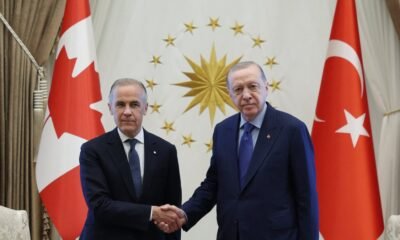
Canada’s PM Carney plans Türkiye visit for talks with President Erdoğan
-

 Sports1 day ago
Marked by teen stars, marred by mishaps: 2026 Asian Games end