
Politics
Turkish police arrest 13 over funding of FETÖ terrorists

Turkish authorities on Friday said some 13 out of 34 suspects captured over their links to the Gülenist Terror Group (FETÖ) were arrested.
Police caught 41 suspects in synchronized raids across five cities, including in Istanbul and western Izmir province, earlier this week. Seven other suspects fled abroad, police said.
Authorities released four suspects on probation and let 21 others go after their questioning.
The suspects are charged with tax evasion and using a sweets shop as a front to funnel funds to the terrorist group. They issued dummy invoices for commercial transactions at the shop to evade state taxes and transfer the money to FETÖ, authorities found.
The shop, which did not hire anyone with an apparent connection to FETÖ, provided the group with financing under the guise of “benevolence” by making deductions from employee wages.
Authorities also discovered organizational meetings were held at the shop.
A branch of the sweets shop in Izmir’s Bayraklı district was raided last year in December on suspicion of FETÖ-linked activity. Authorities had found the business was used as a “cell house” for the terrorist group and generated TL 40 million ($1.02 million) in funding for FETÖ.
The terrorist group orchestrated the defeated coup of July 15, 2016, in Türkiye, in which 252 people were killed and 2,734 were wounded. Ankara also accuses FETÖ of being behind a long-running campaign to overthrow the state through the infiltration of Turkish institutions, particularly the military, police and judiciary.
Türkiye has targeted its active members and sleeper cells nonstop, and its influence has been much reduced since 2016. However, the group maintains a vast network, including infiltrators suspected of still operating within Turkish institutions.
FETÖ backers in army ranks and civil institutions have disguised their loyalty, as operations and investigations have indicated since the 2016 coup attempt. FETÖ is also implicated in a string of cases related to its alleged plots to imprison its critics, money laundering, fraud and forgery.
The terrorist group faces operations almost daily as investigators still try to unravel their massive network of infiltrators everywhere. In 2024 alone, police apprehended hundreds of FETÖ suspects across the country, including fugitives on western borders trying to flee to Europe.
Those apprehended were mostly low-ranking members of the group, as high-ranking members managed to flee the country before and immediately after the coup attempt.
Turkish security sources also say the group is in turmoil after the death of its leader, Fetullah Gülen, in October last year.

Türkiye’s ruling Justice and Development Party (AK Party), founded under the leadership of President Recep Tayyip Erdoğan on Aug. 14, 2001, marked its 25th anniversary Friday, completing a quarter-century in which it has won every general election it has contested and reshaped the country’s political landscape.
Established as Türkiye’s 39th political party by a movement led by Erdoğan, then a former Istanbul mayor, the AK Party entered national politics with a pledge for sweeping political change.
“From now on, nothing in Türkiye will be the same,” Erdoğan said at the party’s launch. Two days later, he was unanimously elected its chair.
Just 15 months after its establishment, the AK Party won the Nov. 3, 2002, general election with 34.28% of the vote. Erdoğan was barred from running because of a political ban, and Abdullah Gül formed the 58th government.
Erdoğan enters Parliament
After legal changes lifted his political ban, Erdoğan won a parliamentary seat in a rerun election in the southeastern province of Siirt on March 9, 2003.
Following Gül’s resignation as prime minister, Erdoğan formed Türkiye’s 59th government on March 15, beginning more than a decade as premier.
The AK Party consolidated its position in subsequent elections, receiving 41.7% in the 2004 local elections and 46.58% in the 2007 general election.
The party faced one of its most serious legal challenges in 2008 when Türkiye’s chief prosecutor filed a case seeking its closure and political bans for 71 figures, including Erdoğan and Gül.
Six Constitutional Court judges voted to close the party and five opposed the move, falling short of the qualified majority required for a ban.
Referendums, election victories
A constitutional referendum in September 2010 became another milestone for the party, with 57.88% voting in favor of a package of constitutional amendments.
The AK Party subsequently received 49.83% of the vote in the 2011 general election, one of its highest nationwide vote shares.
In 2014, Erdoğan shifted from the prime minister’s office to the presidency. He won 51.79% of the vote on Aug. 10, becoming Türkiye’s first president elected directly by popular vote.
Ahmet Davutoğlu succeeded Erdoğan as AK Party chair. After the June 2015 election produced no single-party government, the AK Party regained its parliamentary majority in the Nov. 1 snap election.
Binali Yıldırım became party chair and prime minister in May 2016.
Presidential system changes
Türkiye’s political trajectory changed sharply with the July 15, 2016, coup attempt by the Gülenist Terror Group (FETÖ).
Erdoğan called on citizens to take to the streets and public squares, while resistance to the coup attempt helped foster closer political cooperation between the AK Party and the Nationalist Movement Party (MHP), laying the groundwork for the People’s Alliance.
A constitutional referendum on April 16, 2017, approved a shift to an executive presidential system with 51.41% support.
The changes also allowed the president to retain party membership. Erdoğan rejoined the AK Party after 979 days and was reelected its chair at an extraordinary congress in May 2017.
The AK Party and MHP contested the June 24, 2018, elections under the People’s Alliance, as Türkiye held presidential and parliamentary elections simultaneously for the first time.
Erdoğan won the presidency with 52.59%, becoming the first president under the new system, while the AK Party received 42.56% in the parliamentary vote.
The alliance continued into the 2019 local elections, in which the AK Party received 44.33% nationwide.
The COVID-19 pandemic later disrupted the party’s congress process, but its seventh ordinary congress was eventually held in March 2021, with Erdoğan again elected chair.
Erdoğan wins new term in 2023
Türkiye returned to the polls in May 2023 for presidential and parliamentary elections.
Erdoğan received 49.52% in the first presidential round, forcing a runoff. The AK Party received 35.62% of the parliamentary vote and secured 268 seats.
Erdoğan defeated his challenger in the May 28 runoff with 52.18%, securing another presidential term.
The victory extended the AK Party’s record of finishing first in every general election it had contested since its establishment and maintained its position as the longest-governing party since Türkiye entered its multiparty era in 1946.
The March 31, 2024, local elections represented a setback for the AK Party, which received 35.49% of the vote and won 24 provincial and 357 district municipalities.
Erdoğan acknowledged the message delivered by voters and pledged to evaluate the results, after which the party began replacing provincial and district officials.
That renewal accelerated at the AK Party’s eighth ordinary congress on Feb. 23, 2025. Thirty-nine new members joined its Central Decision and Management Board, renewing 52% of the body.
Further organizational changes followed, including replacements of provincial chairs in 15 provinces.
‘Terror-free Türkiye’ initiative
One of the latest chapters in the AK Party’s quarter-century in politics has been the “Terror-Free Türkiye” initiative, which followed a call by MHP Chair Devlet Bahçeli in October 2024 and was subsequently backed by Erdoğan.
A parliamentary National Solidarity, Brotherhood and Democracy Commission began work in August 2025 to address terrorism, social integration, national unity, democracy and the rule of law.
The commission adopted its report in February 2026.
A bill setting out the legal framework for the process was submitted to Parliament on Aug. 5, 2026. The legislation links its implementation to an official determination that the PKK terrorist group and affiliated structures have ended their operational existence and surrendered weapons under their control.
Parliament approved the legislation on Aug. 10 with 467 votes in favor, 87 against and seven abstentions.
Turkish Cypriot leaders on Friday commemorated the victims of the 1974 killings in the villages of Muratağa, Sandallar and Atlılar, marking the 52nd anniversary of one of the deadliest episodes of intercommunal violence on the divided island.
Turkish Republic of Northern Cyprus (TRNC) President Tufan Erhürman and Prime Minister Ünal Üstel paid tribute to Turkish Cypriots killed on Aug. 14, 1974, according to the Turkish News Agency Cyprus (TAK).
Commemoration ceremonies were held at cemeteries in Muratağa, Sandallar and Atlılar, where officials laid wreaths, observed moments of silence and attended prayers for the victims.
Speaking at the Muratağa-Sandallar cemetery, Erhürman said the victims represented the suffering endured by the Turkish Cypriot community during the conflict.
“Each of our martyrs lying here is the most concrete indication of the suffering experienced and the heavy price paid by the Turkish Cypriot people,” Erhürman said.
He criticized what he described as international silence over the killings, saying the lack of acknowledgment raised questions about the international community’s approach to the events.
Üstel, in a separate message marking Aug. 14, described the date as one associated with both resistance and deep suffering in Turkish Cypriot history.
He said Turkish Cypriots had refused to abandon their homeland, freedom or future despite years of violence and pressure, adding that they continued to show the same determination in the face of what he called “unjust isolation and embargoes.”
On Aug. 14, 1974, armed Greek Cypriot groups, including members of the ultranationalist EOKA terrorist group, attacked the three Turkish Cypriot villages.
A total of 126 Turkish Cypriots, many of them women and children, were killed. The youngest victim was 16-day-old Selden Ali Faik, while the oldest was 95-year-old Hüseyin Osman.
A mass grave in Atlılar was discovered on Aug. 20, 1974, after the second phase of Türkiye’s operation on Cyprus began.
The victims in Muratağa and Sandallar were discovered in early September after a shepherd noticed a hand protruding from the ground.
The mass graves were later opened in the presence of United Nations observers, and the remains of the victims were identified before being reburied at cemeteries.
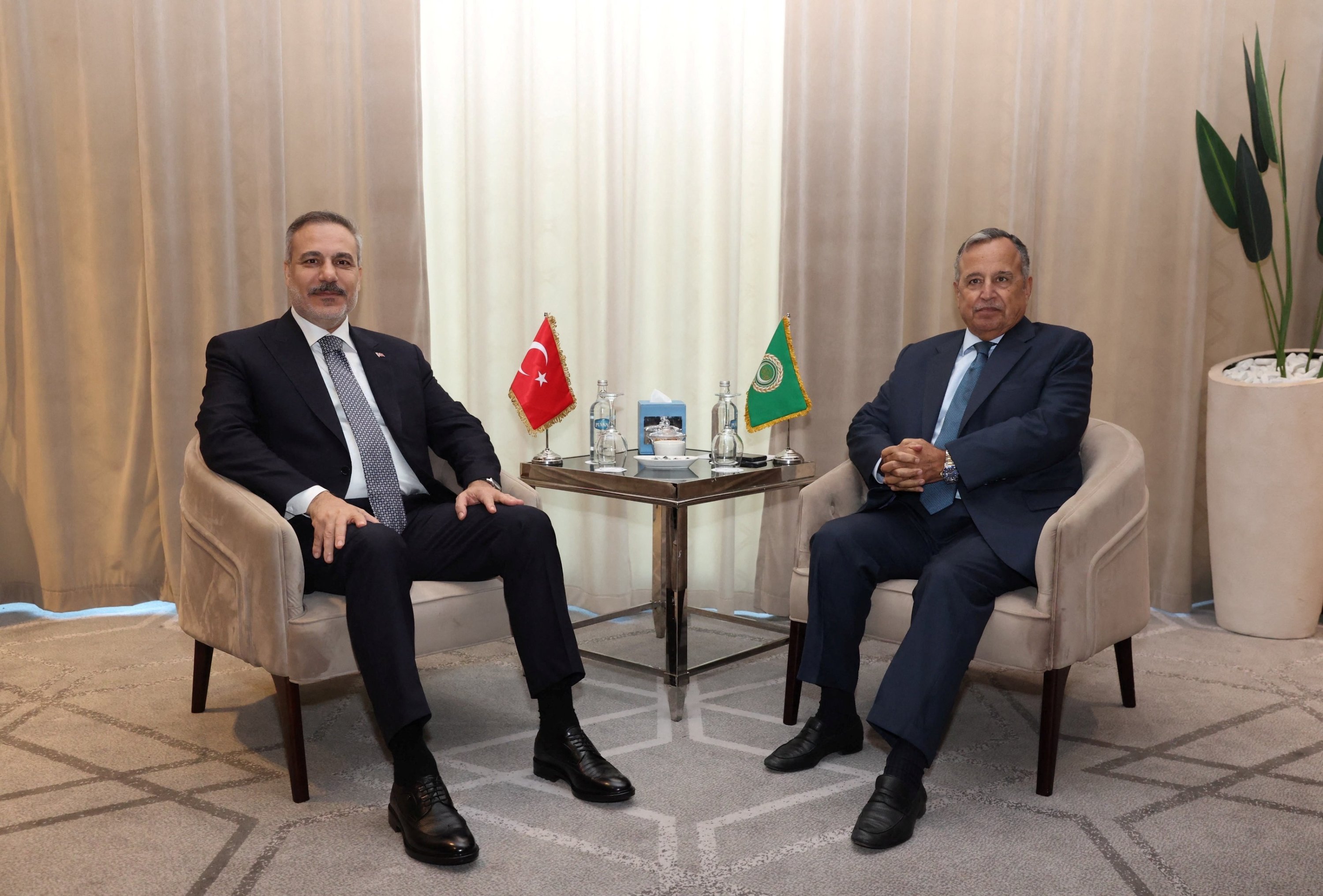
Foreign Minister Hakan Fidan met Thursday with Arab League Secretary-General Nabil Fahmy and Egyptian General Intelligence Service chief Maj. Gen. Hassan Rashad in the coastal city of el-Alamein, the Foreign Ministry said.
Fidan began a two-day visit to Egypt on Thursday.
During the visit, Fidan is scheduled to be received by Egyptian President Abdel Fattah el-Sissi and meet senior Egyptian officials, according to Turkish Foreign Ministry sources.
He will discuss bilateral relations, review the current status of agreements under negotiation and encourage mutual investment in line with a common goal of increasing bilateral trade volume to $15 billion, diplomatic sources said.
The Turkish foreign minister will also discuss cooperation in hydrocarbons, electricity grid integration, energy infrastructure and mining, according to the sources.
Fidan will assess steps that can be taken to advance existing cooperation in the military and defense industries and emphasize the importance of addressing regional issues through dialogue and diplomacy on the basis of regional ownership and shared responsibility, the sources said.
He will also underline Türkiye’s determination to continue joint efforts bilaterally and through multilateral platforms such as the R4 initiative, which brings together the foreign ministers of Türkiye, Egypt, Pakistan and Saudi Arabia.
The visit will include the second meeting of the Türkiye-Egypt Joint Planning Group, co-chaired by Fidan and Egyptian Foreign Minister Badr Abdelatty, according to the sources.
The meeting will review the outcomes of the second meeting of the High-Level Strategic Cooperation Council, held in Cairo in February, and prepare for a third meeting planned in Türkiye in 2028.
Fidan will express support for diplomatic efforts aimed at restoring the ceasefire between the U.S. and Iran and reopening the Strait of Hormuz, the sources said.
He will also stress the importance of immediately halting ongoing attacks in Gaza, fully implementing the ceasefire and ensuring the uninterrupted delivery of humanitarian aid.
The minister is expected to exchange views on implementing the second phase of the Gaza Peace Plan and Israel’s attacks on Palestine, Lebanon and Syria, according to the sources.
Fidan will underline the need to continue joint efforts to ensure lasting stability and security in Libya based on the country’s territorial integrity and political unity.
He will also reaffirm Türkiye’s support for Sudan’s sovereignty, unity and territorial integrity, the sources said.
Fidan will share assessments on the roles and contributions Türkiye and Egypt can make toward establishing lasting peace and stability in the Eastern Mediterranean.
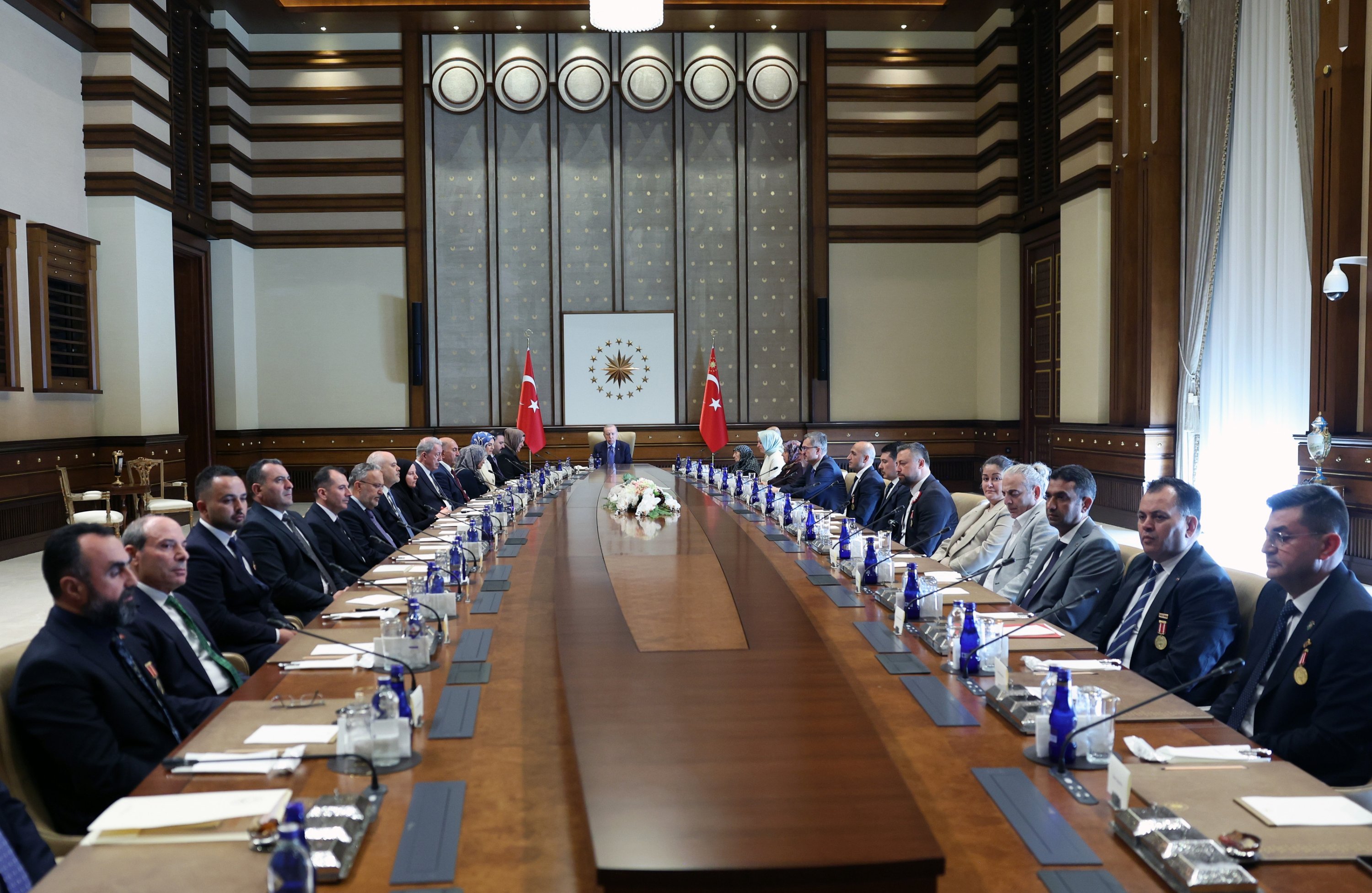
President Recep Tayyip Erdoğan received lawmakers Pervin Buldan and Mithat Sancar, members of the PKK-linked Peoples’ Equality and Democracy Party’s (DEM Party) Imralı delegation, and held a meeting with the families of fallen soldiers and veterans at the Presidential Complex in Ankara on Thursday.
The closed-door meeting lasted about one hour and 40 minutes and was also attended by the ruling Justice and Development Party (AK Party) acting Chair Efkan Ala and National Intelligence Organization (MIT) chief Ibrahim Kalın.
No statement was immediately issued following the meeting.
Buldan and Sancar have served as intermediaries in contacts with jailed PKK terrorist ringleader Abdullah Öcalan on Imralı Island as part of Türkiye’s terror-free initiative.
Later Thursday, Erdoğan received families of fallen soldiers and veterans at the Presidential Complex.
Family and Social Services Minister Mahinur Özdemir Göktaş attended the meeting and said Türkiye would continue to honor the memory of its fallen soldiers, recognize the sacrifices of its veterans and stand by their families.
In a statement on social media, Erdoğan later said that he had met with the families of fallen soldiers and veterans at the Presidential Complex.
“The homeland where we live freely, in peace and security, is entrusted to us by our fallen soldiers and veterans. The families of those who sacrificed their lives and shed their blood to protect the unity and integrity of this country are also entrusted to us,” Erdoğan said.
He said the state had mobilized all available resources to support veterans and the families of fallen soldiers and would continue to do so.
Referring to Türkiye’s “terror-free Türkiye” initiative, Erdoğan said Parliament had taken an important step this week as part of efforts to eliminate terrorism from the country.
“Türkiye has reached this stage, above all, thanks to the heroic struggle of our nation’s sons and daughters, the resilience of your families and the achievements our state has made, particularly in the defense industry in recent years,” he said.
“God willing, by acting with patience, common sense and composure, we will rid Türkiye of this scourge once and for all,” Erdoğan added.
The talks come after Parliament approved the Law on Strengthening National Solidarity and Social Integration, commonly referred to as the “framework law,” with broad parliamentary support.
Parliament on Monday passed a landmark 12-article law supporting the country’s “Terror-Free Türkiye” initiative, following months of political efforts led by President Recep Tayyip Erdoğan and Nationalist Movement Party (MHP) leader Devlet Bahçeli.
The Law on Strengthening National Solidarity and Social Integration was approved with 468 votes in favor and 88 against, with six abstentions.
The legislation forms a key part of the legal framework surrounding the ongoing “terror-free Türkiye” initiative, which seeks to bring an end to decades of terrorism and strengthen social integration.
Türkiye and Egypt will continue to deepen bilateral ties based on mutual trust and shared interests as the two regional powers seek to contribute to peace and stability, Foreign Minister Hakan Fidan said Friday following a visit to Egypt.
Fidan said in a statement shared on the Turkish social media platform NSosyal, that the visit provided an important opportunity to discuss what he described as the “excellent level” of bilateral cooperation between Ankara and Cairo, as well as regional developments.
“Strengthening cooperation between our countries serves not only the common interests of our peoples but also the establishment of peace, stability and prosperity in our region.”
The minister noted that Türkiye and Egypt were two major states acting with an awareness of the responsibilities placed on them by their history and geography.
During the visit, Fidan and his Egyptian counterpart, Badr Abdelatty, co-chaired the second meeting of the Türkiye-Egypt Joint Planning Group.
Fidan also held talks with Egyptian General Intelligence Service chief Hassan Rashad and Arab League Secretary-General Nabil Fahmy.
The two sides signed agreements aimed at increasing bilateral trade, diversifying economic relations and strengthening connectivity between the countries, he said.
It was also added that Ankara and Cairo would continue working “shoulder to shoulder” in line with the vision of their presidents to further strengthen bilateral relations.
Egypt is one of Türkiye’s leading trade and export partners in Africa. Bilateral trade reached about $8 billion in 2025, with the two countries aiming to increase the figure to $15 billion, a target set by President Recep Tayyip Erdoğan and el-Sissi.
Turkish investments in Egypt have exceeded $4 billion, underscoring the growing economic ties between the two countries. Turkish-owned companies currently contribute to the employment of about 100,000 Egyptians.
Invited by President Recep Tayyip Erdoğan, Palestinian Authority President Mahmoud Abbas arrived in Ankara on Tuesday.
Erdoğan hosted a welcoming ceremony for Abbas on Wednesday before the two leaders sat down for talks on the future of Palestine and Israel’s actions undermining hopes for a solution.
The two leaders, who were scheduled to hold a joint news conference later on Wednesday, focused on the latest developments regarding Palestine, bilateral ties between Ankara and Ramallah, and regional developments.
Israel’s attacks on Gaza, international efforts against its attempts to annex the West Bank, and steps taken by the Netanyahu government to expel Palestinians from their territories, both through its genocidal campaign in Gaza and through illegal settlements, were expected to be on the agenda during the meeting.
According to the latest U.N. secretary-general’s report on settlements, Israeli authorities advanced or approved plans to build 4,750 settlement units in the West Bank, including occupied East Jerusalem, between March 14 and June 12.
On March 25, the Israeli government also approved the establishment or legalization of 34 illegal settlements in Area C of the West Bank, the largest number approved in a single Israeli government decision, according to the same U.N. report.
U.N. Security Council Resolution 2334 affirms that Israeli settlements in Palestinian territory occupied since 1967, including occupied East Jerusalem, have “no legal validity” and constitute a flagrant violation of international law.
The meeting was also expected to address attacks on holy sites, such as Al-Aqsa Mosque in East Jerusalem, led by Israeli politicians, the delivery of humanitarian aid to Gaza, and initiatives led by Türkiye. The Gaza peace plan and reconstruction efforts in Palestine, particularly in Gaza, were also expected to be discussed.
Türkiye champions the Palestinian cause on every platform and seeks to be a voice for Palestinians in the international community. President Erdoğan raises the issue at international events, and this is also expected to be the case at next month’s United Nations General Assembly in New York, United States.
Thanks to Türkiye’s diplomatic initiatives, the number of leaders and influential figures speaking out against Israel has increased. Ankara continues its efforts to intensify international pressure on Israel while consistently raising the Palestinian cause and Israel’s aggression on every platform.
On Gaza, Türkiye has consistently supported an immediate cease-fire, expanded humanitarian access, and the establishment of an independent Palestinian state based on the 1967 borders, with East Jerusalem as its capital, while remaining among the strongest international critics of Israel’s attacks. Working in close strategic alignment with Doha, Ankara has coordinated joint mediation efforts alongside Qatar and regional partners to enforce a lasting cease-fire, secure uninterrupted humanitarian relief and advance diplomatic channels for a comprehensive regional peace settlement.


-
 Economy3 days ago
Türkiye to launch its 1st offshore wind tender in Q1 2027
-
 Politics3 days ago
Palestinian leader Abbas returns to Türkiye, set to meet Erdoğan
-
 Politics3 days ago
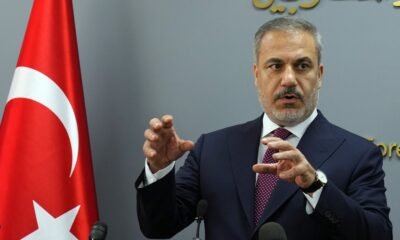
Fidan heads to Egypt as Türkiye, Cairo deepen cooperation
-

 Economy3 days ago
Turkish Airlines carries Juventus on longest nonstop flight ever
-
 Sports21 hours ago
6 Arab federations reaffirm support for Infantino amid FIFA rift
-

 Sports3 days ago
Fenerbahçe close in on Romelu Lukaku as transfer window nears end
-

 Sports1 day ago
Beşiktaş sign Juventus forward Vlahovic on 3-year deal
-
 Economy2 days ago
Baykar duo tops list of highest taxpayers in Türkiye for 5th year