
Politics
France hails mediation push as possible US–Iran talks eyed in Istanbul

French Foreign Minister Jean-Noel Barrot on Tuesday praised the mediation efforts paving the way for potential U.S.–Iran discussions that could take place in Istanbul.
“I understand that they will take place in Istanbul. We are in close contact with the countries mediating between the United States and Iran, and we support them in this effort,” Barrot told broadcaster Franceinfo.
He said, “That is a good thing” if the Iranian regime decided to take up the U.S. proposal for negotiations.
“The first decision to be made is, of course, to put an end to this bloody repression, to release prisoners, to restore communications, and to give the Iranian people back their freedom. Then, indeed, to address the nuclear issue, missile issues, and the issue of support for terrorist organizations in the region, which raise major security concerns not only for the region but also for Europe,” Barrot added.
When asked whether U.S. President Donald Trump can have a positive influence in negotiations on what is happening inside Iran, Barrot said he “sincerely” hoped so.
Earlier, U.S. media reported that senior officials from Washington and Tehran are preparing for rare face-to-face talks in Istanbul on Friday.
The Wall Street Journal and The New York Times reported on Monday that the planned meeting would bring together U.S. special envoy Steve Witkoff, President Donald Trump’s son-in-law Jared Kushner, and Iranian Foreign Minister Abbas Araghchi, with Türkiye hosting and officials from Qatar, Egypt and other regional states expected to attend.
There has been no official confirmation of the venue for the talks.
The talks are expected to explore parallel tracks, including Iran’s nuclear program and broader U.S. demands related to missiles and regional militias, even as both sides remain far apart.

Türkiye will host the multinational Nusret-2026 Invitation Exercise from Oct. 6-16 in the Gulf of Izmir and off the coast of Karadeniz Ereğli, the Defense Ministry said Sunday.
The exercise will bring together Turkish forces, as well as military personnel and assets from allied and partner countries, with 20 ships, five aircraft and unmanned systems, the ministry said.
Participants will include units from the Turkish Naval Forces, Air Force and Coast Guard Command, as well as NATO’s Standing Mine Countermeasures Group 2 (SNMCMG-2), comprising assets from Germany, Greece, Italy, Spain and Türkiye.
The Black Sea Mine Countermeasures Task Group, known as MCM Black Sea, with units from Bulgaria, Romania and Türkiye, will also participate.
Explosive ordnance disposal and autonomous underwater vehicle teams from the United States, Belgium, the Netherlands, Kuwait, Romania and Oman will participate in the drills, while 32 military observers from a number of countries will attend.
According to the ministry, the exercise is aimed at improving the participating units’ capabilities in the planning, execution and assessment of mine warfare operations.
It also seeks to enhance interoperability among mine warfare units from different countries and strengthen their ability to conduct coordinated multinational operations.
Türkiye most recently conducted the Sea Wolf-I/2026 (“Denizkurdu-I/2026”) Exercise from Sept. 20-25 in the Black Sea, Aegean Sea and Eastern Mediterranean, with 100 ships, 50 aircraft and 14,000 personnel taking part.
The growing rift between the main opposition New Party (YP) and the former main opposition Republican People’s Party (CHP) manifested in Muğla, a southwestern city home to world-famous Bodrum and other top tourism destinations. A local CHP official suggested that Mayor Ahmet Aras should face disciplinary proceedings for his contacts with YP.
YP was formed in July by Özgür Özel, the former chair of CHP. Özel was removed from office by a court ruling over allegations of vote-buying during a 2023 intra-party election that brought him to power. He was replaced by his predecessor Kemal Kılıçdaroğlu. Kılıçdaroğlu’s return sparked a bitter row with supporters of Özel, who accused him of betraying the party by accepting the court’s request for his reinstatement. Özel initially appealed the verdict but decided to form the new party after receiving overwhelming support among CHP lawmakers.
Under Kılıçdaroğlu, CHP began what it called a “cleansing” process, expelling several figures accused of corruption. The new administration has been more muted about the fate of members openly supporting Özel while several mayors resigned from the party and remain independent, leaving the door open for a future switch to YP.
Aras, who was Bodrum mayor for CHP before his election as Muğla Metropolitan Municipality mayor in the 2024 elections, faces accusations of cooperating with YP while remaining in CHP. CHP’s local branch was angered when Aras temporarily handed over his duties to a YP municipal assembly member in Muğla during a recent visit to Syria. Aras also reportedly ceased contact with CHP’s Muğla branch.
Aziz Gürsoy, head of CHP’s disciplinary board in Muğla, told the Sabah newspaper that Aras has almost severed all ties with CHP.
“It is neither ethical nor legitimate for Mr. Aras to remain in the CHP under the current conditions. In fact, I believe there is bad intent here. He needs to be expelled immediately. Even during his trips abroad, he leaves the municipality (to YP). He has no communication with us. He no longer has any emotional or organic ties to the CHP,” Gürsoy stated.
Stating that they will protect the institutional structure of the CHP under all conditions and that no one is above the party, Gürsoy said: “The current picture creates serious concern among the CHP base. If this situation continues, as the president of the provincial disciplinary board, I will personally apply to headquarters for Mr. Aras’s expulsion. We will not hesitate to take any step necessary to protect the rights, rules and institutional structure of the CHP.”
According to the CHP bylaws, metropolitan mayors can only be referred to the High Disciplinary Board upon the request of the Party Assembly.
The name of Lütfü Türkkan, a lawmaker from the opposition Good Party (IP), came up in an investigation into judiciary officials accused of taking bribes. Prosecutors in Istanbul separated the case of Türkkan and referred it to Ankara on Monday for further investigation.
The Bakırköy Chief Prosecutor’s Office in Istanbul has recently ordered the arrest of eight suspects in an investigation into judges accused of taking bribes in exchange for verdicts in favor of defendants in some cases. The investigation specifically focused on a former judge working at the Court of Enforcement who was accused of receiving millions of Turkish liras in bribes.
Suspects in the case are also accused of running a criminal organization apparently thriving on bribes. Authorities are now looking into cases handled by several Istanbul courts between 2022 and 2024, on suspicion that some businesspeople, politicians and lawyers sought to influence trials and get verdicts in their favor in exchange for bribes, employing judges and court staff. In connection with the case, the Board of Judges and Prosecutors suspended five people, including judges and prosecutors.
In one instance of the suspicious cases, investigators are looking into the claim that M.Ş. and Y.A., identified only through their initials, served as mediators in a case involving lawmaker Türkkan and secured a verdict in favor of the lawmaker, reports by Turkish media outlets say.
In a social media post on Sunday, Türkkan rejected claims, though he acknowledged that a case he was party to was handled by one of the arrested judges. He said that being a party to a trial involving the suspect did not mean that he should be associated with “allegations (of bribery).” He said his lawyers were looking into the case and he never met the judge in person during the trial.
Foreign Minister Hakan Fidan will be joined by National Defense Minister Yaşar Güler and Chief of General Staff Selçuk Bayraktaroğlu on a visit to Saudi Arabia’s Riyadh on Monday.
They will attend a meeting of the Strategic Political and Defense Committee of the historic Mecca Joint Defense Alliance, formed by Türkiye, Saudi Arabia and Pakistan in August. The meeting comes amid rising threats to Saudi Arabia by the Houthis in Yemen.
Foreign Ministry sources said on Sunday that Fidan would reaffirm Türkiye’s strong solidarity with and support for Saudi Arabia in the face of Houthi attacks and underline that provocative acts targeting sacred sites are unacceptable. Saudi Arabia is the birthplace of Islam and home to its most sacred site, the Kaaba, located in Mecca. Mecca has recently come under fire from the Houthis.
The Houthi group said on Saturday that it targeted Saudi oil company Aramco in Riyadh with ballistic missiles and drones in response to attacks on the Yemeni capital, Sanaa.
The operation “successfully achieved its objective,” causing fires at the targeted sites, Houthi military spokesperson Yahya Saree said in a televised statement.
Saree added that Sanaa and other provinces had been subjected to 60 airstrikes over the last 24 hours, bringing the total number of strikes to 1,420. He attributed the attacks to Saudi Arabia.
The spokesperson warned that the group would respond to “blockade with blockade, and escalation with escalation.”
Meanwhile, Turki al-Maliki, spokesperson for the Saudi-led coalition supporting Yemen’s government, said in remarks carried by Saudi media, including Asharq Al-Awsat, that Houthi claims of targeting Riyadh on Saturday were “misleading.”
He added that the Houthis were trying to “divert attention from the scale of their losses and growing public anger over the militias’ conduct and their ties to foreign agendas that have brought chaos and destruction to Yemen.”
Since March 2015, Saudi Arabia has led a military coalition supporting Yemen’s internationally recognized government against Houthi forces, which have controlled Sanaa and several other governorates since September 2014.
In July this year, the Houthis announced a naval blockade on Saudi Arabia, saying the move was in response to a Saudi naval and air siege on areas under their control in Yemen. The group has since targeted energy infrastructure in the kingdom.
President Recep Tayyip Erdoğan, Pakistani Prime Minister Muhammad Shahbaz Sharif and Saudi Crown Prince and Prime Minister Mohammed bin Salman Al Saud signed the Mecca agreement for joint defense in Mecca on Aug. 7, 2026. The agreement aims to bolster the security of Türkiye, Pakistan and Saudi Arabia through joint deterrence and defense, and reflects the three countries’ commitment to developing regional solutions to regional issues and their shared strategic vision centered on regional security and stability.
A Strategic Political and Defense Committee, comprising the foreign and defense ministers and chiefs of general staff of the three countries, was established to guide activities under the agreement. The committee held its inaugural meeting in Istanbul on Aug. 31, 2026. At the meeting, foundational decisions were adopted, and technical work toward institutionalizing the alliance was reviewed. Accordingly, the alliance’s secretariat is expected to be established in Riyadh as soon as possible. Retired Pakistani Lt. Gen. Nauman Mahmood has been nominated to serve as its first secretary-general.
The foreign ministers of the three countries held a meeting in New York on Sept. 24, 2026, on the sidelines of the High-Level Week of the 81st United Nations General Assembly. Regional developments were discussed at the meeting. In a joint statement issued afterward, the three countries condemned attacks targeting the holy city of Mecca and Saudi Arabia’s civilian and economic infrastructure. The chiefs of general staff of the three countries met in Riyadh on Sept. 25, 2026.
Turkish sources said Fidan would convey Türkiye’s views on the next steps for the alliance and its institutionalization process. He will also offer Türkiye’s assessment of threats to peace and stability in the Middle East and views on regional developments related to the joint security of the allies. He is also expected to highlight how the alliance’s progress in a short time has proved valuable for the prospects of lasting stability in the region, as well as the importance of the alliance both in building capacity for a joint and efficient response to existing threats and in preventing regional crises.
Fidan is also expected to underline the prioritization of peaceful means to resolve conflicts in the region and the need to avoid steps that may escalate tensions. He will also stress the importance of ensuring the freedom and security of navigation on international trade routes and discuss how Israel has continued to undermine efforts for regional peace and stability.
In an interview last month, Fidan said the alliance had reached an advanced stage, with efforts underway to establish its headquarters and assign personnel, describing the initiative as a “very game-changing platform.” Fidan also implied that Türkiye stood ready to provide technical assistance to Saudi Arabia amid an escalating conflict with the Houthis in Yemen.
Fidan stated that there is “a very strong will” behind the alliance and that Ankara is working to turn that political will into action.
“The Mecca alliance is really at a good stage. There’s a very strong will that has been put forward. We’re working with all our strength to put this will into action,” Fidan told broadcaster NTV last month.
He said steps toward institutionalizing the alliance are underway, particularly work to establish a secretariat envisaged under the agreement and a military headquarters affiliated with it. He added that detailed preparations for both structures have “almost been completed” and that the three countries have reached a common understanding of how they will operate.
“There are steps currently being taken toward institutionalization. In particular, the work on establishing the secretariat mentioned in the agreement and bringing an affiliated military headquarters into operation is almost complete. We have reached a common understanding. From now on, the remaining stage is to send personnel and make the headquarters operational. I am pleased with the process on this issue,” Fidan said.
He said that once institutionalization steps are completed, talks could be held with the other two founding countries on admitting new members.
“There is such a principle decision because our president said this from the beginning. If this does not grow, then it would not be an alliance area. We would have created a bloc. Our regional vision is for as many countries in the region as possible to come together and establish a common defense area.
“This defense area is not against outsiders; it is about solving problems within the region better through regional ownership and creating an environment of trust that has not existed before, in order to prevent new crises from emerging. The basic point of departure for all of this is the search for regional solutions to regional problems,” Fidan said.
He stressed that the alliance was not intended to create a new regional bloc against other countries but to establish a common defense framework based on regional ownership.
“It is an alliance open to the countries of the region,” he said.
Vice President Cevdet Yılmaz was among the dignitaries attending the International Bediüzzaman Symposium, held under the theme “Quranic Solutions to Global Crises,” in Istanbul on Sunday. The occasion was also a remembrance of prominent 20th-century Muslim scholar Said Nursi, who also carried the honorific Bediüzzaman, or “wonder of the age.”
Speaking at the symposium, Yılmaz explained how the Gülenist Terror Group (FETÖ) sought to portray itself as followers of Nursi and how the scholar fought against imperialist forces during his lifetime.
The two-day event hosts scholars from across the world. Along with Yılmaz, Mohammed Abu al-Khair Shukri, Syria’s minister of Awqaf, or Endowments, in charge of managing religious affairs; Safi Arpaguş, head of Türkiye’s Presidency of Religious Affairs; and Necmettin Bilal Erdoğan, head of the board of trustees at Türkiye’s Foundation for Dissemination of Knowledge, attended Sunday’s symposium.
Nursi, who passed away in 1960, was a Kurdish scholar best known for his Risale-i Nur collection of writings on the Quran. Early in his life, he was instrumental in the fight against the Russian occupation of eastern Türkiye, where Nursi originated. He was also a staunch opponent of Western powers invading present-day Türkiye in the last days of the Ottoman Empire. Nursi inspired several movements that came to be known as “Nurcular.” FETÖ also claimed to follow Nursi’s teachings but evolved into what it is known today: a terrorist group that tried to seize power in 2016 through its military infiltrators.
In his speech at the symposium, Yılmaz delved into FETÖ’s scheme to brainwash people into doing its bidding. “Unfortunately, we confronted a network exploiting the name of Bediüzzaman and his writings, a network that stirred up strife in our country. FETÖ is a terrorist network serving international powers and intelligence agencies. It is also a structure treating its members as slaves who do not question the leader. The Quran teaches us to use our minds. FETÖ held people’s minds hostage,” Yılmaz said.
Yılmaz, who also heads a board overseeing the terror-free Türkiye initiative, spoke at length about the process that aims for the full dissolution of the terrorist group PKK. The PKK, exploiting disillusioned Kurds deprived of their rights, carried out a campaign of violence since the 1980s that killed tens of thousands of people across Türkiye. In 2024, Türkiye launched the initiative by highlighting the need to strengthen unity between Turks and Kurds against external threats. Yılmaz said they wanted to remove terrorism from Türkiye’s and the wider region’s agenda permanently.
He lamented that, for a long time, the very imperialist powers Nursi fought against sought to pit people against each other in the region.
“As the Republic of Türkiye, we have to end those conflicts, this ethnic and sectarian strife, and act in unison. We have to create a region where terrorism is no longer an issue, where foreign powers are not able to exploit our resources,” he said.
“Bediüzzaman Said Nursi was a man of these lands. He fought against imperialists. He did not flee to another country to incite strife in Türkiye as certain people did,” he said, referring to Fethullah Gülen, who died in Pennsylvania, United States, where he spent his last years in a self-styled “exile” while facing multiple arrest warrants issued by Türkiye for his role in the 2016 coup attempt.
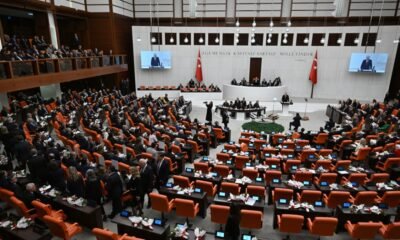
The Turkish Parliament will begin its weekly session on Tuesday, following the inauguration of the new legislative year last Thursday. Parliament’s General Assembly will debate a new bill on the Turkish Red Crescent, while the Planning and Budget Committee will hear from Central Bank Governor Fatih Karahan.
The bill on the Turkish Red Crescent would make the Turkish Red Crescent, the International Federation of Red Cross and Red Crescent Societies, the International Committee of the Red Cross, and the national Red Crescent and Red Cross societies of other countries the sole authorized entities for receiving and using in-kind and cash assistance sent to Türkiye during ordinary or extraordinary circumstances. Cash compensation will also be paid to personnel of the Turkish Red Crescent who are actively serving in the field to carry out the organization’s activities during extraordinary periods and times of disasters, war and conflict. In provinces and districts where Red Crescent branches and representative offices are located, the heads of the provincial and district Red Crescent branches will also become members of the boards of trustees of the Foundations for Social Assistance and Solidarity, the state entities overseeing social aid schemes for disadvantaged individuals.
On Tuesday, Central Bank Governor Fatih Karahan will make a presentation to the Parliamentary Planning and Budget Committee. Karahan is expected to deliver a comprehensive presentation on global developments, the Turkish economy, inflation and the monetary policy framework at the meeting.
The Parliamentary Public Works, Reconstruction, Transport and Tourism Commission will also convene to discuss the bill on Foreign Digital Accommodation Platforms.
On Tuesday and Wednesday, parliamentary group meetings of the political parties represented in Parliament will be held.


-

 Economy1 day ago
Revolut: $115 billion fintech taking on Europe’s biggest banks
-

 Economy1 day ago
Global M&A deal rush slowed down in Q3 as borrowing costs bite
-
 Economy3 days ago
Teknofest Southeast combines technology, local culture in Şanlıurfa
-
 Economy2 days ago
Egypt’s Sisi calls for peaceful solutions to Africa’s conflicts
-

 Sports1 day ago
Ronaldo’s Portugal future enters uncharted waters after walkout
-
 Economy1 day ago
ACE BPSC 2026 summit to be held this week in Istanbul
-
 Politics1 day ago
Erdoğan vows action over Soma mine collapse at Teknofest
-
 Politics1 day ago
New Party walkout during Erdoğan speech draws criticism in Türkiye