
Politics
Camps, bases emptied in Syria amid new deal with US-backed terrorists

The notorious al-Hol camp in northeastern Syria that once housed tens of thousands of women and children with alleged links to Daesh has been emptied after a government operation last month freed the area from the control of the YPG terrorist group, officials said Sunday.
Fadi al-Qassem, the Syrian Foreign Ministry representative for the al-Hol camp administration, said the final convoy left the camp Sunday morning.
Hundreds of residents have been transferred to the Akhtarin camp in Aleppo province in recent weeks and others have been repatriated to Iraq.
Officials have said the decision to empty the al-Hol camp was made because of its remote location in the desert, far from services and close to areas where the authorities do not have complete control of the territory.
The U.N. refugee agency said it assisted in the return of 191 Iraqi citizens from Syria’s al-Hol camp to Iraq Thursday.
The Syrian Observatory for Human Rights, a U.K.-based war monitor, also reported that an unspecified number of residents “left the camp individually, without waiting for the organized convoys.”
After the defeat of Daesh in 2019, around 73,000 people were living at al-Hol, most of them Syrian and Iraqi citizens, but also including thousands from other countries. The camp’s residents are mostly women, including wives or widows of Daesh members, and their children.
Since then, the number has declined, with some countries repatriating their citizens, leaving about 24,000 as of last month.
According to the latest camp data obtained by Reuters, dated Jan. 19 – a day before the government took control of the camp – its population was 6,639 families comprising 23,407 people, mostly Syrians and Iraqis, as well as 6,280 foreigners of more than 40 nationalities.
UNHCR, the U.N. refugee agency, said it had observed “a significant decrease in the number of residents in al-Hol camp in recent weeks,” adding in a statement to Reuters that there were no confirmed figures on the remaining population.
“Over the weekend, the camp administration advised UNHCR not to enter the camp due to the unrest and anxiety in the camp,” it added.
The camp’s residents were not technically prisoners and most had not been accused of crimes, but they had been held in de facto detention at the heavily guarded facility for years.
Last month, Syrian government forces captured the al-Hol camp in a weekslong offensive against the YPG terrorist group, which had been running the camp near the border with Iraq for a decade. A cease-fire deal has since ended the fighting.
During and after the fighting, many families are believed to have escaped from the camp.
A Syrian government security source said most people in the camp fled that day during a five-hour period when it was unguarded and that some had left with men who came to take their relatives to unknown destinations.
The security source and a source from a non-governmental organization working there said a section of the camp that housed its most dangerous residents, known as the annex, was empty.
The source added that the escapees had spread throughout Syria and that security authorities, working in cooperation with international partners, had established a unit to “follow up on the matter and pursue those who are wanted.”
The fate of the similar but smaller Roj camp in northeastern Syria, which is still under YPG control, remains unclear. Most of the residents of that camp are foreigners, whose countries have largely refused to take them back.
Syrian authorities turned back a group of 34 Australian women and children on Feb. 16 after they left the Roj camp, headed toward Damascus to board a flight back to Australia. Australian authorities later said they would not repatriate the families.
A Syrian government official who spoke on condition of anonymity because he was not authorized to comment publicly said Sunday that the issue stemmed from “the lack of prior coordination with the Syrian government” by the YPG and families of the would-be returnees before attempting to send them to Damascus.
The official added that “whether they will be allowed (to return) will depend on the Australian government.”
On the other hand, Iraqi deputy prime minister and foreign minister, Fuad Hussein, and the U.S. envoy Thomas Barrack met Monday to discuss coordination and joint cooperation on combating terrorism.
Barrack expressed its appreciation for the important step taken by the Iraqi government in transferring Daesh members from detention centers abroad to Iraqi prisons, as part of strengthening Iraq’s sovereignty and fulfilling its legal responsibilities.
The minister affirmed that Iraq continues to communicate with several countries to transfer their citizens involved in terrorism cases to their countries of origin.
He also expressed appreciation for the Turkish government’s agreement to receive Turkish citizens among these individuals.
The agreement between the YPG and the Syrian Government was also discussed, with both sides affirming their support for this agreement and the need to adhere to its implementation, given its direct impact on strengthening security and stability in Syria.
Türkiye considers the Daesh terrorist group one of the biggest threats to the country’s security and peace, as the group faces nationwide raids, and was one of the first countries to declare it a terrorist group in 2013.
The National Intelligence Organization (MIT) thwarted the terrorist group’s efforts for recruitment, obtaining funds and logistics support after its latest operation in the aftermath of a church shooting in Istanbul in January 2024.
Terrorists from Daesh and other groups, such as the PKK and its Syrian wing, the YPG, rely on a network of members and supporters in Türkiye.
US withdraws key base
The United States began withdrawing Monday from a major military base in northeastern Syria that remains under the control of YPG, according to a YPG official, who spoke on condition of anonymity.
According to an AFP team, a convoy of dozens of trucks carrying armored vehicles and prefabricated structures was seen traveling along a road linking the Qasrak base in Hassakeh province to the Iraqi border.
The withdrawal follows the departure of American forces from two other bases in recent weeks, al-Tanf in southeastern Syria and Shadadi in the northeast, signaling a continued drawdown of the U.S. military footprint in the country.
Moreover, some U.S. media reports recently noted that the United States plans to withdraw all of its roughly 1,000 troops from Syria within the next two months.
Washington will end its presence in the country after the Syrian government extended its control over the country and the U.S.-backed YPG pledged to integrate into the state, according to reports.
Television network CBS also reported on the plan, citing unnamed U.S. officials.
The U.S. has drawn close to Syria’s new authorities since the fall of Bashar Assad in late 2024 and has transferred thousands of Daesh fighters from prisons to secure facilities in Iraq.
The Republican People’s Party (CHP) has “cleansed itself,” its chair, Kemal Kılıçdaroğlu, recently claimed, but the new era of calm within the party may not last long. After losing its status as the main opposition party, the CHP is now bracing for another potential bout of internal strife following the departure of former Chair Özgür Özel, who founded the New Party (YP). Media outlets reported this week that a group of lawmakers plans to challenge Kılıçdaroğlu in a future intra-party election. The move may threaten Kılıçdaroğlu’s efforts to reset the party by unloading those associated with corruption allegations.
Kılıçdaroğlu was reinstated as party chair in May after a court ruling nullified Özel’s chairmanship over allegations of vote-buying in the party’s 2023 leadership election. Before his departure, Özel called on the Kılıçdaroğlu administration to convene another party congress, expressing confidence that he could win the next leadership race. The CHP had earlier announced that preparations for the congress would begin in September, and Kılıçdaroğlu’s challengers are reportedly already working behind the scenes.
One of them is Gürsel Erol, a lawmaker representing Elazığ province, who recently lost the race for the post of CHP parliamentary group chair to Faik Öztrak. Erol won the first two rounds of voting before withdrawing from the third. After the election, he made a pointed statement, claiming there was a “monopoly” within the party without naming anyone directly.
Ali Öztunç, a lawmaker representing Kahramanmaraş province, made similar remarks in an interview with a pro-CHP YouTuber, saying the party is not “anyone’s property.”
“We stayed in the CHP so it would not be shut down, but some people see it as their own property. Now they will face intra-party opposition,” he was quoted as saying.
Öztunç and Erol were among the lawmakers who remained with Kılıçdaroğlu’s CHP, while Özel took nearly 100 lawmakers with him to the YP. Öztunç has emphasized that they will continue pushing for a party congress as soon as possible “to reinvigorate the CHP.”
Media outlets reported that Öztunç, Erol and like-minded lawmakers would try to persuade Kılıçdaroğlu not to seek re-election as party chair. The Turkish service of the BBC reported on Thursday that around 15 of the CHP’s 44 lawmakers, who describe themselves as proponents of a “third way,” would soon release a joint declaration outlining their position. According to the report, they neither support Kılıçdaroğlu’s leadership nor are they willing to join the YP. It added that they could leave the CHP to sit as independents or join the YP if Kılıçdaroğlu refuses to meet their demands.
So far, Kılıçdaroğlu has remained vague about whether he will seek another term as party chair, though he said in a recent interview that he would “consider running” if nominated by other party members.

The New Party (YP), founded by Özgür Özel after his departure from the Republican People’s Party (CHP), began setting up offices across the country last Friday. As the party seeks to attract voters, its chairperson, Özgür Özel, found himself in hot water, at least among some supporters, after a video showing him performing Islamic ablution circulated on social media.
The video shows the YP chair washing his face, arms, feet and head, following the rules of the Islamic ritual required before performing prayers almost to perfection. Some of Özel’s supporters accused him of resorting to a ploy to attract conservative voters, who have traditionally favored the ruling Justice and Development Party (AK Party) over the CHP, which advocates a more secular ideology and seeks to keep religion out of the public sphere. Before establishing the YP, Özel pledged to adhere to his former party’s ideological principles while also seeking to appeal to a broader cross-section of voters.
Some social media users claimed the video was a public relations stunt, while the YP released a statement saying it had been recorded before the party’s foundation by a supporter during Özel’s visit to the northern city of Kastamonu. The party said it had not approved the video’s release and insisted that Özel was unaware he was being filmed while performing ablution. Özel’s staunch supporters said the video was quite natural and highlighted the everyman image of the chairperson.
Özel was also photographed praying at the tomb of a Muslim mystic in Ankara on the day the party was founded, an image that contrasted with an earlier video showing him drinking rakı beside the grave of a former lawmaker, footage that had angered many pious Turks.
Whether it was a PR stunt or not, Özel will need as much voter support as possible ahead of the 2028 general election, his first major electoral test as leader of the YP and of the country’s main opposition party.
His lieutenants met with journalists on Thursday to discuss the party’s road map. Party Secretary-General Yunus Emre said the party’s headquarters had not yet been fully opened and would be ready within a month. YP Deputy Chair Ensar Aytekin told reporters that branches would be established in 60 provinces and their districts by the end of next week.
The Palestine Convoy, bringing together civil society representatives and volunteers from different countries to draw attention to human rights violations in Palestine and the ongoing humanitarian crisis, entered Türkiye through the Ipsala Border Gate in Edirne after setting off from Srebrenica, Bosnia-Herzegovina.
The convoy, which has brought together civil society representatives from more than 20 European countries in solidarity with Palestinians living under Israeli occupation, crossed into Türkiye on Thursday through the Ipsala Border Gate on the Greek border after departing from Srebrenica. The 85 participants, who traveled through Albania and Greece, will cross Iraq and Jordan before reaching the border of the occupied Palestinian territories on Aug. 21, 2026. They were welcomed at the border crossing by civil society organizations from Istanbul carrying Turkish and Palestinian flags.
Speaking at the border crossing, Palestine Convoy spokesperson and Turkish activist Hüseyin Durmaz said the journey began in Srebrenica, where they commemorated the genocide that took place there 31 years ago.
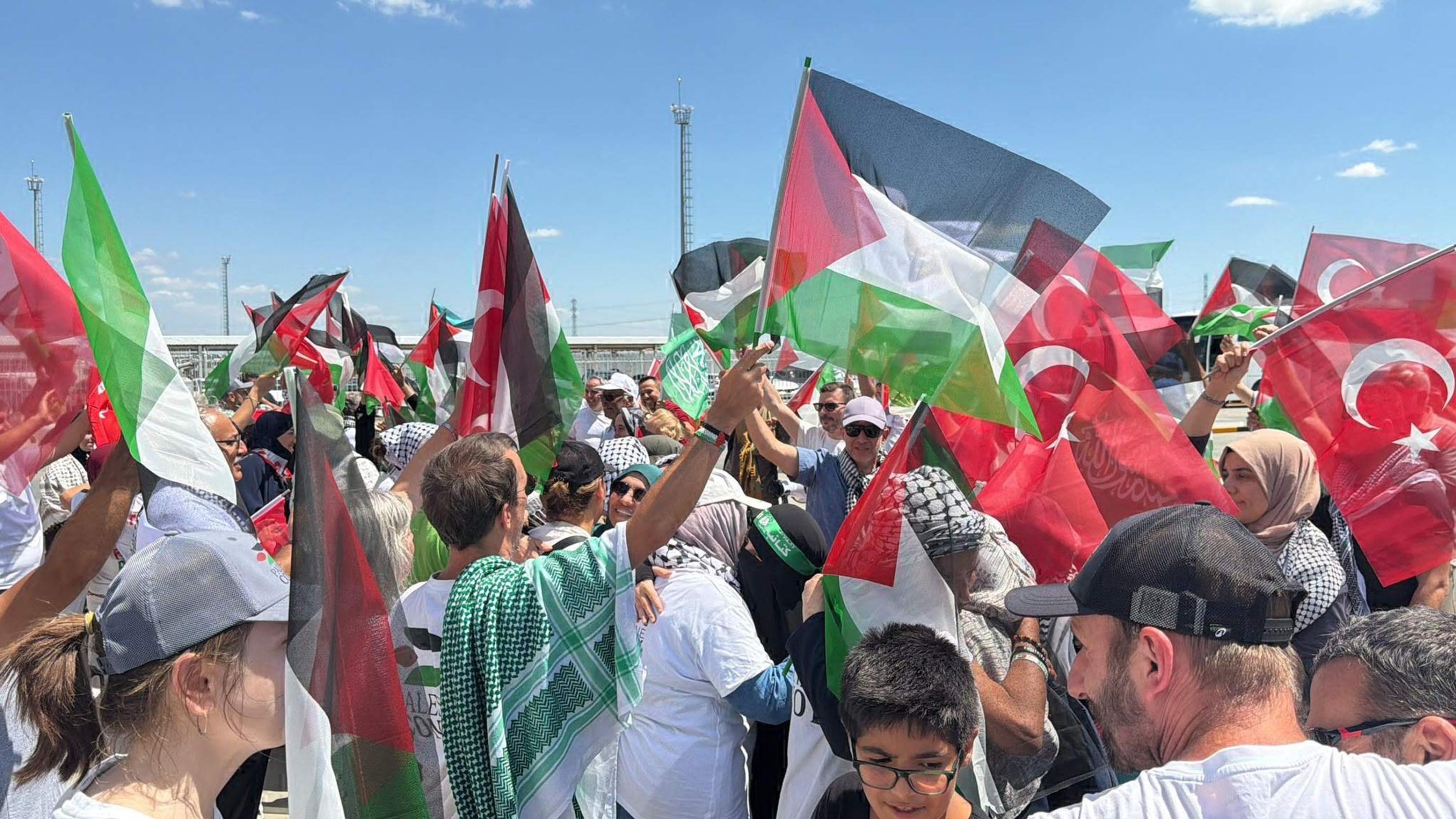
“There, we commemorated the genocide that took place 31 years ago, prayed for those killed and reflected on the fact that evil is a shared responsibility. We believe our silence contributed to the suffering because we could not intervene or reach those in need at the time. That is why we have taken action so as not to remain silent about what is happening today in Gaza, the West Bank and Palestine. It is our duty to stop a genocide taking place in our own lifetime,” he said.
“Our convoy continues its journey with the participation of activists from many countries around the world. In Bosnia-Herzegovina, Montenegro, Albania and Greece, it has received tremendous public interest and support across the Balkans,” he said.
Durmaz said the convoy has three main objectives.
“First, we do not want the West Bank to become another Gaza. As you know, Israel is currently pursuing a very serious policy of forced displacement in the West Bank and openly says it intends to turn it into another Gaza. It is our duty to prevent that.
“At a time when Israel should be withdrawing from Gaza following the cease-fire and humanitarian aid should be entering the territory, we see that it is instead expanding its occupation every day and making plans to annex all of Gaza. Humanitarian aid is still not reaching Gaza. Because of the cease-fire, Gaza has also begun to fade from the global agenda, and we want to bring it back into international focus and increase pressure on Israel.”
Durmaz said the convoy has been expanding “like a snowball” by meeting with people and raising awareness of the Palestinian cause.
Durmaz said the convoy’s mission is to help stop what he described as genocide.
“The issue is ending this genocide in our own era. We will continue this journey until it ends. As you know, we have taken part in many global initiatives before, but each time we were only able to go so far. This time we are following a route that has already been tested. We believe the countries along the route will not obstruct our march or our convoy because we are not targeting those countries or their domestic politics. Our only target is Zionism and what we see as its genocidal policies. Our aim is to increase its international isolation and help bring an end to these actions,” he said.
Lebanese President Joseph Aoun said Wednesday that Lebanon is counting on Türkiye to contribute to its economic recovery, support the implementation of the U.S.-mediated framework agreement and help strengthen stability in southern Lebanon.
Ahead of his first official visit to Türkiye on Thursday since taking office in January 2025, Aoun told an interview with the Anadolu Agency (AA) that Lebanese-Turkish relations have “the potential to move to advanced levels of cooperation.”
“Türkiye has a central position in the current regional scene, and coordination with it is a strategic necessity, not a temporary option,” he said.
Lebanon and Israel signed the U.S.-sponsored framework agreement on June 26. The deal provides for a gradual Israeli withdrawal from all occupied Lebanese territory in return for the deployment of the Lebanese army there, along with the disarmament of armed groups, including Hezbollah.
“Türkiye’s NATO membership and broad regional ties qualify it to play a supportive role in the international promotion of the framework formula and to encourage relevant parties to fully comply with its terms,” Aoun said.
“Türkiye can contribute to the success of this track, especially since the framework that emerged from negotiation rounds in Washington and Rome requires broad regional and international follow-up to ensure its implementation on the ground,” he added.
The Lebanese president stressed that Beirut is committed to implementing the framework agreement.
“But the success of this agreement depends on clear guarantees, foremost among them a full Israeli withdrawal that is simultaneous with the deployment of the Lebanese army, a permanent halt to violations and attacks in the south, and an effective international mechanism to verify both sides’ compliance, so that Lebanese commitments do not become a unilateral step in the absence of a corresponding Israeli move,” Aoun said.
“We call on Türkiye, given its regional weight and multiple relationships, to support this track politically and diplomatically in a way that strengthens its chances of success, prevents it from becoming an agreement with incomplete implementation, and contributes to supporting Lebanon’s efforts to achieve the Israeli withdrawal and strengthen international efforts aimed at preventing any security vacuum in the south, in line with our keenness to preserve stability in this sensitive area,” the president said.
Asked about Türkiye’s possible role in supporting Lebanon’s sovereignty and stability, Aoun said: “Ankara, as an active regional state, has real tools of influence and can contribute to supporting the Lebanese state and its legitimate institutions, foremost among them the army, in a way that strengthens the extension of state authority over all territory.”
“Türkiye can also use its relations to contribute to controlling the eastern and northern borders and preventing any arms smuggling or infiltration that threatens Lebanese security,” he said.
“We are not asking Türkiye for a role that replaces the Lebanese state, but for a supportive and complementary role that aligns with our effort to place arms solely in the hands of legitimacy and stabilize the country after years of war,” he added.
Aoun said Lebanon looks forward to strengthening cooperation with Türkiye in supporting state institutions, especially the army, and opening new horizons for cooperation on border stability and combating the transfer of illegal weapons.
On the economic front, Aoun said Lebanon is counting on Türkiye to contribute to economic recovery in Lebanon through investment, trade and reconstruction.
“This could be done by encouraging Turkish companies to pump direct investments into Lebanon’s productive sectors, activating existing trade agreements, removing logistical obstacles to the exchange of goods in a way that eases the burden on Lebanon’s struggling economy, and benefiting from Türkiye’s wide experience in reconstruction,” he said.
On military cooperation, Aoun said the Lebanese army needs multi-level support to strengthen its deployment and extend state authority.
“The Lebanese army is facing an existential challenge in extending the state’s authority over all its territory,” he said. “This requires multi-faceted support: modern equipment and gear, specialized training, and logistical support that enables it to deploy effectively in sensitive areas, especially in the south, where its deployment is supposed to coincide with a full and simultaneous Israeli withdrawal.
Aoun said he will raise with the Turkish side the possibility of expanding the existing military support and training programs, especially since Ankara has shown readiness to contribute to strengthening the capabilities of the Lebanese military institution.
“But at the same time, we emphasize that any Turkish support comes in addition to existing U.S. and international support, not as an alternative to it,” he said.
Asked about the possibility of Türkiye joining an international force that could replace the U.N. Interim Force in Lebanon (UNIFIL) in the south, Aoun said: “This file is still under discussion.”
“There are multiple proposals, including one that speaks of a European force led by France and Italy, another that proposes Turkish participation with NATO support, alongside other proposals that include Arab and Islamic countries,” he said.
“For us, the priority is to ensure that no security vacuum occurs after UNIFIL’s mandate ends,” Aoun said. “Any proposal to form an alternative force, including possible Turkish participation, will be viewed from one angle: its ability to support the Lebanese army in extending its authority and ensuring stability in the south.
“We are not in the process of excluding any serious partner in this track, but the final decision remains linked to broader international consensus and to what serves Lebanese sovereignty first,” he added.
“Türkiye has contributed through UNIFIL’s naval force to peacekeeping in the south,” Aoun said. “This participation was effective in controlling maritime movement toward Lebanon over the past years, in coordination with the Lebanese army’s naval forces.”
Asked about Hezbollah’s rejection of any negotiating track with Israel and its impact on efforts to implement cease-fire understandings and address outstanding issues, Aoun said: “The size of this challenge cannot be underestimated, as any negotiation or implementation track needs a minimum level of internal consensus to succeed on the ground.”
“The Lebanese state, represented by the presidency and the government, is the only party constitutionally authorized to make decisions related to sovereignty, security and foreign relations, and this is what we constantly insist on,” he said.
“At the same time, we realize that the success of implementing the ceasefire understandings and addressing outstanding issues, foremost among them placing arms solely in the hands of the state, requires a cumulative approach and continuous internal dialogue, away from confrontation, so that everyone becomes convinced that Lebanon’s supreme interest lies in a strong state with its legitimate institutions alone, not in the continuation of division over decisions of war and peace,” he added.
On reports about a possible Syrian role or mediation in placing weapons under Lebanese state control, despite repeated denials by Damascus, Aoun said: “The decision to place arms solely in the hands of the Lebanese state is an exclusively Lebanese sovereign decision.”
“There is no room for any mediation or external interference in it, whether Syrian or otherwise,” he added.
“The Syrian side itself has repeatedly affirmed, at the highest levels, that it does not intend to intervene militarily in Lebanese affairs, and that its support is limited to backing the principle of placing weapons and decisions of war and peace in the hands of the Lebanese state,” Aoun said. “This is a position we welcome, and it aligns with our vision of the sovereignty of Lebanese decision-making.”
The Lebanese president said he stressed during meetings with Syrian President Ahmad al-Sharaa that coordination between the two countries should be at the level of political leadership and based on respect for each country’s sovereignty and noninterference in internal affairs.
“As for statements or speculation about a broader Syrian role, these are media interpretations that do not reflect any negotiating reality or official position,” he said. “We are always keen to correct any confusion that may arise regarding this sensitive file.”
Former Prime Minister Ahmet Davutoğlu announced Wednesday that he is stepping away from party politics and ending the political activities of the Future Party (GP), arguing that Türkiye’s political system has become incapable of reforming itself.
In a statement posted on social media, Davutoğlu said the decision followed consultations with the party’s leadership and members.
“We have decided to withdraw from party politics and terminate the Future Party’s political activities,” he said.
Davutoğlu argued that the country’s political landscape is trapped between the concentration of power on one side and the fragmentation of alternative political forces on the other. The main opposition Republican People’s Party (CHP) lost a majority of its lawmakers after chairman Özgür Özel formed the New Party (YP) after being ousted as party leader in May following a court ruling. Tensions remain high between the two parties as CHP stands to lose more members. Media reports say that around 200 CHP mayors across Türkiye are expected to join the YP soon, while 264 former CHP lawmakers pledged their loyalty to the new party in a joint statement on Monday. The YP is also expected to attract more CHP lawmakers in the coming days, potentially increasing its parliamentary group to around 100 members and further diminishing the CHP’s status in Parliament.
He said Türkiye’s political mechanisms have largely lost the ability to correct themselves and warned that the country’s three major ideological traditions – conservatism, nationalism and modernization – are facing an existential test.
He stressed that the move should not be interpreted as surrender or an abandonment of politics.
“This is not a decision of surrender. It is a decision to establish moral distance,” he said. “This is not giving up on politics, but a call for everyone to rethink politics.”
Davutoğlu said his political struggle would continue outside party structures through work in areas including education, culture, diplomacy, economics and social solidarity.
“Our struggle did not begin with any office, nor will it end with the legal existence of any political party,” he said.
The Future Party’s dissolution is unlikely to significantly alter Türkiye’s political landscape, where nearly 190 registered political parties are active. However, only a small number wield meaningful electoral influence or hold seats in the legislature, with most remaining minor parties lacking a nationwide political presence.
Turkish Republic of Northern Cyprus (TRNC) Prime Minister Ünal Üstel said Thursday that any lasting settlement to the decades-long Cyprus dispute must begin with recognition of the Turkish Cypriots’ sovereign equality and equal international status, following U.N. Secretary-General Antonio Guterres’ latest contacts on the island.
In a written statement issued after Guterres’ meeting with the leaders of the two sides, Üstel said the U.N. chief’s visit demonstrated that the political realities on the island “can no longer be ignored” and argued that future negotiations should be based on those realities rather than past frameworks.
He underlined that a fair, permanent and sustainable agreement could only be achieved after the Turkish Cypriots’ inherent rights, sovereign equality and equal international status are acknowledged. Without those principles, Ustel said, any new negotiating process would have little chance of success.
Reiterating the Turkish Cypriot leadership’s longstanding position that Cyprus is home to “two separate peoples, two separate democracies and two separate states,” he added that efforts to revive a federation-based settlement model had repeatedly failed and would not provide a lasting solution.
The prime minister also criticized the Greek Cypriot administration’s continued efforts to resume talks from where negotiations ended at Crans-Montana in 2017. He said the Turkish Cypriot side would not participate in negotiations that were unlikely to produce results, would consume time or would reopen issues affecting what he called the Turkish Cypriot people’s acquired rights.
“What’s important is not holding meetings, but establishing a realistic framework that guarantees the rights of the Turkish Cypriot people,” Üstel said.
He also noted Ankara’s role as a guarantor and the presence of Turkish troops on the island as indispensable for the security of Turkish Cypriots and for peace and stability in the Eastern Mediterranean, emphasizing those issues were not open for negotiation.
Despite the political disagreements, Üstel said his government would continue supporting practical cooperation aimed at improving daily life and promoting mutually beneficial initiatives between the two sides.
However, he said such cooperation would not come at the expense of the Turkish Cypriots’ statehood, sovereign equality or equal international status.


-
 Economy2 days ago
Türkiye helping shape NATO’s future security architecture: TAI
-
 Economy1 day ago
About 6,000 Audi workers protest over threatened plant closure
-
 Daily Agenda22 hours ago
Clear statement from the Ministry of Foreign Affairs: We confirm our full support to the Turkish Cypriot people.
-
 Politics7 hours ago
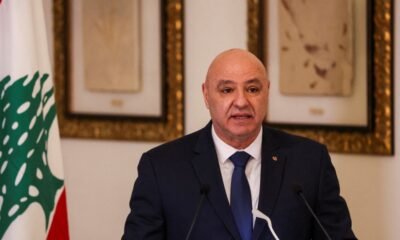
Lebanon’s Aoun hails Türkiye for support to boost recovery, stability
-

 Daily Agenda2 days ago
KADES continues to save lives! It was downloaded 10 million times: More than 200 thousand reports were received!
-
 Daily Agenda12 hours ago
AK Party Eskişehir Provincial Minister Gürhan Albayrak: We will not let Eskişehir residents lose their rights! Public receivables of 550 thousand liras must be accounted for
-
 Daily Agenda13 hours ago
The Iraqi Minister first insisted and then signed! Who did the Development Road Project disturb? Here’s what’s behind the scenes
-

 Lifestyle1 day ago
Heat waves fuel ‘coolcation’ boom, Mediterranean appeal endures