
Sports
‘Ale, ale, ale!’ to meh: World Cup loses its spark to boring music

The World Cup has always been more than the matches on the pitch. For a brief, electrifying moment every four years, it extends into the streets, bars, and living rooms of millions of fans worldwide. And for a long stretch, from 1998 through 2010, that heartbeat came in the form of music.
The songs weren’t just background noise as they carried motivational fire, capable of uniting entire nations and turning casual spectators into believers.
Ricky Martin’s “The Cup of Life” in 1998 was the spark that changed everything.
The horn-driven salsa, the chantable “¡Ale, ale, ale!”, the relentless energy, it bypassed language barriers and demanded participation.
My friend, who watched his first World Cup in 1998, always says it felt like every stadium and every living room with a TV was beating to the same unstoppable rhythm.
It wasn’t merely a hit song; it was the tournament itself distilled into four minutes of explosive Latin fire.
Suddenly, the World Cup had a voice, a pulse, and a personality that echoed far beyond the Stade de France.
The golden era of World Cup music continued into the early 2000s, each official track carrying its own energy and flair. Anastacia’s “Boom” in 2002 delivered dance-pop adrenaline, while Il Divo and Toni Braxton’s 2006 ballad “The Time of Our Lives” added cinematic drama without losing its motivational core.
These songs shared a crucial DNA: they were alive. They were tied to place, time, and the communal joy of sport.
Then came 2010 in South Africa.
This one hits especially close to home, as Africans, it felt like the world was in our hands, with every street from Cape Town to Cairo alive with the roar of vuvuzelas.
The undeniable peak of World Cup anthems accompanied the traditional instrument.
Shakira’s “Waka Waka (This Time for Africa)” fused Afro-pop rhythms, South African instrumentation, and a chorus designed for stadium-wide sing-alongs.
K’naan’s “Wavin’ Flag” became a companion piece, a deeply personal anthem transformed into a celebration of resilience and triumph.
For the first time, the tournament felt truly global, yet rooted in the spirit of its host continent.
Fans across Africa and the world debated which track carried more weight: Waka Waka’s infectious party energy or Wavin’ Flag’s emotional depth.
Together, they created a sonic moment that remains unmatched, a reminder of what happens when music and sport converge perfectly.
Even controversies, like the plagiarism of Cameroon’s “Zangalewa” by Shakira, couldn’t diminish the impact.
These songs didn’t just play during matches; they defined them. They moved crowds, motivated players, and turned the World Cup into a festival that transcended sport.
After 2010, the magic began to fade. By the 2014 Brazil World Cup, the anthem formula had shifted.
Pitbull, Jennifer Lopez, and Claudia Leitte’s “We Are One (Ole Ola)” carried star power and carnival energy, but it felt manufactured.
It was polished, professional, and commercially successful, but it lacked the heartbeat of previous anthems.
Four years later, “Live It Up” in Russia, with Nicky Jam, Will Smith, and Era Istrefi, felt even more engineered for mass appeal, a boring song built to hit streaming charts rather than to unite fans in stadiums.
By Qatar 2022, FIFA abandoned the single-track model entirely, splintering its soundtrack across multiple artists and genres.
The result was the safe Dreamers by BTS’ Jung Kook, forgettable music that rarely inspired a crowd to sing in unison or move with genuine energy.
The first preview for 2026, “Lighter” by Jelly Roll and Carin Leon, has already sparked criticism online.
Too country, too slow, too disconnected from the global pulse of football, it signals a continued departure from the era when World Cup songs felt like an event in themselves.
The stadium-shoutable chorus, the infectious beat, the cultural authenticity all seem absent.
In their place are tracks designed for streaming algorithms and cross-market appeal, losing the grit, the soul, and the communal energy that once made the World Cup soundtrack a global event in its own right.
The decline is not accidental. It is a product of three converging forces.
First, commercial pressures turned the anthem into a multi-track, multi-market production, diluting focus and emotional impact.
Second, safety and formula replaced risk and cultural authenticity. Producers optimized for global streaming trends rather than creating music grounded in the host nation’s rhythms and identity.
And third, the modern digital era, dominated by TikTok snippets and short-form virality, undermines the long-form build-up that makes a song a communal, stadium-filling experience.
A track can be a social media hit, but it cannot be chanted by 80,000 fans in unison if it was designed for a 15-second clip.
And so, the motivational fire of World Cup songs, once capable of turning ordinary fans into believers, has dwindled.
Today’s tracks play and fade, rarely leaving a lasting imprint. The memories of Ricky Martin’s La Copa de la Vida, Shakira’s Waka Waka, and K’naan’s Wavin’ Flag endure precisely because they carried emotional weight, cultural grounding, and raw energy.
They remind us that the right song can transform a tournament into an unforgettable moment in history.
Daniil Medvedev was disqualified from his China Open semifinal against Novak Djokovic on Monday after hitting a spectator with a ball in an incident he described as an accident.
The spectator was escorted from the arena with a hand covering his left eye after being struck by Medvedev’s backhand.
“I feel terribly sorry for him actually and I just hope he’s OK,” Medvedev said. “Hopefully I can meet him and make up for it somehow.”
The incident occurred with Djokovic serving for the match at 7-5, 5-3. After Djokovic hit a forehand volley winner, the ball bounced off the advertising boards and back toward Medvedev. The Russian then struck a backhand that sailed into the front row and hit the spectator.
Medvedev immediately appeared to raise his left hand in apology but remained on the court.
“It was 100% an accident,” Medvedev said. “You can see that I didn’t hit the ball in anger. The ball was bouncing back, so I tried to just hit it anywhere, so it wouldn’t go out of the court.”
“When I saw the result, I felt horrible,” Medvedev said. “The most important thing is I hope that he’s OK because you never know with these types of situations.”
The chair umpire and tournament supervisor came onto the court to talk with Medvedev, who didn’t appear to put up much of an argument over the disqualification. Medvedev then walked to the net and shook hands with Djokovic.
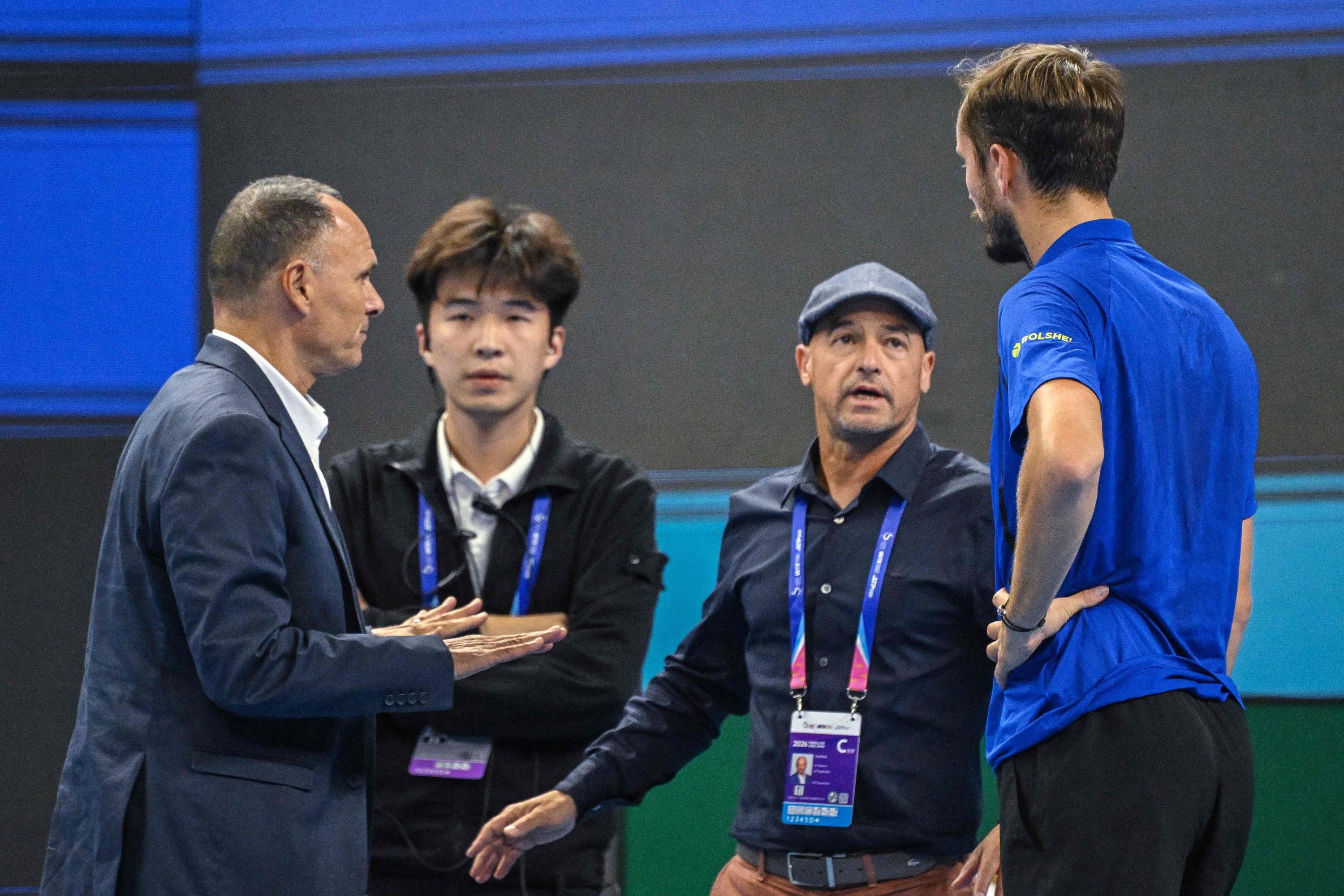
The incident was reminiscent of when Djokovic was defaulted from the 2020 U.S. Open for hitting a line judge in the throat with a ball. That was also accidental.
“A bit of a shock, to be honest,” Djokovic said. “I honestly didn’t see what happened. I hope that person is not badly injured. On the other hand, I also feel sorry for Daniil, because I know exactly how he feels to be disqualified in a big match. … I am sure that Daniil didn’t want to do this intentionally. It just happens.”
Medvedev has a history of on-court behavior issues. In April, he was fined 6,000 euros ($7,000) for unsportsmanlike conduct after smashing his racket seven times during a 6-0, 6-0 loss to Matteo Berrettini at the Monte Carlo Masters.
Djokovic extended his perfect career record at the China Open to 33-0.
Aiming for a seventh China Open title in Tuesday’s final, Djokovic will face ninth-ranked Alex de Minaur, who advanced when Hubert Hurkacz retired because of an apparent injury midway through the second set of their semifinal.
It will be Djokovic’s second final of the year after losing to Carlos Alcaraz at the Australian Open.
With his ranking down to No. 11, this is the first time in eight years that Djokovic is playing a tournament without being in the top 10. It’s also his first tournament since a first-round exit from the U.S. Open. The 39-year-old Serb rallied to beat top-seeded Alexander Zverev in the quarterfinals Sunday.
Against Medvedev, Djokovic was twice caught exceeding the time limit on the serve clock. After first receiving a warning, he was then stripped of his first serve on a crucial break point midway through the second set. But Djokovic still won the point.
Medvedev won only two of 18 break points as the pair of former No. 1s traded one grueling rally after another.
“It was a tough match for me,” Medvedev said. “He played really well. I felt he played like when we played our best matches. I had some opportunities, which I missed. He played incredibly, so I think he has big chances in the final.”
The match was 2 1/2 hours old when Medvedev was defaulted.
“I was three points away from the win,” Djokovic said. “It’s always a big battle with Daniil and it’s so hard to play him when he’s feeling the ball well in slower conditions with a big serve. But we move on.”
De Minaur led 6-4, 3-2 when Hurkacz, who was barely able to run for balls in the second set, stopped playing. The nature of Hurkacz’s injury was not immediately clear.
In the third round of the women’s tournament, which ends Sunday, Coco Gauff eliminated 16-year-old Chinese wild card Sun Xinran 7-5, 6-1. Sun recently won the U.S. Open junior title.
Also, six-time Grand Slam champion Iga Swiatek rallied past Donna Vekic 4-6, 7-6 (0), 6-2 and will next meet Iva Jovic, who beat Kamilla Rakhimova 6-1, 7-5.
Elina Svitolina beat Maria Sakkari 6-4, 7-5.

Türkiye Wrestling Federation President Taha Akgül says the country’s wrestling program is undergoing a long-term rebuild, with as much as 70% of the federation’s budget being directed toward developing young athletes and creating a new generation of wrestlers.
Akgül spoke to Anadolu Agency (AA) in Erzurum, where he traveled to follow the national team’s preparations at a training camp on Mount Palandöken ahead of the 2026 Senior World Wrestling Championships.
The Olympic champion said Türkiye needed to take the difficult step of investing heavily in an area where the results may not be immediately visible.
“We needed a new generation, a new period of sowing. We had the courage to do it and we started,” Akgül said. “It is not easy to start this because you are actually investing in an area that is not visible. It is similar to the investments municipalities make in youth development. They are not always seen.”
Akgül said the federation has committed a significant portion of its financial resources to youth development, with roughly 60% to 70% of its budget now being used for grassroots programs.
He said the federation’s staff are focused on expanding opportunities for young wrestlers and rebuilding the enthusiasm of athletes and their families.
“We are constantly thinking about what more we can do for the grassroots,” Akgül said. “For two years, we have been on the right path. We have restored the energy that the children and their families had lost.”
The federation has expanded competitions and development programs across Türkiye, including events and projects stretching from Hakkari in the east to Ankara.
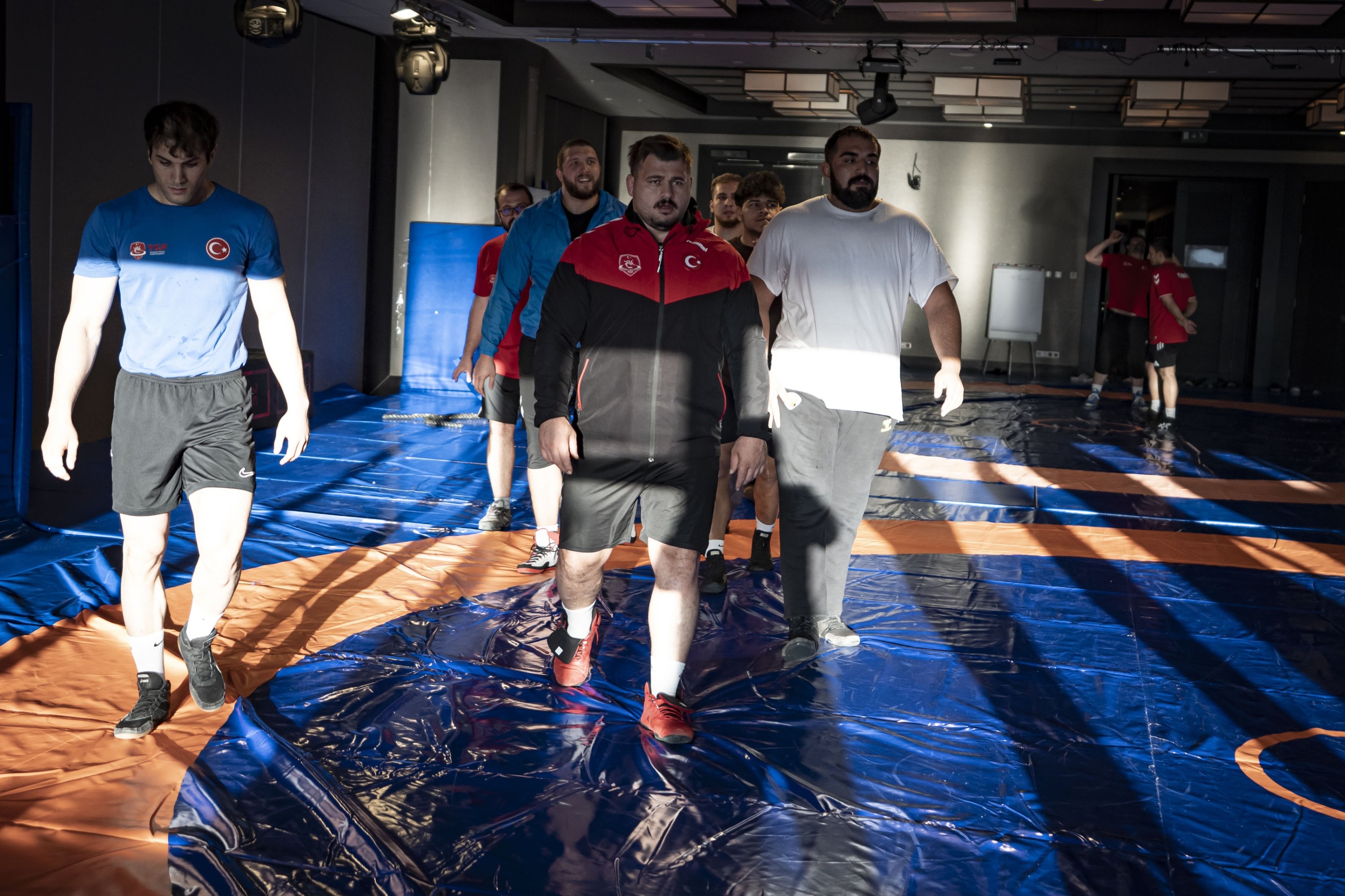
Akgül said the federation intends to increase the number of such initiatives while using its available resources to improve the quality and reach of its programs.
Building the next generation
Akgül described the past two years as a period of planting seeds for the future of Turkish wrestling, acknowledging that the federation will have to endure the difficult part of the process before the benefits become fully visible.
“We have been in a serious period of sowing for two years,” he said. “Unfortunately, we will have to endure the hardship of this period. Whether we are here in the future or not, wrestling will win.”
He said the long-term success of Turkish wrestling matters more than the legacy of individual administrators or athletes.
“If we want Turkish wrestling to have a good future, we have to go through this period and endure the difficulties,” Akgül said. “We have the strength to shoulder this.”
The federation has also sought to increase participation at national championships, creating a broader pool from which promising athletes can be identified.
Akgül said nearly 10,000 wrestlers competed at this year’s Türkiye Championships, describing the figure as a major achievement for a sport practiced across all 81 provinces.
Managing an event of that scale presents logistical challenges, but Akgül said the federation is also trying to ensure athletes receive meaningful support, including competition gear with the help of sponsors.
The goal, he said, is not simply to produce elite wrestlers but to keep young athletes engaged with the sport long enough for their potential to emerge.
“We select talents according to different age groups,” Akgül said. “Those we identify are sent to wrestling education centers. They did not have development camps because it was not considered necessary to organize camps for those age groups. We believe it is necessary.”
850 youngsters in camps
The federation has already brought 850 young athletes together through camps held in 15 different cities, giving them opportunities to experience different parts of Türkiye while strengthening their connection with wrestling.
For some, the camps offered experiences beyond sport, including visiting Çanakkale and swimming in the sea for the first time.
Akgül said the broader social impact of wrestling should not be measured only by the number of future champions it produces.
“Maybe many of these children will not become champions, but they could become very good architects, lawyers, bureaucrats, governors or statesmen,” he said. “All of them will say, ‘We were wrestlers.’”
That, Akgül said, is another measure of the sport’s value.
“If we produce 10 top-level athletes out of 10,000, we can say that Turkish wrestling has been saved,” he said.
Olympic test
While the federation is investing in the future, Akgül said its immediate focus is the 2026 World Championships and the longer-term goal of the 2028 Los Angeles Olympics.
“We are always focused on the Olympics,” he said. “We have entered the Olympic atmosphere completely.”
The national team is preparing in the relative isolation of Erzurum, where Akgül believes the quiet surroundings, climate and natural environment provide ideal conditions for an intense training camp.
The 2026 World Championships will serve as an important test for a team undergoing significant generational change.
“We know it will be difficult, but we are in a renewal process,” Akgül said. “Hopefully, we will have a good championship.”
Türkiye’s wrestling program has traditionally been one of the country’s strongest sources of Olympic medals. At the most recent Olympics, wrestling produced two medals for Türkiye, and Akgül expects the sport to remain one of the country’s leading medal hopes.
The federation president has also remained closely involved with the athletes on the mat, training alongside the Olympic team after recently ending his own competitive career.
“I train one-on-one with my Olympic team,” Akgül said. “I have just retired from wrestling, so my performance has not dropped yet. We are there with the children on the field.”
For Akgül, the rebuilding process is ultimately about ensuring the next generation inherits a stronger wrestling system than the one it entered.
“We are on the right path,” he said. “Turkish wrestling will become even better. Our people should pray for us.”
Carlos Alcaraz overcame another sluggish start Tuesday to defeat Jiri Lehecka 7-6 (4), 6-4 in the Japan Open final, successfully defending his Tokyo title and adding another milestone to his return from a lengthy wrist injury layoff.
The victory gave the third-ranked Spaniard his third title of the season and his 27th career trophy. It also marked his first championship since winning the Qatar Open in February and strengthened his comeback just two tournaments after returning to competition.
Alcaraz, 23, became the first man to win consecutive Japan Open titles since American Pete Sampras in 1993 and 1994.
“It’s been a while and obviously it’s extra special after my injury and my comeback, in the second tournament that I’m playing,” Alcaraz said. “It was a really tough week and I didn’t play my best tennis and my best level, but I did find good solutions and that’s what matters in the end.”
The final followed a familiar pattern for Alcaraz in Tokyo. He dropped serve in the opening game but quickly settled, increasing the pace and intensity of his game before breaking Lehecka with a blistering backhand to level the first set at 3-3.
Lehecka, ranked 19th in the world, remained competitive and took a 4-2 lead in the tiebreaker. But Alcaraz responded by winning five consecutive points, producing some of his best tennis of the match when the pressure was highest.
He dug out a difficult ball at his feet after a net cord from Lehecka, hammered a powerful forehand return and then produced a perfectly timed forehand drop shot for a winner. Two backhand errors from Lehecka handed Alcaraz the set.
The Spaniard carried that momentum into the second set and finally created separation when he broke Lehecka for a 4-3 lead. He then closed out the championship at love on his first opportunity, forcing an error on match point before celebrating with his team courtside.
“I would say today was the best match of the week,” Alcaraz said.
That assessment came after a tournament in which he often had to find ways to win without producing his best tennis. In his semifinal against qualifier Jaume Munar, Alcaraz dropped the opening set during a stretch in which he lost 16 consecutive points.
Lehecka arrived at the final in strong form, having won six straight matches. The Czech had helped his country defeat the United States in Davis Cup qualifying, winning both of his singles matches, before advancing through his first four matches in Tokyo.
But Alcaraz proved too difficult to overcome when the key points arrived.
The title also provided a significant psychological boost after a difficult period away from the sport. Alcaraz missed the French Open and Wimbledon while recovering from a right wrist injury that kept him out for nearly five months. He returned at the U.S. Open in late August and reached the quarterfinals, where he lost to Ben Shelton in a match that finished at 3:33 a.m.
Since returning, Alcaraz has continued to wear a compression sleeve on his right arm, but his latest title offered further evidence that his confidence and physical condition are returning.
He acknowledged that the injury layoff brought plenty of uncertainty.
“A lot of negative thoughts come to your mind,” Alcaraz said. “If you’re going to come back healthy, if you’re going to come back the same as you were before, if I will be able to hit the ball normally without pain.”
Alcaraz said he and his team focused on putting those doubts aside and trusting his recovery.
“My team and I knew that if I come back, I’m going to be healthy 100%. If I feel something, it’s not going to be anything at all. So I have to go full to every shot, every ball,” he said. “I trusted myself and it worked out.”
Real Madrid have reached an agreement with Türkiye midfielder Arda Güler on a contract extension that will keep him at the Spanish giants until 2031, local media reported Monday.
The 21-year-old, whose current contract runs until 2029, has agreed to a two-year extension until 2031, according to Madrid-based sports daily AS; it will be his first contract renewal since joining Real Madrid.
The extension would keep Güler at Real Madrid for at least another five years.
The new agreement also includes a salary increase reflecting Güler’s growing importance in the team, the report said.
Following the reports, German football database website Transfermarkt updated Güler’s current market value to €100 million ($112 million) from €90 million ($100.8 million).
Güler has started five matches so far this season under Jose Mourinho.
The Türkiye international also played an important role last season, making 40 starts and finishing the campaign with six goals and a team-high 14 assists.
Güler joined Real Madrid from Turkish club Fenerbahce in 2023 and is now in his fourth season with the Spanish side.
AS said Real Madrid view Güler as an important player for both the present and future, with coaches who have worked with him during his time at the club highlighting his quality and potential for further development.
Mourinho also praised the Turkish international’s influence on the team.
“For me, his playing quality is incredible: the vision, the decision-making, the organization of play, the stability he gives the team, the creation,” he said.
“He is a player with fantastic potential who already has very interesting numbers, and they are not only assists and goals. They come from a deeper analysis. He’s a young man who has a great influence.”
Türkiye suffered their fourth consecutive UEFA Nations League defeat Monday as Italy claimed a 3-1 victory in Bologna, leaving the Crescent-Stars rooted to the bottom of Group 1 without a point.
Goals from Gianluca Scamacca, Riccardo Calafiori and Pio Esposito secured the victory for Italy at the Renato Dall’Ara Stadium, while Aral Şimşir scored Türkiye’s lone goal.
Italy started brightly, with Scamacca firing narrowly wide in the 11th minute, but Türkiye soon began creating chances of their own.
Irfan Can Kahveci threatened after breaking onto a through ball before losing control, while Gianluigi Donnarumma was called into action to deny Ozan Kabak and Salih Özcan.
Italy broke the deadlock in the 26th minute when Antonio Vergara’s deflected cross fell to Scamacca, who fired in off the underside of the crossbar.
Türkiye continued to push and were rewarded in the 61st minute. A deflection off Eren Elmalı sent the ball into the path of Şimşir, who converted from close range to level the score.
The hosts responded almost immediately.
Nicolo Barella’s free kick found Calafiori, whose header beat Uğurcan Çakır in the 65th minute to restore Italy’s advantage.
Türkiye came close to another equalizer in the 77th minute when Yunus Akgün picked out Özcan, but Donnarumma produced a strong save to preserve Italy’s lead.
Esposito then put the result beyond doubt late on, converting from inside the penalty area to make it 3-1.
The victory continued Italy’s improved run under returning coach Roberto Mancini and strengthened their bid for a Nations League quarterfinal place.
Türkiye, meanwhile, remain without a point after four matches and sit bottom of the group following their fourth straight defeat.
Italy moved to seven points in second place after recording their second victory in three matches.
Türkiye will host Belgium on Nov. 12, while Italy welcome France on the same day.
Lionel Messi will play his final match for Argentina Tuesday in a farewell friendly against Benin, marking the end of his international career for the South American champions.
After more than two decades of service to his country, the 39-year-old superstar will hand over the captain’s armband for good as he makes his final appearance in the Albiceleste jersey at the Estadio Monumental in Buenos Aires.
Messi will be joined for his international swansong by 85,000 spectators and several of the teammates with whom he reached the pinnacle of football at the 2022 World Cup in Qatar, alongside members of Argentina’s emerging generation.
The friendly marks a symbolic passing of the torch for a player whose international legacy includes a World Cup title, two Copa America crowns and the Finalissima.
Messi also bows out as Argentina’s record appearance-maker and leading scorer, with 125 goals in 207 games, as well as a record 68 assists.
His farewell comes two and a half months after Argentina’s ill-tempered World Cup final defeat to Spain in New Jersey, where Messi exited in tears after making little impression.
“I gave it my all; I have nothing left to give, and besides, there are great young players coming up who deserve their chance,” Messi wrote when announcing his international retirement in August.
Messi remains under contract with Inter Miami until 2028, although following the death of his father, Jorge, two months ago, he revealed he may hang up his boots for good sooner than anticipated.
Friends reunited
Members of Argentina’s 2022 World Cup-winning squad – the players who delivered the country’s third star – and their families will join Messi for Tuesday’s farewell against Benin, ranked 93rd in the world.
Veterans of that Doha triumph such as Angel Di Maria, who retired from international football in 2024, will be there to witness the passing of the torch to a new generation charged with extending the Albiceleste’s golden era.
Several of the newcomers, including Franco Mastantuono and Leonel Flores, were not even born when “La Pulga” (“The Flea”) made his Argentina debut in 2005 for a team whose history had for so long been dominated by Diego Maradona.
“It’s going to be an unforgettable day for everyone. Everyone wants to be at this match, and now it’s just about enjoying it,” Argentina coach Lionel Scaloni said.
Argentina’s new generation has already shown what it can do without its captain, although nobody is pretending replacing a man regarded by many as the greatest footballer in history will be straightforward.
“Collectively, we will try to fill the void left by Leo,” said Scaloni, who is negotiating a contract extension after leaving his future unresolved following the World Cup defeat in July.
Scaloni, who mastered the art of building the right supporting cast around Messi, will also say goodbye on Tuesday to 38-year-old vice-captain Nicolas Otamendi.
Like Messi and Otamendi, midfielders Rodrigo De Paul and Giovani Lo Celso were called up solely for the Benin game, raising the possibility that neither will represent Argentina again.
New generation
Those certain to be involved, at least from the bench, include other veterans of the 2022 World Cup who will be the standard-bearers for Argentina after Messi: defender Cristian Romero, midfielders Alexis Mac Allister and Enzo Fernandez, and forwards Julian Alvarez and Lautaro Martinez.
Tenacious center-back Romero is set to inherit the captain’s armband, first worn by Messi at the 2010 World Cup in South Africa.
Goalkeeper Emiliano Martinez and Lautaro Martinez are next in the captaincy hierarchy.
They have already begun to rally around Messi’s heirs, who showed their appetite for success in Argentina’s first game since the World Cup final, against Bolivia in Cordoba Wednesday.
Argentina swept the Bolivians aside 4-0, with young talents Nico Paz and Jose Manuel Lopez among the scorers.
They followed that victory with a 7-0 rout of Burkina Faso at the Monumental on Saturday, with Mastantuono and Gianluca Prestianni scoring their first international goals.
While Argentina’s future is beginning to take shape, one small but symbolically significant question remains: who inherits Messi’s No. 10 shirt?
“We won’t give the No. 10 to anyone until Leo’s match takes place,” Scaloni said. “After that, we’ll see.”


-

 Economy3 days ago
Revolut: $115 billion fintech taking on Europe’s biggest banks
-

 Economy3 days ago
Global M&A deal rush slowed down in Q3 as borrowing costs bite
-

 Economy1 day ago
Brazilian assets rally as Flavio Bolsonaro tops first-round vote
-

 Economy2 days ago
Türkiye’s Halkbank after secondary offering amid strong interest: CEO
-

 Politics2 days ago
MP hints at more access for Öcalan amid terror-free Türkiye bid
-

 Economy1 day ago
Türkiye says Development Road could become $80B ‘energy corridor’
-

 Economy1 day ago
Top central bankers due in Istanbul to discuss policy challenges
-

 Politics1 day ago
Türkiye’s CHP seeks removal of mayor with divided loyalty