
Politics
Syria’s al-Sharaa calls Türkiye ties cornerstone for global stability

Syrian President Ahmed al-Sharaa said Friday that a strengthened partnership between Syria and Türkiye could serve as a cornerstone for regional stability and global security, as his country seeks to rebuild ties and reposition itself after years of conflict.
Speaking to Anadolu Agency (AA) on the sidelines of the Antalya Diplomacy Forum (ADF), al-Sharaa emphasized the historical and geographic ties between the two countries, describing their relationship as a foundation on which broader cooperation could be built.
“The Syria-Türkiye partnership is a base upon which many things can be constructed for the future of regional and global security,” he said.
Al-Sharaa noted that Syria had been largely isolated from the region and the international community under the former regime, but said the country’s transition had opened new opportunities to restore diplomatic and economic relations.
“The liberation of Syria from the former regime created an opportunity to rebuild ties regionally and internationally,” he said, adding that Türkiye had been a consistent supporter of the Syrian opposition for more than a decade.
He described Syria as moving from a period of crisis into a period of opportunity, highlighting ongoing efforts to attract investment and deepen cooperation with regional partners, particularly Türkiye.
Addressing energy security and supply chains, al-Sharaa said Syria’s geographic position offers strategic advantages as a transit corridor linking East and West.
He pointed to disruptions in global energy markets following recent regional tensions, including conflict involving Iran, as increasing the importance of alternative routes.
“Syria can provide a secure corridor for energy supply and trade routes,” he said, noting connections linking the Arab Gulf to Türkiye through Syria and Jordan, as well as access to the Mediterranean Sea.
He also referred to the so-called “Four Seas” project, a regional integration initiative aimed at connecting energy and trade networks across the Caspian Sea, the Mediterranean, the Red Sea and the Gulf. Al-Sharaa said the project reflects a broader global demand for secure supply chains and diversified energy routes.
As part of economic cooperation, al-Sharaa said Syria and Türkiye are working on establishing a free trade zone in the northwestern province of Idlib, located along key transit routes connecting Idlib, Latakia, Aleppo and Damascus.
He added that infrastructure projects are underway, including airport expansions and port investments, with Turkish companies playing an active role in Syria’s reconstruction efforts.
Integration process
On internal developments, al-Sharaa said progress had been made in integrating various armed groups into a unified national framework.
He noted that forces linked to the YPG terrorist group are being incorporated into state structures, while remaining foreign military elements in northeastern Syria have withdrawn.
“The integration process between the Syrian state and these forces is ongoing and progressing positively,” he said, describing it as critical for national stability.
On Jan. 30, the Syrian government announced that it had reached a comprehensive agreement with the U.S.-backed YPG aimed at ending divisions in the country and launching a new phase of integration.
The ministry said the completion of the handover of U.S. sites “represents a natural outcome of the successful integration of the YPG into national structures, and of the Syrian state assuming full responsibility for combating terrorism and addressing regional threats on its territory.”
Recently, the Syrian Foreign Ministry also announced that the government has taken control of all military bases previously used by U.S. forces deployed in the country as part of the international coalition against Daesh, marking a significant shift in control over northeastern regions.
The ministry said in a statement that it “welcomes the completed handover of military sites where United States forces were previously present in Syria to the Syrian government,” adding that the move was carried out “in full coordination between the Syrian and American governments.”
Moreover, reflecting on the Antalya forum, he praised Türkiye’s role in hosting international dialogue platforms and contributing to global diplomacy.
“Türkiye has become a country with significant influence both regionally and globally,” he said.
He concluded with a message to the international community, urging engagement with a changing Syria.
“Syria is no longer defined by crisis,” he said. “It is becoming a place of reconstruction, stability and a new future, a historic opportunity.”

Turkish National Defense Minister Yaşar Güler welcomed NATO defense ministers and senior alliance officials to the Ay Yıldız (Crescent and Star) Joint Headquarters in Ankara on Tuesday, using the high-profile reception to showcase Türkiye’s next-generation military command center as the country hosts the 36th NATO Heads of State and Government Summit.
The reception was held in the Yıldız (Star) section of the still-under-construction headquarters, according to Türkiye’s National Defense Ministry. Güler greeted guests upon their arrival before delivering remarks during the event, which formed part of the two-day NATO summit in the Turkish capital.
The gathering offered one of the first major international glimpses inside the sprawling Ay Yıldız complex, an ambitious defense project that will eventually bring together the Turkish Armed Forces’ top command under one roof.
Designed to centralize Türkiye’s military leadership, the headquarters will house the National Defense Ministry, the General Staff, and the commands of the Land, Naval and Air Forces in a single integrated complex. Officials say the project will strengthen coordination, speed decision-making and enhance the country’s joint operational capabilities.
Construction of the headquarters began in 2021 following a groundbreaking ceremony attended by President Recep Tayyip Erdoğan. Located in Ankara’s Etimesgut district, the 12.6 million-square-meter site is expected to accommodate approximately 15,000 personnel once completed, with the full project scheduled for completion in early 2028.
Inspired by the crescent and star on the Turkish flag, the headquarters combines symbolic architecture with advanced military infrastructure. The facility incorporates smart-building technology, environmentally sustainable features and modern command, control and communications systems designed to support both current and future operational needs.
Turkish officials describe the complex as a cornerstone of the country’s defense modernization strategy, strengthening institutional integration while improving Türkiye’s ability to contribute to NATO missions. Because of its scale and centralized command structure, it has frequently been compared to the Pentagon in the United States.
The reception came as Türkiye hosts the 36th NATO Heads of State and Government Summit, marking the second time the country has welcomed the alliance’s leaders after the 2004 summit in Istanbul.
The two-day summit, held in Ankara, has brought together leaders from NATO’s 32 member states, senior alliance officials, Asia-Pacific partners and invited guests, including Ukrainian President Volodymyr Zelenskyy.
Discussions are expected to focus on reinforcing allied unity amid evolving transatlantic dynamics, maintaining long-term support for Ukraine, increasing defense spending and strengthening NATO’s future military posture.
A central topic is the alliance’s proposed “NATO 3.0” vision, which envisions European allies assuming greater responsibility for conventional defense while the United States reassesses its military presence across Europe. The strategy reflects growing calls for increased burden-sharing within the alliance as NATO adapts to an increasingly complex global security environment.
The summit also includes talks on defense industrial cooperation, military readiness and the implementation of commitments made at previous alliance meetings.
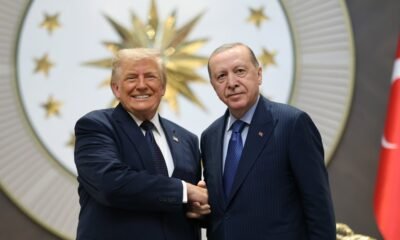
President Recep Tayyip Erdoğan said Tuesday he is confident that long-standing issues between Türkiye and the United States can move toward positive outcomes, citing his close cooperation and strong relationship with U.S. President Donald Trump following their high-profile meeting at the NATO Summit in Ankara.
Erdoğan made the remarks in a social media post after holding bilateral talks with Trump at the Presidential Complex, where Türkiye welcomed the U.S. president with a full state ceremony featuring military honors, Turkish and American flags, and an official reception.
“I was pleased to host my valued friend, U.S. President Donald Trump, who paid an official visit to our country on the occasion of the NATO Ankara Summit,” Erdoğan wrote. “I believe we will achieve positive results on many of the issues on our agenda through our solidarity and strong relations.”
The meeting took place on the opening day of the July 7-8 NATO Summit, which Türkiye is hosting for the second time after the alliance gathered in Istanbul in 2004. Trump’s visit also marks the first by a sitting U.S. president to Türkiye since Barack Obama traveled to the country in 2015.
The leaders met as NATO members debated some of the alliance’s most pressing security challenges, including increased defense spending, military production, support for Ukraine, regional stability, and burden-sharing among member states. Trump has urged allies to raise defense spending to 5% of gross domestic product, making the issue one of the summit’s defining topics.
Türkiye entered the summit with growing influence inside the alliance, backed by NATO’s second-largest military, an expanding defense industry, and its strategic position between Europe, the Middle East, and the Black Sea region.
Although neither side released a detailed readout of the discussions, the meeting was widely expected to cover several key bilateral issues. Among them were defense cooperation, including the future of U.S. sanctions on Türkiye and Ankara’s long-standing interest in rejoining the F-35 fighter jet program. Trump has previously suggested he is open to advancing defense ties with Türkiye, pointing to his personal relationship with Erdoğan.
Regional security also likely featured prominently, with discussions expected to include developments in Syria, the broader Middle East, the U.S.-Iran ceasefire, counterterrorism efforts, and energy security.
Economic cooperation was another likely focus, as both governments continue exploring opportunities to expand trade and investment while strengthening collaboration in Türkiye’s rapidly growing defense manufacturing sector. Turkish-made drones and other advanced defense systems have been showcased during the summit’s Defense Industry Forum.
The meeting underscored the increasingly personal diplomacy between Erdoğan and Trump, a relationship that has endured despite years of disagreements over issues such as Türkiye’s purchase of the Russian S-400 missile defense system and differing approaches to the conflict in Syria.
Trump has repeatedly described Erdoğan as a close friend and an important strategic partner, saying their relationship played a major role in his decision to attend the Ankara summit.
Erdoğan’s message reflected optimism that their longstanding rapport can translate into tangible progress on issues that have complicated U.S.-Türkiye relations for years, while reinforcing cooperation within NATO as the alliance confronts evolving global security challenges.
The NATO summit continues with plenary sessions, bilateral meetings, and working groups involving alliance leaders, including Ukrainian President Volodymyr Zelenskyy, with additional announcements expected as discussions progress.
First Lady Emine Erdoğan on Tuesday said she was honored to welcome NATO leaders and their spouses to an official dinner held during the 36th NATO Heads of State and Government Summit in Ankara, expressing hope that the gathering would strengthen dialogue and consensus as the alliance confronts growing global challenges.
President Recep Tayyip Erdoğan and Emine Erdoğan hosted the official dinner on Monday evening at the Presidential Complex as part of the summit’s high-level program, bringing together heads of state, government leaders and their spouses attending the two-day NATO meeting.
In a statement shared on her NSosyal account, Emine Erdoğan reflected on Türkiye’s role as host and emphasized the importance of cooperation in addressing common international challenges.
“We were greatly pleased to host the heads of state and government and their esteemed spouses at the official dinner on the occasion of the 36th NATO Heads of State and Government Summit, hosted by our country. At a time when efforts to find solutions to the world’s common problems are gaining momentum, I hope this important summit will further advance the culture of dialogue and consensus,” she said.
The 36th NATO Summit, held July 7-8 in Ankara, marks the second time Türkiye has hosted the alliance’s leaders following the 2004 summit in Istanbul.
The meeting has brought together leaders from NATO’s member states to discuss some of the alliance’s most pressing security and defense priorities.
Among the key issues on the agenda are increasing defense spending, expanding military production and industrial capacity, strengthening collective security, sharing defense responsibilities among allies, continuing support for Ukraine, and reinforcing alliance unity amid an increasingly volatile global security environment.
The summit has also provided a platform for a series of bilateral meetings between participating leaders. U.S. President Donald Trump, Ukrainian President Volodymyr Zelenskyy and other NATO leaders are taking part in discussions centered on transatlantic security, European defense cooperation and regional stability.
Alongside the political meetings, the summit’s opening day featured a Defense Industry Forum, underscoring Türkiye’s expanding role in NATO’s defense industry and its position as one of the alliance’s key military contributors.
While the summit’s primary focus remains on defense and security policy, the official dinner and accompanying spouses’ program served as an important diplomatic event, highlighting the role of hospitality and informal engagement in fostering closer relations among allied nations.
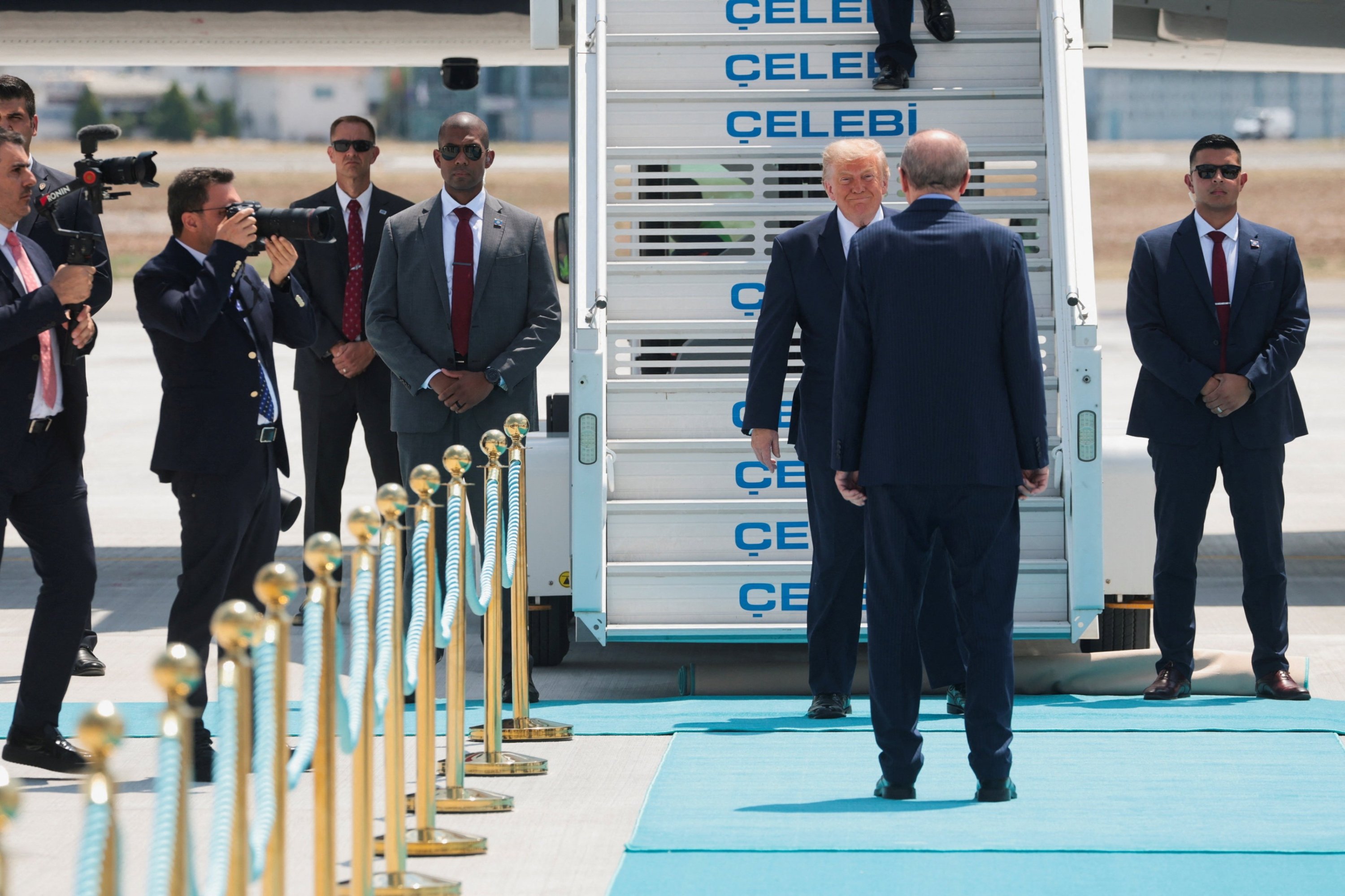
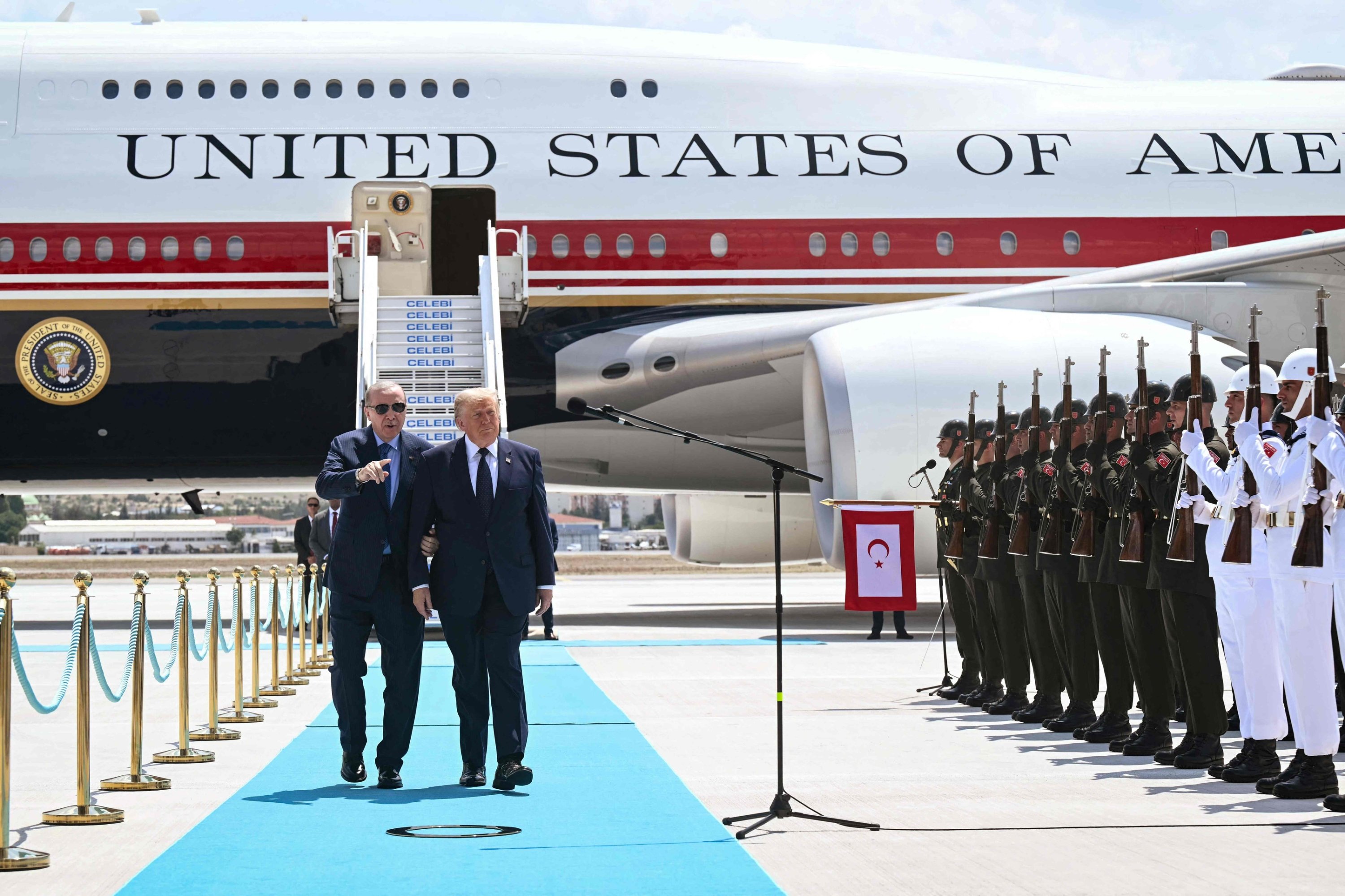
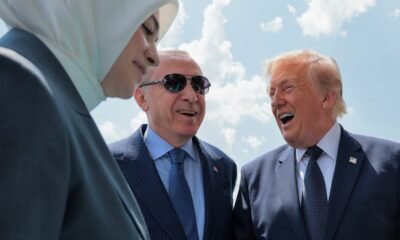
U.S. President Donald Trump arrived in Ankara on Tuesday to attend the NATO leaders’ summit, joining heads of state and government from across the alliance for talks expected to focus on collective defense, regional security and burden sharing.
Trump’s aircraft landed at Ankara Airport, where he was welcomed by President Recep Tayyip Erdoğan before departing for the Presidential Complex where he was expected to hold talks with the president. On Air Force One, Trump was accompanied by Secretary of Defense Pete Hegseth and Secretary of State Marco Rubio. This was also the inaugural flight abroad for the new presidential plane gifted by Qatar with Trump aboard. Ankara Airport, originally Etimesgut Airport, was heavily modified and had its runways expanded specifically for leaders and delegations arriving for the NATO summit.
The two-day gathering is expected to bring together leaders from NATO’s 32 member states, with discussions set to cover defense spending, Russia’s war in Ukraine, the alliance’s deterrence posture and broader security challenges.
The U.S. president will hold one-on-one talks with Erdoğan at the Presidential Complex in the capital, and U.S.-Turkish delegations will hold talks separately on the margins of the summit.
It was also reported that the agenda in the Erdoğan-Trump meeting will be diverse, but four topics will be the main items in discussions. These include the lifting of Countering America’s Adversaries Through Sanctions Act (CAATSA) sanctions, Türkiye’s readmission to the F-35 program, the U.S. sale of engines for Türkiye’s locally made fighter jet Kaan and new defense projects.
Additionally, Trump and Erdoğan are expected to discuss boosting bilateral trade volume and possible collaboration on energy.
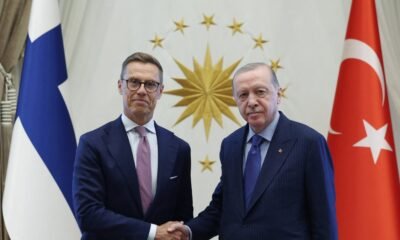
President Recep Tayyip Erdoğan on Tuesday held talks with his Finnish counterpart Alexander Stubb as the latter arrived for a two-day NATO summit in the Turkish capital.
Later on Tuesday, Stubb will attend a dinner hosted by Erdoğan and first lady Emine Erdoğan in honor of the heads of state and government and their spouses.
Finland became a full member of NATO in 2023. It shares a long 1,340-kilometer (832.64-mile) border with Russia, the longest of any NATO ally, and has built its defense posture around that reality for decades, with the USSR’s successful invasion in 1939-1940 still long remembered. Its spending reflects post-Ukraine urgency and a long tradition of credible territorial defense.
Türkiye was instrumental in Finland’s membership of NATO, as well as in the admission of Sweden. Ankara initially objected to the memberships, conditioning that both countries should take more action to combat terrorism, and consented to their admission after Finland and Sweden demonstrated commitment to that extent.
President Recep Tayyip Erdoğan hosted his U.S. counterpart, Donald Trump, at the Presidential Complex on Tuesday as the latter arrived for bilateral talks and a key NATO summit in Ankara. While delivering comments, the U.S. president vowed that they would lift CAATSA sanctions.
Speaking alongside President Recep Tayyip Erdoğan at the Presidential Complex after arriving in Ankara for the NATO leaders summit, Trump said the time had come to remove sanctions that have strained relations between the two NATO allies.
“We’re going to lift the sanctions,” Trump said. “We don’t want to sanction our friends. I don’t want to choke my friend with sanctions.”
The sanctions were imposed under the U.S. Countering America’s Adversaries Through Sanctions Act (CAATSA) after Türkiye purchased the Russian-made S-400 air defense system, leading Washington to suspend Ankara from the multinational F-35 fighter jet program in 2019.
Asked whether Türkiye could rejoin the program, Trump praised Ankara as a reliable ally.
“Türkiye has been a much more loyal partner than many others,” he said.
Moreover, Trump also said he might not have attended the NATO summit had it not been hosted by Türkiye.
“Frankly, if this summit had not been held in Türkiye, and if my friend, a very strong leader, a very strong person, had not been here, I probably would not have come,” he underlined, referring to Erdoğan.
Calling Türkiye a militarily powerful country under Erdoğan’s leadership, Trump remarked that relations between Washington and Ankara were at their strongest point in years.
“I have great respect for President Erdoğan,” he said. “This is truly in the interest of both countries. I can say that our relationship with Türkiye is better now than it has ever been.”
Trump also defended U.S. spending within NATO, saying Washington had invested “trillions of dollars” in the alliance to protect European allies from security threats, including those posed by Russia.
The U.S. president was scheduled to attend the summit’s official dinner later Tuesday. On Wednesday, he is expected to hold bilateral meetings with Ukrainian President Volodymyr Zelenskyy and Syrian President Ahmad al-Sharaa before concluding his visit with a news conference and departing Ankara.
Trump’s arrival in Ankara
The two men, who often refer to each other as “friend,” first met on the tarmac of Ankara Airport, a military airport redesigned for Air Force One and other presidential planes. They later proceeded to the airport’s guest house and, later, to the Presidential Complex.
A ceremonial team of guardsmen dressed in historical costumes of Turkish states of the past, from Seljuks to Ottomans, attended the welcoming ceremony for Trump at the complex.
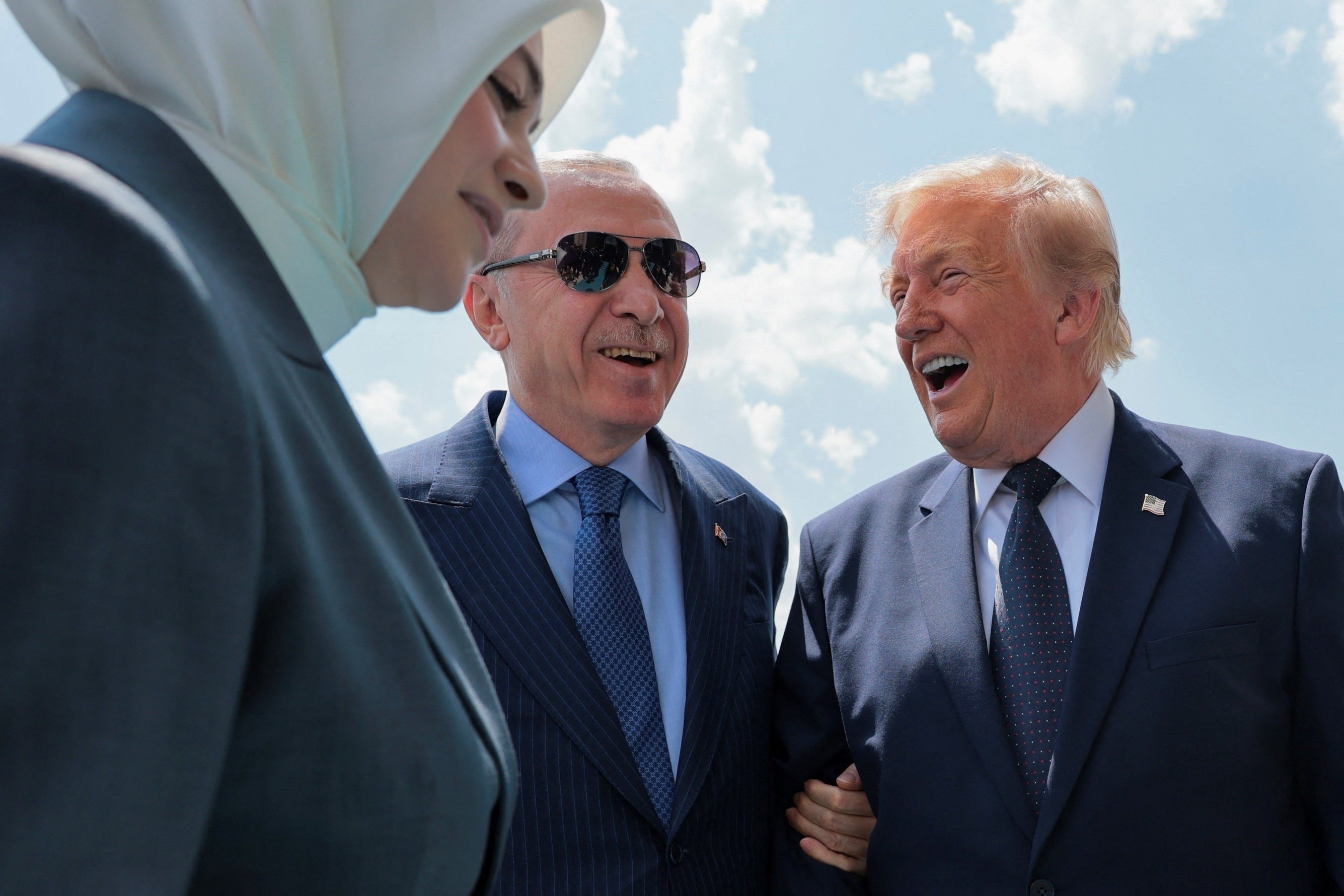
This is Trump’s first visit to Türkiye in his two presidential terms and the first by a sitting U.S. president after the end of the Biden administration. Erdoğan visited the White House last year, and the two leaders often hold phone calls in critical times, including the recent U.S.-Israel-Iran conflict. Trump, however, is no stranger to Türkiye, where skyscrapers bearing the name of his franchise tower over central Istanbul. He attended the opening ceremony of the towers in 2012, alongside Erdoğan, then prime minister.
Speaking to journalists before their meeting, the two leaders affirmed good ties and friendship. “We feel stronger now having my precious friend here in Ankara,” Erdoğan said.
“We are very good friends, you are a respected leader,” Trump said in turn. “We are going to talk about trade, military, Iran,” the U.S. leader said. Trump also expressed his frustration with NATO. “I was very disappointed with NATO. I am not sure they would be there for us. Why are we spending hundreds of billions of dollars if they are not there for us?” he said.
On Türkiye’s return to the F-35 program, Erdoğan said he trusted Trump as “a man of his word.”
The Turkish president also said he will discuss engines for Türkiye’s indigenous Kaan fighter jet with Trump during the NATO leaders’ summit, adding he expects Trump to reiterate positive commitments.


-
 Refugees1 day ago
Prosecutors credit gold trader in Iran sanctions case with key help before sentencing
-
 Politics18 hours ago
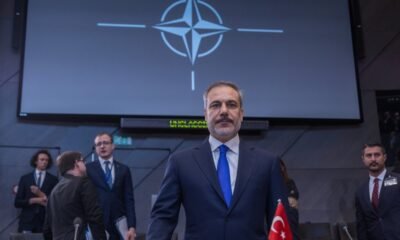
Turkish FM says Erdoğan-Trump ties could help ease NATO divisions
-
 Politics12 hours ago
US President Trump arrives in Ankara in inaugural visit, for NATO summit
-
 Daily Agenda3 days ago
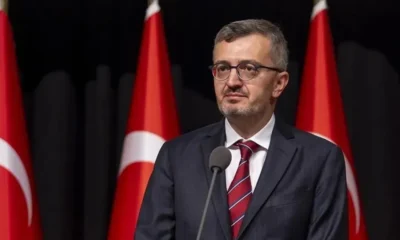
BREAKING NEWS… NATO Summit statement from Director of Communications Burhanettin Duran: The alliance’s efforts in the field of deterrence and defense will be evaluated
-
 Refugees3 days ago
Trump plans to meet with Ukrainian and Syrian presidents at the NATO summit
-
 Daily Agenda2 days ago
AK Party General Secretary Eyyüp Kadir İnan: We kept the reputation of our nation and the interests of our country above all else.
-
 Politics8 hours ago
Erdoğan confident Trump talks will produce positive results
-
 Politics13 hours ago
Erdoğan welcomes Stubb as newcomer Finland attends key NATO summit