
Refugees
Trump plans to meet with Ukrainian and Syrian presidents at the NATO summit

WASHINGTON (AP) — President Donald Trump plans to meet with Ukrainian President Volodymyr Zelenskyy and Syrian President Ahmad al-Sharaa on Wednesday while attending the NATO summit in Turkey, the White House said. Those discussions will come as Kyiv tries to refocus Trump’s attention on the conflict with Moscow and as Trump has publicly mused about Syria’s role in the Middle East.
White House spokesperson Anna Kelly confirmed the meetings in a call with reporters while previewing the upcoming summit in Ankara, where Trump also plans to meet with Turkey’s President Recep Tayyip Erdogan on Tuesday. Before returning to the United States on Wednesday, Trump is scheduled to have a news conference, Kelly said.
Trump’s meeting with Zelenskyy comes as Russia’s war in Ukraine is now in its fifth year. Both Zelenskyy and Russian President Vladimir Putin held phone calls with Trump on Saturday, congratulating him on the July Fourth commemoration of the 250th anniversary of American independence.
Zelenskyy said in a statement on X after his call that he and Trump spoke about the situation on the front lines of the war, where analysts say Russian advances have sputtered. Ukraine, has stepped up its attacks on Moscow and demonstrated its ability to strike deeper into Russia.
The Ukrainian leader said there is “a real prospect of ending this war,” and that conversation would continue at the NATO summit in Ankara.
Kremlin foreign affairs adviser Yuri Ushakov said that in Putin’s call with Trump, the Republican president reaffirmed his “readiness to help achieve a quick cessation of hostilities and search for peaceful solutions to settle the crisis” in Ukraine.
A senior U.S. official who spoke to reporters on condition of anonymity on Sunday to describe the administration’s approach said Trump feels a sense of urgency to bring the war to an end and will speak to Zelenskyy about how to do that. Trump is expected to follow up with Putin after his meeting with Zelenskyy in Ankara, the official said.
U.S. officials did not provide any details about the goals for Trump’s meeting with al-Sharaa.
As Trump has grown frustrated with Israel’s war with Hezbollah in Lebanon, which has complicated negotiations in the Iran war, the U.S. leader has repeatedly stunned many in the region by suggesting that Syria instead fight Hezbollah.
Al-Sharaa, who led an Islamic insurgent group and whose rebel forces ousted Bashar Assad as Syria’s president, has said he has no interest in doing so. He has suggested Trump’s comments were misconstrued, even as Trump has repeated them.
ISTANBUL (AP) — A Turkish court on Monday convicted five mayors of municipalities run by the country’s main opposition party on corruption charges in a trial that critics have denounced as politically motivated.
The case before an Istanbul court included allegations of bribery, bid-rigging and fraud in relation to municipal contracts. Critics of the government of Turkish President Recep Tayyip Erdogan say the trial targeted the opposition Republican People’s Party, or CHP, and that the prosecution relied on secret witnesses and defendants implicating other defendants in return for lighter punishment.
The Turkish government insists the country’s judiciary is independent and free from political influence.
The case focused on allegations that companies controlled by businessman Aziz Ihsan Aktas secured municipal tenders through bribery, bid-rigging and fraud. The opposition, meanwhile, has said that municipalities under Erdogan’s party control that did business with Aktas were not as thoroughly investigated.
Of the five convicted, the mayor of Istanbul’s Besiktas district, Riza Akpolat, received the heftiest sentence of 23 years and three months for accepting bribes, money laundering and bid-rigging.
The sentences of the four other mayors — who like Akpolat were removed from their posts following their arrests — ranged between five and eight years.
The seven-month trial in a courthouse next to Silivri Prison, west of Istanbul, included 200 defendants. Some of them were also sentenced while others were acquitted, though details of their cases were not immediately clear.
Aktas was arrested in Istanbul in January last year, after which authorities launched investigations into other Istanbul districts controlled by the Republican People’s Party, or CHP. The southern Turkish municipalities of Adana and Adiyaman, both run by CHP, were also investigated.
Aktas initially denied the charges but later testified against co-defendants under Turkey’s “effective repentance” law, alleging he had provided mayors and other officials with cash, cars and other bribes to get municipal contracts.
Aktas was separately tried and sentenced to two years and eight months for bid-rigging but was acquitted of bribery charges.
Most of the defendants denied knowing Aktas and accused him of giving false evidence. They also said that tenders had been allocated under long-standing processes and previous audits had uncovered no irregularities.
Another controversial aspect of the trial was the use of secret witnesses by the prosecution, many of whom admitted their evidence was based on hearsay.
Akpolat, the mayor of Besiktas, told the court that investigators offered to drop the charges if he gave evidence in a separate investigation into the CHP’s 2023 congress.
That investigation led to a court ordering the removal of the CHP’s top echelon in May on the grounds of voting irregularities during leadership elections. Many CHP members followed deposed leader Ozgur Ozel to the New Party, which is now the largest opposition group in parliament.
The CHP won several major cities in the 2019 local elections, including Istanbul and Ankara, the country’s capital. Further wins followed in the 2024 municipal polls but since then, an array of court cases have been brought against the opposition.
Ekrem Imamoglu, the metropolitan mayor of Istanbul and the opposition’s favored challenger to Erdogan in the next presidential election, has been behind bars since March last year.
He faces several legal cases, with the main one alleging corruption within the Istanbul municipality — claims that echo those in the Aktas case. If convicted, he could be sentenced to more than 2,300 years in total.
WASHINGTON (AP) — Treasury Secretary Scott Bessent said Monday that new U.S. sanctions aim to block all potential sources of revenue for Iran and told nations to cut economic ties to Tehran or face retaliation.
Bessent said it’s “no longer acceptable to operate in the gray spaces” of the conflict.
He did not name what countries could face potential secondary sanctions from the United States, but China, Turkey and the United Arab Emirates are Iran’s largest trade partners.
“Let there be no ambiguity as to the position of the United States,” Bessent told a news conference. “An economic engagement of any kind with this murderous regime will expose those responsible to the full reach of American power.”
Washington has said the new sanctions aim to put more pressure on an economy already battered by previous sanctions and a U.S. naval blockade.
Iranian currency falls to a record low
Bessent made the announcement as Iran’s currency hit a record low.
The rial dropped to 2.02 million to the U.S. dollar as trading opened on currency markets. Iran’s official Central Bank rate stood at around 1.5 million rial to the dollar, but the market rate is what most Iranians pay.
The currency had already been under pressure before the U.S. and Israel attacked Iran on Feb. 28, as Iran faced double-digit inflation and negative growth. The rial has repeatedly hit new lows as nearly six months of war have taken an even greater toll.
Iranians find daily staples increasingly unaffordable. Since the war began, rice is up some 60% and beef prices are more than 150% higher. The International Monetary Fund forecasts that gross domestic product will contract more than 5%.
Still, economic pressure has not yet translated into political pressure. Iran retains a key strategic advantage: Its attacks and threats on ships in the Strait of Hormuz have brought traffic in the vital waterway to a near halt, damaging the world economy and heaping pressure on U.S. President Donald Trump ahead of congressional elections.
The war, as a result, has devolved into a fight over who controls the strait, through which a fifth of the world’s traded oil transited before the conflict. Iran is now refusing to fully reopen it unless it can charge ships.
Iran and Oman, which is on the opposite side of the strait, are reportedly in the final stages of agreeing on a plan for joint management of the waterway. Oman’s foreign minister is set to visit Iran on Tuesday.
Administration seeks leverage with stronger sanctions
In an attempt to break the impasse, the administration promised even stronger sanctions, including secondary sanctions on countries that continue to do business with Iran.
Ahead of the announcement, Trump posted on social media that “IRAN IS COMPLETELY COLLAPSING!!!”
“President Trump decimated Iran’s economy to a point where the rial has never been weaker and inflation has rarely been higher,” Bessent wrote Sunday in an opinion piece in the Financial Times. “The regime’s final refuge now lies in the self-deception of fearful nations that still believe accommodating aggression can secure a durable peace.”
Already last week, the United Arab Emirates announced that it was suspending all trade with Iran. The UAE has long been one of Iran’s largest trading partners and its biggest source of imports.
Iranian Foreign Ministry spokesperson Esmail Baghaei told reporters in Tehran on Monday that “any escalation of this situation will undoubtedly bring about consequences.”
“Our hands are not tied,” he added.
Pakistani delegation visits Iran
Pakistan, which played a key role in brokering a 60-day ceasefire in June, sent a high-level delegation to Iran on Monday to encourage the U.S. and Iran to return to negotiations, two senior officials said. The officials spoke on condition of anonymity because they were not authorized to speak to the media on the record.
The military confirmed only Field Marshal Asim Munir’s visit, saying it was aimed at deescalating tensions in the region.
Trump spoke with Munir ahead of the army chief’s visit to Iran, according to a person familiar with the discussion. The person spoke on condition of anonymity to confirm a private conversation. Reuters, citing Pakistani sources, first reported the call.
Munir met Iranian Interior Minister Eskandar Momeni in Tehran, according to the two senior officials. Munir was accompanied by Pakistani Interior Minister Mohsin Naqvi and other officials. Munir was expected to remain in Iran overnight and meet the Iranian president and other senior officials before returning to Pakistan.
His previous visit to Tehran in May helped pave the way for a memorandum of understanding signed by the U.S. and Iran in June.
In downtown Tehran, 73-year-old Sadegh Mahmoudi did not hold out hope for a resolution. He joined a line of about a dozen people to purchase U.S. dollars with his remaining savings to hedge against further declines.
“There is no hope for a deal and peace,” he said.
___
Amiri reported from New York. Associated Press writers Nasser Karimi in Tehran, Iran; David Rising in Dubai, United Arab Emirates; Seung Min Kim in Washington; and Munir Ahmed in Islamabad contributed.
BEIRUT (AP) — The U.S. special envoy to Syria and ambassador to Turkey on Sunday walked back his comments from two days ago that Israel “still” occupies the Golan Heights in violation of U.N. resolutions, remarks that went against U.S. President Donald Trump ‘s position on the disputed territory.
Israel captured the Golan Heights from Syria in the 1967 Mideast war and annexed it in 1981. The United Nations and most of the international community consider the territory occupied Syrian land and does not recognize Israel’s annexation of it.
In 2019, Trump recognized Israeli sovereignty over the territory, reversing decades of U.S. policy.
Ambassador Tom Barrack on Friday said that Israel “still” occupies the territory in an interview with Lebanese-Australian entrepreneur Mario Nawfal.
Barrack now says that was a description of the territory’s historical status, “not an endorsement of the United Nations’ position” on the Golan.
“United States policy on the Golan was set by President Trump in 2019 and is unchanged,” he said in a statement to The Associated Press on Sunday.
He said he intended to explain why he does not anticipate annexation in Lebanon, where Israeli forces are occupying parts of the south after the latest Israel-Hezbollah war, and to argue that negotiated agreements, rather than territorial maps, are more durable and that he had cited the Golan as an example that “territory taken by force remains contested for generations.”
In the Friday interview, Barrack had also criticized Israel’s strikes on an airbase in northern Syria earlier last week. Israeli officials said the strikes intended to prevent Turkey from establishing a presence at the base.
Israeli Defense Minister Israel Katz defended the strikes, saying on X on Sunday that critics who initially called it “unnecessary and politically motivated” changed their position after the government said they were based on “clear intelligence” and at the recommendation of the Israeli army. He added that Israel would not allow Turkey “to establish itself in Syria and threaten Israeli security.”
The strikes last Tuesday have highlighted growing tensions between Israel and Turkey over Ankara’s increased influence in Syria following the fall of Bashar Assad. Turkey and Syria have denied that Turkish forces were due to be deployed at the Abu Duhur base.
Barrack’s comments on the Golan also sparked a backlash in Washington.
Florida Republican Sen. Rick Scott wrote on X that the ambassador appears to have “forgotten” Trump’s recognition of Israeli sovereignty over the territory.
Barrack went further on the defensive on Sunday, responding to criticism of his assessment of ongoing negotiations between Israel and Lebanon over Israeli withdrawal and the disarmament of the militant group.
He had said “there are two people missing from that (negotiating) table – Hezbollah and Iran.” That remark prompted speculation Barrack meant Tehran and Hezbollah should join the U.S.-backed negotiations.
On Sunday, Barrack stressed that the U.S. does not negotiate with Hezbollah, but said he was pointing out that “the weapons in question are supplied and financed by Iran,” which complicates negotiations over their fate.
“I was describing the difficulty of the problem, not proposing a new table,” Barrack told the AP. “Hezbollah is a designated foreign terrorist organization. We do not negotiate with it, and nothing I said suggests otherwise.”
He also defended his remarks questioning who would replace Tehran’s financial support for Shiite communities in southern Lebanon, saying that raising those questions was “not conferring standing on anyone.”
ISTANBUL (AP) — Israel did not warn the United States before it struck an air base in northern Syria this week, despite fears of an escalation with Turkey, the U.S. special envoy to Syria said.
Tom Barrack, who also serves as ambassador to Turkey, said the attack on Tuesday on the Abu Duhur base could have been Israel “baiting the Turks … that was the serious and worrying part.”
In the wake of the strikes, which caused damage but no casualties, the office of Israeli Prime Minister Benjamin Netanyahu said the base was attacked because Syria was “on the verge of breaching” an agreement by allowing Turkish troops to deploy there.
Barrack said it was likely that Israel had intelligence suggesting Turkey may be bolstering its presence in the area and “a commander somewhere in the field made a decision ‘We’re not going to let that happen’… What they didn’t do is tell us or Turkey.”
He added that another possible reason for the attack was miscommunication between the Israel’s military and intelligence agency.
Abu Duhur lies around 80 kilometers (50 miles) east of the Turkish border.
“When they (the Turkish military) see these jets coming towards the border and they don’t know what the purpose, direction or intention is, they start to say ‘We’re going to have to scramble our own,’” Barrack said as he outlined how close Israel and NATO member Turkey came to direct confrontation.
He pointed out that Turkey had shot down a Russian jet over its Syrian frontier in 2015.
The ambassador’s comments were published on X late Friday by Mario Nawfal, a Lebanese-Australian entrepreneur.
Two Syrian officials, who spoke on condition of anonymity because they were not authorized to comment publicly, said on Wednesday that a Turkish delegation had visited the air base in the northwestern province of Idlib a day before the air strike to review reconstruction work underway there.
Israel had raised concerns about Turkish military activity at the air base but the U.S. concluded that was “not happening,” Barrack said.
“The unintended consequence of a mistake could be really consequential,” he added.
Turkey has been supporting Syria’s effort to rebuild its armed forces by training Syrian personnel and supplying equipment and logistical support. The two countries signed an agreement last year that formalized their military cooperation.
Turkish officials have repeatedly stated that Ankara does not consider Syria’s security separate from its own.
Israel, meanwhile, has remained suspicious of the new authorities in Damascus, led by former Islamist insurgents. Syria’s interim President Ahmad al-Sharaa has said repeatedly that he does not want a conflict with Israel.
Israel carried out hundreds of airstrikes around Syria after the fall of Bashar Assad’s government in late 2024. The Israeli military also seized control of a U.N.-patrolled buffer zone in southern Syria, which it continues to occupy.
Turkey, which recently signed a defense pact with Saudi Arabia and Pakistan, gave no indication that it would respond militarily to the Israeli strikes in Syria, but the incident added further strain to already tense Turkish-Israeli relations.
___
Associated Press writer Ghaith Alsayed in Damascus, Syria, contributed to this report.
Iran’s president says the world has accepted that it’s won the war with the United States and remarks by the U.S. Ambassador to Turkey and special envoy for Syria appear to contradict official U.S. position over the Golan Heights.
Here’s a look at the latest developments in the Iran war and the wider Middle East on Saturday. Full coverage can be found here.
Iran’s President says the world has accepted that Iran won the war
Iranian state media reported Friday that President Masoud Pezeshkian said the war with the U.S. should end since the world has already accepted that Iran has won.
“The entire world approved our victory and the U.S. is hated,” he said according to IRNA news agency.
The remarks came as the Trump administration is touting a crushing financial campaign against Iran, promising an “economic D-Day” against the country. President Donald Trump announced that the U.S. would be imposing an “unprecedented” level of economic warfare and isolation on Iran, aiming to force its leadership to cave to demands to end its nuclear program and fully reopen the crucial Strait of Hormuz to oil and natural gas tankers.
U.S. Ambassador to Turkey and special envoy for Syria appears to contradict official U.S. position on the Golan Heights
In an interview Friday, Tom Barrack said that Israel “still” occupies the territory in violation of U.N. resolutions.
In his comments made to Mario Nawfal, a Lebanese-Australian entrepreneur, Barrack said that “in the Golan, with Syria, they (Israel) still occupy the Golan, against the U.N. resolutions.”
Israel captured the Golan Heights from Syria in the 1967 war and annexed it in 1981. The U.N. considers the territory occupied Syrian land and the annexation null and void, with U.N. resolutions calling for Israel’s withdrawal to the June 4, 1967, line.
In March 2019, Trump signed a proclamation recognizing Israeli sovereignty over the Golan Heights, reversing decades of U.S. policy. The move did not change the territory’s status under international law or win broader international recognition.
Colombia became the second country to recognize Israeli sovereignty over the Golan this month, joining the United States.
Barrack’s remarks sparked a backlash Saturday from conservative activist and U.S. presidential ally Laura Loomer, who posted on X that he “should resign for his lack of understanding of U.S. foreign policy.”
A projectile hit a ship as it sailed out of the Strait of Hormuz early Tuesday, according to the British military’s UK Maritime Trade Operations center, and an Iranian official said the waterway would not be reopened until the United States meets Iran’s conditions.
There was no immediate claim of responsibility but the attack highlights the danger of attempting to transit the strait as Iran throttles shipping traffic, even as it finalizes negotiations with Oman on a plan to manage the passage that’s critical to global supplies of oil and natural gas.
Here’s a look at the latest developments Monday in the Iran war and the wider Middle East. Full coverage can be found here.
A casualty is reported after a ship is hit in the strait
An unidentified projectile damaged the ship’s engine room and “resulted in a crew casualty” off the coast of Oman, the UKMTO said, citing a report from the company’s security office.
The maritime monitoring agency did not release any details about the ship or its cargo, and it was not clear whether the crew member was killed or wounded. It said the Omani Coast Guard was assisting other crew members and authorities were investigating.
There has been growing concern about oil spilling into the Persian Gulf and other area waters from vessels damaged as they attempted to transit the strait. The UKMTO said no environmental damage had been reported in the latest attack.
Iran effectively closed the strait — through which roughly one-fifth of the world’s traded oil supplies passed before the war — after Israel and the U.S. attacked the country on Feb. 28.
The U.S. is currently blockading Iranian shipping traffic through the strait.
Iran’s parliamentary speaker and negotiator in previous talks with the U.S., Mohammad Bagher Qalibaf, reiterated Tuesday that Tehran plans to maintain its grip on shipping traffic until Washington meet Iran’s conditions.
“Until the United States fulfills its commitments under the agreement, including lifting the blockade, releasing frozen assets, lifting oil sanctions, ending threats and military operations on all fronts, and implementing the other conditions to which it committed, the Strait of Hormuz will not reopen,” he said.
With negotiations between the U.S. and Iran stalled, Iran has been holding separate talks with Oman on a plan to manage ships transiting the strait, and said Monday it was finalizing details for a joint statement.
U.S. President Donald Trump reacted angrily, reportedly telling Fox News reporter Trey Yingst in a telephone interview that the U.S. would bomb Oman if it “gets in the way.”
Following a meeting between Egyptian Foreign Minister Badr Abdelatty and Omani counterpart Badr al-Busaidi, the Egyptian Foreign Ministry said Tuesday that the Iranian-Omani deal could pave the way for Washington and Tehran to return to negotiations for a “comprehensive and permanent deal that addresses all concerns and enhances regional security and stability.”
The statement did not address Trump’s latest threat against Oman.
Iran-backed Houthis claim an attack on a Saudi oil refinery
Yemen’s Iran-backed Houthi rebels claimed they fired drones at an oil refinery in neighboring Saudi Arabia, the latest attack threatening to reignite Yemen’s civil war and open another front in the Middle East.
The attack targeted a facility run by Saudi Aramco, Saudi Arabia’s state-owned oil company, according to a report by the Houthi-run SABA news agency. There were no immediate reports of damage or comment from Saudi Arabia.
The Houthis have escalated attacks against government forces in Yemen and oil facilities in Saudi Arabia, which supports the Yemeni government, and the kingdom’s shipping in the Red Sea, an important alternative to the Strait of Hormuz.
At least 17 Yemeni civilian deaths have been reported in government-controlled areas in Yemen as a result of rebel attacks since Aug. 6, while two casualties were reported in Houthi-controlled areas in late July, the United Nations said Monday.
The attacks included a Houthi missile strike on an internally displaced persons camp in Ma’rib province and an Aug. 11 attack on a cargo ship in the Bab el-Mandeb Strait, which killed four crew members and injured several others.
Turkey urges Trump to seek a diplomatic solution to the war
Turkish President Recep Tayyip Erdogan urged Trump in a telephone call to continue to seek a diplomatic solution to the conflict with Iran.
The call came late Monday as the 60-day negotiating period to find a peace deal between the United States and Iran was expiring, with no word of an extension and both sides seemingly as far apart as they were at the start.
“President Erdogan said it is important to make maximum use of diplomacy amid tensions between Iran and the United States,” according to a statement from the Turkish presidential communications office.
Turkey, a NATO member that borders Iran, earlier this month signed a joint defense agreement with Saudi Arabia and Pakistan, which stipulates “that any armed attack against any one of the three states shall be regarded as an attack against them all.”
Trump has praised the agreement, saying that “it shows how the Middle East is coming together, and how Countries will finally be able to defend themselves in a more meaningful way.”
Erdogan told Trump the deal reflected “a strong stance to ensure regional stability and security.”


-

 Sports3 days ago
Top 10 greatest sports rivalries in world, ranked
-

 Sports2 days ago
Hull roar back into Premier League with 2-0 rout of Man Utd
-
 Economy3 days ago
US imposes 50% tariffs on Canadian goods as trade talks collapse
-
 Politics7 hours ago
Netanyahu clings to anti-Türkiye campaign amid Likud’s decline
-
 Politics10 hours ago
Verdict likely due in cases of corruption linked to CHP mayors of Türkiye
-
 Economy2 days ago
At 55, China-Türkiye ties expand beyond trade into strategic co-op
-
 Politics2 days ago
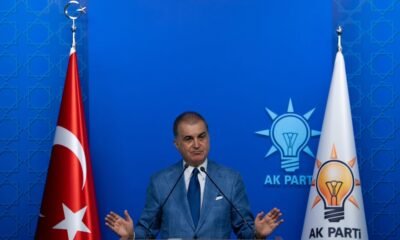
Erdoğan targeted for standing up to Netanyahu’s genocide: AK Party spox
-

 Economy9 hours ago
Turkish households shift toward gold as real estate appeal declines