
Politics
Govt ally urges EU not to keep Türkiye at door

“Türkiye’s place is not in the waiting room of Europe,” Nationalist Movement Party (MHP) leader Devlet Bahçeli said Tuesday.
The government ally lamented that the European Union acted with political calculations instead of seeing the reality about Türkiye. “Türkiye’s membership process has been assessed based more on political judgment than technical criteria,” he told a parliamentary group meeting of his party in Ankara. “They blocked chapters of accession, postponed their responsibility and have not fulfilled their promises while Türkiye’s fair expectations have been overshadowed by (Europe’s own) agenda,” he said.
Bahçeli’s remarks are a reflection of Türkiye’s oft-repeated frustration with the bloc and come at a time when Türkiye strives for another shot at membership as the continent explores collaboration options, especially for security in the shadow of the Russia-Ukraine conflict. Earlier this month, Türkiye hosted a NATO summit attended by EU heads of state and government. The summit was also an occasion for Türkiye to call for more cooperation with European Union countries, especially in defense.
The MHP itself has been a target of European Parliament reports critical of the country, with calls for the criminalization of Ülkü Ocakları or Idealists’ Clubs, known as Grey Wolves in Europe, an affiliate of the party.
“Europe narrowed its strategic horizon by keeping Türkiye in its waiting room. They think Europe will remain strong by excluding Türkiye, but I suggest they see the security and stability challenges they face now. Europe is increasingly facing a strategic uncertainty,” Bahçeli stated.
Bahçeli also hit out at Greece’s stance on Türkiye’s relations with the European Union. “It is neither smart nor sustainable to limit Europe’s security with political calculations of Athens,” he said.
“Third countries cannot hold Turkish-European relations hostage,” Bahçeli added. Greece and the Greek Cypriot administration often oppose Türkiye’s ambitions for EU membership or the expansion of security and defense cooperation between the bloc and Ankara.
“No country has the right to present its own problems with other countries as a joint security challenge for the entire Europe,” he underlined.

Somali authorities said Saturday that the Turkish navy, along with Somali armed forces, had freed a hijacked vessel held in Somali waters and killed 14 pirates after a battle lasting several days.
The Horn of Africa has seen a resurgence in piracy since April, according to figures from the International Maritime Organization, with at least 15 attacks off the coast of Somalia this year, the highest number since 2013.
“During the 10-day operation, four boats used by the pirates were destroyed and 14 pirates were killed,” a Somali Defense Ministry statement said.
“The sustained military pressure finally forced the remaining pirates to abandon the ship,” it added.
“The forces subsequently secured the MV LATUF, which has now safely resumed its journey.”
According to sources in Puntland, at least eight crew members were on board, including one Turk.
The MarineTraffic website shows that the vessel, which operates under a Cameroonian flag, left Türkiye in late July bound for the Tanzanian port of Dar es Salaam.
The joint Türkiye-Somalia operation was carried out as part of a defense cooperation agreement between the two countries.
Piracy was rampant off the coast of Somalia in the 2000s, peaking in 2011 before being curbed by international naval deployments and new protection measures for commercial shipping. But attacks have surged since April, with at least five cargo ships held hostage, the latest of which was seized on Aug. 20 off Yemen.
A Defense and Economic Cooperation Framework Agreement signed between Türkiye and Somalia in February 2024 covers defense ties as well as efforts to strengthen Somalia’s maritime security capabilities.
Under the agreement, Türkiye is expected to support Somalia in protecting its maritime jurisdiction, securing marine resources and combating illegal activities. Türkiye has also long provided military training and capacity-building support in Somalia.
An Israeli Foreign Ministry social media post targeting President Recep Tayyip Erdoğan outraged Türkiye, a steadfast champion of the Palestinian cause.
Ömer Çelik, spokesperson for Erdoğan’s ruling Justice and Development Party (AK Party), said in a statement on Sunday that the post by the Israeli ministry was “terrorism propaganda of the genocide network” of Israeli Prime Minister Benjamin Netanyahu.
“It does not mean anything for anyone, but the strong voice of our president for humanity’s alliance will continue guiding those engaged in politics to preserve humanity’s dignity,” Çelik said in a social media post.
The Israeli Foreign Ministry branded Erdoğan “anti-Semitic,” an adjective now casually thrown at anyone opposing Israel’s genocidal actions toward Palestinians in Gaza and beyond.
Çelik stated that the “genocidal network is churning out lies, targeting our president.”
Erdoğan’s remarks during an event in Istanbul on Friday reignited rising anti-Turkish rhetoric in Israel. The president lashed out at the “radical, genocidal ideology of Zionism” in his speech.
“When we draw attention to the expansionist ambitions of Zionism, we are not doing so for ourselves, but on behalf of all the peoples of the region, regardless of their faith, and on behalf of humanity as a whole,” Erdoğan said at the event held to mark the birthday of the Prophet Muhammad.
“Even kites are seen as a threat and prevented from flying in Gaza, which the genocide network has turned into the world’s largest children’s cemetery. Millions of our brothers and sisters in Palestine alone are struggling to survive under extremely difficult conditions, deprived of even the most basic necessities. Likewise, in Lebanon, 1.3 million of our brothers and sisters have been forced to leave their homes due to attacks by the Israeli administration. More than 4,000 people have been killed, while more than 12,000 Lebanese, most of them women and children, have been injured. Israel’s current government, addicted to war, is trying every provocation imaginable to drag our entire region into instability.”
President Erdoğan said civilians pay the price for silence in the face of ruthless oppressors.
“Unfortunately, in recent history, civilians were forced to pay the price for the silence in the face of Hitler, Pol Pot and other ruthless tyrants. Millions of people from different backgrounds and faiths were subjected to genocide in Hitler’s concentration camps and Pol Pot’s killing fields. Sadly, humanity could do nothing but watch what was happening at the time. Today, the same mistake is being repeated in Gaza, the West Bank and Lebanon.
“The necessary reaction is not being shown by the world to the genocide network’s policies, which recognize no rules, laws, principles, values or boundaries. Neither global institutions nor the international community are demonstrating the strong resolve needed to prevent massacres today, just as they failed to do so in the past. I believe we must now recognize this reality: As Muslims, we cannot get anywhere by placing our hopes in others. We must be strong, be capable of deterring threats, defend our rights and interests together, and jointly build peace and security in our region. That is why we say there is strength in alliances, and we are working to expand alliances and reduce disagreements both among ourselves and across the Islamic world,” he said.
“The lies and slanders targeting our President in the statement issued by the Israeli Foreign Ministry reflect the cowardly and rotten mentality of the criminals serving in the Israeli government, particularly (Benjamin) Netanyahu,” the Turkish Foreign Ministry said in a statement on Saturday in response to the Israeli Foreign Ministry’s post.
The ministry said Netanyahu and his “criminal network” had brought “historic shame” upon the entire Israeli people by committing genocide in Gaza and had displayed expansionism unprecedented in the modern history of the Middle East, making them a primary source of regional and global instability.
“The immunities enjoyed by Netanyahu and his criminal network are disappearing both legally and politically,” the statement said.
The ministry said the efforts of Israeli institutions, which it said operate in a manner similar to “Goebbels’ propaganda machine,” were no longer sufficient and that the international community no longer believed the Netanyahu government’s “lies.”
“Türkiye, under the leadership of our President, has maintained an honest and determined stance against the crimes committed during the Netanyahu era,” the ministry said. “We will continue to defend and voice the truth.”
Burhanettin Duran, head of the Turkish Presidency’s Communications Directorate, said in a social media post on Saturday that Israel’s statement was “a stark example of a mindset that resorts to slander and propaganda rather than confronting the facts.”
He said Israel was attempting to “conceal their aggression, the genocide they have committed, war crimes, and crimes against humanity” by “hiding behind the concept of ‘anti-Semitism.’”
Duran said Türkiye’s opposition was directed at Israel’s occupation, oppression, massacres and violations of international law, stressing that Erdoğan would continue defending the Palestinian cause and supporting the people of Gaza and regional stability.
Türkiye has granted visa exemptions to Syrian citizens holding diplomatic passports for official assignments in the country, as well as for tourist travel and transit crossings, according to a presidential decision published in the Official Gazette on Friday.
The decision, signed by President Recep Tayyip Erdoğan, allows Syrian diplomatic passport holders to travel to Türkiye without a visa for tourist purposes for up to 90 days within any 180-day period. The exemption also covers transit passages through Türkiye.
Syrian citizens holding diplomatic passports who are assigned to official duties in Türkiye will likewise be exempt from visa requirements under the new arrangement.
The decision, numbered 6458, was issued under Article 18 of Türkiye’s Law on Foreigners and International Protection.
The measure establishes a specific visa regime for Syrian diplomatic passport holders, distinguishing their travel requirements from those applicable to holders of ordinary Syrian passports.
The new arrangement covers three categories of travel: assignments to Türkiye for official duties, tourist visits and transit travel. For tourism, the 90-day limit applies cumulatively within each 180-day period.
The decision comes as Türkiye and Syria continue to expand official contacts and diplomatic engagement following a period of major political change in Syria.
The visa exemption is expected to facilitate travel by Syrian diplomatic officials and other eligible diplomatic passport holders between the two countries, while also simplifying transit and short-term visits.
Türkiye summoned Ukraine’s ambassador on Saturday after two Turkish-operated commercial vessels were damaged in separate drone attacks in the Black Sea near the Russian port of Tuapse, raising fresh concerns in Ankara about the safety of civilian shipping in the region.
Ukrainian Ambassador Naryman Dzhelialov was called to the Turkish Foreign Ministry in Ankara following attacks on the Lider Bordo Mavi and Lider Kocatepe, according to Turkish Foreign Ministry sources.
The diplomatic move came after the Lider Bordo Mavi was struck Aug. 26 while sailing near Tuapse. The vessel was carrying fresh produce and caught fire after being hit by three drones, according to Turkish shipping and regional sources. Five crew members were injured.
The ship, which flies the Cameroon flag and is operated by a Turkish company, had left the Turkish Black Sea port of Samsun around Aug. 25. It was bound for Tuapse after reportedly being unable to call at the Russian port of Novorossiysk.
A second Turkish-operated vessel, the Lider Kocatepe, was sent to the area the following day to assist the damaged ship. It was also targeted by a drone while en route, sustaining material damage before returning to Samsun, Turkish media reported.
There was no immediate public claim of responsibility from Ukraine for either attack. Russia has attributed similar recent strikes on commercial shipping to Ukrainian forces.
The incidents have added to mounting concerns over the risks facing commercial vessels operating in the Black Sea, where civilian ships have increasingly been caught up in the fighting between Russia and Ukraine.
Türkiye warns over civilian shipping
During Saturday’s meeting, Turkish officials conveyed Ankara’s concerns over the attacks and stressed the need to protect lives, property, navigation and the marine environment, according to Foreign Ministry sources.
Türkiye has repeatedly warned that the war must not further threaten civilian maritime traffic or disrupt commercial navigation in the Black Sea. Ankara has also maintained diplomatic contacts with both Kyiv and Moscow after incidents involving ships connected to Türkiye.
The latest attacks come as Türkiye seeks greater protections for civilian vessels and commercial infrastructure in the Black Sea. Turkish officials have recently pushed for a mutual halt to attacks on civilian ships, commercial ports and energy facilities.
The issue carries particular importance for Türkiye, a Black Sea coastal state whose shipping industry has continued to operate routes linking Turkish ports with Russia and other regional markets despite the war.
Growing risks at sea
The Black Sea has become increasingly dangerous for commercial shipping since Russia launched its full-scale invasion of Ukraine in February 2022. Ports, energy facilities and maritime infrastructure have been repeatedly targeted, while commercial vessels have faced growing risks from missiles, drones and naval activity.
Ukrainian officials have said attacks on vessels and infrastructure connected to Russia are aimed at disrupting Moscow’s wartime logistics and revenue rather than deliberately targeting civilians. They have also acknowledged the dangers faced by seafarers and urged shipowners to take the security situation into account when operating in the region.
The recent attacks involving Turkish-operated ships have nevertheless increased pressure on Ankara to safeguard its citizens, commercial interests and maritime trade.
Türkiye has sought to balance its relations with both Russia and Ukraine while positioning itself as a mediator in efforts to reduce the impact of the war on civilian activity. Ankara played a central role in the Black Sea Grain Initiative, which helped facilitate the export of Ukrainian agricultural products through the region.
As of Saturday, the condition of the five injured crew members from the Lider Bordo Mavi was being monitored. The full extent of the damage to both vessels was still being assessed.
Turkish Foreign Minister Hakan Fidan held separate phone calls Saturday with Qatari Prime Minister and Foreign Minister Sheikh Mohammed bin Abdulrahman Al Thani and Egyptian Foreign Minister Badr Abdelatty, as Ankara continued diplomatic consultations with key Middle Eastern partners.
Fidan discussed regional and bilateral issues with both officials, according to Turkish diplomatic sources. The sources did not provide further details about the conversations.
The calls come as Türkiye maintains intensive diplomatic engagement with Qatar and Egypt over a range of regional issues, including the situation in Gaza, developments in Syria and tensions affecting maritime security and energy routes.
Regional diplomacy
Türkiye, Qatar and Egypt have emerged as important diplomatic players in efforts to address conflicts and tensions across the Middle East.
Qatar has played a prominent mediation role in Gaza-related negotiations and other regional disputes, while Egypt’s geographic position and longstanding influence in Arab affairs have made Cairo a key player in efforts involving Gaza and broader regional stability.
Ankara has maintained close consultations with both capitals as it seeks to coordinate positions on regional crises and strengthen bilateral ties.
Fidan has held several rounds of discussions with his Qatari and Egyptian counterparts in recent weeks. His latest conversations with Sheikh Mohammed and Abdelatty underscore the continued importance Ankara places on maintaining direct communication with its regional partners.
Türkiye-Qatar ties
Türkiye and Qatar have developed a strategic partnership that covers political, economic and defense cooperation.
The two countries have maintained close relations through frequent high-level contacts, joint initiatives and expanding trade and investment ties. Qatar has also been an important partner for Türkiye in regional diplomacy, particularly on issues involving Gaza and wider Middle Eastern security.
Fidan and Sheikh Mohammed have held regular discussions on regional developments, including tensions surrounding the Strait of Hormuz and efforts to prevent further escalation in the region.
Sheikh Mohammed, who serves as both Qatar’s prime minister and foreign minister, has been at the center of Doha’s diplomatic efforts and has maintained contacts with regional and international officials as Qatar pursues its mediation role.
Türkiye-Egypt relations
Türkiye’s relationship with Egypt has also strengthened significantly after years of strained ties.
Ankara and Cairo have expanded political and economic cooperation through high-level visits and regular diplomatic consultations. The two countries have also sought to increase bilateral trade and investment while expanding cooperation in areas including defense and energy.
Fidan and Abdelatty have frequently discussed Gaza, Syria, Libya and Sudan, among other regional issues.
Fidan visited Egypt earlier this month for the second meeting of the Türkiye-Egypt Joint Planning Group, where the two sides reviewed bilateral relations and regional developments. The meeting also focused on strengthening economic cooperation and coordinating positions on several regional crises.
The two countries have expressed support for Libya’s unity and territorial integrity and for stability in Syria, while calling for stronger efforts to address the humanitarian and political situation in Gaza.
The latest calls are part of Fidan’s broader effort to maintain frequent contact with regional counterparts.
Since becoming foreign minister in June 2023 after serving as head of Türkiye’s National Intelligence Organization, Fidan has placed a strong emphasis on direct diplomatic engagement and coordination with regional and international partners.
Türkiye should turn its geopolitical advantages into technological and production capacity that is difficult to replace as artificial intelligence, semiconductors and critical minerals increasingly reshape global alliances, a report by the country’s National Intelligence Academy said Friday.
The report, titled “Alliances, Strategic Competition and Türkiye in the Technopolitical Order,” examined how technological transformation is changing international competition, alliances and the global distribution of power.
It said artificial intelligence, semiconductors, critical minerals and energy infrastructure have moved beyond economic competition to become central elements of national security, industrial policy and strategic autonomy.
Talha Köse, head of the National Intelligence Academy, noted Türkiye’s key challenge was to convert its geopolitical position into technological and manufacturing strength and secure an indispensable role in critical value chains.
The report described the emerging international landscape as “controlled techno-bloc formation,” in which economic ties continue while strategic dependencies are increasingly reorganized around trusted partners.
It said the United States, China and the European Union were responding to technological competition through different models. Washington has focused on building technology and security networks, Beijing relies on its manufacturing scale and industrial depth, while the EU is seeking to combine regulatory influence with industrial policy.
For Türkiye, the report highlighted NATO membership, economic integration with Europe, industrial infrastructure and ties across multiple regions as strategic advantages.
It recommended a model combining “selective integration” with domestic capacity building rather than relying exclusively on a single geopolitical bloc or pursuing broad balancing.
The report said Türkiye should strengthen AI applications in defense, finance, logistics and industry while specializing in selected segments of semiconductor value chains.
It also called for a sector-based critical technology and supply-chain inventory and greater coordination between technology diplomacy, defense requirements, energy planning, trade and investment policies.
Türkiye’s long-term strategic weight, it said, will depend on its ability to transform geopolitical influence into lasting technological and manufacturing capabilities.


-

 Sports3 days ago
BJK face tough Europa League draw, Trabzonspor drop to Conference
-
 Economy3 days ago
Back to Aleppo after 22 years, Türkiye’s trade chief eyes stronger ties
-
 Politics3 days ago
Türkiye detains 2 in FETÖ probe as minister cites links in Yazıcıoğlu case
-
 Politics3 days ago
Erdoğan holds talks with DR Congo, Rwanda leaders on regional peace
-

 Economy3 days ago
Warsh says Fed has ‘work to do’ if above-target inflation persists
-
 Economy3 days ago
Türkiye’s trade deficit up 13.6% despite best July exports ever
-
 Politics3 days ago
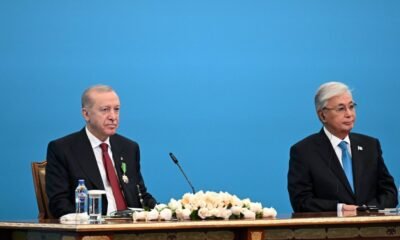
Erdoğan, Tokayev discuss Türkiye-Kazakhstan ties, regional issues
-

 Sports2 days ago
Galatasaray close in on Rafael Leao signing from AC Milan