
Politics
Iran FM credits Türkiye with blocking efforts to destabilize Iran

Iranian Foreign Minister Abbas Araghchi on Sunday said Türkiye played a decisive diplomatic role in blocking U.S. and Israeli efforts to destabilize and partition Iran during the recent conflict, praising Ankara for maintaining a firm position throughout the crisis.
Speaking to Javad Moghouei during an online interview, Araghchi said Türkiye actively engaged with Washington and regional actors while opposing any attempt to fuel internal unrest or territorial fragmentation in Iran.
His remarks came as tensions between the United States and Iran continued following the collapse of the Islamabad agreement, which had previously helped reduce hostilities.
Araghchi said the risk of Iran’s fragmentation emerged during the early days of the conflict. Recalling events on the fourth day of the war, he said U.S. President Donald Trump contacted leaders in Iraq’s semi-autonomous Kurdistan Regional Government (KRG).
The Iranian foreign minister said he subsequently spoke with Kurdistan Democratic Party leader Masoud Barzani, Patriotic Union of Kurdistan leader Bafel Talabani and Iraqi Prime Minister Mohammed Shia al-Sudani, warning that Iran would respond to any threat originating from the Kurdish region.
He also said he held talks with Turkish Foreign Minister Hakan Fidan that same evening, describing Türkiye as a key diplomatic actor during the crisis.
“Türkiye played a very effective role. They held talks with the Americans and maintained a very firm position on this issue,” Araghchi noted. “These collective efforts prevented the plot to divide Iran and create internal unrest from succeeding.”
The conflict between the U.S. and Iran has flared up again, with the U.S. military concluding its ninth consecutive night of attacks on Iran early Monday. Iran has been responding with attacks on countries hosting U.S. military bases in the region.
The U.S. has targeted bridges, electrical facilities and other targets in Iran and Tehran has retaliated by hitting power and desalination plants in Kuwait, threatening daily life in that small, oil-rich desert nation.
Iran also has stepped up its threats to further expand the strikes, drawing a warning overnight from the United Arab Emirates.
Kuwait and Bahrain again activated air defenses Sunday morning as they warned of incoming Iranian drones and missiles.
Mossad’s plan
His comments echoed previous media reports claiming that Israel had sought U.S. backing for plans aimed at encouraging separatist unrest inside Iran during the opening phase of the conflict.
Araghchi also accused exiled Iranian opposition figure Reza Pahlavi, the son of Iran’s last shah, of supporting plans to partition the country during a visit to Israel. He alleged that Pahlavi proposed allowing border regions to be separated while seeking to rule the country’s center, although he did not provide evidence to support the claim.
Israeli media previously reported that Israel’s Mossad intelligence agency proposed supporting armed Kurdish separatist groups in western Iran to increase pressure on Tehran. Those reports claimed the proposal was ultimately shelved by the White House following strong objections from Türkiye.
Separately, Araghchi described difficult negotiations with U.S. envoy Steve Witkoff, saying he reminded the American official that Iranian negotiators had continued diplomatic contacts despite facing the threat of military strikes.
“You cannot threaten us or buy us,” Araghchi said, adding that Iran would not back down under military or political pressure.
Meanwhile, reports from Russia suggested that Mojtaba Khamenei, who succeeded his father Ayatollah Ali Khamenei following his reported death during the conflict, could hold his first foreign contact with Russian President Vladimir Putin. Russia’s state-run TASS news agency cited an unnamed Iranian official as saying Moscow remained Tehran’s closest strategic partner. Kremlin spokesman Dmitry Peskov said Putin was prepared to speak with Iran’s leadership whenever necessary.
Developments in field
Fighting between the United States and Iran continued over the weekend. U.S. Central Command said American forces targeted Iranian command centers, missile launch sites, drone facilities and communications infrastructure. Iran responded with strikes targeting locations in the Gulf region and what it described as an enemy command center in Syria.
The U.S. military also reported that one American service member was killed and another wounded in northern Iraq while attempting to safely dispose of an unexploded Iranian drone. Days earlier, two U.S. troops were killed, four were wounded and another was reported missing in Jordan.
Amid the escalating conflict, Reuters reported that mediators had proposed a 10-day pause in hostilities to revive negotiations between Washington and Tehran, while assessments circulating within the Trump administration suggested U.S. munitions stockpiles had been strained by the prolonged fighting.

Statements by two women to investigators revealed how Muhittin Böcek, former mayor of the southern Turkish province of Antalya for the opposition Republican People’s Party (CHP), sexually harassed them and used sex in exchange for jobs at the municipality.
Böcek was arrested last year on corruption charges, and investigators have since launched a probe into allegations of sexual harassment by the mayor. Several women have already come forward, shedding light on the allegations. Two more women testified in the case, and their statements, made public on Sunday, show how they were lured to Böcek’s residence with the promise of being hired at the municipality. The unidentified women accused Tuğçe Güney, the director of a municipal youth center who was arrested earlier, of arranging their meetings with Böcek. One of the victims said Güney told her that Böcek would hire her and provide financial assistance to her family if she slept with him.
She said she had sexual intercourse with Böcek and was given TL 2,000 when she left the house after the incident. The other victim, meanwhile, said she was taken to Böcek’s home twice on the promise of getting a job at the municipality and that Böcek initiated physical contact with her during both meetings, which made her uncomfortable.
According to the first newly surfaced testimony, the incident took place in 2024. The female victim alleged that Tuğçe Güney asked her to meet with Muhittin Böcek “for the purpose of prostitution.” In her testimony, the woman said Güney told her: “He is the mayor. If you sleep with him, he will give you a job at the municipality and provide financial assistance to you and your family.”
The woman said she accepted the offer because she was experiencing financial difficulties and went with Tuğçe Güney to Muhittin Böcek’s home in the Konyaaltı district.
The victim said that when they arrived at the house, Tuğçe Güney stayed in the living room while she went into another room with Muhittin Böcek. However, she said she did not want to have intercourse with Böcek because she felt uncomfortable and left the room.
According to her testimony, as she was preparing to leave the house, Tuğçe Güney stopped her and said: “Use your common sense. Muhittin likes you. Go back to the room.”
The woman said she then returned to the room and had sexual intercourse with Muhittin Böcek.
One of the most striking allegations in the victim’s testimony concerned a payment allegedly made after the meeting. The woman said Böcek gave her TL 2,000 as she was leaving the house.
The victim said she later asked Tuğçe Güney whether she had received any payment herself. She alleged that Güney replied, referring to Muhittin Böcek, “My father already takes care of all my needs. My father supports me.”
The second newly surfaced victim testimony in the case file said the incidents began approximately four years ago. The female victim said she met Tuğçe Güney through a mutual friend and that Güney took her phone number on the day they met and asked her, “Shall I arrange a job for you at the municipality?”
The woman said she was receptive to the offer because she was unemployed at the time. A few days later, she said, Güney called her and told her, “I will take you to the mayor’s house, introduce you to him and get you a job at the municipality.”
According to the victim’s account, Güney later called her and said they would go to Böcek’s house for dinner. The two met in Konyaaltı and took a taxi to Böcek’s home. The woman said that, besides Böcek, a man in his 30s who introduced himself as an assistant was also at the house.
The victim said that during dinner, Muhittin Böcek began touching her legs and that she moved his hand away because she was uncomfortable. In her testimony, she said no discussion took place that day about hiring her at the municipality. After leaving the house, she said she asked Tuğçe Güney why Böcek had touched her and alleged that Güney replied, “He liked you very much; that’s why he touched you. Never mind.”
When she asked what would happen with her being hired by the municipality, the woman said Güney told her, “I’ll take care of it, don’t worry.”
Previously, the testimonies of three victims of a similar nature had been reported by the media in the investigation conducted by the Antalya Chief Public Prosecutor’s Office. With the two newly surfaced testimonies, the number of victim testimonies related to the alleged prostitution investigation involving Böcek and his associates that have been reported by the media has risen to five.
The new testimonies are expected to further highlight several aspects of the investigation, particularly whether promises of municipal employment were used to arrange meetings between women and Muhittin Böcek, Tuğçe Güney’s role in the process, and whether other women were similarly directed into such settings using the same method.
The investigation by the Antalya Chief Public Prosecutor’s Office is continuing on multiple fronts.
The opposition Peoples’ Equality and Democracy Party (DEM Party) held its congress on Sunday amid rumors that it may undergo a significant overhaul. Party sources quoted by the media say the transformation is scheduled for the future, while Sunday’s event in Ankara was merely the fulfillment of a technical requirement for political parties to hold their regular congresses.
The DEM Party follows a left-wing ideology, but its signature issue has been Kurdish rights. Although popular in the southeastern provinces with predominantly Kurdish populations, the DEM Party has narrowed its fight for Kurdish rights to its association with the terrorist group PKK. The party played a key role in the Terror-Free Türkiye initiative launched by Nationalist Movement Party (MHP) leader Devlet Bahçeli for the dissolution of the PKK.
It postponed its congress during the course of the initiative, which led to the implementation of a new law providing for the deferral of sentences for surrendered PKK members. In parallel with the initiative, the DEM Party will likely be transformed as its main argument, “peace” with the PKK, enters a new phase. The PKK’s jailed ringleader, Abdullah Öcalan, in his messages to the public through DEM Party lawmakers, highlighted “democratic struggle” after the PKK’s dissolution, and political pundits say this may lead to a transformation in the party. Some even go further, claiming that Öcalan may become the “honorary” chair of the DEM Party.
The DEM Party held its last congress in 2023, and it was at that congress that the party changed its name from the Green Left Party and elected incumbent co-Chairs Tuncer Bakırhan and Tülay Hatimoğulları. The duo was elected again at Sunday’s congress. Party spokesperson Ayşegül Doğan told BBC Turkish that another congress would be held in the near future, where the party would undergo a substantial change, though she did not hint at what changes the future would bring. She only stated that they were planning to establish a model that would “strengthen the understanding of a democratic republic.”
Addressing the congress on Sunday, Hatimoğulları said it was a “threshold where DEM will review its policies.” She underlined the need for changes in the party’s organization and political language, noting that social expectations and policymaking have changed in recent years.
The party is a continuation of parties like the Peoples’ Democratic Party (HDP), which strictly aligned itself with the PKK and advocated for policies the PKK desired, such as greater autonomy for southeastern provinces. Its open support for the terrorist group paved the way for investigations into DEM Party members. The party was quick to boost pro-PKK propaganda after the new law on Terror-Free Türkiye was implemented, angering critics of the initiative by setting up “condolence events” for PKK terrorists who died years ago in counterterrorism operations.
The party has long been ahead of other small opposition parties and, for the opposition, was viewed as a kingmaker when it was called the HDP. In the 2023 elections, the DEM Party’s predecessor supported the main opposition candidate for the presidency. In the 2024 municipal elections, the main opposition Republican People’s Party (CHP) sought a less blatant alliance with the DEM Party, and DEM Party voters’ support for CHP candidates in the local elections reportedly led to unprecedented wins for the latter.
Yet, the Terror-Free Türkiye initiative pushed the DEM Party to pursue closer ties with the People’s Alliance of the ruling Justice and Development Party (AK Party) and MHP. Indeed, it was Bahçeli’s warm handshake with DEM Party lawmakers at the inauguration of the new Parliament session in 2024 that paved the way for the declaration of the Terror-Free Türkiye initiative. The DEM Party still remains a fierce opponent of the alliance, though it is mostly on the same page regarding the Terror-Free Türkiye initiative. The opposition, meanwhile, remains fragmented over the initiative.
Bakırhan said at the congress that the party would remain a “third way” in the current political landscape in Türkiye. He stated that the congress was also the beginning of a new political era they defined as the “democratic republic movement.”
As the main opposition pushes for an early vote, the ruling Justice and Development Party (AK Party) is still ahead, according to the latest opinion poll by a polling company that gave the closest prediction of the result of the 2023 elections.
The poll by Betimar shows that 35.4% of respondents were willing to vote for the AK Party if an election were held next week. The New Party (YP), which grabbed the main opposition position shortly after its inception, trailed the AK Party at 20.1%.
YP leader Özgür Özel had repeatedly called for rescheduling the 2028 election while he was the chair of the Republican People’s Party (CHP). Özel still advocates rescheduling the election and is overconfident, as he recently claimed that the YP would secure 60% of the vote in an early election.
Betimar’s poll also showed a surprise leap for the Good Party (IP), which scored 9.3% in the poll, ahead of the Peoples’ Equality and Democracy Party (DEM Party), which usually surpasses it in opinion polls. The CHP, meanwhile, declined to 5.3%, according to the poll, an expected fall given that it lost its main opposition status with the founding of YP by a former CHP lawmaker.
The government, meanwhile, appears intent on holding elections on time. This was underlined by Vice President Cevdet Yılmaz. As he announced the medium-term program for the economy on Sunday, Yılmaz noted that the program was prepared on the basis that the elections would be held on time, in the spring or summer of 2028, and that any rescheduling was at the discretion of Parliament. The president also has the authority to call an early election, although President Recep Tayyip Erdoğan has so far not openly responded to the opposition’s calls.
Last month, the AK Party marked its 25th anniversary, pledging to provide more services to the country against the backdrop of successive election victories over the past two decades, the longest period the country had been governed without coalition governments since the 1990s.
Sahak Maşalyan, patriarch of the Armenian Orthodox Church in Türkiye, accompanied the Christian congregation to a religious service in the eastern province of Van on Sunday. Maşalyan said that, along with prayers for global peace and brotherhood among people, they had “a special prayer” this year “for the restoration of Türkiye-Armenia ties.”
“People living in these lands deserve peace. We ask God for His blessing,” he said after the religious service at the historic Akdamar Church on the eponymous island in Lake Van.
Maşalyan was accompanied by Armenian faithful from across Türkiye, the United States, Europe, Armenia and neighboring Iran. Bishop Mesrob Parsamyan, primate of the Eastern Diocese of the Armenian Church of North America, led the religious service.
Türkiye and Armenia took major steps toward rapprochement this year, especially after a visit to Yerevan by Vice President Cevdet Yılmaz and regular meetings between delegations from both sides to normalize relations. The two countries agreed to work on a direct railway route and the restoration of a historic bridge on the border.
Türkiye was one of the first countries to recognize Armenia’s independence within months of its declaration in 1991. Yet, one year later, Türkiye began cutting ties with Armenia and shut down the border when Armenia attacked Azerbaijan.
It took 15 years for the first steps toward normalizing relations to be taken. In 2009, the two countries signed protocols to that end, but the political climate in Armenia at the time stalled the normalization efforts. Under incumbent Prime Minister Nikol Pashinyan, Armenia has largely abandoned its anti-Turkish rhetoric and introduced the “Real Armenia” doctrine, which promotes peace with its neighbors.
Kemal Kılıçdaroğlu, who returned to the chairmanship of the opposition Republican People’s Party (CHP) by pledging to eliminate “thieves and bribe-takers through cleansing,” is intent on carrying out a historic transformation of Türkiye’s oldest party. In less than three months, he has reshuffled the party’s top cadres, and more is on the way, especially through changes to the party’s delegate system. Some delegates have acknowledged that they were paid by associates of Kılıçdaroğlu’s rival, Özgür Özel, in a 2023 party election that Kılıçdaroğlu lost.
While party organizations are being completely overhauled, most lawmakers and mayors suspected of corruption have either been referred to disciplinary boards or subsequently forced to resign and join the New Party (YP). The YP was founded by Özel in July, and although it has reduced the CHP’s presence in Parliament, it is tainted by allegations of corruption involving CHP-run municipalities, whose mayors are mostly supportive of the YP.
In the final stage of the purge pledged by Kılıçdaroğlu, attention has now turned to the party’s delegate structure.
In this context, all eyes in the CHP are on Sept. 9, which is also considered the party’s founding anniversary. Kemal Kılıçdaroğlu is expected to make important statements on the day when various events will be held. It is anticipated that Kılıçdaroğlu himself will announce the long-awaited congress schedule to the public on that date. CHP provincial and district heads will also be in Ankara for the special occasion.
As part of the congress process in the CHP, elections will be held for provincial and district leadership positions, while congress delegates will be determined from scratch. This will, in a sense, eliminate the controversial delegate structure that has caused major problems for the party for the past three years. The CHP’s grand congress is expected to be convened quickly following the Court of Cassation’s ruling on absolute nullity in the case involving vote-buying allegations in the 2023 intra-party election. The aim is to complete the congress processes at the provincial and district levels by the time the Court of Cassation issues its ruling, which will either validate or nullify Kılıçdaroğlu’s reinstatement.
Bribery allegations overshadowed the CHP’s 2023 congress, in which Kılıçdaroğlu unexpectedly lost the chairmanship by a very narrow margin. Rumors that Özel and Imamoğlu had bought the votes of hundreds of delegates in exchange for money were brought before the courts, and the allegations were effectively confirmed by the absolute-nullity ruling issued by the regional appeals court recently. Former Istanbul Mayor Imamoğlu, who was arrested last year on charges of municipal corruption, was a key figure within the CHP. Prior to the intra-party election, he was caught on video at a meeting where he schemed with other party figures to support Özel against Kılıçdaroğlu, who had helped his rise in the party.
Özel’s supporters have accused Kılıçdaroğlu of attempting to undermine the CHP’s prospects of winning the next presidential election under Özel’s leadership, with some of his allies going as far as branding the former chair a “traitor.”
Kılıçdaroğlu, meanwhile, has continued to challenge Özel and his supporters, deepening the political rupture that eventually contributed to the establishment of the YP.
In August, the CHP referred 49 members to disciplinary proceedings over allegations that they worked for another political party while remaining members of the CHP, party spokesperson Müslim Sarı announced. Sarı said the party had previously warned that working for another political party while remaining within the CHP would be considered both unethical and subject to disciplinary rules.
Ayşenur Ezgi Eygi’s killing in the occupied West Bank on Sept. 6, 2024, was another bitter loss for peaceful activism against Israel’s brutal occupation of the Palestinian territories. Two years after the incident, her family says there has been virtually no progress toward accountability for her death.
“It’s exactly where it was on day one,” Hamid Ali, Eygi’s husband, told Anadolu Agency (AA) from his home in Seattle. “We’re still asking for the same thing, which is an investigation as a first step toward getting justice for her.”
Eygi, 26, a dual Turkish U.S. citizen, was killed while participating in a protest against Israeli settlement expansion in the West Bank town of Beita, near Nablus.
The Israeli military said she was hit “indirectly and unintentionally” by Israeli military fire that “was not aimed at her” as its forces fired at protesters allegedly throwing rocks.
Witnesses and her family disputed the Israeli account, saying she was deliberately targeted during a peaceful protest.
A Washington Post investigation found that she was shot around 20 minutes after clashes had ended, when protesters had already retreated more than 200 yards (182 meters) from Israeli forces.
Then-Secretary of State Antony Blinken called Eygi’s killing “unprovoked and unjustified” days after the shooting.
But two years later, the U.S. has not opened an independent investigation into her death despite repeated calls from her family and members of Congress.
Washington instead deferred to an Israeli inquiry that has never produced a public finding.
For Eygi’s father, Mehmet Suat Eygi, the absence of an investigation has left little hope that the U.S. will deliver the accountability his family has sought.
“I don’t have much hope for justice because America is the financier of Aysenur’s killing. America therefore cannot investigate itself,” he told AA.
The lack of movement in Eygi’s case comes as the number of Americans killed by Israeli forces or settlers has continued to grow.
Eygi is among 14 U.S. citizens killed by Israeli forces or settlers since 2003, according to the rights group DAWN, which tracks the cases. None has resulted in a criminal prosecution.
The list includes Sayfollah Musallet, a 20-year-old beaten to death by settlers in the West Bank in July 2025, and Nasrallah Abu Siyam, a 19-year-old shot near Jerusalem in February.
Brad Parker, associate director of policy at the Center for Constitutional Rights and part of the legal team supporting Eygi’s family, said two years have brought no U.S. criminal investigation or other accountability measures.
“There are no new developments on the investigation front, criminal investigation from the U.S., or really anything focused on accountability for Ayşenur’s killing,” he said. “There’s absolutely no follow-up, no update.”
He added that the family has little confidence that an Israeli-led investigation would produce meaningful accountability, pointing to previous cases, including that of Shireen Abu Akleh, a Palestinian American journalist for Al Jazeera who was fatally shot on May 11, 2022.
“There’s no indication that the Trump administration is interested in holding perpetrators accountable for killing American citizens in the West Bank, in Gaza, sort of anywhere,” he said. “The impunity that exists is perpetuated over the years by lack of action by the U.S. government,” Parker added.
With no independent federal investigation, the family’s push for accountability has increasingly extended to Washington state, where Eygi grew up.
A joint memorial calling for a U.S. investigation into her death advanced through the state Legislature this year but failed to win final passage before the end of the legislative session. “The support we got from the members of the Washington State Legislature in that memorial was so heartening,” Ali said.
He attributed its failure primarily to timing and legislative maneuvering, saying Republicans in the Washington Statehouse used the limited time remaining in the session as leverage over other issues.
“I don’t think it was because of lack of support. I think it was just more of a strategical kind of failure,” Ali said.
‘A symbol’
While pursuing accountability, Eygi’s family and friends have also sought to preserve her memory in the community where she grew up.
Around her birthday on July 27, friends and supporters gathered in Seattle to paint a community mural of her portrait, designed by artist James Hesketh. “It’s not all negative. We’ve been building community,” Ali said.
He said the family hopes Eygi’s legacy will encourage ordinary people to believe their actions can matter.
“She’s become a symbol, and we can’t really help that,” he said. “But it doesn’t mean that what she did was exceptional.
“I don’t think she thought by going to the West Bank and being a part of the protests, she was going to change the tide of the war or free Palestine,” he added. “But she understood that you can do something, and it does make a difference. It does have an effect.”
For Eygi’s father, the two-year anniversary is also a measure of a loss that time has done little to diminish. “It is impossible to get used to a life without Ayşenur. She is always on our minds, every second,” he said.
Despite the lack of accountability, he said Eygi’s emergence as a symbol of solidarity with Palestinians and protests against Israel’s genocidal war on Gaza was a source of pride. “Ultimately, justice has not been served. What remains for us is a life without Ayşenur.”
AA asked the U.S. State Department whether it supports an independent investigation into Eygi’s killing, given the lack of accountability from Israel’s inquiry.
“The Department of State has no higher priority than the safety and security of Americans. Embassy Jerusalem remained in touch with the family of Ayşenur Eygi and the Government of Israel as it investigated this case,” it said.
The Justice Department did not respond to a request for comment. The Israeli military also did not respond.
The Turkish Foreign Ministry called Eygi’s killing a “murder committed by the Netanyahu government,” and Turkish prosecutors opened their own investigation into her death.
As Eygi’s family enters a third year without the independent U.S. investigation it first demanded after her killing, Ali said it is preparing for a longer fight.
“We’ve been developing a long-term strategy and what we want to do for Ayşenur, for her legacy, but also to help others, unfortunately, who might be in a similar situation,” he said.


-
 Economy1 day ago
Türkiye outlines new 2027-2029 Medium-Term Program
-

 Economy3 days ago
Global transition will fail without affordable climate finance: Türkiye
-

 Sports2 days ago
‘Leader’ Raphinha emerges as Barcelona’s unlikely No. 9 answer
-
 Economy1 day ago
Disinflation remains top priority as Türkiye unveils 2027-2029 road map
-
 Politics1 day ago
Türkiye prepares to lead OTS with focus on deeper integration
-
 Economy1 day ago
THY aims to be 1st Turkish firm among top 100 global brands
-

 Sports2 days ago
MXGP Türkiye gets underway in Afyonkarahisar for 9th edition
-
 Politics1 day ago
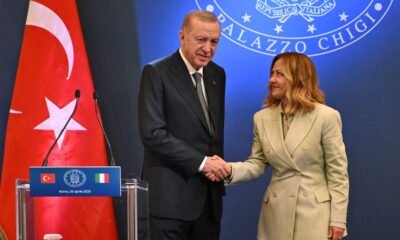
President Erdoğan congratulates Meloni on record tenure as Italian PM