
Economy
Türkiye eyes stronger trade, defense ties with ASEAN

Türkiye is expected to expand cooperation with the Association of Southeast Asian Nations (ASEAN) in trade, economic relations, the defense industry and energy after becoming a “dialogue partner” of the regional bloc.
According to information compiled by Anadolu Agency (AA), Türkiye was granted dialogue partner status at the 59th ASEAN Foreign Ministers’ Meeting in Manila, the capital of the Philippines.
The move, considered politically and diplomatically significant, is expected to mark a new chapter in Türkiye’s relations with the region, which has a population of nearly 700 million and an economy worth more than $4 trillion.
ASEAN comprises 11 member states: Indonesia, the Philippines, Malaysia, Singapore, Thailand, Vietnam, Brunei, Laos, Myanmar, Cambodia and Timor-Leste.
Türkiye’s exports to ASEAN member states increased 17.1% from $2.4 billion in 2021 to $2.8 billion in 2025. Exports to the bloc totaled $1.2 billion in the first five months of this year.
Imports from ASEAN countries rose 50.7% during the same period, increasing from $8.8 billion to $13.3 billion. Imports reached approximately $6 billion in the January-May period of this year.
As a result, Türkiye’s total trade volume with the region reached $16.1 billion in 2025.
Precious stones top exports
An analysis of Türkiye’s exports to ASEAN by product category showed that “precious or semi-precious stones, precious metals, pearls, imitation jewelry and coins” ranked first last year, with exports totaling $419.4 million.
The category was followed by “mineral fuels, mineral oils and products of their distillation” at $412.9 million, and “boilers, machinery, mechanical appliances and equipment” at $268 million.
Among ASEAN member states, Singapore was Türkiye’s largest export destination last year, with shipments totaling $709.5 million.
Singapore was followed by Malaysia and Indonesia, both of which were visited by President Recep Tayyip Erdoğan during his Asia tour last year.
During Erdoğan’s visits, the sides discussed cooperation in a wide range of areas, including energy and the defense industry.
Türkiye’s exports to Malaysia reached $629.2 million, while exports to Indonesia totaled $481.2 million in 2025. Türkiye’s direct investment in ASEAN member states also increased significantly, rising from $106.5 million in 2023 to $410.4 million in 2024.

The ACE BPSC 2026 summit, a major business gathering hosted by the TABA-AmCham association, will be held in Istanbul this week, organizers said.
Held under the auspices of the Trade Ministry and hosted by the Turkish-American Business Association (TABA-AmCham), the ACE BPSC 2026 Summit is set to bring together 70 AmCham leaders from 30 countries and 250 global CEOs in Istanbul from Oct. 7-9, with the aim of shaping the new direction of global trade.
At a time when the balance of global trade is undergoing significant transformation, Istanbul will become a meeting point for leading representatives of the international business community.
Under the vision of “Entrepreneurship for Innovation, Investment, Technology and Trade: Building a Stronger Transatlantic Future,” the summit will provide a major platform for shaping the global economy.
The “AmCham Leadership & Gala Dinner,” to be held on Oct. 7, the first day of the event, will bring together senior government officials and global business leaders.
The opening remarks of the exclusive gala dinner are expected to be delivered by Trade Minister Ömer Bolat, Industry and Technology Minister Mehmet Fatih Kacır, Istanbul Governor Davut Gül, Ajsa Vodnik, the chair of AmChams in Europe (ACE), and Süleyman Ecevit Sanlı, the president of TABA-AmCham.
One of the summit’s most critical sessions will take place on Oct. 8 under the title “Commercial and Political Developments Following the NATO Summit.”
The panel will begin with opening remarks by H. Eren Derinkök, vice president of TABA-AmCham, and will be moderated by Bekir Polat, vice president of the Investment and Finance Office.
During this strategic session, Mustafa Tuzcu, deputy trade minister, H. Ali Özel, deputy foreign minister, and Demet Sabancı Çetindoğan, vice chair of the board of DEMSA, will assess regional and global developments in the new era from the perspective of the business community.
The summit’s closing program, “Creative Network Awards & Bosphorus Closing,” will take place on Oct. 9, the final day of the event.
Bringing together 70 AmCham leaders from 30 countries and 250 global CEOs, ACE BPSC 2026 is expected to further strengthen the foundations for new business partnerships extending from Istanbul to the world.
Türkiye’s automotive industry closed in on reaching $4 billion in monthly exports in September, preserving the top spot among the sectors contributing the most to the country’s outbound shipments, trade data showed.
According to data from the Türkiye Exporters Assembly (TIM), the automotive industry, one of the sectors within the industrial group, maintained its leading position in September with exports worth $3.94 billion.
Among the sectors with the highest export volumes, chemicals and chemical products ranked second with $3.06 billion, while electrical and electronics ranked third with $2.06 billion.
Türkiye’s overall exports in September surged to $26 billion, also marking a fresh record.
“The all-time record for September exports was broken (last month). We achieved $26 billion in exports, marking a 15.4% increase on an annual basis,” Trade Minister Ömer Bolat said on Saturday, when announcing preliminary foreign trade data for the month.
When presenting the data, Bolat recalled that the highest-ever monthly figure was recorded in December last year with $26.3 billion, suggesting that the all-time record “was missed by only $300 million.”
“Exports for the January-September period also reached $211 billion with a 5.2% increase, setting a new record. Our target under the 2026 Medium-Term Program (MTP) was $282 billion. As of September, our annualized total goods export figure rose to $283.7 billion, marking a record for annual goods exports,” he also said.
The jewelry sector recorded the highest percentage increase in exports last month, rising by 203.3%. The sector’s exports in September increased to $1.51 billion, the data revealed.
The industrial group, which accounted for 72.5% of Türkiye’s total exports, increased its exports by 16.8%, surpassing $18.8 billion.
The agricultural group, which accounted for 12.3% of total exports last month, recorded exports of approximately $3.2 billion, an increase of 9.2%. Meanwhile, the mining group, which represented 2.6% of exports, saw its exports rise by 24.2% to $682.6 million.
At the same time, Trade Ministry data showed that overall imports in September rose by 5.9% year-over-year to $31.2 billion.
With this, the trade gap narrowed notably by 24.8% to $5.2 billion.
Revolut has grown into Europe’s most valuable startup, emerging as a serious competitor to centuries-old banking institutions. Since its launch just over a decade ago as a fintech focused on offering lower foreign-exchange fees, the company has expanded at remarkable speed.
Yet Revolut faces many hurdles itself, with the amount of revenue it extracts per customer a fraction of its established competitors and a small lending business by industry standards.
A spokesperson for Revolut said in an email that the London-based company has a “diversified business model,” earning its revenue from various products and services rather than lending.
“That means our growth depends on building things customers value, rather than on interest rates,” the spokesperson said.
Here’s Revolut’s rise, in five charts:
Going for global
CEO Nik Storonsky has stressed he wants Revolut to be truly global, expanding into markets from Mexico to Australia.
The company has announced several new licenses in recent weeks, as it aims to become one of only a handful of banks with retail operations spanning so much of the globe.
Meanwhile, some traditional lenders seen as global, including HSBC, are reducing their retail footprint.
Valued at $115 billion privately, Revolut is now worth more than Britain’s Barclays and France’s Societe Generale as investors bet on its tech platform winning over more customers globally.
Revolut’s 2025 pretax profit was 1.7 billion pounds ($2.2 billion), a fraction of Barclays’ 9 billion pounds, but growing fast.
Paulo Macedo, CEO of Portugal’s biggest bank, Caixa Geral de Depósitos, said in June that 2025 was the last year in which the 150-year-old bank would record higher profit than Revolut.
“When you go to Europe the bank CEOs there are talking about Revolut as their most important threat because of their aggressive marketing and growth,” said Cihan Duran, director at S&P Global Ratings.
Marred by setbacks
In the U.S., where Revolut has a provisional license, it will face tougher competition, investors said.
“The U.S. could be potentially the biggest growth for Revolut. But at the same time, the U.S. is the most competitive market,” said Konstantin Sidorov, CEO of the London Technology Club, which invested in Revolut when it was valued at just $5.5 billion.
There have been setbacks, including a fine in Lithuania for failing to prevent money laundering. Revolut said an investigation had not identified any confirmed instances of money laundering, adding that it had signed a settlement with the central bank and taken steps to resolve shortcomings.
And in September, Revolut accidentally sent customer data to hackers posing as government investigators. The company said its systems and customer funds were unaffected and it had contacted the “limited number of impacted individuals” to give support.
In 2024 and 2025, Revolut was the most-complained-about bank in Britain in fraud cases whereby customers are tricked into sending cash to scammers, Ombudsman data compiled by consumer advocacy firm Which? showed.
Revolut has previously said in response that it takes fraud very seriously and has robust customer protections in place.
Customers have surged
A striking measure of its growth is customer numbers.
In Ireland, for example, Revolut said that 80% of the adult population has a Revolut account.
Revolut’s website shows it has 80 million customers, against 84 million for JPMorgan and 41 million for HSBC.
Revenue-per-customer is low
Revolut makes far less from each of its customers than traditional banks, a Reuters analysis of its figures shows. Average deposit balances are also much lower.
Lower per-customer revenue is in part because Revolut lends much less than traditional banks, instead relying on fees such as card subscriptions.
With just 2.2 billion pounds in loans at end-2025, Revolut’s loan-to-deposit ratio of 6% compares with 55% for HSBC and 86% for Societe Generale.
Scaling its lending business will introduce risks, including managing big and complex credit exposures, while entering fiercely competitive local mortgage markets will not be easy, analysts and investors said.
Too few primary accounts
Revolut has attracted customers with its easy-to-use app, but executives acknowledge too few use it as a primary bank account.
Revolut declined to comment in its latest results on how many customers did so in 2025, but said the figure was up 45% from a year ago.
This metric is a focus for Revolut’s biggest backers.
Alex Immerman, an investor at Andreessen Horowitz, which is known as “a16z,” told Reuters it was watching for primary-account adoption, as well as total customer balances.
Global M&A activity slowed down in the third quarter of the year, totaling $993 billion, down 41% compared to the prior quarter, marking the first quarter below $1 trillion since the second quarter of 2025, according to LSEG data.
Banca Monte dei Paschi’s $32 billion bid for Banco BPM and Gold Fields’ $25.7 billion bid for Northern Star Resources were among the 10 deals over $10 billion announced in the third quarter, the lowest number of quarterly megadeals since the fourth quarter of 2024.
While the boom in artificial intelligence and data center building has lifted the outlook for economic growth, surging energy costs have been fanning inflation and pushing expectations that higher interest rates are coming.
The benchmark 10-year U.S. Treasury yield hit 5.34% on Thursday, its highest level since 2002, after posting the biggest quarterly rise this century in the three months to September.
“At the margins (higher yields) makes valuations sometimes a little tougher,” said John Collins, global head of M&A at Morgan Stanley.
“That said, the impact is hard to quantify, so I’m not ready to call a slowdown based on what we are seeing.”
So far this year, worldwide M&A volume is up 28% to $3.9 trillion, the highest level in the period since 2001, while the number of deals fell 8%, levels not seen since 2020.
“Corporates are still looking for scale or access to markets and technologies they are not in,” said Carsten Woehrn, Goldman Sachs’ co-head of M&A in Europe, Middle East and Africa.
He sees total deal value exceeding the 2021 peak if the pace continues.
“Megadeals are continuing and we’ve seen significant activity since the summer,” Woehrn said. “Boards feel a greater urgency to pull the trigger on strategic deals.”
Historic levels of investment in the technology sector have bolstered deals, with strategic stake purchases in those companies accounting for about one quarter of global M&A so far this year.
Earlier this year, both Claude maker Anthropic and ChatGPT maker OpenAI raised tens of billions of dollars from investors.
While U.S. and European dealmaking fell sharply in the last three months, Asia Pacific M&A totalled $242 billion, up 8% from the second quarter and up 36% from the same period last year.
This has been the strongest year to date for global private equity-backed dealmaking by value since records began in 1980, but the third quarter also saw a slowdown versus the same period last year.
“We had an extraordinary Q2. Q3 is a normalization rather than an end of a cycle,” said Sarah Jones, global head of corporate at law firm Clifford Chance. “Strategics are still working to pursue their goals.”
Cross-border dealmaking remains a strong theme this year to date, up 32% on the same period last year.
“We’re seeing a fair amount of appetite from U.S. companies thinking about acquisitions in Europe for the first time, taking advantage of a strong dollar. In reverse, you’re seeing people considering investment in the U.S. to take advantage of the potentially higher growth opportunity in the country,” said Charlie Bouckaert, JPMorgan’s global head of M&A.
Trillion-dollar IPOs and dealmaking
New listings, particularly in the technology sector, have fuelled M&A, giving the companies new currency to buy up rivals.
SpaceX acquired AI coding startup Cursor just days after its blockbuster Nasdaq debut, which saw its valuation surge to more than $2 trillion.
“One of the drivers of activity is that being larger may help companies navigate transition in AI better,” Collins said.
The June IPO of Elon Musk’s SpaceX helped drive $215 billion worth of initial public offerings (IPOs), excluding SPACs, priced globally in the year to date, the highest level since 2021, from a lower number of deals than in the same period last year.
In the last three months, stock sales raised $284 billion, 26% less than the proceeds raised across equity capital markets during the second quarter, although marking a 39% increase from the third quarter of 2025, thanks to offerings from SK Hynix and Intel.
Some bankers did sound a note of caution that some investors were taking more of a pause when approaching some technology and AI-related deals.
“Until about 10 days ago, no one seemed to worry about the midterms, but with rising diesel prices and rates and a risk of a change in political direction, it is prompting caution,” said Andreas Bernstorff, global head of equity capital markets at BNP Paribas.
In recent weeks, some IPOs have been delayed as higher interest rates and setbacks in the data center ecosystem threaten to derail a slew of new issues from the sector.
But even with the uncertainty ahead, bankers remain confident.
“Strong secular trends (such as AI) are driving activity, and we expect 2027 to be another robust year,” JPMorgan’s Bouckaert said.
Egyptian President Abdel-Fattah el-Sissi Saturday urged African countries to prioritize peaceful solutions to conflicts, strengthen state institutions and respect national sovereignty, saying stability is essential for economic development.
“Economic development cannot be built in unstable countries, and stability is not a luxury but a fundamental pillar sought by investors, manufacturers and farmers so they can operate in a safe environment,” el-Sissi said in his opening speech at the Alamein Africa Forum, which began Friday in New Alamein on Egypt’s northern coast.
“Across our African continent, we fully understand that security begins with supporting the national state and its institutions, respecting its unity and sovereignty, prioritizing peaceful solutions to conflicts and crises, and upholding the principle of good neighborliness,” he added.
The three-day forum has brought together about 1,500 government officials, business leaders, investors and representatives of financial institutions from across Africa, with discussions focused on economic development, investment and greater continental integration.
El-Sissi said Africa’s private sector is the main driver of the continent’s economies, contributing more than 70% of its gross domestic product.
About 85% of transactions by Africa’s private sector are conducted with companies from outside the continent, el-Sissi added.
Despite trade agreements and preferential arrangements among African countries, intra-African trade has accounted for only about 18% of the continent’s total trade in recent years, el-Sissi said.
On international developments, el-Sissi said Africa aspires to “a world characterized by peace and stability, rather than being made to bear the consequences of global crises in which it was not a party but whose negative repercussions it suffers.”
He cited the current energy crisis as an example, pointing to the impact of rising fuel and fertilizer prices and disruptions to supply and shipping chains on African countries.
Last February, the African Union summit in Addis Ababa approved plans to hold the Alamein Africa Forum every two years in New Alamein.
Egypt is organizing the forum in cooperation with the African Export-Import Bank and the African Union Development Agency.
Egyptian President Abdel Fattah al-Sisi on Saturday urged African countries to prioritize peaceful solutions to conflicts, strengthen state institutions and respect national sovereignty, saying stability is essential for economic development.
“Economic development cannot be built in unstable countries, and stability is not a luxury but a fundamental pillar sought by investors, manufacturers and farmers so they can operate in a safe environment,” Sisi said in his opening speech at the Alamein Africa Forum, which began Friday in New Alamein on Egypt’s northern coast.
“Across our African continent, we fully understand that security begins with supporting the national state and its institutions, respecting its unity and sovereignty, prioritizing peaceful solutions to conflicts and crises, and upholding the principle of good neighborliness,” he added.
The three-day forum has brought together about 1,500 government officials, business leaders, investors and representatives of financial institutions from across Africa, with discussions focused on economic development, investment and greater continental integration.
Sisi said Africa’s private sector is the main driver of the continent’s economies, contributing more than 70% of its gross domestic product.
About 85% of transactions by Africa’s private sector are conducted with companies from outside the continent, Sisi added.
Despite trade agreements and preferential arrangements among African countries, intra-African trade has accounted for only about 18% of the continent’s total trade in recent years, Sisi said.
On international developments, Sisi said Africa aspires to “a world characterized by peace and stability, rather than being made to bear the consequences of global crises in which it was not a party but whose negative repercussions it suffers.”
He cited the current energy crisis as an example, pointing to the impact of rising fuel and fertilizer prices and disruptions to supply and shipping chains on African countries.
Last February, the African Union summit in Addis Ababa approved plans to hold the Alamein Africa Forum every two years in New Alamein.
Egypt is organizing the forum in cooperation with the African Export-Import Bank and the African Union Development Agency.


-

 Economy2 days ago
Türkiye moves to finalize capital markets law changes after fund turmoil
-

 Politics2 days ago
Erdoğan calls for ‘grand consensus’ amid terror-free Türkiye success
-
 Politics3 days ago
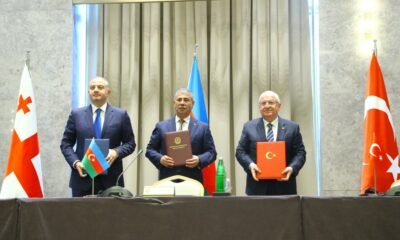
Türkiye, Azerbaijan, Georgia defense chiefs discuss Caucasus security
-

 Politics3 days ago
8 may vie for top seat at Türkiye’s dwindling CHP
-

 Politics2 days ago
Türkiye vows continued co-op with Iraq after troop withdrawal
-

 Sports2 days ago
Protesters throw tennis balls, urge Ireland to boycott Israel match
-

 Politics2 days ago
Türkiye condemns Houthis’ attack on holy city of Medina
-

 Economy2 days ago
AI use doubles in Türkiye, but lack of expertise remains key barrier