
Economy
Türkiye’s unemployment rate rises slightly to 8.1% in July

Türkiye’s seasonally adjusted unemployment rate rose by 0.5 percentage points from the previous month to 8.1% in July, according to official data released Monday.
The number of unemployed people aged 15 and over increased by 150,000 month-on-month to 2.86 million, the Turkish Statistical Institute (TurkStat) said.
The unemployment rate stood at 6.8% among men and 10.6% among women.
The number of employed people fell by 388,000 from June to 32.36 million, while the employment rate declined by 0.6 percentage points to 48.3%.
The employment rate was 65.5% for men and 31.4% for women.
Türkiye’s labor force decreased by 238,000 to 35.22 million in July, with the labor force participation rate falling by 0.4 percentage points to 52.5%.
The participation rate stood at 70.3% among men and 35.2% among women.
The seasonally adjusted youth unemployment rate, covering the 15-24 age group, increased by 1.5 percentage points to 14.5%.
The rate was estimated at 11.3% for young men and 20.3% for young women.
Meanwhile, the composite measure of labor underutilization, which includes unemployment, time-related underemployment and the potential labor force, rose by 1.8 percentage points to 30.6%.
The combined rate of time-related underemployment and unemployment was 20.8%, while the combined rate of unemployment and the potential labor force stood at 19.5%.
Seasonally and calendar-adjusted average weekly working hours decreased by 0.4 hours from the previous month to 42 hours in July.

Japan’s Defense Ministry asked for a record budget of 8.9 trillion yen ($55.6 billion) Monday, as Tokyo turns to artificial intelligence to sharpen decision-making in an increasingly tense security climate.
The final budget reportedly could reach 10 trillion yen as Tokyo undergoes a sweeping upgrade of its defense in order to navigate growing tension with neighbors such as China, North Korea and Russia.
The latest request focuses on countering “new ways of warfare,” with an emphasis on the use of AI, drones and standoff missiles.
Under the request, the ministry hopes to implement an AI-powered decision support system.
It also wants to procure low-cost drones that can work in tandem with long-range missiles to neutralize enemy assets.
The ministry said it plans to develop underwater-launched hypersonic missiles and establish a new unit to bolster defenses against cognitive warfare, a growing threat aimed at shaping public opinion through disinformation campaigns and other operations.
The budget request for the fiscal year starting from April 2027 highlights the latest step by Japan to boost its military to meet the volatile geopolitical reality, gradually shedding its traditional pacifist stance that limited the use of force purely for self-defense.
China’s rapid military expansion and North Korea’s steady development of missiles and nuclear weapons have pressed Japan to shore up its defense.
Russia’s war in Ukraine has fueled worries among Japanese policymakers that a similar conflict could erupt in East Asia, considering China’s mounting pressure on Taiwan and its escalating territorial disputes with Japan.
Request could increase
The Nikkei newspaper said the Defense Ministry’s request may jump to more than 10 trillion yen, citing an unnamed ruling party lawmaker.
The current request did not specify the estimated costs of many products and services, including missiles, drones and digital systems.
These figures will be finalized once the government finishes its revision of core national security documents by the end of the year, defense officials said.
Those three documents set the outline of the country’s future defense capabilities while assessing the country’s security environment.
Japan has been beefing up military spending and security cooperation in Asia, deploying missile launchers to outer islands, moving to acquire “counterstrike” capabilities and easing rules on weapons exports.
Prime Minister Sanae Takaichi, seen as a China hawk, has placed national defense at the top of her conservative agenda.
Japan’s ties with China deteriorated sharply after she suggested in November that Japan could intervene militarily in any conflict over Taiwan, which Beijing insists is its territory.
China has expressed alarm at what it sees as a return to “new militarism” by Japan.
Under Takaichi, the government is expected to make an overall budget request of around 143 trillion yen, a sharp increase from 122.4 trillion yen requested for the ongoing fiscal year, the Nikkei newspaper reported.
China’s three largest state-owned airlines posted first-half losses for the seventh straight year, hit by soaring jet fuel costs, with a weak summer season dimming the outlook for the rest of the year.
Air China, China Eastern Airlines and China Southern Airlines posted combined first-half net losses of about 8.2 billion yuan ($1.22 billion), having warned last month the figure could reach as high as 9 billion yuan.
The losses were a sharp reversal from their combined first quarter profit of 4.82 billion yuan, which was boosted by strong Lunar New Year demand, and sent their shares lower in mainland China and Hong Kong trading on Monday.
Flag carrier Air China reported a net loss of 2.3 billion yuan, widening from a 1.81 billion yuan loss a year earlier. China Eastern posted a loss of 2.2 billion yuan, versus a 1.43 billion yuan loss in the same period of 2025. China Southern reported a loss of 3.7 billion yuan, compared with a loss of 1.53 billion yuan a year earlier.
The weak results underscored the post-pandemic fragility of China’s aviation sector, as the trio confronted what China Eastern described as a profit environment “severely undermined” by disrupted international routes and persistently elevated jet fuel prices linked to the Middle East conflict.
Fuel costs at each of the carriers rose between 35% and 38% in the first half.
Unlike many Asian and European rivals, Chinese airlines hedge little of their fuel purchases, leaving them more exposed to oil price swings. China Southern said in its filing there was currently “no effective means available” to manage its exposure to jet fuel price fluctuations.
Revenue growth was strong at the carriers, with Air China up 10.5%, China Eastern up 11.1% and China Southern up 9.7%, driven by international demand. European routes were particularly buoyant as some travelers avoided Middle Eastern hubs disrupted by the Iran war.
But weaker economic conditions and competition from high-speed rail and driving holidays have hindered their ability to make substantial domestic fare hikes like those seen in the U.S. market without depressing demand.
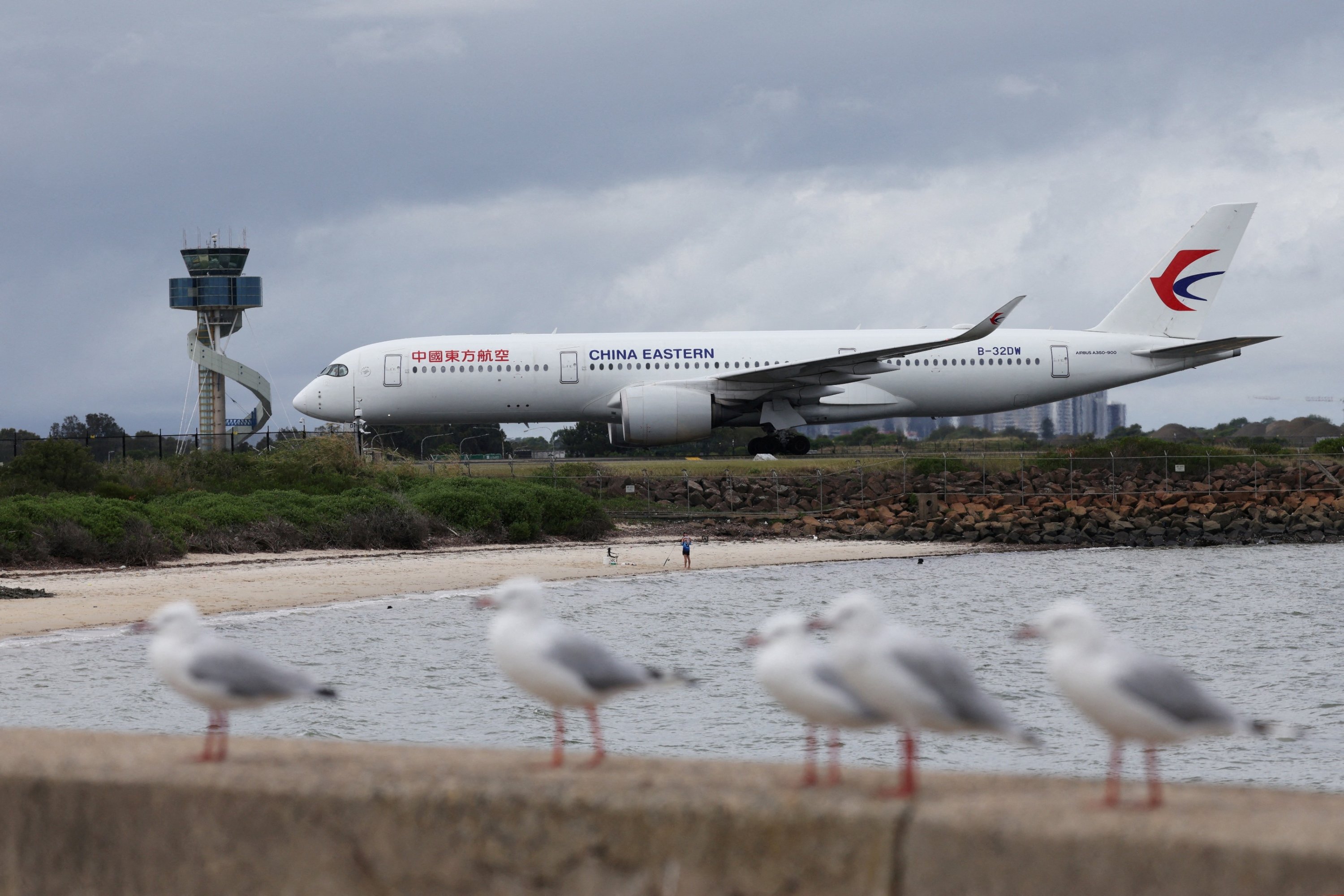
Although jet fuel prices have fallen from their second quarter peak, they remain more than 50% above prewar levels.
Typhoon disruptions
The third quarter, typically the most profitable for Chinese carriers, has so far offered little relief, with an unusually strong typhoon season disrupting domestic routes during the peak summer travel period.
Meteorological data shows 21 typhoons have formed in the northwestern Pacific Ocean and the South China Sea so far this year, nine more than the historical average for the same period.
Aviation data firm Flight Master projected traffic carried by Chinese airlines on domestic and international routes would fall 3.6% year-over-year to 142 million passengers in July and August. That would mark the first contraction in the peak season since 2022, when much of China was locked down during the pandemic.
HSBC analysts expect China’s three biggest carriers to post combined losses of about 16.8 billion yuan in 2026, compared with the market expectation for a combined profit of 1.3 billion yuan.
Shanghai-listed shares of all three carriers have fallen at least 36% so far in 2026 as weaker domestic travel demand has continued to pressure their profit outlooks, and none declared an interim dividend.
The trio did report expanding their fleets of domestically made COMAC jets. China Eastern grew its fleet of narrow-body planes to 17 after taking three deliveries in the first half. Air China and China Southern each operated 11 C919s, having taken two and three deliveries respectively in the period.
China Eastern said it expected to receive 13 fewer C919 deliveries than previously forecast between 2026 and 2028. Air China maintained its earlier forecast and China Southern did not disclose a forecast in its interim report.
Türkiye’s economy grew 2.3% year-over-year in the second quarter of 2026, official data showed Monday.
Gross domestic product (GDP) expanded 1.1% from the previous quarter on a seasonally and calendar-adjusted basis, according to the Turkish Statistical Institute (TurkStat).
Agriculture, forestry and fishing recorded the strongest annual growth among economic activities, with value added rising 13.3% in the April-June period.
Information and communication grew 8.6%, followed by public administration, education, human health and social work activities at 4%.
Value added increased 3.2% in other service activities, 2.4% in industry, and 2.1% each in financial and insurance activities and real estate.
Professional, administrative and support services expanded 2%, while trade, transportation, accommodation and food services posted growth of 0.5%.
Construction was the only major sector to contract, falling 1.9% from a year earlier.
At current prices, Türkiye’s GDP rose 36% year-over-year to 19.87 trillion Turkish liras ($438.35 billion) in the second quarter.
Household final consumption expenditure increased 3.5% annually in volume terms, while government consumption declined 1.8%.
Gross fixed capital formation, a measure of investment, grew 0.6% from the same period last year.
Exports of goods and services fell 3.4% year-over-year, while imports decreased by a sharper 6.4%.
Annual GDP grows 3.7% in 2025
Separately, TurkStat’s independent annual GDP calculations showed that the Turkish economy expanded 3.7% in 2025.
GDP at current prices increased 41.6% to 63.24 trillion liras last year, while GDP per capita stood at 714,682 liras, or $18,103.
Manufacturing accounted for the largest share of GDP at 15.6%, followed by wholesale and retail trade and motor vehicle repairs at 12.9%, and real estate activities at 9.2%.
Construction posted the strongest sectoral growth in 2025, rising 11%, followed by arts, entertainment and recreation at 8.5%, and information and communication at 7.9%.
Agriculture, forestry and fishing contracted 8.5%, while water supply, sewerage and waste management declined 5%.
Household consumption grew 4.2% in 2025 and accounted for 54.4% of GDP. Gross fixed capital formation increased 7.3%, while government consumption rose 1%.
Exports of goods and services declined 0.6%, while imports increased 4.6% last year.
Türkiye’s steel industry maintained a positive momentum in production in July after a positive first half of the year, with output rising 7% on an annual basis, according to a report on Saturday.
Crude steel production rose to 3.4 million tons in July, up 7% compared to the same period a year earlier, Anadolu Agency (AA) reported, citing sectoral data.
According to the figures released by the Turkish Steel Producers Association (TÇÜD), production rose by 7.9% to 23.2 million tons in the first seven months of the year overall.
TÇÜD, which also provides data on consumption and foreign trade, said that finished steel product consumption, meanwhile, declined by 5.1% year-on-year in July to 3.5 million tons. Meanwhile, consumption for the January-July period increased by 4.7% to 23.3 million tons.
Foreign trade in steel products
Steel product exports, on the other hand, increased by 2.9% year-over-year in July in volume terms, reaching 1.2 million tons, while their value rose by 4.4% to $827.3 million.
During the January-July period, exports rose by 2.4% on a yearly basis in volume terms to 9 million tons, while their value rose by 1.6% to $6.1 billion.
Imports in July fell by 19.7% year-over-year in volume terms to 1.5 million tons, while their value declined by 17.6% to $1.1 billion.
In the first seven months of the year, imports decreased slightly by 3% year-over-year in volume terms to 10.7 million tons, while their value dropped by 4.9% to $7.4 billion.
The ratio of exports to imports, which stood at 76.9% in the January-July period last year, thus improved to 82.1% during the same period this year.
In a statement, TÇÜD Secretary General Veysel Yayan said the increase in production demonstrated that the sector had strengthened its production performance during the first seven months of the year.
Yayan noted that an 85% increase in exports to South America, which reached 762,000 tons, had a positive impact on total steel product exports.
Protection measures, EU exports
However, “all these developments do not yet fully reflect the negative consequences of the quota system, which is expected to lead to a contraction of approximately 4 million tons in our exports to the EU,” he said.
“In the coming months, the contraction in our exports to the EU is expected to accelerate,” he added.
“On the other hand, the presence of Chinese-origin steel products in the Turkish market continues to increase, with steel imports from China reaching approximately 2.5 million tons during the first seven months of the year,” Yayan noted.
“In this context, we believe that implementing safeguarding measures in Türkiye, similar to those already being applied in various countries, particularly the EU, the U.S., Mexico, and Canada, would make a significant contribution to increasing capacity utilization rates, supporting domestic production, economic growth, and employment.”
The last days of summer, with almost the whole of September, will be packed with a slew of key data for the Turkish economy, alongside a closely anticipated economic road map that is set to outline new priorities and targets.
Türkiye faces a busy economic agenda starting as of this week, with markets focusing on growth, exports, inflation and the new Medium-Term Program (MTP).
On Aug. 31, all attention will turn to second quarter growth figures, which will be released by the country’s statistical institute. The Turkish economy grew by 2.5% in the first quarter of this year.
Economists participating in the survey conducted by Anadolu Agency (AA) forecast that gross domestic product (GDP) will expand by 2.8% on a yearly basis in the second quarter.
On the same day, the Turkish Statistical Institute (TurkStat) will also release labor market data for July.
Export, inflation data
Meanwhile, the provisional foreign trade data for August are expected to be released on Sept. 3 by the Ministry of Trade and the Türkiye Exporters Assembly (TIM).
The foreign trade figures are expected to be announced in Ankara by Trade Minister Ömer Bolat and TIM President Mustafa Gültepe.
Exports reached a record $25.6 billion in July, marking the highest July export figure in Türkiye’s history and the second-best monthly performance on record.
Inflation figures are also expected to be announced on the same day.
In July, the consumer price index (CPI) rose 1.78% month-over-month, while the domestic producer price index (PPI) increased by 1.52%. Annual consumer inflation stood at 31.75%, while producer prices increased 27.83% year-over-year, according to official data.
Treasury and Finance Minister Mehmet Şimşek, in his earlier remarks, said that the stickiness in services inflation had eased as a result of the measures taken and the ongoing disinflation process. He added that Türkiye would not compromise on fiscal discipline or its goal of achieving lasting price stability while effectively managing risks arising from geopolitical developments.
TurkStat is also set to announce other monthly statistics, including industrial production for July. In June, industrial production increased by 0.1% month-on-month but declined by 1.4% year-on-year.
Focus turns to interest-rate decision
Markets will also be closely watching the Monetary Policy Committee (MPC) of the Central Bank of the Republic of Türkiye (CBRT).
The committee, which will meet for the sixth time this year, is scheduled to announce its interest rate decision on Sept. 10.
At its most recent meeting, the committee decided to keep the one-week repo auction rate – the policy rate – unchanged at 37%.
While it is unclear would the bank move to cut its rate after keeping it on hold since the start of Iran conflict, with decision to resume its weekly auctions, markets and economists see it a step toward easing of monetary policy.
On Sept. 11, the central bank will also release balance-of-payments data for July.
Türkiye recorded a current-account deficit of nearly $4.2 billion in June, while the current account excluding gold and energy posted a surplus of $1.46 billion.
Budget, property sales data
The second half of the month will also see critical data, including central budget figures for August on Sept. 15, as well as housing and commercial property sales statistics for August, on Sept. 17.
In July, a total of 123,603 homes were sold across Türkiye, marking a contraction of 17% from the same month a year earlier. Commercial property sales also declined by 4.1%, to some 16,733 units.
MTP, new targets
In addition to macroeconomic indicators, the details of the Medium-Term Program, which serves as a three-year road map for the Turkish economy, will be closely monitored next month.
The MTP will establish key macroeconomic targets for the 2027-2029 period, including economic growth, inflation, employment, exports and the current account balance.
“In the first week of September, we hope to share the updated MTP with our society,” Vice President Cevdet Yılmaz said regarding the work on the program.
“Our primary priority is, of course, price stability, while at the same time continuing to improve our growth, employment and investment.”
Following the work on the program, preparations for the 2027 budget are also expected to pick up pace. The budget proposal will be submitted to the Parliament by Oct. 17, as per the AA report.
The fresh data comes amid renewed optimism following recent figures that showed that economic confidence climbed above the 100 threshold in August.
The cost of insuring exposure to Türkiye’s sovereign debt also declined to its lowest level in about six-and-a-half months, with CDS hovering at around 217 basis points.
Türkiye’s economic confidence index rose above the 100-point threshold in August, official data showed Friday.
The index increased 0.8% from the previous month to 100.6, up from 99.8 in July, according to the Turkish Statistical Institute (TurkStat).
A reading above 100 indicates optimism regarding the overall economic outlook, while a figure below the threshold signals pessimism.
The improvement was driven by higher confidence among consumers and manufacturers.
The consumer confidence index rose 1% month-over-month to 90.8, while the real sector confidence index for the manufacturing industry climbed 1.2% to 102.4.
Confidence weakened modestly across the services, retail trade and construction sectors.
The services confidence index edged down 0.1% to 111.9, while retail trade confidence fell 0.8% to 110.1.
The construction confidence index declined 0.4% to 83.1, remaining the weakest among the sectoral indicators.


-

 Sports3 days ago
BJK face tough Europa League draw, Trabzonspor drop to Conference
-

 Economy3 days ago
Back to Aleppo after 22 years, Türkiye’s trade chief eyes stronger ties
-

 Economy3 days ago
Warsh says Fed has ‘work to do’ if above-target inflation persists
-
 Politics3 days ago
Erdoğan holds talks with DR Congo, Rwanda leaders on regional peace
-

 Politics3 days ago
Türkiye detains 2 in FETÖ probe as minister cites links in Yazıcıoğlu case
-

 Sports2 days ago
Galatasaray close in on Rafael Leao signing from AC Milan
-

 Economy3 days ago
Türkiye launches nearly $5.2B financing package for manufacturing
-
 Politics3 days ago
Erdoğan, Putin to discuss Ukraine, Black Sea at SCO summit