
Economy
Türkiye says to seek historic climate action plan at COP31

Türkiye will seek to deliver a historic action plan with concrete solutions to the climate crisis at the COP31 climate summit it will host in November, Environment, Urbanisation and Climate Change Minister Murat Kurum said Tuesday.
Kurum, who is also president of COP31, said the summit in the Mediterranean hub of Antalya would be an “Implementation COP” focused on turning climate commitments into tangible action rather than setting new targets.
“The world does not need to constantly set new targets at the negotiating table. What it needs is an unwavering will to turn those targets into action in the field, in industry and in cities,” Kurum told an event in Ankara.
“Let Antalya not be a place where problems are discussed over and over again, but rather a place where solutions are found.”
He said Türkiye would use its diplomatic capacity and experience to overcome barriers to implementation and ensure that commitments made under the Paris Agreement translate into concrete results.
6 global initiatives by 2035
Kurum said Türkiye and Australia, which are working together to lead the COP process, had set six major global initiatives to be implemented by 2035.
The first focuses on electrification, with a goal of increasing its global share to 35%.
The second aims to cut the growth in global waste by half, while the third targets a 25% reduction in energy consumption in buildings by 2035.
The fourth initiative seeks to increase the use of circular materials in industry to 15%, reducing pressure on natural resources.
The fifth focuses on climate literacy and education, while the sixth aims to establish a “Climate Implementation Bridge” connecting countries in need with financing and solutions.
Kurum said governments alone could not finance the scale of investment required to tackle climate change and called on banks, investors and major companies to play a greater role in the green transition.
“This historic crisis cannot be overcome with the limited budgets of governments alone,” he said, urging the private sector to join the effort at the center of the green transformation.
Stronger role for vulnerable countries
Kurum said Türkiye would seek to ensure that vulnerable countries, particularly those in Africa and small island states, have a stronger voice in the COP31 process.
He said climate impacts did not respect national borders and that climate justice would remain Türkiye’s guiding principle during the negotiations.
Türkiye is working with Australia around three pillars, dialogue, consensus and action, and plans to engage with countries and stakeholders ahead of the Antalya summit, he said.
Kurum said Türkiye would also use the process to bring together young people, cities, businesses, farmers and scientists to develop practical solutions.
He said the world leaders summit in Antalya would provide an opportunity to give new direction to international climate efforts.
“Do not expect a piece of paper from Antalya that will gather dust on shelves,” Kurum said. “We will produce a strong action plan from Antalya that will shake the world to its foundations and rewrite history.”
Climate finance and preparations
Kurum said Türkiye would continue preparations through a series of international meetings and initiatives, including events in Fiji, Baku, New York and London.
He said the Pre-COP meeting in Fiji would be particularly important for giving vulnerable Pacific island states a platform to make their concerns heard.
Türkiye will also launch a major seabed mud-cleaning project in the Gulf of Fethiye and address marine environmental issues in the Black Sea province of Trabzon as part of its broader climate agenda, Kurum said.
Antalya, which has historically served as a meeting point for civilizations and trade routes, would become a venue for international cooperation on the shared future of humanity, he said.
“We will start with dialogue, grow through consensus and bring it to life through action,” Kurum said.

A majority of Americans oppose President Donald Trump’s moves last week to raise taxes on imported Canadian goods and his order to rename Lake Ontario as “Lake America,” according to a poll Tuesday.
The three-day Reuters/Ipsos poll, which concluded Sunday, showed Americans are wary of the feud with Canada – for decades a top U.S. trading partner – which has escalated since trade talks between the two countries collapsed and Trump last week ordered the hike in tariffs on Canadian goods.
Only 20% of poll respondents supported higher tariffs on Canadian goods compared to 57% who opposed them and 21% who couldn’t say where they stood. About one in five poll respondents hadn’t heard about the development.
U.S. households are already under financial pressure from the surge in gasoline prices since Trump launched a war on Iran in February, and American voters rate the cost of living as the top issue determining how they will vote in Nov. 3 midterm elections.
Trump’s Republican allies will be defending slim congressional majorities in the elections. Trump’s approval rating in recent weeks has been mired at the lowest level of his political career.
The trade conflict took a theatrical turn last week when Trump on Thursday renamed Lake Ontario, one of the five Great Lakes of North America, as “Lake America.”
Trump’s designation applies to U.S. federal usage about the lake, and does not govern what Canada, international bodies or other organizations call the lake.
The president has often ribbed Canada, threatening to annex the longtime ally as a 51st U.S. state. He ordered the Gulf of Mexico be renamed the “Gulf of America” at the start of his second term in January 2025.
Just 14% of Americans in the Reuters/Ipsos poll said they supported changing the name of Lake Ontario, which has gone by that name for more than 400 years. Sixty-three percent of poll respondents opposed the name change and the rest were unsure or didn’t answer the question.
The poll, which was conducted online and nationwide, gathered responses from 1,023 U.S. adults and had a margin of error of 4 percentage points.
Iran is suggesting it has “enough” foreign currency despite U.S. sanctions, according to Abdolnaser Hemmati, the country’s central bank governor on Tuesday, in what appeared to be soothing remarks after recent measures announced by Washington.
U.S. Treasury Secretary Scott Bessent earlier said Tehran was lashing out because it was losing the economic war.
The central bank was ready to inject up to $2 billion into the foreign exchange market to calm recent volatility, Hemmati said, according to the semi-official Tasnim news agency.
“I am telling the President of the United States: Iran has (foreign) currency and it has enough,” he added.
His comments appeared aimed at reassuring markets after Iranian officials, including President Masoud Pezeshkian, pointed to growing difficulties for an economy facing U.S. sanctions and a naval blockade.
Hemmati said the central bank was continuing to collect foreign currency receivables and had domestic reserves as well as other resources, though he added that details of those could not be disclosed.
“I tell the people with complete honesty that economic conditions and livelihood management have become difficult, but collapse has never happened and will never happen. These claims are just psychological warfare and the dust will settle soon,” Hemmati said.
Iran’s currency plunged to a record low in August, crossing the psychological threshold of 2 million rials to the U.S. dollar, while annual inflation reached 66% in July.
Bessent said on Monday that Iran was taking U.S. sanctions seriously and was “lashing out kinetically because they are losing economically.”
Washington has been increasingly relying on economic pressure to try to force Tehran to meet its demands, and Bessent has warned that those doing business with Iran could face U.S. sanctions.
The United States’ decision on Monday to welcome Russia back to a G-20 meeting while denying access to some journalists unsettled several finance leaders attending, distracting from Washington’s effort to center the talks on global economic growth.
The two-day meeting in Asheville, North Carolina, came as the global economy is being buffeted by an energy shock triggered by the Iran war, faces rising tensions over China’s huge goods trade surplus and is braced for how an investment surge in AI will ultimately play out.
As U.S. Treasury Secretary Scott Bessent opened the meeting, some ministers were surprised and dismayed to see Russian Finance Minister Anton Siluanov sitting at the G-20 table, the first time they had attended the forum in person since Russia invaded Ukraine in 2022.
A traditional “family photo” of officials was taken Monday without Siluanov, and away from credentialed media, as European officials declined to appear in a picture with their Russian counterpart.
EU economy chief Valdis Dombrovskis said Tuesday that it is not the time to “normalize” Moscow’s presence.
“I think the European position is known,” Dombrovskis told reporters on the sidelines of the gathering. “We do not think now is the time to normalize Russia” or its presence at such talks, the Latvian official said.
Polish Finance Minister Andrzej Domanski said he was unhappy to see Russia represented, although he recognized the right of G-20 hosts to invite guests.
“We do not trust Russia. They lie constantly and you need to be really, really cautious while discussing with them,” he told Reuters, stressing that Russia was the aggressor in its conflict with Ukraine.
“So for me it would be very difficult to have any kind of conversation with Russia.”
Siluanov also held a bilateral meeting with Bessent that covered financial cooperation within the G-20 framework, Russia’s Finance Ministry said. A U.S. official said the focus of that meeting was on President Donald Trump’s peace plan for Ukraine. A source familiar with the discussions said Bessent told Siluanov no economic relief for Russia or agreements on other issues were possible until the war ends.
German Finance Minister Lars Klingbeil said Europe was preparing a further package of sanctions against Russia, but Siluanov’s presence at the Asheville meeting sent a “quite troubling” signal for U.S. cooperation with the effort.
“I would have wanted greater clarity from the American side that he should not be received here as a normal guest,” Klingbeil said.
Siluanov’s appearance marks a stark contrast from April 2022, when even his virtual participation in a G-20 meeting in Washington drew broad condemnation of Russia’s invasion of Ukraine and prompted a walkout by officials from the U.S., Britain, Canada and the European Central Bank (ECB).
Focus on growth
Bessent told reporters that stronger growth was the best path out of a debt overhang built up since the 2008 global financial crisis and the COVID-19 pandemic.
Global debt levels earlier this year hit a record of nearly $353 trillion, leading to concerns about financial stability and prompting some investors to reappraise even traditionally safe havens such as U.S. Treasuries.
“The world is awash in debt post-GFC, post-COVID, and the only way for us to get out of this is to grow our way out of this,” Bessent said at the start of the meeting, referring to the 2007 to 2009 global financial crisis.
“I’m confident that a lot of the leaders are very receptive to this,” he added.
The Treasury also took the unusual step of inviting private-sector luminaries to participate in some of the G-20 sessions on promoting stronger growth, reflecting the Trump administration’s view that growth was best served by deregulation, producing more energy and fostering innovation.
Bessent told one of the sessions that global growth had underperformed its potential for too long and that causes can no longer include “policy failures of our own making.”
He said the U.S. Treasury had identified several impediments to growth that G-20 countries needed to work on, including “excessive regulatory and administrative burdens, poorly designed financial incentives and tax systems, insufficient public and private investment, internal market fragmentation, and gaps in workforce skills and mobility.”
Press access denials
Another issue that drew criticism was the U.S. Treasury’s decision to deny certain journalists media credentials to cover the event, including teams from Bloomberg News and specific reporters from The New York Times and The Wall Street Journal.
“I believe the press has a completely legitimate interest in reporting openly and freely on this G-20 summit,” Klingbeil said. “I consider it unacceptable for journalists or entire editorial teams to be excluded.”
A U.S. Treasury spokesperson said that over 300 media were covering the event, including another New York Times reporter, and access comes with a “responsibility to report factual information consistent with established journalistic standards.”
U.S. Federal Reserve (Fed) Chair Kevin Warsh, attending his first international economic policy meeting since taking office in May, said he was looking forward to learning more about growth prospects among member economies. He said an era of “secular stagnation” marked by a lack of innovation looked to be over amid an AI investment boom.
“If I were to try to characterize this moment, it would be one of a global investment surge,” he said, adding that it had reversed the “global savings glut,” which in the past had kept capital idle due to a shortage of investment opportunities.
No debt market ‘turmoil’
Bessent also highlighted strong U.S. growth, which has benefited from investments in AI infrastructure that have also helped to push up Treasury debt yields by soaking up savings that had previously held borrowing costs down by flowing into Treasuries.
Ahead of the G-20 talks, Bessent played down mounting market scrutiny of U.S. debt levels, arguing the United States was in a stronger position than many advanced economies because it continues to grow, even while running large budget deficits.
“First of all, I’m not sure where the bond market turmoil is,” he told Reuters in an interview on Sunday. “What’s important, too, is that we are growing.”
On Tuesday, the U.S. was to focus on reducing global trade imbalances, and Bessent said he would urge G-20 members to re-examine their terms of trade with China to pressure Beijing to rebalance its economy away from exports and toward domestic consumption.
“The world cannot have a China with a $1.2 trillion trade surplus,” Bessent said. “In China, the economy is quite weak, and they are trying to export their way out of it, and they need to rebalance their economy.”
Economists say the U.S. must also reduce its growing fiscal deficits as part of this rebalancing effort.
“We need a more balanced world,” French Finance Minister Roland Lescure said. “We know that every big zone, whether China, the U.S. and Europe, has got their own homework to do.”
Eurozone inflation rose to 3.3% August, the highest level seen in three years, as the war in the Middle East kept pressure on energy costs, official data showed Tuesday.
Well above the 2% target set by the European Central Bank (ECB), the figure from the EU’s statistical office was up sharply from 2.9% in July and in line with forecasts by analysts for Bloomberg.
“Looking at the main components of euro area inflation, energy is expected to have the highest annual rate in August,” Eurostat said, noting that energy prices were up 14.3% in August after rising 10.3% in July.
The U.S. war against Iran and the near-total closure of the Strait of Hormuz, a key energy trade route, have sent global energy costs soaring.
“Inflation should remain well above target into next year, as higher gas and food prices put additional upward pressure on the index,” said Leo Barincou of Oxford Economics.
The ECB is expected to again raise interest rates at its meeting on Sept. 10 to tame the surge in prices, after a first hike in June.
The bank’s chief, Christine Lagarde, warned in July that the energy shock from the conflict “could intensify further.”
ECB hike expected
“The ECB will hike again next week,” said Kamil Kovar at Moody’s Analytics, adding that the jury was out on whether the decision would be followed by another increase in December.
“The broad-based increase in energy prices – not just transport fuel, but also gas and now even electricity – is playing in hawks’ favor,” he said.
Core inflation, which strips out volatile energy and food prices, has remained largely stable in recent months.
In August, it slowed back to 2.4% after accelerating slightly to 2.5% in July.
Food and drinks inflation in August remained at 1.2%, the same level recorded last month.
Eurozone inflation was last above 3.3% in September 2023, when it stood at 4.3%.
At the time, consumer price rises were slowing after reaching a peak of 10.6% in October 2022, driven by surging energy prices caused by Russia’s invasion of Ukraine.
Shares in online fast-fashion retailer Shein dropped 4% in their first day of trading in Hong Kong on Tuesday after slumping as much as 10%, with investors worried about the impact of setbacks of its long-delayed listing potentially undermining its competitive advantages.
Known globally for selling $5 tops and $10 dresses, Shein has been humbled by tariff and duty changes in the U.S. and Europe that have contributed to a dramatic decline in valuation for the company.
Founded in China in 2012 and headquartered in Singapore since late 2021, Shein spent years touting its credentials as a global company before re-embracing its roots to list in Hong Kong.
That capped a four-year quest to go public after failing to list in New York and London. Intense scrutiny of its business practices also hampered its attempts, which were ultimately blocked by Chinese authorities.
Its shares traded at HK$46.62 ($5.95) by mid-session, down from its HK$48.56 ($6.19) IPO price tag, but recovering somewhat from an earlier slide of as much as 10%.
That values the company at about $25.3 billion, compared to its peak of nearly $100 billion in 2022.
“As a new company listed in Hong Kong, we will continue to innovate, optimize and cooperate with our supply chain partners for mutual benefit and win-win results,” Shein Chief Financial Officer Leigh Gui said at the opening gong ceremony.
Founder and CEO Sky Xu, known for disliking the limelight, did not speak at the event, although he later took pictures with Shein employees on stage. He declined to respond to Reuters’ questions.
Valuation still seen as expensive
Investors and analysts have worried about Shein’s slower growth, higher trade costs and tighter regulatory scrutiny.
“I think the weak debut shows that even after the huge valuation reset, investors still don’t see Shein as obviously cheap,” said Charu Chanana, chief investment strategist at Saxo.
She said Shein was valued at 15 times forward earnings, more than double the multiple for PDD, the owner of rival Temu, which meant “investors were being asked to pay a premium despite weaker growth visibility and significant regulatory and trade risks.”
Demand for Shein’s stock during the IPO was tepid compared to high-profile offerings from the AI and robotics sectors.
The retail tranche was subscribed 5.63 times, while the international portion was subscribed 2.59 times. Some deals have been hundreds of times oversubscribed, especially from Hong Kong’s army of retail investors who track IPOs very closely.
Despite Shein’s growth worries, existing investors who participated in the IPO included billionaire Michael Bloomberg’s family office Willett Advisors, French billionaire entrepreneur and investor Xavier Niel and Microsoft, a filing showed on Monday.
Indian billionaire Mukesh Ambani’s Reliance also bought more shares in Shein, according to the filing, as did Bolivian American billionaire Marcelo Claure’s Claure Group and the SoftBank Vision Fund.
The amount sold in the IPO represents about 6.6% of Shein’s enlarged share capital. Cornerstone investors took about one-fifth of the IPO and are locked up for six months, leaving roughly 5% freely tradable.
Q1 loss, new strategies
Last year, the U.S. ended the de minimis duty exemption for e-commerce shipments under $800 that had powered Shein’s direct-shipping model. The European Union recently followed suit, imposing fees on low-value packages.
Shein’s net income slid 39% last year, and it swung to a loss in the first quarter.
Shein has said it expects first-half operating profit margin to be slightly lower than in the first quarter, hurt by higher customs duties, tariffs, fees and logistics costs in Europe and the Middle East.
“Daily active users in Europe have fallen around 45% since the EU scrapped its duty exemption on small parcels, and Temu has seen a similar drop,” said Josh Gilbert, lead analyst for Asia-Pacific at eToro.
“This is less a Shein problem, but more so the end of an era for cheap cross-border shipping. The brand’s reach is unquestionable, but a large share of that loyalty has always belonged to the price tag.”
Shein has been trying to widen beyond its own-label ultra-cheap fast fashion, having expanded its third-party marketplace and bought U.S. apparel brand Everlane in May.
Regulatory risks remain a concern.
Shein has disclosed an ongoing U.S. Federal Trade Commission (FTC) consumer protection investigation that could result in significant penalties.
The European Commission is also examining the company’s handling of illegal products, the potentially addictive design of its platform and the transparency of its recommendation systems.
The IPO has helped Shein compensate early investors who invested at much higher valuations. The company has agreed to make cash payments totaling about $3.5 billion and share adjustments to some preferred shareholders.
“This IPO is not just a fundraising event; it is also, and probably more of, a capital-structure event,” said Jianggan Li, CEO of consultancy Momentum Works.
The European Union said Monday the bloc would stop imports of Brazilian meat and other animal products as of Thursday pending assurances from Brazil that it is complying with its animal health rules.
The European Commission said Brazil has failed to provide sufficient guarantees that its exports meet EU standards aimed at preventing the misuse of antibiotics in livestock farming.
“Brazil will no longer be authorized to export to the Union food-producing animals and products of animal origin intended for human consumption,” a Commission spokesperson told Agence France-Presse (AFP) on Monday.
This will affect commodities like poultry, meat, eggs, honey and casing. Brussels declined to provide a timeline for when imports might resume.
In May, Brazil was put on an EU list of countries that do not keep to rules on the use of antibiotics in animals.
An audit of Brazil’s poultry and honey sectors is due to conclude on Friday.
If the findings are positive and EU member states give approval, Brazilian poultry exports to the bloc could resume within weeks. Beef imports may take longer.
The commission said the timeline would depend on how quickly Brazil can demonstrate compliance with EU requirements.
“Brazil is an important partner for the EU and we are working closely, constructively and positively with Brazilian authorities to ensure their compliance with these requirements,” the spokesperson said.
“Once compliance is demonstrated, exports to the EU will be able to resume.”
The EU is keen to show its vigilance after facing strong criticism from farmers and from France following its signing in January 2026 of a free trade agreement (FTA) with South America’s Mercosur group of countries – Argentina, Brazil, Uruguay and Paraguay.
Brazil was the EU’s second-largest supplier of beef in 2025, exporting more than 92,000 tons worth over 713 million euros ($825 million).
The bloc bans the use of antimicrobials to promote growth in livestock and restricts the use of antibiotics reserved for human medicine, as part of efforts to curb antimicrobial resistance.


-

 Sports1 day ago
Sole Çalhanoğlu strike secures narrow Inter win over Cagliari
-

 Sports2 days ago
Galatasaray complete Rafael Leao signing from Serie A’s AC Milan
-

 Sports3 days ago
Fenerbahçe-Beşiktaş Süper Lig derby set for Sept. 5
-
 Politics2 days ago
Muslim unity key to countering Israeli threat, President Erdoğan says
-
 Politics2 days ago
FM Hakan Fidan holds calls with Qatari, Egyptian counterparts
-
 Politics2 days ago
Türkiye rejects legal impact of Greek spatial plan in Aegean
-
 Sports2 days ago
Mourinho tips Mbappe for Ballon d’Or despite lack of major trophies
-
 Economy1 day ago
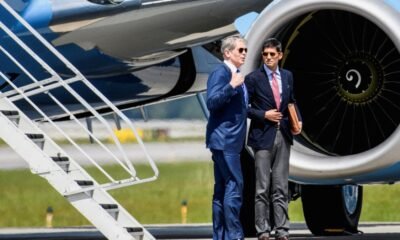
US says world ‘cannot have China with $1.2 trillion trade surplus’