
Politics
Western Thrace Turks demand action after mosque targeted in Xanthi

Representatives of the Western Thracian Turkish community condemned Monday an attack on the Çınar Mosque in Xanthi (Iskeçe), in Greece’s Western Thrace, after insulting messages targeting Islam and sacred values were written on an exterior wall of the mosque.
The elected Mufti’s Office of Komotini (Gümülcine) condemned the incident, saying the messages disregarded “moral and humanitarian values.”
The office said negative rhetoric targeting the religious and cultural values of the Muslim Turkish minority in Western Thrace has increased recently, warning that such acts undermine social peace and a culture of coexistence.
Xanthi lawmaker Burhan Baran also condemned the attack, saying disrespect toward places of worship was unacceptable and calling on authorities to identify those responsible and take necessary legal action.
Fellow Xanthi lawmaker Hüseyin Zeybek said the incident should not be regarded as ordinary graffiti, describing it as a provocation targeting social peace and coexistence.
Türkiye’s Consul General in Komotini Aykut Ünal visited the mosque following the incident and expressed solidarity with members of the Turkish community. He also voiced hope that those responsible would be identified and brought to justice.
The offensive messages targeting Islam and Allah were written by an unidentified person or persons on a wall near the mosque’s entrance on Sunday, Sept. 13.
The Western Thrace region, located near Greece’s northeastern border with Türkiye, is home to a substantial, centuries-old Muslim Turkish minority numbering around 150,000.
The rights of Western Thracian Turks are guaranteed under the 1923 Treaty of Lausanne. But over the decades, the situation has seriously deteriorated for the community, which is also economically one of the poorest in Greece.
The Western Thracian Turkish community often complains of double standards and continuing inequalities in the country, namely socioeconomic discrimination, lack of equal access to quality education for children of minorities, and political rights.

An Israeli business newspaper has highlighted Türkiye’s expanding regional influence under President Recep Tayyip Erdoğan, describing Ankara as an increasingly consequential actor in the Middle East and a growing rival to Israel.
In an analysis, Israeli financial daily Calcalist said on Sunday that Erdoğan had significantly expanded Türkiye’s influence in Washington and across the Arab world.
“Erdoğan has made Türkiye a player that is difficult to ignore in the Middle East and, for Israel, a rival with growing influence in the areas surrounding it,” the newspaper said.
The report underlined that relations between Türkiye and Israel have continued to deteriorate, pointing to a near-total breakdown in economic, commercial and aviation ties. It cited Turkish Trade Ministry data showing that direct trade with Israel has remained at zero since May 2024.
Calcalist also said tensions between Ankara and Tel Aviv have increasingly extended beyond the Gaza Strip into Syria.
Türkiye has emerged as one of the key backers of Syria following the fall of the Assad regime in December 2024, the report said, noting Ankara’s security support for Damascus and efforts to deepen economic integration between the two neighbors.
Türkiye has set a target of increasing bilateral trade with Syria to $5 billion within two years.
Meanwhile, speaking during a visit to Syria on Sunday, Fidan said Israeli policies represented the “biggest obstacle” to positive progress in the fight against terrorism and argued that Israeli attacks were damaging joint counterterrorism efforts.
“Israel is trying to destabilize Syria through its attacks,” Fidan stressed, accusing Israel of supporting terrorist groups such as Daesh. “We know that Israel has a hand in the instability here, and they do not deny it.”
The minister reiterated that Türkiye wanted to see a Syria that had fully established its sovereignty and could contribute to stability for its neighbors.
He also highlighted rapidly expanding ties between Ankara and Damascus, saying Türkiye-Syria relations had gained significant momentum over the past two years.
The analysis also pointed to Ankara’s growing diplomatic role in Washington and the Arab world. It cited Türkiye’s participation as a founding member of the Gaza Peace Council at the invitation of U.S. President Donald Trump and its defense cooperation with Pakistan and Saudi Arabia.
Moreover, Calcalist also highlighted strengthening ties between Ankara and Washington, noting Trump’s participation in the NATO summit held in the Turkish capital on July 7-8.
U.S. President Donald Trump has maintained close ties with President Recep Tayyip Erdoğan, frequently highlighting his personal relationship with the Turkish leader and praising his leadership.
The relationship was on display during the NATO summit in Ankara, where Trump thanked Erdoğan for hosting what he described as a “very successful” gathering of the alliance.
Trump called Erdoğan “a great leader” and a longtime friend, while praising his strong leadership and Türkiye’s growing role within NATO.
The report further said the developments have reinforced Türkiye’s regional standing while sharpening its rivalry with Israel amid continued disagreements over Gaza and Syria.
Israeli violence continues
Israel continued attacks in the Gaza Strip and neighboring Lebanon despite cease-fire arrangements, with Lebanese authorities reporting artillery fire and other military activity in the country’s south on Monday.
According to Lebanon’s state-run National News Agency, Israeli troops set fire to several homes in the town of Tayr Harfa in the Bint Jbeil district of Nabatieh province.
Israel launched an intensive air campaign against Lebanon on March 2 and occupied several areas in the country’s south. The Lebanese government said more than 1 million people were displaced during the fighting.
A cease-fire between Israel and Lebanon took effect on April 17 and was later extended several times. The Lebanese Health Ministry has said at least 4,383 people have been killed in Israeli attacks since March 2.
Meanwhile, Israeli attacks continued in the Gaza Strip, where the Palestinian Health Ministry said the death toll since Oct. 7, 2023, had risen to 73,786.
The ministry said two Palestinians were killed and 25 others wounded in Israeli attacks over the past 24 hours.
It said 1,372 people have been killed since a cease-fire took effect on Oct. 10, 2025, while 831 bodies have been recovered from rubble and 4,659 people have been wounded during the same period.
According to the ministry, a total of 174,771 people have been wounded in Gaza since the start of Israel’s attacks on Oct. 7, 2023.
Foreign Minister Hakan Fidan reaffirmed Türkiye’s commitment to Syria’s unity, stability and prosperity after a two-day visit to Damascus, where talks also focused on President Recep Tayyip Erdoğan’s planned visit to the Syrian capital.
In a statement on X, Fidan said he traveled to Syria at a critical time for the region and was received by Syrian President Ahmed al-Sharaa on the first day of his visit. He also held talks with Foreign Minister Asaad al-Shaibani and Interior Minister Anas Khattab.
During the meetings, the two sides reaffirmed their shared determination to preserve Syria’s unity and territorial integrity and help the Syrian people achieve the peace and prosperity they deserve, Fidan said.
The talks also addressed Erdoğan’s planned visit to Damascus, which will be his first since the Assad regime collapsed in 2024.
On the second day, Fidan met with members of Syria’s Turkmen community, whom he described as an integral part of the country.
He praised Syrian Turkmens for their role on the front lines of the struggle against the Baath regime and said they were continuing to make significant contributions to building a stable and prosperous Syria.
Fidan also visited several sites reflecting the two countries’ shared historical and cultural heritage, including the tombs of Ibn Arabi, Mawlana Khalid al-Baghdadi and Salahuddin Ayyubi, as well as the Turkish Air Martyrs’ Cemetery and the Suleymaniye Complex.
Reflecting on the two-day visit, Fidan said he saw the streets of Damascus becoming increasingly peaceful and vibrant.
He welcomed the Syrian people’s efforts to build, through their own will, a secure, stable and prosperous country that embraces all segments of society.
“We will continue to stand by Syria throughout this process,” Fidan said.
The Turkish Foreign Ministry on Monday rejected statements by Greek authorities concerning the period when Greece sought to occupy Anatolia, calling the claims “baseless” and urging Greek officials to act with “seriousness and common sense.”
Ankara also recalled that Greece carried out mass killings and destruction against civilians in Anatolia during the period, saying Athens acknowledged those acts and its obligation to pay reparations under Article 59 of the Treaty of Lausanne.
Türkiye’s Foreign Ministry last week released archival documents and photographs that show atrocities committed by Greek forces in Anatolia between 1919 and 1922.
The ministry shared the material on its social media accounts, saying the records document actions carried out by Greek forces during their occupation of Anatolia and subsequent withdrawal.
“During the occupation of Anatolia and while retreating, Greek forces pursued a systematic policy of destruction, as acknowledged by the Treaty of Lausanne and international reports,” the ministry stated.
The ministry said the archival records included evidence from a village near Bursa, describing it as “a painful example of the massacre carried out against Turkish civilians.”
Greek Defense Minister Nikos Dendias had earlier Monday commented on the wartime period in Anatolia in a post on social media platform X.
In his remarks, Dendias stated the contributions of Greeks who migrated from Anatolia to Greece and offered his account of events during the Turkish War of Independence, prompting a response from Ankara.
Statements from witnesses in a case against Alihan Kuriş, the leader of the Süleymancılar movement accused of running a criminal gang, point to connections between the group and the Gülenist Terror Group (FETÖ).
The Süleymancılar are a religious movement, much like FETÖ portrayed itself before launching an all-out offensive to topple the government through its infiltrators.
The investigation into Kuriş’s alleged wrongdoings and the suspicious death of former Transportation Minister Arif Ahmet Denizolgun, who led the movement before Kuriş, revealed the connections.
R.Ş., a witness who was part of Süleymancılar for years, told prosecutors that Kuriş was “handled” by FETÖ. M.K., a businessperson, also testified that Denizolgun was opposed to FETÖ. M.K. told prosecutors that Denizolgun told him and a fellow businessperson before FETÖ’s first attempt to topple the government in December 2013 that FETÖ leader Fetullah Gülen sought to cooperate with him “in the near future.”
“He told us that Gülen sent him a letter about cooperation, and he was considering rejecting the proposal. ‘We stand with the state,’ Denizolgun added,” M.K. said.
Y.K., another witness, said Kuriş had always been a greedy man and sought to lead the movement. Y.K. said he believed that Denizolgun’s death was not from natural causes. “Kuriş had been greedier (before Denizolgun’s death). He was ambitious; he wanted to lead. Both he and his mother repeatedly spoke about these ambitions,” he said.
Denizolgun died in Istanbul in 2016 at the age of 60 from a brain hemorrhage. His nephew, Fatih Süleyman Denizolgun, pointed the finger at Alihan Kuriş over his death. Kuriş was arrested last month on corruption charges, along with other top figures of the group. Earlier this month, authorities announced that Denizolgun’s body had been exhumed over suspicions of foul play.
R.Ş. said that Denizolgun was aware of the ambitions of Alihan Kuriş and his mother, Ayşe Gülderen, and feared that they would kill him. “He told his close circle that Alihan and his mother might attempt to poison him,” R.Ş. told investigators.
He stated that Kuriş was a puppet of FETÖ. “He knew he would be removed as leader of the movement if he did not pledge allegiance to FETÖ. FETÖ opposed Arif Ahmet Denizolgun’s leadership because he was loyal to the state,” he said.
Justice Minister Akın Gürlek and other dignitaries joined a large crowd Sunday as the 745th edition of the annual Remembrance of Ertuğrul and Yörük Festival came to a close in Söğüt, the town where the Ottoman Empire was launched centuries ago in western Türkiye.
The event is an occasion to remember the father of Osman I, founder of the empire that lasted for more than six centuries, and to celebrate Yörüks, nomadic Turks who trace their roots to fellow Oghuz clans of which Ertuğrul was a member. Representatives of Yörük tribes staged parades in Söğüt, now part of Bilecik province, while guests visited Ertuğrul’s tomb.
Dressed in traditional Yörük garb, Gürlek addressed a fervent crowd in Söğüt and said the “sacred fire” that burned in the town centuries ago had illuminated the path of the Century of Türkiye, referring to Türkiye’s vision for the future in the centenary of the Republic of Türkiye.
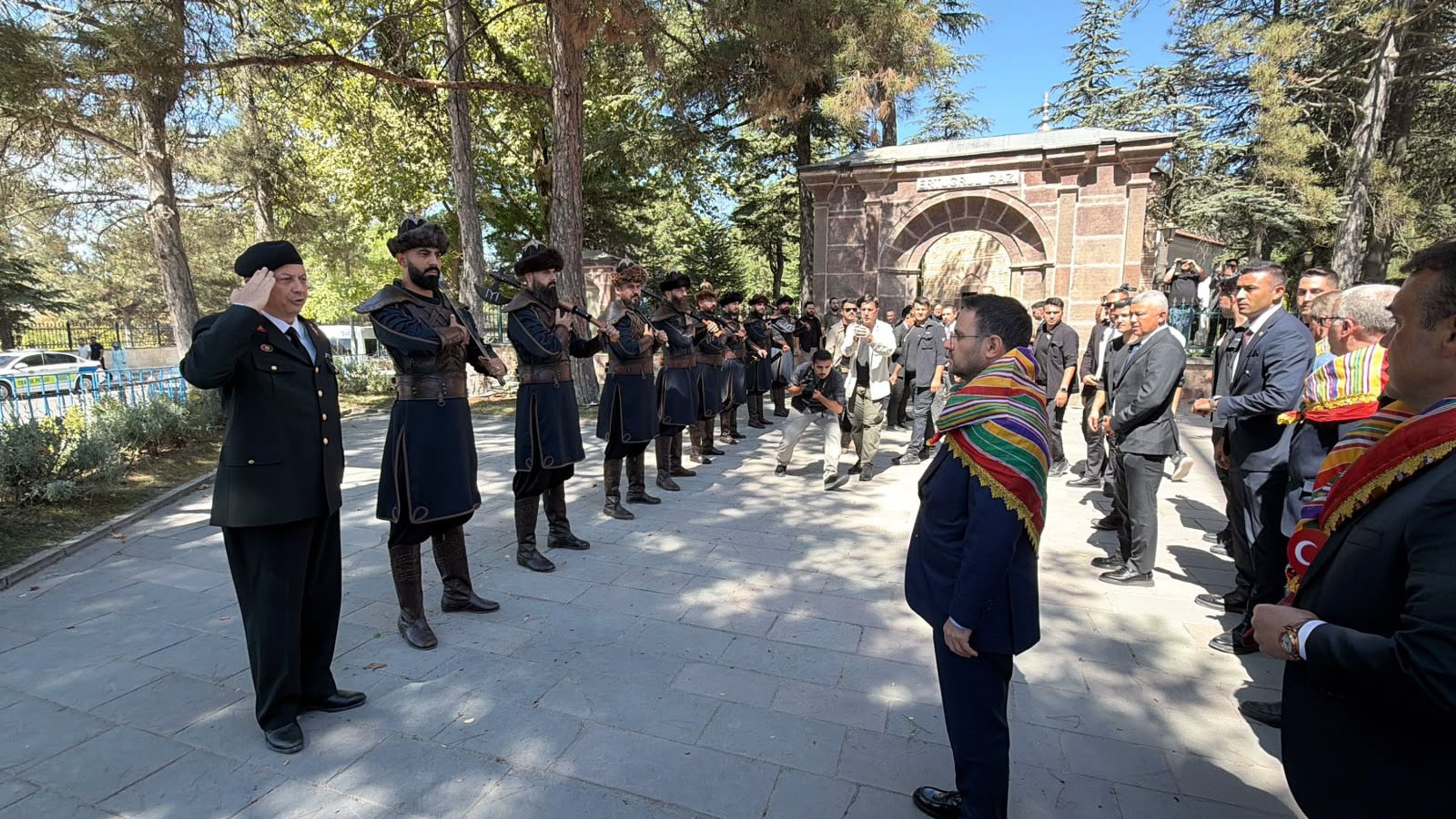
Gürlek said the Turks’ march began in a tent in Söğüt and continued toward new goals under the leadership of President Recep Tayyip Erdoğan.
The event’s exact history is not known, but it was inspired by a banquet hosted by Ertuğrul himself more than seven centuries ago after he returned to Söğüt from a campaign in the Domaniç highlands. After Ertuğrul’s death, this “toy” (a Turkic term for a large feast or banquet) became a tradition and evolved into its current form, a three-day festival that starts on a solemn note with prayers for Ertuğrul and the Ottoman ancestors of the nation.
“Shaped by the determination of Ertuğrul Gazi, the courage of Osman Gazi and Sheikh Edebali’s philosophy that ‘Keep people alive so that the state may live,’ these lands became one of the strongest bearers of our civilizational history, placing justice and winning hearts before the sword,” Gürlek said in a speech at the event, referring to Osman I’s father-in-law and the first qadi of the Ottoman Empire.
“Keeping alive today the deep-rooted memory extending from the guild tradition of Ahilik (the tradition of craftsmen in the Ottoman era) to the Horasan saints (ancient spiritual leaders) is our greatest responsibility inherited from our past. The understanding of justice and tolerance that our ancestors brought to the lands they conquered served as a guarantee of regional peace for centuries. The small sapling planted in Söğüt grew into a mighty plane tree of civilization that took deeper and stronger roots throughout history, even when attempts were made to bring it down. It is our duty to protect the children and young people who are the guarantors of our future and who will carry this deep-rooted legacy into tomorrow from the traps of the modern age that hold minds captive and from all threats that seek to distance them from our national and spiritual values,” Gürlek added.
Foreign Minister Hakan Fidan was in Damascus on Sunday for a meeting with Syria’s top diplomat Asaad al-Shaibani.
Speaking at a news conference with his counterpart, Fidan said they discussed several matters, including details for a planned inaugural visit by President Recep Tayyip Erdoğan in the post-Baathist Syria.
Fidan also welcomed the dissolution of the SDF (another name for the PKK’s Syrian wing, YPG) in the country and its integration into Syria’s security forces. “It is a precious, important step,” he said.
“Türkiye’s perspective is that Kurdish citizens of Syria will have more prosperity and freedom (in line with the SDF’s dissolution),” Fidan said.
The YPG claimed to fight for the autonomy of Kurds in Syria during the Syrian civil war.
The SDF announced its dissolution in August while its leader Ferhat Abdi Şahin was appointed as an adviser to Syrian President Ahmed al-Sharaa. The dissolution was part of an early deal between Damascus and the group, which was the Syrian wing of the terrorist group PKK. Türkiye, which was often targeted by the PKK, has carried out a process for its dissolution. Its border towns suffered from YPG attacks during the Syrian civil war.
Ankara, however, was supportive of al-Sharaa’s efforts for the integration of the YPG into the Syrian security forces as part of a deal that aimed at more control in northern Syria by the central administration. Just like the terror-free Türkiye initiative it pursues with the PKK, Türkiye views the matter in Syria as a stepping stone for unity of the country. National unity is particularly essential for Syria, which remained fragmented for years under the Assad rule and thus suffered from weakened stability and fears of an expanding civil war.
Fidan also commented on Israel’s incursion into Syria and an attack by Israel on a military base that Tel Aviv claimed hosts Turkish forces.
“Israel is an actor working to destabilize Syria; it is the biggest obstacle to Syria’s stability. The attack on the Abu Al-Duhur base is an example of Israel’s attack on the stability of Syria. Israel systematically targets Syria’s military capacity, indirectly supporting terrorist groups like Daesh,” Fidan said.
For his part, al-Shaibani said, “The partnership between Türkiye and Syria is advancing rapidly and the main contours of the strategic orientation are taking shape.”
He said that the fact that only a few days had passed since their talks in Ankara in August “demonstrates the momentum of the partnership between the two countries,” adding that relations between Türkiye and Syria “are progressing on solid foundations.”
He stated that Türkiye was among the first countries to reopen its embassy in Damascus after Syria was liberated on Dec. 8, 2024. He said Türkiye had reopened its border crossings and supply routes and taken a leading role on international platforms in efforts to lift the sanctions that had been imposed on the Syrian people for many years.
“Türkiye’s leadership will always have a place in the national memory of Syrians. Damascus and Ankara have made progress that will surpass all other bilateral relations,” al-Shaibani said.
He noted that dozens of meetings had been held between the two countries at the presidential and ministerial levels, adding that 40 agreements and memorandums of understanding had been signed and an institutional communications network had been established linking 22 Syrian ministries and institutions with their counterparts in Türkiye.
The Syrian minister said these developments had translated into tangible results that directly affect the lives of citizens, citing the energy agreement signed in May 2025, the delivery of electricity across the border to northern Syria, the establishment of sister-city ties between Aleppo and Gaziantep, and the resumption of 24-hour road transit through the Bab al-Hawa and Salama border crossings.
On the SDF deal, al-Shaibani said Syria was moving forward “with determined steps toward establishing a single national army, bringing weapons under the control of legitimate institutions and fully reintegrating the northeast into national unity through a process that belongs entirely to Syria.”
He emphasized that, as a result of 20 months of intensive efforts, the “Caesar Act” sanctions imposed by the U.S. had been brought to an end and Syria had been removed from the list of state sponsors of terrorism, thereby regaining its natural position on Arab and international platforms. The Syrian minister said that, as a result of this stability, approximately 1.6 million Syrians had returned to Syria from abroad, while approximately 2 million internally displaced Syrians had returned to their own regions.
Israel’s violations
On Israel, the Syrian foreign minister said that the country continued “to violate national sovereignty and carry out territorial incursions into the southern regions.”
“Israel is targeting secure villages and the property of civilians. Israel’s Aug. 18 attack on Abu Al-Duhur Airport carries meanings beyond its direct military dimension. The attack represents a destructive message targeting the process of rebuilding the Syrian state,” he said.
Al-Shaibani said the effort to prevent closer ties between Syria and Türkiye “reflects a clear desire to keep the region in a state of weakness and division,” adding that Syria’s position in response to the escalation remained firm and resolute.
He said Israel must withdraw to the lines it held before Dec. 8, 2024, and fully comply with the 1974 Agreement on Disengagement of Forces.
“We remain committed to the diplomatic struggle because we are deeply aware of the cost of wars,” he said.
He added, “We are doing this also to thwart any pretext that the aggressor could use.”
The minister said they greatly appreciated Türkiye’s position, noting that, “Türkiye has clearly condemned these attacks, called for the implementation of the 1974 Agreement and firmly supported Syria’s sovereignty and territorial integrity.”
Emphasizing that Syria was now freely charting the road map for its national policies with full sovereignty, Shaibani said it was “choosing its partnerships and determining the direction of its investments and development in line with its national interests.”
“The Israeli attacks on Syrian territory and institutions are not affecting Syria-Türkiye relations. Relations between the two countries are going through their best period,” he said.


-

 Economy2 days ago
‘This is the test’: All eyes turn to Fed as rate hike probable
-
 Economy2 days ago
US-Canada trade war reshapes Canadian supermarket shelves
-
 Politics2 days ago
Turkish police detain 20 in FETÖ infiltration raids in 6 provinces
-
 Politics2 days ago
Erdoğan vows to shield Türkiye from regional turmoil
-
 Politics2 days ago
Peace in Syria, Iraq key to regional prosperity, FM Fidan says
-
 Politics2 days ago
FM Fidan discusses attacks on oil pipeline with Saudi counterpart
-

 Economy15 hours ago
Türkiye among countries with highest AI adoption
-

 Economy18 hours ago
Türkiye completes production of spacecraft for 1st Moon mission