
Economy
Nvidia announces record $150B share buyback

Chip giant Nvidia announced Monday that it authorized $150 billion in share buybacks, setting a new record, as the company continues to ride strong on the AI boom.
Combined with previously authorized amounts, the company’s overall buyback program now totals $235 billion, which Nvidia expects to complete by the end of its fiscal year 2028 in January.
The announcement far surpasses Apple’s previous record of $110 billion, authorized in 2024.
A stock buyback is when a company uses cash to buy back its own shares from investors, reducing the total number of shares outstanding, typically boosting the stock price.
Markets received the news positively. Nvidia now stands as the world’s most valuable company at roughly $5.6 trillion, a commanding lead over second-place Apple at $4.9 trillion.
Its shares rose more than 3% at market opening.
The company is also using its cash to invest in AI companies and providing loans to its major customers, strengthening its commanding position in the industry.

Corporate donors to U.S. President Donald Trump’s ballroom and participants in business deals brokered by Trump family members are expected to be among the first targets of investigations if Democrats take control of the House or Senate in November’s midterm elections, a report said Monday.
Control of either chamber would give Democrats subpoena power and funding to bolster investigative staff, enabling them to launch probes as early as February and potentially triggering lengthy legal battles that would place the Trump family business empire squarely in the spotlight.
That’s according to a Reuters report, citing multiple Capitol Hill staffers, lawmakers and attorneys.
The investigations could dominate the second half of Trump’s term after two years of dealmaking in which the Trump family expanded into crypto, drones, artificial intelligence and prediction markets, while the president’s personal wealth grew by an estimated $2.2 billion.
“I don’t think the Democrats are going to have patience. They’re going to expect documents pretty quickly. You’re not going to play the old run-out-the-clock game,” said Ashley Callen, a lawyer with law firm Jenner & Block who was previously general counsel to Republican House Speaker Mike Johnson.
U.S. House of Representatives Democratic Leader Hakeem Jeffries of New York told reporters on September 17: “We’re going to hold the crooks accountable, beginning on day one.”
The Trump administration criticized the potential for investigations. “Democrats have no agenda to improve the lives of the American people, just plans to obstruct and baselessly target President Trump’s commonsense agenda,” White House spokesperson Olivia Wales said in an emailed statement to Reuters.
Corporations are a ripe target for investigations because, unlike the White House, they cannot claim their activities are protected by executive privilege.
Of particular interest are Trump-linked crypto firms and Donald Trump Jr.’s venture capital firm, 1789 Capital, according to Democratic Representative Jamie Raskin of Maryland and Democratic Senator Richard Blumenthal of Connecticut, although both cautioned there is no definitive list of targets yet.
Companies with ties to Trump and his family are conducting urgent preparations, including hiring lawyers for internal audits and crisis communications firms for public outreach, according to interviews with corporate counsels, crisis management specialists, congressional staff and lawmakers.
Democratic Senator Sheldon Whitehouse of Rhode Island unveiled a report on Thursday, saying oil and gas companies won tax breaks, subsidies and looser environmental regulations after Trump asked them for $1 billion in donations during his 2024 presidential campaign, adding yet another potential avenue for investigation.
Focus on Trump family
Adam Schiff, Democratic senator from California, sent a warning to companies not to delete any records related to transactions with Trump and his administration.
“We can make life very difficult for the administration if you abuse legitimate oversight requests of Congress,” Schiff said in an interview, citing Congress’ power over funding for agencies.
Among transactions Schiff is focused on is the proposed sale of a portion of Yosemite National Park to a private developer with ties to Republican campaign committees. “In this administration everything is for sale, including our most precious gems like Yosemite,” he said.
But the prime target for Democrats appears to be the Trump family – especially Donald Jr., who has entered into a flurry of business deals since his father won office in November 2024.
“The First Family has been making money hand over fist,” said Schiff.
Trump son-in-law Jared Kushner “is a corporate executive that we absolutely will need to talk to,” said Raskin, who could become chair of the powerful Judiciary Committee if Democrats take control of the House.
He said Kushner has not responded to two letters inquiring about his private equity firm Affinity Partners’ dealings with Middle East “oil monarchies and governments” while he also represents the United States in diplomatic negotiations.
Raskin pointed to deals Kushner secured with Saudi Arabia, Qatar and the United Arab Emirates (UAE) while serving as a presidential envoy. “That’s an outrageous conflict of interest,” he said.
Kushner is a U.S. special envoy for peace but not a government employee. Federal employees are subject to rules prohibiting them from engaging in activities that could affect them financially.
Chad Mizelle, a lawyer for Kushner, said in a statement that allegations against him are false. “And to date, no one – not even Jared’s critics – has identified a single applicable rule or regulation he has violated,” Mizelle said.
Raskin also singled out a $620 million Pentagon loan to rare-earth startup Vulcan Elements announced some three months after an investment by Don Jr.’s 1789 venture fund.
“He seems to have a clairvoyant sensibility of exactly who is going to get government contracts and who is going to get favorable government regulatory treatment in the Trump administration,” Raskin said.
In a statement to Reuters, a Vulcan spokesperson said the company “did not ask or solicit its investors to facilitate the Pentagon loan” and that it would continue to engage with Congress in “good faith.”
1789 Capital hired top law firm Quinn Emanuel to handle congressional investigations and is already signaling its intention to rebuff Democratic inquiries.
“1789 Capital welcomes legitimate congressional oversight,” it said in a response to Congress dated Sept. 9, “but it has no intention of being held hostage to political gamesmanship.”
In a statement to Reuters, a 1789 spokesperson said “Rep. Raskin has offered no proof of wrongdoing, only politically motivated accusations,” adding that his letter demonstrated “a troubling lack of financial literacy.”
Jeopardy for corporate executives
Republican Senator Kevin Cramer of North Dakota dismissed the need for such investigations and said Democrats could face a backlash from voters by “fixating and obsessing on Donald Trump and his personal life and his dealings, rather than on the things that matter to the American people.”
But some Republicans may join Democrats’ efforts. Freshman Republican Senator John Curtis of Utah called for Don Jr. to be investigated for allowing a Russian oligarch to pay for his wedding parties in the Bahamas.
Firms will have to decide whether to quickly comply with investigations, which could incur Trump’s wrath, some of the lawyers said. A failure to cooperate with Congress could result in legal jeopardy for executives and possible consumer blowback.
“There is the reputational risk always with any congressional investigation,” said Kevin Edgar, a BakerHostetler law partner and former congressional aide.
One lawyer, who requested anonymity to protect clients, said an ideal outcome could actually be being sued by the White House to stop them from producing information on the grounds of executive privilege. “It gives them the ability to say: Mom and dad tell me what to do,” the attorney said.
Some companies were already referring requests for information to the White House.
In a previously unreported July 1 letter reported by Reuters, ballroom contractor Clark Construction responded to a request about “ballooning costs” from Blumenthal by saying the terms of the deal required all information to come from the White House.
Blumenthal, who is in line to chair an investigations panel, said: “We will use our subpoena power, absolutely,” if Democrats win control of the Senate in November.
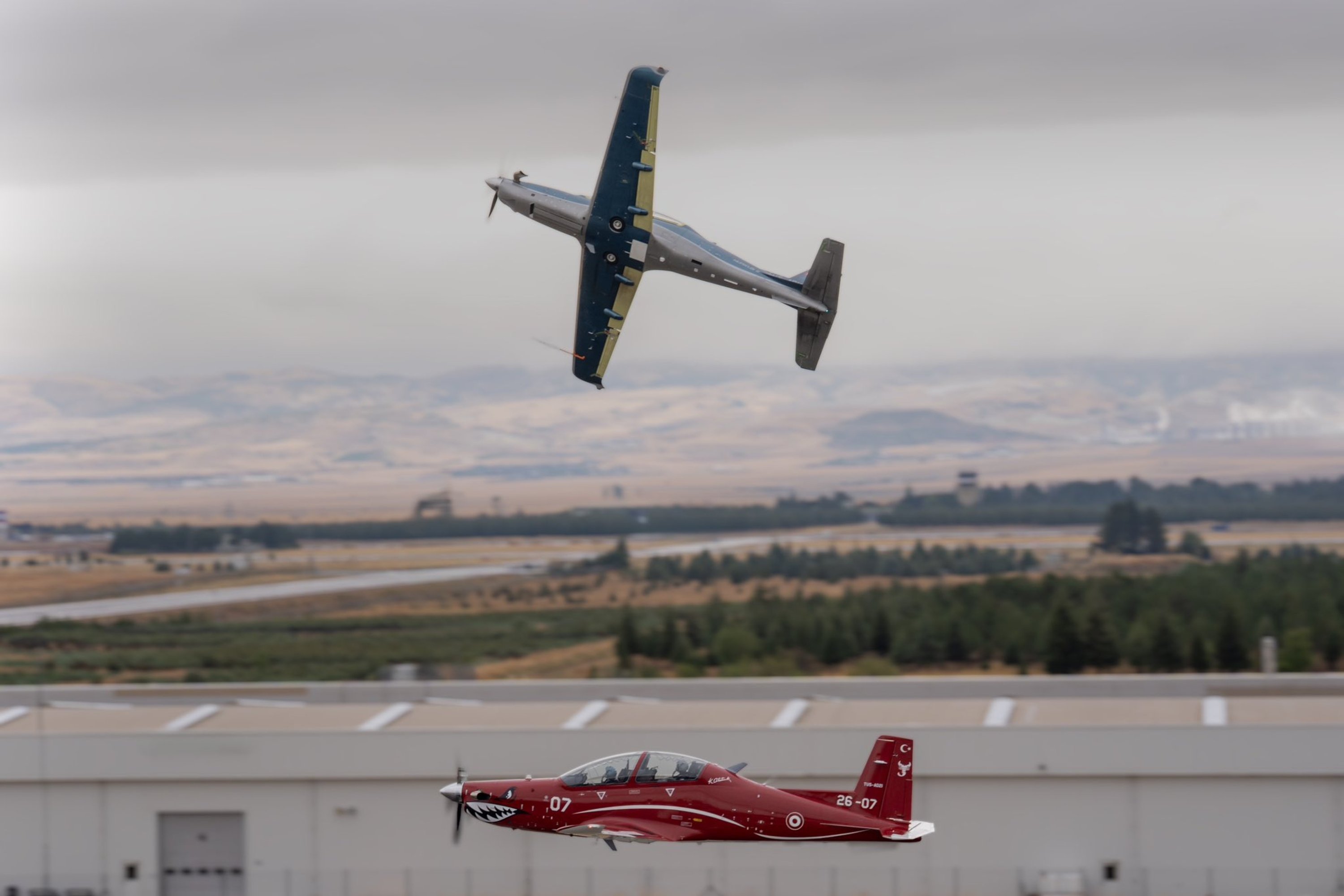
Türkiye began Monday deliveries of its domestically developed and redesigned Hürkuş advanced trainer aircraft to the Turkish Air Forces Command, with the first planes entering service following the completion of acceptance tests.
A total of 55 Hürkuş II aircraft are planned to be delivered through 2028, including 12 that are scheduled for delivery by the end of this year, according to Haluk Görgün, head of Türkiye’s Presidency of Defense Industries (SSB).
The first two aircraft of the substantially redesigned version of the original Hürkuş variant were formally handed over at a ceremony at Turkish Aerospace Industries’ (TAI) facilities in Kahramankazan, Ankara.
“This is a historic day for Turkish aviation,” Görgün said at the ceremony, adding that Türkiye had, for the first time, entrusted a domestically developed manned aircraft to its own pilots.
With its modern avionics, performance and maneuverability, Hürkuş II is expected to help develop the flight skills of trainee pilots while providing a common training foundation for Türkiye’s next generation of locally developed combat aircraft.
The aircraft features a wingspan of 10.8 meters, has a maximum takeoff weight of 3.3 metric tons, a service ceiling of 39,270 feet, a maximum range of 1,190 km and a maximum cruise speed of 533 kilometers per hour. Equipped with an anti-G system, the aircraft can fly upside down for 30 seconds.
“We confidently say that we have built the best aircraft in its class,” Görgün said, referring to the flight performance and engineering capabilities.
Designed to support Hürjet, Kaan training
The Hürkuş’s cockpit and avionics architecture were designed to be compatible with other domestically developed aircraft, including the Hürjet advanced trainer and fifth-generation Kaan fighter jet, Görgün said.
The common architecture is intended to make the transition easier for pilots moving to more advanced platforms.
The project has also helped build Türkiye’s engineering capabilities in the design, development, testing and integration of manned aircraft, Görgün said.
He said approximately 23,000 hours of testing were carried out during the Hürkuş development process, including ground, laboratory and system-integration work.
The aircraft received military type certification to international standards on Sept. 9, Görgün said.
Export ambitions
Alongside basic pilot training, Hürkuş can also perform light-attack and close-air-support missions, making it a multipurpose platform for international markets, Görgün said.
Several countries from different regions have already expressed interest in the aircraft, he added, citing demand for hundreds of planes in the basic trainer market.
“We will soon start sharing export news about Hürkuş,” Görgün said, without identifying potential customers.
The aircraft is being produced with a localization rate approaching 80%, with Turkish Aerospace Industries as the prime contractor and contributions from companies including Aselsan and Havelsan.
Görgün said the use of domestically developed subsystems and software would also facilitate the integration of Turkish-made munitions.
Order increased
The Hürkuş procurement program initially covered 15 aircraft but was expanded by 40 additional aircraft to a total of 55, Görgün said.
“We plan to see Hürkuş fleets in the Turkish Air Force in 2027 and to have all 55 aircraft in the Air Force inventory by the end of 2028,” he said.
TAI CEO Mehmet Demiroğlu described the aircraft as a milestone for Türkiye’s fixed-wing aviation capabilities, saying engineering expertise gained through Hürkuş had been transferred to subsequent projects including Hürjet and Kaan.
Air Force Commander Gen. Rafet Dalkıran said Hürkuş II would play an important role in pilot training and provide a foundation for the training and operational integration of domestically developed aircraft.
Legal proceedings against those involved in market-distorting transactions in the fund market are continuing, Treasury and Finance Minister Mehmet Şimşek said Monday, adding that liquidity measures needed to support financial stability would be maintained.
Authorities moved in quickly earlier this month to ensure market stability and launched investigations into suspected share-price manipulation in a number of thinly traded stocks that triggered heavy losses and redemption pressures at investment funds.
The government is protecting fund investors’ rights amid the turmoil, Şimşek said on the social media platform X, while stressing that investment, employment, production, and export capacity in the real sector remain a priority.
Almost half a million investors hold stakes in 131 investment funds that are said to be worth around $20 billion, which authorities ordered to be liquidated on Sept. 17.
Şimşek said the Treasury and Finance Ministry was coordinating with the Justice Ministry.
“Necessary measures will continue to be taken to prevent adverse effects on the financial system and the real economy. In this context, the liquidity required by the market will be provided,” he said.
The number of arrests in connection with the suspected stock manipulation has risen to 51, according to officials.
The problems emerged after Türkiye’s Capital Markets Board (SPK) changed its guidelines for investment funds, saying they could no longer invest all their assets in one stock but were required to diversify.
The move sought to address concerns that many funds were heavily investing in a small number of obscure or hard-to-sell stocks.
To comply, some funds began selling holdings, spooking investors who started trying to cash in their investments.
But a scandal erupted almost two weeks ago when several companies admitted they were unable to satisfy investor redemption demands.
President Recep Tayyip Erdoğan said last week there was no risk to either the financial system or the Turkish economy.
“All necessary steps are being taken within the framework of capital market regulations and the law. Whoever is responsible will be held accountable before the law,” Erdoğan told reporters.
Separately, Türkiye lifted asset-freeze orders imposed on 46 companies under the investigation, media reported Monday.
The Istanbul chief prosecutor’s office said in a statement the decision was taken following new assessments and notifications from the Capital Markets Board, NTV and other media reported.
Istanbul’s main BIST 100 index was down 2.7% Monday after a loss of 2.9% the previous week. The index has fallen back to levels last seen in early March.
The companies affected by the prosecutor’s statement were among dozens of legal entities, investment funds and individuals whose assets were frozen as investigators examined large stock market transactions carried out between July, when the funds reached peak assets under management, and Sept. 16, the day before the SPK ordered the liquidation of the funds.
Justice Minister Akın Gürlek said last week investigators were scrutinizing large share purchases and sales during that period under the probe into alleged market manipulation.
Authorities had frozen the assets of 46 companies, 18 funds and 42 individuals and imposed overseas travel bans on 37 people.
At the weekend, a deputy chair of Türkiye’s ruling Justice and Development Party (AK Party) said she was stepping down so the claims could be “clarified” after allegations she had sold shares worth tens of millions of dollars shortly before the problems emerged.
“I have submitted my request to our party chairman to be excused from all positions and responsibilities I currently hold,” Fatma Betül Sayan Kaya wrote on X.
“I believe it’s necessary to take political responsibility to ensure the office I hold doesn’t become the subject of public debate and that investigation can be conducted independently, impartially, and without any suspicion or undue influence.”
AK Party spokesperson Ömer Çelik said Erdoğan had accepted Kaya’s resignation.
“We declare that all those who are involved in irregularities, corruption, abuse or anything that causes harm will be held accountable,” Çelik added.
Türkiye began Monday deliveries of its domestically developed Hürkuş trainer aircraft to the Turkish Air Forces Command, with the first two planes entering service following the completion of acceptance tests.
A total of 12 additional Hürkuş aircraft are scheduled for delivery in 2026, while all 55 planes ordered are planned to be delivered by the end of 2028, according to Haluk Görgün, head of Türkiye’s Presidency of Defense Industries (SSB).
The first two Hürkuş-II aircraft were formally handed over at a ceremony at Turkish Aerospace Industries’ (TUSAŞ) facilities in Kahramankazan, Ankara.
“This is a historic day for Turkish aviation,” Görgün said at the ceremony, adding that Türkiye had, for the first time, entrusted a domestically developed manned aircraft to its own pilots.
With its modern avionics, performance and maneuverability, Hürkuş is expected to help develop the flight skills of trainee pilots while providing a common training foundation for Türkiye’s next generation of locally developed combat aircraft.
Görgün said the final test flight before delivery had been conducted about two weeks earlier. “We confidently say that we have built the best aircraft in its class,” he said, referring to the aircraft’s flight performance and engineering capabilities.
Designed to support Hürjet, Kaan training
The Hürkuş’s cockpit and avionics architecture were designed to be compatible with other domestically developed aircraft, including the Hürjet advanced trainer and fifth-generation Kaan fighter jet, Görgün said.
The common architecture is intended to make the transition easier for pilots moving to more advanced platforms, allowing them to work with upgraded versions of systems they are already familiar with.
The project has also helped build Türkiye’s engineering capabilities in the design, development, testing and integration of manned aircraft, Görgün said.
He said approximately 23,000 hours of testing were carried out during the Hürkuş development process, including ground, laboratory and system-integration work.
The aircraft received military type certification to international standards on Sept. 9, marking another milestone for Türkiye’s ability to test and certify an aircraft domestically, Görgün said.
Export ambitions
Alongside basic pilot training, Hürkuş can also perform light-attack and close-air-support missions, making it a multipurpose platform for international markets, Görgün said.
Several countries from different regions have expressed interest in the aircraft, he added, citing demand for hundreds of planes in the basic trainer market.
“We will soon start sharing export news about Hürkuş,” Görgün said, without identifying potential customers.
The aircraft is being produced with a localization rate approaching 80%, with Turkish Aerospace Industries (TAI) as the prime contractor and contributions from companies including Aselsan and Havelsan.
Görgün said the use of domestically developed subsystems and software would also facilitate the integration of Turkish-made munitions.
Order increased
The Hürkuş procurement program initially covered 15 aircraft but was expanded by 40 additional aircraft to a total of 55, Görgün said.
“We plan to see Hürkuş fleets in the Turkish Air Force in 2027 and to have all 55 aircraft in the Air Force inventory by the end of 2028,” he said.
TAI CEO Mehmet Demiroğlu described the aircraft as a milestone for Türkiye’s fixed-wing aviation capabilities, saying engineering expertise gained through Hürkuş had been transferred to subsequent projects including Hürjet and Kaan.
Air force Commander Gen. Rafet Dalkıran said Hürkuş would play an important role in pilot training and provide a foundation for the training and operational integration of domestically developed aircraft.
Oil prices spiked with bond yields Monday as Donald Trump’s rejection of an Iranian offer of a seven-day truce stoked inflation concerns, while stocks were mixed as traders look ahead to the release of key U.S. data.
Tehran last week set out a plan at the U.N. General Assembly for a halt in hostilities that would see the Strait of Hormuz reopened, which would ease a crippling supply crisis that has jacked up costs around the world.
The waterway is key to the world’s energy supply and is now central to the conflict between the U.S. and Iran, particularly with Houthis seizing Yemen’s entire Red Sea coast, including the Bab al-Mandab Strait, a vital shipping lane.
However, the U.S. president told reporters outside the White House, “I reject their proposal.”
Still, he told Axios that he expects negotiations to resume.
“They want to make a deal, but it is not the deal that I want to make,” he told the news platform. “It is what we would have maybe agreed to a year ago.”
“They overplayed their hand,” Trump added in the interview published Sunday.
Citing sources familiar with the matter, Axios reported that indirect talks between Washington and Tehran could take place as early as Monday.
Iran was still standing by its conditions for reopening the Strait, including the release of frozen assets, the lifting of sanctions on its oil and an end to the U.S. naval blockade.
Oil prices, which fell more than 2% Friday on news of the offer, bounced back at the start of the new week, with Brent surging more than 3% back above $107 a barrel.
That stoked inflation concerns again, and weighed on stock markets.
Seoul fell 2.7% as it reopened after a long break, while Tokyo, Shanghai, Manila, Mumbai, Bangkok and Jakarta also dropped.
There were gains in Hong Kong, Sydney, Singapore and Wellington, while London, Paris and Frankfurt were also on the front foot.
Bond yields climbed, with the average on a gauge of world bonds topping 4% last week for the first time since 2007, according to Bloomberg.
The rise in prices puts the focus back on the Federal Reserve (Fed) ahead of its next policy meeting at the end of October, with CME’s FedWatch tool putting the chances of a second successive interest rate hike at more than 65%.
Before that decision is made, investors will see the release of the bank’s preferred gauge of inflation this week as well as a key jobs report that could play a vital role in policymakers’ thinking.
“Middle East tensions have flared again after President Donald Trump rejected Iran’s latest proposal to reopen the Strait of Hormuz,” wrote Stephen Innes at Quintex Intel.
“Oil has pushed higher, Asian equities are softer, and suddenly the brief Friday reprieve in global fixed income looks more like an intermission than the end of the show.”
Still, he added: “The market is still pricing some probability that everyone eventually finds their way back to the table, even if they continue to spend the next few weeks shouting across it first.”
Key figures at around 0810 GMT:
West Texas Intermediate: Up 2.2% at $94.50 per barrel
Brent North Sea Crude: Up 2.5% at $106.96 per barrel
Tokyo – Nikkei 225: Down 0.7% at 65,877.62 (close)
Hong Kong – Hang Seng Index: Up 0.5% at 24,642.51 (close)
Shanghai – Composite: Down 1.7% at 3,823.62 (close)
London – FTSE 100: Up 0.4% at 10,736.87
Dollar/yen: Down to 156.78 yen from 157.20 yen Friday
Euro/dollar: Down to $1.1382 from $1.1399
Pound/dollar: Down to $1.3266 from $1.3251
Euro/pound: Down to 85.80 pence from 86.03 pence
New York – Dow: Up 0.9% to 51,828.62 (close)
Agriculture and Forestry Minister Ibrahim Yumaklı has stepped up diplomatic efforts to help minimize the impact of geopolitical risks on agriculture and food supplies, according to a report on Sunday.
Accordingly, Yumaklı has intensified agricultural diplomacy efforts at the global level and across multiple fronts in an effort to minimize the risks, the report by Anadolu Agency (AA) said.
The effects of the Russia-Ukraine war, geopolitical risks in the Middle East, and disruptions in the Strait of Hormuz continue to be felt across many areas, from agriculture and energy to food and logistics. These developments are affecting agricultural inputs globally, including fertilizers and freight costs.
In line with this, Türkiye has been taking steps through its active agricultural diplomacy in recent months to prevent disruptions to supply chains.
As part of these efforts, Yumaklı has been holding bilateral and delegation-level talks with numerous countries and groups of countries, particularly Russia, China and the Turkic republics.
Fertilizer meeting to be held on Oct. 25
In this context, talks with Russia have addressed issues including the trade of fertilizers, citrus fruits and tomatoes.
During Yumaklı’s visit to Russia, steps were taken to resolve the issue concerning tomatoes waiting at the Russian border. The two sides also agreed that their respective teams would remain in communication and coordinate their efforts regarding problems related to plant health and quarantine procedures.
In bilateral talks, an agreement was reached that there would be no restrictions on fertilizer shipments to Türkiye.
Relevant institutions and companies from the two countries are scheduled to meet again in Türkiye on Oct. 25 to discuss fertilizer-related issues, according to AA.
Agricultural diplomacy with China gains momentum
China is also among the countries where agricultural diplomacy is gaining momentum. Minister Yumaklı recently hosted a Chinese delegation at the ministry.
Key topics on the agenda included the export of agricultural products such as almonds, bay leaves, poultry meat and seafood.
In his remarks, Yumaklı said that relations with China would continue in the area of food and agricultural product exports.
“I would like to emphasize here the importance of agricultural diplomacy and bilateral cooperation. In particular, the transfer of technology, knowledge and experience will also continue,” he stated at the time.
Visit to Uzbekistan
At the same time, the minister is also expected to travel to Tashkent, the capital of Uzbekistan, on Sept. 28-29 to attend the 5th IAOM Eurasia Conference and Exhibition, organized by the International Association of Operative Millers (IAOM).
Uzbekistan stands out as a strategically important country for flour exports, thanks to its strong milling industry and its wheat supplies from Kazakhstan. The conference is particularly significant at a time when wheat trade is being reshaped by developments in the Black Sea region and new trade routes are gaining prominence.
Yumaklı is also expected to hold bilateral meetings on the sidelines of the conference.


-
 Politics3 days ago
Türkiye advances ‘terror-free’ process with parliamentary backing
-

 Economy3 days ago
Arrests in Türkiye investment fund probe reach 45
-
 Sports3 days ago
Mbappe lifts France past Türkiye 1-0 in Zidane’s winning debut
-
 Sports3 days ago
Busenaz Sürmeneli wins 2nd straight European boxing gold
-
 Politics3 days ago
FM Fidan urges stronger Turkic coordination amid global challenges
-

 Sports2 days ago
Every Formula One world champion from 1950 through 2025
-

 Sports2 days ago
Man City found guilty of 114 of 115 alleged financial breaches
-
 Economy2 days ago
Erdoğan touts Türkiye’s export surge as MÜSİAD EXPO wraps up