
Economy
McDonald’s sued over alleged AI-powered price fixing

Fast-food chain McDonald’s has been sued in federal court in Chicago in a proposed nationwide class action alleging that the company illegally coordinates menu prices across its franchises and company-owned restaurants by using an AI-powered pricing system.
The lawsuit, filed on Friday, said McDonald’s violated U.S. antitrust law by conspiring with independent franchisees to fix prices using algorithms trained on nonpublic data.
Reuters reported recently that McDonald’s pricing engine uses machine-learning algorithms to continually analyze data from millions of daily transactions across its nearly 14,000 restaurants.
The lawsuit cited the Reuters article, which said that other fast-food companies are also turning to AI to help with pricing and other operations.
“Independent businesses must set their prices independently,” the lawsuit said.
McDonald’s, in a statement on Monday, called the allegations speculative and uninformed.
“AI does not set the price of a Big Mac or any other menu item,” the company said.
It said franchisees make their own pricing decisions, and that the use of pricing recommendation tools and analytics is widespread across industries.
U.S. plaintiffs have filed a wave of class actions in recent years alleging that companies used algorithms or AI to illegally coordinate prices for hotel rooms, apartment rentals and other purchases.
Lark Turner, a lawyer for the plaintiff, said in a statement that McDonald’s is “leveraging its troves of data and its franchised system to nickel-and-dime consumers down to the last French fry.”
The plaintiff, an Illinois resident, is seeking to represent a class of potentially millions of McDonald’s customers, the lawsuit said.

German factory orders dropped sharply in August, more than forecasted, official data showed Tuesday, underscoring the fragility of a recovery in Europe’s biggest economy.
New orders, a key indicator of future business activity, were down 10.6% from a month earlier due to a drop in large-scale domestic orders, according to provisional data from Destatis.
It was the first decline in four months and more than the 1% decrease forecast by analysts surveyed by the financial data firm FactSet.
The long-stagnant German economy has been slowly recovering on the back of massive public spending, with some recent data generally pointing to signs of growing strength.
The economy ministry said August’s order data thus represented a “marked setback.”
But it also noted that without the fall in big orders, the situation was virtually unchanged from July.
August’s drop was driven by lower domestic orders. There was a more than 60% decrease in the category that includes military vehicles, aircraft, ships and trains.
Orders in this area have boomed in recent years as Germany spends huge sums on its military to face a hostile Russia and amid worries over U.S. security guarantees to Europe.
The ministry emphasized that the growing importance of public procurement meant that orders were “highly volatile.”
On a less volatile three-month basis, new orders from June to August were 1.3% higher than in the previous three months.
The energy shock from the U.S. war against Iran has added to headwinds for Germany’s recovery, but so far the economy has withstood the fallout better than initially feared.
Leading economic institutes recently doubled their growth forecast for this year to 1.3%.
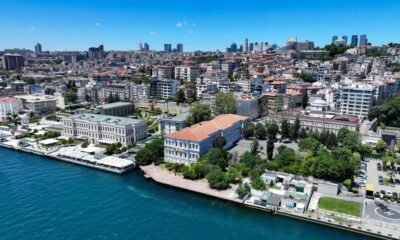
Some of the world’s most prominent central bankers will attend the Istanbul Economic Forum this week to discuss inflation, monetary policy and the global economic outlook, the forum’s website said.
U.S. Federal Reserve (Fed) Governor Christopher Waller, Bank of England (BoE) Governor Andrew Bailey, Bank for International Settlements (BIS) General Manager Pablo Hernandez de Cos and Banque de France Governor Emmanuel Moulin are among those due to attend the two-day forum on Thursday and Friday.
Other expected attendees include the central bank governors of Greece, the Netherlands, Hungary, Saudi Arabia, Malaysia, Azerbaijan and Kazakhstan, according to the website compiled by the Central Bank of the Republic of Türkiye (CBRT).
In total, 16 central bank governors and eight deputy governors, as well as the finance ministers of Türkiye and Egypt and officials of international financial institutions, are scheduled to join the meeting.
The forum said participants will discuss topics including navigating a fragmenting global economy, monetary policy under uncertainty, debt dynamics, and the implications of artificial intelligence and digital innovation for macroeconomic policy.
The Federal Reserve website included Waller’s planned speech at the conference on its schedule for Thursday.
Türkiye plans to transform the Development Road project into a multi-billion-dollar link carrying oil, natural gas and electricity from Iraq and the Gulf to Europe, according to Energy and Natural Resources Minister Alparslan Bayraktar.
Bayraktar, who met with Iraqi Oil Minister Basim Mohammed Khudair in Ankara on Friday, said Türkiye aims to turn the Development Road into a strategic “energy corridor.”
Unveiled in May 2023, the project is a $20 billion regional infrastructure initiative designed to facilitate the transport of goods from the Gulf to Europe via the Grand Faw Port in Basra in southern Iraq. The port would be linked to Türkiye and subsequently to Europe through an extensive network of railways and highways.
In April 2024, Türkiye, Iraq, the UAE and Qatar signed a memorandum of understanding (MoU) for joint cooperation on the project.
Bayraktar said oil and natural gas transported along the route could alone generate an annual economic value of around $80 billion if the project’s energy infrastructure is developed alongside its transportation network.
“We are determined to build the Development Road as a strategic ‘energy corridor,'” he told Anadolu Agency (AA), noting that developing the energy infrastructure alongside the route will greatly boost its economic value.
Bayraktar said Iraq’s oil resources offered significant potential for the project’s energy dimension and that the route could eventually carry up to 2.5 million barrels of oil per day (bpd).
Iraq currently produces around 4 million bpd, while Kuwait has a production capacity of around 2 million bpd.
Qatari gas could be transported through Iraq
Bayraktar said the Development Road also had significant potential for natural gas transportation, particularly by providing an alternative route for Qatar’s gas exports to Europe.
Qatar, one of the world’s largest gas exporters, currently ships most of its gas as liquefied natural gas (LNG).
Bayraktar said Qatar’s LNG exports rely heavily on the Strait of Hormuz and that transforming the Development Road could provide an alternative route for some of the country’s gas.
He said the initiative could therefore evolve from a project aimed at strengthening trade and transportation links between Iraq and Türkiye into a multidimensional corridor encompassing oil, natural gas and electricity infrastructure.
Ceyhan could become global energy hub
Bayraktar said alternative routes to the Strait of Hormuz had become increasingly important at a time when energy security and supply diversification were gaining greater significance.
Extending the Kirkuk-Ceyhan pipeline, the current infrastructure connecting Iraqi oil to Türkiye’s Mediterranean export terminal at Ceyhan, to Basra and increasing its capacity could provide a strong alternative to the Gulf region and the Strait of Hormuz for oil transportation, Bayraktar stated.
Türkiye also aims for its state-owned Turkish Petroleum Corporation (TPAO) to play a more active role not only in the Kirkuk fields but also in other oil fields in Iraq, Bayraktar said.
“We will continue to strongly pursue concrete projects in close cooperation with the new Iraqi government,” he said.
“We aim to reach the target of supplying 1 million barrels of crude oil, increase trade and turn Ceyhan into a global energy hub,” Bayraktar said.
President Recep Tayyip Erdoğan said Monday that Türkiye had never allowed itself to fall behind in the space race, stressing that space should not be the preserve of a handful of powerful nations.
“The space race cannot be a competition between just a few countries,” Erdoğan told the International Astronautical Congress in the southern city of Antalya.
It is the first time Türkiye is hosting the event that brings together scientists and delegates from 111 countries.
Erdoğan set out what he called Türkiye’s principle on space: that it should not be treated as a prize for whoever gets there first.
“Militarizing space and turning it into a vehicle for an arms race would be utterly wrong,” he noted.
Erdoğan said Türkiye is now one of the few countries able to design, develop, build, test and operate its own satellites in orbit.
He pointed to the IMECE satellite, which he said gave Türkiye an important high-resolution Earth observation capability, and to the Göktürk satellites, which he said had expanded its ability to observe and survey from space.
Türkiye has also launched the Türksat 5A and 5B communications satellites. In 2024, it launched and put into service Türksat 6A, its first domestically designed and built communications satellite.
Erdoğan said that satellite had confirmed the country’s engineering capability, industrial base, human resources and confidence in space technology.
Space, he said, is not only about satellites.
In 2024, Türkiye sent Alper Gezeravcı to the International Space Station on the country’s first crewed space mission.
A suborbital research flight by Tuva Cihangir Atasever followed, giving Türkiye experience in microgravity research.
Erdoğan called these steps meaningful but not sufficient, and said Türkiye was pursuing bigger goals.
Moon program
Erdoğan said one of the most ambitious goals of the National Space Program, announced in 2021, is a mission to the Moon.
He said Türkiye had set that goal five years ago and had since turned it into a concrete program.
“We have completed the production, assembly, and integration of the lunar rover we developed as part of our Moon Research Program,” Erdoğan said. He said the spacecraft was now undergoing system-level environmental tests.
The vehicle weighs about 3.5 metric tons and has a domestic content rate of more than 80%, which he called a source of great pride.
He added that experience gained on projects such as IMECE and Türksat 6A was being carried over to the lunar mission, so that Türkiye did not have to start from scratch each time.
Spaceport in Somalia
Erdoğan said that having satellites was not enough to be a space power and that access to space was also essential.
He said Türkiye had given priority to launch access and a spaceport in its space program and had begun construction of a spaceport in Somalia. He said the project would strengthen Türkiye’s access to space and help develop the space ecosystem of the African continent.
The euro plunged to its lowest level against the dollar in 17 months on Monday amid growing concerns about France’s high debt and deficits and political future, which have sent its government bond yields higher.
An underwhelming 2027 budget plan unveiled last week fanned concerns that government spending will remain high ahead of next year’s presidential elections, in which the far-right Marine Le Pen, seen as a fiscal populist, stands a chance of winning.
That has rattled bond investors at a time when interest rates – and hence borrowing costs – are rising in developed economies worldwide to combat inflation.
French debt is projected to rise to nearly 122% of the country’s gross domestic product (GDP) next year, despite billions of euros in planned spending cuts.
That has sent its 10-year government bond yield to 4.8%, the highest since the 2011 eurozone bond crisis.
“The fact that French bonds and the euro sold off last week, and the downward momentum could persist this week, is a sign that Europe is out of favor with investors and bond market vigilantes are watching developments in the eurozone closely,” said Kathleen Brooks, research director at XTB.
A call for snap elections in Spain by Prime Minister Pedro Sanchez also surprised investors, after lawmakers rejected a hotly debated housing relief bill from his Socialist-led minority government.
“France had already been under pressure due to questions over fiscal credibility and political stability,” said Patrick Munnelly, market strategist at Tickmill Group.
“Spain now adds another layer of uncertainty,” he added. “Europe’s political risk is weighing on the euro.”
Stocks, meanwhile, were broadly higher, with the Nasdaq opening higher after hitting another all-time high on Friday in the wake of weak U.S. jobs data, and the broader Dow also still near record territory.
That tempered expectations of an imminent rate hike by the Federal Reserve (Fed), and fueled optimism on Asian and European equity markets that the AI-fuelled rally still has room to run.
Paris was dragged lower, however, by Schneider Electric after the industry group unveiled a $22.6 billion all-cash deal to buy the U.S. engineering software specialist PTC, which pulled its share price down nearly 10%.
Lower oil prices provided additional support, after G-7 countries, in coordination with the International Energy Agency (IEA), agreed on Friday to immediately release 100 million barrels of diesel and crude oil to ease supply concerns caused by the U.S.-Iran war.
Exports of Middle East oil, excluding Iran, surpassed their pre-war levels last week despite attacks on ships in the Strait of Hormuz, according to data from the maritime tracking firm Kpler.
But Saudi Aramco chief executive Amin Nasser on Monday described oil stockpiles as “scarily thin” as the European winter looms.
France and Germany are seeking a new rapid-response trade tool that the European Union would use to position itself better against countries that harm the bloc economically in a new world where trade is increasingly used as a weapon.
German officials said the EU needed a tool as powerful as the Section 301 tariffs imposed by the U.S. or China’s restrictions on exports of critical minerals.
The new measure would not target any specific country, but highlights dumping, widespread subsidies and restriction of currency convertibility – market distortions that many EU leaders say China is engaged in.
A French-German document published on Monday, 10 days before EU leaders discuss Chinese trade imbalances at a summit in Brussels, said “systemic and persistent market distortions” jeopardize the European economy and particularly its industrial base, with widespread job losses.
The bloc, said the document, needs to deploy its trade defense tools more swiftly and efficiently, with more investigations and a broader approach to cover whole sectors.
France and Germany also said the European Commission should propose two new instruments as soon as possible to focus EU efforts on diversification and securing economic security.
The first, which the Commission has already mentioned, would seek to limit companies’ reliance on single sources for certain critical supplies.
The second would limit access to the EU single market for countries that undermine fair market conditions through political or economic means, without specifying what the trigger for EU reaction would be or what action the EU should take.
The paper said that any proposal by the Commission to activate counter-measures against another country should be adopted unless a qualified majority of EU members opposed – a lower hurdle than for some trade measures.
The paper also said the Commission should be able to activate such new measures swiftly, which German government officials said could mean a matter of days.
Legislation to enact a new instrument would still need approval by EU governments and the European Parliament.
A French presidential adviser said it was urgent for the EU to take action, that the imbalances with some trade partners had become unsustainable, and that France and Germany were keen for the bloc to deploy existing anti-dumping measures as soon as possible.
“France and Germany are very keen to put an end to the naivete on trade,” the adviser told reporters.


-

 Economy2 days ago
Revolut: $115 billion fintech taking on Europe’s biggest banks
-

 Economy2 days ago
Global M&A deal rush slowed down in Q3 as borrowing costs bite
-
 Economy18 hours ago
Brazilian assets rally as Flavio Bolsonaro tops first-round vote
-
 Economy22 hours ago
Türkiye’s Halkbank after secondary offering amid strong interest: CEO
-
 Politics1 day ago
MP hints at more access for Öcalan amid terror-free Türkiye bid
-
 Economy3 days ago
Egypt’s Sisi calls for peaceful solutions to Africa’s conflicts
-
 Economy2 days ago
ACE BPSC 2026 summit to be held this week in Istanbul
-

 Sports2 days ago
Marked by teen stars, marred by mishaps: 2026 Asian Games end