
Politics
Erdoğan begins South Korea visit, eyes new partnerships

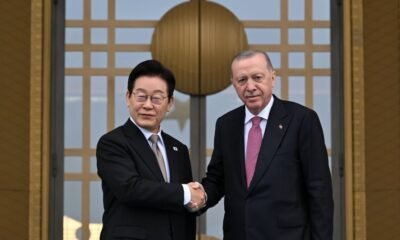
Accompanied by a delegation of ministers and first lady Emine Erdoğan, Turkish President Recep Tayyip Erdoğan arrived in Seoul on Monday for an official visit at the invitation of President Lee Jae Myung. The president and the first lady were welcomed at Seoul Air Base in Seongnam by South Korean Trade Minister Park Jung-sung.
Erdoğan’s visit will mostly concentrate on economic relations and, particularly, partnership in nuclear power.
The president is accompanied on his visit by Foreign Minister Hakan Fidan, Energy and Natural Resources Minister Alparslan Bayraktar, National Defense Minister Yaşar Güler, Industry and Technology Minister Mehmet Fatih Kacır, Justice and Development Party (AK Party) Deputy Chair and head of Health Policies Halit Yerebakan, and Defense Industries Secretary Haluk Görgün.
Erdoğan said South Korea could become a partner in developing Türkiye’s planned Sinop nuclear power station, according to an interview with Yonhap News Agency reported on Monday. Türkiye has been studying the technical and economic terms of the Black Sea project with state-run Korea Electric Power Corp, Erdoğan said. Ankara would weigh financing, electricity costs and benefits to the Turkish economy before choosing a partner, he added.
In his interview with Yonhap, Erdoğan also identified defense, semiconductors, artificial intelligence and robotics as potential areas for cooperation and called for more South Korean investment and joint production in Türkiye. He said the countries were working toward a $15 billion bilateral trade target, while calling for efforts to address an imbalance in South Korea’s favor. He invited South Korean companies to participate in Turkish transport and logistics projects linking Asia and Europe.
Türkiye and South Korea signed a memorandum of understanding on nuclear energy cooperation during President Lee’s visit to Türkiye in 2025, a deal covering reactor technology, site assessment, licensing, financing and business models. “We attach considerable importance to the negotiations we are holding with Korea on this topic. We are well aware of our Korean friends’ experience with nuclear energy,” Erdoğan was quoted by Yonhap. “We are taking into account our contacts with other countries and examining all possible choices in light of our national interests,” he also said.
“With its strong manufacturing infrastructure, skilled workforce and strategic location, Türkiye offers significant opportunities for Korean investors,” Erdoğan also said in the interview. “By combining the Republic of Korea’s expertise in technology and innovation with Türkiye’s manufacturing strength, we can achieve far greater success.”
He cited investments by South Korea’s Hyundai and Posco as examples of bilateral cooperation, pointing out that Hyundai launched electric vehicle production in Türkiye’s Izmit recently. Erdoğan said risks to global energy markets and trade routes, including those through the Strait of Hormuz, which faced the fallout from the U.S.-Iran war, necessitated more investment in Türkiye’s transport and logistics infrastructure and invited South Korean firms to invest in his country more.
“The current crisis has once again demonstrated just how vital it is to develop reliable alternative routes for international trade,” he said. Erdoğan also urged the two countries to address what he described as a significant imbalance in bilateral trade. “We have set a target of $15 billion in bilateral trade volume. As we work toward this goal, we prioritize developing a more balanced trade structure, expanding investment and encouraging greater collaboration in production,” he told Yonhap.
Looking beyond economic and strategic cooperation, Erdoğan stressed the importance of the longstanding friendship between the two countries, describing their relationship as one “forged in blood,” in reference to Turkish troops fighting in the Korean War decades ago. “The bonds of brotherhood and mutual trust that have been passed down through generations are at the center of our relationships. It is our responsibility to pass this treasured legacy on to future generations in an even stronger form,” he said. “I believe that our visit will pave the way for concrete steps to further advance cooperation between our two countries.”
South Korea and Türkiye are set to mark the 70th anniversary of the establishment of diplomatic relations in 2027, providing an opportunity to further strengthen their longstanding political, economic and cultural ties.

A maritime jurisdiction deal Libya approved years after its signing with Türkiye was on the agenda of Devlet Bahçeli as he addressed fellow lawmakers of his Nationalist Movement Party (MHP), part of the ruling People’s Alliance, on Tuesday.
The deal, which confirms maritime delimitation between the two countries, has irritated the European Union, which counts Greece and the Greek Cypriot administration, two opponents of the deal, among its members.
Bahçeli told the parliamentary group meeting of his party in Ankara that they “noted that those disturbed by the friendly relations between Türkiye and Libya have voiced their outrage over this development.”
“It has immediately become clear that Greece, the Greek Cypriot administration, Israel, which is provoking them against Türkiye, and the European Union, which does not hesitate to criticize Türkiye based on Greek and Greek Cypriot positions under the guise of ‘union solidarity,’ are all troubled by this development. The joint press statement issued by the presidents of the European Commission and the European Council has exposed the EU’s contradictory approach and desperation,” Bahçeli said, referring to a statement that defined the agreement as “null and void” and an “infringement on the sovereign rights of third countries.”
“All officials in Brussels must understand that lecturing Türkiye, dictating its course and instructing it on what it can or cannot do is beyond the bounds of what Europe, like anyone else, can presume to do to a country such as Türkiye, which has the power and will to make and implement decisions fully independently and solely in line with its own interests. Neither Türkiye nor Libya is obliged to act in accordance with their expectations and demands. Furthermore, respecting the sovereign rights of countries bordering the Mediterranean would be the most legally and politically appropriate course of action for everyone,” he said.
Libya’s House of Representatives unanimously approved the maritime boundary agreement last month, marking a significant development in the long-running dispute over maritime jurisdiction in the Eastern Mediterranean.
Originally signed in November 2019 between Türkiye and Libya’s former U.N.-recognized Government of National Accord (GNA), the memorandum establishes maritime boundaries between the two Mediterranean countries.
Ankara maintains that the agreement safeguards both countries’ sovereign rights and counters what it considers excessive maritime claims by Greece and the Greek Cypriot administration.
Athens, however, rejects the agreement, arguing that it disregards the maritime rights of Greek islands and violates international maritime law.
“The reactions from the European Union, Greece and other actors carry little significance from a legal standpoint, as international law recognizes agreements concluded between sovereign states,” Ufuk Necat Taşçı, assistant professor of International Relations at Çanakkale Onsekiz Mart University, told Daily Sabah on Oct. 21, stressing that the agreement had already been registered with the U.N., and it now enjoys broad support across Libya’s political and military leadership, including the parliament, the western-based government and military forces in both eastern and western Libya.
Riots in Europe
Bahçeli was also sardonic about riots and protests that gripped Europe in the past few weeks, from France to Germany, as students and others dissatisfied with the state policies took to the streets. “The European Union should remind its member states about its sensitivity to basic rights and freedoms, as well,” Bahçeli said, in a pushback to criticism of Türkiye by the bloc in the past on rights and freedoms.
“The social movements that began in France and spread to other countries evolved in a short time into violent riots disrupting public order and peace. Europeans should examine the underlying causes of violent riots. Europe sought political gains for a long time through Islamophobia, Turkophobia and anti-migrant sentiments. Now, the seeds of strife they sowed have hit them,” he stated.
President Recep Tayyip Erdoğan issued a statement Tuesday on the anniversary of the Justice and Development Party’s (AK Party) first election victory in 2002.
“We opened the doors to a big, strong Türkiye in the Nov. 3, 2002, elections, when we received the blessings of our nation for the first time. We accomplished an Anatolian revolution 24 years ago,” Erdoğan said in a social media post Tuesday, during his visit to South Korea to seal new bilateral deals.
“We have been the servant of our revered nation for a quarter of a century with our projects and investments. We worked tirelessly under the motto ‘everything is for Türkiye.’ We know that we are walking a long, narrow path where, Allah willing, we will serve the country more and take Türkiye to a more advanced level in every field,” he said, using a line from a song by Turkish folk singer Aşık Veysel.
“Allah willing, we will continue serving this nation we fell in love with, this country we love,” he added.
The AK Party hosted a panel at its headquarters on Tuesday for the anniversary, and the party’s deputy chair Efkan Ala explained how the party ensured that the people’s will governed the country. He said in his speech at the panel that the AK Party had established itself as a brand in governance, describing management as the most important resource for any country.
Referring to Türkiye’s goal of becoming one of the world’s 10 most developed countries, Ala emphasized that a common characteristic of the 10 most developed nations was “well-functioning governance.” Recalling President Erdoğan’s remark that “the people founded the AK Party, we simply put up its sign,” Ala explained the circumstances behind the statement.
He said the Feb. 28, 1997, coup had taken place during a time when trust between society and the state had collapsed, the country was experiencing an economic crisis, and politics had failed to recover. It was against this backdrop, he said, that the AK Party was founded. Noting that the average government tenure was one year and seven months before AK Party governments took office, Ala said: “The AK Party has changed such a system. Look, we are now in our 24th year and have entered our 25th.”
“Do they sell scarves in August?” Özgür Özel rhetorically asked during a speech on Tuesday.
The leader of the main opposition New Party (YP) was accused by the son of a former lawmaker of taking bribes. Emir Sarıgül, whose father Mustafa recently parted ways with the YP after the exposure of a corruption and sex scandal, told investigators that the lawmaker paid bribes to Özel when the latter was chair of the Republican People’s Party (CHP), including one instance when he hid the cash among scarves his son purchased in August.
“Özel has nothing to do with money,” the YP leader, who often refers to himself in third person, told the parliamentary group meeting of his party in Ankara on Tuesday.
He said those who witnessed such an act of bribery should come forward with tangible evidence other than the statement of Emir Sarıgül.
Emir Sarıgül has claimed that his father bribed Özel to secure his position. He said Mustafa Sarıgül had handed Özel a total of $350,000 in cash concealed among gift packages.
The younger Sarıgül was one of 24 suspects detained last month as part of an investigation into the Sarıgül family over allegations of money laundering and unexplained wealth. He recently gave an additional statement to prosecutors, detailing the hundreds of thousands of dollars allegedly handed directly to Özel.
“I know that during the establishment of the New Party, $250,000 was left inside a vehicle belonging to Özgür Özel to cover the interior furnishing of the party’s headquarters. The money was handed over outside a restaurant in Ümitköy, Ankara. My father and Özgür Özel had dinner that day with a group of six or seven members of Parliament. As they left the restaurant, my father personally placed the $250,000 in the back of Özgür Özel’s vehicle. He told me this himself.
“He also told me that Özel had been given another $100,000 in cash last month. At the time, my father told me that Özgür Özel would be coming to his house in Ankara for dinner. He asked me to buy two scarves from a store. I purchased them and handed them to my father. He then placed $100,000 inside the scarf package at his house in Istanbul. The scarves were placed alongside the money. We then prepared the package as a gift. He took the package and drove to Istanbul Airport in his own vehicle. He flew to Ankara, first stopping by Parliament before going to his house in Ümitköy. Özel came over for dinner that evening, and the money was handed to him in person. My father told me about it the following day,” he said.
Özel’s name has been repeatedly linked to bribery allegations dating back to his tenure as head of the CHP. Figures close to Özel already face charges of bribing delegates to secure their votes for him in the party’s 2023 internal election, which brought him to power. Muhittin Böcek, the former mayor of Antalya who was arrested on corruption charges, has also claimed that he repeatedly delivered cash to Özel in secret to secure his nomination as the CHP’s candidate in the 2024 municipal elections.
An examination of the body of Kaşif Kozinoğlu, a former intelligence officer who died in prison, reportedly of a heart attack, revealed toxic materials enough to kill a healthy person, according to a report published by the Sabah newspaper on Tuesday.
Kozinoğlu died on Nov. 12, 2011, after falling ill while being held at Silivri Prison in Istanbul. He was jailed as part of the Ergenekon investigations that Turkish authorities now describe as a plot orchestrated by the Gülenist Terror Group (FETÖ) and died shortly before he was due to present his defense in court.
A new probe was launched into his death, long described as suspicious by Kozinoğlu’s friends, after Justice Minister Akın Gürlek took office earlier this year and announced he would pursue new investigations into unsolved crimes and suspicious deaths of the yesteryear in high-profile cases.
The new autopsy report of Kozinoğlu, whose last tenure was as the chief adviser in charge of Asian affairs at the National Intelligence Organization (MIT), indicates findings of antimony in his hair and fingernails. High doses of antimony can cause cardiac arrest.
The report on the body, which was exhumed on Sept. 12, noted that it was in an advanced state of decomposition.
The most striking finding in the report was that although antimony was not detected in any of the seven different grave soil samples examined, it was found at various levels in the body. The presence of such high concentrations of antimony in biological tissues despite its complete absence from the soil strengthened the possibility that the substance had entered the body from an external source, heightening suspicions of foul play, according to the Sabah report.
Antimony causes cellular damage similar to that caused by arsenic and can have fatal consequences by triggering severe gastrointestinal disorders, liver and kidney failure, and cardiovascular shock.
Allegations that Kozinoğlu drank coffee in prison shortly before his death, along with suspicions raised in the investigation file, have been brought under renewed scrutiny in light of the antimony and arsenic findings in the report. In forensic toxicology literature, coffee is recognized as a highly effective vehicle for concealing differences in the taste and smell of chemical substances due to its bitter flavor, strong aroma and dense consistency, the Sabah report says.
A total of 30 people have faced legal proceedings so far in the broader investigation into Kozinoğlu’s suspicious death. Nine suspects, including Ali Işgören, the Silivri chief public prosecutor at the time, former MIT operative Enver Altaylı, a prison guard and emergency medical technicians, have been arrested. An arrest warrant has also been issued for one prison official.
Sabah newspaper has also released images from the security camera footage of the prison ward at the time of Kozinoğlu’s death. The footage allegedly shows Kozinoğlu’s cellmate Hasan Atilla Uğur switched off the ambient lighting for about 14 minutes while Kozinoğlu was taking a walk in the prison.
The footage also showed Kozinoğlu’s cellmates, Uğur and Hasan Ataman Yıldırım, washing the glass from which Kozinoğlu had drunk coffee on the kitchen counter shortly after he fell ill and was taken to hospital. Uğur and Yıldırım were released under house arrest in recent months following statements they gave to investigators.
Kozinoğlu has said in a statement shortly before his death that he feared he could be killed. Prosecutors had accused him of being a member of a terrorist group and leaking confidential documents, and he was questioned by Zekeriya Öz, a prosecutor who is now on the run after an arrest warrant was issued for him on charges of FETÖ membership.
The Ergenekon case began in 2007 after weapons were discovered in Istanbul’s Ümraniye district and eventually led to the prosecution of hundreds of military officers, journalists, academics and other public figures accused of belonging to an alleged clandestine network plotting to overthrow the government.
Following the failed coup attempt in 2016, Turkish authorities reassessed many of the investigations and trials carried out by members of FETÖ’s network within the judiciary. Officials have since argued that the Ergenekon proceedings were part of a broader effort by the terrorist group to remove senior military personnel and expand its influence within state institutions.
President Recep Tayyip Erdoğan sent a congratulatory message to Azerbaijani President Ilham Aliyev and the Azerbaijani people ahead of the country’s Nov. 8 Victory Day while flying through Azerbaijani airspace en route to South Korea on Sunday.
Erdoğan conveyed his greetings and best wishes through the aircraft’s pilot radio system, reaffirming Türkiye’s commitment to strengthening its alliance and cooperation with Azerbaijan.
“While passing through the airspace of brotherly Azerbaijan during my trip to South Korea, I extend my warmest greetings and best wishes to you and the Azerbaijani people on behalf of myself and my delegation,” Erdoğan said.
The president expressed confidence that bilateral relations would continue to deepen in the coming years.
“I would like to reiterate my strong belief that the allied relations and cooperation between our countries will continue to strengthen and develop in the future,” he said.
Erdoğan also congratulated Aliyev and the Azerbaijani people on the upcoming Victory Day, wishing the country lasting peace, prosperity and progress.
On Nov. 8, 2020, the Azerbaijani army liberated the city of Shusha, which was later declared as Victory Day by a presidential decree.
Most of the Karabakh region, which had been under illegal Armenian occupation for nearly three decades, was liberated by Azerbaijan during a 44-day war in the fall of 2020, which ended after a Russian-brokered peace agreement and also opened the door to normalization with Yerevan.
Ankara’s support for Azerbaijan, and especially Turkish Bayraktar TB2 unmanned combat aerial vehicles (UCAVs), had been decisive in Baku’s victory.
Turkish authorities detained 21 suspects linked to the Gülenist Terror Group (FETÖ) in two separate investigations targeting the group’s covert public-sector network and financial activities, the Ankara Chief Public Prosecutor’s Office said Tuesday.
According to a statement from the prosecutor’s office, the operations were carried out in coordination with Türkiye’s National Intelligence Organization (MIT) and the Ankara Police Department’s counterterrorism branch.
In the first investigation, prosecutors issued detention warrants for 14 suspects accused of operating within FETÖ’s covert network in public institutions.
All 14 suspects were detained in simultaneous operations conducted across 10 provinces, including Ankara, following intelligence and police investigations.
In a separate investigation targeting the group’s financial network, authorities identified 11 suspects accused of providing financial support to FETÖ members and participating in the group’s ongoing activities.
Coordinated raids led to the detention of seven suspects, while efforts to locate and apprehend the remaining four are continuing.
Prosecutors said both investigations remain ongoing.
The terrorist group orchestrated the failed coup attempt of July 15, 2016, in Türkiye, during which 252 people were killed and 2,734 were wounded. Ankara also accuses FETÖ of being behind a long-running campaign to overthrow the state through the infiltration of Turkish institutions, particularly the military, police and judiciary.
Türkiye has continuously targeted FETÖ’s active members and sleeper cells, and its influence has diminished considerably since 2016. However, the group maintains a vast network, including infiltrators suspected of still operating within Turkish institutions.


-

 Economy3 days ago
Germany’s powerful IG Metall union launches warning strikes
-
 Politics3 days ago
Thousands join silent march for Gaza in southern Türkiye
-
 Politics2 days ago
41 arrested in Türkiye’s counterterror operations targeting FETÖ
-

 Sports2 days ago
Galatasaray seek 5th straight win as Stuttgart come knocking in UCL
-

 Sports2 days ago
Antonelli becomes youngest F1 champion with 3rd place in Mexico
-
 Politics2 days ago
Erdoğan heads to South Korea to build on strong ties
-

 Sports1 day ago
Tenerife striker Jesus de Miguel dies after on-field collision
-
 Politics2 days ago
Son, whistleblower expose alleged dirt on Turkish lawmaker