
Politics
President Erdoğan signals fresh Putin talks pushing for peace

President Recep Tayyip Erdoğan reaffirmed Türkiye’s commitment to diplomatic efforts aimed at ending the Russia-Ukraine war, saying Ankara hopes to hold talks with Russian President Vladimir Putin following discussions with Ukrainian President Volodymyr Zelenskyy.
Speaking to journalists aboard his return flight from South Korea, Erdoğan emphasized Türkiye’s determination to continue its mediation efforts and support initiatives aimed at achieving a peaceful resolution to the conflict.
In remarks published on Thursday, Erdoğan said Ankara intends to maintain diplomatic engagement with both Moscow and Kyiv, expressing his desire to speak with Putin following his meeting with Zelenskyy.
Türkiye has maintained diplomatic channels with both Russia and Ukraine since the outbreak of the war, repeatedly advocating negotiations as the most viable path toward a sustainable peace. It has played a role in facilitating diplomatic contacts between the two countries and consistently calling for an end to hostilities through dialogue.
Zelenskyy was in Istanbul last Saturday, where he met Erdoğan for talks focusing on the Black Sea grain corridor and maritime safety. Also on Saturday, Foreign Minister Hakan Fidan, who was in the U.S. city of Atlanta for a G-20 foreign ministers’ meeting, called on both sides of the Russia-Ukraine conflict to make a deal to reach a peace agreement, warning that the nearly five-year war has inflicted enormous damage on the global economy and carries the risk of further regional escalation.
The conflict increasingly threatens Black Sea security, especially for Turkish-owned vessels, which have been targets of sometimes fatal drone attacks in the past few months, while Russia and Ukraine often blame each other for attacks. Türkiye is also a part of a maritime security group for the elimination of stray naval mines, a product of the conflict, in cooperation with Romania and Bulgaria.
Erdoğan said he had the opportunity to discuss peace efforts with Zelenskyy and explained how he emphasized the importance of diplomatic steps to end the war.
“We continue doing our best to pave the way to peace. After our meeting with Mr. Zelenskyy, we now want to turn our focus to Russia. Our foreign minister and other officials are contacting their Russian counterparts to arrange a meeting,” he said.
Turning to developments in the U.S., Erdoğan expressed hope that the results of the U.S. midterm elections would contribute to lasting peace and stability in the region. “Wars, conflicts and oppression unfortunately continue all around us. We want our region to achieve peace as soon as possible. Our greatest wish is for the election results to contribute to lasting peace and stability in our region,” Erdoğan noted.
The president also emphasized the longstanding strategic partnership between Türkiye and the U.S.: “Turkish-American relations are longstanding and rest on solid foundations. We are two NATO allies with a strategic relationship spanning many years.”
U.S. President Donald Trump often boasts a close relationship with Erdoğan, something that was evident during his visit to Ankara for the NATO summit. Under Trump’s tenure, Türkiye saw an apparent reversal of White House policies, which significantly deteriorated under the Biden administration. Nevertheless, Ankara still expects more concrete steps from Washington to improve ties, especially on defense deals suspended under the previous administration.
Azerbaijan visit
Erdoğan also announced plans to visit Azerbaijan on Nov. 8 to mark the country’s Victory Day, reaffirming the close ties between Ankara and Baku.
The president described relations between Türkiye and Azerbaijan as extending far beyond conventional diplomatic engagement, emphasizing their shared history, culture and strategic partnership.
“Our relations with Azerbaijan go far beyond traditional diplomatic contacts. The unbreakable bond between our two countries is the product of our shared history, culture, destiny and, God willing, our future,” he said. Erdoğan already congratulated Azerbaijan President Ilham Aliyev from the presidential plane on Monday as it was crossing Azerbaijani airspace en route to South Korea.

Parliament Speaker Numan Kurtulmuş said Thursday that the state’s determination and the public’s conscience have converged in Türkiye’s efforts to end terrorism, describing the ongoing “terror-free Türkiye” initiative as one of the most significant projects of the republic’s second century.
Speaking at the launch of the “United in a Shared Future” communication campaign organized by the Presidential Directorate of Communications in Ankara, Kurtulmuş emphasized that public support and the PKK terrorist group’s willingness to abandon armed activities were essential to the success of the initiative.
“For the first time in Türkiye’s fight against terrorism, the legitimacy of the state’s position and the conscience of the nation have converged,” Kurtulmuş said.
“The alignment of the state’s determination with the public’s conscience is extremely important for the success of the steps being taken. Without this convergence, it would not have been possible to implement the current measures successfully,” he added.
Kurtulmuş identified the PKK’s declared willingness to lay down its arms, surrender weapons and dissolve its organizational structure as a crucial stage in the process.
Kurtulmuş expressed confidence that the initiative would ultimately remove terrorism from Türkiye’s national agenda, contrasting the country’s decades-long struggle with its aspirations for the future.
“Terrorism was one of the most significant problems of the republic’s first century. A terror-free Türkiye is the greatest project of its second century,” he said.
He acknowledged that previous governments had pursued initiatives to end PKK terrorism but had failed to achieve lasting results.
Since the 1980s, the PKK terrorist group has waged a violent campaign that has killed tens of thousands of people. The group’s campaign, aimed at establishing a so-called Kurdish state in southeastern Türkiye, posed the country’s greatest security threat for decades.
Kurtulmuş also emphasized the historical and cultural ties between Türkiye’s ethnic communities, rejecting attempts to portray their relationship as inherently divided.
“Turks, Kurds, Arabs and other communities living in this country have coexisted for centuries. We are all people of the same land, civilization and tradition,” he underlined.
He argued that external interventions and regional divisions, rather than differences between communities, had contributed to instability.
Reflecting on the human and economic consequences of terrorism, Kurtulmuş said decades of violence had claimed tens of thousands of lives and consumed substantial national resources.
Dialogue, reconciliation
Presidential Communications Director Burhanettin Duran, also addressing the launch, described the initiative as a historic opportunity to strengthen national unity, economic development and regional stability.
“We stand at a historic turning point,” Duran said, crediting President Recep Tayyip Erdoğan’s leadership and Nationalist Movement Party (MHP) Chairperson Devlet Bahçeli’s call with advancing the initiative.
He said ending terrorism could create new opportunities across sectors, including tourism, energy, education, investment and employment.
“The real question is how Türkiye, freed from the shadow of terrorism, will use its opportunities, strengthen its social bonds and shape the country it leaves to future generations,” he said.
Duran also highlighted Parliament’s role in providing a democratic and legal foundation for the initiative.
“Our shared future will be built through the democratic discussion of different views and expectations,” he noted.
The National Solidarity and Social Integration Law was adopted by the Turkish Parliament on Aug. 10, 2026, with a record number of votes in favor.
The legislation passed the Grand National Assembly of Türkiye with 467 votes in favor, 87 against and seven abstentions.
Duran stressed that dialogue and reconciliation would remain central to the process, while preserving the authority of Parliament and respecting public sensitivities.
He also paid tribute to those killed or injured in Türkiye’s decades-long struggle against terrorism, emphasizing the importance of protecting their legacy.
The nationwide communication campaign launched under the theme “United in a Shared Future” was not merely an effort to inform the public but also aimed to listen to the expectations and concerns of different segments of society, according to Duran.
He outlined three main objectives of the campaign: providing accurate information about the ongoing process, engaging with different segments of society and fostering a shared vision for the future.
Workshops would be organized through the Presidential Directorate of Communications’ 17 regional offices, while cooperation with universities would seek to encourage young people to contribute to the process, Duran said.
The Ministry of National Defense announced Thursday that Private Yusuf Sait Ünlü is believed to have been killed by gunfire from the Iranian side of the Turkish-Iranian border on Oct. 31 and that Turkish officials were in contact with Iranian authorities over the incident.
The ministry’s statement, issued following a weekly briefing, confirmed earlier reports about the circumstances surrounding the killing of the young soldier, who was deployed at a military outpost along the border. The ministry said Ünlü and other soldiers were attempting to prevent “illegal crossings” along the border when the incident occurred.
The nature of the attempted crossing was not clarified, as the term could refer to both irregular migrants from Asian countries such as Afghanistan, who often use the Iranian route to enter Türkiye, and terrorists attempting to infiltrate the country. The terrorist group PKK, which agreed last year to dissolve itself as part of the terror-free Türkiye initiative endorsed by Parliament, also has a branch in Iran, PJAK, which has so far not announced that it will join the dissolution process.
The ministry said administrative and criminal investigations were launched immediately after Ünlü’s death and that Turkish officials contacted their Iranian counterparts. It noted that officials from both sides met at the scene on Nov. 3. Iranian authorities also launched an investigation into the incident, and the two sides were coordinating to “shed light on all aspects of the incident,” the ministry said.
The U.S.-Israel-Iran war has already put Türkiye on alert, particularly after several missiles fired toward Turkish territory were intercepted by NATO air defense systems deployed in the country. The incidents have been isolated, however, unlike the barrage of missiles targeting Gulf countries. Türkiye and Iran maintain good relations, and Ankara at one point sought to mediate the conflict between the U.S. and Iran, which is still ongoing, with occasional bursts of missile launches.
Türkiye’s eastern border has already been reinforced to prevent illegal crossings. In Van, the eastern province where Türkiye shares its longest stretch of border with Iran, security measures are particularly stringent against irregular migration, smuggling and terrorist infiltration.
A concrete wall stretching approximately 380 kilometers (236 miles) has been constructed along the border. Türkiye has also dug ditches extending for 553 kilometers to deter migrants from crossing. Elsewhere, watchtowers equipped with thermal cameras and other high-tech surveillance equipment monitor the border.
Troops known as “Border Eagles,” gendarmerie units and volunteer security guards are active along the border, while police squads regularly patrol cities near the frontier to prevent irregular migration.
Authorities use a range of technologies for effective monitoring, from motion sensors to drones.
The statement also addressed security along the Turkish-Iraqi border, with the ministry welcoming Iraq’s decision to strengthen security measures there.
Haidar al-Karkhi, a general in charge of the Iraqi army’s Border Guards Command, recently told the media outlet Rudaw that border guards had deployed additional troops to improve security along the country’s borders with Türkiye, Syria and Iran.
Al-Karkhi said new outposts had been established on steep mountains along the Iraqi-Turkish border and that Iraqi forces were in close contact with the Peshmerga, the security forces of the Kurdistan Regional Government (KRG), which controls areas along the border.
The Iraqi official said strategic control points along the border had been reinforced and that military personnel were now present throughout the area, including in previously inaccessible locations. He added that state authority had been fully established along the border to eliminate the activities of illegal armed groups and smuggling networks.
He also noted that joint coordination centers established with Türkiye, along with security memorandums, had helped strengthen the countries’ ability to respond to any border-related crises.
The Turkish Defense Ministry said Türkiye would continue to provide “all support to neighboring Iraq” to ensure effective border security and eliminate terrorism in the region, with the ultimate goal of restoring peace, prosperity and stability.
The first article of a bill approving the Mecca agreement on joint defense among Türkiye, Pakistan and Saudi Arabia was adopted by the Turkish Parliament early Thursday.
Following the completion of discussions on the bill as a whole at the General Assembly, lawmakers proceeded to debate its individual articles on Wednesday.
Following the adoption of the bill’s first article, Deputy Parliament Speaker Celal Adan suspended the session until further deliberations scheduled for late Thursday.
Türkiye, Saudi Arabia and Pakistan signed the Mecca Joint Defense Agreement at a trilateral summit in Mecca on Aug. 7, pledging to strengthen collective security, deepen defense cooperation and promote peace and stability in the region and beyond.
The opposition Republican People’s Party (CHP) is among supporters of the alliance. The party’s parliamentary group chair, Faik Öztrak, told the session where the bill was discussed that the agreement offered Türkiye an opportunity to establish a new regional security structure outside NATO, with Türkiye at its center.
“This agreement is particularly significant in that it opens up a new autonomous space in the East-West balance. It is also noteworthy that Iranian President Masoud Pezeshkian has said they are ready to join the agreement, that Syria’s foreign minister has announced that Damascus is considering joining it, emphasizing the Middle East’s need for joint defense systems and deterrence, and that the foreign ministers of the countries party to the Mecca agreement have met with Iran’s foreign minister in Tehran. Keeping the Mecca agreement within the boundaries of ‘defense and deterrence’ and maintaining security diplomacy with Iran are guarantees against the outbreak of a new Shiite-Sunni conflict in the region,” he said.
Fuat Oktay, chair of Parliament’s Foreign Affairs Committee and a lawmaker for the ruling Justice and Development Party (AK Party), said at the session: “The agreement stipulates that a ‘comprehensive consultation and objective assessment mechanism’ be activated in the event of an attack against one of the parties, with decisions taken by consensus, or joint agreement. Accordingly, there is no question of our country being drawn into an uncontrolled process against its own will. Furthermore, the deployment of the Turkish Armed Forces abroad to participate in conflicts is possible only through motions approved by the parliament, pursuant to Article 92 of our Constitution.”
Describing the Mecca agreement as a regional security ring that complements Türkiye’s own security, Oktay said: “It is evident that the Mecca alliance is fully compatible with our 360-degree security approach, our fight against terrorism and regional stability. Türkiye’s profile as a country that assumes responsibility in its region is welcomed by all countries. Some of our lawmakers have also criticized the absence of a common definition of terrorism. As you know, there is no multilateral international agreement that contains a common definition of terrorism accepted by all parties. Such a definition is not even included in NATO’s founding treaty. Under the Mecca agreement, any form of support related to counterterrorism will be determined through consultations, following an assessment of the situation and needs, and on the basis of an agreement reached among the parties.”
“The Mecca Joint Defense Agreement is fundamentally about solidarity and deterrence,” Hulusi Akar, former army chief and defense minister who now serves as an AK Party lawmaker, said.
“We already have military cooperation agreements with both Pakistan and Saudi Arabia. This agreement further develops those relations. Drawing on our past experience and in light of our needs, this agreement has been brought to the agenda. It is in no way an alternative to NATO; rather, it is a complementary partnership and is not directed against any country. None of our troops are currently deployed abroad, and should such a deployment become necessary in the future, it will certainly be subject to parliamentary approval. There is no issue on that front. We are working to institutionalize these relations. I would also like to draw your attention to the fact that other countries may join this partnership if they express such a wish or interest. However, their participation would also be subject to parliamentary approval,” he said.
Armenian Prime Minister Nikol Pashinyan announced Thursday plans to travel to Türkiye’s southern resort city of Antalya for the COP31 U.N. climate summit, in a visit that comes amid ongoing efforts to normalize relations between the two neighboring countries, state-run Armenpress reported.
“Yes, I plan to go to Antalya to participate in the COP,” Pashinyan told reporters during a briefing.
President Recep Tayyip Erdoğan invited Pashinyan to the summit during their meeting in New York in September, where they discussed efforts to normalize relations between the two countries.
COP31 will take place Nov. 9-20, bringing together world leaders, experts and civil society representatives to discuss international efforts to address climate change.
The conference’s leaders’ summit is scheduled for Nov. 11-12.
Turning to the Collective Security Treaty Organization (CSTO), Pashinyan said Armenia had “exhausted” its interest in the military alliance.
“I want to state once and for all that our interests in the CSTO have been exhausted,” he said during a briefing.
His remarks came after CSTO Deputy Secretary General Taalatbek Masadykov said that there was no question of expelling Armenia from the organization.
However, he said an upcoming CSTO Council meeting could result in the application of Article 25 of the organization’s charter, which would suspend Armenia’s right to nominate candidates for quota-based positions and its voting rights until it settles outstanding membership fee arrears.
Armenia suspended its participation in the CSTO in February 2024 and has since stopped taking part in the organization’s activities and paying membership fees.
Pashinyan also said Armenia did not intend to withdraw from the Eurasian Economic Union (EAEU), while reiterating plans to apply for European Union membership in 2027 or 2028.
“We have not started preparations to leave the EAEU. We are preparing to offer our people alternative options, as we promised. Our people must have the opportunity to choose,” he said.
Pashinyan said Armenia would follow the necessary procedures before holding a referendum on leaving the EAEU and joining the EU.
Foreign Minister Hakan Fidan discussed ongoing negotations between Tehran and Washington with his Iranian counterpart, Abbas Araghchi, on Thursday, amid evolving regional developments.
The two ministers exchanged views on the diplomatic process between Iran and the U.S., as well as other regional issues, according to diplomatic sources.
Türkiye has been calling on the U.S. and Iran to end the war and return to the negotiation table.
The U.S.-Israel-Iran war has already put Türkiye on alert, particularly after several missiles fired toward Turkish territory were intercepted by NATO air defense systems deployed in the country. The incidents have been isolated, however, unlike the barrage of missiles targeting Gulf countries. Türkiye and Iran maintain good relations, and Ankara at one point sought to mediate the conflict between the U.S. and Iran, which is still ongoing, with occasional bursts of missile launches.
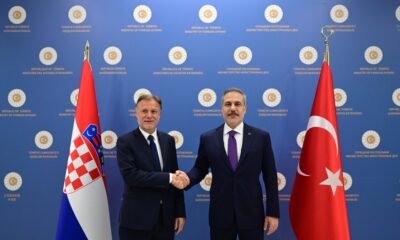
Foreign Minister Hakan Fidan held talks Thursday with Croatian Parliament Speaker Gordan Jandrokovic in Ankara as the senior Croatian official paid an official visit to Türkiye, the ministry said.
Separately, Defense Minister Yaşar Güler also met with Jandrokovic at the Defense Ministry, where the two chaired talks between their delegations, the ministry said in a statement.
Türkiye and Croatia maintain close diplomatic and economic ties, underpinned by their shared NATO membership and cooperation on regional security. Türkiye was among the first countries to recognize Croatia’s independence in 1992, and the two countries have since strengthened relations through political dialogue, trade and investment, as well as cooperation aimed at promoting stability in southeastern Europe.


-

 Sports2 days ago
Beşiktaş put Europa League record on line against off-color Celtic
-
 Politics3 days ago
Turkish authorities launch anti-FETÖ ops, detain 21 suspects
-
 Politics3 days ago
Erdoğan sends radio message to Azerbaijan flying over airspace
-

 Economy2 days ago
Stocks recover, dollar dips as Democrats score big in US midterms
-
 Politics2 days ago
Suspected poison found in body of former Turkish intel officer
-
 Economy2 days ago
Will Turkish central bank continue easing? Analysts are split
-
 Sports2 days ago
Trabzonspor aim to keep European fire burning against Freiburg
-
 Politics20 hours ago
Türkiye’s FM Fidan meets Croatian parliament speaker in Ankara