
Economy
US hiring drops as Trump pushes trade agenda

U.S. job growth is cooling significantly as President Donald Trump’s unpredictable trade policies unsettle businesses and cloud the outlook for the world’s largest economy.
The Labor Department reported Friday that U.S. employers added just 73,000 jobs last month, well short of the 115,000 forecasters had expected.
Worse, revisions shaved a stunning 258,000 jobs off May and June payrolls. And the unemployment rate ticked up to 4.2% as Americans dropped out of the labor force and the ranks of the unemployed rose by 221,000.
“A notable deterioration in U.S. labor market conditions appears to be underway,” said Scott Anderson, chief U.S. economist at BMO Capital Markets. ”We have been forecasting this since the tariff and trade war erupted this spring and more restrictive immigration restrictions were put in place. Overall, this report highlights the risk of a harder landing for the labor market.”
Economists have been warning that the rift with every U.S. trading partner will begin to appear this summer and the Friday jobs report appeared to sound the bell.
“We’re finally in the eye of the hurricane,” said Daniel Zhao, chief economist at Glassdoor. “After months of warning signs, the July jobs report confirms that the slowdown isn’t just approaching-it’s here.”
U.S. markets recoiled and the jobs report and the Dow tumbled more than 600 points at the opening bell Friday.
The revelations in the new data raise questions about the health of the job market and the economy as President Donald Trump pushes forward with an unorthodox overhaul of American trade policy.
Trump has discarded decades of U.S. policy that had favored fewer barriers and ever-freer trade. Instead, Trump is imposing hefty import taxes – tariffs – on products from almost every country on earth. Trump believes the levies will bring manufacturing back to America and raise money to pay for the massive tax cuts he signed into law July 4.
Mainstream economists say the cost of the tariffs will be passed along to Americans, both businesses and households. That has already begun to happen.
Walmart, Procter & Gamble, Ford, Best Buy, Adidas, Nike, Mattel, Shein, Temu, Stanley Black & Decker, have all announced, or said that they would hike prices, due to U.S. tariffs.
Trump has also sowed uncertainty in the erratic way he’s rolled the tariffs out – announcing, then suspending them, then coming up with new ones. Overnight, Trump signed an executive order that set new tariffs on a wide swath of U.S. trading partners to that go into effect on Aug. 7., and that arrived after a flurry of unexpected tariff-related actions this week.
“There was a clear, significant, immediate, tariff effect on the labor market and employment growth essentially stalled, as we were dealing with so much uncertainty about the outlook for the economy and for tariffs,” said Blerina Uruci, chief U.S. economist for the brokerage T. Rowe Price.
Still, Uruci said the data suggests we could be past the worst, as hiring actually did pick up a bit in July from May and June’s revised and depressed levels.
“I’m not overly pessimistic on the U.S. economy based on this morning’s data,” she said, though she does think that hiring will remain muted in the coming months as the number of available workers remains limited due to reduced immigration and an aging population.
Trump has sold the tariffs hikes as a way to boost American manufacturing, but factories cut 11,000 jobs last month after shedding 15,000 in June and 11,000 in May. The federal government, where employment has been targeted by the Trump administration, lost 12,000 jobs. Jobs in administration and support fell by nearly 20,000.
Healthcare companies added 55,400 jobs last month – accounting for 76% of the jobs added in July and offering another sign that recent job gains have been narrowly concentrated.
The department originally reported that state and local governments had added 64,000 jobs in education in June. After the revisions released Friday, that number fell to below 10,000.
After the big revisions for May and June, Labor Department data show that the U.S. economy has generated an average of just 85,000 jobs a month this year, barely half last year’s average of 168,000 and well below an average 400,000 from 2021-2023 as the economy rebounded from COVID-19 lockups.
The weak jobs data makes it more likely that Trump will get one thing that he most fervently desires: A cut in short-term interest rates by the Federal Reserve, which often — though not always — can lead to lower rates for mortgages, car loans, and credit cards.
Fed Chair Jerome Powell and other Fed officials have repeatedly pointed to a healthy job market as a reason that they could take time to evaluate how Trump’s tariffs were affecting inflation and the broader economy. Now that assessment has been undercut and will put more pressure on the Fed to reduce borrowing costs.
Wall Street investors sharply raised their expectations for a rate cut at the Fed’s next meeting in September after the report was released.
On Wednesday, the Fed left its key rate unchanged for the fifth straight meeting and Powell signaled little urgency to reduce rates anytime soon. He said the “labor market is solid” with “historically low unemployment.” But he also acknowledged there is a “downside risk” to employment stemming from the slow pace of hiring that was evident even before Friday’s weaker numbers.
The current situation is a sharp reversal from the hiring boom of just three years ago when desperate employers were handing out signing bonuses and introducing perks such as Fridays off, fertility benefits and even pet insurance to recruit and keep workers.
The rate of people quitting their jobs – a sign they’re confident they can land something better – has fallen from the record heights of 2021 and 2022 and is now below where it stood before the pandemic.
Drees Homes, a homebuilder based outside Cincinnati in Fort Mitchell, Kentucky, has hired about 50 people over the past year, bringing its workforce to around 950. Pamela Rader, Drees’ vice president for human resources, it’s “gotten a little bit easier’’ to find workers.
A couple of years ago, Rader said jobseekers were focused on getting more pay. Now, she said, they emphasize a better work-life balance, stable employment and prospects for advancement.
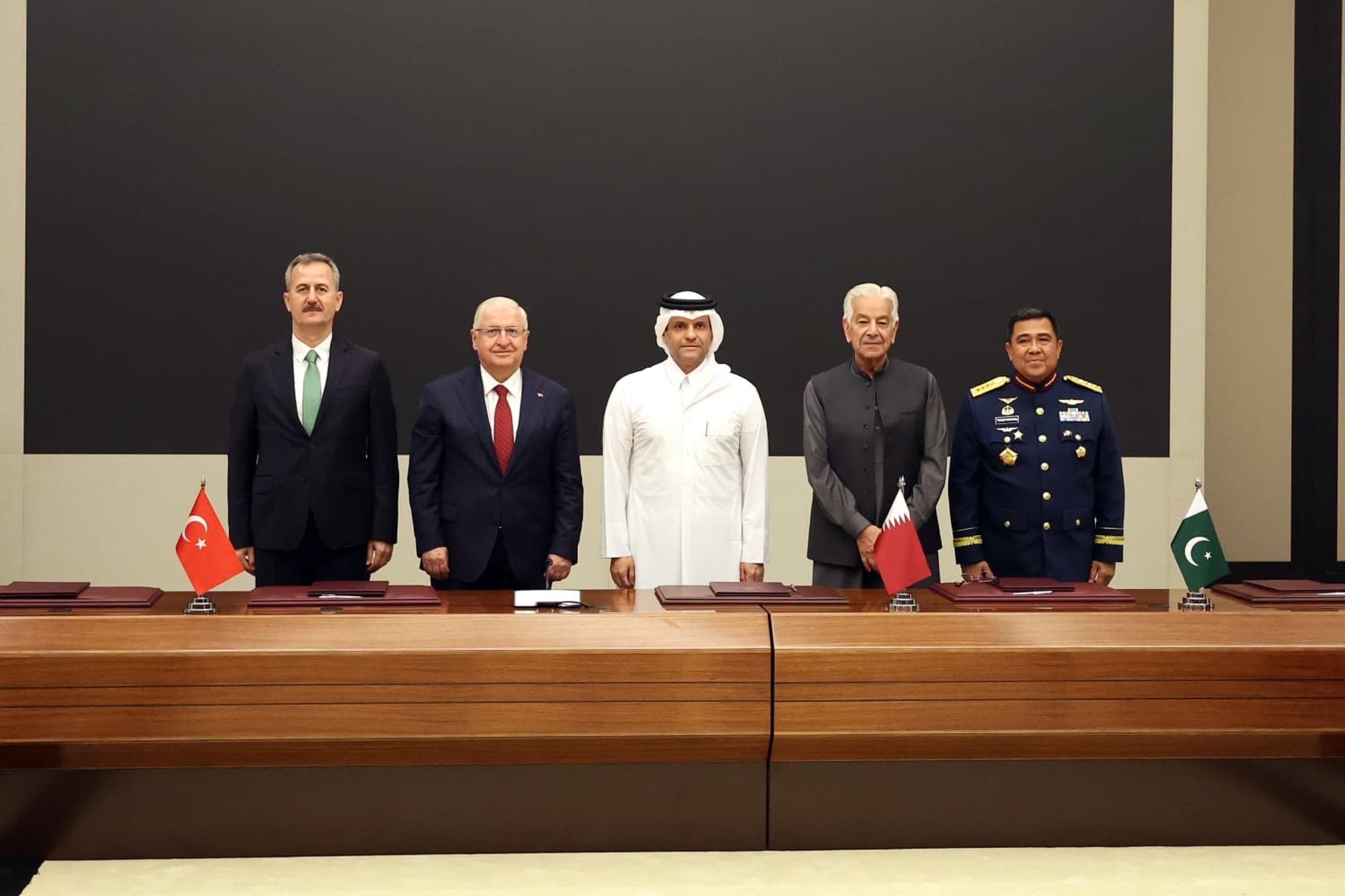
Türkiye, Qatar, Pakistan and Indonesia signed a quadrilateral defense cooperation agreement in Doha on Wednesday, the Turkish Defense Ministry said.
The “Badr Memorandum of Understanding” is aimed at boosting defense cooperation and strengthening the four countries’ defensive capabilities. It will also support military exercises and training and cooperation on research and development (R&D) and contribute to joint efforts to improve their defense industries, the ministry said.
“The agreement holds substantial economic importance,” it said. “By leveraging the unique military production capabilities of each country, the initiative will facilitate cooperation and integration, enhance defense industrial capacities, and enable the fulfillment of the needs of allied and friendly nations.”
Türkiye, which has NATO’s second-largest army and a robust defense industry, has been helping Gulf nations, including Qatar, where it has a military base, bolster their defenses amid the Iran war.
In August, it signed the Mecca Joint Defense Agreement with nuclear-armed Pakistan and Saudi Arabia, under which an attack on one party constitutes an attack on all. Ankara also has close ties with Indonesia, notably in the defense industry.
Türkiye says that the Mecca partnership is meant to strengthen collective deterrence, enhance joint capabilities in the defense sector and safeguard security and stability in the region.
The Badr accord will strengthen ties between the countries’ defense industries and bolster collaboration to promote security and achieve shared objectives, the Defense Ministry said.
Wednesday’s agreement builds on existing bilateral relationships and could create new areas of cooperation. It could also help bring together the countries’ industrial capabilities in projects already underway.
Areas of concrete cooperation include joint R&D projects, joint production of certain components of defense products, training of technical personnel, sharing of engineering experience, adapting jointly developed products to each side’s needs and marketing them internationally.
Existing ties
Cooperation between Türkiye and Qatar has recently turned toward joint investment and production models. Bayraktar TB2 armed drones, armored vehicles and assault boats have entered Qatar’s armed forces inventory.
Barzan Holding, owned by Qatar’s Defense Ministry, has signed several agreements with Turkish firms including Aselsan, STM and MKE. Through BARQ, a company set up in Qatar by Aselsan and Barzan, assembly, production and calibration of remote-controlled weapon systems (SARP) and electro-optical devices have begun in Qatar.
In Pakistan, a major example is the PN Milgem (Babur-class) corvette project, led by the Turkish contractor ASFAT. Of the four corvettes, the first two were built in Istanbul and the other two at Karachi Shipyard in Pakistan.
The project modernized the yard’s production infrastructure and passed shipbuilding and outfitting skills to the local workforce.
With Indonesia, recent concrete steps include the sale of the Kaan fighter jet, the joint development of the Kaplan MT medium tank and an armored personnel carrier, and the supply and co-production of the Atmaca anti-ship missile.
Under an intergovernmental agreement between the Presidency of Defense Industries (SSB) and Indonesia’s Defense Ministry, the Kaplan MT was co-designed by Türkiye’s FNSS and Indonesia’s PT Pindad.
Prototypes and the first production tanks were delivered to Indonesian users, and production continues in Indonesia at PT Pindad under a technology transfer arrangement.
Türkiye’s defense exports
The agreement comes as Türkiye’s defense exports reach record levels.
According to figures from the Defense and Aerospace Industry Exporters’ Association (SSI), Türkiye’s defense and aerospace sector exported about $54 billion between 2012 and 2026, including the first nine months of this year.
More than $30 billion of that was in 2023-2026, meaning the last four years account for over 55% of the total for the past 14 years.
Exports rose 48% in 2025 to a record of more than $10 billion, and exports over the last 12 months topped $11 billion for the first time.
The Stockholm International Peace Research Institute (SIPRI) says Türkiye raised its arms exports by 122% over the past five years, making it the world’s 11th-largest arms supplier. About 56% of Türkiye’s defense and aerospace exports go to NATO allies, the report said.

Billionaire Mukesh Ambani’s Jio Platforms drew notable investor interest on Wednesday, being able to fully subscribe to its initial public offering (IPO) within two hours of opening, setting the stage for what is likely to be India’s largest-ever listing.
Jio Platforms, which houses the country’s biggest wireless operator and is the digital services arm of Ambani’s Reliance Industries, is looking to raise up to $3.2 billion in India’s most anticipated IPO this year.
Bids placed by investors exceeded the 197.5 million shares on offer within 100 minutes of opening, according to BSE stock exchange data, with local media calling it the “fastest-ever subscribed IPO” in India.
Most analysts expect gains when the stock debuts in Mumbai next week – likely Oct. 28 – despite the weak performance of Indian equities this year.
Launched a decade ago, Jio’s wireless service disrupted the market with steep discounts that helped it rapidly win customers from rival telecom firms Bharti Airtel and Vodafone.
The company’s 533 million subscribers provide a “strong foundation for future growth,” analysts at financial services firm Motilal Oswal said in a note.
But they also cautioned that “monetisation of newer digital services” still needs to be “demonstrated at scale.”
While the massive IPO is seven years in the making, it comes at a challenging time for Reliance – India’s most valuable listed company, which still depends heavily on its traditional oil business to make money.
U.S. ties
Reliance’s refining empire drew the anger of the U.S. last year after White House adviser Peter Navarro accused Indian tycoons of profiting off the Ukraine war by buying discounted Russian crude.
While Navarro did not identify a specific businessperson, it was widely seen as a swipe at Ambani, who appeared this year to offer an olive branch by supporting the construction of America’s first major new oil refinery in half a century.
Ambani was set to meet U.S. Secretary of State Marco Rubio on Wednesday in the western city of Jamnagar – where Reliance’s massive refinery complex is located – as Washington seeks to boost energy cooperation with India.
Experts say Jio is key to Reliance’s strategy to evolve beyond its oil business and the touchstone of its future tech ambitions.
While Jio makes most of its money from telecoms, it has expanded into areas including artificial intelligence.
Reports also said it was considering a low-orbit satellite constellation to provide internet services from space, a venture that would put it in competition with Musk’s Starlink, which has been trying for years to launch in India.
Musk accused unnamed Indian “oligarchs” this month of preventing Starlink’s rollout in the country, and referred to the Reliance boss as “Prime Minister Ambani” and the “real boss of India.”
Reliance responded by noting that it had never “feared competition” and welcomed offerings from rivals in satellite communications, including Starlink.
Netflix is aiming to increase the amount of time users spend watching its films and series as the streaming giant reported on Tuesday its slowest quarterly revenue growth in years.
“We want to be the must-have entertainment service,” co-chief executive Ted Sarandos told analysts during a video conference.
His counterpart Greg Peters agreed, saying: “We know that we can do better.”
Revenue rose 12% year-over-year to $12.9 billion, the slowest growth in three years but in line with analysts’ expectations. Net profit increased by around 44% to $3.66 billion.
Netflix remains the clear leader in video streaming, but Sarandos recently acknowledged that the business was not growing as quickly as hoped. Market research firms have repeatedly reported declining engagement among Netflix viewers in recent months.
Netflix productions also struggled to make an impact at recent awards ceremonies, while new releases have yet to establish the same cultural presence as hits such as “Stranger Things” and “Squid Game.”
Netflix shares fell more than 5% in after-hours trading following the earnings release.
Last week, Netflix announced plans to cut around 6% of its workforce, affecting about 1,000 employees. The shake-up extended to senior management, with long-serving chief content officer Bela Bajaria leaving the company.
Film chief Dan Lin was also subsequently ousted. Peter Rice, who built his career at traditional studios including Disney, will take over Bajaria’s role.
The appointment has fuelled speculation that Netflix could give films a wider theatrical release under Rice. Sarandos has consistently rejected the idea of cinema releases as a distraction from the company’s core business.
Sarandos reiterated that Netflix remained primarily focused on streaming. “That is our core,” he said. However, some films, including “Narnia” by “Barbie” director Greta Gerwig, will receive an exclusive 45-day cinema run, following the traditional studio model.
Peters also suggested Netflix could expand its partnership with French broadcaster TF1, whose programming is available on the streaming platform, to other markets.
Türkiye is part of a region that has an $872 billion pipeline of infrastructure projects, highlighting its investment potential and offering international and corporate investors greater exposure to the region ahead of 2030, according to a report from HSBC.
Investment in alternative logistics routes could mitigate the impact of the Iran war and make the Strait of Hormuz “redundant” in the next five years, HSBC Group CEO Georges Elhedery told an event in Dubai on Tuesday.
The report, published Monday and based on data from MEED, a Dubai-based construction industry market intelligence platform, covers the Middle East, North Africa and Türkiye (MENAT) region.
The $872 billion is part of a wider infrastructure pipeline worth $1.4 trillion.
The Iran war has shown how heavily the world relies on the Strait of Hormuz, the narrow waterway at the mouth of the Persian Gulf between Iran and Oman. A fifth of global oil and liquefied natural gas trade previously passed through it.
The conflict is pushing Gulf nations to channel resources into energy pipelines to ports, Elhedery said. He said this investment will help the region weather the fallout.
“Of course, we do wish and hope to see a resolution to the conflict,” he said, but “Hormuz, probably in five years’ time, may become redundant.”
“We do see this region being able to recover and then continue growing,” he said. “It will mean a lot of investment.”
A recent HSBC survey of over 1,600 business leaders and around 820 global institutional investors, meanwhile, found that they still considered the Gulf an attractive investment hub.
However, after growth of 3.3% in 2025, the World Bank last week forecast a deep economic contraction of 1.3% in the Middle East, North Africa and Pakistan region this year due to the war. That should be followed by a strong but uneven rebound in 2027.
HSBC’s report doesn’t say which Turkish projects are included in the $872 billion or how much of it is in Türkiye.
The country’s place in the grouping reflects its role as a route between the Gulf and Europe.
The most direct example is the Development Road, a planned corridor linking the Persian Gulf to Europe through Iraq and Türkiye. It complements the Middle Corridor, the route across Central Asia and the Caucasus.
Cargo leaving Iraq’s Faw Port, on the Gulf coast in Iraq’s far south, would travel about 1,200 kilometers by rail to Ovaköy, a crossing on the Türkiye-Iraq border in southeastern Türkiye.
Turkish officials have linked that project to Hormuz and said that, had the Development Road been completed, the world’s energy supply would have been far less affected.
Earlier this month, Türkiye opened the Çerkezköy-Kapıkule section, the longest part of the Halkalı-Kapıkule high-speed rail line, extending the network to the EU border.
The line is 229 kilometers long. It begins on Istanbul’s western edge and ends at Türkiye’s main rail and road border crossing with Bulgaria, at Kapıkule near the northwestern city of Edirne.
President Recep Tayyip Erdoğan said the line is a key component of the 2,094-kilometer Turkish section of the Development Road.
Canadian Prime Minister Mark Carney is set to arrive in Türkiye on a trip expected to give a new push to relations between the two countries that are working toward a free trade agreement (FTA).
Carney will travel to Ankara and Istanbul from Wednesday to Friday and is scheduled to hold talks with President Recep Tayyip Erdoğan during what will mark the first dedicated bilateral visit to NATO ally Türkiye by a Canadian leader.
The trip marks Carney’s latest diplomatic effort as he seeks to reduce the country’s reliance on the United States, by far its biggest trading partner, after a collapse in trade talks in August.
The talks with Erdoğan are meant to cover political and diplomatic issues as well as trade, defense industry, energy and mutual investment.
Carney and his delegation are also expected to meet Turkish business representatives to discuss opportunities in areas such as aviation, advanced technologies and critical minerals.
The premier has vowed to double Canada’s non-U.S. trade over the next decade and has rushed to establish ties with a host of countries, including China and India, with which it had past strains.
Relations received a boost from the NATO leaders’ summit in Ankara in July, when Carney and Erdoğan formally launched negotiations for a free trade agreement.
Türkiye has also agreed to join Canada’s Defense Security and Resilience Bank as one of 10 founding member nations of Carney’s multilateral “middle powers” bank.
The bank’s purpose is to bolster the defense of like-minded allied nations by raising up to 100 billion pounds ($134 billion) in cheap financing.
The two countries’ technical teams have worked intensively since July to define the scope and goals of the trade agreement.
Trade Minister Ömer Bolat and Canadian International Trade Minister Maninder Sidhu also met in June to discuss advancing the economic partnership. They described energy as a “promising area” for deeper cooperation, and discussed possible cooperation in nuclear energy.
Trade, tourism, investment
Türkiye’s exports to Canada last year totaled about $1.58 billion, and its imports from Canada about $1.16 billion. That put two-way trade at about $2.74 billion.
The leading Turkish exports in 2025 were boilers, machinery and mechanical appliances, at $158.8 million, followed by iron and steel at $104.4 million and articles of iron or steel at $97.0 million.
In the first eight months of this year, exports to Canada reached about $1.02 billion and imports about $955 million, bringing trade close to $2 billion.
Boilers and machinery again led exports at $96.1 million, followed by aluminum and aluminum articles at $73.8 million and edible fruits and nuts at $49.5 million.
If an FTA is signed, the two countries aim to lift trade to $7-$8 billion in the short term, and to $10 billion later.
Visitors from Canada to Türkiye rose 6.1% to 321,271 in 2025, from 302,728 in 2024. In the first eight months of 2026, arrivals rose 2.9% year-over-year to 209,176.
According to Statistics Canada, Canada’s stock of direct investment in Türkiye stood at CA$3.3 billion ($2.35 billion) as of 2025. Türkiye’s direct investment stock in Canada was CA$233 million.
Turkish households’ confidence in the lira remains resilient, a leading rating agency suggested in a report, also suggesting that the country’s economy can withstand the effects of the energy shock resulting from the Middle East war despite the upward pressure on inflation.
The resilient household confidence in the Turkish lira and declining demand for foreign currency have also allowed the Central Bank of the Republic of Türkiye (CBRT) to partially rebuild its foreign exchange reserves, according to S&P Global Ratings’ analysis of the Turkish economy.
In this context, household confidence in the Turkish lira remained resilient throughout the year. As of September, foreign-currency deposits accounted for 38.7% of total bank deposits, unchanged from the beginning of the year.
Meanwhile, the impact of the fund investigation that began in September and the liquidation of certain investment funds remained limited, according to the S&P.
Although forced asset sales triggered a sharp correction in the stock market and led to the liquidation of approximately $18 billion in funds, the CBRT’s rapid provision of liquidity and the targeted measures implemented within the regulatory framework prevented “financial contagion.”
The fact that funds leaving these investments largely flowed into Turkish lira-denominated bank deposits rather than foreign-currency deposits suggests that these developments did not trigger a broader loss of confidence in the Turkish lira.
Moreover, according to the analysis, the energy price shock following the war in the Middle East is expected to put upward pressure on inflation in Türkiye. Inflation is forecast to average 30.9% this year and 21.7% in 2027.
S&P Global Ratings’ stable outlook for the Turkish economy reflects its assessment that Türkiye can withstand the ongoing energy price shock, provided that policymakers maintain tight monetary and wage-setting policies and avoid further depleting foreign exchange reserves.
Economic growth in Türkiye is expected to reach 3% this year, compared with 3.7% last year. Due to the war in the Middle East, this year’s growth forecast is 0.4 percentage points lower than the agency’s previous estimate. Economic growth is expected to accelerate again in 2027, reaching 3.7%.
The budget deficit, which stood at 2.6% of gross domestic product (GDP) last year, is forecast to widen slightly this year, approaching 3% of GDP. Meanwhile, public debt as a share of GDP is expected to remain low, staying below 30%.
In its latest assessment, published in April, S&P Global Ratings affirmed Türkiye’s credit rating at “BB-/B” and maintained its outlook at stable. The agency subsequently skipped its scheduled review of Türkiye, which had been expected on Oct. 16.


-

 Politics3 days ago
Turkish Embassy rejects reports of FM Fidan’s ‘secret talks’ in Baku
-

 Economy3 days ago
Türkiye foresees spending over $20B on transportation next year
-

 Sports2 days ago
Fenerbahçe seek Champions League reset against Slavia Prague
-
 Politics2 days ago
Busy week awaits Erdoğan with key speech, Carney visit
-
 Politics3 days ago
Türkiye, Cambodia sign military coop. deal as Erdoğan hails growing ties
-
 Politics3 days ago
Turkish FM heads to Baghdad for OIC talks on Gaza, regional tensions
-
 Economy3 days ago
Vietnam, EFTA nations sign free trade deal
-

 Politics1 day ago
Turkish, Saudi FMs discuss regional security in phone call