
Politics
Ankara opposes Greece’s energy deal near Crete, cites 2019 Libya pact

Türkiye on Thursday criticized Greece’s agreement with Chevron for hydrocarbon exploration south of Crete, calling the move contrary to international law and good neighborly ties.
“We oppose this unlawful activity, which is being attempted in violation of the 2019 Memorandum of Understanding on Maritime Jurisdiction between Libya and our country,” the Turkish Defense Ministry said at its weekly press briefing.
It noted that the activity, while not directly impacting Türkiye’s continental shelf in the region, also violated Libya’s maritime jurisdiction declared to the United Nations on May 27, 2025.
“We continue to provide the necessary support to the Libyan authorities to take action against these unilateral and unlawful activities by Greece,” the ministry said.
The Chevron-led consortium signed exclusive lease agreements on Monday to look for natural gas off southern Greece, expanding the United States’ presence in the Eastern Mediterranean.
The 2019 agreement signed by Türkiye and Libya set out maritime boundaries in the Mediterranean Sea and was rejected by Greece as it ignored the presence of the Greek island of Crete between the coasts of Türkiye and Libya.
The Chevron deal doubles the amount of Greek maritime acreage available for exploration and is the second in months involving a U.S. energy major as the European Union seeks to phase out supplies from Russia and the U.S. seeks to replace them.
As neighbors and NATO members, Türkiye and Greece have been at odds over a range of issues for decades, primarily maritime boundaries and rights in the Aegean, an area widely believed to hold energy resources and with key implications for airspace and military activity.
Relations with Somalia
Responding to questions about recent developments in Somalia and the status of Turkish troops in the country, the ministry also said Türkiye’s training, advisory and support activities aimed at ensuring security and stability in the friendly nation were continuing with increasing scope as part of its contributions to international stability.
The statement said Türkiye would continue to provide security for ongoing drilling operations as well as for the “Space Port and Test Launch Site” being built in Somalia, and to offer maximum support to counterterrorism operations carried out by the Somali National Army. It added that the Turkish Armed Forces (TSK) would maintain effective deterrence through their presence and support in Somalia.
Somalia’s territorial integrity also matters for Türkiye, which is a major partner of Mogadishu, especially in the wake of Israel’s controversial recognition of breakaway Somaliland. Ankara has joined other countries to condemn the recognition by its major foe in the Middle East, which looks to expand its footprint in Africa, where Türkiye also emerged as a key actor in the past two decades under the leadership of President Erdoğan.
On Feb. 5, Somalia’s federal Cabinet approved a series of major maritime trade agreements, including a new cooperation deal with Türkiye that covers maritime trade developments, ship traffic improvements, port service modernization, mutual recognition of seafaring certificates of competency, technical cooperation and know-how sharing, ensuring equality in port services, and the facilitation of commercial activities.
The Türkiye-Somalia cooperation has developed in a multidimensional way since 2011, especially in the economy, education, health, infrastructure and development.
Moreover, it was recently announced that Türkiye’s new deep-drilling ship Çağrı Bey left for Somalia from the southern province of Mersin to begin the operation for oil exploration.
It is the second Turkish vessel to be deployed in Somali waters after Oruç Reis. It is also the first drilling ship to be deployed outside Turkish waters.
The research and seismic vessel Oruç Reis was dispatched to Somalia from Istanbul in October 2024, and it completed its mission in the summer of last year.
Türkiye, which enjoys close ties with Somalia, has a strong cooperation with Mogadishu in a number of areas, from energy to defense to infrastructure investments. The two governments have signed several deals on cooperation in recent years.
Developments in Syria
Regarding the latest developments in Syria, the ministry stressed that, “Türkiye expects the integration process between the Syrian government and the YPG to be completed swiftly,” adding that authorities are closely monitoring developments on the ground and taking all necessary measures in line with Türkiye’s interests.
The statement also noted that there is no alternative to an integration that reinforces Syria’s unitary structure and upholds the principle of “one state and one army.”
The Syrian Army launched an operation against the YPG on Jan. 16 in areas west of the Euphrates River. The operation later expanded east of the river with the participation of tribal forces, leading to all of the territories previously occupied by the group coming under government control.
On Jan. 18, the Syrian government and theYPG reached a comprehensive cease-fire and full integration agreement, outlining sweeping measures to restore state authority in the northeast.
Syrian security forces and administrative bodies have entered areas previously controlled by the YPG, including Hassakeh, Qamishli and Ain al-Arab (Kobani), as well as strategic facilities such as airports, oil fields, and border crossings.
The agreement provides for the gradual handover of security responsibilities, the deployment of state institutions, and the integration of YPG forces into official government structures.

NATO officials have praised Türkiye’s major contribution to the alliance’s largest exercise of the year, highlighting the strong presence of Turkish forces and the performance of advanced drone capabilities.
Col. Matthias Boehnke, spokesperson for NATO’s Joint Force Command Brunssum, said Türkiye was the leading contributor to the Steadfast Dart 2026 exercise, which is being conducted in Germany and the Baltic region.
“Türkiye is the nation providing the largest contribution to this exercise. The core forces and a significant portion of the units come from Türkiye,” Boehnke said during a media and distinguished visitors day at the Putlos training area on the Baltic Sea.
The Steadfast Dart 2026 exercise, NATO’s largest of the year, tests the rapid deployment and integration of the Allied Reaction Force (ARF). Running from January to March 2026, it involves around 10,000 personnel from 11 NATO countries.
The exercise is organized by Joint Force Command Brunssum, one of NATO’s three operational joint commands alongside Naples and Norfolk, and aims to test the alliance’s rapid deployment and interoperability capabilities.
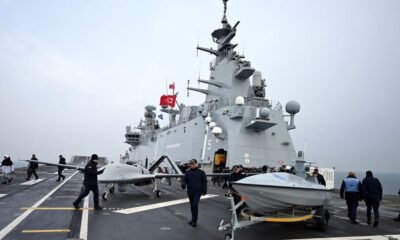
Boehnke also noted the significance of the deployment of the amphibious assault ship TCG Anadolu, which is operating far from its usual area for the first time.
“The large vessel you see behind us is Anadolu. This marks one of the first missions in which the ship has deployed beyond the Mediterranean, operating here in the Baltic Sea,” he said.
The maritime phase included an amphibious landing operation involving Spanish units and a large contingent of Turkish forces, demonstrating NATO’s ability to conduct complex joint operations.
NATO officials also highlighted the debut of Türkiye’s Bayraktar TB3 drone on the international stage during the exercise. The drone’s ability to operate from TCG Anadolu was described as a key capability.
“I believe its performance has been highly successful,” Boehnke said. “Unmanned systems are central to modern warfare. They are vital for reconnaissance, operational effectiveness and, ultimately, for saving lives.”
He added that the integration of drone operations with a naval platform significantly enhanced the overall value of the exercise.
Addressing reports about Ukrainian participation, Boehnke clarified that Ukrainian troops were not part of the Allied Reaction Force taking part in the drills, which consists primarily of Turkish, Italian and Spanish units.
However, Ukrainian personnel were invited separately to share their battlefield experience, particularly lessons learned from drone warfare and counter-drone operations.
“They are not participants in the exercise itself,” Boehnke said. “But they have been invited to present their operational experience and insights into modern warfare.”
Fifteen ships and 2,600 personnel from Türkiye, France, Poland, Germany, the Netherlands and Spain participated in the operation.
Türkiye joined NATO on Feb. 18, 1952. The alliance was founded in 1949.
Over the past 74 years, leveraging its strategic location, Türkiye has continued to make critical contributions to NATO as the first ally in the region to directly confront threats and risks, particularly in the fight against terrorism.
Among 32 allies, Türkiye ranks seventh in contributing to the alliance’s budget. Its total contribution is expected to amount to 300 million euros (just over $355 million) this year and to rise to 620 million euros in 2030.
Türkiye is preparing legislation that would require identity verification for social media users, with Justice Minister Akın Gürlek saying the move aims to increase accountability and curb online abuse, disinformation and criminal activity.
Under the planned regulation, individuals who post, comment or share content would be required to verify their identities, ending the widespread use of anonymous or fake accounts.
Verified identities would ensure that users who spread harmful content, incite harassment, target individuals or engage in unlawful online behavior could be held legally responsible, Gürlek told a Turkish newspaper on Wednesday.
He stressed that anonymity has enabled online intimidation campaigns, misinformation and the targeting of public figures and private citizens alike, adding that clearer accountability would help create a safer digital environment.
Once the law is passed by Parliament, the Information and Communication Technologies Authority (BTK) is expected to oversee implementation. Existing accounts may be given a transition period to complete verification, after which unverified accounts could face restrictions.
Gürlek said the ministry is coordinating the effort with relevant institutions, noting that the regulation is intended to balance freedom of expression with the need to prevent crimes and rights violations online. He added that the government views the measure as part of a broader strategy to adapt the legal system to the risks posed by rapidly evolving digital platforms.
Juvenile crime reforms
The ministry is also working on changes to the legal framework for juveniles involved in crime as part of the upcoming 12th Judicial Reform Package, in coordination with the Family and Social Services Ministry.
Gürlek said authorities are reviewing the current age-based categories of criminal responsibility and considering adjustments to the definition of “children driven to crime.”
Türkiye’s current system assigns criminal liability within the 12-15 and 15-18 age groups.
The planned reforms aim to address cases in which criminal networks and street gangs exploit legal gaps by using minors.
Gürlek said the government is determined to prevent the rise of youth gangs and strengthen deterrence while ensuring a balanced legal approach. The proposal is expected to be submitted to parliament by the summer.
The number of children involved in incidents reported to security units across Türkiye rose sharply in 2024, reaching 612,651, a 9.8% increase from the previous year, according to data from the Turkish Statistical Institute.
The figures show multiple reasons for contact with law enforcement. Of the total, 279,620 children were recorded as victims, while 202,785 were classified as “children driven to crime.” Another 96,438 were questioned for information, 18,561 were reported missing and later found, 8,729 were linked to minor offenses, and 6,518 were brought in for other reasons.
Among children driven to crime, assault was the most common allegation, accounting for 40.4% of cases. Theft followed at 16.6%, and drug-related offenses, including use, sale or purchase, made up 8.2%. Other cases involved threats (4.6%), crimes posing general danger (4.2%) and a range of other offenses totaling 26%.
‘Alo Justice’ hotline
To improve public access to judicial services, the ministry will launch an AI-supported “Alo Justice” hotline, with a pilot phase beginning in Istanbul.
The system will allow citizens to submit complaints, requests or feedback by phone, email or digital platforms. Officials say artificial intelligence will help identify systemic problems, detect recurring issues and improve service efficiency across courts and judicial institutions.
The initiative is intended to make the justice system more accessible and responsive by enabling faster communication between citizens and authorities.
Fight against illegal betting
Gürlek also reiterated the government’s determination to combat illegal betting networks, noting that large-scale operations conducted during his tenure as Istanbul chief prosecutor had disrupted major criminal structures.
Authorities say illegal betting organizations frequently change methods to evade detection, but enforcement efforts will continue with a focus on dismantling financial networks, strengthening digital monitoring and protecting citizens from fraud and organized crime.
Speaking to journalists during his return from Ethiopia, President Recep Tayyip Erdoğan confirmed that Türkiye would be represented by Foreign Minister Hakan Fidan at Thursday’s Board of Peace meeting in Washington.
“I hope the Board of Peace will contribute to permanent stability in Gaza,” he was quoted as saying in remarks published on Wednesday.
“I hope it will, ultimately, contribute to a cease-fire and peace,” he added.
Erdoğan stated that the Gaza issue was a test of conscience for humanity.
“We have demonstrated where we stand on this matter since day one. The suffering our Palestinian brothers and sisters went through should end. (the Board of Peace) should aim to make the cease-fire permanent, ensure delivery of humanitarian aid to Gaza and solidify the ground for a two-state solution. We hope that the board will serve this purpose. Türkiye has always been open in its support to any initiative for the benefit of our Gazan brothers,” he underlined.
In January, the White House announced the formation of the Board of Peace alongside the approval of a National Committee for the Administration of Gaza, one of four bodies designated to manage the transitional phase in the enclave. Fidan joined U.S. President Donald Trump and representatives of countries in signing the Board of Peace charter in Davos, Switzerland, last month.
A Turkish diplomatic source told Reuters on Wednesday that Fidan, during the talks, would call for determined steps to resolve the Palestinian issue and emphasize that Israel must end actions that hinder the flow of aid into Gaza and stop its cease-fire violations. Fidan will also reiterate Türkiye’s readiness to contribute to Gaza’s reconstruction and its desire to help protect Palestinians and ensure their security, the source said. He will also call for urgent action against Israel’s “illegal settlement activities and settler violence in the West Bank,” the source added.
The creation of the board coincided with the launch of phase two of a cease-fire agreement, which halted Israel’s genocidal war on Gaza, which has killed more than 71,000 people and injured over 171,000 others since October 2023.
The initiative is part of a 20-point plan proposed by Trump and adopted by the U.N. Security Council under Resolution 2803 last November.
Türkiye is a resolute supporter of the Palestinian cause in the face of Israel’s genocidal attacks. Erdoğan and his team of diplomats played an effective role in the issue, and most recently, Ankara contributed to efforts to secure a cease-fire between Israel and Hamas. At every international event and platform, Erdoğan has been vocal about his opposition to the Netanyahu administration’s blockade of Gaza and slaughter of innocent civilians since 2023.
At one point, Türkiye spearheaded efforts to establish a guarantorship model in Palestine, though Ankara concentrates on its ultimate goal: helping broker a solution to the longstanding issue by establishing a sovereign State of Palestine.
Europe’s defense
Erdoğan also commented on ties with the EU and the situation in Iran. “It is time to include Türkiye in Europe’s defense and security mechanisms,” Erdoğan said.
Türkiye is under the spotlight for its massive contribution to NATO’s biggest exercise, Steadfast Dart 2026, currently underway in Germany. The exercise, in which some 2,000 Turkish troops are participating, highlighted Türkiye’s contribution to the alliance, mostly made up of European countries. Europe seeks to bolster its defenses amid the spillover of the Russia-Ukraine conflict on its eastern flank.
Answering a question, Erdoğan said the world was changing, and the European Union cannot confine itself to “(certain) narratives” in this age of rapid developments.
“A good choice for them will be lifting ideological barriers blocking Türkiye’s integration with the EU and empowering Europe.
“They have to admit that it does not make sense to exclude Türkiye and turn a blind eye to the reality on the ground. If they want to build a new defense architecture, it will be futile to create it without Türkiye. The Turkish army is one of the biggest and most efficient armies in NATO. We trust it. Türkiye is not some country that only proceeds with diplomatic skills. It is a country showcasing its abilities in the field. I hope it is understood that Europe cannot speak of a functioning security equation without Türkiye,” he said.
Last summer, EU countries adopted a regulation setting up SAFE, a new financial instrument designed to support member states that wish to invest in defense industrial production through common procurement, focusing on priority capabilities. The mechanism was created at the height of Europe’s concerns about the spillover of the Russia-Ukraine conflict.
Under the approved part of the regulation, joint defense procurement of the bloc may include third countries not members of the EU, such as Türkiye. Türkiye, a EU candidate country, expressed interest in joining the programs and received support from major member states, including Germany, Spain and Italy. But minor players, Greece and the Greek Cypriot administration, objected, stalling the process.
Military action in Iran
“We conveyed to our counterparts that Türkiye is against military intervention in Iran,” Erdoğan said.
Türkiye’s eastern neighbor was rocked with unrest in recent months, prompting the U.S. to hurl threats of military action against the country. Erdoğan told reporters that Ankara favors dialogue for a resolution of the problems between Iran and the U.S. He said they had high-level contacts with both countries.
“I last held talks with the Iranian president. I also held talks with President Trump. We discussed how we can move forward. Türkiye is a country that does not build walls between countries. It is not a country fuelling conflict. It is a country building bridges and paving the way for peace. A new war targeting Iran will not benefit anyone. On the contrary, our region will stand much to lose,” he said.
“There is hope as long as the door to diplomacy is open,” he added.
Iran said Tuesday it had agreed with the U.S. in talks in Geneva on “guiding principles” for a deal to avoid conflict, but Vice President JD Vance said Tehran had not yet acknowledged all of Washington’s red lines. The Omani-mediated talks were aimed at averting the possibility of U.S. military intervention to curb Iran’s nuclear program. Iran’s supreme leader had warned earlier in the day that the country had the ability to sink a U.S. warship recently deployed to the region, after Trump alluded to “consequences” should the two sides fail to strike a deal.
Ties with Ethiopia
On his visit to Ethiopia, Erdoğan said he was pleased to visit the country after an 11-year break and thanked Prime Minister Abiy Ahmed for the warm welcome.
He stated that they discussed the steps needed to reach a $1 billion trade volume target with Ethiopia, highlighting opportunities to increase Turkish investment and signing agreements in the fields of economy and energy. Noting that Ethiopia serves as a key aviation hub for flights across Africa, Erdoğan said the country is advancing a major airport project and that Turkish companies could contribute to it.
Describing Ethiopia as the largest country in the strategically significant Horn of Africa, Erdoğan said it has strong potential with its deep-rooted state tradition and population of nearly 130 million. He pointed out that Addis Ababa, home to the African Union and several United Nations agencies, is often referred to as the diplomatic capital of Africa.
Erdoğan said the opening of Türkiye’s oldest embassy in sub-Saharan Africa in Addis Ababa in 1926 demonstrates that the city has long been at the heart of Türkiye’s relations with the continent. He noted that just prior to his visit, Ethiopia hosted an African Union summit, and that next year, Addis Ababa will host the U.N. Climate Change Conference of the Parties under the United Nations Framework Convention on Climate Change. Erdoğan said Türkiye would share its experience from hosting the conference in November with Ethiopian officials.
“If we want to tap into Africa’s potential, one of the key gateways is undoubtedly Ethiopia,” he said.
Recalling the Ankara Process, Erdoğan said Türkiye has established a habit of working closely with Ethiopia and noted that the Ankara Declaration adopted in December 2024 helped strengthen trust between Ethiopia and Somalia.
“We have achieved good results together, and, Allah willing, we will continue to do so,” he said.
Erdoğan said his visit to Addis Ababa also reflects Türkiye’s broader partnership policy toward Africa. He added that he shared this approach with Mahmoud Ali Youssouf, chairperson of the African Union Commission, and discussed continental issues as well as preparations for the 4th Türkiye-Africa Partnership Summit.
Speaking at an event in Istanbul on Tuesday, Turkish Cypriot President Tufan Erhürman said talks with Greek Cypriots cannot be resumed unless the political equality of both sides is guaranteed.
“This should be the state before negotiations. U.N. Secretary-General Antonio Guterres is also aware that the system of negotiations in place failed to produce a solution,” he said.
Erhürman was recently in New York to hold talks with the U.N. chief over the decades-old Cyprus question.
Cyprus has been mired in a decades-long dispute between Greek Cypriots and Turkish Cypriots, despite a series of diplomatic efforts by the U.N. to achieve a comprehensive settlement. The Greek Cypriot side is recognized as a political entity by most of the international community, while the Turkish Republic of Northern Cyprus (TRNC) pushes for recognition, with the support of Türkiye.
Erhürman said they presented a four-article methodology for talks to the United Nations.
The Turkish Cypriot leader said his nation had joint and equal sovereignty rights legally on the island, from security and energy to maritime jurisdiction, rights on hydrocarbons and international trade routes, but these rights could not be exercised so far. He accused the Greek Cypriot administration of ignoring the existence of Turkish Cypriots on the island while they signed security, energy and hydrocarbon deals with Israel, the U.S., France and India. He noted that the European Union financed the Great Sea Interconnector (for electrical interconnection between Greece, the Greek Cypriot side and Israel), but even Greek Cypriots did not consider this project as economically viable.
“Despite this, the EU claims to work for a solution in Cyprus, though they seek to exclude Turkish Cypriots and Türkiye,” he lamented.
Erhürman stated that the island had strategic importance and wealth, and Turkish Cypriots should be viewed as an equal partner in the entire island. he also stressed that Türkiye should be recognized as a guarantor state.
“Regional developments demonstrate that you summon your elder brothers when you are not strong enough to fight others. This is what Greek Cypriots do. They want to summon their brothers, but everyone knows that once these brothers arrive, it is difficult to eject them,” he said. Erhürman said Greek Cypriots’ deals risked the entire island. “But it is us forced to share this risk, though we don’t share the authority,” he complained.
The president said they did not want to start negotiations with Greek Cypriots from scratch. “There should be a time frame. We don’t intend to squander our time on negotiations table,” he stated. “If they avoid negotiations, we will not go back to the status quo.”
“We will not go back to a status quo where direct commerce and flights (to the TRNC) are not allowed,” he added.
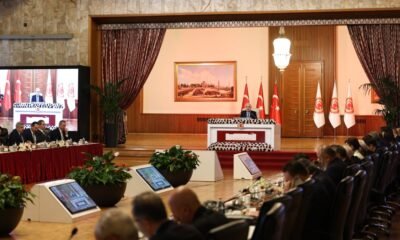
The National Solidarity, Brotherhood and Democracy Commission, established under the goal of a “terror-free Türkiye” initiative, approved its report by majority vote on Wednesday, following deliberations among party representatives at the Turkish Grand National Assembly (TBMM).
The commission, chaired by Parliament Speaker Numan Kurtulmuş, said 47 lawmakers voted in favor of the report, two voted against it and one abstained, underlining that the report is a cornerstone in the initiative that aims for the full dissolution of the terrorist group PKK.
The 60-page report includes recommendations for Parliament for future legislative steps to facilitate the process. Among them are legal reforms that will go hand in hand with the PKK’s moves to get rid of its weapons and fully dissolve itself. Reform proposals urge the judiciary to review current legislation and suggest more compliance with the European Court of Human Rights (ECtHR) and Constitutional Court rulings. The report, whose parts were published in Turkish media earlier this week, is portrayed as a guide for strengthening democracy in Türkiye and ensuring the elimination of PKK terrorism.
During his remarks, Kurtulmuş stated that the report consists of seven sections: “In the first section, titled ‘Commission Activities,’ the process regarding the commission’s work is explained. The second section emphasizes the commission’s main objectives within the framework of our discussions. The third main heading addresses the historical roots of the Turkish-Kurdish brotherhood and the legal framework of that fraternity. The fourth section focuses on areas of consensus that emerged from the speeches delivered by individuals heard by the commission, based on an analysis of their statements. The fifth section covers the ‘Process of the PKK Dissolving itself and Laying Down Arms.’ The sixth includes legislative proposals related to the process, while the seventh presents ‘Recommendations on Democratization.’ The report concludes with a section on results and evaluations,” he noted.
Kurtulmuş continued by saying that the commission’s work reflects a historic responsibility undertaken within the representative authority and democratic legitimacy of the TBMM to strengthen social peace, unity and national solidarity.
He said issues that the public has faced for many years at great cost gain the prospect of a lasting solution when addressed through the legislative and supervisory authority of Parliament.
“Today we are passing through a historic period regarding the issue of terrorism,” Kurtulmuş said. “In this process, our Parliament, as the embodiment of the national will, has undertaken its duty without hesitation.”
He said terrorist acts that have consumed the country’s energy and resources for decades have narrowed Türkiye’s development prospects, strained social bonds and confined politics to security reflexes. Following the end of the Cold War, terrorist groups increasingly became instruments of division, proxy conflicts and fragmentation in the region, he said, adding that local problems were turned into tools of global calculations that deepened social fault lines.
Kurtulmuş emphasized that Türkiye would continue to pioneer integrative policies in the region despite global power pressures. In an environment where power balances are shifting and geopolitical risks are rising, he said, strengthening domestic unity while ensuring lasting peace and stability in the region would create new opportunities for both national security and regional order.
He said a natural alliance among Turks, Kurds, Arabs and other peoples of the region would undermine scenarios of fragmentation and division designed by external actors.
“Resolving the issue of terrorism in Türkiye permanently requires multidimensional, multilayered and multi-actor policies that go beyond security measures alone,” he said, adding that political legitimacy, social acceptance and democratic capacity must be strengthened simultaneously.
The Turkish Parliament, he pointed out, is the legitimate address for resolving all issues concerning the nation’s future. The National Solidarity, Brotherhood and Democracy Commission was established to bring this historic responsibility onto the parliamentary floor.
Adopting a common-sense approach that prioritizes shared ground, the commission was able to discuss issues in depth without departing from consensus, he said. Recent political contacts, growing public demand for peace and developments regarding the organization’s laying down of arms made parliamentary consultation more visible and necessary.
He said the goal of a “terror-free Türkiye” also opens onto a broader vision of a terror-free region, adding that each step reinforcing domestic tranquility enhances Türkiye’s strength in the pursuit of regional and global justice.
Kurtulmuş said Parliament’s role is to establish the legal framework for shared life, amplify diverse voices into a common future and strengthen a democratic structure in which every citizen feels equal, secure and respected.
He said the commission’s report is not the conclusion of a completed process but a “cornerstone guiding” future steps.
Kurtulmuş also thanked President Recep Tayyip Erdoğan for adopting the issue as a matter of state policy and taking initial steps, as well as Nationalist Movement Party (MHP) leader Devlet Bahçeli for his calls that helped initiate the process. He also expressed gratitude to opposition leaders and political parties that supported the commission’s work.
He said 137 individuals from various fields including former Parliament speakers, ministers, representatives of public institutions, the head of the National Intelligence Organization, families of fallen soldiers, veterans, civil society representatives, bar association leaders, human rights organizations, labor unions, employer representatives, academics, think tanks, retired security personnel, and youth and women’s groups were heard by the commission and contributed to the report.
He thanked commission members, administrative staff and media representatives for their efforts and expressed appreciation to the public for its support.
“Our greatest gratitude is to our noble nation,” Kurtulmuş concluded, commemorating fallen soldiers with mercy and veterans with respect, and emphasizing that their memory reinforces the responsibility to uphold human dignity, justice and a shared future.
Moreover, during his speech on Wednesday, Erdoğan also addressed the commission, saying he has repeatedly stressed that the fight against terrorism is not solely a security issue.
“I have frequently emphasized that counterterrorism is not just a matter of security,” Erdoğan said. “We continuously address its legal and social dimensions as well. At present, we are handling this matter very carefully together with our Parliament speaker and our colleagues on the commission. With patience, wisdom and determination, we are proceeding on this path. At the end of this road, the terrorism problem that has harmed our country for years will, God willing, be permanently removed from our agenda,” Erdoğan remarked.
The committee was formed in August 2025 to support a potential new phase in efforts to end the campaign of terrorism that has killed more than 40,000 people and stymied economic development.
Türkiye plays a vital role in NATO’s deterrence posture and efforts to maintain stability across its southern flank, a senior alliance official said, highlighting Ankara’s growing strategic importance as NATO advances a comprehensive “360-degree” security approach ahead of an upcoming summit in Ankara.
Speaking in an exclusive interview with Anadolu Agency (AA), Javier Colomina, NATO secretary-general’s special representative for the southern neighborhood, described Türkiye as a central actor in shaping alliance policy toward the Mediterranean and wider southern neighborhood, citing its military capabilities, geographic position, and active contributions to regional security.
“Türkiye plays an essential role… is an actor that is well known for its ability to secure the shores, for its ability to provide defense industry assets, for its ability with their armed forces, and is indeed one of our more committed allies,” he said.
“And particularly in the Mediterranean, it plays a huge role in ensuring that the Mediterranean is a secure basin, together with the other Allies.”
Colomina said Ankara has been instrumental in developing NATO’s Southern Neighborhood Action Plan and remains a key supporter of its implementation, particularly as the alliance strengthens deterrence and resilience against interconnected threats ranging from terrorism and irregular migration to geopolitical competition.
“The Southern Neighborhood, it’s been an important topic for the alliance for many years, but it was a year and a half ago that we decided to approve a Southern Neighborhood Action Plan,” he added, noting that Türkiye played “a very important role in making that happen.”
Southern Neighborhood Action Plan and Ankara summit
Colomina said the Southern Neighborhood Action Plan, which is based on pillars such as political dialogue, practical cooperation, regional presence, and coordination with organizations such as the African Union, the U.N., the EU, the Gulf Cooperation Council, and the Arab League, is heavily reliant on cooperation among allies.
“In all of those pillars… It’s been very clear the support from Türkiye,” he said.
The upcoming NATO summit in Ankara is expected to focus primarily on implementing decisions taken at last year’s summit in The Hague, including increased defense investment targets and continued support for Ukraine.
Colomina emphasized that the geographical location of the meeting carries symbolic and strategic importance.
“The fact of having this summit in the Southern Neighborhood, geographically located in the south, as it’s Ankara, would mean a lot for our Southern Neighborhood Action Plan, for the approach we have to our partners, and for all the work that we’ve been doing in the last couple of years,” he said.
While concrete deliverables specific to the southern flank remain under discussion, he indicated that the southern dimension will likely feature prominently.
Eastern Mediterranean security and Türkiye’s role
Addressing NATO’s priorities in the Eastern Mediterranean, Colomina underscored long-standing cooperation frameworks such as the Mediterranean Dialogue, launched more than three decades ago, and the role played by southern allies.
“We have partners in the Mediterranean and allies that do play a role in the southern side of the alliance, from Türkiye… to Greece, Portugal, Spain, Italy,” he said, highlighting efforts to safeguard energy corridors and maritime routes.
According to Colomina, Türkiye is particularly influential in regional security due to its military capabilities and strategic position. He added that Ankara contributes significantly to ensuring that the Mediterranean remains “a secure basin.”
NATO’s evolving defense concept focuses on threats across all strategic directions, north, east, west, and south, reflecting an interconnected security environment, Colomina said.
“The 360-degree approach is at the core of everything that we do,” he explained, linking the strategy to collective defense planning and deterrence efforts across the Euro-Atlantic area.
He pointed to growing challenges across the southern neighborhood, including terrorism, irregular migration, maritime and energy security concerns, cyber threats, and geopolitical competition involving Russia, China, and Iran.
NATO’s response involves cooperation with a wide network of partners, including 12 southern partners among its 35 global partners, according to Colomina.
“NATO doesn’t have to be the first responder for all of them,” he said, emphasizing instead capacity-building initiatives and cooperation with regional partners to promote stability.
The alliance is closely monitoring developments in Syria, Lebanon, Gaza, the Gulf, and the Red Sea, he said, stressing the need to contribute to stability without necessarily taking a leading operational role.
Responding to debates in some allied countries about burden-sharing and collective defense credibility, Colomina said NATO remains strong and united following decisions taken at the 2024 summit in The Hague.
“I think we had a historical summit in The Hague last summer, where we took historical decisions to increase our investment to 5%,” he said, calling the move evidence of the alliance’s “good health” and continued commitment to Article 5 mutual defense guarantees.
He noted that many allies have significantly increased defense spending and capabilities while emphasizing the continued role of the US within NATO.
“That doesn’t mean that the Americans will no longer be with us. They still have 80,000 soldiers in Europe,” he said, adding that greater European and Canadian contributions will ultimately strengthen the alliance.
Despite regional crises, NATO continues to rely on structured dialogue mechanisms such as the Mediterranean Dialogue and the Istanbul Cooperation Initiative, which bring together partners from the Mediterranean and Gulf regions.
“We need to work with all of them,” Colomina said, stressing flexible and tailored approaches to cooperation. He noted that NATO marked the 30th anniversary of the Mediterranean Dialogue and the 20th anniversary of the Istanbul Cooperation Initiative in 2024, underlining their continued relevance.
Congratulating Türkiye on the 74th anniversary of its NATO membership, Colomina described Ankara as a major contributor to alliance security and defense efforts.
“Türkiye contributes greatly to our security and defense efforts, particularly in the southern neighborhood, being one of the countries more exposed to southern neighborhood challenges,” he said, praising the country’s defense industry and military capabilities across land, sea, and air.
“We’re very pleased with the work that we continue to do with our Turkish friends everywhere where we are deployed and in Brussels, where we work on a daily basis,” he added.


-
 Daily Agenda2 days ago
Early election statement from AK Party Deputy Chairman Hüseyin Yayman: There will be no early elections in Türkiye at the request of the opposition!
-
 Politics2 days ago
Türkiye contributes to NATO’s largest exercise using indigenous assets
-
 Daily Agenda3 days ago
Türkiye’s biggest problem is the decreasing population
-
 Politics10 hours ago
Turkish lawmakers unveil ‘cornerstone’ report on disarming PKK
-
 Politics1 day ago
Israeli recognition of Somaliland would not benefit region: Erdoğan
-
 Daily Agenda3 days ago
This Ramadan will be full again
-
 Politics12 hours ago
NATO official underscores Türkiye’s pivotal role in deterrence, stability
-
 Daily Agenda1 day ago
‘We solved the zoning problem and produced 7 thousand 500 houses’