
Sports
Barca take 7-point La Liga lead with Atletico win as Real fumble

Barcelona forward Robert Lewandowski scored a dramatic late winner as the Catalonians beat Atletico Madrid 2-1 Saturday to move seven points clear atop La Liga after Real Madrid stumbled.
Second-placed Real were beaten 2-1 at Mallorca earlier on and Barca capitalized at the Metropolitano stadium to take a big step toward defending the league title.
Coach Hansi Flick said the race for the Spanish crown was not over but admitted it was an important victory.
“We have eight games to play and for me nothing is done, we have to stay focused,” said Flick.
“The (players) were happy, everyone knows that these were big points today … but everyone knows it’s not done.”
Marcus Rashford pulled Barca level after Giuliano Simeone opened the scoring for the hosts in the first half.
Atletico midfielder Nico Gonzalez was sent off just before the break and his team dug deep with 10 men to try and avoid defeat, which they almost managed.
Veteran Polish striker Lewandowski had other ideas and used his shoulder to deflect home a rebound from point-blank range after 87 minutes.
‘Very happy’
“We all knew what happened in the afternoon,” Barca defender Eric Garcia told DAZN.
“We knew that if we won today, we would be taking a big step (towards the title), so we’re very happy.”
This was the first of a trilogy of matches between the sides, clashing in the Champions League quarterfinals over the next fortnight.
With little left to play for in La Liga, Atletico coach Diego Simeone rotated heavily with Wednesday’s visit to Camp Nou in mind.
Barca’s 18-year-old star Lamine Yamal hit the post with a dinked effort as the game flowed from end to end.
Atletico took the lead in the 39th minute through Giuliano Simeone, the coach’s son, bursting in behind Barca’s high defensive line and slamming past Joan Garcia.
The visitors pulled level just three minutes later, Rashford exchanging passes with Olmo and drilling past Juan Musso on only his third league start since January.
Atletico were reduced to 10 men just before halftime when Gonzalez scythed down Yamal on the edge of the box as he ran toward goal.
Barcelona defender Gerard Martin was dismissed early in the second half as he thumped the ball away, but then clattered Thiago Almada with a high foot. However, after a VAR review, the red card was revoked, much to Atletico’s fury.
Barca struggled to make their numerical advantage count until later on when Joao Cancelo’s shot was pushed out by Musso, only for substitute Lewandowski to cleverly turn home with his shoulder.
“When it was 11 against 11 we were better, that gives us confidence,” said Atletico stopper Musso.
Flick said both teams would be better in the Champions League quarterfinal first leg Wednesday.
“There is the Champions League, where every player has 5-10% more to give,” said Flick.
Muriqi redemption
Vedat Muriqi’s late strike secured Mallorca a shock late win over Real Madrid.
Alvaro Arbeloa’s side thought they had rescued a point after Eder Militao nodded home with two minutes remaining to level Manu Morlanes’s opener before Muriqi pounced to help the hosts climb to 17th.
“For me, it is easy to see, but the hard thing is for the players to know that without giving 200% today, we were not going to win,” Arbeloa told reporters.
“We were on top in the first half, but because of one mistake, they scored. Here, if you slip up for a moment … you end up paying the price.”
Arbeloa started the game with Vinicius Junior on the bench, with Tuesday’s Champions League quarterfinal against Bayern Munich in mind.
Mallorca goalkeeper Leo Roman saved well from Madrid’s top goalscorer Kylian Mbappe and Arda Güler, before Mallorca nosed ahead.
Morlanes lost Eduardo Camavinga and tucked Pablo Maffeo’s cross past Andriy Lunin.
Arbeloa sent on Vinicius, Jude Bellingham and Militao for his first appearance since December after injury.
Madrid huffed and puffed but to little avail until Militao nodded home from a corner late on.
However, there was a sting in the tail for Madrid. Muriqi, second top scorer in the division behind Mbappe with 19 goals, lashed home in stoppage time.
The striker was visibly emotional after scoring, having missed a penalty in the team’s previous game, a defeat by relegation-battling rivals Elche.
“It’s been two difficult weeks … emotions and nerves get the better of me, I’m human,” said Muriqi, who also missed out on World Cup qualification with Kosovo in a play-off against Türkiye.

At the 8th Ethnosport Forum in Antalya, Bilal Erdoğan delivered a message that cut beyond sport, framing traditional games as a bridge in a fractured world while formally advancing plans for the ambitious Ethnosports 2027 project.
Addressing ministers, federation leaders and cultural delegates from nearly 30 countries, Erdoğan said the forum had evolved from a meeting platform into what he called a “global family,” united not only by heritage but by shared human experience.
Tracing the roots of traditional sports, he pointed to striking commonalities across cultures, from rhythms and rituals to games and cuisine, arguing that these parallels reveal a deeper truth: different societies are expressions of the same human story.
That idea now sits at the heart of a rapidly expanding movement.
Under Erdoğan’s leadership, the World Ethnosport Union has grown into a cross-continental network promoting traditional disciplines not as relics of the past, but as living systems of identity, discipline and community.
From wrestling and archery to equestrian sports and folk games, these practices are being revived and reintroduced to younger generations with increasing institutional backing.
“We are entering a new era,” Erdoğan said, describing a shift toward standardized rules, stronger governance and rising global recognition for traditional sports.
The forum itself reflects that transition.
What began years ago as a platform for dialogue has become a decision-making space focused on delivery.
This year’s gathering is centered on one defining outcome: Ethnosports 2027.
Positioned as a global multi-sport event, the project aims to bring together traditional sports from across continents under a unified competitive and organizational framework.
Unlike conventional mega-events, the emphasis is not just on results, but on cultural authenticity and shared values.
Erdoğan described it as a turning point that will move traditional sports beyond local boundaries and onto a global stage, where they can be practiced, followed and respected worldwide.
“This is not just about sport,” he said. “It is about building respect between communities by first having the confidence to express who we are.”
That message carried a sharper edge as he turned to ongoing global conflicts.
Referencing the realities faced by children in war zones, including Gaza and Iran, Erdoğan said the world was failing its youngest generation.
He spoke of children exposed to violence instead of classrooms and play, calling it a moral reckoning for humanity.
“Peace is what we need now,” he said. “A world where children cannot play is a world that has lost its way.”
For Erdoğan, the answer lies partly in shared cultural spaces like ethnosport, where dialogue replaces division and identity becomes a point of connection rather than conflict.
He urged participants to make peace the “common language” moving forward.
Türkiye’s Youth and Sports Minister Osman Aşkın Bak echoed that stance, describing ethnosport as a strategic tool that sits at the intersection of sport, culture, education and youth policy.
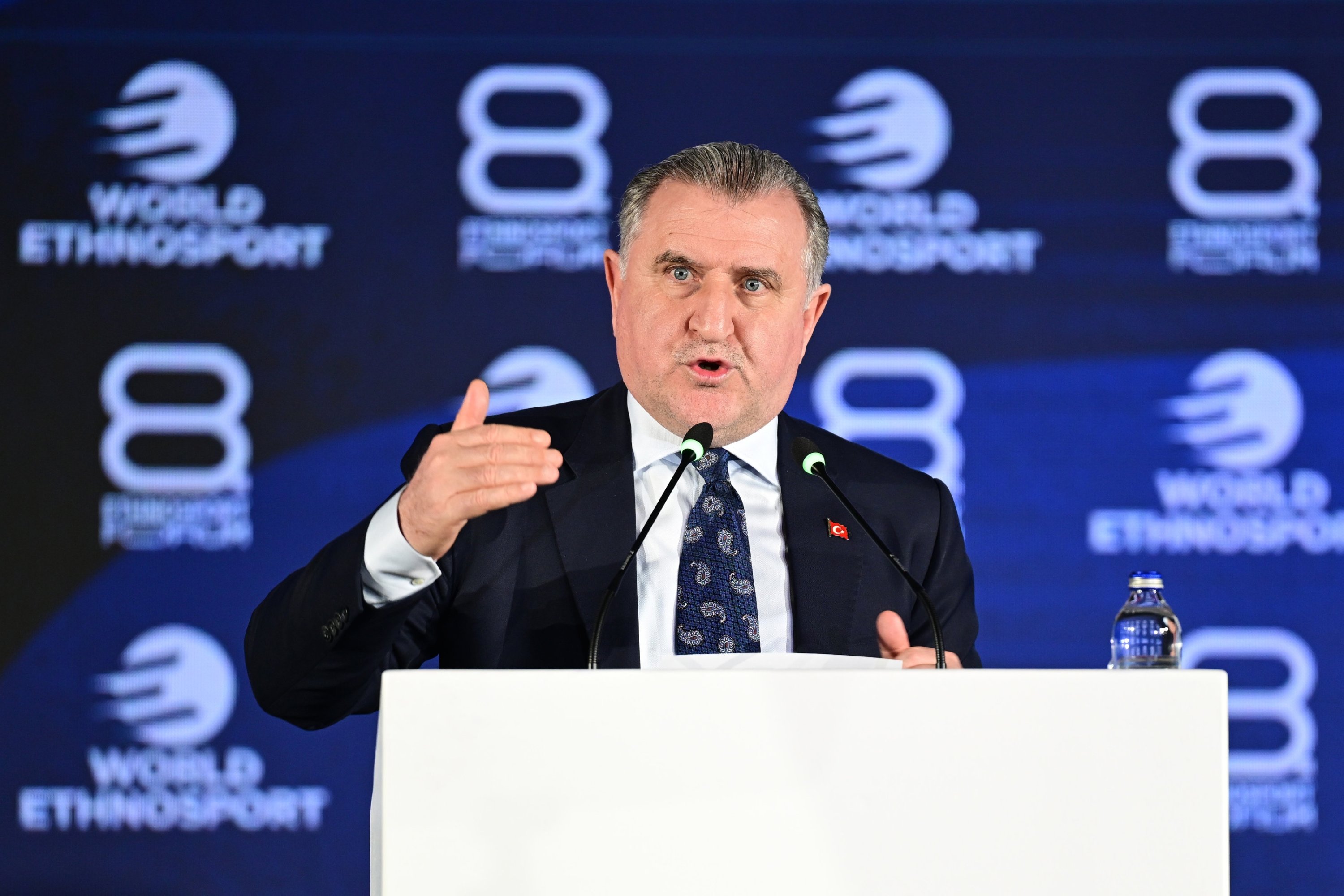
He pointed to ongoing efforts to integrate traditional sports into universities, youth centers and national programs, while expanding their international visibility through federations and UNESCO-linked initiatives.
Bak also stressed the role of sport diplomacy, saying ethnosport provides a rare platform for cooperation across regions stretching from Central Asia to Africa and the Balkans.
“Sport has the power to unite where politics often divides,” he said, reaffirming Türkiye’s commitment to peace, stability and cultural preservation under the leadership of Recep Tayyip Erdoğan.
The forum, which ran from April 3 to 5, drew more than 100 high-level participants, including over 15 ministers, alongside academics, researchers and practitioners.
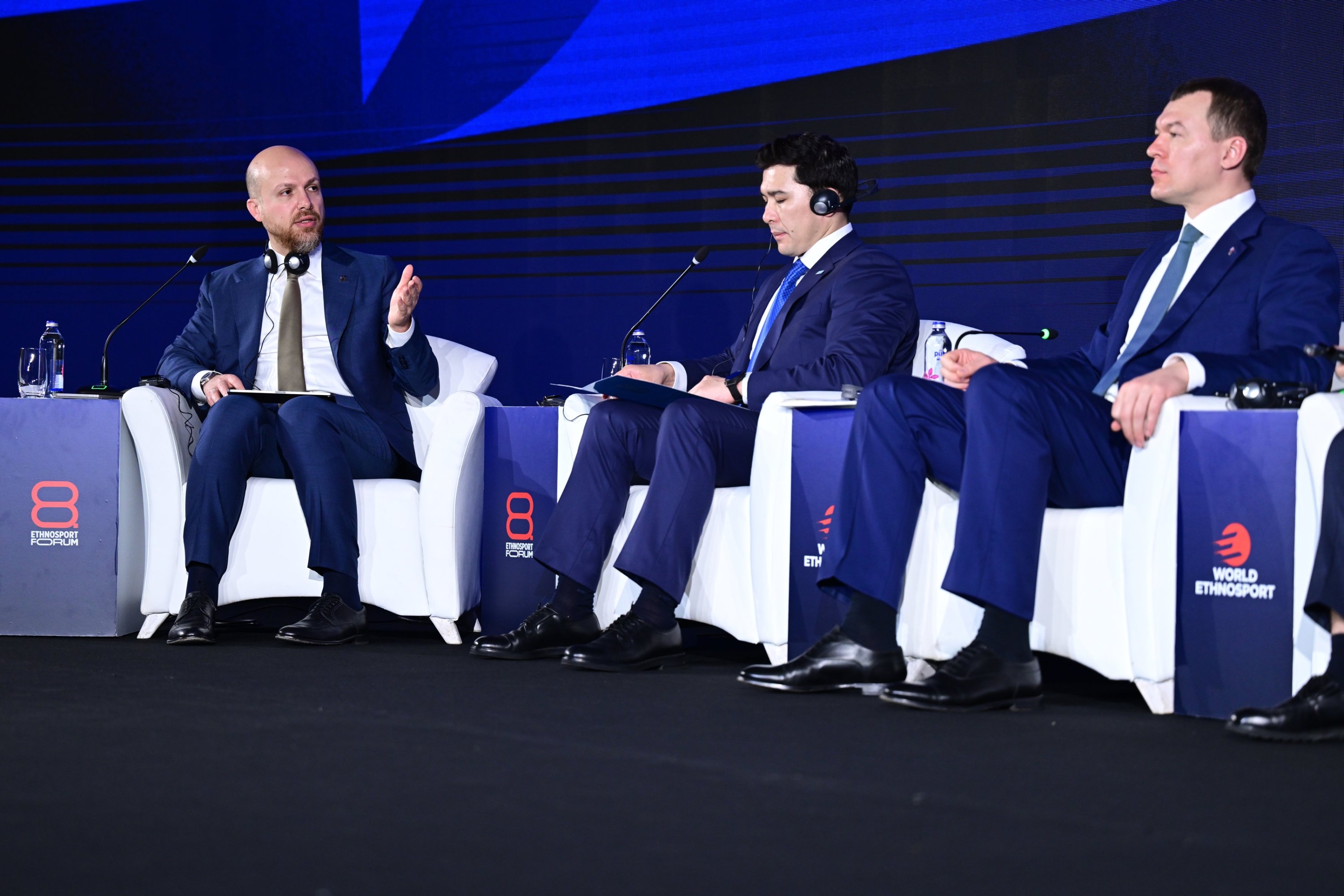
Its sessions focus on governance models, competition systems, marketing strategies and global participation frameworks for the 2027 event.
Beyond policy, the gathering has become a live demonstration of ethnosport’s core idea: that shared traditions can create common ground.
Delegates from diverse regions exchanged experiences, built partnerships and contributed to what organizers describe as a “global call for tradition,” set to be formalized in the forum’s final declaration.
The views and opinions expressed in this article are solely those of the author. They do not necessarily reflect the editorial stance, values or position of Daily Sabah. The newspaper provides space for diverse perspectives as part of its commitment to open and informed public discussion.
Manny Pacquiao is standing firm: his September rematch with Floyd Mayweather Jr. is a fully sanctioned professional fight, not an exhibition, despite recent comments from the American that have sparked controversy.
The two boxing icons, who first faced off in the 2015 “Fight of the Century,” announced their long-awaited rematch on Feb. 23, 2026.
The fight is scheduled for Sept. 19 at The Sphere in Las Vegas, a $2.3 billion immersive venue, and will stream globally on Netflix.
Pacquiao, 47, and Mayweather, 49, have not fought each other professionally since May 2, 2015, when Mayweather secured a unanimous decision victory at the MGM Grand Garden Arena.
That bout remains one of boxing’s biggest commercial events, generating 4.6 million pay-per-view buys and a $72 million live gate.
Pacquiao addressed the growing dispute upon arriving in Los Angeles on April 2. “If that’s what he is feeling, he signed for a real match.
The contract we signed is for a real fight.
He has to remember that,” Pacquiao said. “I wouldn’t fight an exhibition. It’s a real fight… the contract we signed is a real fight. So it’s for sure.”
The tension escalated after Mayweather told Vegas Sports Today on March 29 that the fight was “not actually a fight” but an exhibition and that the venue had not been finalized, mentioning The Sphere as one of several possibilities.
He described the exhibition format as entertainment-focused, saying both fighters would be “winners” regardless of the outcome.
Jas Mathur, CEO of Manny Pacquiao Promotions and producer of the event, pushed back, confirming that Mayweather signed three separate agreements between October 2025 and January 2026, explicitly for a professional bout.
Payments were made for each contract, including an advance on Mayweather’s purse. Mathur noted the agreements contain verifiable DocuSign records and wet signatures.
“No one in the last three months has raised anything about the fight not being professional. His team has had all the contracts. He signed all the contracts,” Mathur told ESPN. He added that a site visit to The Sphere included 35-40 representatives from both camps and Netflix production partners.
Mathur said Mayweather is “officially in breach of his contract” for publicly calling the fight an exhibition and for scheduling other exhibitions, including a proposed June bout against Greek kickboxer Mike Zambidis.
The contract allows a “cure period” for Mayweather to rectify the violation after receiving written notice, but Pacquiao Promotions maintains the fight remains scheduled as a professional match.
Pacquiao has long sought a rematch, citing a shoulder injury that he said limited him in the 2015 contest.
Mayweather, undefeated at 50-0 with 27 knockouts, has largely focused on exhibitions since stopping Conor McGregor in 2017. Both fighters remain icons, and the rematch carries immense commercial and historical stakes.
The views and opinions expressed in this article are solely those of the author. They do not necessarily reflect the editorial stance, values or position of Daily Sabah. The newspaper provides space for diverse perspectives as part of its commitment to open and informed public discussion.
When Azzurri legend and coach Gennaro Gattuso questioned the modern World Cup format in late 2025, I did not hear a technical critique. I heard something familiar, something Africa has dealt with for decades: the suggestion that when the rest of the world rises, Europe somehow suffers
From the looks of it, that argument is not only flawed, it is also revealing.
This is not 1990. And Italy’s problem is not that the world has caught up. It is that Italy has not moved with it.
“Unfair difficulty” illusion
Gattuso’s criticism rests on a premise that collapses under even light scrutiny, that expanding World Cup access has made qualification unfair for European nations.
History tells a different story.
At the 1990 FIFA World Cup, Africa had just two qualification spots.
Two places for a continent rich in talent, diversity, and footballing culture. Yet even within that narrow gateway, Cameroon reached the quarterfinals and reshaped global perceptions.
That achievement did not happen because the system was fair. It happened in spite of it.
For decades, the World Cup leaned heavily toward Europe and South America. It was global in name, but selective in structure.
Entire regions were underrepresented, not because they lacked quality, but because they lacked access.
The expansion to the 2026 FIFA World Cup is not a gift. It is a long-overdue correction.
Europe still holds the largest allocation of places. UEFA remains dominant in numbers. What has changed is that the rest of the world is no longer squeezed into the margins.
And most importantly, qualification remains regional. Africa does not take places from Europe. Asia does not block South America. Each confederation competes within its own framework.
If Italy cannot qualify from Europe, then the problem is not global expansion. It is internal limitation.
A decline years in the making
Italy’s third consecutive absence from the World Cup is often framed as a shock. In reality, it is the logical outcome of a slow, visible decline.
The first World Cup final I remember watching in its entirety was the 2006 edition.
Italy, at its peak, built on the spine of Juventus, AC Milan and Inter Milan. A team rooted in its domestic strength, disciplined, experienced and unshaken on the biggest stage.
And of course, that moment. Zinedine Zidane’s headbutt on Marco Materazzi, a flashpoint that still defines the final as much as the result itself.
Those really were the good days.
But what followed tells a very different story. After that triumph, Italy failed to evolve. Their academy system stagnated, investment lagged, and while their European rivals modernized and surged ahead, Italy gradually lost ground.
France invested in elite academies and built a production line of world-class talent. Germany restructured its entire development model after early 2000s failures. Spain aligned its identity across all levels of football. Even England, long criticized for inefficiency, embraced modern coaching and youth development reforms.
Italy did not respond with the same urgency.
The consequences are now clear. A reduced talent pipeline. Fewer technically adaptable players. A national team that struggles to dictate tempo against opponents who are tactically sharper and physically prepared.
This is not bad luck. It is accumulated neglect.
Accountability without transformation
The latest setback, a playoff defeat to Bosnia and Herzegovina, forced long-awaited consequences.
Gabriele Gravina stepped down as federation president. Gianluigi Buffon left his role within the national setup. Gattuso’s own position has come under scrutiny.
These exits signal acknowledgment. But acknowledgment is not the same as reform.
Italian football now faces a deeper challenge. It must move beyond reactive decisions and confront structural issues. Youth development, coaching philosophy, tactical evolution, and long-term planning all require fundamental reassessment.
Without that, leadership changes become symbolic rather than transformative.
Myth of declining quality
One of the central arguments against expansion is the fear that increasing the number of teams will dilute quality.
From an African perspective, that claim feels detached from reality.
African players are not on the margins of elite football. They are central to it. They influence outcomes in Europe’s top leagues, including Serie A, the very system Italy draws from.
And at international level, the evidence is undeniable.
The current and controversial AFCON champions, Morocco’s run to the semifinals in 2022, was not an isolated moment.
It was the result of organization, discipline, and a generation of players developed across both African and European systems. It reflected a broader shift in global competitiveness.
The gap has not disappeared, but it has narrowed significantly.
Expanding access does not weaken the tournament. It exposes its true competitive depth.
A narrative that holds the game back
When expansion is framed as a problem, it reinforces an outdated hierarchy in football.
Gattuso’s statement gave voice to a persistent Eurocentric bias that still views the World Cup as Europe’s private club with a few invited guests. It implies that growth outside traditional centers is a disruption rather than a progression.
This thinking does more than distort reality. It limits the game.
Football’s global strength lies in its diversity. In its unpredictability. In the emergence of new contenders who challenge established power.
Restricting access does not preserve quality. It preserves comfort.
And comfort, in modern football, is often the first step toward decline.
Italy at a crossroads
Gattuso’s legacy as a player is built on resilience, intensity, and an uncompromising will to compete. Those qualities defined Italy’s success in 2006.
But the modern game demands evolution alongside effort.
Italy’s absence from another World Cup, their third successive edition, is not the result of African inclusion, Asian growth, or a changing global landscape. It is the product of years of hesitation in a sport that rewards adaptation.
From where it stands, the issue is not that the World Cup has changed.
It is that Italy has not changed enough.
The ghost of 1990 is no longer shaping football’s future. But it still lingers in how some choose to interpret the present.
Until Italian football confronts that reality, no reduction in teams, no shift in format, and no appeal to nostalgia will bring it back to where it once stood.
The stakes are sharpening by the week for Fenerbahçe, and Sunday’s derby against Beşiktaş now looms as a pivotal checkpoint in a title race that refuses to settle.
With leaders Galatasaray holding a narrow advantage and games in hand, Fenerbahçe enter Matchday 28 knowing that anything short of victory risks shifting the balance of the season.
Fenerbahçe’s position tells a story of control without full command.
They have lost just once in 27 league matches, a remarkable return built on structure and discipline, yet nine draws have kept the door open for rivals. Level on points with Trabzonspor, they sit in a crowded lane where momentum can flip in a single weekend.
A win would lift them to 63 points and keep pressure firmly on Galatasaray. A stumble could widen the gap and invite a late surge from behind.
Since arriving in September, Domenico Tedesco has reshaped the team into a side that thrives on compactness and intensity.
The pressing is coordinated, the transitions are quick, and the defensive line holds its shape under strain.
At home, they have been particularly difficult to break, combining territorial control with patience in possession.
The midfield has become the engine of that balance. N’Golo Kante shields the defense with relentless coverage, while Matteo Guendouzi adds vertical passing and tempo. Ahead of them, Marco Asensio operates as the creative hinge, drifting into pockets and unlocking tight spaces.
The attacking line has offered variety rather than reliance, with Dorgeles Nene stretching defenses and Talisca providing a direct threat inside the box.
Defensively, the potential return of Milan Skriniar could prove decisive. His presence would stabilize a back line already supported by Jayden Oosterwolde’s athleticism and disciplined positioning.
Goalkeeping rotation has not disrupted rhythm, a sign of depth that has carried Fenerbahçe through a demanding schedule.
Beşiktaş arrive with a different kind of momentum. Under Sergen Yalçın, the team have rediscovered a familiar edge built on tactical awareness and derby resilience.
They are not chasing the title directly, but with 52 points they remain firmly in the European race and capable of shaping the destiny of others.
Recent results point to a side growing in confidence.
Wins over Kasımpaşa and Gençlerbirliği have tightened their structure, even if the narrow defeat to Galatasaray exposed the fine margins they must navigate against elite opponents.
Their away record is solid, and they have shown they can absorb pressure before striking with purpose.
Midfield remains their strongest platform.
Wilfred Ndidi anchors the defensive phase, breaking up play and protecting transitions.
Orkun Kökçü drives forward with composure, linking phases and dictating rhythm, while Vaclav Cerny adds unpredictability in wide areas.
In attack, Oh Hyun-gyu’s movement and Junior Olaitan’s pace offer outlets when space opens.
The tactical battle is likely to hinge on control versus timing. Fenerbahçe will look to dominate territory and press high, forcing errors in dangerous zones.
Beşiktaş are expected to sit deeper, compress space, and exploit the gaps left behind with quick vertical attacks. Discipline in transition will be critical on both sides.
Recent meetings underline the unpredictability.
Fenerbahçe edged a 3-2 comeback win earlier this season, only for Beşiktaş to respond with a 2-1 victory in the Turkish Cup.
Ukraine’s sports authorities on Wednesday urged the International Olympic Committee to review the “neutral” status granted to certain Russian athletes, alleging some have ties to the military or have competed in events that breach Olympic sanctions.
The IOC cleared a limited number of athletes from Russia and Belarus to compete at the 2024 Paris Olympics and the 2026 Milan Winter Games under strict neutrality rules, barring national flags and anthems and requiring thorough eligibility checks.
Those conditions explicitly prohibit athletes with military affiliations or those who supported Moscow’s 2022 invasion of Ukraine.
In a formal appeal, Ukrainian Sports Minister Matvii Bidny and National Olympic Committee president Vadym Guttsait said they had gathered evidence suggesting some competitors violated IOC guidelines introduced in 2023.
The appeal pointed to what it described as “systematic violations,” particularly in sport climbing and within its governing body, the International Federation of Sport Climbing.
“The Ukrainian side has provided evidence of direct links between a number of athletes and the military structures of the aggressor state,” the statement said.
It cited several athletes officials alleged had links to the military, supported the invasion or had trained in Crimea, which Russia seized and annexed from Ukraine in 2014.
It also said an international competition was held in Moscow last November under the auspices of the International Military Sports Council, in violation of IOC rules.
“This confirms the involvement of Russian military structures in the international sports movement with the aim of legitimizing Russia’s aggressive policy,” the appeal said.
“The Ukrainian side calls on the leadership of the IOC and the IFSC to conduct a comprehensive review of these facts and to suspend the individuals in question from international competitions.”
Some sports bodies have eased restrictions on Russian and Belarusian athletes. The International Paralympic Committee allowed athletes from the two countries to compete at the recent games in Italy with anthems and flags, drawing protests from Ukraine and other countries.
The views and opinions expressed in this article are solely those of the author. They do not necessarily reflect the editorial stance, values or position of Daily Sabah. The newspaper provides space for diverse perspectives as part of its commitment to open and informed public discussion.
Qualifying is over. The 48-team World Cup in North America is set, and the tournament promises a mix of elite superstars, rising talents, and debut nations bringing their own stories to the world stage.
Over 2.5 years, teams played 2,527 goals, endured heartbreak, and celebrated triumph, culminating Tuesday with six nations claiming the final tickets to soccer’s grandest stage.
Sweden’s journey is nothing short of astonishing.
In its European qualifying group, the Swedes drew two and lost four, finishing last.
Conventional wisdom would have written them off, yet UEFA’s complex system offered a lifeline. Sweden’s top finish in League C of the 2024-25 Nations League, beating Azerbaijan, Slovakia, and Estonia, earned a playoff spot.
In a tense semifinal, Sweden dominated Ukraine 3-1, with Alexander Isak orchestrating the attack and Emil Forsberg dictating tempo in midfield.
The final against Poland was a thriller: trailing 2-1 at halftime, Sweden rallied with a late Forsberg penalty and a stoppage-time strike from Dejan Kulusevski to win 3-2.
Critics may debate whether Sweden “deserves” a World Cup spot, but their grit and tactical adaptability proved enough.
Italy, once a footballing titan, suffered another catastrophic failure.
A penalty shootout loss to Bosnia-Herzegovina sealed their absence from Europe’s 16 slots.
This marks the third consecutive tournament Italy will miss, a blow to a nation that has won four World Cups.
Analysts point to a generation lacking cutting-edge talent, managerial missteps, and questionable squad rotation.
Veteran defenders like Leonardo Bonucci and Marco Verratti failed to provide the defensive backbone expected, while coach Luciano Spalletti struggled to unlock the team’s offensive rhythm.
Italian media branded the outcome “The third apocalypse,” reflecting a national identity crisis in football.
Yet Italian influence persists elsewhere. Vincenzo Montella guided Türkiye to victory over Kosovo, pairing tactical discipline with an attack led by Enes Ünal to clinch World Cup qualification.
Fabio Cannavaro, captain of Italy’s 2006 World Cup-winning team, now leads Uzbekistan, combining disciplined defense and rapid counterattacks to propel a debutant nation onto the world stage.
Carlo Ancelotti joined Brazil last May, bringing his trademark positional fluidity, while Gennaro Gattuso took the Italian job after Claudio Ranieri declined, emphasizing high-press intensity and midfield resilience.
Geopolitics intersected with football. FIFA President Gianni Infantino, a lifelong Azzurri supporter, skipped Italy’s playoff loss to meet Iran’s delegation in Antalya, Türkiye.
Ensuring Iran plays its three scheduled group-stage games in Los Angeles and Seattle despite ongoing conflict will test FIFA’s diplomacy.
Iran’s domestic league remains suspended, but the national team remains determined, highlighting the tournament’s entanglement with global politics.
The expanded 48-team format has introduced new stories. Curaçao, population 156,000, becomes the smallest nation ever to qualify, relying on striker Rangelo Janga’s finishing and goalkeeper Eloy Room’s reflex saves.
Cape Verde, an archipelago off West Africa, used a tight defensive system and efficient set-piece routines to secure their debut.
Congo returns after 52 years, once Zaire, led by captain Chancel Mbemba, whose defensive leadership anchors a young, energetic side.
Uzbekistan and Jordan also join the tournament for the first time, offering a mix of tactical pragmatism and spirited play that could upset traditional powers.
For fans, qualifying’s final days brought logistical hurdles. U.S. authorities and FIFA rushed to process visas for supporters of newly qualified nations, including Iraq, Türkiye, and Congo, under the expedited “FIFA Pass” system championed by President Donald Trump.
Many African nations still face visa bonds up to $15,000, raising concerns for fans wanting to witness history firsthand.


-
 Daily Agenda23 hours ago
Minister Göktaş: “9 thousand 152 foster families offer a warm home to 10 thousand 897 children”
-

 Economy2 days ago
Global food prices could keep rising if Iran war lasts, FAO warns
-
 Lifestyle2 days ago
Antwerp: Europe’s most individual fashion pilgrimage
-
 Politics2 days ago
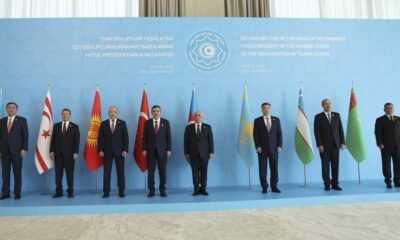
Turkish VP warns Iran-Israel-US conflict threatens wider region
-
 Politics2 days ago
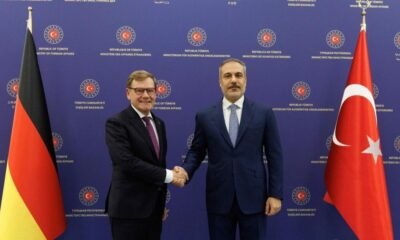
Turkish, German foreign ministers speak on regional developments
-

 Daily Agenda2 days ago
Prison sentence for 4 DISK members
-
 Daily Agenda14 hours ago
Here is the bill for the 7.7 million VIP favor
-
 Politics2 days ago
Far-right leader seeks alliance with Turkish main opposition CHP