
Economy
ECB expected to keep rates steady again as inflation moderated

The European Central Bank (ECB) is expected to keep interest rates steady for its third straight meeting when policymakers meet later this week, with inflation largely under control and the long-struggling eurozone economy looking healthier.
Following a yearlong series of cuts, the ECB has kept its key deposit rate on hold at 2% since July.
Inflation has settled around the central bank’s 2% target in recent months, as Europe has weathered U.S. President Donald Trump’s tariff onslaught better than initially feared.
ECB officials still face many headwinds: France’s political crisis has pushed up borrowing costs in the eurozone’s second-biggest economy, and the risk of a flare-up in trade tensions lingers.
But for now, the central bank is “in a good place,” ECB President Christine Lagarde said in a September speech in Helsinki, bolstering expectations of no change to borrowing costs at Thursday’s meeting.
“With policy rates now at 2%, we are well placed to respond if the risks to inflation shift, or if new shocks emerge that threaten our target,” Lagarde said.
In contrast to the ECB, the U.S. Federal Reserve (Fed) is expected to make its second straight rate cut when it meets on Wednesday as concerns grow over the labor market amid layoffs and signs that businesses are reluctant to hire.
The eurozone economy has long been treading water, dragged down in particular by a poor performance in Germany, with growth rates lagging far behind those of China and the U.S.
But the picture for the 20 countries that use the euro looks a little brighter than in the first half of the year.
The ECB raised eurozone growth forecasts for this year and next at their last meeting.
More cuts to come?
Rate-setters will gather in Florence, Italy, for this week’s meeting, one of their regular tours away from the institution’s Frankfurt headquarters.
Investors will be closely watching Lagarde’s post-rate call press conference for clues about the path forward.
Thursday’s decision seems a done deal, economist Michel Martinez of French bank Societe Generale told Agence France-Presse (AFP), calling the meeting “a moment to take stock rather than to take action.”
But debate is already brewing about whether to push on with cuts later.
Pointing to a strong euro that makes imports cheaper as well as slowing eurozone wage growth, Lithuania’s Gediminas Simkus, a member of the ECB’s governing council, made a case for a cut at the next meeting in December.
“From a risk-management perspective, it’s better to cut than not,” he said in a September interview with Bloomberg, warning of the risk that inflation rates could fall too far.
Carsten Brzeski of Dutch bank ING said there were “some valid dovish arguments that could still force the central bank to cut once again at the December meeting.”
The risks range from a possible adverse impact of U.S. tariffs down the line to delays to Germany’s planned defense spending splurge and a deepening of France’s political crisis, Brzeski said.
“If any of these downside risks materialize, we can expect the ECB to engage in one or two more rate cuts,” he said.
Andrew Kenningham, an economist at Capital Economics, told AFP he expected the ECB to cut rates further in 2026 as inflation and wage growth cool.
“There are now very few reasons to fear a resurgence of inflation – the economy remains so weak, the labor market is loosening,” he said.

Libya’s two rival legislative bodies have signed the divided country’s first unified state budget in more than a decade, the central bank said on Saturday.
The north African country has struggled to recover from the chaos that erupted following the 2011 Arab Spring uprising that toppled longtime ruler Muammar Gaddafi.
It remains divided between a U.N.-recognized government led by Prime Minister Abdulhamid Dbeibah based in Tripoli and an eastern administration in Benghazi backed by military leader Khalifa Haftar.
“This step reflects real progress toward unifying fiscal policy and strengthening the good management of public spending,” the central bank said of the new budget, calling the agreement “the first consensus on unified spending across Libya in over 13 years”.
The agreement was signed by Issa Al-Arebi, a representative of the Benghazi-based House of Representatives, and Abdul Jalil Al-Shawish, a representative of the High Council of State in Tripoli.
Despite generating $22 billion in oil revenues last year, up more than 15% compared to the year before, Libya faces a foreign currency deficit of $9 billion, according to the central bank.
Last January, the bank devalued the dinar by nearly 15% for the second time in less than a year, citing a host of issues including the lack of a unified state budget.
The central bank said the new agreement would bolster financial stability in the country, commending the “positive role of the United States in supporting mediation efforts” between the two sides.
Libya holds Africa’s largest oil reserves at around 48.4 billion barrels, and currently produces about 1.5 million barrels per day while seeking to increase output to two million.
Dbeibah also thanked Trump’s senior adviser on Arab and African affairs Massad Boulos for “supporting the mediation efforts that led to this agreement”.
“This is a step that carries promising signs, but the true test remains the serious commitment of all parties, so that it translates into tangible results for citizens in their daily lives,” Dbeibah wrote in a statement.
Treasury and Finance Minister Mehmet Şimşek said on Friday the economic impact of the Middle East conflict would be negative but manageable, stressing that Türkiye’s disinflation-focused program had already proven its resilience against external shocks.
Şimşek described the conflict as a “major shock” and warned that wars tend to have longer-lasting and deeper economic consequences than other types of crises.
He was speaking at the International Economy Summit in the Sapanca district of the northwestern Sakarya province.
“Wars create much more permanent and larger consequences than other shocks,” Şimşek said. “We believe Türkiye is resilient. We proved this last year, and we will prove it again this year.”
The U.S.-Israeli war on Iran, which started in late February before the sides agreed on a fragile two-week cease-fire this week, has damaged Gulf energy production, stranded tanker traffic and boosted oil prices by about 50% in the world’s worst energy shock.
That came as a major test for countries that import most of their energy needs, including Türkiye.
Şimşek said the conflict had a particularly strong impact on global energy markets because of the strategic importance of the Strait of Hormuz, a key route for oil, natural gas and fertilizer.
Opening the waterway at the southern tip of the Gulf to free hundreds of stranded tankers and other vessels was a condition of the cease-fire announced on Tuesday.
But the flow remains heavily restricted, keeping futures prices near $100 a barrel.
“We are aware of the magnitude of this shock,” Şimşek said, adding that even if the cease-fire holds, both the global economy and Türkiye will still suffer some degree of damage.
Turkish authorities have taken steps to cushion the fallout of the war on domestic markets. Şimşek on Thursday said they were prepared for more steps if the cease-fire does not hold.
The Turkish central bank has already halted its easing cycle at 37%, lifted its overnight rate by about 300 basis points to near 40%, and sold and swapped tens of billions of dollars in foreign exchange and gold reserves to support the Turkish lira.
Şimşek said the conflict caused some deterioration in the inflation outlook, which authorities had hoped would dip below 20% by year-end. Annual inflation eased to 30.9% in March.
Strong fiscal buffers
Şimşek on Friday said the government’s medium-term economic program introduced in mid-2023 had strengthened Türkiye’s macroeconomic foundations, increased resilience and enabled the country to better absorb external shocks.
“The program has proven itself,” he said. “Despite the trade wars, the ’12-Day War,’ drought and agricultural frost last year, we got through all of these shocks without major losses in the program,” he noted.
He said Türkiye was seen as one of the countries best positioned to withstand geopolitical shocks because of its relatively strong fiscal buffers, lower macroeconomic imbalances and limited direct energy dependence on the Gulf region.
According to Şimşek, Türkiye has almost no dependence on oil supplies that pass through the Strait of Hormuz, while natural gas imports from Iran continue to flow through pipelines and have not been disrupted.
“This is important because if the cease-fire does not hold and the war drags on, many countries could face energy supply security problems,” he said.
Şimşek said one of Türkiye’s strongest buffers was its fiscal position.
Despite the cost of the devastating 2023 earthquakes and other spending pressures, he said the budget deficit was reduced to below 3% of gross domestic product and that both public debt and the deficit remain low compared with other emerging markets.
He noted that average budget deficits in emerging economies stood at 6.3% of GDP last year, more than double Türkiye’s level.
Şimşek acknowledged that the current account deficit would worsen because of higher oil prices, weaker tourism revenues and trade disruptions.
“A current account deficit increase of around 1 percentage point is possible, while growth could slow by around half a percentage point,” he said. “All of these effects are manageable and will not derail the program.”
He also said Türkiye remained comfortable in terms of reserve adequacy despite some capital outflows during the early phase of the conflict.
“With the cease-fire, those flows are returning,” Şimşek said. “Demand for foreign currency from our citizens remained very limited thanks to confidence in the program. We are in a very comfortable position in terms of reserve adequacy.”
Şimşek reiterated that the government would continue prioritizing disinflation and said authorities would do whatever was necessary to maintain price stability and preserve macroeconomic discipline.
Celine Dion’s fans are not the only ones excited about the megastar’s new tour in Paris – hotels, restaurants and shops are hoping for a multimillion-euro boost from concertgoers in the French capital.
The 58-year-old Canadian singer announced last month that she was returning to the stage for 16 concerts after a lengthy break prompted by a rare health condition.
She could prove the latest in a series of stars to bring with them significant economic uplift from music fans, following Taylor Swift’s record-breaking Eras Tour and as the South Korean mega-group BTS embarks on its tour.
The Eiffel Tower was lit up to honour the return of the singer – who sings both in French and English – and with the city covered in billboards and posters, Parisian businesses are hoping the tour will prove a major money spinner.
Dion’s tour could bring an additional 300 million to 500 million euros ($351-$585 million) into the city, said Alexandra Dublanche, president of Choose Paris Region, the organization that promotes the wider Paris area.
This includes ticket sales, hotel and restaurant bookings, retail spending and more, she told Agence France-Presse (AFP), adding that international visitors tend to spend more than domestic travellers.
When Swift held four concerts in Paris in 2024, the city saw an economic boost of around 150-180 million euros, Dublanche said.
Dion has said she was diagnosed with Stiff Person Syndrome, an incurable autoimmune disorder and she was forced to cancel her last tour dates due to both the COVID-19 pandemic and ill health.
The latest tickets for Dion’s shows went on sale Friday, with an estimated half a million fans to attend the concerts, a third from overseas, according to Dublanche.
Others have put the figure higher, with MKG Consulting estimating the potential economic impact at more than 1 billion euros, including a 180-million-euro boost for the Parisian hotel industry.
MKG analyst Vanguelis Panayotis said the economic benefits could reach 1.2 billion euros if taking into account transportation and all the associated expenses and logistics of Dion’s support team as well as fans.
Driver of travel
Swift’s Eras tour became the highest-grossing musical tour in history, with ticket revenues estimated at more than $2 billion and hundreds of millions of dollars in extra economic activity in cities where she performed.
“Major musical events are a driver of travel,” said Vanessa Heydorff, managing director for France at Booking.com.
The hotel reservation site said that searches for Paris around the dates of Dion’s concerts increased by 49%.
The Adagio chain, which has 10 hotels in the city’s La Defense district where the concerts will be held, saw a 400% increase in bookings.
“This will be good for Paris because the capital is currently experiencing a drop in hotel occupancy rates” due to the international situation, said Didier Arino, chief executive at the consulting firm Protourisme.
Arthur Lemoine, CEO of the high-end Galeries Lafayette department stores, said they saw a boost in shoppers during Swift’s concerts, not only during the days when she was performing in Paris, but also around the timing of gigs in the neighbouring city of Lyon.
“Celine Dion’s presence in Paris for a month and a half should definitely benefit business on Boulevard Haussmann,” he said, referring to the high-end street that is home to Galeries Lafayette’s flagship store.
After South Korea’s BTS announced two upcoming concert dates in Paris, searches for hotels in the French capital soared by 590%, according to the Hotels.com website.
“This phenomenon is part of a broader trend called ‘gig-tripping’, where the concert becomes the starting point but not the sole reason for booking a trip,” said Heydorff, adding the challenge was to keep the visiting fans within the region in the days before and after the concert.
For Panayotis, at MKG, “Events that draw fans – whether a singer, an artist or a football team – are becoming an extremely powerful indicator of tourism spending, something we’re seeing everywhere.”
“There’s a real strategic advantage (for cities) in attracting events of this kind because they generate extremely strong economic benefits,” he said.
A Turkish drilling ship docked at the port of Mogadishu on Friday ahead of Somalia’s first offshore oil drilling project, the two countries announced.
Energy and Natural Resources Minister Alparslan Bayraktar called it a “historic” mission that will “open a new chapter in Turkish energy history.”
A hydrocarbon development deal signed in 2024 granted Türkiye’s state-owned energy company TPAO the right to explore three offshore blocks of around 5,000 square kilometers (1,900 square miles) each.
In late 2024, another Turkish vessel carried out seismic surveys in the three blocks to identify drilling sites.
The Çağrı Bey, featuring a red bow emblazoned with a white star and crescent and topped by a drilling derrick, arrived in Somali waters Thursday and docked in the capital’s port Friday.
“It docked this (Friday) morning… the ship is very big, we have never seen anything like this at the port before,” Abshir Yare, a port employee, told Agence France-Presse (AFP).
The vessel will carry out “Somalia’s first-ever offshore drilling operations,” the African nation’s state news agency SONNA reported Thursday.
It will also conduct Türkiye’s “first overseas deep-sea drilling” operations outside its own waters, Bayraktar said on the social media platform X.
“We believe that this cooperation between Türkiye and Somalia, based on mutual trust, brotherhood and a common understanding of development, will open the door to a new and powerful era in the relations between the two countries,” he noted.
Bayraktar was due to attend a ceremony at the Mogadishu port on Friday alongside Somali President Hassan Sheikh Mohamud.
Türkiye is one of Somalia’s main military and economic partners, with Ankara inaugurating its largest overseas base in Mogadishu in 2017.
The drilling campaign is expected to last nearly 10 months.
The Çağrı Bey will begin drilling at a well located about 372 kilometers off the Somali coast. The well has been named “Curad,” meaning the first-born child in Somali families, and is expected to become one of the world’s deepest offshore wells.
Consumer inflation in the United States increased by the most in nearly four years in March as the war with Iran boosted oil prices and the pass-through from tariffs persisted, further diminishing chances for an interest rate cut this year.
The Consumer Price Index (CPI) jumped 0.9% last month, the Labor Department’s Bureau of Labor Statistics said on Friday, the largest increase since June 2022, when prices soared in response to the Russia-Ukraine war.
Consumer prices rose 0.3% in February. In the 12 months through March, the CPI advanced 3.3% after rising 2.4% in February.
The jump in consumer inflation followed in the wake of a sharp rebound in job growth last month, which suggested the labor market remained stable. There are, however, concerns that a prolonged conflict in the Middle East could undercut the labor market, especially if households respond to high prices by pulling back spending.
The U.S.-Israeli war with Iran has sent global crude oil prices surging more than 30%, with the national average retail gasoline price breaking above $4 a gallon for the first time in more than three years.
Though President Donald Trump on Tuesday announced a two-week cease-fire on the condition that Tehran reopen the Strait of Hormuz, the truce appeared fragile.
Last month’s increase only showed the immediate effects of the oil price shock, which has also raised the cost of diesel. March’s surge underscored the affordability challenges facing consumers. Trump won the 2024 presidential election on a promise to lower prices.
Secondary effects of oil price shock expected
Excluding the volatile food and energy components, the CPI rose 0.2% last month after climbing 0.2% in February. That translated to a year-on-year increase of 2.6% in the so-called core CPI.
The moderate rise after a 2.5% advance in February likely offers no comfort for officials at the U.S. central bank, with an acceleration expected in April as the secondary effects of the oil price shock filter through. The Federal Reserve (Fed) tracks the Personal Consumption Expenditures (PCE) price index for its 2% inflation target. Those measures posted strong monthly gains in February.
Both core CPI and PCE inflation have been driven by businesses passing on some of Trump’s broad tariffs to consumers, offsetting the disinflationary trend in rents.
In the months ahead, economists expect the Middle East conflict to lift core prices through expensive jet fuel that will raise airline fares, and diesel, which will increase the cost of goods transported by road. Prices of fertilizer and plastics, among other goods, are also expected to rise.
Firming inflation has left some economists believing the Fed would not reduce borrowing costs this year, a conviction that was reinforced by the release on Wednesday of minutes of the central bank’s March 17-18 policy meeting, which showed a growing group of policymakers last month felt that rate hikes might be needed.
The Fed left its benchmark overnight interest rate in the 3.50%-3.75% range. Some economists still see a chance of a rate cut if labor market conditions deteriorate. Others argued that consumers pulling back as gasoline prices eroded their purchasing power could make it difficult for some businesses to pass on higher costs from oil prices.
Syria is in the final stages of establishing a correspondent bank account with neighboring Türkiye’s central bank and will also discuss a potential currency swap aimed at boosting trade, according to the Syrian central bank chief.
Türkiye has been the main backer of the Syrian government of President Ahmed al-Sharaa since the ousting of longtime dictator Bashar Assad in late 2024. Al-Sharaa has been seeking to rebuild state institutions and the economy after more than a decade of war, sanctions and financial isolation.
Trade between the two countries has surged, but businesses say the lack of a cross-border payments system was one of the biggest impediments to further growth and investment. A correspondent bank account would help to facilitate cross-border payments and trade finance transactions, which traders say are currently cash only and handled by traditional money transfer offices.
In written responses to Reuters questions, Abdulkader Husrieh, Syria’s central bank governor, said he expected Syrian-Turkish cooperation to expand “into integrated payment systems, cross-border settlements, and more structured trade finance frameworks.”
“Cooperation with Türkiye, particularly between the Central Bank of Syria and Turkish authorities, is accelerating and becoming increasingly institutionalized,” said Husrieh, who was on a two-day working visit to Türkiye this week.
Lenders eye expansion
On Tuesday, Turkish Trade Minister Ömer Bolat said Türkiye and Syria were accelerating cooperation between their central banks, adding that Syria’s central bank governor would meet Turkish banking regulators.
Bolat said closer banking ties and the entry of Turkish lenders into Syria could help boost trade and industrial investment.
Turkish state lender Ziraat Bank and smaller private Aktif Bank were also expected to begin Syrian operations “in the near term,” Husrieh said.
Both banks have submitted applications and their officials said operations are expected to start soon.
Business leaders this week said restoring banking services and resolving customs and logistics issues would be key to increasing bilateral trade.
Türkiye’s exports to Syria jumped following Assad’s ouster by 60% to $3.5 billion last year, official data show, while Syria’s imports were at $235 million. The countries aim to almost triple trade volume to $10 billion over the medium term.
“This ambition will require a fully functioning financial system in Syria, supported by strong correspondent banking relationships,” Husrieh said.


-
 Politics3 days ago
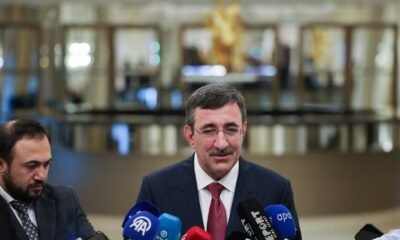
Türkiye destined for key security role: VP Yılmaz
-
 Daily Agenda2 days ago
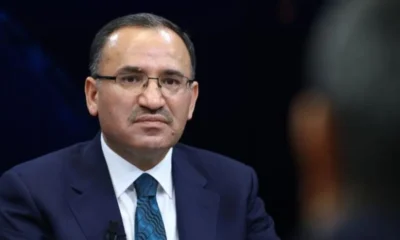
By-election message from Deputy Speaker of the Grand National Assembly of Turkey Bekir Bozdağ: Turkish people do not have such an agenda
-

 Daily Agenda2 days ago
Scientific touch to historical artifacts in museums
-
 Daily Agenda3 days ago
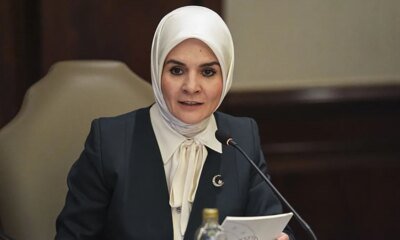
Minister Göktaş: “We do not have an agenda to close or ban the games”
-

 Politics3 days ago
Türkiye, UK discuss efforts to end regional war, push for lasting peace
-

 Economy2 days ago
Türkiye’s Şimşek touts ‘capacity’ to tackle shocks, says new steps possible
-
 Politics2 days ago
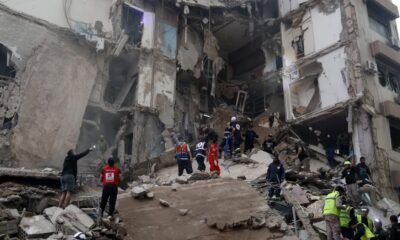
Türkiye condemns Israel’s Lebanon strikes, urges protection of civilians
-

 Daily Agenda2 days ago
DMM denied the claim that ‘chemical spraying was carried out by planes’