
Economy
European firms cut jobs in face of slowing economy, tariffs

Several European companies have frozen hiring or cut jobs over the past year, including consumer goods giants and some of the major brands in the automotive sector, citing difficult economic conditions exacerbated by U.S. tariffs.
The automotive industry in particular was hit hard in recent years, first by rising competition from China, but then also pressure stemming from quickly changing trade policies of the new U.S. administration.
Danish companies such as Orsted, which operates in the wind energy sector and pharmaceuticals giant Novo Nordisk have also announced layoffs.
Orsted, last year, canceled plans to build one of the U.K.’s largest offshore wind farms, while it also faced headwinds in the U.S. due to the policies of the Trump administration, which increasingly promotes fossil fuels. The administration suspended leases on several large offshore wind projects in December.
At the same time, Novo Nordisk, which has previously boomed amid growing demand for weight loss medications, announced it would cut as many as 9,000 jobs, and it also issued a warning last week that its profits and sales could drop as much as 13% this year.
On Wednesday, Dutch brewer Heineken became the latest one to say it would reduce its workforce.
Here is a look at some of the companies that announced layoffs in recent months.
Car and car parts makers
Bosch: The German home appliance manufacturer will cut 13,000 jobs, it said on Sept. 25.
Continental: The German tire maker plans to cut 1,500 additional jobs at its ContiTech rubber and plastics division, a works council source said on Nov. 24, on top of the 10,000 job cuts announced group-wide in restructuring efforts.
Daimler Truck: The truckmaker confirmed media reports on Aug. 1 that it would cut 2,000 jobs across its plants in the U.S. and Mexico, on top of the previously announced 5,000 job cuts in Germany.
Man: The German truckmaker plans to cut around 2,300 jobs over the next decade, a spokesperson said on Nov. 20.
Renault: The French carmaker confirmed on Oct. 4 that it was planning cost cuts but said it had no figures to report yet, after a newsletter reported it would cut 3,000 jobs by year-end in support services at its headquarters and other locations worldwide.
Banks
Lloyds: The British bank will consider the dismissal of around half of 3,000 staff to cut costs, a source familiar with the matter told Reuters on Sept. 4.
Abn Amro: The Dutch bank plans to cut 5,200 jobs by 2028, it said on Nov. 25.
Energy sector
OMV: The Austrian oil and gas company plans to cut 2,000 positions, or a 12th of its global workforce, the Kurier newspaper reported on Sept. 4.
Semiconductors
Ams Osram: The Austrian semiconductor supplier and sensor maker will launch a cost-cutting programme that will affect about 2,000 employees, it said on Feb. 10.
ASML: The Dutch chip equipment maker said on Jan. 28 it would cut 1,700 jobs, some 3.8% of its staff, as part of a broader plan to shed 3,000 management posts and hire engineers to focus on innovation.
Industrials and engineering
Sika: The Swiss industrial and construction chemicals maker said on Oct. 24 it would cut up to 1,500 jobs in persistently weak markets such as China.
Thyssenkrupp: The German industrial group’s steel division said on Dec. 1 it had agreed with the IG Metall union to cut or outsource about 11,000 jobs, or 40% of its workforce, in an agreement lasting until 2030.
Wacker Chemie: The German chemical company said on Nov. 27 it would cut more than 1,500 jobs, or around 9% of its workforce, by the end of 2026, blaming high energy costs and bureaucratic red tape in Germany.
Consumer goods
Burberry: The British luxury brand will shed 1,700 jobs or around a fifth of its global workforce, it said on May 14.
Heineken: The Dutch brewer will cut up to 6,000 jobs globally over the next two years as strained consumer finances, bad weather and geopolitical tensions take their toll, it said on Feb. 11.
Nestle: The group will cut 16,000 jobs, or 5.8% of its staff, it said on Oct. 16.
Others
Ericsson: The Swedish telecommunications equipment maker will cut some 1,600 jobs in Sweden, it said on Jan. 15, as it weathers a prolonged downturn in telecoms spending.
Lufthansa: The German airline group said on September 28 it would cut 4,000 administrative jobs by 2030.
Kuehne+Nagel: The Swiss freight forwarder will target 1,500 jobs under a cost-cutting programme to combat margin pressures and overcapacity, it said on Oct. 23.
Novo Nordisk: The Danish pharmaceutical company will cut 9,000 jobs globally, it said on Sept. 10.
Orsted: The Danish wind power group said on Oct. 9 it would cut around 2,000 jobs by the end of 2027, a quarter of its workforce.
Telefonica: The Spanish telecoms company will cut more than 4,500 jobs in Spain, union representatives said on Dec. 17 following negotiations.

The World Trade Organization (WTO) is in need of an urgent reform, its chief warned Wednesday, saying that she does not think “the status quo is an option.”
“We are meeting today at an inflection point, not just for the WTO, but … for the multilateral system,” WTO head Ngozi Okonjo-Iweala told reporters, saying that if the global trading system were allowed to lapse, it would be “chaos.”
“We need to change to fit with the times,” she said.
Reform will be at the heart of the WTO’s ministerial meeting in Cameroon next month.
The World Trade Organization regulates large swathes of global trade but is handicapped by a rule requiring full consensus among members, and a dispute settlement system crippled by the U.S.
The Geneva-based organization faced structural and geopolitical obstacles long before U.S. President Donald Trump returned to the White House last year and dramatically ratcheted up global trade tensions.
Speaking at the WTO’s headquarters, Okonjo-Iweala said that “the world is moving so fast … If you look at the speed at which technology is moving, and AI is moving and quantum technologies are moving.”
“If your organization doesn’t adapt, then you’ll be left behind,” she said.
“This organization provides stability and predictability,” she added, hailing that “in spite of all the knocks, it is still the bedrock for so much of world trade.”
“If we don’t have this system, what does it mean? I’ll be very honest with you: there’ll be chaos,” she said.
“It means a business will send goods somewhere without the knowledge of how those goods will be valued when it arrives at customs … you wouldn’t know how your goods will be valued before you’re tariffed. You wouldn’t know whether you’re going to make money or not.
“You’ll be confronted when your goods arrive with rules that you were never aware of,” she said.
Türkiye imported a record amount of silver last month, marking a monthly high, as prices of the precious metal rose at an unprecedented level at the start of the year, a report showed on Tuesday.
The country imported 273.3 tons of silver in January, compared to 31.55 tons in January 2025, Anadolu Agency (AA) reported, citing data from the Turkish stock exchange Borsa Istanbul’s precious metals market report.
The figure was also up from December’s 65.56 tons, according to the report.
At the same time, Türkiye’s gold imports totaled 7.79 tons last month, down from 9.65 tons in January 2025 and 10.92 tons in December.
Silver prices surged over 50% through January, buoyed by higher industrial demand, tightening physical conditions, and geopolitical tensions.
However, after hitting a historic high of $121.67 per ounce at the end of January, silver prices have fallen more than 33% since the start of February, due to easing geopolitical tensions and falling expectations of a Federal Reserve (Fed) rate cut.
The choice of Kevin Warsh as the next Fed chair set off a wave of selling in risk assets that had sent precious metals tumbling, reversing much of the gains recorded in January.
Warsh, whom the markets see as hawkish in relation to monetary policy, if confirmed, is likely to succeed Jerome Powell, who often was at odds with U.S. President Donald Trump over the pace of rate cuts.
Simmering tensions between the U.S. and Iran, which appeared to have somewhat eased in recent days, are also considered to have pushed prices of gold and silver down. However, small fluctuations are still visible.
On Wednesday morning, spot silver was up 3.4% at $83.40 per ounce, after falling more than 3% in the previous session.
Gold prices also gained slightly on Wednesday, buoyed by a weaker dollar and lower Treasury yields, while investors awaited key U.S. jobs data later in the day for clues on the Federal Reserve’s policy outlook.
Spot gold was 0.5% higher at $5,048.27 per ounce by 08:31 a.m. GMT. U.S. gold futures for April delivery gained 0.8% to $5,072.60 per ounce.
Gold was at nearly $5,600 on Jan. 29, the highest on record. Retail and central banks’ demand around the world has spurred prices of gold to unseen levels and investors and analysts predict they are likely to maintain an upward momentum this year.
A tired group of Indian men with sports bags stood in line at passport control at a bustling Moscow airport one recent evening after traveling more than 2,700 miles, including a stop in Uzbekistan, in search of work.
“I have a contract for one year. In the rubbish disposal business. The money is good,” said Ajit, one of the men, speaking in English.
Faced with what the authorities say is an immediate shortage of at least 2.3 million workers, a shortfall exacerbated by the strain of Russia’s war in Ukraine and one that Russia’s traditional source of foreign labor – Central Asians – is not able to fill, Moscow is turning to a new supplier: India.
Indian influx helps make up labor shortfall
In 2021, a year before Russia sent its troops into Ukraine, some 5,000 work permits were approved for Indian nationals. Last year, almost 72,000 permits were okayed for Indians – nearly a third of the total annual quota for migrant workers on visas.
“Currently, expatriate employees from India are the most popular,” said Alexei Filipenkov, director of a company that brings in Indian workers.
He said workers from ex-Soviet Central Asia, who do not need visas, had stopped coming in sufficient numbers. Official figures show they still made up the majority of some 2.3 million legal foreign workers not requiring a visa last year, however.
But a weaker ruble, tougher migration laws, and increasingly sharp anti-immigrant rhetoric from Russian politicians have eroded their numbers and encouraged Moscow to boost visa quotas for workers from elsewhere.
The choice of India for unskilled labor reflects strong defense and economic ties between Moscow and New Delhi.
India has been buying discounted Russian oil that Moscow – due to Western sanctions – cannot easily sell elsewhere, although that may now be in question.
President Vladimir Putin and Indian Prime Minister Narendra Modi signed a deal in December to make it easier for Indians to work in Russia. Denis Manturov, Russia’s first deputy prime minister, said at the time that Russia could accept an “unlimited number” of Indian workers.
At least 800,000 people were needed in manufacturing, and another 1.5 million in the service and construction sectors, he said.
Indian workers in Russian factories, farms
Brera Intex, a Moscow textiles company, has hired around 10 workers from South Asia, including Indians, to make curtains and bed linen.
Sat at a sewing machine, 23-year-old Gaurav from India said he had been working in Russia for three months.
“I was told to come (over) to this side, that the work and money are good,” he said. “Russian life is very good.”
Married with two children, he said he spoke to his family back in India by phone every day and told them he missed them.
Olga Lugovskaya, the company’s owner, said the workers – with the help of samples and supervision – had picked up the work in time and were highly motivated.
“Some of the guys who came in didn’t even know how to switch on a sewing machine,” she said. “(But) after two or three months, you could already trust them to sew a proper finished item.”
Outside Moscow, the Sergiyevsky farm relies on Indian workers too, using them to process and pack vegetables for an average salary of about 50,000 rubles ($660) per month, a salary for which the farm says locals will not work.
“I have been working here, at Sergiyevsky, for one year,” said Sahil, 23, who said he was from India’s Punjab region.
“In India, there is little money, but here there is a lot of money. The work is here.”
U.S. pressure on India to halt its purchases of Russian oil – something President Donald Trump has linked to a trade deal between the United States and India announced this month – could yet dampen Moscow’s appetite for Indian workers.
But for now, it’s unclear how New Delhi will recalibrate its oil purchases, and Moscow has played down any suggestion of tensions.
China’s consumer prices eased in January and missed forecasts, official data showed Wednesday, as leaders unveiled a batch of measures aimed at boosting sluggish spending during the upcoming Lunar New Year holiday, which is expected to trigger consumption activity.
The world’s No. 2 economy has been hamstrung by lackluster domestic consumption since the end of the COVID-19 pandemic, presenting a major hurdle to government growth targets.
But this year’s nine-day public holiday – the longest in history – starts on Sunday and has been touted by officials as a chance to kickstart activity.
In the latest blow to efforts to revive economic activity, figures from the National Bureau of Statistics (NBS) on Wednesday showed the consumer price index (CPI), a key measure of inflation, slowed to 0.2% year-over-year in January.
That was well down from December’s 0.8%, which was the quickest in almost three years, and more than the 0.4% rise forecast in a Bloomberg survey.
China’s vast economy has stagnated in recent years, despite a historic boom in exports.
Authorities have adopted measures to boost consumption, including a subsidy scheme for household goods, but results have been muted.
Consumer inflation is “likely to bounce back in February,” wrote Zichun Huang of Capital Economics. But she added that “with the imbalances between supply and demand set to persist, we doubt China’s deflationary pressures will fade any time soon.”
Officials vowed at a news conference in Beijing on Wednesday to enact further measures to encourage domestic spending.
Local authorities across China have allocated 2.05 billion yuan ($297 million) to “directly benefit consumers” during the upcoming holiday, said Vice Minister of Commerce Sheng Qiuping.
The “New Year’s gifts” will be distributed through vouchers, subsidies and traditional red envelopes containing money, state broadcaster CCTV said.
Factory gate prices decline at a slower pace
Other data released Wednesday suggested a recent easing of persistent deflation in the manufacturing sector.
Prices at the factory gate – stuck in negative territory since October 2022 – fell at a slower rate last month, NBS data showed.
The producer price index’s (PPI) 1.4% year-over-year decrease was the slowest pace of deflation since July 2024.
It was also slightly better than the 1.5% decrease forecast in the Bloomberg survey.
Improvements were “concentrated in non-ferrous metals, likely reflecting recent volatility in global commodity markets,” wrote Huang.
PPI expanded 0.4% month-over-month.
That growth “suggests the deflationary pressure in the manufacturing sector may have become less severe,” wrote Zhang Zhiwei, president and chief economist of Pinpoint Asset Management.
Official data released last month showed China’s economy grew 5% in 2025, meeting the government’s target but among the slowest rates in decades.
Experts expect leaders to announce the same or a slightly lower goal for this year at a key political gathering in early March.
Valentine’s Day spending, combined with the additional demand from Ramadan, coming in the same period this year, is expected to boost e-commerce volume in February in Türkiye, sector representatives said on Tuesday.
The e-commerce volume is expected to top TL 400 billion ($9.1 billion), according to Hakan Çevikoğlu, president of the Electronic Commerce Operators Association (ETID).
Valentine’s Day creates a significant spike in demand in the sector as the first major campaign period of the year in e-commerce, Çevikoğlu told Anadolu Agency (AA).
He noted that with the campaigns starting from the last week of January, there has been noticeable activity in both transaction volume and user interaction on e-commerce platforms as well as with retailers.
Valentine’s Day, which comes later this week, is traditionally a popular period when an uptick in sales of fresh flowers and personalized gifts occurs, both in Türkiye and worldwide.
At the same time, the holy month of Ramadan, which this year begins on Feb. 19, is a time when families and friends often come together for breaking the fast (iftar) and when dishes are prepared with utmost diligence.
Ahead of Ramadan, individuals and families tend to do larger shopping, purchasing foods and drinks specific to this month, such as dates and special types of flavored juices (sherbets).
Sales rise of 50% to 60%
“The combination of Valentine’s Day week with pre-Ramadan shopping is expected to signal a stronger demand outlook in e-commerce sales across the sector,” Çevikoğlu maintained.
“Therefore, in addition to gift-focused categories, we anticipate that sales in food and fast-moving consumer goods related to Ramadan will increase by an average of 50%-60%,” he added.
Noting that the Valentine’s Day campaigns, along with Ramadan needs, will not only create a short-term sales momentum, Çevikoğlu said they expect e-commerce to stand out as a strategic period that shapes the sector’s first-quarter performance and allows insights into consumer trends for the rest of the year.
Furthermore, he highlighted that the most demanded categories in e-commerce during this period are clothing, cosmetics, electronics, jewelry and accessories, home decoration and Valentine’s Day-themed gift products.
Consumer preferences
“Flowers and chocolates, as every year, are among the indispensables of this special day, while the impact of the winter season sees noticeable activity in products like sweaters, blankets and specially printed textiles,” he noted.
Çevikoğlu explained that there has been a shift in gift preferences toward more meaningful, experience-based and personalization-focused items in recent years.
“Consumers are increasingly turning to experience-based gifts such as travel, concert and event tickets, vacation and hotel reservations, alongside traditional products,” he said.
“Donations to associations or non-governmental organizations (NGOs) in the name of loved ones, tree planting, and scholarship support, which contain social responsibility aspects, are also becoming more widespread,” he added.
“We expect the e-commerce volume in February to exceed TL 400 billion. During this period, the average basket size is expected to rise to around TL 3,000 to TL 5,000 due to the effect of Valentine’s Day campaigns,” Çevikoğlu also said.
Israel’s targeting of Palestinian labor following the genocidal Gaza war has pushed the occupied West Bank deeper into economic crisis, leaving tens of thousands without income and raising fears of social collapse.
With most work permits revoked and only a fraction restored, families that once depended on higher-paying jobs inside Israel are struggling to afford food, rent and basic necessities, as unemployment surges and desperation spreads across the occupied territory.
Hanadi Abu Zant has been unable to pay the rent on her West Bank apartment for almost a year since her permit to work in Israel was revoked. When her landlord contacts the police, she takes refuge in a mosque.
“My biggest fear is being kicked out of my home. Where will we sleep, on the street?” she said, wiping tears from her cheeks.
She is among some 100,000 Palestinians whose work permits were revoked since Israel’s relentless war on Gaza began. Confined to the occupied territory, where jobs are scarce and wages far lower, they face dwindling and dangerous options as the economic crisis deepens.
Some have sold their belongings or gone into debt as they try to pay for food, electricity and school expenses for their children. Others have paid steep fees for black-market permits or tried to sneak into Israel, risking arrest or worse.
Israel, which has been occupying the West Bank for nearly six decades, claims it is under no obligation to allow Palestinians to enter for work and makes such decisions based on security considerations. Thousands of Palestinians are still allowed to work in scores of Jewish settlements across the West Bank, built on land they want for a future state.
Risk of collapse
The World Bank has warned that the West Bank economy is at risk of collapse because of Israel’s restrictions. By the end of last year, unemployment had surged to nearly 30% compared with around 12% before the war, according to the Palestinian Central Bureau of Statistics.

Israel’s genocidal war has killed over 72,000 people in Gaza, mostly women and children, since Oct. 7, 2023, after Palestinian resistance group Hamas’ surprise cross-border attack, according to the Health Ministry. The U.N. and independent experts consider it the most reliable source on war casualties.
Since the last October cease-fire, Israel’s attacks have killed more than 580 Palestinians.
Before the war, tens of thousands of Palestinians worked inside Israel, mainly in construction and service jobs. Wages can be more than double those in the landlocked West Bank, where decades of Israeli checkpoints, land seizures and other restrictions have weighed heavily on the economy.
About 100,000 Palestinians had work permits that were revoked after the outbreak of the war. Israel has since reinstated fewer than 10,000, according to Gisha, an Israeli group advocating for Palestinian freedom of movement.
Wages earned in Israel injected some $4 billion into the Palestinian economy in 2022, according to the Institute for National Security Studies, an Israeli think tank. That’s equivalent to about two-thirds of the Palestinian Authority’s budget that year.
Israel seized the West Bank, Gaza and East Jerusalem in the 1967 Mideast war, territories the Palestinians want back for a future state. Some 3 million Palestinians live in the West Bank, along with over 500,000 Israeli settlers who can come and go freely.
The war in Gaza has brought a spike in settler violence. And military operations that Israel claims are aimed at dismantling armed groups have caused heavy damage in the West Bank and displaced tens of thousands of Palestinians.
‘My refrigerator, it’s empty’
After her husband left five years ago, Abu Zant secured a job at a food-packing plant in Israel that paid around $1,400 a month, enough to support her four children. When the war erupted, she thought the ban would only last a few months. She baked pastries for friends to scrape by.
While there are no definite figures, tens of thousands of Palestinians are believed to be working illegally in Israel, according to Esteban Klor, professor of economics at Israel’s Hebrew University and a senior researcher at the INSS. Some risk their lives trying to cross Israel’s separation barrier, which consists of 9-meter-high (30-foot) concrete walls, fences and closed military roads.
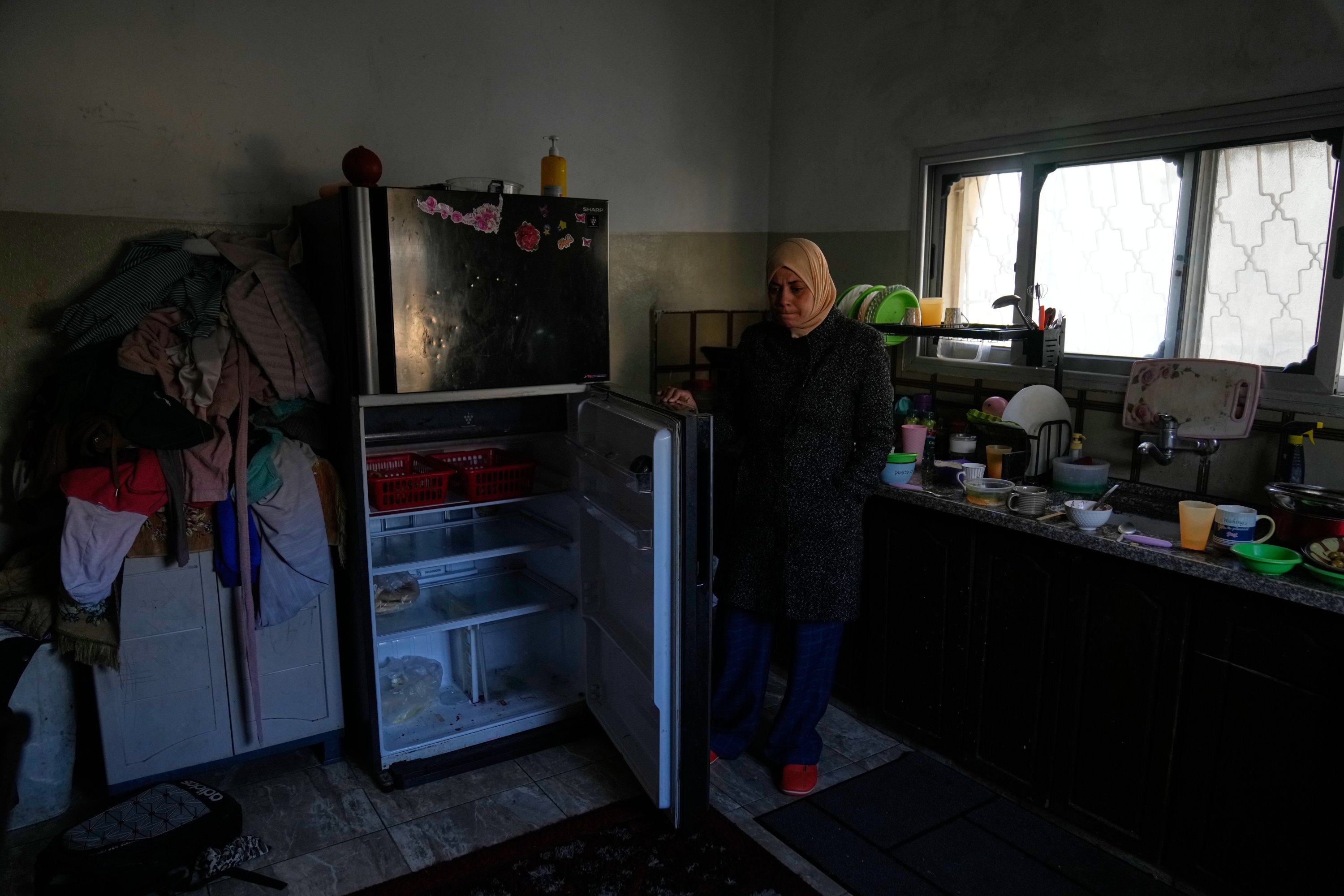
Shuhrat Barghouthi’s husband has spent five months in prison for trying to climb the barrier to enter Israel for work, she said. Before the war, the couple worked in Israel, earning a combined $5,700 a month. Now they are both unemployed and around $14,000 in debt.
“Come and see my refrigerator, it’s empty, there’s nothing to feed my children,” she said. She can’t afford to heat her apartment, where she hasn’t paid rent in two years. She says her children are often sick and frequently go to bed hungry.
Sometimes she returns home to see her belongings strewn in the street by the landlord, who has been trying to evict them.
Forced to work in settlements
Of the roughly 48,000 Palestinians who worked in Israeli settlements before the war, more than 65% have kept their permits, according to Gisha. The Palestinians and most of the international community view the settlements, which have rapidly expanded in recent years, as illegal.
Palestinians employed in the settlements, speaking on condition of anonymity for fear of retribution, say their employers have beefed up security since the start of the war and are far more willing to fire anyone stepping out of line, knowing there are plenty more desperate for work.
Two Palestinians working in the Mishor Adumim settlement said security guards look through workers’ phones and revoke their permits arbitrarily.
Israelis have turned to foreign workers to fill jobs held by Palestinians, but some say it’s a poor substitute because they cost more and do not know the language. Palestinians speak Arabic, but those who work in Israel are often fluent in Hebrew.
Raphael Dadush, an Israeli developer, said the permit crackdown has resulted in costly delays.
Before the war, Palestinians made up more than half of his workforce. He’s tried to replace them with Chinese workers but says it’s not exactly the same.
Assaf Adiv, the executive director of an Israeli group advocating for Palestinian labor rights, said there has to be some economic integration, or there will be “chaos.”
“The alternative to work in Israel is starvation and desperation,” he said.


-

 Daily Agenda3 days ago
Parliamentary Foreign Affairs Committee is going to the USA! Fuat Oktay: The constructive attitude of the congress is of critical importance in Türkiye-US relations
-

 Daily Agenda3 days ago
Minister of Justice Tunç: “The regulation regarding children involved in crime will come to the parliament after the commission works are completed.”
-

 Economy3 days ago
Facing US tariffs, South Africa steps toward trade deal with China
-

 Politics3 days ago
Türkiye captures 2 suspected of spying for Mossad in Istanbul
-

 Sports2 days ago
Akar carries Türkiye’s hopes into Olympic short track spotlight
-

 Politics2 days ago
Arrest, outrage after far-right man targets Turkish mayor’s dress
-

 Economy3 days ago
Ukrainian businesses struggle to stay afloat amid ongoing power cuts
-

 Daily Agenda2 days ago
Immoral and excessive attack on women