
Politics
FM Fidan urges trust, regional solidarity-based Mideast security pact

Türkiye’s Foreign Minister Hakan Fidan said the Middle East must develop its own security architecture based on mutual trust, arguing that lasting stability depends on inclusive regional cooperation rather than deterrence or dominance by any one actor.
In an interview with Al Jazeera aired on Thursday, Fidan said that the main issue of cooperation in security among Gulf countries is “the lack of trust between states” in the region.
He said the region needs its own security arrangements, stressing that the priority should be “creating the fundamental and ultimate trust” among regional states rather than focusing first on deterrence. Trust, he argued, is the real foundation of security and stability.
He said the lack of trust between nation-states remains the core problem in the region, and increasing mutual confidence would help bring peace without domination by any single power. Drawing a parallel with the European Union, Fidan said regional countries could also come together responsibly.
Responding to a question about a Saudi Arabia-Pakistan defense pact and Türkiye’s possible participation, Fidan said: “Any pact in the region should be more inclusive,” adding that broader regional cooperation could follow if built on these principles.
“No domination, no Turkish domination, no Arab domination, no Farsi domination, no other domination. The regional countries are coming together, acting responsibly,” Fidan said.
Emphasizing inclusivity, he said: “We don’t want to create another camp. We want to create a regional solidarity platform.”
“We need regional cooperation and the establishment of a regional security architecture. If we are to fight anyone, it should be terrorists,” the minister stressed.
He added that reliance on external hegemons has repeatedly failed, leaving behind instability and high costs, and argued that regional ownership, institutionalization, and shared platforms are necessary so countries no longer “outsource” their security.
Türkiye doing its best to facilitate the cease-fire process in Syria
Regarding Syria, Fidan said the cease-fire is holding and it is facilitating American forces to transfer Daesh prisoners from Syria to Iraq.
“This is a significant development and everybody should help.”
He added that Türkiye is doing its best to facilitate the process together with the U.S., stressing that coordination among relevant parties is crucial to prevent the collapse of the ceasefire.
Fidan said the understanding reached between the Syrian government and the terrorist YPG-dominated Syrian Democratic Forces (SDF) is important in principle, noting that Türkiye supports agreements that contribute to stability, provided its national security concerns are respected.
“Whatever understanding the parties reach, we support it, because as long as they agree on certain principles, it is worth supporting,” Fidan said.
He said that despite Ankara having its own concerns and red lines regarding Turkish national security interests, “when the Damascus government engages in an agreement with the SDF, these are usually observed.”
Fidan said the YPG terror group is essentially an extension of the PKK in Syria, and that the terror organization has four branches in four countries: Syria, Iraq, Iran, and Türkiye.
“In Syria, what we want is this: we value Syrian Kurds and they should be treated fairly. But the PKK has recruited and mobilized many people and deployed them in Syria together with the SDF. These are non-Syrians whose sole objective is to hurt Turkish national security interests, and we want this to end,” Fidan stressed.
He said it is little known internationally that, beyond PKK elements, Turkish leftist groups are also sheltered in SDF-controlled areas of Syria, with around 300 armed members “looking for opportunities to attack Turkish military and security forces.” He continued by saying that Ankara knows who they are and wants this situation to end.
The rest should be dealt with under the principles of a sovereign and unitary state, the minister stressed.
“In any sovereign and unitary state, you would not want two armies. There has to be one single army under one authority,” Fidan said, noting that police forces and other matters can be arranged between Damascus and the YPG-led SDF. “We do not want to micromanage.”
Responding to a question on Syria being a point of tension between the U.S. and Türkiye in the past, Fidan stressed that what U.S. President Donald Trump is trying to do in foreign policy makes a difference, emphasizing his efforts to reach a cease-fire in Gaza and to stop the war between Russia and Ukraine.
“When it comes to Syria, our perspectives largely overlap. The Trump administration wants the new Syrian administration to take responsibility and act as a responsible member of the international community,” Fidan said.
“Damascus is responding quite well to the demands of regional and international actors,” he added.
“For the past 14 years, the world has faced two major consequences of the Syrian conflict: mass migration and terrorism,” he said, noting that millions of Syrians were forced to flee their homes.
He added that Syrian President Ahmad al-Sharaa’s visit to Washington and his signing of the charter to include the new government in the international coalition against Daesh was a meaningful step. While acknowledging occasional disagreements among the US, Damascus, and the SDF, Fidan said extensive talks are ongoing to resolve the issues smoothly.
Gaza peace efforts and mediation
Coming to Palestine, Fidan said the Gaza peace plan was introduced as part of ongoing efforts to address the crisis in the enclave, building on a process that began in September last year in New York when eight Muslim country leaders met Trump to seek ways to halt the genocide.
“We believe the board of peace is a platform where we can advance the Gaza agenda,” he said, noting that the initiative has since moved forward through sustained consultations, institution-building, and agreements.
He stressed that Ankara’s present position is to do whatever is possible to contribute to the ongoing peace process in Gaza, whether in humanitarian, military, or political form.
Fidan said Türkiye has made it clear it would not resume trade with Israel while the war continues and humanitarian aid is prevented from entering Gaza, underscoring Ankara’s firm stance on the issue.
”Our problem is not with Israel; our problem is with Israeli policies in the region, especially toward the Palestinians, and, most recently, the genocide in Gaza,” Fidan said.
Responding to a question on how future agreements would be enforced if Hamas is fully disarmed in the deal’s second phase, he said the group has never served as a military deterrent to Israel due to the imbalance of power, with Israel backed by the US.
He said Hamas could maintain local security in Gaza but was never a deterrent, and that “one proposal is the creation of an international stabilization force. If implemented, it could help ensure security for both sides and prevent violations of agreements.”
On Türkiye’s possible participation in an international force for Gaza, he said the issue would depend on comprehensive negotiations, noting that the country is part of the Board of Peace and the Gaza national committee.
He added that Ankara, alongside Egypt, Qatar, and the US is a core member of the mediation group. “If asked, we are ready to contribute military units.”
Iran tensions, Ukraine peace hopes and NATO’s future
On a possible Israeli attack on Iran, Fidan said Tel Aviv mainly aims to weaken Tehran’s critical military capabilities, and doubted whether they could achieve regime change.
“It’s wrong. It’s wrong to attack Iran. It’s wrong to start the war again. Iran is ready to negotiate on the nuclear file again,” Fidan said, adding that his advice to the Americans has always been to resolve issues step by step, starting with the nuclear issues.
He urged Iran to find ways to cooperate with different ideologies and systems in the country.
On a potential peace deal between Ukraine and Russia, Fidan expressed his hope that the agreement is “closer than ever,” and also touched upon Türkiye’s mediator role between the two parties.
“Any peace agreement will involve not only Russia and Ukraine, but also Europe and the U.S.,” he said.
Pointing out NATO’s future, Fidan urged Europe to improve its defense capacity, though the alliance “remains the primary security framework.”
He said major European countries, including the U.K. and Türkiye, should discuss a new security architecture and create their own “center of gravity” instead of relying indefinitely on external powers.
Parliament Speaker Numan Kurtulmuş received the final decision of the Gaza Tribunal from the head of the Islamic Cooperation Youth Forum (ICYF) during a meeting at Parliament, officials said Thursday.
According to a statement from the speaker’s office, ICYF President Taha Ayhan briefed Kurtulmuş on the findings of the independent initiative and formally presented the tribunal’s final ruling, announced in Istanbul on Oct. 26, 2025.
The tribunal’s conscience jury concluded that Israel and those supporting its actions were responsible for ongoing genocide and serious international crimes in Gaza.
The ruling highlighted alleged violations, including the use of starvation as a weapon, widespread destruction of homes and civilian infrastructure, environmental devastation, attacks on health facilities and personnel, and the targeting of journalists and educational institutions.
Evidence and witness testimonies collected during the proceedings were compiled by legal experts and are set to be submitted to relevant international bodies, including the International Criminal Court and the International Court of Justice, for use in ongoing or potential legal cases.
The Gaza Tribunal was established in London in November 2024 as an independent people’s court initiative led by global civil society in response to what organizers described as insufficient enforcement of international law.
Chaired by former U.N. special rapporteur Richard Falk, the process included hearings in Sarajevo in May 2025 and final sessions in Istanbul attended by thousands of participants and dozens of experts and victim witnesses.
Officials said the initiative aims to strengthen international accountability efforts and raise global awareness of alleged violations in Gaza.

President Recep Tayyip Erdoğan’s chief adviser Akif Çağatay Kılıç on Wednesday received Igor Khovayev, Moscow’s special representative for the normalization process between Azerbaijan and Armenia
Kılıç said on the social media platform NSosyal that he received Khovayev along with the Russian delegation at the Presidential Complex in the capital Ankara.
The meeting addressed the bilateral relations between Ankara and Moscow, the ongoing Baku-Yerevan normalization process aimed at establishing lasting peace between Azerbaijan and Armenia, as well as the latest developments in the South Caucasus, he noted.
On Aug. 8, 2025, Azerbaijani President Ilham Aliyev and Armenian Prime Minister Nikol Pashinyan met in Washington under U.S. mediation and signed a joint declaration reaffirming their commitment to ending decades of conflict. On the same occasion, the foreign ministers of both countries initialed a peace agreement, underscoring a shared determination to advance toward full normalization.
Türkiye and Armenia have held five rounds of normalization talks in recent years, seeking to restore diplomatic ties and reopen borders closed since the early 1990s.
The two countries share a complex history. Armenia, for a long time, has accused Türkiye, or rather, the Ottoman Empire, of committing “genocide” against the Armenian population in the country during World War I. Türkiye has repeatedly denied the claims, although it has acknowledged a high number of deaths among Armenians due to isolated incidents and diseases.
Borders have remained closed since 1993 following Armenia’s illegal occupation of the Azerbaijani territory of Karabakh. Relations began to thaw after the 2020 Karabakh war, with both sides appointing special envoys to pursue normalization talks and negotiating the reopening of their land border. So far, limited agreements have allowed third-country citizens and diplomats to cross, but a full reopening remains elusive.
Despite the hurdles, there have been tentative gestures toward cooperation. The Margara border crossing has been used twice in recent years for humanitarian purposes: in February 2023 to deliver Armenian aid trucks following a devastating earthquake in southeastern Türkiye, and in March 2024 for humanitarian aid shipments to Syria via Türkiye. Armenia has also upgraded the crossing in anticipation of future use.
The Ministry of Foreign Affairs released a statement on Thursday to commemorate the victims of the Khojaly Massacre in Azerbaijan, on the anniversary of the tragic incident.
Soon after the dissolution of the Soviet Union, Armenian forces took over the town of Khojaly in Karabakh on Feb. 26, 1992, after battering it with heavy artillery and tanks.
The town was the site of a two-hour Armenian offensive that killed 613 Azerbaijani civilians, including 106 women, 63 children and 70 elderly people, and seriously injured 487 others, according to Azerbaijani figures.
Some 150 of the 1,275 Azerbaijanis that the Armenians captured during what has now been called the Khojaly Massacre remain missing, while eight families were completely wiped out.
The Karabakh region was the site of mass killings and burials since the First Karabakh War in the early 1990s, during which the Armenian military occupied Nagorno-Karabakh, a territory internationally recognized as part of Azerbaijan, and seven adjacent regions, including Khojaly.
In the fall of 2020, in 44 days of fighting, Azerbaijan liberated several cities, villages and settlements in Karabakh from some 30 years of Armenian occupation.
In September 2023, the Azerbaijani army initiated a counterterrorism operation in Karabakh to establish a constitutional order, after which illegal separatist forces in the region surrendered.
Türkiye was among the first countries to recognize the Khojaly incident as a massacre and has called for justice for its victims.
The ministry said it condemned the massacre against innocent civilians and noted that it remained a dark stain on humanity’s conscience.
“We carry the pain of 613 Azerbaijani brothers and sisters, those who went missing, those who were held in captivity, those who were injured,” the ministry said.
On Wednesday, President Recep Tayyip Erdoğan expressed his sorrow over the tragedy, saying on X: “On the 33rd anniversary of the Khojaly Massacre, a tragedy we will never forget, I remember with deep sorrow our Azerbaijani brothers who lost their lives.”
He also extended his condolences to the people of Azerbaijan, emphasizing the unity between the two, saying: “We stand united in both good times and bad.”
The mayor of Nizip in southeastern Türkiye is facing backlash after appointing several relatives and close associates to senior municipal posts following his election in March.
Ali Doğan of the main opposition Republican People’s Party (CHP) won the Nizip mayoral seat in the March 31 local elections, marking the first time since 1994 that the party secured the municipality. Doğan previously served as mayor of nearby Karkamış between 2019 and 2024.
According to the reports of Sabah newspaper, shortly after taking office, Doğan appointed two sons-in-law of his brother, his brother-in-law, another in-law, a former driver from his previous term and a childhood friend to various department head positions within the municipality.
The posts include security, science center, information technology, purchasing, parks and gardens, garage services and neighborhood affairs units.
Only one of the appointees was previously employed as a civil servant at another public institution before transferring to the municipality, while the others reportedly began working at City Hall after Doğan assumed office.
The appointments have drawn criticism, including from within his own party. Nizip Municipal Council member Habeş Doğan, also from the CHP and not related to the mayor despite sharing the same surname, resigned from both the council and the party this week.
In a social media post announcing his resignation, the council member criticized what he described as favoritism, alleging that the newly appointed officials receive monthly salaries of TL 75,000 to TL 80,000 (nearly $2.000).
He called for transparency and urged authorities to address public concerns over the appointments.
Türkiye aims to strengthen its close partnership with Azerbaijan through expanded education cooperation, a senior Turkish lawmaker said during a visit to Turkish-run schools in the Azerbaijani capital on Wednesday.
Fuat Oktay, head of the Turkish Parliament’s Foreign Affairs Commission, visited several Turkish educational institutions in Baku while attending the 10th trilateral meeting of the foreign affairs committees of Türkiye, Azerbaijan and Georgia
At the Baku Turkish Anatolian High School, affiliated with Türkiye’s Education Ministry, Oktay met teachers and students and received briefings on academic activities. He later said the school reflected the “strong brotherly ties” between the two countries and expressed satisfaction with efforts to raise well-equipped future generations.
Oktay and the parliamentary delegation also toured the Azerbaijan International Maarif Schools youth campus, operated by the Türkiye Maarif Foundation. Students presented robotics and artificial intelligence projects along with cultural performances.
“These institutions carry strategic importance for our shared future,” Oktay said, adding that cooperation in education would further reinforce fraternal relations between Ankara and Baku.
Speaking to reporters, Oktay said the visit confirmed that Türkiye-Azerbaijan ties “stand firm and are stronger than ever,” noting that the partnership would continue to deepen.
He also said discussions at the trilateral parliamentary meeting focused on regional development and connectivity projects, including transport links such as the proposed Zangezur corridor, which Türkiye views as a key initiative for regional peace, economic growth and closer integration across the region.
Oktay expressed hope that normalization efforts in the South Caucasus would shift the region’s agenda toward “peace, prosperity and development.”
A new debate has emerged in recent days over school activities related to Islam’s holy month of Ramadan, after a group of 168 signatories, including journalists, artists and academics, issued a statement titled the “Secularism Declaration.” The statement, which critics said echoed the rhetoric of the Feb. 28 postmodern coup era, sparked widespread public reaction. Experts, however, argue that such informational and cultural activities are not in violation of secularism.
“If a declaration interprets secularism in a way that categorically excludes the public visibility of religion, or disregards the constitutional framework concerning religious education and religious practices, such an approach contradicts the freedom of religion guaranteed under Article 24. It even amounts to an assault on fundamental freedoms,” Zakir Avşar, a professor from Ankara Hacı Bayram Veli University, told Daily Sabah.
In the statement titled “We Defend Secularism Together,” 168 writers, artists, academics, journalists and representatives of professional organizations claimed that Ramadan activities were a violation of a secular state, saying, “We will not surrender to darkness.”
Reminding that Article 24 of the Constitution of the Republic of Türkiye stipulates that everyone has the right to declare, practice and worship in accordance with their religious beliefs and religious and moral education shall be conducted under the supervision and control of the state, and that compulsory courses on religious culture and ethics shall be included in the curriculum, Avşar stressed that, “Secularism does not mean hostility toward religion; rather, it signifies that the state maintains equal distance from all beliefs and ensures freedom of religion.”
National Education (MEB) Minister Yusuf Tekin also said the declaration reminded him of the Feb. 28 process, describing it as a malicious statement based on mind-reading.
“In their view, celebrating Christmas or Halloween is not contrary to secularism, but when it comes to Ramadan activities that reflect the continuation of our cultural heritage, secularism somehow comes to mind.”
Tekin also announced that he would initiate legal proceedings against the signatories, arguing that the text was ill-intentioned and ideological.
“Just as they exercise their democratic rights, I will exercise mine,” Tekin said.
Avşar noted that the Feb. 28 process marked a period in Türkiye when secularism was applied within a rigid, exclusionary and prohibitive framework. In the field of education in particular, practices such as persuasion rooms, headscarf bans and the coefficient system, along with restrictive measures targeting religious practices, resulted in violations of fundamental rights and freedoms.
Given this historical background, he said, “any tendency to reinterpret secularism through a prohibitive and uniform approach inevitably evokes memories of that era.”
On Feb. 28, 1997 military memorandum was issued by Türkiye’s National Security Council (MGK), which has since been dubbed the “postmodern coup.” The coup was no different than others otherwise. It targeted certain members of the public and kept fear of military intervention alive whenever powerful generals disliked the government.
During the period, the lives of millions took a sharp turn after the Turkish army, then still adhering to a tradition of self-claimed “tutelage” of Türkiye’s secular elite, joined forces with the judiciary organs in vehement opposition to what they called “reactionary forces” in power. This especially affected women expelled from schools for wearing headscarves and men deemed “too conservative” to hold public sector jobs and were fired, as well as others who suffered threats and lengthy legal processes.
Moreover, Tacettin Kutay, an academic at Turkish-German University and a columnist expert argued that the core characteristic of French Enlightenment thought and its model of secularism is built on disregarding the “other” and, if possible, eliminating elements associated with it.
“Unfortunately, in Türkiye, those who describe themselves as secular have largely shaped their intellectual framework based on French Enlightenment traditions and therefore do not operate outside that practice. For this reason, we consistently witness that those involved in these debates express discomfort with the very existence of the other side,” he said.
Previously, Suat Özçağdaş, head of the Education Policy Board of the main opposition Republican People’s Party (CHP), told reporters at Parliament that the government prefers opening Quran courses and described those as structures of “unclear nature.” Accusing the Education Ministry of paving the way for religious orders and communities, Özçağdaş said, “You are hostile to secular education; you are hostile to Türkiye’s secularism.”
Kutay further remarked that it remains unclear what, specifically, has caused discomfort over Ramadan-related activities in schools. “Was any child forced to fast? Was there an imposition outside the curriculum? No,” he said, adding that the reaction appears to stem from unease among those who do not accept that religious elements are also part of cultural heritage.
He concluded that Islam, which constitutes a part of Türkiye’s cultural heritage, is consistently rejected by what he described as an aggressive minority, whose demands are being imposed despite representing a minority view.
“As in nearly every year, the approach of Ramadan in 2026 has prompted statements from circles that describe themselves as secular,” he said, characterizing the circles as hostile toward the nation’s religious beliefs and values.
“It is not surprising,” Ekrem Kızıltaş, a columnist and author, said, commenting on the declaration.
According to Kızıltaş, this year’s debate appears to have been fueled by the fact that Ramadan began close to the anniversary of the Feb. 28 process and by the Education Ministry’s circular encouraging broader coverage of Ramadan-related themes in schools.
Last week, speaking at the Governors’ Meeting Program, President Recep Tayyip Erdoğan said they would organize various school activities to ensure that children, the guarantee of our future, are aware of the significance of the holy days of Ramadan and benefit from what he described as their atmosphere of spiritual abundance.
“There is no debate on secularism in Türkiye, and freedoms are in no way restricted,” Erdoğan said. “We will never deviate from what we believe is right, without paying heed to the ravings of an aggressive group that cannot tolerate our nation living its faith freely.”
On the other hand, Kızıltaş also pointed out that the anger stemming from the detention of several mayors from the CHP on charges such as bribery and corruption may also have played a role in prompting such statements. The group in question, he added, lacks any connection to objectivity, noting that both the president and the education minister have already delivered the necessary responses.
Regarding the critics of the Ramadan activities at schools, he concluded: “It can also be said that, beyond being alienated from the beliefs and values of a nation that is 99% Muslim, their aggressive tone causes them to undermine their own position the more they speak.”


-
 Politics3 days ago
Turkish deputy FM labels Gaza crisis ‘genocide’ urges global action
-
 Economy23 hours ago
Türkiye’s wealth fund in talks on $10B petrochemicals project
-
 Economy13 hours ago
Syria reportedly pressed by US to shift from Chinese telecom systems
-

 Daily Agenda3 days ago
The 17th hearing of the Aziz İhsan Aktaş criminal organization case has started
-
 Politics3 days ago
Terror-free Türkiye architect Bahçeli calls for clarification in plan
-

 Daily Agenda2 days ago
BREAKING NEWS I Clear message from President Erdoğan: “We will build a Türkiye without terrorism”
-
 Daily Agenda1 day ago
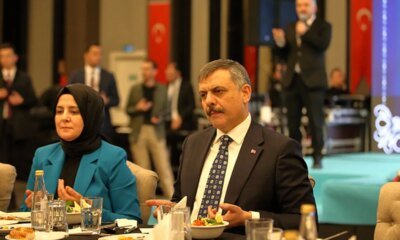
Minister Çiftçi spoke at the iftar table in Çorum: “No one will stop our determined march”
-

 Economy3 days ago
CBRT household expectations survey sees inflation at 48.8% in 12 months