
Politics
Laws of terror-free Türkiye set to reintegrate PKK members

Türkiye has moved to the second stage in the terror-free Türkiye initiative for disarmament of the terrorist group PKK. After the group announced it would dissolve itself last year, a parliamentary committee recently approved a report for legislation to speed up the process.
The report, which will serve as a guide for Parliament to draft legislation, will help facilitate the process after authorities confirmed that the PKK fully abandoned arms.
The National Solidarity, Brotherhood and Democracy Committee, set up exclusively for the PKK’s disarmament, has heard from all segments of the society since last August and wrapped up the work with a report offering advice on the fate of PKK members. The report involves suggestions for the rehabilitation of terrorists after the complete dissolution of the PKK. The Justice Ministry will set up a working group for legislation while the ruling Justice and Development Party (AK Party) will call other political parties to set up an informal working group at Parliament to debate future legislation.
All legislative work will be preceded by a confirmation process by the National Intelligence Organization (MIT) and the Ministry of National Defense regarding the disarmament. A report will be presented by the National Security Council chaired by the president and if the MGK accepts that the PKK is dissolved and has abandoned its arms, it will start the legislation process.
Several legal amendments are already being planned for PKK members, including separate legal definitions for members. They will be categorized in three groups: those involved in acts of terrorism, those who were not involved and those already incarcerated in PKK-related crimes.
Members of the PKK who were not involved in any acts of terrorism will be subject to legal proceedings once they returned to Türkiye and judiciary control practices. The PKK announced last year that all of its members in Türkiye have left the country as part of the initiative. The PKK’s senior leadership and most members hide out in mountainous territories in northern Iraq, particularly in and around the Qandil mountain area. The nature of judiciary control is not clear, but it will most likely be similar to judiciary control for other crimes where convicts are required to report to local police station regularly and/or are banned from traveling abroad. PKK members in this category will also benefit from a string of rehabilitation and reintegration programs, including education, vocational training and psychiatric support.
The PKK is commanded by “veteran” terrorists who joined the group at a younger age and have had no life outside PKK hideouts. Lower ranks are populated by the youth who usually skipped school and were brainwashed to join the terrorist group. Starting over is expected to be difficult for those, especially members who lived outside Türkiye for years. Ministries and relevant institutions are expected to collaborate to create rehabilitation programs.
For those involved in acts of terrorism and those convicted and serving time, the Turkish Penal Code, the Penal Execution Law and the Counterterrorism Law will undergo amendments. The amendments will be exclusive to PKK members and will not cover members of other terrorist groups such as the Gülenist Terror Group (FETÖ). A new law independent of others are also being considered, with a clear definition of PKK membership.
The group’s dissolution means cessation of several crimes under counterterrorism laws, such as membership of a terrorist group, aiding and abetting a terrorist group and propaganda of the same group. Under existing laws, PKK members face additional sentencing for the crime of “attempt to overthrow the constitutional order,” in addition to sentences for crimes of terrorism. Dissolution of the terrorist group would mean cessation of crimes against constitutional order and in turn, the sentences will be dropped.
The existing laws substantially increases prison sentences for manslaughter, extortion, etc., if they were committed by a terrorist group. Cessation of the PKK will mean that people convicted of those crimes would only be sentenced for the “original crime.” Authorities also plan a reduction in sentences and introduction of parole. Under existing laws, based on crime, convicts are eligible for early release if they served three-fourths or two-thirds of their prison sentences. Further reduction is expected in those sentencing system and convicts who served half of their sentence will be eligible for parole. Currently, people convicted of terror-related crimes are not eligible for parole. The same procedures will also apply to members of the PKK in Europe who want to return to Türkiye. They will be eligible for sentence reduction and parole if they are not convicted of crimes.
Elsewhere, new legal amendments are planned for those living in PKK-operated camps in Iraq, such as Makhmour. Those camps are mostly populated by supporters of the PKK who left Türkiye decades ago but have not been on the run as other members of the group. Based on the scale of their involvement with the terrorist group, residents of those camps will be offered reintegration into Turkish society and will be given IDs and education opportunities if they were not involved in acts of terrorism.

Foreign Minister Hakan Fidan held a phone call with his Iranian counterpart Abbas Araghchi on Sunday, diplomatic sources said.
The two men held talks on Saturday too, when the U.S. and Israel launched attacks on Tehran. Sources said Fidan and Araghchi exchanged views “on the latest developments.”
Earlier on Saturday, the Foreign Ministry warned that the developments risked the region’s future and global stability. In a statement, the ministry said they were deeply concerned about every action running against international law and threatening the lives of innocent civilians, and condemned any provocation that may escalate the violence. The ministry also said Türkiye was ready to offer support for mediation between the sides. With attacks increasing, Foreign Minister Hakan Fidan on Saturday has engaged in phone diplomacy with his counterparts in Iran, Iraq, Saudi Arabia, Qatar, Syria, Egypt and Indonesia, discussing steps to end the attacks.
The Sabah newspaper reported that Ankara had three priorities as tensions unfolded: maintaining the cease-fire across the region, minimizing the civilian losses and paving the way for diplomacy. Türkiye is also vigilant over its border security as it shares a lengthy border with Iran. Türkiye on Saturday rejected claims circulating on social media that Ankara supported the joint Israel-U.S. attacks on Iran, saying the posts contain disinformation.
Education Minister Yusuf Tekin, who found himself at the heart of a secularism debate after he instructed schools to organize Ramadan-themed events, stood his ground as more people came out to endorse the practice.
Prior to Ramadan, a so-called “secularism declaration” by a group of celebrities, writers and intellectuals claimed Türkiye was becoming “Talibanized” and with Ramadan, the debate heightened, with the opposition parties joining the chorus against the events.
Speaking at an event in Istanbul on Saturday, on the anniversary of the Feb. 28, 1997 coup, Tekin drew parallels with that process, which was basically a witch hunt targeting Muslims in Türkiye.
Tekin said that during the Feb. 28 process, pressure spread from school gates and campus corridors to teachers’ lounges and even into families’ private decisions at home. Girls wearing headscarves, students of imam-hatip schools (which offer additional curriculum on religion) and devout working families all bore the heavy burden of the intervention together.
Referring to recent criticism surrounding Ramadan activities in schools, Tekin said the country is now facing an updated version of the same language used by proponents of the coup and that the issue should be addressed openly and directly.
“When our children learn about Ramadan, understand the discipline of fasting, grow curious about the meaning of prayer and meet the voice of their own civilization through hymns in the schoolyard, who exactly is triggered into an ideological alarm, and why?” he asked.
“How can a child learning about iftar, patience, charity and respect be construed as a threat? What kind of regime crisis can you manufacture from children decorating for Ramadan? Please explain to me which legal order is harmed by children singing hymns during recess. Those who speak of pedagogy, by what pedagogical standard do you exclude children’s right to know their own culture? Those who speak of freedom, why do you resort to prohibitive language when it comes to the nation’s faith and this country’s spiritual memory? How do those who claim to defend secularism justify portraying the joy of Ramadan in a schoolyard as reactionism, children’s engagement with values education as a threat and society’s genuine bond with faith as a danger?”
Tekin said statements circulated in response to the activities once again revealed what he described as a longstanding intolerance toward the public visibility of the nation’s faith.
“The language that labels a Ramadan event a regime crisis, while targeting the joy of children in schoolyards, clearly shows discomfort with the authentic bond formed with the essence of these lands,” he said. “From this perspective, we can better understand why debates on secularism are repeatedly dragged into the same channel.”
Tekin underlined that secularism in Türkiye had been turned into one of the sharpest tools of tutelage. Responding to those who repeat that “defending secularism is not a crime,” Tekin said, “Of course it is not. The problem lies in a mentality that uses that sentence as a shield while hurling insults at women wearing headscarves, people in religious attire or even an elected mayor because of traditional dress.”
He said the same mindset that once expelled headscarf-wearing students from campuses as centers of reactionism and profiled teachers as “bearded, unionized, risky personnel” now appears in those who cry that “secularism is under threat” over Ramadan activities.
“The problem is not secularism,” he said. “The problem is an obsessive and arrogant understanding of secularism. Those who try to manufacture a regime crisis out of children singing hymns during recess or learning about their own culture and calendar under values education are effectively saying: ‘This society’s faith cannot be visible in the public sphere.’”
Tekin noted that in Western countries, a vast industry has grown out of church-based gospel music without prompting concerns that secularism is under threat.
He said there is an effort to confine children’s awareness of national and spiritual values and their singing of hymns to the home, opposing the reflection of those values in schools, streets or even Parliament. In Türkiye, however, he said, a single hymn, a single piece of traditional clothing or a single Ramadan activity is enough to trigger what he called secular anxiety.
“This is nothing more than the marketing of naked Islamophobia under the packaging of secularism,” Tekin said. “This nation does not have to feel embarrassed for defending its faith and its children’s education. Our objection is to a tutelary language that repeatedly turns the principle of secularism into a pretext for attacking the nation’s beliefs and values.”
Türkiye’s Foreign Minister Hakan Fidan discussed the recent developments in the region with counterparts from across the Middle East, a Turkish Foreign Ministry source said Saturday.
Fidan held phone calls with foreign ministers of Iran, Saudia Arabia, Qatar, Syria and others, to discuss steps to take in order to end U.S. and Israeli attacks on Türkiye’s neighbor Iran, the source said.
The United States and Israel launched strikes on Iran earlier on Saturday, targeting its leadership and plunging the Middle East into a new conflict that President Donald Trump said would end a security threat to the U.S. and give Iranians a chance to topple their rulers.
Tehran responded by launching missiles at Israel. Explosions also rang out in nearby oil-producing Gulf Arab countries, which said they had intercepted missiles from Iran after Tehran warned it would strike the region if it was attacked.
The first wave of strikes in what the Pentagon named “OPERATION EPIC FURY” mainly targeted Iranian officials, a source familiar with the matter said.
Türkiye on Saturday said the security situation in Iran is sensitive and advised Turkish citizens to remain in secure areas and avoid going out amid Israeli, U.S. attacks across the country.
In a notice shared on X, the Turkish Embassy in Tehran urged Turkish nationals to postpone their trips to Iran except in emergency situations, stressing that the security situation in Iran remains “sensitive.”
“Our citizens in Iran are advised to remain in secure areas, stay away from military zones and buildings, refrain from going outside, and those who plan to travel to Iran are advised to postpone their travel except in emergencies,” the notice said.
It also said that the Türkiye-Iran land border crossings of Esendere, Kapıköy, and Gürbulak are open, and that it is possible for Turkish citizens to return to Türkiye by land.
The notice asked the Turkish nationals to follow new statements regarding developments through the official websites and social media accounts of the ministry and Türkiye’s missions in Iran.
The United States and Israel launched strikes on Iran earlier on Saturday, targeting its leadership and plunging the Middle East into a new conflict that President Donald Trump said would end a security threat to the U.S. and give Iranians a chance to topple their rulers.
Tehran responded by launching missiles at Israel. Explosions also rang out in nearby oil-producing Gulf Arab countries, which said they had intercepted missiles from Iran after Tehran warned it would strike the region if it was attacked.
The first wave of strikes in what the Pentagon named “OPERATION EPIC FURY” mainly targeted Iranian officials, a source familiar with the matter said.
Türkiye on Saturday rejected social media claims that it supported recent attacks on Iran, calling them disinformation and reiterating that its airspace, territory and maritime zones are not used for military operations in conflicts to which it is not a party.
Authorities said allegations circulating online that Türkiye facilitated or assisted the strikes were unfounded and intended to mislead the public.
Officials stressed that Ankara does not allow its air, land or maritime assets to be used in ways that would benefit any side in an external conflict, describing the policy as a core principle of the country’s foreign and security approach.
They added that Türkiye exercises full sovereignty over its airspace, territory and maritime jurisdiction areas, and that any activity within those zones is conducted solely in line with national security assessments and under the supervision of relevant authorities.
The government also urged the public to disregard speculative or unverified reports and to rely on information issued by official sources.
The United States and Israel launched an attack Saturday on Iran, with the first apparent strike happening near the offices of Supreme Leader Ayatollah Ali Khamenei.
Iranian media reported strikes nationwide, and smoke could be seen rising from the capital.
President Donald Trump said in a video posted on social media that the U.S. had begun “major combat operations in Iran.” He claimed Iran has continued to develop its nuclear program and plans to develop missiles to reach U.S.
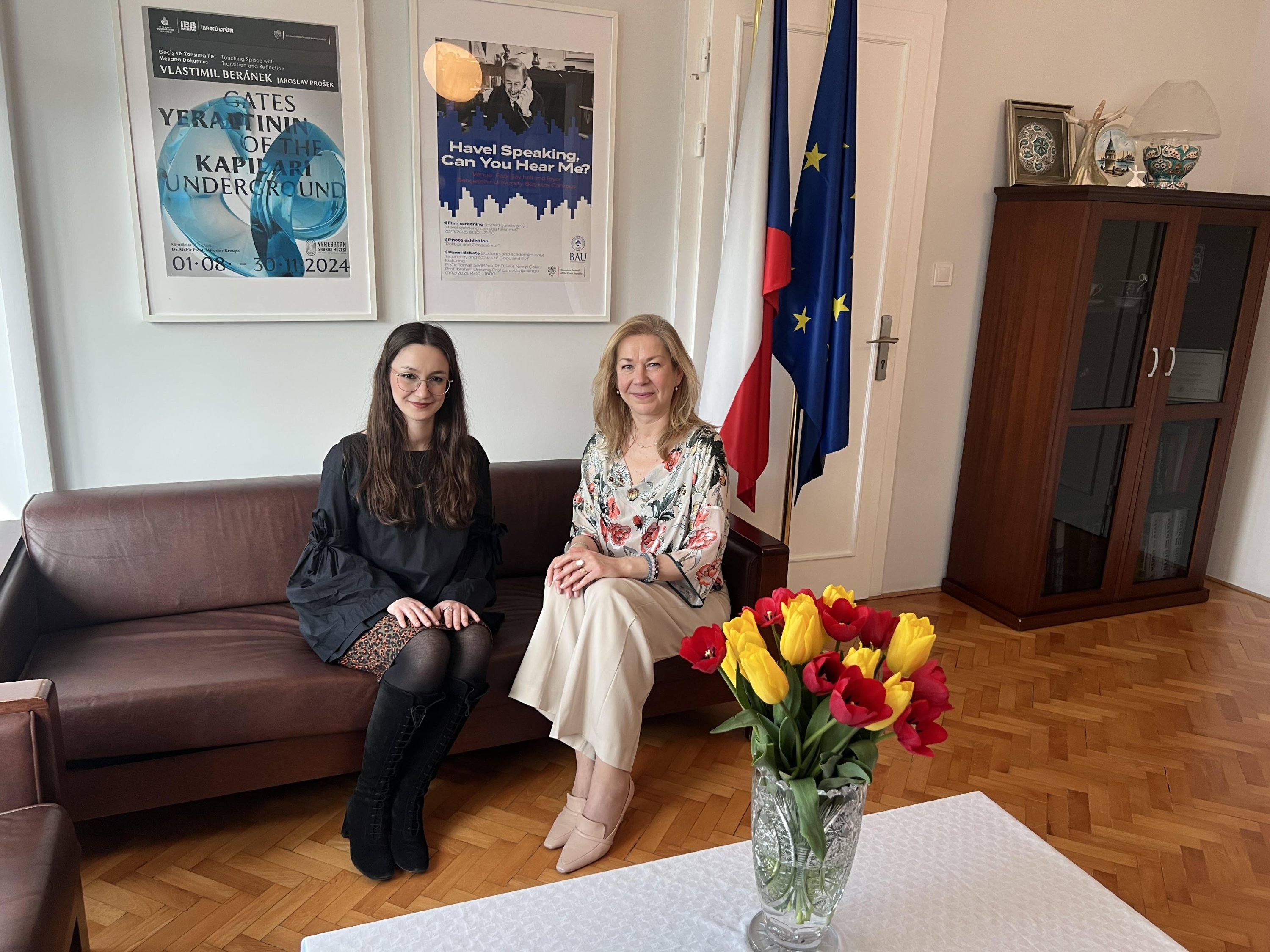
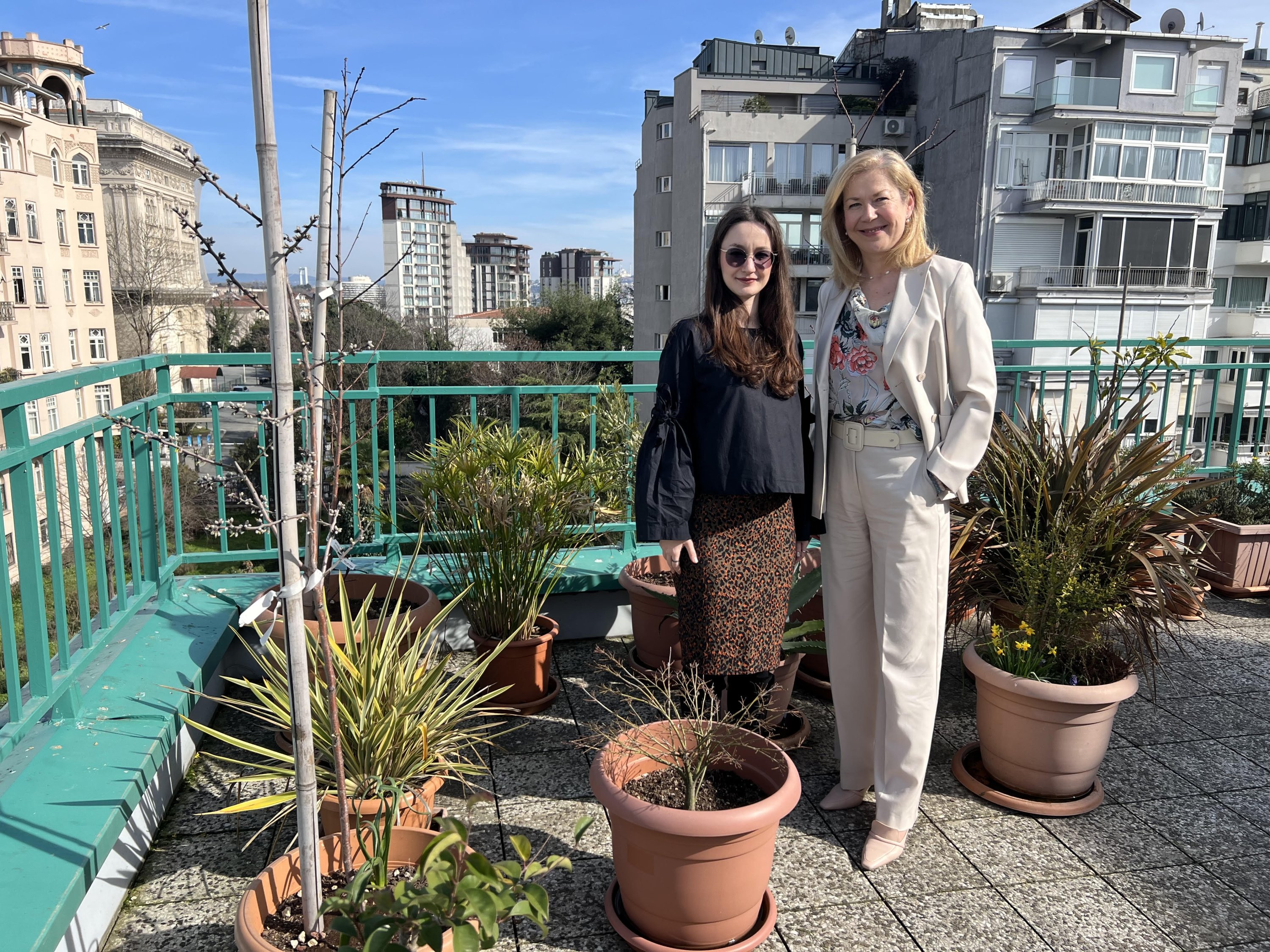
While giving a tour of the terrace garden she maintains at the Czech Consulate, Olga Hajflerova, paused to admire the Istanbul skyline.
“It’s a privilege to be in this part of the city,” the consul general remarked.
Hajflerova, who recalled her two and a half years of experience in Türkiye with great admiration, said that she appreciates the strengthening ties between the two countries.
She noted that many Czech citizens once viewed Türkiye as a distant holiday destination with a different culture and that Europe and Türkiye have not always been certain how they perceive one another.
However, defining her mission as helping Czechs and Europeans understand that Türkiye and they have much in common, she said, “We are based on the same values, not just interest or needs. We are one people.”
“Our societies may function slightly differently in detail, but fundamentally we are the same,” Hajflerova added, reminding that she gave the same message a year ago in the opinion article she wrote for Daily Sabah.
To promote mutual understanding, Consul General Hajflerova and her team have been actively working in Istanbul.
“If I had a team 10 times bigger here, I would still be very busy because the potential is enormous,” she explained.
Expanding cultural, educational ties
One of Hajflerova’s personal interests is education, as she described the Czech Consulate General as one of Istanbul’s most dynamic in this field, supporting more than 20 student clubs.
She shared her love of meeting with Turkish university students and discussing international affairs, political developments, and diplomatic careers with them.
“In exchange for my experience, I receive their energy and motivation, and I hope it is as meaningful for them as it is for me,” she said.
Apart from the field of education, the Czech Consulate General organizes events to promote cultural exchange.
The next planned event, Hajflerova said, is a photo exhibition by Turkish photographer Izzet Keribar. Opening April 2 at Nişantaşı Işık Gallery, it will showcase Prague and Czechia to Turkish visitors.
Following that, in May, Hajflerova noted the consulate will organize a Czech food festival. As the third edition of the event, the festival will feature special chefs from Czechia’s Ministry of Foreign Affairs.
Previously, the consulate hosted several other events, which included an exhibition of Czech crystal artistry at the Basilica Cistern and a photo and documentary exhibition dedicated to the legacy of former Czech President Vaclav Havel.
Hajflerova added that, beyond the success of these events, attracting the Turkish public’s interest in the Czech Republic requires little effort, as Turks are already enthusiastic about the country, especially when it comes to visiting.
Growing co-op across sectors
However, when it comes to visiting the European Union for academic, touristic or business reasons, Turkish citizens have been facing difficulties in obtaining Schengen visas for years.
The EU has argued that the processes managed by accredited visa agencies have been slow due to the high number of applications and that it has been discussing possible solutions with Ankara.
“The general imagination that the EU countries restrict Turkish citizens from coming to Europe is not true,” Hajflerova said, adding that the Czech Consulate has been trying to make the procedure as easy as possible for visitors.
She also emphasized that about 90% of Turkish applicants for Schengen visas to visit Czechia were approved.
According to Türkiye’s Minister of Trade, Ömer Bolat, tourism flows between Türkiye and the Czech Republic are steadily increasing, with approximately 100,000 Turkish citizens traveling to the Czech Republic each year, while the number of Czech visitors to Türkiye has reached about 400,000 annually.

Underlining the significance of connectivity, Hajflerova also highlighted Turkish Airlines and Pegasus having multiple daily direct flights between Türkiye and the Czech Republic.
“I am also very pleased to announce that we are in talks with Pegasus Airlines, and I understand they are eager to expand connections between our countries,” she added.
In December 2025, Turkish low-cost carrier Pegasus Airlines announced it signed a deal to buy the biggest Czech airline, Smartwings, along with its owner, Czech Airlines (CSA), in a bid to strengthen its presence in Europe and expand globally.
While tourism and civil aviation connectivity are important elements of Türkiye and the Czech Republic’s relations, defense cooperation also has a significant place in the two countries’ bilateral relations.
In February, Türkiye’s defense and electronics giant Aselsan and Czech defense firm Excalibur International, part of the CSG group, signed a strategic cooperation agreement to establish an EU-based joint venture while simultaneously introducing the Korkut air defense system integrated on the Tatra Force 6×6 wheeled platform.
“The partnership aims to expand joint defense capabilities for European and global markets,” stated the Czech firm.
Hajflerova emphasized that, in addition to existing economic, industrial and defense cooperation, many other sectors have potential for growth, including agriculture.
Referring to Czech companies’ participation in Agroexpo International Agriculture and Livestock Exihibition which was organized in İzmir in February, Hajflerova said, “We brought ecological methods of agricultural production to help that production is healthy and sustainable.”
The consul general said that Czech participation in the event drew strong interest not only from Turkish companies but also from firms in the region.
Agroexpo 2026, one of Europe’s four largest agricultural fairs and Türkiye’s largest, hosted 426 participants, 56 of whom were foreign. A total of 110,715 people visited Agroexpo, 12,760 of whom were foreign, from 112 countries.


-
 Daily Agenda2 days ago
February 28 message from Sümeyye Erdoğan Bayraktar: We have not forgotten, we will not let you forget
-
 Daily Agenda22 hours ago
BREAKING NEWS | Investigation into ANKA’s ‘Incirlik Base’ images
-
 Politics3 days ago
Turkish Parliament speaker briefed on Gaza Tribunal findings
-
 Daily Agenda2 days ago
Minister Gürlek’s emphasis on the new constitution: “We need to put it on a strong basis”
-
 Daily Agenda6 hours ago
Tanju Özcan is in custody: He demanded extortion under the guise of a scholarship
-
 Politics5 hours ago
Türkiye urges citizens in Iran to stay in secure areas amid US-Israeli attacks
-
 Daily Agenda23 hours ago
Address delivery tender scandal in CHP’s Etimesgut Municipality: 760 million irregularities from Erdal Beşikçioğlu!
-
 Politics2 days ago
Terror-free Türkiye initiative enters ‘new political era’ a year on