
Politics
NATO official underscores Türkiye’s pivotal role in deterrence, stability

Türkiye plays a vital role in NATO’s deterrence posture and efforts to maintain stability across its southern flank, a senior alliance official said, highlighting Ankara’s growing strategic importance as NATO advances a comprehensive “360-degree” security approach ahead of an upcoming summit in Ankara.
Speaking in an exclusive interview with Anadolu Agency (AA), Javier Colomina, NATO secretary-general’s special representative for the southern neighborhood, described Türkiye as a central actor in shaping alliance policy toward the Mediterranean and wider southern neighborhood, citing its military capabilities, geographic position, and active contributions to regional security.
“Türkiye plays an essential role… is an actor that is well known for its ability to secure the shores, for its ability to provide defense industry assets, for its ability with their armed forces, and is indeed one of our more committed allies,” he said.
“And particularly in the Mediterranean, it plays a huge role in ensuring that the Mediterranean is a secure basin, together with the other Allies.”
Colomina said Ankara has been instrumental in developing NATO’s Southern Neighborhood Action Plan and remains a key supporter of its implementation, particularly as the alliance strengthens deterrence and resilience against interconnected threats ranging from terrorism and irregular migration to geopolitical competition.
“The Southern Neighborhood, it’s been an important topic for the alliance for many years, but it was a year and a half ago that we decided to approve a Southern Neighborhood Action Plan,” he added, noting that Türkiye played “a very important role in making that happen.”
Southern Neighborhood Action Plan and Ankara summit
Colomina said the Southern Neighborhood Action Plan, which is based on pillars such as political dialogue, practical cooperation, regional presence, and coordination with organizations such as the African Union, the U.N., the EU, the Gulf Cooperation Council, and the Arab League, is heavily reliant on cooperation among allies.
“In all of those pillars… It’s been very clear the support from Türkiye,” he said.
The upcoming NATO summit in Ankara is expected to focus primarily on implementing decisions taken at last year’s summit in The Hague, including increased defense investment targets and continued support for Ukraine.
Colomina emphasized that the geographical location of the meeting carries symbolic and strategic importance.
“The fact of having this summit in the Southern Neighborhood, geographically located in the south, as it’s Ankara, would mean a lot for our Southern Neighborhood Action Plan, for the approach we have to our partners, and for all the work that we’ve been doing in the last couple of years,” he said.
While concrete deliverables specific to the southern flank remain under discussion, he indicated that the southern dimension will likely feature prominently.
Eastern Mediterranean security and Türkiye’s role
Addressing NATO’s priorities in the Eastern Mediterranean, Colomina underscored long-standing cooperation frameworks such as the Mediterranean Dialogue, launched more than three decades ago, and the role played by southern allies.
“We have partners in the Mediterranean and allies that do play a role in the southern side of the alliance, from Türkiye… to Greece, Portugal, Spain, Italy,” he said, highlighting efforts to safeguard energy corridors and maritime routes.
According to Colomina, Türkiye is particularly influential in regional security due to its military capabilities and strategic position. He added that Ankara contributes significantly to ensuring that the Mediterranean remains “a secure basin.”
NATO’s evolving defense concept focuses on threats across all strategic directions, north, east, west, and south, reflecting an interconnected security environment, Colomina said.
“The 360-degree approach is at the core of everything that we do,” he explained, linking the strategy to collective defense planning and deterrence efforts across the Euro-Atlantic area.
He pointed to growing challenges across the southern neighborhood, including terrorism, irregular migration, maritime and energy security concerns, cyber threats, and geopolitical competition involving Russia, China, and Iran.
NATO’s response involves cooperation with a wide network of partners, including 12 southern partners among its 35 global partners, according to Colomina.
“NATO doesn’t have to be the first responder for all of them,” he said, emphasizing instead capacity-building initiatives and cooperation with regional partners to promote stability.
The alliance is closely monitoring developments in Syria, Lebanon, Gaza, the Gulf, and the Red Sea, he said, stressing the need to contribute to stability without necessarily taking a leading operational role.
Responding to debates in some allied countries about burden-sharing and collective defense credibility, Colomina said NATO remains strong and united following decisions taken at the 2024 summit in The Hague.
“I think we had a historical summit in The Hague last summer, where we took historical decisions to increase our investment to 5%,” he said, calling the move evidence of the alliance’s “good health” and continued commitment to Article 5 mutual defense guarantees.
He noted that many allies have significantly increased defense spending and capabilities while emphasizing the continued role of the US within NATO.
“That doesn’t mean that the Americans will no longer be with us. They still have 80,000 soldiers in Europe,” he said, adding that greater European and Canadian contributions will ultimately strengthen the alliance.
Despite regional crises, NATO continues to rely on structured dialogue mechanisms such as the Mediterranean Dialogue and the Istanbul Cooperation Initiative, which bring together partners from the Mediterranean and Gulf regions.
“We need to work with all of them,” Colomina said, stressing flexible and tailored approaches to cooperation. He noted that NATO marked the 30th anniversary of the Mediterranean Dialogue and the 20th anniversary of the Istanbul Cooperation Initiative in 2024, underlining their continued relevance.
Congratulating Türkiye on the 74th anniversary of its NATO membership, Colomina described Ankara as a major contributor to alliance security and defense efforts.
“Türkiye contributes greatly to our security and defense efforts, particularly in the southern neighborhood, being one of the countries more exposed to southern neighborhood challenges,” he said, praising the country’s defense industry and military capabilities across land, sea, and air.
“We’re very pleased with the work that we continue to do with our Turkish friends everywhere where we are deployed and in Brussels, where we work on a daily basis,” he added.
Germany’s defense minister on Wednesday underscored Türkiye’s strategic importance to European security, commending Ankara for its significant contributions to NATO’s defense planning and collective deterrence efforts.
Speaking to reporters after observing NATO’s Steadfast Dart 2026 military exercise in the Baltic Sea, Boris Pistorius said NATO allies are united and prepared to confront security challenges.
“Türkiye is a very, very important NATO partner on the southeastern flank with considerable capabilities, which have become impressively evident today, for example, with the amphibious boats,” he told reporters. “These are new to the Turkish Navy and have proven to be of high quality.”
The Steadfast Dart 2026 exercise, NATO’s largest of the year, tests the rapid deployment and integration of the Allied Reaction Force (ARF). Running from January to March 2026, it involves around 10,000 personnel from 11 NATO countries.
Pistorius thanked Türkiye for its substantial contribution, which includes around 2,000 military personnel, Bayraktar TB3 armed unmanned aerial vehicles, its largest warship TCG Anadolu, several frigates, and various other indigenous assets. He praised the quality of Turkish equipment and forces.
“The contribution of the Turkish allies, the Turkish friends here at this deployment exercise, is of central importance, of course, for NATO as a whole. Because it shows that NATO is bigger than some people believe. And that Türkiye has always played a central role in this, and probably even more so today,” Pistorius said.

President Recep Tayyip Erdoğan on Tuesday conveyed his wishes for a blessed Ramadan, expressing hope that the holy month brings goodness and prosperity to Türkiye, the Islamic world and all humanity while strengthening unity and solidarity.
In a statement posted on social media, the president said he prays that the sacred days, marked by the opening of the gates of mercy, reinforce national unity and togetherness.
The people in Türkiye will start fasting on Thursday, but various countries started fasting on Wednesday.
Muslims around the world will fast for approximately 12 to 15 hours a day during Ramadan. In the Northern Hemisphere, fasting hours will lengthen as days grow longer, while in the Southern Hemisphere, they are expected to gradually shorten.
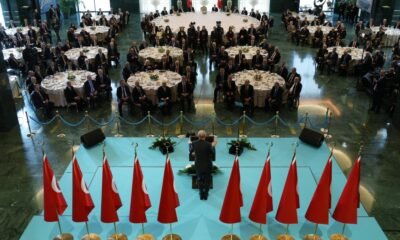
Governors from 81 provinces joined newly appointed Interior Minister Mustafa Çiftçi on Wednesday as President Recep Tayyip Erdoğan, fresh off a visit abroad, hosted the Governors’ Meeting at the Presidential Complex.
Before delivering awards to governors with outstanding accomplishments and after remarks underlining that the governors “embodied the state in the field,” Erdoğan urged caution to the highest public administrators in every province while conducting their work.
“You should not be drunk with power while serving people and should not seek any interest other than for the people you should be honored serving,” he said, adding that serving people should be their priority rather than “focusing on advancing your career.”
Erdoğan also pointed out that recent complaints against public officials were especially related to social media. “As social media platforms proliferated, a major portion of communication and information services (of public institutions) shifted there. Naturally, our institutions and officials utilize them more and more. Nevertheless, we occasionally witness the excess (on the part of officials) on social media, for the sake of gaining favor and interaction. The privacy of people is violated and we see people acting in contradiction to the seriousness that conducting the state’s work requires. These behaviors devolve into communication mishaps and crises. I believe you and people working under you will act sensibly in those matters,” he said.
“If administrators act arrogantly against people, they will lose favor,” Erdoğan added.
The president said they expected governors to come up with fast and efficient solutions to people’s problems and “win hearts.” “They have to act with maximum efficiency. This is actually what leadership takes. A successful governor means a good leader. Good leadership requires taking responsibilities and risks and staying away from referring matters they can solve locally to Ankara,” he underlined.
“The state, in Turkish tradition, does not merely refer to an administrative organization. It also embodies meanings such as power and compassion. Justice lies at the foundation of the nation’s millennia-old state tradition. In this sense, governance is intertwined with wisdom. One cannot ensure administration without establishing justice and goodness,” he stated.
Erdoğan said the Turkish nation has never been without a state at any point in its history and has upheld the principle of “Ebed Müddet” or the eternal state, passing it on to future generations.
“Our national and spiritual values, our human and cultural heritage, and our vision of the past and the future are directly embedded in our philosophy of the state,” he said. “That is why, for us, the state does not merely signify an administrative structure. It also encompasses meanings such as power, prosperity, compassion and mercy.” He said justice forms the foundation of the centuries-old state tradition, with people at its center, and virtue and morality at its core.
“In this respect, governance is intertwined with wisdom,” Erdoğan said, citing Yusuf Kamil Pasha, who served in senior posts including grand vizier during the Ottoman Empire. Erdoğan quoted him as saying, “Government is inseparable from wisdom.”
“You cannot ensure administration without establishing justice and goodness. If you disregard people and exclude wisdom, you cannot secure peace and stability,” he said. “You must use the resources entrusted to you by our state with great diligence for the benefit of our people and our cities,” he also said.
The Turkish Parliament’s National Solidarity, Brotherhood and Democracy Committee, tasked with guiding the terror-free Türkiye initiative, will hold its 21st session on Wednesday. The convention will focus on a joint report by the parties expected to be released soon.
The initiative aims to end the campaign of violence by the PKK terrorist group. It was proposed by the government ally Nationalist Movement Party (MHP) in 2024 and took a new turn when the PKK decided to dissolve itself upon a call by its jailed leader Abdullah Öcalan in February 2025.
Ending PKK terrorism will be a major gain for Türkiye, which has lost tens of thousands to violence since the 1980s.
Mustafa Çiftçi, the newly appointed interior minister, vowed to support the initiative with all the resources of the ministry at a meeting with governors on Tuesday in Ankara.
“We are currently in a process where we will crown the accomplishments we have had in the past 40 years. With terror-free Türkiye, we aim to save our country from its shackles forever. Currently, we are at an important stage in this process, thanks to the resolute leadership of our president and the strong support of MHP leader Devlet Bahçeli. As the Interior Ministry, we will act in coordination with all relevant institutions to ensure that the initiative reaches its goals and adheres to the requirements of the rule of law. We will never allow those trying to undermine the initiative,” he said.
The committee is viewed as instrumental in advancing the terror-free Türkiye initiative, which has so far been confined to unilateral moves by the PKK.
Legislative steps are a tricky issue as authorities strive to clarify that they would not provide impunity to the PKK.
So-called “return home laws” are expected to be included in the final version of the report, covering sentencing or non-prosecution for members of the PKK involved or not involved in acts of terrorism if they return to Türkiye. The PKK is currently based in northern Iraq, while its wings are active in Syria and Iran as well. A report by the Sabah newspaper says the return of PKK members to Türkiye would be subject to intense scrutiny, and even those without a criminal record would be subject to legal proceedings once they return to Türkiye. Those not involved in crimes while working for the PKK will be released with judicial control after they testify, the newspaper reported.
NATO spokesperson Allison Hart on Tuesday underlined Türkiye’s role in NATO, saying Türkiye is a staunch ally and valued contributor to shared security.
In a written statement to Anadolu Agency (AA) marking the anniversary of Türkiye’s accession to NATO, Hart emphasized Ankara’s contributions to the alliance.
“As we look forward to the next NATO Summit in Ankara in July, we are reminded today of the many ways in which Türkiye contributes to the Alliance, as it has done for 74 years since joining NATO,” she said.
Hart noted that Türkiye has NATO’s second-largest army and pointed to the country’s “steady investment in defense,” “robust defense industry” and “consistent contributions to NATO missions, activities and exercises.”
Meanwhile, Naval Forces Command commander Adm. Ercüment Tatlıoğlu also said Tuesday that the Anadolu Turkish Maritime Task Force played a significant role in NATO’s largest exercise of the year, deploying domestically produced assets.
Tatlıoğlu spoke to journalists aboard Türkiye’s largest warship, TCG Anadolu, during the NATO Steadfast Dart 2026 exercise in the Baltic Sea.
“We are participating as the Anadolu Turkish Maritime Task Force with our multipurpose amphibious ship TCG Anadolu, our replenishment combat support ship TCG Derya, our first national and local frigate TCG Istanbul, and our TCG Oruçreis frigate, whose midlife modernization we carried out with national means,” Tatlıoğlu said.
The admiral reported that an amphibious marine infantry battalion – armored amphibious assault vehicles capable of operating both at sea and on land, underwater offense and defense commandos, helicopters, unmanned surface vehicles, and three Bayraktar TB3 armed unmanned aerial vehicles – also participated from Türkiye.
He highlighted two key points about the exercise. First, it demonstrated the power projection capability of the Naval Forces Command, with marines and amphibious units transported over a distance of more than 8,000 kilometers (4,971 miles) aboard TCG Anadolu.
Second, the TB3 drones were used for the first time in a NATO exercise and for the first time in an amphibious operation. Tatlıoğlu noted this represents a new doctrine for NATO, marking the alliance’s first amphibious operation using UAVs.
Fifteen ships and 2,600 personnel from Türkiye, France, Poland, Germany, the Netherlands, and Spain participated in the operation.
Türkiye joined NATO on Feb. 18, 1952. The alliance was founded in 1949.
Over the past 74 years, leveraging its strategic location, Türkiye has continued to make critical contributions to NATO as the first ally in the region to directly confront threats and risks, particularly in the fight against terrorism.
Among 32 allies, Türkiye ranks seventh in contributing to the alliance’s budget. Its total contribution is expected to amount to 300 million euros (just over $355 million) this year and to rise to 620 million euros in 2030.
An indictment filed against Istanbul Mayor Ekrem Imamoğlu and three other defendants on charges of “political espionage” has been accepted by a court, which set the first hearing for May 11 in Silivri.
The Istanbul 25th High Criminal Court ruled that the trial of Imamoğlu, Hüseyin Gün, Necati Özkan and Merdan Yanardağ will begin at 10 a.m. on May 11 at a courtroom inside the Marmara Prison complex in Silivri, Istanbul.
Imamoğlu, who was suspended from his post as mayor of the Istanbul Metropolitan Municipality (IBB) following his arrest in a separate case involving allegations of leading a criminal organization for financial gain, faces between 15 and 20 years in prison if convicted of political espionage. The other three defendants face the same prison term.
The court completed its review of the indictment prepared by the Istanbul Chief Public Prosecutor’s Office and issued its preliminary ruling. In its decision, the court said there is a strong suspicion of a crime supported by concrete evidence regarding political or military espionage. It cited the nature and classification of the alleged offense, the fact that the defendants have not yet presented their defenses and that evidence collection has not been completed.
On those grounds, the court ruled to continue the detention of Imamoğlu, Özkan, Yanardağ and Gün.
The panel also ordered that official correspondence be sent to the Bakırköy Chief Public Prosecutor’s Office and the Silivri District Gendarmerie Command to ensure that the hearing can be held at the prison complex and that necessary security measures are taken.
Prosecutors say a search of digital materials belonging to Gün led to the discovery of data exclusively found in IBB’s database. According to prosecutors, Özkan obtained the data originally and, upon instructions of Imamoğlu, relayed them to open-source intelligence (OSINT) websites. Gün is accused of accessing confidential documents of the municipality.


-
 Daily Agenda2 days ago
Early election statement from AK Party Deputy Chairman Hüseyin Yayman: There will be no early elections in Türkiye at the request of the opposition!
-

 Economy3 days ago
Closer look at Türkiye’s booming date trade as Ramadan nears
-
 Daily Agenda19 hours ago
President Erdoğan: We are not interested in the swamp that CHP has fallen into… We are just minding our business
-
 Economy18 hours ago
Türkiye’s Oyak targets asset growth, IPOs, foreign-backed investments
-
 Politics3 days ago
Erdoğan, UAE leader talk about expanding ties in phone call
-
 Politics3 days ago
Türkiye condemns Israel’s ‘illegal’ move for West Bank land grabs
-
 Politics17 hours ago
Turkish president warns governors to avoid being drunk with power
-
 Daily Agenda7 hours ago
NATO post from the Ministry of National Defense: “74 years in NATO. Respected ally for world peace”