
Politics
Turkish intel chief holds high-level talks in Syria

ANKARA
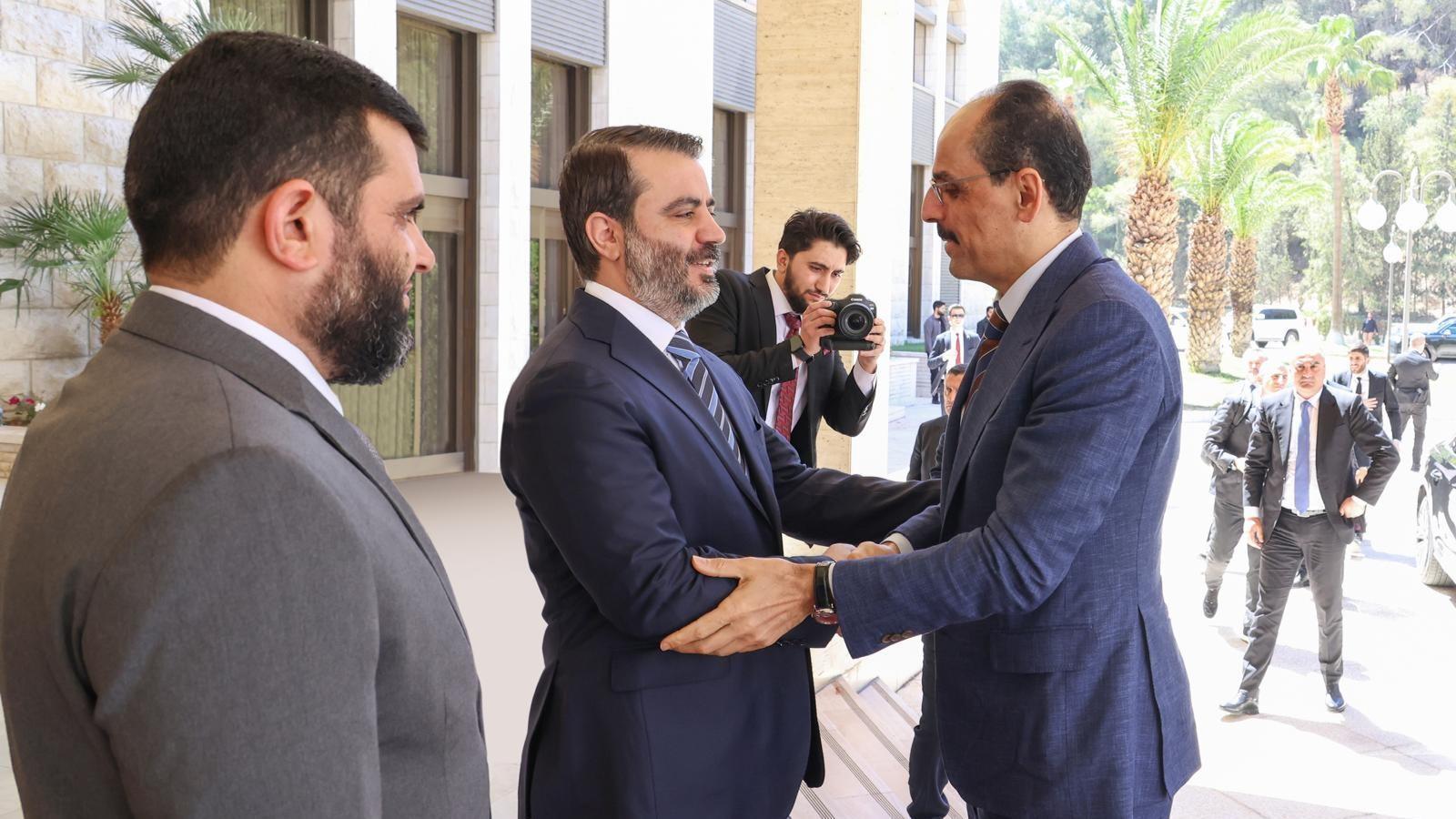
Türkiye’s National Intelligence Organization head İbrahim Kalın held a series of meeting with Syrian President Ahmad al-Sharaa and his foreign minister and spy chief in Syria, Turkish security sources said on May 20.
Kalın met with Sharaa, Foreign Minister Asaad al-Shaibani and intelligence chief Hussein Al-Salamah during his visit to Syria on May 19, the sources announced.
The talks focused on bilateral relations between Türkiye and Syria, with an emphasis on the importance of Syria’s territorial integrity, sovereignty and political stability, the sources informed the Turkish media.
Türkiye reaffirmed its commitment to stand by Syria under all circumstances, the statement said.
Among the key topics discussed were the disarmament and integration of all armed groups, including the PKK/YPG terrorist organization, into the new Syrian army, as well as issues concerning border security and the transfer of control over prisons and camps housing ISIL members.
Within the context of regional developments, the talks also addressed Israel’s airstrikes and violations of Syrian airspace, as well as the need to lift all sanctions imposed on Syria, the sources stated.
Discussions also covered the ongoing fight against ISIL and the voluntary and safe return of Syrian refugees to their homeland.
The meeting came before a scheduled working group session between Türkiye and the United States on Syria, to be held in Washington on May 20, as part of ongoing efforts to align priorities and enhance cooperation in the country.
Foreign Minister Hakan Fidan met with Palestinian Vice President Hussein al-Sheikh in Ankara on Tuesday, according to diplomatic sources.
The meeting focused on regional and global developments, the sources said.
The sources said on Monday that Türkiye would reiterate its full support to the State of Palestine, safeguarding the rights of the Palestinian people and the vision for a two-state solution during the talks. It was also highlighted that Türkiye will not allow the Netanyahu government’s illegal actions and annexation policies in the occupied Palestinian territories to hinder regional and international efforts for the two-state solution.
Fidan was also expected to underline the international community’s responsibility to prevent the humanitarian crisis in Gaza from deepening. The talks would focus on the “Board of Peace” and related mechanisms, the situation on the field and future steps, sources said, adding that they would also raise the issue of Israel’s attempts to undermine the Board of Peace’s activities.
The Turkish public and government are major supporters of the Palestinian cause. Türkiye has been a traditional ally to Palestine, but as the Israeli attacks became more brutal, Ankara has become harsher in its criticism in the past year. It has condemned what it calls genocide, halted all trade with Israel and applied to join the genocide case against Israel at the World Court, which Israel rejects.

Türkiye’s intelligence chief held talks with a senior Hamas delegation in Ankara, with discussions centered on the ongoing Israeli attacks in Gaza and the deepening humanitarian crisis, security sources said.
The head of the National Intelligence Organization (MIT), Ibrahim Kalın, met with Khalil al-Hayya, head of Hamas’ negotiating team, along with accompanying officials, in a meeting that addressed key regional developments.
According to sources, the talks focused on the situation in Gaza, including Israel’s continued military operations and their humanitarian impact. The sides also discussed Israeli settler violence in the West Bank and restrictions imposed on worshippers at Al-Aqsa Mosque.
Participants emphasized the need for Israel to fulfill its obligations under the first phase of the Gaza cease-fire plan and reviewed prospects for implementing the second phase.
The Hamas delegation expressed appreciation for Türkiye’s efforts to support peace in Gaza and conveyed thanks to President Recep Tayyip Erdoğan for Ankara’s ongoing diplomatic engagement.
Turkish authorities have issued detention warrants for 12 suspects as part of an investigation into the alleged “public sector confidential structure” of the Gülenist Terror Group (FETÖ), prosecutors said Tuesday.
According to a statement from the Ankara Chief Public Prosecutor’s Office, the Terror Crimes Investigation Bureau identified suspects who allegedly operated within the group’s covert network, infiltrating state institutions. The probe focused on operational phone lines and communication methods used by the organization.
Authorities said evidence indicates that the suspects used ByLock, an encrypted messaging application associated with FETÖ, and were in contact through sequential calls made via payphones and prepaid lines, a known communication tactic of the group.
Some suspects are also linked to prior testimonies regarding organizational activities.
Among the 12 suspects, five are reportedly still employed in public institutions. Police counterterrorism units, in coordination with the National Intelligence Organization (MIT), launched simultaneous operations across four provinces centered in Ankara to detain the suspects.
Separately, in the northwestern province of Edirne, four individuals, including three suspects accused of links to FETÖ, were captured while they were allegedly attempting to cross the border illegally, officials said Monday.
According to security sources, teams from the Provincial Police Department’s Intelligence Branch and the Keşan Police Department’s Counterterrorism Unit conducted an operation targeting individuals preparing for illegal departure abroad.
Following procedures at the police station, all four suspects were referred to court. A judge ordered their arrest pending trial, authorities said.
FETÖ is behind the defeated coup attempt, in which 252 people were killed, and 2,734 were wounded. The attempt was plotted and carried out by FETÖ.
Along with the 2016 coup attempt, FETÖ is also accused of being behind a long-running campaign to overthrow the state through infiltration.
Türkiye has targeted the terrorist group’s active members and sleeper cells nonstop, and its influence has been much reduced since 2016.
Abdullah Öcalan, jailed ringleader of the PKK terrorist group, confirmed that his group’s “armed struggle” ended and there was no turning back. “It is a process of transition to peace within a democratic republic,” Öcalan said in a message relayed through a delegation of pro-PKK Peoples’ Equality and Democracy Party (DEM Party) on Tuesday.
The delegation visited Öcalan the island prison where he is incarcerated on March 27 as part of the terror-free Türkiye initiative.
The terror-free Türkiye initiative was launched by government ally Nationalist Movement Party (MHP) leader Devlet Bahçeli in 2024. Öcalan has agreed to Bahçeli’s invitation to call on the PKK to lay down arms. After Öcalan’s landmark message in February 2025, the PKK consented to start the disarmament process. Since then, Turkish authorities have monitored the full disarmament process and are expected to implement laws to further facilitate the initiative, including by possible leniency in sentencing for PKK members not involved in acts of terrorism.
In his message, Öcalan said the process’ success would “double the strength of the republic.”
“The democratic society is based on such a solution. We have to develop an understanding of citizenship regulating Kurds’ relation with the state in a positive manner,” Öcalan said.
For decades, the PKK carried out a campaign of violence for what it called a self-styled Kurdish autonomy. Öcalan underlined that the initiative was an attempt to resolve a major problem and people should not have a narrow view.
“Pro-hegemony forces have designs for the Middle East. We have seen relatively positive developments in Syria but now war on Iran broke out. The war on Iran laid bare three sides: the U.S.-Israel side, a side led by the United Kingdom, some international and regional powers seeking to maintain status quo and the third side is ours, a side defending democracy and coexistence with the ‘Peace and Democratic Society Process,’” he said, using a name he gave to the terror-free Türkiye initiative.
”What is happening in Iran proved that the process in Türkiye is on the right path and demonstrated that it is important,” Öcalan said.
Justice Minister Akın Gürlek, colleagues and friends of Mehmet Selim Kiraz joined on Tuesday a commemoration ceremony for Mehmet Selim Kiraz, the prosecutor who was killed by terrorists 11 years ago. On the same day, authorities announced a new operation into the Revolutionary People’s Liberation Party-Front (DHKP-C), which was behind the killing, and captured 12 suspects linked to the group.
Kiraz was the prosecutor behind the investigation into the death of Berkin Elvan, who was killed in the Gezi Park riots in 2014. Elvan posthumously became a poster child for DHKP-C propaganda. On March 31, 2015, two DHKP-C terrorists, including one posing as a lawyer, entered the Istanbul courthouse where Kiraz was working. The two suspects held Kiraz hostage for hours before the security forces closed in on them. The terrorists who briefly broadcast the incident live murdered Kiraz hours later. Security forces then stormed the room where Kiraz was held hostage and killed the two murderers of 46-year-old Kiraz.
The main courthouse of Istanbul in the Çağlayan neighborhood was named after the prosecutor posthumously. Gürlek, who worked at the same courthouse as chief prosecutor before his appointment as minister last February, paid tribute to Kiraz in a speech at the courthouse, near the room where Kiraz was killed, which was turned into a commemoration spot.
“These bullets were not just meant for Kiraz. They tried to attack the Turkish judiciary, but let them; the judiciary never succumbs to fear,” Gürlek said in a speech at the ceremony on Tuesday.
Also on Tuesday, police in Istanbul and the northern city of Giresun launched operations against the DHKP-C and detained 12 suspects who were working for an association linked to the terrorist group.
The DHKP-C is an offshoot of an extremist Marxist-Leninist movement that emerged in the 1970s and was formally established in the 1990s after splintering from a broader coalition of far-left organizations. The group has been responsible for a series of violent attacks over the decades, including the assassination of two politicians and several intelligence officials in 1980.
While the organization maintained a relatively low profile for years, it resurfaced with high-profile attacks in the past decade. In 2013, a DHKP-C militant carried out a suicide bombing at the U.S. Embassy compound in Ankara, killing a Turkish security guard.
In 2024, the group attempted a similar attack at the courthouse where they killed Kiraz, but police officers stationed outside the building thwarted the operation, killing two attackers before they could enter.
A ballistic munition launched from Iran and entering Turkish airspace was successfully intercepted by NATO air and missile defense systems in the Eastern Mediterranean, the Defense Ministry announced Monday, underscoring Ankara’s readiness to act decisively against any threat to its sovereignty.
The ministry said the projectile was detected and neutralized before it could pose a risk, highlighting the effectiveness of coordinated defense mechanisms in the region.
It continued by emphasizing that all necessary measures are being implemented without hesitation to safeguard the country’s territory and airspace. The statement also stressed that developments across the region are being monitored closely, with national security remaining the top priority.
The interception comes amid heightened regional tensions, reinforcing Türkiye’s commitment to maintaining stability while protecting its borders through rapid and coordinated military responses.
The views and opinions expressed in this article are solely those of the author. They do not necessarily reflect the editorial stance, values or position of Daily Sabah. The newspaper provides space for diverse perspectives as part of its commitment to open and informed public discussion.


-

 Economy3 days ago
Iran signals tighter control, possible tolls for Strait of Hormuz
-
 Daily Agenda3 days ago
Harsh response from AK Party member İnan to Özgür Özel: You are the puppet of thieves! Support for Özlem Çerçioğlu
-

 Sports3 days ago
Teenage sensation Antonelli takes F1 lead with Japanese GP win
-
 Refugees3 days ago
Iranian official warns US against ground invasion as diplomats meet
-
 Daily Agenda2 days ago
Minister Kurum: “A more just world is possible with zero waste”
-
 Daily Agenda3 days ago
Minister Kacır: Being strong is possible with technology capabilities
-

 Daily Agenda3 days ago
CHP municipality remained silent to the risk of disaster
-
 Politics3 days ago
Experts see Türkiye filling gap as Gulf reassesses security strategy