
Politics
Türkiye urges citizens in Iran to stay in secure areas amid US-Israeli attacks

Türkiye on Saturday said the security situation in Iran is sensitive and advised Turkish citizens to remain in secure areas and avoid going out amid Israeli, U.S. attacks across the country.
In a notice shared on X, the Turkish Embassy in Tehran urged Turkish nationals to postpone their trips to Iran except in emergency situations, stressing that the security situation in Iran remains “sensitive.”
“Our citizens in Iran are advised to remain in secure areas, stay away from military zones and buildings, refrain from going outside, and those who plan to travel to Iran are advised to postpone their travel except in emergencies,” the notice said.
It also said that the Türkiye-Iran land border crossings of Esendere, Kapıköy, and Gürbulak are open, and that it is possible for Turkish citizens to return to Türkiye by land.
The notice asked the Turkish nationals to follow new statements regarding developments through the official websites and social media accounts of the ministry and Türkiye’s missions in Iran.
The United States and Israel launched strikes on Iran earlier on Saturday, targeting its leadership and plunging the Middle East into a new conflict that President Donald Trump said would end a security threat to the U.S. and give Iranians a chance to topple their rulers.
Tehran responded by launching missiles at Israel. Explosions also rang out in nearby oil-producing Gulf Arab countries, which said they had intercepted missiles from Iran after Tehran warned it would strike the region if it was attacked.
The first wave of strikes in what the Pentagon named “OPERATION EPIC FURY” mainly targeted Iranian officials, a source familiar with the matter said.

Türkiye’s Foreign Minister Hakan Fidan discussed the recent developments in the region with counterparts from across the Middle East, a Turkish Foreign Ministry source said Saturday.
Fidan held phone calls with foreign ministers of Iran, Saudia Arabia, Qatar, Syria and others, to discuss steps to take in order to end U.S. and Israeli attacks on Türkiye’s neighbor Iran, the source said.
The United States and Israel launched strikes on Iran earlier on Saturday, targeting its leadership and plunging the Middle East into a new conflict that President Donald Trump said would end a security threat to the U.S. and give Iranians a chance to topple their rulers.
Tehran responded by launching missiles at Israel. Explosions also rang out in nearby oil-producing Gulf Arab countries, which said they had intercepted missiles from Iran after Tehran warned it would strike the region if it was attacked.
The first wave of strikes in what the Pentagon named “OPERATION EPIC FURY” mainly targeted Iranian officials, a source familiar with the matter said.
Türkiye on Saturday rejected social media claims that it supported recent attacks on Iran, calling them disinformation and reiterating that its airspace, territory and maritime zones are not used for military operations in conflicts to which it is not a party.
Authorities said allegations circulating online that Türkiye facilitated or assisted the strikes were unfounded and intended to mislead the public.
Officials stressed that Ankara does not allow its air, land or maritime assets to be used in ways that would benefit any side in an external conflict, describing the policy as a core principle of the country’s foreign and security approach.
They added that Türkiye exercises full sovereignty over its airspace, territory and maritime jurisdiction areas, and that any activity within those zones is conducted solely in line with national security assessments and under the supervision of relevant authorities.
The government also urged the public to disregard speculative or unverified reports and to rely on information issued by official sources.
The United States and Israel launched an attack Saturday on Iran, with the first apparent strike happening near the offices of Supreme Leader Ayatollah Ali Khamenei.
Iranian media reported strikes nationwide, and smoke could be seen rising from the capital.
President Donald Trump said in a video posted on social media that the U.S. had begun “major combat operations in Iran.” He claimed Iran has continued to develop its nuclear program and plans to develop missiles to reach U.S.
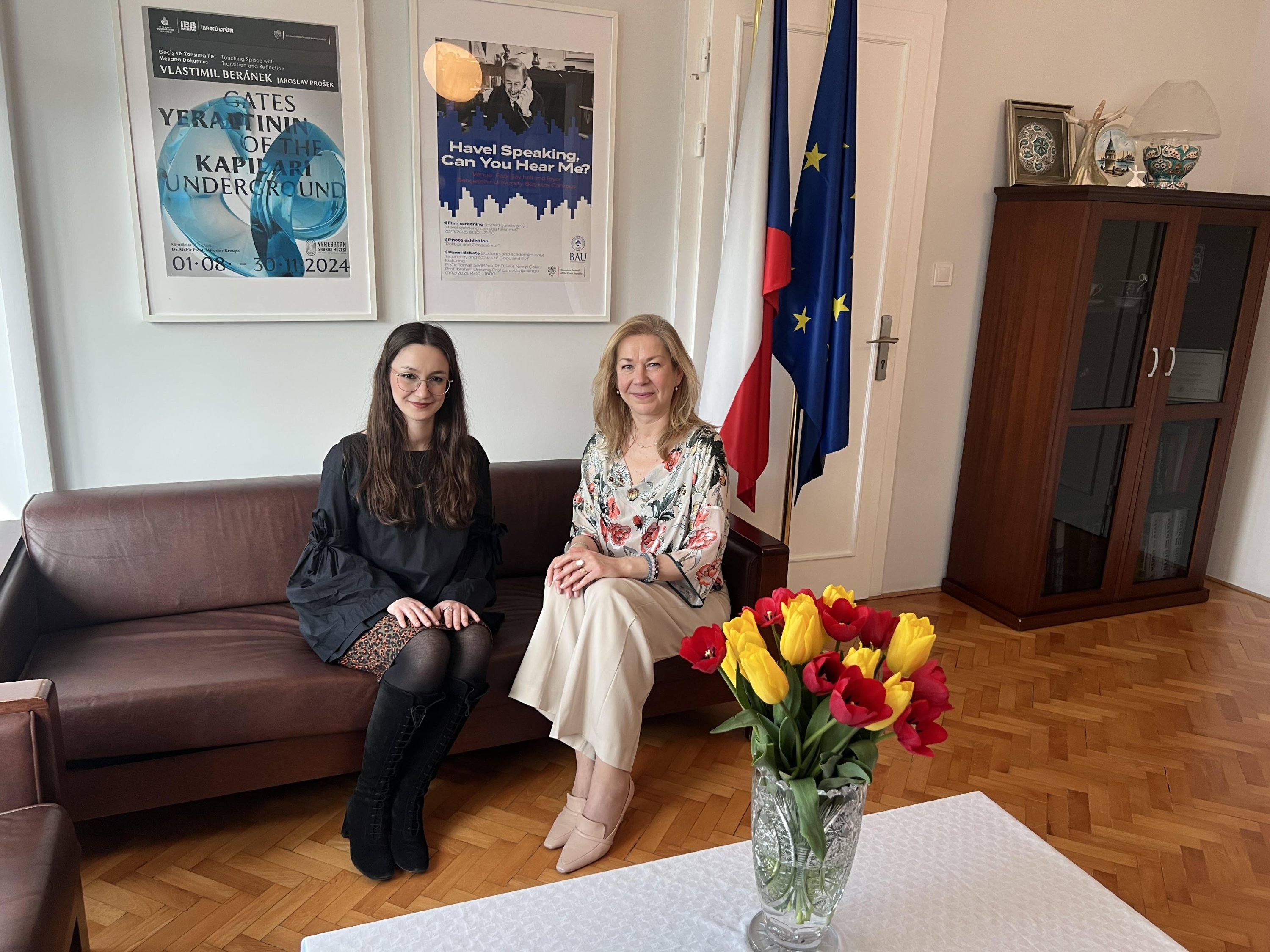
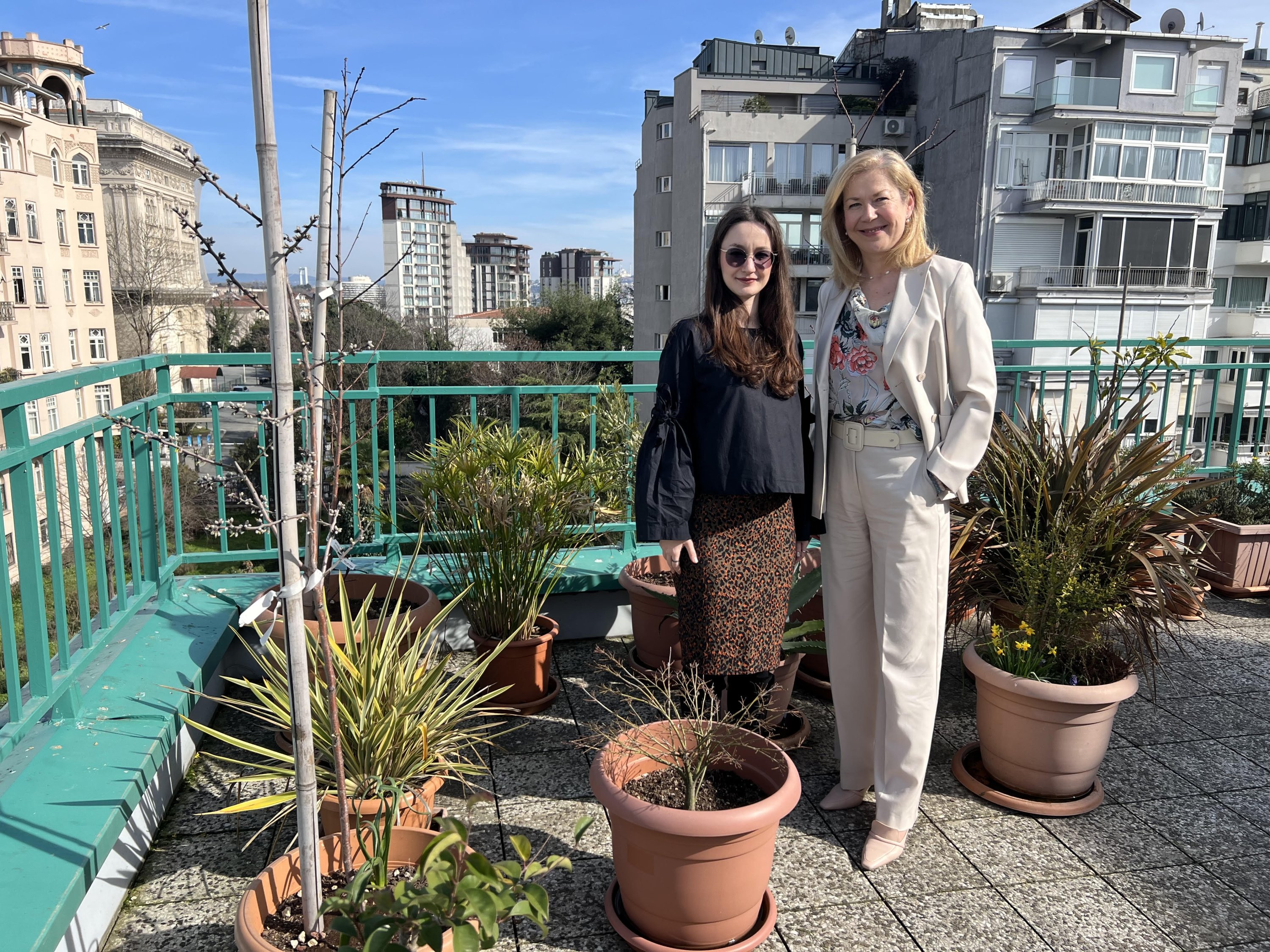
While giving a tour of the terrace garden she maintains at the Czech Consulate, Olga Hajflerova, paused to admire the Istanbul skyline.
“It’s a privilege to be in this part of the city,” the consul general remarked.
Hajflerova, who recalled her two and a half years of experience in Türkiye with great admiration, said that she appreciates the strengthening ties between the two countries.
She noted that many Czech citizens once viewed Türkiye as a distant holiday destination with a different culture and that Europe and Türkiye have not always been certain how they perceive one another.
However, defining her mission as helping Czechs and Europeans understand that Türkiye and they have much in common, she said, “We are based on the same values, not just interest or needs. We are one people.”
“Our societies may function slightly differently in detail, but fundamentally we are the same,” Hajflerova added, reminding that she gave the same message a year ago in the opinion article she wrote for Daily Sabah.
To promote mutual understanding, Consul General Hajflerova and her team have been actively working in Istanbul.
“If I had a team 10 times bigger here, I would still be very busy because the potential is enormous,” she explained.
Expanding cultural, educational ties
One of Hajflerova’s personal interests is education, as she described the Czech Consulate General as one of Istanbul’s most dynamic in this field, supporting more than 20 student clubs.
She shared her love of meeting with Turkish university students and discussing international affairs, political developments, and diplomatic careers with them.
“In exchange for my experience, I receive their energy and motivation, and I hope it is as meaningful for them as it is for me,” she said.
Apart from the field of education, the Czech Consulate General organizes events to promote cultural exchange.
The next planned event, Hajflerova said, is a photo exhibition by Turkish photographer Izzet Keribar. Opening April 2 at Nişantaşı Işık Gallery, it will showcase Prague and Czechia to Turkish visitors.
Following that, in May, Hajflerova noted the consulate will organize a Czech food festival. As the third edition of the event, the festival will feature special chefs from Czechia’s Ministry of Foreign Affairs.
Previously, the consulate hosted several other events, which included an exhibition of Czech crystal artistry at the Basilica Cistern and a photo and documentary exhibition dedicated to the legacy of former Czech President Vaclav Havel.
Hajflerova added that, beyond the success of these events, attracting the Turkish public’s interest in the Czech Republic requires little effort, as Turks are already enthusiastic about the country, especially when it comes to visiting.
Growing co-op across sectors
However, when it comes to visiting the European Union for academic, touristic or business reasons, Turkish citizens have been facing difficulties in obtaining Schengen visas for years.
The EU has argued that the processes managed by accredited visa agencies have been slow due to the high number of applications and that it has been discussing possible solutions with Ankara.
“The general imagination that the EU countries restrict Turkish citizens from coming to Europe is not true,” Hajflerova said, adding that the Czech Consulate has been trying to make the procedure as easy as possible for visitors.
She also emphasized that about 90% of Turkish applicants for Schengen visas to visit Czechia were approved.
According to Türkiye’s Minister of Trade, Ömer Bolat, tourism flows between Türkiye and the Czech Republic are steadily increasing, with approximately 100,000 Turkish citizens traveling to the Czech Republic each year, while the number of Czech visitors to Türkiye has reached about 400,000 annually.

Underlining the significance of connectivity, Hajflerova also highlighted Turkish Airlines and Pegasus having multiple daily direct flights between Türkiye and the Czech Republic.
“I am also very pleased to announce that we are in talks with Pegasus Airlines, and I understand they are eager to expand connections between our countries,” she added.
In December 2025, Turkish low-cost carrier Pegasus Airlines announced it signed a deal to buy the biggest Czech airline, Smartwings, along with its owner, Czech Airlines (CSA), in a bid to strengthen its presence in Europe and expand globally.
While tourism and civil aviation connectivity are important elements of Türkiye and the Czech Republic’s relations, defense cooperation also has a significant place in the two countries’ bilateral relations.
In February, Türkiye’s defense and electronics giant Aselsan and Czech defense firm Excalibur International, part of the CSG group, signed a strategic cooperation agreement to establish an EU-based joint venture while simultaneously introducing the Korkut air defense system integrated on the Tatra Force 6×6 wheeled platform.
“The partnership aims to expand joint defense capabilities for European and global markets,” stated the Czech firm.
Hajflerova emphasized that, in addition to existing economic, industrial and defense cooperation, many other sectors have potential for growth, including agriculture.
Referring to Czech companies’ participation in Agroexpo International Agriculture and Livestock Exihibition which was organized in İzmir in February, Hajflerova said, “We brought ecological methods of agricultural production to help that production is healthy and sustainable.”
The consul general said that Czech participation in the event drew strong interest not only from Turkish companies but also from firms in the region.
Agroexpo 2026, one of Europe’s four largest agricultural fairs and Türkiye’s largest, hosted 426 participants, 56 of whom were foreign. A total of 110,715 people visited Agroexpo, 12,760 of whom were foreign, from 112 countries.
Türkiye called on Pakistan and Afghanistan to return to the negotiation table regarding the recent tension between both sides, Turkish diplomatic sources said Friday.
Foreign Minister Hakan Fidan held a series of phone calls with several of his regional counterparts on Friday to discuss the recent tensions between Islamabad and Kabul and pledged to help facilitate both sides sitting at a negotiation table, sources said.
Fidan spoke separately with Pakistani Foreign Minister Muhammad Ishaq Dar, Afghanistan’s acting Foreign Minister Amir Khan Muttaqi, Qatari Prime Minister and Foreign Minister Sheikh Mohammed bin Abdulrahman Al Thani and Saudi Foreign Minister Prince Faisal bin Farhan Al Saud, the sources said.
The conversations focused on the latest tensions and diplomatic developments between Pakistan and Afghanistan, amid heightened regional attention to security and political dynamics between the two neighbors.
Pakistan and Afghanistan exchanged heavy cross-border fire on Thursday after Kabul launched retaliatory strikes against Pakistani military positions, prompting Islamabad to accuse the Afghan Taliban administration of “unprovoked action” and insisting its forces delivered an “immediate and effective response” across multiple sectors of the frontier.
Cross-border clashes intensified Thursday along the Pakistan-Afghanistan frontier, with both sides reporting military operations and casualties in some of the most serious fighting since recent tensions began to escalate.
The airstrikes follow months of hostilities between the two countries. The last serious flare-up was in October, after which a fragile cease-fire brokered by Türkiye and Qatar was reached.
In November 2025, Istanbul hosted the third round of Afghan and Pakistani delegations for high-level talks on a cease-fire agreement between the two neighbors.
The Turkish Foreign Ministry had previously announced that the session would bring together senior officials from both countries to address the unresolved issues. Neither side, however, has disclosed who will be representing them in Istanbul, and the lack of clarity has raised questions about the effectiveness of the dialogue.
The two-day talks in Istanbul, mediated by Türkiye and Qatar, were the third round of peace negotiations that were viewed as one of the most significant diplomatic efforts between the two neighbors since the Taliban seized power in Afghanistan 2021. Despite intense back-channel diplomacy, officials said discussions stalled late Friday without tangible progress.
Throughout the second round of negotiations, which took place last year, officials from both Kabul and Islamabad traded accusations of incompetence and inefficiency, further complicating the peace process.
The talks were marked by repeated deadlocks, though the two sides ultimately managed to agree on extending the cease-fire in place.
Twenty-nine years have passed since Türkiye’s Feb. 28, 1997, National Security Council (MGK) meeting, widely described as a “postmodern coup,” a process that reshaped the country’s political, social and institutional landscape for years.
The meeting, held amid escalating tensions between the military establishment and the elected government, produced decisions that ultimately forced the resignation of the coalition led by Prime Minister Necmettin Erbakan.
The developments surrounding the Feb. 28 process remain a defining episode in Türkiye’s political history, often cited as an example of military-bureaucratic intervention against democratic will.
The events unfolded during the tenure of the 54th government, formed by the Welfare Party (RP) and the True Path Party (DYP), which took office on June 28, 1996.
Erbakan served as prime minister, while DYP leader Tansu Çiller held the posts of deputy prime minister and foreign minister. The government quickly became the focus of controversy amid accusations from secular circles that it posed a threat to the constitutional order.
Rising tensions
Political and institutional pressure intensified in early 1997. The Chief Public Prosecutor’s Office at the Supreme Court warned the Welfare Party over activities during a January visit by Erbakan to Kayseri, stating that uniform clothing worn by local party officials violated the Political Parties Law and demanding disciplinary action.
The warning included the possibility of a closure case if the party failed to comply.
Tensions escalated further following a Jan. 31 event known as “Jerusalem Night,” organized by Sincan Mayor Bekir Yıldız of the Welfare Party and attended by Iran’s ambassador to Ankara. The speeches and displays at the event fueled nationwide debate over the government’s orientation.
On Feb. 1, despite objections and resistance from some coalition partners, Erbakan submitted for Cabinet signature a decree allowing the headscarf at universities, another development that intensified political polarization.
Investigations, military signals
Judicial authorities opened investigations into the Jerusalem Night event, while Iran’s ambassador was summoned to the Foreign Ministry to receive a formal protest.
One of the most memorable moments of the period came on Feb. 4, when tanks and armored vehicles moved through the Ankara district of Sincan en route to a military exercise area. The display was widely interpreted as a warning from the armed forces and caused public alarm.
That same day, Interior Minister Meral Akşener suspended Mayor Yıldız from office. He was later arrested along with several others on charges including aiding an illegal organization and inciting public hatred.
The developments triggered sharp political debates, drawing in then-President Süleyman Demirel and exposing growing strains within the coalition.
‘Balance adjustment’ to democracy
Public tensions spilled into the streets, with civil society organizations arranging large demonstrations in Ankara.
Following mounting criticism, Iran’s ambassador left Türkiye. Meanwhile, Demirel requested an investigation into alleged “religious fundamentalist” staffing in municipalities.
Erbakan sought to calm concerns, stating after a Feb. 21 meeting with Demirel that Türkiye did not face a regime crisis.
On the same day in Washington, then-Deputy Chief of General Staff Gen. Çevik Bir made a remark that would become emblematic of the period, saying the military had given “a balance adjustment to democracy” in Sincan.
Decisive MGK meeting
Amid intensifying controversy, Demirel sent Erbakan a letter on Feb. 26 outlining concerns about the direction of the regime.
Two days later, the MGK convened under Demirel’s chairpersonship in one of the longest meetings in its history. The session lasted eight hours and 45 minutes, running from midafternoon until nearly midnight.
Top civilian and military officials attended, including Chief of General Staff Gen. Ismail Hakkı Karadayı and senior commanders of the armed forces.
Following the meeting, the council issued a statement emphasizing that no concessions would be made in implementing constitutional principles and warning against activities seen as undermining the secular, democratic order.
The decisions were later followed by a list of 20 measures presented to the government, including extending compulsory education to eight years and restructuring religious vocational schools.
Pressure on government
Erbakan initially resisted some of the measures, and political tensions deepened as voices within the DYP began calling for withdrawal from the coalition.
Çiller met Erbakan to persuade him to sign the MGK decisions. At a press conference, Erbakan pushed back against political maneuvering, declaring, “Governments are formed in Parliament, not at the MGK.”
Nevertheless, he signed the decisions on March 5.
Debates over their implementation, particularly the education reform, accelerated divisions between coalition partners and weakened the government’s position.
Political restructuring
As tensions grew, Çiller requested that the premiership be transferred to her in July. Erbakan refused.
President Demirel stressed that the MGK decisions were constitutional and warned that failure to implement them would disrupt state functioning.
Meanwhile, the Supreme Court chief prosecutor filed a case on May 21 seeking the closure of the Welfare Party on the grounds that it had become a focal point of activities against secularism.
Within the military, the General Staff established the Western Working Group on June 11 to monitor religious activity, a move later cited by critics as evidence of institutional pressure.
On June 18, Erbakan resigned, hoping that Çiller would be tasked with forming a new government under a revised coalition arrangement.
Instead, after consultations with opposition leaders, Demirel gave the mandate to Mesut Yılmaz, leader of the Motherland Party (ANAP). The decision drew strong criticism from the outgoing coalition partners.
End of Welfare Party era
The new government was formed on June 30 under Yılmaz, in coalition with other parties.
One of the most consequential policies of the Feb. 28 process, eight years of uninterrupted compulsory education, was approved by Parliament in August and implemented at the start of the 1997-1998 academic year.
The political repercussions continued.
On Jan. 16, 1998, Türkiye’s Constitutional Court ordered the closure of the Welfare Party, ruling that it had violated the principles of the democratic and secular republic and become a center of anti-secular activity.
Several senior figures, including Erbakan, received five-year political bans. The decision, published in the Official Gazette on Feb. 22, brought the party’s 14-year political life to an end.
Lasting impact
The Feb. 28 process is widely viewed as a defining moment in Türkiye’s modern political history, an intervention carried out without a direct military takeover but through coordinated pressure from military, judicial and bureaucratic institutions.
Today, for many, the episode represents a period in which an elected authority was constrained by unelected actors. The events are frequently invoked as a cautionary example of tutelary intervention and as a turning point that reshaped Türkiye’s democratic trajectory.
Nearly three decades later, the legacy of Feb. 28 continues to influence political discourse, institutional reforms and debates over civil-military relations, religious freedoms and the limits of democratic authority in Türkiye.
A senior official from Türkiye’s ruling party said Friday that President Recep Tayyip Erdoğan has a firm and determined will to advance cooperation across the Turkic world, announcing plans to promote Turkology departments in Turkish universities.
Kürşad Zorlu, deputy chair of the Justice and Development Party (AK Party) and head of relations with Turkic states, spoke to reporters in Baku following a conference marking the 100th anniversary of the First Turkology Congress, held on Feb. 26, 1926.
Zorlu said the original congress brought together scholars from across the Turkic world to negotiate issues of common language and adopt the Latin alphabet, describing the anniversary as “a historic day” for Turkic nations.
He noted that communication among Turkic states weakened during the Soviet era but said they are now strengthening unity under the Organization of Turkic States (OTS).
Zorlu recalled that member states had reached a consensus on adopting a 34-letter common alphabet framework.
“With the will of our heads of state, the dedicated efforts of our institutions and the belief of our peoples, we believe we will carry this into the future,” he said.
He added that Türkiye’s Education Ministry had agreed to introduce new measures to encourage and prioritize Turkology departments, arguing that strengthening the field would bolster linguistic convergence and help transmit shared history and culture to future generations.


-
 Daily Agenda2 days ago
February 28 message from Sümeyye Erdoğan Bayraktar: We have not forgotten, we will not let you forget
-
 Economy3 days ago
Syria reportedly pressed by US to shift from Chinese telecom systems
-
 Daily Agenda19 hours ago
BREAKING NEWS | Investigation into ANKA’s ‘Incirlik Base’ images
-
 Politics3 days ago
Presidential advisor hosts Russia’s envoy for Azerbaijan-Armenia talks
-
 Daily Agenda3 days ago
Minister Çiftçi: “We consider it an honor to stand by our martyrs’ families”
-
 Politics3 days ago
Turkish Parliament speaker briefed on Gaza Tribunal findings
-
 Daily Agenda3 days ago
Statement from Minister of Justice Akın Gürlek about illegal betting: We need to drain this swamp
-
 Politics2 days ago
Terror-free Türkiye initiative enters ‘new political era’ a year on