
Politics
Türkiye warns against efforts to incite civil war in Iran

Foreign Minister Hakan Fidan on Thursday warned that Ankara will not permit any attempts to incite civil war in Iran amid Tehran’s war with the U.S. and Israel.
“We are against plans aimed at triggering a civil war in Iran and provoking conflicts along ethnic and religious fault lines,” Fidan told a press conference with his German counterpart Johann Wadephul in Ankara.
“We are warning about this. No one should pursue such a fantasy. We would not allow it,” Fidan said.
He assured Ankara and Berlin agreed the war must stop “as soon as possible” and that the two NATO allies were working on it.
Fidan and Wadephul met as the two NATO allies seek to deepen cooperation in political, economic and security fields.
The impact of the U.S.-Israel-Iran conflict is already evident, Fidan said, adding that the risk of it spreading remains.
“There should be no questioning of Iran’s territorial integrity, and no pursuit of regime change,” Fidan said.
Fidan also called for an end to Israel’s bombardment of neighboring Lebanon “before it collapses.”
“Israel, pursuing expansionist policies, is bringing its dirty war into Lebanon. Israeli attacks must end before the Lebanese state collapses,” he said.
“The government of (Israeli Prime Minister Benjamin) Netanyahu is at the heart of every crisis in the region,” he told a news conference with his German counterpart, Johann Wadephul.
“Israel, pursuing an expansionist policy, is exploiting the current war to bring its dirty war into Lebanon,” he added.
“Israel’s attacks must end before the Lebanese state collapses,” he said, warning that if that were to happen, it would “profoundly affect the entire region,” especially the neighboring countries.
The mass displacement of people in Lebanon is “absolutely unacceptable,” he said.
Lebanon was drawn into the Middle East war last week when Hezbollah attacked Israel in response to the killing of Iranian supreme leader Ayatollah Ali Khamenei in U.S.-Israeli strikes.
Israel, which kept up its strikes in Lebanon even before the war despite a 2024 cease-fire, has since launched air raids and sent ground troops into border areas.
The violence has killed more than 687 people, according to Lebanese authorities, while more than 800,000 people have registered as displaced.
Wadephul arrived from the Saudi capital Riyadh in Türkiye as the final stop of his trip to the Middle East and the Gulf region. The minister visited the Greek Cypriot administration on Monday before traveling for talks to Israel, Saudi Arabia, the United Arab Emirates and Qatar.
For his part, Wadephul said Germany was prepared to “take on responsibility before its continent.”
A solution to security issues in the strategically important Strait of Hormuz can only be achieved diplomatically, he also said. “A reliable and sustainable solution can only be achieved through diplomatic channels, and that is why I believe … that we should pool our common interests from the Gulf region, but also here in the neighborhood.
Iran’s retaliation to U.S.-Israeli aggression has included strikes on ships in the Strait of Hormuz, bringing non-Iranian vessel transits through the main gateway for much of Middle Eastern oil exports to a near standstill and forcing producers in the region to cut output.
“Together, we must find a way out of this war and, at the same time, develop an initial idea of what a future security architecture for the region might look like,” Wadephul said.
He also said Germany and Türkiye had a joint interest in preventing large migration from Iran during the war.

Türkiye on Thursday defended what it called “legitimate” security measures in the Turkish Republic of Northern Cyprus (TRNC), including the deployment of fighter jets and air defense systems, citing growing regional risks stemming from the war involving Iran.
In a weekly briefing in Ankara, the Defense Ministry officials said the steps, which include stationing six F-16 fighter jets on the island, are aimed at strengthening deterrence and protecting airspace in the Eastern Mediterranean as missile and drone threats rise following U.S.-Israeli strikes on Iran.
Officials said the additional measures would contribute not only to the security of the TRNC but to the stability of the entire island.
“The security of the Turkish Republic of Northern Cyprus and the preservation of peace and stability in the Eastern Mediterranean are of strategic importance for Türkiye, and our position on this issue is clear and unchanged,” they said.
The island of Cyprus has been directly affected by retaliatory attacks following the U.S.-Israeli strikes on Iran, with an Iranian-made drone hitting a British base on the island last week.
Authorities in the Greek Cypriot administration said the drone was likely launched by Iran-backed Hezbollah in Lebanon rather than directly from Iran.
The island remains divided between the Turkish Cypriot north and the Greek Cypriot administration in the south, an EU member not recognized by guarantor Türkiye.
Following the incident, several European countries pledged to send air defenses and other military assets to southern Cyprus, with France ordering the aircraft carrier Charles de Gaulle to the Mediterranean, along with a frigate and air defense units to the island.
Turkish officials said the presence of additional foreign military assets in the region further underscored the legitimacy of Ankara’s actions.
“Türkiye is a guarantor country in Cyprus. In an environment where some countries that are not guarantors are deploying military elements to the island and the Eastern Mediterranean, the measures taken by Türkiye are extremely legitimate, appropriate and part of a balanced security approach,” ministry sources said.
“Türkiye is sufficient for the Turkish Republic of Northern Cyprus.”
There is also unease on the Turkish side over the Greek Cypriot administration’s expanding military cooperation with Western partners, particularly after the United Kingdom allowed the United States to use its military facilities on the southern part of the island.
British installations, including the Royal Air Force base at Akrotiri, have played a key logistical role in Western operations in the Middle East in recent years.
Despite decades of diplomatic efforts by the U.N., the island of Cyprus has remained divided for more than 50 years. The TRNC was established in 1983 and is recognized only by Türkiye.
“Türkiye acts with an understanding that protects peace and stability rather than escalating tensions in the region,” ministry officials said. “The security of the Turkish Republic of Northern Cyprus is our security concern.”
They added that Ankara would not allow any hostile actions targeting the rights and interests of Turkish Cypriots and would not hesitate to use the authorities granted by its guarantor status if necessary.
Patriot system
The ministry also addressed recent developments related to air defense measures in southeastern Türkiye.
Türkiye said Monday that NATO air defenses intercepted a second ballistic missile fired from Iran that entered Turkish airspace, marking the second such incident in a week.
Ankara warned that it would take any necessary steps against threats.
In response to the evolving security situation, officials said consultations with NATO allies had been activated.
“In addition to the national measures we have taken to ensure the security of our airspace and citizens, consultation mechanisms with our NATO allies have been effectively activated,” ministry sources said.
“As part of this framework, a Patriot system assigned by NATO Allied Air Command in Ramstein, Germany, is being deployed to Malatya as a complementary element of the air defense architecture.”
It remained unclear where the missile was headed before it was intercepted by NATO defenses stationed in the eastern Mediterranean.
U.S. air forces are stationed at the Incirlik base in southern Türkiye, and a NATO radar installation in Malatya province provides early warning capabilities for the alliance.
Fragments from the intercepted missile fell in empty fields in Gaziantep, located between the two facilities, authorities said.
Ankara has said Washington did not use Incirlik in the air campaign carried out alongside Israel against Iran.
Iran has not commented on the incident but has repeatedly stated it is not at war with regional countries and does not explicitly target Türkiye.
Officials also stressed that NATO remains committed to protecting allied territories.
“NATO is a security alliance with the will to defend the airspace and territory of its member states,” ministry sources said.
“Türkiye, with its geostrategic location, strong armed forces and critical role on NATO’s southeastern flank, is one of the most important elements of this structure.”
They said recent steps were aimed at reinforcing collective defense and deterrence.
“These measures are intended to strengthen the common security of both Türkiye and NATO in line with the alliance’s principles of defense, deterrence and allied solidarity,” the sources added.
Incirlik remains Turkish base
The ministry also emphasized that Incirlik Air Base remains under Turkish sovereignty.
“Incirlik is a Turkish base,” officials said, noting that the 10th Main Jet Base Command, which operates under the Turkish Air Force’s Combat Air Forces Command in Eskişehir, is stationed there.
The base hosts Türkiye’s F-16 fleet, tanker aircraft and unmanned aerial vehicles, and all facilities belong to the Republic of Türkiye, the ministry said.
The base commander is a Turkish brigadier general.
“The presence of American personnel there does not mean it is an American base,” officials said, adding that military personnel from Spain, Poland and Qatar are also present.
Air defense decisions
Officials also addressed questions about why Türkiye’s Russian-made S-400 air defense systems were not used during the missile incident.
They said the country’s air and missile defense operations are conducted through a multilayered structure based on threat assessments and operational requirements.
“In this framework, the most appropriate defense element is determined by considering the rules of engagement and the current operational picture,” the ministry said.
Türkiye is integrated into NATO’s air and missile defense system, which consists of early warning sensors, command and control networks and interceptor missiles.
“When a ballistic missile is detected, the system automatically selects and activates the fastest and most suitable interception asset due to the very short response time required,” officials said.
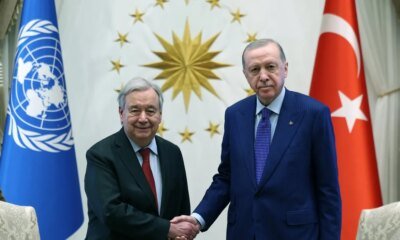
President Recep Tayyip Erdoğan said Türkiye will continue its diplomatic efforts with “patience and determination” despite attempts to undermine hopes in ongoing diplomacy involving the United States, Israel and Iran, where he welcomed U.N. Secretary-General Antonio Guterres at the Presidential Complex in Ankara.
Erdoğan said Türkiye remains committed to diplomatic engagement as regional tensions intensify.
He stressed that Ankara is actively working to prevent escalating conflicts in the region from turning into a broader catastrophe, saying Türkiye is striving to ease crises wherever they arise.
Erdoğan said Türkiye will continue pursuing diplomatic initiatives despite efforts to weaken the prospects for dialogue in the ongoing diplomatic process involving the United States, Israel and Iran.
The Turkish president also reiterated his belief that justice is essential for development, peace and stability, adding that Türkiye will continue supporting efforts to make the United Nations a more inclusive institution.
During his remarks, Erdoğan praised Guterres’ leadership and longstanding commitment to dialogue and peace, recalling his previous roles as Portugal’s prime minister and as the United Nations high commissioner for refugees.
Erdoğan noted that Türkiye has strengthened its cooperation with the United Nations during Guterres’ tenure as secretary-general, highlighting joint diplomatic initiatives aimed at addressing global crises.
He pointed to the Black Sea Grain Initiative as an example of successful cooperation that helped prevent a global food crisis and said Türkiye continues to work closely with the United Nations on efforts to end the war in Ukraine.
Erdoğan also commended Guterres’ stance on Gaza, describing it as a principled position during what he called one of the most severe injustices of the current era.
The president emphasized that diplomacy and dialogue remain the safest path toward achieving a just and lasting peace.
Foreign Minister Hakan Fidan and Akif Çağatay Kılıç, the president’s chief adviser on foreign policy and security, also attended the meeting.
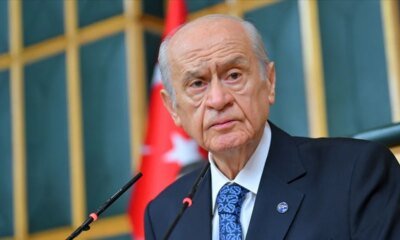
Nationalist Movement Party (MHP) Chairman Devlet Bahçeli warned that attempts are underway to provoke conflict between Türkiye and Iran and ignite broader regional tensions, vowing that Ankara will not bow to any threats.
Speaking at an iftar gathering attended by members of the party’s Central Executive Board, Central Disciplinary Board and lawmakers, Bahçeli said there were efforts aimed at pushing Türkiye and Iran into confrontation while also fueling clashes between Iran and Gulf countries to influence the course of regional conflicts.
Bahçeli stressed that Türkiye is not a state that would fall into intelligence or perception traps designed to destabilize the country.
He warned that Türkiye must remain vigilant against geopolitical schemes seeking to drag the country into chaos and reshape the regional balance through conflict.
The MHP leader said Türkiye should be prepared for all possible scenarios and act carefully to prevent such plans from succeeding.
His remarks came days after ballistic missiles fired from Iran toward Turkish airspace were intercepted by NATO defense systems, with Turkish officials condemning the violation of the country’s airspace and warning that Ankara would take necessary measures to protect its sovereignty.
Türkiye has recently intensified diplomatic contacts with regional and international partners as fighting in the Middle East raises concerns about the risk of a broader regional conflict and its potential impact on the country’s security.
Türkiye on Thursday marked the 10th anniversary of a car bombing in central Ankara, one of the deadliest attacks carried out by the PKK terror group during a wave of urban violence in 2015-2016.
The March 13, 2016, attack targeted bus stops in the capital’s busy Kızılay district, where a car packed with explosives was detonated at Güvenpark, killing 36 people and injuring 344 others.
Among those killed were four children. Thirty-two children were also among the wounded.
Authorities said the vehicle was detonated by PKK members Seher Çağla Demir and Özgür Ünsal. The attackers were killed in the explosion.
One of the victims was an unborn baby carried by six-month pregnant Songül Yılmaz, who was injured in the blast. The baby was later described as the youngest victim of the attack.
The bombing came after the PKK launched a violent campaign in several southeastern districts, including Şırnak, Silopi, Cizre, Nusaybin, Derik, Idil, Sur and Yüksekova, where militants dug trenches, erected barricades and declared so-called “autonomous zones.”
Security forces responded with operations to restore control in those areas. After failing to sustain the campaign, the group carried out the Güvenpark bombing targeting civilians waiting at bus stops in the capital.
Perpetrators brought to justice
Following the attack, the Ankara Chief Public Prosecutor’s Office launched an investigation that led to an indictment against 55 suspects, including senior PKK figures. The trial began on June 19, 2017, and concluded on Nov. 21, 2018, at an Ankara court.
Mehmet Veysi Dolaşan received 37 aggravated life sentences for the killing of 36 victims and for attempting to undermine the unity and territorial integrity of the state. He was also sentenced to an additional 10,260 years in prison for the attempted murder of the 344 people injured in the blast, along with further prison time and a fine for explosives-related offenses.
Two other defendants, Sebahattin Karakoç and Azamattin Karakoç, were also given aggravated life sentences.
In a separate trial concluded in November 2020, Ferit Ak and Salih Şahin were each sentenced to 15 years in prison for knowingly aiding the terrorist group.
The Güvenpark bombing remains one of the most devastating attacks in Ankara’s recent history and a stark reminder of the PKK’s campaign of violence targeting civilians in Türkiye.
Major PKK attacks
The PKK terrorist group has carried out numerous deadly attacks in Türkiye over the past decades, targeting both security forces and civilians as part of its terror campaign that began in 1984. More than 40,000 people have been killed since then.
Türkiye first sought a political solution to the PKK issue in the early 1990s under then-President Turgut Özal, who promoted a civilian approach and explored greater rights for the country’s Kurdish community. His outreach contributed to a brief PKK cease-fire, but the effort faltered after renewed attacks and Özal’s death in 1993.
The violence continued until PKK leader Abdullah Öcalan’s capture in 1999. A second peace initiative began in 2012, known as the reconciliation process, during which the government expanded cultural and language rights. The process collapsed in 2015, after which the PKK resumed attacks, prompting intensified Turkish counterterrorism operations at home and across the border.
The following year saw back-to-back PKK attacks across Türkiye, many involving explosives targeting security forces and civilians.
In January 2016, militants attacked a district police headquarters in the Çınar district of Diyarbakır with a truck bomb, rockets and gunfire, killing at least six people, including civilians and children, and wounding dozens.
Two months later, in March 2016, a car bomb targeting an armored police vehicle near a bus terminal in Diyarbakır killed seven police officers and injured 27 people, including civilians.
In May that year, a bomb-laden truck detonated in the Durumlu area of Diyarbakır after civilians intercepted the vehicle suspected of carrying explosives. The blast killed 16 people and wounded more than 20.
The attacks continued through the summer. In August 2016, a suicide car bomb struck a police checkpoint outside district headquarters in Cizre, in the southeastern province of Şırnak, killing 12 police officers and injuring dozens.
Later the same month, a car bomb targeting a police station in Elazığ killed at least six people and wounded more than 200 others.
In October 2016, another large car bomb targeted a military facility in the district of Şemdinli in Hakkari province, killing soldiers and civilians and injuring dozens more.
PKK disarmament
Today, Türkiye is working to bring a permanent end to PKK terrorism with its “terror-free Türkiye” initiative, first conceived in October 2024 by government ally Devlet Bahçeli, who extended an olive branch to Öcalan should he urge his terror group to lay down arms.
After Öcalan appealed to his group last year, the PKK formally disbanded, withdrawing all members from Turkish soil and even holding a symbolic ceremony in northern Iraq where a group of PKK members burned their weapons.
In Ankara, a cross-party parliamentary commission last month published a key report meant to prepare the legal groundwork to advance the process, backing plans to reintegrate former PKK members. Ankara has repeatedly ruled out amnesty for Öcalan or PKK terrorists, with officials saying the legal framework would only consider integration for PKK members who have not engaged in terrorist activities.
The report is expected to be put before Parliament sometime this month, likely after the end of Islam’s holy month of Ramadan. If it passes, it will be the first concrete step taken by Türkiye.
Good Party (IP) leader Müsavat Dervişoğlu said decisions regarding any potential alliances would be discussed within the party’s internal decision-making bodies when the appropriate time comes.
“Decisions about whether to form alliances or not are not something I would decide alone,” Dervisoglu told journalists during an iftar dinner with reporters in Ankara on Wednesday evening.
He responded to the comments, stressing, “Issues concerning my party and my country should be discussed and decided within the party’s authorized institutions.”
Remarks by the leader of Türkiye’s nationalist Victory Party (ZP) about a possible election alliance with the Good Party have sparked renewed debate in Turkish politics over the possibility of a broader nationalist bloc ahead of future elections.
ZP leader Ümit Özdağ said Tuesday during an interview with Turkish media that his party was open to forming an alliance with the IP, describing such cooperation as “perhaps the most natural alliance in Turkish politics.”
Özdağ said both parties’ supporters favored closer political cooperation, raising speculation about whether nationalist-oriented opposition parties could coordinate their strategies in upcoming elections.
Dervisoglu also noted the IP has not held formal alliance talks with any political party since Türkiye’s 2023 elections.
He also acknowledged that opinion polls showing the party’s support at around 8% to 9% would not be sufficient under Türkiye’s current political system.
“Nine percent does not benefit either us or Türkiye,” he said, arguing that the country’s political system requires either winning the presidency or building a parliamentary majority strong enough to govern effectively.
Dervisoglu said the IP aims to become a political platform capable of bringing together different segments of society, describing the party as a potential “umbrella” under which other political groups could gather.
Asked about public trust in the opposition, he said skepticism was not limited to opposition parties.
“This nation does not distrust only the opposition; it does not fully trust the government either,” he said, adding that voters may still be searching for a political leadership they can place their confidence in.
The comments of the leaders have fueled discussions about whether nationalist parties in Türkiye could cooperate more closely in future elections.
The ZP and IP have overlapping political stances, although the ZP stood out with its more hawkish tone, especially in anti-refugee policies that led to an indictment against its chair, Özdağ, on charges of inciting riots against Syrian refugees in Türkiye.
Özdağ was detained last year initially over accusations that he “insulted” the president, but the scope of the investigation was later expanded to include charges of inciting public hatred and hostility.
Moreover, Özdağ was later formally arrested and charged with inciting hatred against migrants. He was blamed for anti-Syrian refugee riots in the central province of Kayseri, during which hundreds of homes and businesses were attacked.
In the 2023 elections, Özdağ endorsed Kemal Kılıçdaroğlu, the candidate of a six-party opposition bloc against President Recep Tayyip Erdoğan, while the ZP won 2.2% of the vote in legislative elections where it jointly ran with the Justice Party under the ATA Alliance. In last year’s municipal elections, it won only 1.74% of the vote.
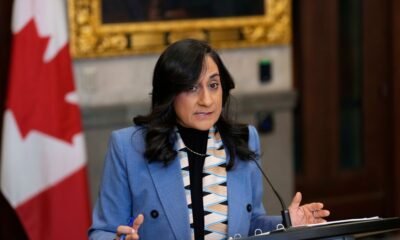
Canadian Foreign Minister Anita Anand said Thursday she will travel to Türkiye in the coming days to meet Foreign Minister Hakan Fidan for talks on the escalating conflict in the Middle East and efforts to reduce tensions.
Anand said at a news conference that she will be “emphasizing and pushing on the needs of Canadians in the region, as well as the need for de-escalation and the protection of civilian lives and civilian infrastructure.”
Her remarks came as Canada announced new humanitarian funding for Lebanon.
Randeep Sarai, Canada’s secretary of state for international development, said Ottawa is providing $37.7 million in assistance to support urgent humanitarian needs.
Canada is working with “trusted humanitarian partners, including Canadian NGOs, such as Humanity and Inclusion Canada, Oxfam Quebec, International Medical Corps Canada, U.N. agencies and the Red Cross to ensure this life saving assistance goes directly to those who desperately need it,” he said. “We call on all actors to immediately de-escalate the situation and engage in constructive dialogue to prevent further suffering. The people of Lebanon deserve safety, dignity and a future free from violence.”
The escalation in the Middle East flared since Israel and the U.S. launched a joint attack against Iran on Feb. 28, killing more than 1,300 victims to date, including then-Supreme Leader Ayatollah Ali Khamenei and over 150 schoolgirls.
Iran has retaliated with drone and missile strikes targeting Israel, Jordan, Iraq and Gulf countries hosting U.S. military assets, killing at least eight U.S. service members and injuring 140.
On March 2, the Lebanese resistance group, Hezbollah, began attacking Israeli military sites in response to repeated Israeli attacks against Lebanon and the killing of Khamenei in a U.S.-Israeli strike.
Israel retaliated by launching a military campaign against Lebanon, carrying out airstrikes on Beirut’s southern suburbs and areas in the south and east. On March 3, it began a limited ground incursion in southern Lebanon.

LATEST SURVEY RESULTS: Here is the AK Party’s vote rate! Faruk Acar announced: We see the decline of CHP – Gallery

Alcaraz sets Medvedev semis at Indian Wells, Svitolina stuns Swiatek

Tanju Özcan’s “scholarship” lie has been debunked! He distributed 11 million, evaporated 100 million!
LATEST SURVEY RESULTS: Here is the AK Party’s vote rate! Faruk Acar announced: We see the decline of CHP – Gallery
Alcaraz sets Medvedev semis at Indian Wells, Svitolina stuns Swiatek
Tanju Özcan’s “scholarship” lie has been debunked! He distributed 11 million, evaporated 100 million!
-
 Politics2 days ago
Turkish comms director stresses role of accurate information
-
 Politics21 hours ago
Canada’s foreign minister to visit Türkiye for talks on Iran war
-

 Daily Agenda2 days ago
The world saw Türkiye’s power, CHP could not
-
 Daily Agenda2 days ago
Minister of Justice Akın Gürlek: No one can give orders to the courts
-
 Daily Agenda2 days ago
Minister of Family Göktaş addressed from the UN rostrum: Women and children are under threat
-
 Daily Agenda3 days ago
MHP Chairman Bahçeli: My Kurdish brothers are not pawns, hitmen, or for sale
-

 Politics2 days ago
‘Türkiye ready to host next Ukraine–Russia talks’
-
 Daily Agenda24 hours ago
BREAKING NEWS | President Erdoğan: “We are carrying out intensive diplomacy to prevent the spiral of violence from growing”