
Economy
Warner Bros. Discovery board rejects $108B hostile bid from Paramount

Warner Bros. Discovery’s board rejected Paramount Skydance’s $108.4 billion hostile bid on Wednesday, saying it failed to provide adequate financing assurances.
In a letter to shareholders, disclosed in a regulatory filing, the board wrote that Paramount had “consistently misled” Warner Bros. shareholders that its $30-per-share cash offer was fully guaranteed, or “backstopped,” by the Ellison family, led by billionaire and Oracle CEO Larry Ellison.
“It does not, and never has,” the board wrote of the guarantee of Paramount’s offer, noting that the offer posed “numerous, significant risks.” Warner Bros’ board said it found Paramount’s offer “inferior” to the merger agreement with Netflix.
The streaming giant’s $27.75 per share offer for Warner Bros.’ film and television studios, its library, and the HBO Max streaming service is a binding agreement that requires no equity financing and has robust debt commitments, the board wrote.
Warner Bros. has not yet set a date for a shareholder vote on the deal, but it is expected to happen sometime in spring or early summer, its chair, Samuel Di Piazza, said in an interview with CNBC.
Netflix welcomed the move.
“The Warner Bros. Discovery Board reinforced that Netflix’s merger agreement is superior and that our acquisition is in the best interest of stockholders,” its co-CEO, Ted Sarandos, said in a statement.
Warner Bros. shares were down 1.4% at $28.5 in premarket trading, while Netflix gained 1.5% and Paramount fell 1.8%.
Paramount last week took its case directly to Warner Bros. shareholders, arguing it has arranged “air-tight financing” to support its bid, with $41 billion in new equity assured by the Ellison family and RedBird Capital, and $54 billion of debt commitments from Bank of America, Citi and Apollo.
Warner Bros. board countered on Wednesday that Paramount’s most recent offer includes an equity commitment “for which there is no Ellison family commitment of any kind,” but rather the backing of “an unknown and opaque” Lawrence J. Ellison Revocable Trust, whose assets and liabilities are not publicly disclosed and are subject to change.
“Despite having been told repeatedly by WBD how important a full and unconditional financing commitment from the Ellison family was … the Ellison family has chosen not to backstop the PSKY offer,” the Warner Bros. board wrote. “A revocable trust is no replacement for a secured commitment by a controlling shareholder.”
Warner Bros. questions Paramount’s creditworthiness
Paramount has submitted a total of six bids to acquire the entire Warner Bros. studio, including its television networks, including CNN and TNT Sports.
It previously said that the Ellison family trust – which Paramount says contains more than $250 billion in assets, including about 1.16 billion shares of Oracle – is more than adequate to cover the equity commitment.
“To suggest that we are not ‘good for the money’ (or might commit fraud to try to escape our obligations), as certain reports have speculated, is absurd,” Paramount wrote in a letter to Warner Bros.’ shareholders last week. Its debt commitments are not conditioned on Paramount’s financial condition, it wrote.
Warner Bros., however, pointed in the filing on Wednesday to what it described as structural risks in Paramount’s proposed financing, and also raised questions about Paramount’s financial condition and creditworthiness.
The offer relied on a seven-party, cross-conditional structure, with the Ellison Revocable Trust providing just 32% of the required equity commitment while capping its liability at $2.8 billion, Warner Bros. said. It noted that the trust’s assets could be withdrawn at any time.
Debt levels after deal with Paramount will be risky
Netflix’s offer is backed by a public company with a market cap in excess of $400 billion with an investment-grade balance sheet, the Warner board noted.
The company has told Warner Bros. it would keep releasing the studio’s films in cinemas in a bid to ease fears that its deal would eliminate another studio and a major source of theatrical films, according to people familiar with the matter.
Paramount, in contrast, has a $15 billion market capitalization and a credit rating a notch above “junk,” Warner Bros. noted on Wednesday. Should the deal close, Paramount would have a debt ratio of 6.8 times its operating income “with virtually no current free cash flow.”
The bidder would also impose what Warner Bros. said would be “onerous operating restrictions” on the company, during the potentially lengthy period between signing and closing, including limits on new content licensing deals.
Paramount’s plans to achieve $9 billion in “synergies” across the two studios were described as “ambitious” from an operational standpoint, the Warner Bros. board noted, and would represent a new round of job losses that “would make Hollywood weaker, not stronger.”
Warner Bros. Discovery’s board dismissed Paramount’s charges of unfairness – that had been set forth in a filing by Paramount last week – saying it held “dozens” of calls and meetings with the studio’s principals and advisors, including four in-person meetings and meals with CEO David Zaslav and Paramount CEO David Ellison, or his father, Larry Ellison.
“After each bid, we informed PSKY of the material deficiencies and offered potential solutions,” the Warner Bros. board wrote. “Despite this feedback, PSKY has never submitted a proposal that is superior to the Netflix merger agreement.”
Paramount said it has already applied for regulatory approval in the United States and has alerted European regulators, shortening the path to regulatory approval.
Warner Bros. Discovery’s board wrote that it considered the regulatory risks in evaluating the Netflix and Paramount offers, and believes that either transaction would obtain the necessary U.S. and foreign regulatory approvals.
Netflix also offered a $5.8 billion break-up fee that was higher than Paramount’s $5 billion break-up fee.
The Warner Bros. Discovery board also described the Paramount offer as “illusory,” adding that it could be terminated or amended at any time prior to the deal’s completion, which is not the same as a binding merger agreement.
“The PSKY offer provides an untenable degree of risk and potential downside for WBD shareholders,” the board wrote.
Türkiye has decided to suspend chicken meat exports ahead of the Muslim holy month of Ramadan in a bid to stabilize domestic prices and prevent what authorities described as unjustified increases that could strain consumers.
The decision came after domestic poultry producers and sellers raised prices by as much as 15% before Ramadan, prompting the government to intervene to protect the domestic market.
The Trade Ministry said the decision aimed to support the supply-demand balance and curb volatility in food prices.
Ramadan is a month when Muslims are united in a ritual of daily fasting from dawn to sunset. This year’s Ramadan is due to start next week.
For Muslims, it’s a time of increased worship, religious reflection, charity and good deeds. Socially, it often brings families and friends together in festive gatherings around meals to break their fast.
Türkiye frequently takes temporary trade measures ahead of Ramadan, when food demand typically rises, to contain inflation and ensure a stable supply of essential goods.
Annual inflation in Türkiye has been gradually easing and lastly dipped to 30.65% in January. Still, food has been one of the main contributors to rising prices.
In a statement, the Trade Ministry said recent regional developments affecting food markets, combined with rising domestic demand and seasonal shifts in consumption patterns, have accelerated price movements in certain product groups, including poultry.
“Price developments in the poultry meat market have been closely monitored, and it has been carefully assessed whether price formation has remained within the framework of normal market conditions,” the ministry said.
“Within this framework, as a step to support the supply-demand balance in the market, measures to suspend poultry meat exports have been implemented as of today.”
The ministry added that “any practice or speculative pricing behavior that could victimize our consumers or disrupt market mechanisms through exorbitant price exploitation is being closely monitored,” noting that the necessary inspection and sanction processes were being carried out with “determination.”
Ramadan is the ninth month of the Islamic lunar calendar; the month cycles through the seasons.
The start of the month traditionally depends on the sighting of the crescent moon. This year, the first day is expected to be on Feb. 19.
Fasting is one of the Five Pillars of Islam, along with the profession of faith, prayer, almsgiving and pilgrimage.
Muslims see various meanings and lessons in observing the fast.
It’s regarded as an act of worship to attain God-conscious piety and one of submission to God. The devout see benefits, including practicing self-restraint, growing closer to God, cultivating gratitude and empathizing with people who are poor and hungry.
The daily fast in Ramadan includes abstaining from all food and drink – not even a sip of water is allowed – from dawn to sunset before breaking the fast in a meal known as “iftar” in Arabic.

Japanese stocks rose to hit record highs on Monday after Prime Minister Sanae Takaichi’s landslide election win; however, experts warn that the country’s first woman leader could struggle to keep both voters and markets happy.
In its best result since its founding in 1955, Takaichi’s conservative Liberal Democratic Party (LDP) won a two-thirds majority in Sunday’s snap lower house election, according to Japanese media.
With the result, Takaichi, 64, managed to capitalize on her strong popularity since taking the helm of a moribund LDP in October and becoming Japan’s fifth premier in five years.
On Monday, the Nikkei 225 briefly jumped more than 5% to pass 57,000 points for the first time, while the yen strengthened against the dollar.
Analyst Kyle Rodda of Capital.com said the victory handed Takaichi “the mandate she was looking for for her big-spending agenda.”
Equities are “poised to benefit from higher fiscal spending but interest rates that remain accommodative and negative in real terms,” he said.
And SPI Asset Management’s Stephen Innes said: “Politically, the win hands… Takaichi’s freedom of movement and removes the need to bargain every decision down to the lowest common denominator.”
But a major reason for voters deserting the party in past elections was inflation, an unwelcome phenomenon for households after several decades of stable or falling prices.
The cost of rice, for example, doubled in 2025.
Food tax
After a $135-billion stimulus last year, economists said Takaichi’s room for manoeuvre was limited because of market concerns about Japan’s debt, which at more than twice the size of gross domestic product (GDP) is at a higher ratio than any other major economy.
The yen has also weakened, prompting speculation that Japanese authorities – potentially in partnership with U.S. officials – might intervene to provide support.
Off-the-cuff remarks by Takaichi earlier this month talking up the benefits for Japanese exporters of a weaker yen added to pressure on the currency.
In the election campaign, Takaichi floated the idea of suspending a consumption tax on food items, but this sent yields on long-term Japanese bonds to record levels.
On Sunday, she told local media further discussions were needed on such a move, which Bloomberg News reported would cost 5 trillion yen ($32 billion) in lost annual revenue.
“Most parties are in favor of reducing the consumption tax… I strongly want to call for the establishment of a supra-party forum to speed up discussion on this, as it is a big issue,” Takaichi said.
She also reiterated her mantra of having a “responsible and proactive” fiscal policy.
But she added: “We will ensure necessary investments. Public and private sectors must invest. We will build a strong and resilient economy.”
‘Betrayed’
Tetsuo Kotani at the Japan Institute of International Affairs said Takaichi could struggle to keep voters happy and that they could end up feeling “betrayed.”
“In reality, the policies of a Takaichi administration are unlikely to curb the inflation that voters expect her to address,” he warned.
“An income tax hike linked to increased defense spending will also be unavoidable. If these policies lead to a triple decline in stocks, the yen, and government bonds, people’s lives will become even more difficult.”
Takaichi has also pledged to increase defense spending as part of commitments to U.S. President Donald Trump that Japan will be less reliant on Washington.
Kotani said that because of a personnel shortage, linked to Japan’s low birth rate, this will “not amount to a fundamental strengthening of Japan’s defense capabilities.”
Marcel Thieliant at Capital Economics added that he did not expect Takaichi to embark on any new major spending splurges or tax cuts.
“(We) view the recent fiscal expansion as an attempt to bolster public support ahead of the election rather than as a sign of things to come,” he said in a note.
“With Upper House elections not due until 2028, we don’t expect any further major fiscal loosening.”
Hiroshi Shiratori, a politics professor of Hosei University, said Takaichi wanted to emulate the “Abenomics” of former premier Shinzo Abe – her mentor – of big spending and lower interest rates.
“But Abemonics was done at the time of deflation in Japan and a higher yen,” Shiratori said.
“Now is the time of inflation, and the cheaper yen exacerbating inflation, with the market reacting to worries over potential worsening of fiscal conditions,” he said.
“But not all voters understand this logic.”
China and South Africa inked a framework agreement for a new trade deal on Friday as Africa’s leading economy increasingly weighs other options following the steep import tariffs imposed on it by the U.S. and its diplomatic fallout with the Trump administration.
South Africa’s Ministry of Trade and Industry said the agreement would start negotiations over a deal that would give some South African goods, such as fruit, duty-free access to the Chinese market. The ministry said it expected the trade deal to be finalized by the end of March.
In return, the trade ministry said China will get enhanced investment opportunities in South Africa, where its car sales have seen rapid growth.
The U.S. slapped 30% duties on some South African goods under U.S. President Donald Trump’s reciprocal tariffs policy, one of the higher rates applied across the world. South Africa has said it is still negotiating with the U.S. for a better deal.
The China-South Africa deal follows others looking for alternatives to U.S. partnership in the face of Trump’s aggressive trade policies.
The announcement on the negotiations between China and South Africa came days after Trump issued a short-term renewal of a longstanding free-trade agreement between the U.S. and African nations. The U.S. extended the African Growth and Opportunity Act, which South Africa is a major beneficiary of, just until the end of the year and indicated it would be modified to fit the administration’s America First policy.
China is already South Africa’s largest trade partner for both imports and exports, while Chinese economic influence across the African continent continues to grow and it dominates in the extraction of Africa’s critical minerals that are key components for new high-tech products.
“South Africa looks forward to working with China in a friendly, pragmatic and flexible manner,” the trade ministry said.
Trade and Industry Minister Parks Tau, who traveled to China to sign the agreement, said the deal would benefit South Africa’s mining, agriculture, renewable energy and technology sectors.
U.S.-South Africa diplomatic ties have plunged to their worst point in decades after the Trump administration accused South Africa of pursuing an anti-American foreign policy and allowing the violent persecution of a white minority group at home. South Africa’s government has denied allegations that white Afrikaner farmers are being killed in a widespread effort to seize their land as baseless.
Trump has also barred South Africa from taking part in meetings of the Group of 20 rich and developing nations this year in the U.S.
South Africa’s biggest exports to China are gold, iron ore and platinum-group metals, while Chinese cars have quickly grown their market share in South Africa. Industry groups estimate Chinese brands have grown from around 2.8% of the South African market in 2020 to between 11% and 15% last year.
China’s BYD overtook Elon Musk’s Tesla in 2025 as the world’s biggest electric vehicle maker.
It is early in the morning in the historic Podil district of Ukraine’s capital, Kyiv, and warm light from the Spelta bakery-bistro’s window pierces the darkness outside. On a wooden surface dusted with flour, the baker Oleksandr Kutsenko carefully divides and shapes soft, damp pieces of dough. As he places the first loaves into the oven, a sweet, delicate aroma of fresh bread fills the space.
Seconds later, the lights go out, the ovens switch off, and darkness envelops the room.
Kutsenko, 31, steps outside into the freezing night, switches on a large rectangular generator and the power kicks back in. It’s a pattern that will be repeated many times as the business struggles to keep working through the power outages caused by Russia’s bombing campaign on Ukraine’s energy grid.
“It’s now more than impossible to imagine a Ukrainian business operating without a generator,” said Olha Hrynchuk, the co-founder and head baker of Spelta.
The cost of purchasing and operating generators to overcome power outages is just one of many challenges facing Ukrainian businesses after nearly four years of war. Acute labor shortages due to mobilization and war-related migration, security risks, declining purchasing power and complicated logistics add to the pressure, officials say.
Hrynchuk, 28, opened the bakery 10 months after Russia launched its full-scale invasion in 2022. That winter was the first year Russia targeted Ukraine’s energy system. Hrynchuk says they barely know what it is to work under “normal” conditions, but have never faced the challenges they do now.

on a generator during a blackout caused by Russia’s regular air attacks
on the country’s energy system, Kyiv, Ukraine, Jan. 30, 2026. (AP Photo)
Production is entirely dependent on electricity and the generator burns about 700 hryvnias ($16) worth of fuel per hour.
Hard times
“We run on a generator for 10 to 12 hours a day. You have no fixed schedule, you have to adapt and refuel it at the same time,” Hrynchuk said.
Olha Nasonova, 52, who is head of the Restaurants of Ukraine analytical center, says the industry is experiencing its most difficult period of the past 20 years.
While businesses were prepared for electricity cuts, no one expected such a cold winter and it’s been especially tough for small cafes and family-run establishments, because they have the least financial resources.
The “Best Way to Cup” project, which has two venues and roasts and grinds its own coffee, is on the brink of permanent closure. Co-founder Yana Bilym, 33, who opened the cafe in May, said a Russian attack shattered all its windows and glass doors in August. Bilym said the cost of renovation was 150,000 hryvnias (about $3,400), half of which she financed with a bank loan that she only recently finished repaying.
Last month, after several consecutive large-scale Russian attacks on the energy sector, her entire building lost its water supply, and soon after, the sewer system stopped working.
“We were forced to close. We believe it’s temporary. Businesses in December and January, unfortunately, operate at a loss,” Bilym said.
Now she has to regularly check the coffee machine and the specialty refrigerators, which she fears may not withstand the cold. Bilym hopes the closure is short-term. Her husband volunteered to serve in the military on the front line and she wants him to have somewhere to come back to when he returns to civilian life.
Many businesses have become a lifeline for communities struggling with plunging temperatures. Ukraine’s government has allowed some firms to operate during curfew hours in the energy emergency as “Points of Invincibility,” allowing access to free electricity to charge phones and power banks, drink tea and have some respite from the cold.
Tetiana Abramova, 61, is a founder of the Rito Group, a clothing company that has been producing designer knitwear for men and women since 1991, the year Ukraine became independent.
It participates in Ukraine Fashion Week, the country’s biggest fashion show, and exports garments to the United States. Abramova took out a loan in 2022 to purchase a powerful 35-kilowatt generator costing 500,000 hryvnias ($11,500) to keep the business running during blackouts and a wood-fired boiler for heating.
“At work we have heat, we have water, we have light, and we have each other,” she said.
But it’s not easy. Operating on generators is 15%-20% more expensive than using regular electricity. As a result, production costs are currently about 15% higher than normal. Added to that, customer numbers have dropped by about 40% as many people have left the country, so the focus is now on attracting new clients through online sales.
“Profitability has fallen by around 50%, partly due to power outages,” she said. “This affects both the volume and efficiency of our work. We simply cannot operate as much as we used to.”
A macroeconomic forecast by the Kyiv School of Economics for the first quarter of 2026 says strikes on the energy system are currently the most acute short-term risk to the country’s gross domestic product (GDP).
The analysis suggested that if business manages to adapt, output losses could be limited to around 1% or 2% of GDP. But if the energy system failures are prolonged, it could lead to larger losses, as much as 2% or 3% of GDP.
Abramova, an entrepreneur with more than 30 years of experience, says she spent nearly 100,000 hryvnias ($2,300) over two months on generator servicing to maintain production. But she cannot pass all those costs on to retailers.
“For us now, the main goal is not to be the most efficient, but to survive,” Abramova said.
Indian farmers have raised concerns that New Delhi has made too many concessions to Washington after the two countries reached a new interim trade deal that would notably lower tariffs following last year’s tensions.
Under the terms of the deal that was laid out in a joint statement from both countries released on Saturday, India will “eliminate or reduce tariffs on all U.S. industrial goods” and other food and agricultural products.
Meanwhile, the U.S. will apply a reciprocal tariff rate of 18% on goods from India, including textiles and apparel, leather and footwear, plastic and rubber, organic chemicals, and certain machinery, the joint statement added.
The terms were released after U.S. President Donald Trump announced a trade deal with India, stating that India’s Prime Minister Narendra Modi had promised to halt Russian oil purchases.
Modi lauded the new trade deal in a post on the social media platform X later on Saturday, saying it would open up opportunities and generate jobs.
But Indian farmer unions weren’t convinced, calling the deal a “total surrender” to American agricultural giants.
“Indian industry, agriculture … are now under grave threat of cheap imports that will be dumped into Indian markets,” the Samyukt Kisan Morcha (SKM), a coalition of multiple farmers’ unions, said in a statement following the announcement.
The group also called on farmers to join a nationwide protest on Feb. 12.
What’s on the table?
The joint statement states that India will “eliminate or reduce” tariffs on a “wide range of U.S. food and agricultural products.”
This includes tree nuts, some fresh fruit, soybean oil, wine, spirits and other “additional products” that were not specified.
Siraj Hussain, a former Agriculture Ministry top official, said Indian consumers were purchasing more nuts, “so it’s import may not have much impact on local production,” and will help satisfy high demand.
Domestic growers do worry, however, about cheap imports on other items such as apples, which they believe could have dire impacts on local producers.
“Import of fresh fruits such as apples … will ruin the farmers,” SKM said.
Officials hope safeguards included in the agreement, such as import quotas or minimum import prices for commodities including apples, will reduce the impact of foreign competition.
New Delhi’s promise of lower duties on dried distillers’ grains and red sorghum for animal feed could also reduce the need for local soybean meal.
Opposition lawmaker Jairam Ramesh said the move to ease imports of dried distillers’ grains and soybean oil would hurt “millions of soybean farmers” in key Indian states such as Maharashtra and Madhya Pradesh.
What’s off the table?
To stem concerns, Indian Trade Minister Piyush Goyal reassured farmers that their interests would be safeguarded, adding that the key red lines that had been drawn by New Delhi had not been crossed.
He said “no concessions” had been extended in “sensitive areas” such as grains, spices, dairy, poultry, meat and several vegetables and fruits, including potatoes, oranges and strawberries.
The trade minister also said genetically modified crops were not part of the agreement.
This includes GM soybean, which the U.S. has searched hard to find new markets for.
Small farms ‘can’t compete’
While the farm sector contributes just 16% to India’s gross domestic product (GDP), it provides livelihood to over 45% of the population.
This makes the industry a key voting bloc often wooed by political parties. Farmer groups have also shown, on multiple occasions, that they are a street force to be reckoned with.
In 2021, the government abandoned plans to reform the sector after months of intense protests that blocked the national capital’s highways and led to Delhi’s historic Red Fort complex being stormed by tractors.
“Indian farms are very small, and they can’t really compete with highly subsidised U.S. agriculture,” Hussain, the former agriculture ministry official, said.
India-U.S. trade
Between January and November 2025, when New Delhi was negotiating with Washington, Indian imports of American agricultural goods rose 34% year-over-year, raking in just under $2.9 billion.
Top imports included cotton, soybean oil, ethanol and various nuts such as almonds. This happened even before the trade deal, although the rise is partly due to India reducing tariffs on some of these U.S. items.
Experts have said that a further reduction in duties for products such as soybean oil, which was announced in the joint statement, will likely lead to a jump in goods being imported by India from the U.S.
The third Türkiye-China Business Conference took place in Istanbul on Saturday, hosting business community representatives from both countries and businesspeople.
According to Trade Minister Ömer Bolat, the conference was attended by Ren Hongbin, chairperson of the China Council for the Promotion of International Trade (CCPIT), along with representatives of the business communities of both countries and a large delegation of businesspeople.
“As Türkiye and China enter the 55th year of their diplomatic relations, our expectation from this important meeting is that these contacts will turn into concrete partnerships, new investments, and agreements that enhance the quality of mutual trade,” he wrote on the Turkish social media NSosyal.
Bolat expressed the hope that the conference would help generate new opportunities and lasting cooperation for the business communities of both countries.
Chinese Ambassador to Türkiye Jiang Xuebin said the event was important for exchanging views on advancing economic and trade relations between the two countries.
Recalling Chinese President Xi Jinping’s initiatives on global development, global security, global civilization, and global governance, Xuebin said these initiatives “offer ideas for advancing a more open, inclusive, equitable, balanced, and win-win path of development.”
China is Türkiye’s largest trading partner, said Xuebin at the event, adding that Chinese companies operating in Türkiye actively contribute to the country’s economic and social development through employment and tax revenues.
Wang Kang, vice president of the Export-Import Bank of China, said Türkiye is China’s fourth-largest trading partner in West Asia and its third-largest export market, while China is Türkiye’s second-largest trading partner overall and its largest source of imports.
He noted that Türkiye is among China’s top five investment destinations in West Asia.
“As a bank that plays a role in supporting overseas investment and development, we attach great importance to cooperation with Türkiye,” he concluded.


-

 Daily Agenda2 days ago
Historical blow from MİT to Mossad: Trade-masked assassination network collapsed
-

 Daily Agenda18 hours ago
Minister of Justice Tunç: “The regulation regarding children involved in crime will come to the parliament after the commission works are completed.”
-

 Economy16 hours ago
Facing US tariffs, South Africa steps toward trade deal with China
-

 Daily Agenda1 day ago
A Akıncı passed from this world
-

 Daily Agenda7 hours ago
Immoral and excessive attack on women
-
 Daily Agenda3 days ago
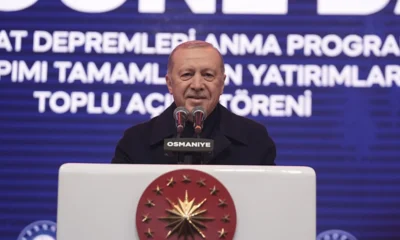
Breaking news! President Erdoğan spoke in Osmaniye on February 6: We were reborn to 86 million people, we showed the power of Türkiye!
-

 Sports17 hours ago
Turkish center Alperen Şengün named in 2026 NBA All-Star
-

 Politics21 hours ago
Türkiye captures 2 suspected of spying for Mossad in Istanbul