
Economy
3 years on, Türkiye draws $8.7 billion for quake-hit region recovery

Türkiye has mobilized close to $8.7 billion in external financing to fund rebuilding efforts and economic revitalization in its southeastern region following the devastating earthquakes almost three years ago.
The disaster early on Feb. 6, 2023, claimed more than 50,000 lives, impacted 11 southeastern provinces, razed hundreds of thousands of buildings and severely impacted the infrastructure.
Ever since, Turkish authorities have sought to channel funding to address what has been estimated to be an economic loss of $150 billion and to support long-term redevelopment across the affected provinces.
The Treasury and Finance Ministry has been working with international financial institutions, government lenders and commercial banks to secure long-term, low-cost financing for reconstruction efforts.
The funds are being directed toward the rebuilding and strengthening of schools, hospitals, housing, industrial facilities and urban infrastructure, while also supporting the real sector to preserve employment and ensure access to financing for businesses operating in the region.
Authorities said the financing aimed to prevent disruptions in credit access, support investment and meet liquidity needs, particularly for small and medium-sized enterprises and exporters.
Broad-based international financing
External funding has been secured across multiple sectors, including health care, agriculture, infrastructure and industry.
In 2023, the World Bank provided $990.8 million for projects implemented by the Health Ministry, the Environment, Urbanization and Climate Change Ministry, and the state lender Ilbank.
The lender also extended $450 million to the Small and Medium Enterprises Development and Support Administration (KOSGEB) to support the recovery and business continuity of SMEs.
The European Investment Bank approved $428.4 million in financing for Ilbank in the same year.
In 2024, the World Bank provided an additional $600 million for projects under the Industry and Technology Ministry and $241.4 million for Agriculture and Forestry Ministry projects.
The Japan International Cooperation Agency (JICA) also extended $387.3 million in financing to support health care and urban reconstruction projects.
Total external financing secured in 2023-2024 exceeded $5 billion.
Funding momentum continued in 2025
Financing efforts continued in 2025 as Türkiye accelerated reconstruction and development initiatives.
The World Bank and the French Development Agency jointly provided 400 million euros ($472.28 million) in co-financing for rural housing renewal and reconstruction projects.
The funds were transferred to the Environment, Urbanization and Climate Change Ministry to support the renewal or reconstruction of approximately 2,800 rural homes in the affected areas.
As part of what the government dubbed “the largest reconstruction mobilization of the century,” more than 455,000 housing units and workplaces have been handed over to survivors in the region as of last month.
Under the Registered Employment Creation Project, the World Bank also provided $500 million to be channeled through the Development and Investment Bank of Türkiye (TKYB).
In addition, the Islamic Development Bank extended 200 million euros in long-term, low-cost financing in 2025 to support reconstruction and urban transportation projects in the quake zone.
Türkiye also launched the Disaster Reconstruction Fund in 2025 to accelerate rebuilding efforts. The fund secured 485 million euros in financing, led by Abu Dhabi Commercial Bank with support from Doğan Investment Bank.
Officials said external financing will continue to play a central role in restoring economic activity, rebuilding infrastructure and supporting sustainable growth in the earthquake-affected region.

China is reportedly restricting fertilizer exports to protect its domestic market, a Reuters report said on Thursday, citing industry sources, in what would mark an additional strain on global markets that were already grappling with shortages caused by the U.S.-Israeli war on Iran.
China is among the largest fertilizer exporters, shipping more than $13 billion worth of it last year, and it has a history of controlling exports to keep prices low for farmers.
Shipments through the war-blocked Strait of Hormuz account for roughly one-third of the sea-borne supply. In mid-March, Beijing banned exports of nitrogen-potassium fertilizer blends and certain phosphate varieties, sources told Reuters.
The ban, which has not been formally unveiled, was reported earlier this week by Bloomberg News.
Added to existing bans and export quotas for urea, only a handful of fertilizers, notably ammonium sulphate, can be exported, five sources said. That would mean between half and three-quarters of China’s exports last year are restricted, potentially up to 40 million metric tons, according to a Reuters estimate.
“This pattern is consistent: China restricts supplies rather than coming to the rescue during global tightness,” said Matthew Biggin, a senior commodities analyst at BMI.
“The export restrictions exist because of their tight domestic balance, they’re prioritizing food security and insulating their domestic market from price shocks.”
Beijing’s curbs, like its move last week to ban refined fuel exports, come as governments limit exports of products whose inputs have been threatened by disruption from the war, worsening shortages and adding to higher prices around the world.
International urea prices have risen by around 40% from pre-war levels. In China, urea futures are near a 10-month high.
Dependent on China
Fertilizers are essential for plant growth and crop yields. Higher prices could lead to reduced usage, or farmers could switch to crops that require less fertilizer.
Last year, China sent Brazil, Indonesia and Thailand roughly a fifth of their fertilizer imports and that figure stood at a third for Malaysia and New Zealand, according to International Trade Centre data. For India, it was around 16%, according to its trade data.
Between half and 80% of those exports are now restricted, according to a Reuters analysis of Chinese customs data.
“Buyers were hoping China would step in and fill the supply gap, but this decision will only tighten supplies further,” a New Delhi-based fertiliser company official said, in reference to the recent restrictions.
The company official declined to be named due to the sensitivity of the matter.
India, which imported more than 40% of its urea, a nitrogen-based fertilizer, and DAP, a blend, from the Middle East last year, has requested China issue export quotas for urea.
When will exports resume?
The Philippines on Wednesday said China had assured it that fertilizer exports would not be restricted.
Asked about the comments a day later, China’s Ministry of Foreign Affairs spokesperson referred the question to other departments.
China’s General Administration of Customs, National Development and Reform Commission and Ministry of Commerce did not immediately respond to requests for comment.
At a fertilizer conference in Shanghai attended by Reuters on Wednesday, five salespeople said they did not expect the fertilizer bans to be lifted before August, after China’s peak June-to-August export period.
Producers are watching for signals from the government after spring planting to see whether bans would be extended.
In December, the state-linked fertilizer association urged major producers to suspend exports of phosphate fertilisers until August.
“Most folks who follow this very, very closely are expecting them to continue to extend the export bans,” said Caitlin Welsh, a director at the Center for Strategic and International Studies.
“China is so reluctant to do anything that would increase the price of grains, especially animal feed, domestically.”
The European Union proposed to Türkiye last month the idea that the candidate for bloc membership could join a cost-cutting payments system to boost integration efforts and benefit those sending money abroad, according to a report on Thursday quoting the EU envoy to Ankara.
Jurgis Vilcinskas, the bloc’s chargé d’affaires in Türkiye, said European Commissioner for Enlargement Marta Kos discussed the proposal with Foreign Minister Hakan Fidan when the two met last month in Ankara.
The EU says its 41-country Single Euro Payments Area (SEPA) makes cross-border euro-currency payments cheaper, faster and more secure. Users in far smaller Balkan candidates, Albania, Moldova, Montenegro and North Macedonia, which adopted the scheme last year, could save up to 500 million euros (around $573 million), it said.
“SEPA could present a valuable opportunity to strengthen Turkiye’s economic integration as a candidate country and a key trade and economic partner of the EU,” Vilcinskas told Reuters in a response, using the Turkish spelling of the country’s name.
It could generate “significant savings annually for Turkish businesses, consumers and diaspora by making cross-border transfers in euros as fast and as cheap as domestic ones,” he said.
Ankara’s view on the matter is unclear.
A Turkish diplomatic source confirmed that during the visit by Kos on Feb. 6, an offer had been conveyed to Ankara, adding the SEPA issue was under the jurisdiction and coordination of the Finance Ministry, which did not immediately comment on the matter.
Steps eyed to bolster economic ties
Under SEPA, Turkish banks could stand to lose revenues on transfers, which vary widely based on size. A Türkiye-Europe transfer of 1,000 euros to 5,000 euros can cost 40 euros, according to Western Union.
Europe is Türkiye’s largest trading partner with more than 200 billion euros in volume. With bloc membership talks effectively stalled for years, both say they want to modernize their customs union and move to boost economic ties.
Trade Minister Ömer Bolat recently reiterated the goal of modernizing the customs union, a decades-old framework, to better suit the present needs. Ankara has also been accepted into the new “Made in Europe” industrial policy, a move seen as reinforcing the economic and trade ties between the duo.
SEPA could bring “significant” savings, especially for the large Turkish diaspora across Europe, a Turkish banking source said.
In an interview this month, Odile Renaud‑Basso, the president of the European Bank for Reconstruction and Development (EBRD), said SEPA would “basically make transactions cost-free.”
The ongoing conflict in the Middle East is leaving numerous consequences on the global economy and commodity markets. Here is the breakdown of the latest events on Wednesday:
Iraq resumes oil exports via Türkiye
Iraq announced it had resumed limited oil exports through the Turkish port of Ceyhan, using a pipeline that avoids the effectively shut Strait of Hormuz.
The state-owned North Oil Company said it was sending an initial 250,000 barrels a day from its fields in the northern Kirkuk province through the pipeline, well below the 3.5 million barrels a day it has shipped in normal times from its southern Basra fields via the Strait of Hormuz.
Oil prices dip
Oil prices fell following Iraq’s announcement.
The WTI benchmark was down about 1.5% at $94.7 a barrel in volatile trading, even as the United States hit Iranian missile sites near the key Strait of Hormuz and Tehran struck back at crude-producing Gulf neighbors.
Stocks rose in Asia, and opened higher in Europe, also lifted by renewed interest in tech shares.
Japan, S. Korea petrochemical industry slows output
The Middle East war is forcing petrochemical giants in key Asian economies to cut production as the conflict rattles supplies of naphtha, a crucial oil-derived component used to make a range of plastic goods.
Mitsubishi Chemical and Mitsui Chemicals have cut output, Shin-Etsu Chemical said it would raise prices, and LG Chem warned it may not be able to fulfil some orders.
Emergency shipping talks
The International Maritime Organization (IMO) will begin an “extraordinary session” on Wednesday to discuss shipping amid the war.
The IMO’s 40-member council could vote Thursday on several proposed resolutions, including one to “establish a safe maritime corridor to allow the safe evacuation of seafarers and ships stranded in the Persian Gulf.”
However, if passed, resolutions remain non-binding.
South Korea secures oil from UAE
South Korea said it would receive an additional 18 million barrels of oil from the United Arab Emirates (UAE) through alternative supply channels, bypassing the need to use the Strait of Hormuz.
The presidential chief of staff declined to elaborate on the route.
About 70% of South Korea’s oil imports normally pass through the strait.
Fed kicks off series of central bank meetings
The U.S. Federal Reserve (Fed) later Wednesday kicks off a string of central bank meetings that will be closely watched for signs of how monetary authorities view the inflationary impact of higher oil prices.
The Fed is not expected to touch its rates, even as signs grow of a weakening labor market.
The European Central Bank (ECB) and the Bank of England (BoE) meetings are also due on Thursday.
Sri Lanka asks EVs to unplug
Sri Lanka, meanwhile, has urged electric vehicle owners to stop charging their cars at night, saying the surge in demand is forcing the country to burn more coal and diesel to keep the power grid running.
Faced with an energy crisis driven by the war, Sri Lanka has begun rationing fuel and has also imposed a four-day working week starting Wednesday in a bid to reduce travel.
A generation ago, Poland was rationing staples like sugar and flour, and its citizens earned just a fraction, about one-tenth, of West German wages. Today, its economy has surpassed Switzerland’s, ranking as the world’s 20th largest with annual output exceeding $1 trillion.
It’s a historic leap from the post-Communist ruins of 1989-90 to today’s European growth champion that economists say has lessons on how to bring prosperity to ordinary people – and that the Trump administration says should be recognized by Poland’s presence at a summit of the Group of 20 (G-20) leading economies later this year.
The transformation is reflected in people like Joanna Kowalska, an engineer from Poznan, a town of half a million people midway between Berlin and Warsaw. She returned home after five years in the U.S.
“I get asked often if I’m missing something by coming back to Poland, and, to be honest, I feel it’s the other way around,” Kowalska said. “We are ahead of the United States in so many areas.”
Kowalska works at the Poznan Supercomputing and Networking Center, which is developing the first artificial intelligence factory in Poland and integrating it with a quantum computer, one of 10 on the continent financed by a European Union program.
Kowalska worked for Microsoft in the U.S. after graduating from the Poznan University of Technology in a job she saw as a “dream come true.”
But she missed having a “sense of mission,” she said.
“Especially when it comes to artificial intelligence, the technology started developing so rapidly in Poland,” Kowalska added. “So it was very tempting to come back.”
The guest invitation to the G-20 summit is mostly symbolic; no guest country has been promoted to full member since the original G-20 met at the finance minister level in 1999, and that would take a consensus decision of all the members.
Moreover, the original countries were chosen not just by gross domestic product (GDP) rank, but by their “systemic significance” in the global economy.
But the gesture reflects a statistical truth: In 35 years – a little less than one person’s working lifetime – Poland’s per capita gross domestic product rose to $55,340 in 2025, or 85% of the EU average.
That’s up from $6,730 in 1990, or 38% of the EU average and now roughly equal to Japan’s $52,039, according to International Monetary Fund (IMF) figures measured in today’s dollars and adjusted for Poland’s lower cost of living.
Poland’s economy has grown an average 3.8% a year since joining the EU in 2004, easily beating the European average of 1.8%.
It wasn’t simply one factor that helped Poland break out of the poverty trap, says Marcin Piatkowski of Warsaw’s Kozminski University and author of a book on the country’s economic rise.
One of the most important factors was rapidly building a strong institutional framework for business, he said. That included independent courts, an anti-monopoly agency to ensure fair competition, and strong regulation to keep troubled banks from choking off credit.
As a result, the economy wasn’t hijacked by corrupt practices and oligarchs, as happened elsewhere in the post-Communist world.
Poland also benefited from billions of euros in EU aid, both before and after it joined the bloc in 2004 and gained access to its huge single market.
Above all, there was the broad consensus, from across the political spectrum, that Poland’s long-term goal was joining the EU.
“Poles knew where they were going,” Piatkowski said. “Poland downloaded the institutions and the rules of the game, and even some cultural norms that the West spent 500 years developing.”
As oppressive as it was, communism contributed by breaking down old social barriers and opening higher education to factory and farmworkers who had no chance before. A post-Communist boom in higher education means half of young people now have degrees.
“Young Poles are, for instance, better educated than young Germans,” Piatkowski said, but earn half what Germans do. That’s “an unbeatable combination” for attracting investors, he said.
Solaris, a company founded in 1996 in Poznan by Krzysztof Olszewski, is one of the leading manufacturers of electric buses in Europe with a market share of around 15%. Its story shows one hallmark of Poland’s success: entrepreneurship, or the willingness to take risks and build something new.
Educated as an engineer under the Communist government, Olszewski opened a car repair shop where he used spare parts from West Germany to fix Polish cars. While most enterprises were nationalized, authorities gave permission to small-scale private workshops like his to operate, according to Katarzyna Szarzec, an economist at the Poznan University of Economics and Business. “These were enclaves of private entrepreneurship,” she said.
In 1996, Olszewski opened a subsidiary of the German bus company Neoplan and started producing for the Polish market.
“Poland’s entry to the EU in 2004 gave us credibility and access to a vast, open European market with the free movement of goods, services and people,” said Mateusz Figaszewski, responsible for institutional relations.
Then came a risky decision to start producing electric buses in 2011, a time when few in Europe were experimenting with the technology. Figaszewski said larger companies in the West had more to lose if switching to electric vehicles didn’t work out. “It became an opportunity to achieve technological leadership ahead of the market,” he said.
Challenges still remain for Poland. Due to a low birth rate and an aging society, fewer workers will be able to support retirees. Average wages are lower than the EU average. While small and medium enterprises flourish, few have become global brands.
Poznan Mayor Jacek Jaakowiak sees domestic innovation as a third wave in Poland’s postsocialist economic development. In the first wave, foreign countries opened factories in Poland in the early 1990s, taking advantage of a skilled local population.
Around the turn of the millennium, he said, Western companies brought more advanced branches, including finance, IT and engineering.
“Now it’s the time to start such sophisticated activities here,” Jaśkowiak says, adding that one of his main priorities is investing in universities.
“There is still much to do when it comes to innovation and technological progress,” added Szarzec, the Poznan economist. “But we keep climbing up on that ladder of added value. We’re no longer just a supplier of spare parts.”
Szarzec’s students say more needs to be done to reduce urban-rural inequalities, make housing affordable and support young people starting families. They say Poles need to acknowledge that immigrants, such as the millions of Ukrainians who fled the Russian invasion in 2022, contribute to economic development in an aging population.
“Poland has such a dynamic economy, with so many opportunities for development, that of course I am staying,” said Kazimierz Falak, 27, one of Szarzec’s graduate students. “Poland is promising.”
The economic impact of the ongoing U.S.-Israel-Iran conflict could remain manageable for Türkiye if it lasts no longer than one to two months, Treasury and Finance Minister Mehmet Şimşek said on Monday, but warned of broader risks if the war drags on.
The war is in its third week, with no end in sight. The Strait of Hormuz remains largely closed off, with U.S. allies rebuffing U.S. President Donald Trump’s request for help to reopen the critical waterway, raising energy prices and fears of inflation.
Şimşek said the conflict is unfolding in one of the world’s most critical energy and trade corridors, which is why it could have a major impact not only on regional economies but also on global markets.
“The key issue is how long the war will last and whether it will spread further,” he told an interview with broadcaster Akit TV, noting that the region accounts for nearly one-fifth of global oil supply.
Energy shock fuels inflation risks
Şimşek said disruptions to supply chains and surging energy prices are already being felt, raising concerns about global inflation.
Brent crude oil prices have risen more than 40% compared to pre-war levels, while natural gas prices in Europe have climbed over 56% and jet fuel prices have nearly doubled, he said.
He highlighted the strategic importance of the Strait of Hormuz, warning that any disruption there would have far-reaching consequences for global trade and energy flows.
“There are serious problems both in the Red Sea and Hormuz, affecting transport between Asia and Europe,” Şimşek said, adding that a prolonged conflict could intensify inflationary pressures and disrupt global trade.
Financial conditions tighten
Şimşek said global risk appetite has weakened as investors shift toward safer assets, tightening financial conditions.
“There is a clear move away from risk. Capital is flowing from emerging markets to what are perceived as safer destinations,” he said.
If the conflict persists, the global economy could face a combination of higher inflation, tighter financial conditions and slower growth, alongside risks of recession or even stagflation, he added.
For Türkiye, Şimşek said the economic impact would be limited if the conflict is short-lived.
“If it lasts one to two months, we think the effects will be manageable, but if it continues longer, it could have negative impacts on the current account deficit and inflation,” he said.
Measures to shield markets and consumers
Şimşek stressed that authorities have not underestimated the risks and are actively managing the situation.
The war-related market volatility prompted Şimşek to convene the Financial Stability Committee, which said it would take all necessary steps to ensure market functioning and contain the fallout.
Şimşek said Türkiye has taken proactive steps to limit the spillover effects on financial markets.
Despite being in the region, Türkiye’s stock market has fallen by around 5.5% since the conflict began, compared with declines of over 10% in countries such as Indonesia, South Korea and South Africa, he noted.
However, he acknowledged that bond yields and risk premiums have risen due to heightened uncertainty.
Fuel price system not sustainable if high oil prices last
To cushion the impact of rising energy prices, the government has reintroduced the sliding scale system, which adjusts the special consumption tax (ÖTV) on fuel products and prevents higher oil prices from being fully passed through to consumers.
Şimşek said without the mechanism, diesel prices in Ankara would have reached TL 83.10 ($1.88) per liter, compared with the current level of TL 67.10. Gasoline prices would have been TL 71.11 instead of TL 62.30.
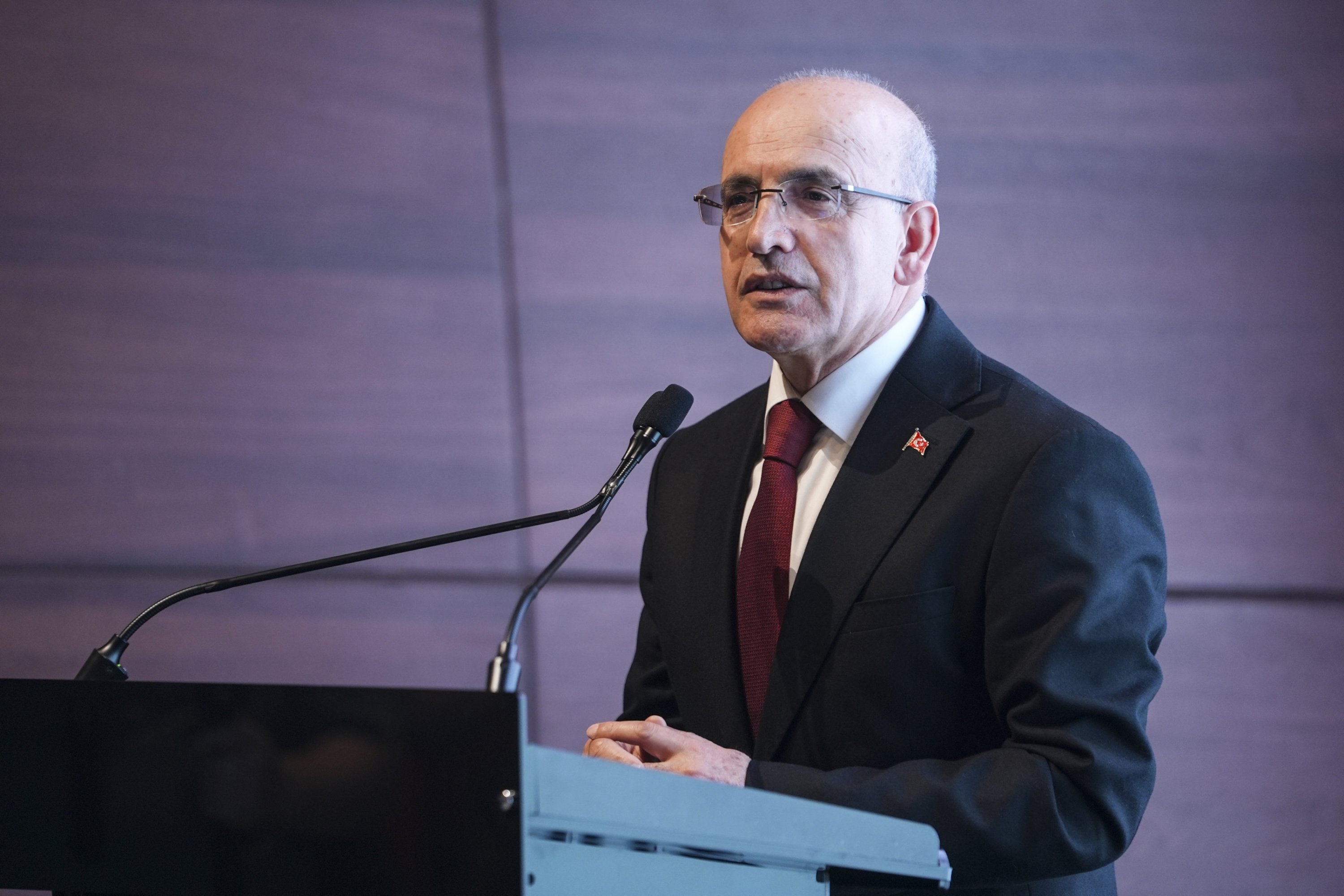
But Şimşek said the system is not sustainable if high oil prices persist, as it is a burden on the budget. He said the government gave up a significant tax income with the scale system to limit the impact of higher oil prices on inflation and consumers’ purchasing power.
“We wanted to limit (the high oil price) impact on our citizens. We believe this is temporary. Of course, if it becomes permanent, it’s not sustainable … We implemented this system assuming it would be temporary,” Şişek said.
External balances and trade at risk
Şimşek said the conflict could weigh on Türkiye’s external balances, particularly through higher energy import costs.
“I am somewhat concerned about the current account deficit, as oil prices directly increase it, but I believe it will remain manageable,” he said.
Türkiye’s exports to the region, including Iran, total around $30 billion annually, while imports stand at about $19 billion. The country also receives around 10 million tourists from the region, generating roughly $10 billion in tourism revenue.
Any disruption to trade routes or regional demand could therefore have broader economic implications, he noted.
Inflation outlook remains intact
Despite the shock, Şimşek said he expects inflation to continue declining this year, although uncertainty remains over the pace of disinflation.
“We are facing a serious shock due to the war, but assuming it is temporary, inflation will continue to fall this year,” he said.
He reiterated the government’s goal of bringing inflation below 20% this year but said it was too early to assess whether that target would be met under current conditions.
Annual inflation slowed from over 40% at the beginning of last year to just over 30% this January. But a rise to 31.5% last month signaled a slowdown in disinflation.
Encouraged by the downward trend, the Central Bank of the Republic of Türkiye (CBRT) has slashed interest rates by 900 basis points since mid-2025 to 37%.
But it halted its easing cycle last week due to fallout from the Iran war that it said could impact inflation.
The bank said it was closely watching the effects of “geopolitical developments” on the inflation outlook, and it was ready to take more liquidity steps if needed to support markets.
The CBRT also left unchanged its band of overnight lending and borrowing rates at 40% and 35.5%, respectively. It responded to the volatility amid the conflict by taking liquidity measures that lifted overnight rates to around 40%, up 300 basis points from pre-war levels.
Şimşek added that last year’s economic program had proven its resilience despite multiple shocks, including domestic developments, global trade tensions and adverse weather conditions affecting agriculture.
Budget and reserves remain supportive
He also pointed to improvements in fiscal and external buffers, saying the budget deficit has continued to narrow and Türkiye’s reserves have increased.
Still, Şimşek warned that the conflict represents a major external shock with potential implications for the whole economy.
“The war is currently a significant source of uncertainty. We are facing a major external shock that could have serious potential impacts on the current account deficit, inflation, growth and the budget,” said the minister.
“Nevertheless, I am speaking on the assumption that the shock will be temporary.”
This month marks five years since the worst U.S. inflation outbreak in a generation, a defining economic shock that continues to shape policy debates, sway national politics and frustrate Federal Reserve officials trying to restore the pace of price increases to their 2% target after a monumental miss.
When nose-diving inflation at the start of the COVID-19 pandemic touched off concerns of a dangerous downward spiral in wages and prices, it was actually considered a good sign when prices across a variety of gauges began rising by more than 2% annually in March 2021. Fed officials even planned to encourage the emerging trend with continued low interest rates.
“We want inflation at 2%, and not on a transitory basis,” Fed Chair Jerome Powell said at a press conference that month in a be-careful-what-you-wish-for statement that would haunt the central bank.
Central bankers said they expected inflation to remain above their target that year, but not by much, and that they would wait on any effort to slow the economy with interest rate hikes until the increase proved durable.
But the pace kept accelerating.
At year’s end, the Personal Consumption Expenditures price index the Fed uses to set its target was rising at more than a 6% annual rate, triple its target. It did not peak until passing 7% in June 2022, with the Fed at that point scrambling to catch up with steep, rapid-fire rate hikes.
Inflation as measured by the separate Consumer Price Index topped 9% that month, the fastest pace since 1981, when the Fed was in the process of taming an even worse unmooring of prices.
The scars – political, financial and economic – won’t fade quickly.
Here’s a look at what’s transpired with inflation in the past half-decade:
Staples vs. paychecks
“People hate inflation” was a popular mantra among Fed officials as they pivoted towards a historically rapid series of rate hikes in 2022 to control inflation, even though they knew tighter credit would cause hardship by pushing new homes or cars out of reach for some consumers, given the financing costs. Monetary policy works in part by discouraging demand through raising the cost of credit, with weaker demand easing the pressure to raise prices.
An even larger risk was a “hard landing” from inflation in the form of rising unemployment or even a recession. That didn’t happen this time around, even though many top economists thought it was inevitable.
It’s easy to see why Fed officials were willing to take those sorts of risks, however. Inflation acts as a tax and leaves everyone worse off. Over the past six years, in fact, inflation has offset most of the increases in personal income, hitting hardest among the less well-off. A dollar today is equivalent to about 79 cents in January 2020.
For homebuyers, a painful cure
Economists sometimes say the solution to inflation is more inflation, since eventually high prices will kill demand. But for the Fed, the solution to inflation is higher interest rates. By raising their short-term policy rate, a range of other borrowing costs goes up, particularly home mortgages.
The Fed’s rate hikes starting in 2022 hit at an unusual time. Loose central bank policy that had taken hold during the 2007-to-2009 financial crisis had conditioned U.S. consumers over more than a decade to very cheap mortgages – cheaper than at any time in recent history.
The abrupt shift back to what are historically more normal financing costs has been a shock. Expectations play a large role in economics and politics, and the public is still adjusting to the fact that “cheap money” is gone for now.
A mortgage rate rising from below 3% to more than 6% adds hundreds of dollars to monthly payments and can be frustrating for those who find their incomes can no longer support a home purchase.
The battle continues
As the Fed meets this week, expected to hold interest rates steady, the U.S. is still confronting the aftermath of what economists came to regard as a collision between supply chains constrained by the pandemic and demand unleashed by trillions of dollars of COVID-era federal spending.
At the same time, the Fed’s preferred inflation measure remains about a point above target at roughly 3%, monetary policy remains somewhat tight, and a new price shock may be developing with oil prices above $100 a barrel due to the U.S.- and Israel-led war with Iran and gas prices topping $3.70, about 25% higher since hostilities began on Feb. 28.
President Donald Trump, who used anger over inflation and high prices as a powerful reelection campaign point in 2024, is struggling with continued voter concerns around “affordability,” with food prices still rising, home mortgage rates stuck above 6%, and healthcare and other major costs stressing family budgets.
He promised prices would fall. They didn’t. They rarely do.


-
 Daily Agenda2 days ago
Minister Güler’s statement about the Iran war: Türkiye continues its constructive efforts
-
 Daily Agenda3 days ago
AK Party Spokesperson Çelik: We will not tolerate those who covet our land
-
 Daily Agenda3 days ago
New development in the corruption case against Antalya Metropolitan Municipality: Arrest warrant for 3 released defendants
-
 Daily Agenda3 days ago
Ramadan Feast message from President Erdoğan: We will not allow Türkiye to be blocked
-
 Politics3 days ago
Turkish minister hits back at CHP leader on ‘baseless property’ claims
-
 Economy3 days ago
EU floats idea for Türkiye to join its payments system
-
 Daily Agenda3 days ago
AK Party Deputy Chairman Hüseyin Yayman: He is attacking our party to cover up the corruption and theft within the CHP.
-
 Politics3 days ago
Fidan heads to Qatar following Riyadh talks on regional developments