
Economy
Eyes on trade, investments, defense as Erdoğan heads to Saudi Arabia

A large delegation of Turkish business leaders will accompany President Recep Tayyip Erdoğan on his visit to Saudi Arabia, where the focus will be on potential announcements signaling further advancements in economic cooperation.
The two-day visit is Erdoğan’s first trip abroad of the year, which comes amid soaring tensions in the region, and is part of a tour that also includes a stop in Egypt.
Erdoğan is scheduled to arrive in Riyadh on Tuesday and be received by Crown Prince Mohammed bin Salman at Al Yamamah Palace.
His visit in mid-2023 resulted in the largest defense and aviation export contract in Türkiye’s history that included the sale of dozens of unmanned combat aerial vehicles manufactured by the Turkish drone powerhouse Baykar.
Developing a local military industry has been part of an ambitious plan by Prince Mohammed to diversify the kingdom’s economy away from oil. The deal with Baykar also entailed cooperation on technology transfer and joint production.
“Erdoğan’s visit to Saudi Arabia represents the will of the two countries to elevate their relations, especially in economy and investments, as well as further advancing private sector cooperation,” said Haşim Süngü, chair of the Türkiye-Saudi Arabia Business Council at the Foreign Economic Relations Board (DEIK).
The focus is expected to primarily be on regional issues, including developments in Gaza and Syria, as well as the Trump administration’s threats of a possible strike on Iran. Ankara and Riyadh are said to have been in touch with leaders in Washington and Tehran to make the case that an escalation by either or both sides would cause massive destabilization throughout the region and affect energy markets.
Erdoğan is expected to attend business forums in both Riyadh and Cairo. Eyes will be on the signings of new strategic cooperation agreements, potentially in energy and defense.
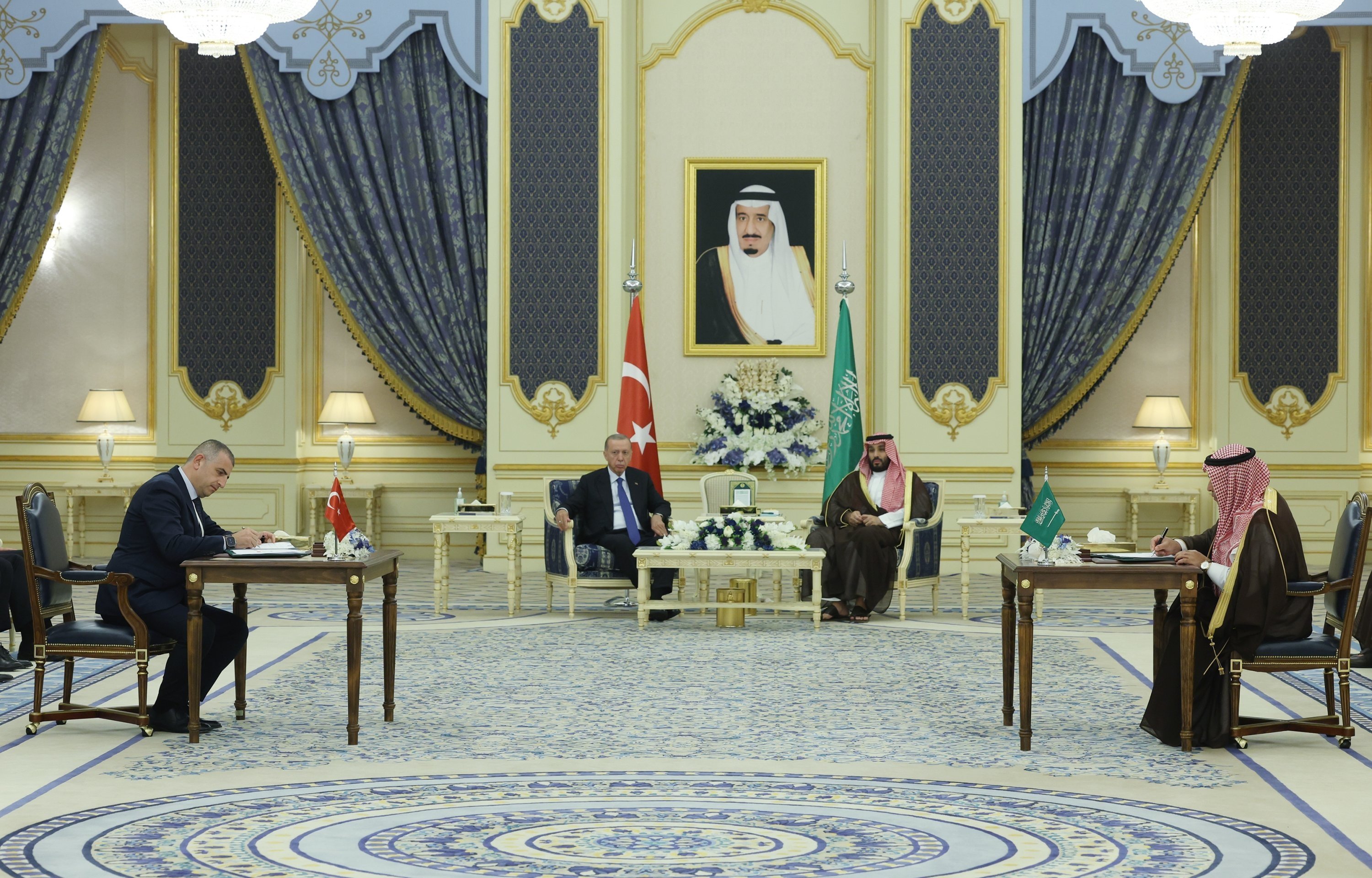
Last week, the Saudi Council of Ministers authorized relevant ministries to conclude agreements with Türkiye in the fields of renewable energy and civil defense, and approved a memorandum of understanding on cooperation in social services between the two countries.
Ankara and Riyadh are seeking to push bilateral trade from roughly $8 billion toward a long-term target of $30 billion.
“The way to achieve such goals is to transcend the traditional understanding of trade and boost investments, support domestic production, and conduct project-based cooperation,” Süngü said.
“Strengthening direct contacts between the business communities of the two countries is key in this process,” he told Anadolu Agency (AA).
Cooperation areas
According to Süngü, energy, infrastructure, construction, industry, defense, health care, tourism and digital transformation are some of the particular areas for cooperation and strong investment opportunities.
He noted Saudi Arabia’s future road map, called the Vision 2030, which he says is largely compatible with Türkiye’s capacities in industry, production, engineering, and technology. Süngü said the visit would offer significant advantages to the Turkish business community in strengthening relations and paving the way for new investment projects.
Süngü also mentioned that massive projects, like the global cities Neom and Qiddiya, the Red Sea Destination and the AlUla Project, which he says represent significant potential for Turkish firms.
“These projects create a foundation for reliable partnerships for Türkiye’s strong engineering, manufacturing, and technology infrastructure, and we think that the coming period will bring with it an increase in mutual investments and more robust long-term strategic partnerships, and thus, the economic relations between the two countries will be more balanced and sustainable,” he added.
Saudi Arabia, which derives up to 90% of its state revenues from oil, exports crude oil and petrochemical products to Türkiye, while importing various goods, including carpets, processed stones for construction, tobacco products, food and furniture.
Bilateral trade stood at over $5.1 billion in 2019 before a dip due to the COVID-19 outbreak. It rebounded to reach nearly $6.5 billion in 2022 and $6.8 billion in 2023. It hovered around $8 billion over the last two years.
Türkiye’s exports to Saudi Arabia rose by more than 11% to nearly $3.15 billion last year. Grains, pulses, oilseeds, and related products ranked first in exports to Saudi Arabia with $371.7 million, followed by carpets with $299.3 million and chemical products with $283.1 million.
Exports to Egypt, meanwhile, dropped by 5% last year compared to 2024 to around $3.3 billion. Chemicals and textiles dominated the shipments to Egypt.
Meanwhile, DEIK President Nail Olpak recently said Turkish overseas contracting firms continue to be involved in major projects in Saudi Arabia.
Olpak said trade with Gulf countries, particularly Saudi Arabia and the United Arab Emirates (UAE), has reached around $45 billion over the past three years.
Saudi Minister of State for Foreign Affairs Adel Al Jubeir had recently said cooperation between Türkiye and Saudi Arabia has particularly improved in recent years.
“We aim to advance cooperation between the two countries in various fields. We have many shared interests in the economic, energy, political and military fields,” Al Jubeir said.

Türkiye has doubled its share of global manufacturing value added (MVA) over the past two decades, according to Industry and Technology Minister Mehmet Fatih Kacır, who tied it to the country’s bolstering its infrastructure and industrial transformation in the same period.
Speaking at the ACE BPSC 2026 conference in Istanbul on Wednesday, Kacır said engagement with American businesses was an important component of bilateral relations.
Held under the auspices of the Trade Ministry and hosted by the Turkish-American Business Association (TABA-AmCham), the ACE BPSC 2026 summit brought together officials and industry leaders in Istanbul from Oct. 7-9, with the aim of shaping the new direction of global trade.
“We have doubled our share of global manufacturing value added thanks to the strong production infrastructure we have built over the past 20 years,” Kacır said.
Annual goods exports have risen from $36 billion in 2002 to $283 billion, he added, also highlighting Türkiye’s role in European value chains.
The minister also recalled that under Presidents Recep Tayyip Erdoğan and Donald Trump, Türkiye and the U.S. share the political will to deepen economic ties and advance toward their $100 billion bilateral trade target.
Innovation, industrial transformation
Türkiye has more than 1,700 R&D and design centers and over 13,000 companies operating in 115 technology parks, Kacır said.
He also said that its R&D workforce has increased from 29,000 in the early 2000s to 311,000.
Moreover, he highlighted advances in defense manufacturing and electric vehicle brand Togg, saying Türkiye aimed to move higher in global technology value chains.
Cooperation with the World Bank has provided more than $1 billion for industrial companies, smaller businesses and green technology startups, he said, adding that work with the European Bank for Reconstruction and Development (EBRD) has also advanced efforts to secure 5 billion euros ($5.59 billion) for green transformation investments.
Data centers, space ambitions
At the same time, the minister said Türkiye aims to expand data center capacity to 1 gigawatt (GW) by 2030 and mobilize at least $10 billion in private investment in AI, cloud technologies and digital infrastructure.
He said assembly and integration of Türkiye’s lunar spacecraft had been completed, with launch planned for early 2027.
He also recalled that Türkiye has joined the Artemis Accords and is developing a spaceport in Somalia.
Among others, he highlighted the Zangezur Corridor, Development Road and Northern Marmara Railway as projects strengthening trade connections.
Inviting U.S. investors to participate, Kacır called for concrete projects, stronger investment flows, deeper technology cooperation and lasting commercial partnerships.
Growing U.S. trade
Also addressing the event, Trade Minister Ömer Bolat emphasized that the U.S. is an important partner for Türkiye and said that the total trade volume between the two countries was $38.6 billion last year and that the U.S. had a trade surplus of $6 billion.
Bolat pointed out that Türkiye-U.S. trade has nearly doubled in the past 10 years, with trade volume rising from about $21 billion in 2015 to $38.6 billion.
“In terms of tourism, 1.6 million American tourists come to Türkiye annually, and from Türkiye around 260,000 people travel to America each year,” he said.
He also said that Turkish Airlines flies to 14 cities in the U.S., with 23 daily flights.
Delivering the opening address at the summit, TABA-AmCham President Süleyman Ecevit Sanlı, for his part, highlighted that this was the first time the American Chambers of Commerce in Europe (ACE) had gathered in Istanbul.
“Our role as TABA-AmCham is very simple: to connect people with great opportunities and to keep doors open for the business world,” he said.
He also underscored several priorities and expectations when looking forward, including the need to modernize the Customs Union between Türkiye and the European Union, to lift transit quotas, and “to remove all bans and eliminate visa and transit barriers so that our businesspeople can travel freely within both the European Union and the United States.”
The export climate for Turkish manufacturers continued to improve in September, rising further from an already positive reading a month earlier, a survey showed on Thursday.
The Manufacturing Sector Export Markets Climate Index, which tracks the performance of Türkiye’s top export markets, rose to 53.2 in September, the Istanbul Chamber of Industry (ISO) said in a bulletin.
This marked the improvement from 52.7 recorded in August and was the highest reading in 52 months, or more than four years.
Any reading above the index’s threshold of 50 indicates an improvement in the export climate, while readings below 50 indicate deterioration.
The reading indicated that the improvement in demand conditions across export markets accelerated for the fifth consecutive month. The index has remained above the 50 threshold every month since January 2024.
In September, production increased in nine of Türkiye’s 10 largest export markets, except for Poland, ISO said.
In the U.S., economic activity “increased strongly,” with growth accelerating to its fastest pace in more than five years, according to the chamber.
Meanwhile, signs of improvement continued across European economies as well.
Production continued to increase in Germany, the U.K., Italy, Spain, Romania and the Netherlands. In France, economic activity increased for the first time in more than two years, albeit only modestly. Exports to these European economies account for 34% of Türkiye’s total manufacturing exports.
Strongest increase recorded in UAE
Among all the economies covered by the survey, the United Arab Emirates (UAE) recorded the strongest increase in production. Growth in the UAE reached its fastest pace since February, just before the start of the war in the Middle East.
In addition to the UAE, economic activity in several other Middle Eastern countries also ended the third quarter on a positive note.
Saudi Arabia, Kuwait and Lebanon recorded growth. In contrast, production continued to decline in Qatar, while Egypt experienced a significant contraction. The decline in Egypt was the sharpest among all the economies monitored in the survey in September.
Commenting on the results, Andrew Harker, Economics Director at S&P Global Market Intelligence, said: “The acceleration in global economic activity seen throughout the third quarter continued in September.”
“The strong increase in economic activity in the U.S., with growth reaching its fastest pace in more than five years, was a major factor behind this acceleration. The improvement in operating conditions was not limited to the U.S. The number of European economies recording expansion increased, while the UAE led the way in terms of growth. Manufacturers hope that the recent improvement in export demand will continue throughout the remainder of 2026,” he added.
The Atlantic puffin, barn owl, buff-tailed bumblebee and European hedgehog will feature on the next series of banknotes, the Bank of England has announced.
The first denomination from the new series will be launched over the next few years, the bank said.
It added that the process of designing, testing and printing banknotes to make sure they are high-quality, resilient and accessible takes years.
As the designs are only in very early stages, they will be unveiled closer to their launch.
The decision on which animals to include was made after nearly 500,000 people responded to a public consultation.
They chose from a shortlist of 18 options across three categories – mammals, birds, and amphibians, insects and fish – developed in collaboration with a panel of U.K. wildlife experts.
The bank used the feedback from the consultation to decide on the four animals. There will be one for each denomination of banknote.
The barn owl, buff-tailed bumblebee and European hedgehog were the most popular animals in their respective categories.
The bank said that the Atlantic puffin was selected because it was the most popular marine animal.
It said the inclusion of a marine animal will add variety to the series, making the denominations easier to distinguish and giving an opportunity to celebrate the British coastline.
The red fox, which was in the mammals category, received more nominations than the Atlantic puffin, with 244,651.
In the birds category, the common kingfisher also received more nominations than the Atlantic puffin, at 211,277 compared with 183,137 for the Atlantic puffin.
The bank has said previously it would not necessarily choose the four animals that receive the highest number of responses.
It said that is important the animals represent different environments from across the U.K.
The bank said the decision on which selected animal will feature on which denomination will be made in due course and announced closer to launch.
The animals selected will feature as the central imagery but the bank said other elements from nature will also be included.
Other shortlisted animals may also potentially be included to complete the designs, it added.
Historical figures who have helped shape thought, innovation, leadership and values have been showcased on Bank of England banknotes since 1970.
The first of the current series has been in circulation since 2016, when 5 pound banknotes featuring Winston Churchill were issued.
The current series of banknotes in circulation also features Jane Austen on the 10 pound banknote, JMW Turner on the 20 pound and Alan Turing on the 50 pound.
The rise in payment technologies such as contactless and mobile wallets has given people an increasing array of alternatives to banknotes and coins.
On June 3, the bank launched a consultation asking the public which animals they would prefer to see used as the central images on the next series of banknotes.
The consultation ran for a month and received 478,531 responses.
The bank said it is the most responses that it has ever received to a banknote imagery consultation.
Those responding placed 2,549,003 selections across the shortlist of 18 animals.
The next series of banknotes will also continue to include a portrait of the monarch.
Victoria Cleland, Bank of England chief cashier, said: “I am delighted that nearly half a million people responded to our wildlife imagery consultation, showing that cash still matters.
“I would like to thank everyone who engaged, including those who I met at our events.
“With their support, we have chosen four distinct and inspiring animals that not only showcase the great variety of wildlife we have in the U.K. but will also enhance the security of our banknotes.”
Rhys Phillips, the bank’s incoming chief cashier who will be responsible for delivering the new series of notes, said: “It’s fantastic to see how engaged the public have been in this choice.
“With these animals as the focus for the design, we can deliver a new series of banknotes that are secure and represent the U.K. at its best.
“We’ll now work to design, test and produce the banknotes, combining the imagery we’ve announced today with cutting-edge security features and materials science.”
The shortlisted animals for the 2026 wildlife imagery consultation are below, with the number of nominations they received in brackets:
Mammals
European hedgehog (259,665) Red fox (244,651) Brown hare (130,614) Grey seal (92,043) Pine marten (82,773) Bottlenose dolphin (48,847)
Birds
Barn owl (270,596) Common kingfisher (211,277) Atlantic puffin (183,137) Great-spotted woodpecker (86,839) White-tailed eagle (46,109) Eurasian curlew (44,521)
Amphibians, insects and fish
Buff-tailed bumblebee (360,399) Emperor dragonfly (143,894) Common frog (120,382) Marsh fritillary butterfly (108,467) Basking shark (69,699) Atlantic salmon (45,090)
Türkiye prioritizes macro-financial stability and a tight fiscal policy to cushion the impact of global headwinds, which have been observed recently, particularly due to wars and higher energy prices, Treasury and Finance Minister Mehmet Şimşek said on Thursday.
Addressing the opening of Istanbul Economic Forum, Şimşek said that the government maintained a tight fiscal policy to cushion the impact of shocks and prioritize macro-financial stability.
The Central Bank of the Republic of Türkiye (CBRT) organized the two-day forum to address global economic policy challenges by bringing together central bank governors and senior policymakers from around the world, including the U.S. and the U.K.
Şimşek noted that global structural headwinds included conflicts, trade protectionism, high indebtedness, unfavorable demographics, impending climate disasters and artificial intelligence.
He also underscored that while Türkiye is focusing on promoting peace, and despite living in the immediate neighborhood of the countries in conflict, the country plans to increase defense spending by 229% in the 2027 budget, against the central bank’s 21% inflation target for next year, to build deterrence.
He also said that the value of research and development (R&D) in defense projects exceeded $100 billion, with around 1,400 defense products and projects, moving the country toward becoming a top 10 exporter.
He said Türkiye ranked among the top three globally for official development assistance and diplomatic footprint.
Turkish Airlines flew to the most destinations compared with other carriers, he recalled.
He also said the government invested in an $8 billion railway project crossing the Bosphorus in Istanbul to connect Beijing to London.
The country also encouraged its neighbors to invest in additional corridors, such as the new development road, to improve connectivity and resilience.
The minister also pointed out that the nation invested in natural gas and oil pipelines to ensure the availability of energy supplies.
The nation boosted the share of renewables in electricity generation to almost 60% and set an ambitious 35% electrification target, up from 23%, as the COP31 host.
FTAs role
The government responded to global trade protectionism by expanding free trade agreements, holding 54 pacts, with three pending and ongoing negotiations with Japan, Indonesia, the Gulf Cooperation Council (GCC) and Canada.
He pointed out that tourism revenue jumped ninefold over the past quarter-century, placing Türkiye among the top five global tourist destinations.
Şimşek also mentioned that the country had over 50 internationally accredited healthcare facilities and attracted medical tourists for cosmetic treatments.
He said the nation became the world’s third-largest exporter of soap operas and ranked second to London in the gaming ecosystem for startups and unicorns.
The country ranked second to China in the global league of contractors and hoped to aid in regional reconstruction, which required at least $1 trillion over the next decade.
Moreover, Şimşek noted that the nation hosted the sixth-largest number of international students at its universities.
Relatively low debt levels
He underscored that total indebtedness remained at 91%, compared with a 230% average for emerging market peers, while public debt to GDP stood at 22%.
The government targeted a 3.1% deficit this year, keeping it well below the 5.8% average for global emerging markets, and reduced current expenditures from 4.6% of the budget to 2.9%.
The administration sought to strengthen its fiscal position by investing in public procurement, state-owned enterprise governance and tax reforms.
Şimşek said the working-age population would continue to grow over the next decade and the administration planned reforms to boost women’s low labor force participation rate.
He said the country invested in 5G+ technology, expanded fiber capacity and planned nuclear power plants, including small modular reactors (SMRs), to power AI.
The government also helped small and medium-sized enterprises boost productivity to capitalize on the positive potential of AI.
The administration invested in irrigation and climate-resilient agriculture to combat global warming.
Şimşek remarked that the country frequently tested its ability to recover quickly from difficulties and adapted its policies despite challenges in a tough neighborhood.
Price stability
He underscored that delivering price stability remained the primary goal of the medium-term economic program while maintaining fiscal discipline.
The minister added that external imbalances remained manageable even though they deteriorated this year because of the war.
He highlighted that real convergence continued as the economy grew slightly more than 3%, outpacing the 1.5% growth of trading partners, while historical growth over the last 25 years stood closer to 5.5%.
Şimşek noted that the central bank utilized quantitative and selective credit-tightening tools while the government was adjusting its fiscal policy to make support more selective and targeted.
He concluded that recent stress in the asset management sector remained contained and the country maintained plenty of policy space to respond in a shock-prone world.
Touching on the country’s disinflation process, the minister said the process had largely stalled this year because of the war, “but we’re not giving up.”
“This year’s deficit would have been actually closer to two and a half percent, had we not deployed fiscal space to cushion or to, to slow the pass-through from crudes to final products,” he added.
Most U.S. Federal Reserve policymakers expect another interest rate hike by the end of the year as stubborn inflation and elevated energy prices continue to complicate the central bank’s efforts to bring price pressures under control, minutes released Wednesday showed.
The Federal Open Market Committee (FOMC) voted unanimously at its September meeting to raise its benchmark interest rate by 25 basis points to a range of 3.75% to 4%.
U.S. households and businesses have faced years of elevated prices since the COVID-19 pandemic, while inflation has remained above the Fed’s long-term 2% target for more than five years.
“With regard to the outlook for monetary policy beyond the current meeting, most participants assessed that another increase in the target range for the federal funds rate would likely be appropriate by year end,” the minutes said.
Several policymakers said they believed the previous policy rate had not been sufficiently restrictive to curb economic activity.
The Fed has a dual mandate to maintain price stability while supporting maximum employment.
The U.S. unemployment rate has remained relatively stable over the past year despite fluctuations in job growth, partly reflecting demographic shifts and lower immigration.
“Almost all participants assessed that, while inflation risks were tilted to the upside, risks to the labor market had diminished and were now broadly balanced,” the minutes said.
Inflation measured by the Personal Consumption Expenditures (PCE) price index, the Fed’s preferred gauge, peaked at 7.2% in June 2022 before declining.
It fell to 2.2% in September 2024 before accelerating again, partly amid the Trump administration’s tariffs on U.S. imports and other economic policy changes.
Energy prices have risen further since the outbreak of the U.S.-Iran war in February, as Iranian retaliation disrupted energy markets.
PCE inflation reached 3.8% in May, its highest level in three years, before easing to 3.4% in August, the latest month for which data is available.
Policymakers said recent progress in bringing inflation down had been insufficient.
They noted that geopolitical developments had driven up crude oil and refined fuel prices, while a surge in artificial intelligence-related investment was also contributing to inflationary pressures.
Officials also warned that the longer energy prices remain elevated, the greater the risk that rising costs in individual sectors could spread into broader price pressures.
Türkiye set out Wednesday a detailed plan to repay nearly half a million investors who have been caught up in the liquidation of more than 130 investment funds.
The first payments are due on Thursday, according to Vice President Cevdet Yılmaz, who told Parliament on Thursday the plan would be funded from the funds’ own assets and not from public money.
Here is how the process is expected to work.
Why are funds being liquidated?
Turkish authorities launched a sweeping investigation and market intervention last month after suspected price manipulation in a number of thinly traded stocks triggered heavy losses and redemption pressures at investment funds.
Capital Markets Board (SPK) halted trading in funds run by seven management companies on Sept. 17 and ordered the funds wound down. Authorities have also detained or ordered the detention of top executives.
The 131 funds ordered to be liquidated account for about 4.6% of all funds in Türkiye and 7.7% of portfolio value, Yılmaz said on Thursday.
When will first payments be made?
Payments will begin on Thursday for 43,643 investors in 17 funds run by three of the companies: A1 Capital, Bulls and Pardus. These funds are being wound down under the “ordinary” liquidation method, which started on Monday.
Authorities are also preparing ordinary liquidation for Atlas Portföy. If the necessary collateral is secured, its 56,614 investors in 16 funds would be paid quickly, Yılmaz said. Another 49 private funds under the first three companies, with 2,098 investors, will be dealt with separately.
The remaining three portfolio management companies include Tera, Hedef and Pusula.
What about other funds?
The remaining funds will go through “extraordinary” liquidation, a new process that depends on a bill now before Parliament and expected to pass soon.
Under the plan, investors would receive an interim payment of up to TL 1 million ($20,326) of their original investment.
Key features of the plan:
The limit applies to each fund separately. An investor with money left in three funds could receive up to TL 1 million from each.
Small investors come first. Roughly 350,000 investors are said to have less than TL 1 million in the funds. They are due to be paid first, with payments planned within October. Money market funds will also be given priority.
Larger claims will be paid later. Investors owed more than TL 1 million lira will receive the rest in stages.
The interim payment is an advance. It will be deducted from what each investor is finally owed.
How will amounts be calculated?
The Central Registry Agency (MKK) will calculate each investor’s “net investment amount,” which forms the basis of the payment.
Officials say the calculation method has been written, and the figures will be produced once price data arrives from Takasbank, the clearing and settlement institution.
The plan being drawn up also envisages paying investors an inflation adjustment on top of their principal.
Is there government guarantee?
No. Officials say public money cannot be used to cover private investment losses. Unlike bank deposits, investment funds carry no state guarantee, and that applies especially to higher-risk hedge funds.
The government’s stated aim is to resolve the problem using the money and assets inside the funds.
Where will money come from?
Each fund’s securities, property and other assets will be sold for cash. The funds’ debts will be paid and amounts owed to them collected.
To handle this, the SPK has opened 131 refund accounts, one per fund, and one general share refund account at the Savings Deposit Insurance Fund (TMSF). Money collected in each fund’s account will go to that fund’s creditors. Money in the general account will be distributed among the funds using a method the SPK will set.
Justice Minister Akın Gürlek said earlier this week that five people had returned profits that authorities say were made unfairly, and that such gains will be transferred to the TMSF fund.
How long will it take?
Authorities expect the full liquidation to take up to six months, after which the final balance left in each fund will be known.
If the bill passes, officials say the interim payments will be made in October, meaning most of the 455,758 affected investors would be repaid in full.
How many people are affected?
According to officials, the 131 funds have 455,758 investors. Ziraat Bank is responsible for liquidating 125 funds, with 151,247 investors, and Işbank for six funds, with 388,718 investors.
What about criminal investigation?
As of Wednesday, authorities had taken legal action against 220 people, including managers of the troubled fund companies. Of these, 85 are in custody, arrest warrants have been issued for 23 suspects, and 81 people face travel bans.
Prosecutors have issued 21 seizure orders covering property of 63 individuals and 12 legal entities. The bank, cryptocurrency and safe-deposit box assets of 67 people and companies have also been seized.


-
 Economy3 days ago
Brazilian assets rally as Flavio Bolsonaro tops first-round vote
-
 Economy3 days ago
Top central bankers due in Istanbul to discuss policy challenges
-

 Politics3 days ago
3 jailed in Türkiye over FETÖ-linked infiltration of MASAK data systems
-
 Politics3 days ago
Türkiye-led Nusret-2026 drills bring together multinational naval forces
-
 Politics3 days ago
Türkiye’s CHP seeks removal of mayor with divided loyalty
-
 Economy3 days ago
Türkiye says Development Road could become $80B ‘energy corridor’
-
 Politics2 days ago
Türkiye condemns Israel’s deepening incursion into Syria
-
 Economy2 days ago
Over $16B shifted into deposits amid fund exits: Turkish central bank