
Economy
Middle East conflict puts everything known about Dubai to test

For years, Dubai has been pitched with images of glittering skyscrapers, tax-free incomes, business-friendly policies and something far more intangible: the unspoken promise that whatever was happening elsewhere in the Middle East, this city was different. The conflicts that destabilized the region would somehow stop at Dubai’s borders.
Since Saturday, that all changed. Iran’s retaliatory strikes across the Gulf hit across Dubai’s key sectors, landing on airports, hotels and ports. They also hit the psychological foundations of a city that had spent four decades constructing that identity as one of the world’s most reliable places to do business in an unreliable neighborhood.
Authorities in the United Arab Emirates (UAE), a close U.S. ally, moved quickly to contain the damage to confidence as much as the physical fallout.
The UAE’s National Emergency, Crisis and Disasters Management Authority said the situation remained under control. For investors and residents watching their landmarks hit by missiles, as they stockpiled supplies, the reassurances were noted. Whether they were enough is another question.
“It’s hard to overstate the peril for Dubai’s economic model,” said Jim Krane, a fellow at Rice University’s Baker Institute.
“The physical damage may be slight, and most of the pain thus far is psychological. But Dubai’s status as a safe haven for expatriates and their businesses is in increasing doubt. The longer the war continues, the more intense the search will be for alternative locations. Dubai needs this war to wrap up now. International capital is highly mobile,” Krane noted.
In a sign of the ongoing strains, the UAE’s stock markets were closed on Monday and Tuesday, while tech outages following a hit to Amazon’s cloud computing facilities were affecting some banking operations, according to a person familiar with the situation.
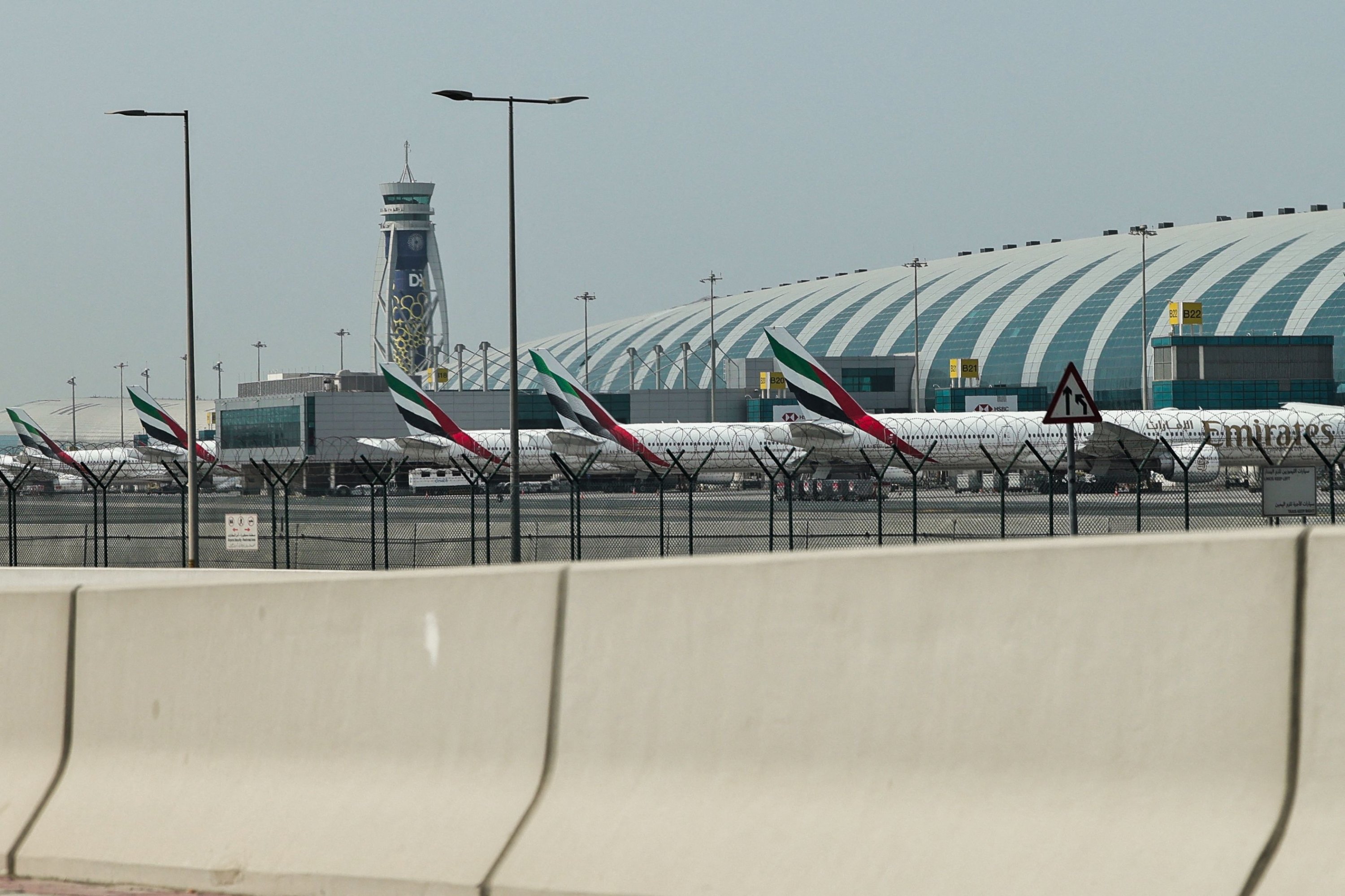
Tens of thousands remained stranded in the UAE as airspaces remained largely closed, with the conflict also laying bare how heavily global air travel relies on a handful of hubs led by Dubai, the world’s busiest international airport.
Four decades after the Gulf’s trading capital set out to exploit its strategic location by setting up Emirates with two rented jets and two routes, Dubai stands at the center of a global network spanning 110 nations and 454,000 flights a year.
How Dubai built brand
Dubai’s transformation from a modest pearling and fishing port into a global financial center was a decadeslong project. The launch of Emirates airline in 1985, the opening of the Burj Al Arab in 1999 and laws in the early 2000s allowing foreigners to own property for the first time were the pillars of Brand Dubai.
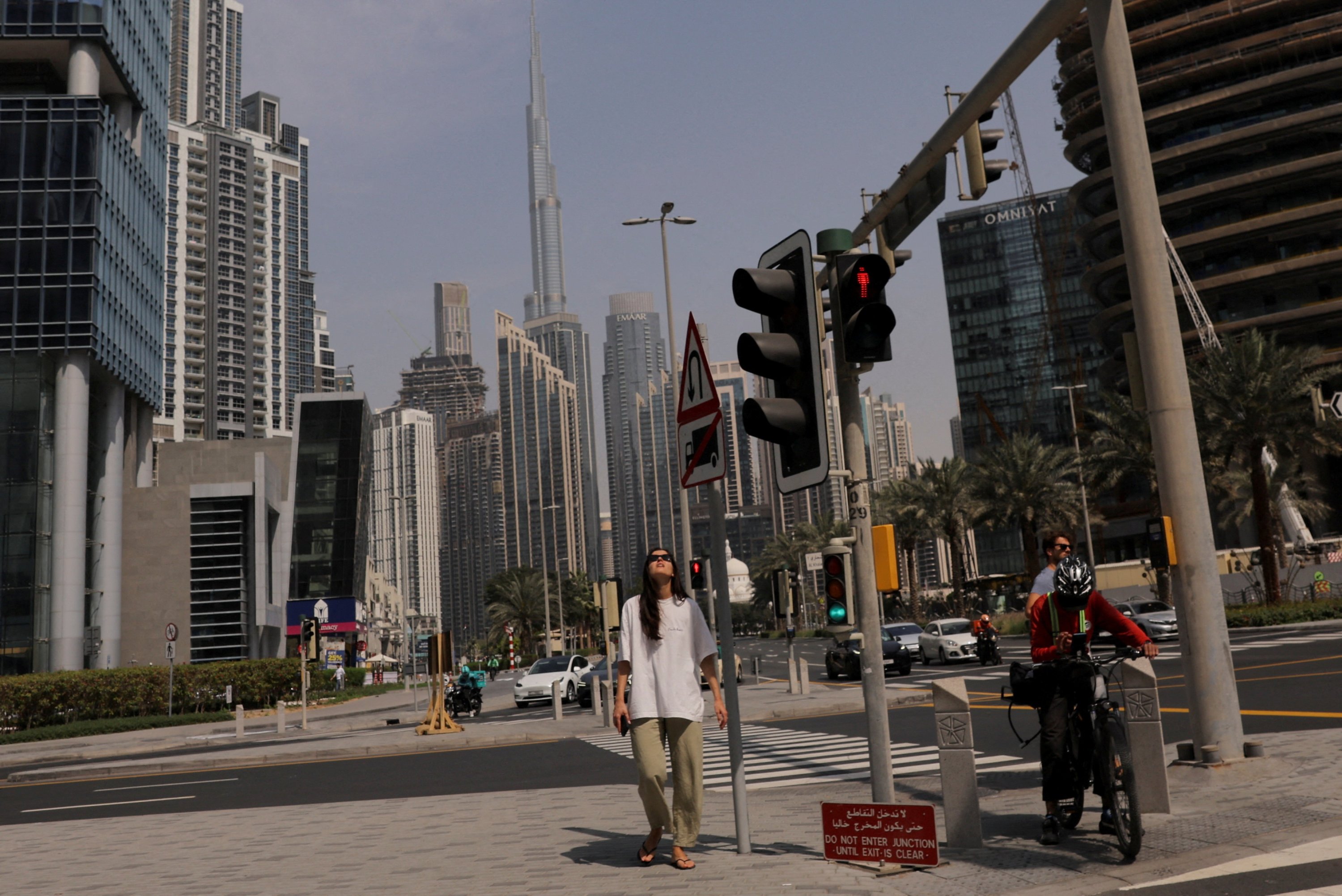
Dubai’s economy is almost fully powered by non-oil sectors, with oil now accounting for less than 2% of gross domestic product (GDP). A mix of trade, tourism, high-end real estate and financial services, built on a regulatory framework that mirrored London and New York, has replaced it.
Neighboring Abu Dhabi, which holds more than 90% of the UAE’s oil reserves, remains more reliant on oil revenue for growth.
Beirut had been the region’s international financial capital until its civil war in the 1970s shattered that image. Bahrain stepped into the vacuum until Dubai’s rise rendered it a more modest player. Each succession was built on the same promise: a stable, open alternative to wherever the region’s last crisis struck. Dubai executed that promise more completely than any of its predecessors.
Dubai’s rise was itself partly built on the instability of others. With Syrians displaced by civil conflict, wealthy families rattled by the Arab Spring, and more recently, Russians fleeing because of the Ukraine war, new residents all poured capital and talent into the emirate.
The population across the UAE ballooned, from about 1 million in 1980 to 11 million in 2024. Last year, the UAE was on track to attract a record 9,800 relocating millionaires, more than any other country on earth, according to Henley & Partners.
Money has poured into real estate, propelling Dubai’s developer Emaar Properties to a record high on Feb. 25, valuing the company at about 149 billion dirhams ($40.6 billion).
The creation of the Dubai International Financial Center (DIFC) in 2004 kickstarted a push to draw financial firms. By the end of 2025, DIFC hosted more than 290 banks, 102 hedge funds, 500 wealth management firms and 1,289 family-related entities.
What Saturday changed
But vulnerabilities have remained.
The Strait of Hormuz, through which roughly a fifth of the world’s seaborne crude oil passes, runs through Dubai’s backyard. Iran, a country with the capability to destabilize Gulf commerce, sits directly across the water.
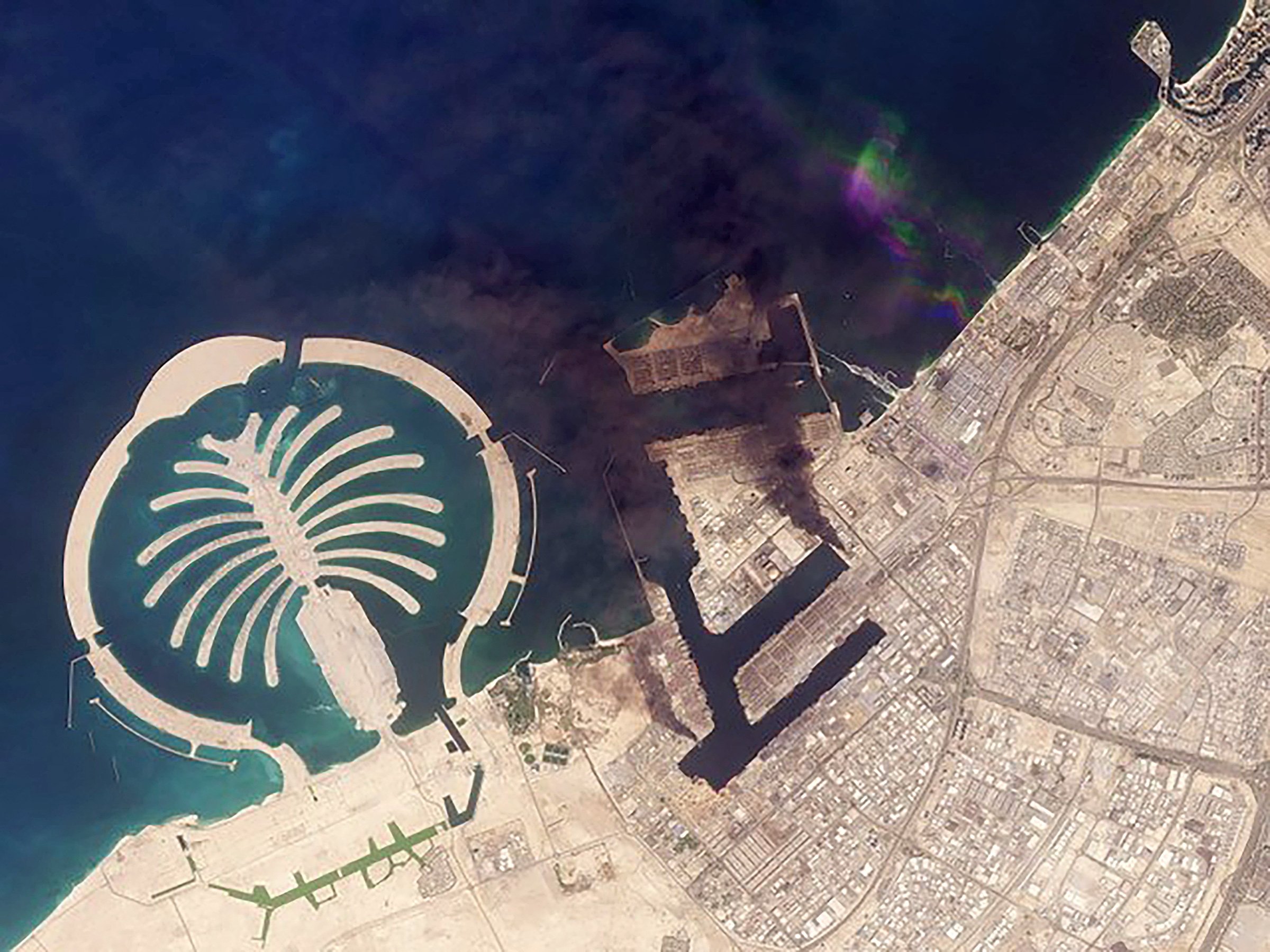
The physical damage over the weekend was stark. Dubai International Airport was hit, a berth at Jebel Ali Port caught fire and the Burj Al Arab sustained damage from interceptor fragments. Three people were killed and 58 injured, according to the UAE Ministry of Defense.
“People are afraid of what’s happening. It’s the first time they have to hide in underground places. Dubai airport, one of the biggest in the world, has to shut down for a few days,” said Nabil Milali, multi-asset portfolio manager at Edmond de Rothschild Asset Management. He reduced the firm’s exposure to stocks globally last week to prepare for the possibility of an attack on Iran.
“There’s a 70% probability we will keep a geopolitical risk premia (on the region) for a long time.”
A source at a UAE-based mid-sized investment firm said their company had begun preemptively planning layoffs and halted fundraising. Demand for gold bars surged, a jewelry industry source said. International private banks, which had been expanding advisory operations in the emirate, may also reassess the scope of their presence, according to a private banker. Firms may begin to rethink serving clients locally versus from another location, the banker said.
“Historically, markets like the UAE have demonstrated resilience during crises, including COVID, supported by strong policy response and governance,” said Madhur Kakkar, founder and CEO of Elevate Financial Services.
“At this stage, a broad structural reallocation of institutional capital away from the UAE or the wider Gulf appears unlikely unless tensions escalate materially or persist for an extended period.”
There is no data yet on capital outflows. The suspension of trading on the Abu Dhabi and Dubai stock exchanges on March 2 and 3 marks an unprecedented step for UAE regulators.
“It’s really quite a big change in perceptions,” said William Jackson, chief emerging markets economist at Capital Economics. “The Gulf economies have generally been seen as safe from Iranian retaliation. I think (that) has really changed over the weekend.”
The impact will depend on how long the conflict continues, he said. “But I think this is quite a big challenge, particularly when we’re thinking about some of the diversification efforts that are underway in the region.”
Momentous task piecing network back together
Dubai now has the momentous task of handling tens of thousands of displaced passengers and piecing its network back together while trying to minimize damage to inbound flights that represent half its traffic.
Most analysts say that, barring a prolonged regional war, the Gulf hubs will recover by virtue of the momentum and the power of their networks. But the unprecedented shutdown of all three major hubs – Dubai, Abu Dhabi and Doha – coincides with growing competition from Türkiye, Saudi Arabia and India.
“That we’ve got such a well-spread geographic business model and are well spread between visitors and those in transit suggests it’s very robust and will continue to survive any geopolitical tension that exists, wherever it may be,” Dubai Airports CEO Paul Griffiths told Reuters in a recent interview.
The strikes by the U.S. and Israel and Iran’s retaliation brought such tensions to Dubai’s doorstep, including an attack on the airport itself.
“There’s no doubt at all this is temporary. They have seen major incidents before and recovered very quickly due to their importance as global hubs,” said U.K.-based travel consultant Paul Charles. “They will recover quickly, even if there is substantial uncertainty in the short term.”
Others are less certain. The whole industry bounced back from the beating taken during the COVID-19 pandemic, thanks to demand outpacing supply. This time, however, it is demand that is at risk.
“Travelers are likely to consider more direct flights rather than stop over in Dubai or Doha. All this hub traffic is likely to take a hit,” said independent aviation adviser Bertrand Grabowski.
Favorable geography
Geography and economics remain strong allies, however.
“One third of the world’s population is within four hours’ flying time and two-thirds within eight hours,” said Dubai Airports’ Griffiths.
“We’ve seen the incredible aggregation power that a hub delivers.”
But threats to the Gulf trio are brewing. Turkish Airlines (THY) could be the biggest short-term winner through its own mega-hub outside the conflict zone, said independent aviation analyst John Strickland.
Saudi Arabia is also muscling in, followed by India, with Asian carriers picking up passengers.
Advances in aircraft design – once favorable to Gulf airlines – are also beginning to work against them. Airbus last week began assembling a second ultra-long-range A350 jet to support plans by Qantas to fly directly from Sydney to London.
Greatest uncertainty?
Emirates was founded at the height of the Iran-Iraq war in 1985. Its rapid growth led to the splintering of Gulf Air – carrier for Qatar, Bahrain, Abu Dhabi and Oman at that time – as, first, Qatar, then Abu Dhabi, set up their own airlines to form what remains a trio of Gulf hubs competing for passengers.
With Dubai’s orderly reputation shaken by Iranian attacks and anti-missile shrapnel, analysts say the greatest uncertainty of all hangs over the future of traffic to the city itself.
Questions have also been raised over the timing of the already delayed expansion of a giant new airport outside the city.
Dubai destination traffic “will doubtless recover, but there is likely to be some lasting damage,” Grabowski said.
For Emirates and sister airline flydubai, that may involve using their market power to get the system running again.
“People have short memories and they might be incentivised by some bargain deals to bring people back, but I don’t think that would need to be there for long,” said Eddy Pieniazek, head of advisory at aviation and leasing consultancy Ishka.
The Atlantic puffin, barn owl, buff-tailed bumblebee and European hedgehog will feature on the next series of banknotes, the Bank of England has announced.
The first denomination from the new series will be launched over the next few years, the bank said.
It added that the process of designing, testing and printing banknotes to make sure they are high-quality, resilient and accessible takes years.
As the designs are only in very early stages, they will be unveiled closer to their launch.
The decision on which animals to include was made after nearly 500,000 people responded to a public consultation.
They chose from a shortlist of 18 options across three categories – mammals, birds, and amphibians, insects and fish – developed in collaboration with a panel of U.K. wildlife experts.
The bank used the feedback from the consultation to decide on the four animals. There will be one for each denomination of banknote.
The barn owl, buff-tailed bumblebee and European hedgehog were the most popular animals in their respective categories.
The bank said that the Atlantic puffin was selected because it was the most popular marine animal.
It said the inclusion of a marine animal will add variety to the series, making the denominations easier to distinguish and giving an opportunity to celebrate the British coastline.
The red fox, which was in the mammals category, received more nominations than the Atlantic puffin, with 244,651.
In the birds category, the common kingfisher also received more nominations than the Atlantic puffin, at 211,277 compared with 183,137 for the Atlantic puffin.
The bank has said previously it would not necessarily choose the four animals that receive the highest number of responses.
It said that is important the animals represent different environments from across the U.K.
The bank said the decision on which selected animal will feature on which denomination will be made in due course and announced closer to launch.
The animals selected will feature as the central imagery but the bank said other elements from nature will also be included.
Other shortlisted animals may also potentially be included to complete the designs, it added.
Historical figures who have helped shape thought, innovation, leadership and values have been showcased on Bank of England banknotes since 1970.
The first of the current series has been in circulation since 2016, when 5 pound banknotes featuring Winston Churchill were issued.
The current series of banknotes in circulation also features Jane Austen on the 10 pound banknote, JMW Turner on the 20 pound and Alan Turing on the 50 pound.
The rise in payment technologies such as contactless and mobile wallets has given people an increasing array of alternatives to banknotes and coins.
On June 3, the bank launched a consultation asking the public which animals they would prefer to see used as the central images on the next series of banknotes.
The consultation ran for a month and received 478,531 responses.
The bank said it is the most responses that it has ever received to a banknote imagery consultation.
Those responding placed 2,549,003 selections across the shortlist of 18 animals.
The next series of banknotes will also continue to include a portrait of the monarch.
Victoria Cleland, Bank of England chief cashier, said: “I am delighted that nearly half a million people responded to our wildlife imagery consultation, showing that cash still matters.
“I would like to thank everyone who engaged, including those who I met at our events.
“With their support, we have chosen four distinct and inspiring animals that not only showcase the great variety of wildlife we have in the U.K. but will also enhance the security of our banknotes.”
Rhys Phillips, the bank’s incoming chief cashier who will be responsible for delivering the new series of notes, said: “It’s fantastic to see how engaged the public have been in this choice.
“With these animals as the focus for the design, we can deliver a new series of banknotes that are secure and represent the U.K. at its best.
“We’ll now work to design, test and produce the banknotes, combining the imagery we’ve announced today with cutting-edge security features and materials science.”
The shortlisted animals for the 2026 wildlife imagery consultation are below, with the number of nominations they received in brackets:
Mammals
European hedgehog (259,665) Red fox (244,651) Brown hare (130,614) Grey seal (92,043) Pine marten (82,773) Bottlenose dolphin (48,847)
Birds
Barn owl (270,596) Common kingfisher (211,277) Atlantic puffin (183,137) Great-spotted woodpecker (86,839) White-tailed eagle (46,109) Eurasian curlew (44,521)
Amphibians, insects and fish
Buff-tailed bumblebee (360,399) Emperor dragonfly (143,894) Common frog (120,382) Marsh fritillary butterfly (108,467) Basking shark (69,699) Atlantic salmon (45,090)

Türkiye prioritizes macro-financial stability and a tight fiscal policy to cushion the impact of global headwinds, which have been observed recently, particularly due to wars and higher energy prices, Treasury and Finance Minister Mehmet Şimşek said on Thursday.
Addressing the opening of Istanbul Economic Forum, Şimşek said that the government maintained a tight fiscal policy to cushion the impact of shocks and prioritize macro-financial stability.
The Central Bank of the Republic of Türkiye (CBRT) organized the two-day forum to address global economic policy challenges by bringing together central bank governors and senior policymakers from around the world, including the U.S. and the U.K.
Şimşek noted that global structural headwinds included conflicts, trade protectionism, high indebtedness, unfavorable demographics, impending climate disasters and artificial intelligence.
He also underscored that while Türkiye is focusing on promoting peace, and despite living in the immediate neighborhood of the countries in conflict, the country plans to increase defense spending by 229% in the 2027 budget, against the central bank’s 21% inflation target for next year, to build deterrence.
He also said that the value of research and development (R&D) in defense projects exceeded $100 billion, with around 1,400 defense products and projects, moving the country toward becoming a top 10 exporter.
He said Türkiye ranked among the top three globally for official development assistance and diplomatic footprint.
Turkish Airlines flew to the most destinations compared with other carriers, he recalled.
He also said the government invested in an $8 billion railway project crossing the Bosphorus in Istanbul to connect Beijing to London.
The country also encouraged its neighbors to invest in additional corridors, such as the new development road, to improve connectivity and resilience.
The minister also pointed out that the nation invested in natural gas and oil pipelines to ensure the availability of energy supplies.
The nation boosted the share of renewables in electricity generation to almost 60% and set an ambitious 35% electrification target, up from 23%, as the COP31 host.
FTAs role
The government responded to global trade protectionism by expanding free trade agreements, holding 54 pacts, with three pending and ongoing negotiations with Japan, Indonesia, the Gulf Cooperation Council (GCC) and Canada.
He pointed out that tourism revenue jumped ninefold over the past quarter-century, placing Türkiye among the top five global tourist destinations.
Şimşek also mentioned that the country had over 50 internationally accredited healthcare facilities and attracted medical tourists for cosmetic treatments.
He said the nation became the world’s third-largest exporter of soap operas and ranked second to London in the gaming ecosystem for startups and unicorns.
The country ranked second to China in the global league of contractors and hoped to aid in regional reconstruction, which required at least $1 trillion over the next decade.
Moreover, Şimşek noted that the nation hosted the sixth-largest number of international students at its universities.
Relatively low debt levels
He underscored that total indebtedness remained at 91%, compared with a 230% average for emerging market peers, while public debt to GDP stood at 22%.
The government targeted a 3.1% deficit this year, keeping it well below the 5.8% average for global emerging markets, and reduced current expenditures from 4.6% of the budget to 2.9%.
The administration sought to strengthen its fiscal position by investing in public procurement, state-owned enterprise governance and tax reforms.
Şimşek said the working-age population would continue to grow over the next decade and the administration planned reforms to boost women’s low labor force participation rate.
He said the country invested in 5G+ technology, expanded fiber capacity and planned nuclear power plants, including small modular reactors (SMRs), to power AI.
The government also helped small and medium-sized enterprises boost productivity to capitalize on the positive potential of AI.
The administration invested in irrigation and climate-resilient agriculture to combat global warming.
Şimşek remarked that the country frequently tested its ability to recover quickly from difficulties and adapted its policies despite challenges in a tough neighborhood.
Price stability
He underscored that delivering price stability remained the primary goal of the medium-term economic program while maintaining fiscal discipline.
The minister added that external imbalances remained manageable even though they deteriorated this year because of the war.
He highlighted that real convergence continued as the economy grew slightly more than 3%, outpacing the 1.5% growth of trading partners, while historical growth over the last 25 years stood closer to 5.5%.
Şimşek noted that the central bank utilized quantitative and selective credit-tightening tools while the government was adjusting its fiscal policy to make support more selective and targeted.
He concluded that recent stress in the asset management sector remained contained and the country maintained plenty of policy space to respond in a shock-prone world.
Touching on the country’s disinflation process, the minister said the process had largely stalled this year because of the war, “but we’re not giving up.”
“This year’s deficit would have been actually closer to two and a half percent, had we not deployed fiscal space to cushion or to, to slow the pass-through from crudes to final products,” he added.
Most U.S. Federal Reserve policymakers expect another interest rate hike by the end of the year as stubborn inflation and elevated energy prices continue to complicate the central bank’s efforts to bring price pressures under control, minutes released Wednesday showed.
The Federal Open Market Committee (FOMC) voted unanimously at its September meeting to raise its benchmark interest rate by 25 basis points to a range of 3.75% to 4%.
U.S. households and businesses have faced years of elevated prices since the COVID-19 pandemic, while inflation has remained above the Fed’s long-term 2% target for more than five years.
“With regard to the outlook for monetary policy beyond the current meeting, most participants assessed that another increase in the target range for the federal funds rate would likely be appropriate by year end,” the minutes said.
Several policymakers said they believed the previous policy rate had not been sufficiently restrictive to curb economic activity.
The Fed has a dual mandate to maintain price stability while supporting maximum employment.
The U.S. unemployment rate has remained relatively stable over the past year despite fluctuations in job growth, partly reflecting demographic shifts and lower immigration.
“Almost all participants assessed that, while inflation risks were tilted to the upside, risks to the labor market had diminished and were now broadly balanced,” the minutes said.
Inflation measured by the Personal Consumption Expenditures (PCE) price index, the Fed’s preferred gauge, peaked at 7.2% in June 2022 before declining.
It fell to 2.2% in September 2024 before accelerating again, partly amid the Trump administration’s tariffs on U.S. imports and other economic policy changes.
Energy prices have risen further since the outbreak of the U.S.-Iran war in February, as Iranian retaliation disrupted energy markets.
PCE inflation reached 3.8% in May, its highest level in three years, before easing to 3.4% in August, the latest month for which data is available.
Policymakers said recent progress in bringing inflation down had been insufficient.
They noted that geopolitical developments had driven up crude oil and refined fuel prices, while a surge in artificial intelligence-related investment was also contributing to inflationary pressures.
Officials also warned that the longer energy prices remain elevated, the greater the risk that rising costs in individual sectors could spread into broader price pressures.
Türkiye set out Wednesday a detailed plan to repay nearly half a million investors who have been caught up in the liquidation of more than 130 investment funds.
The first payments are due on Thursday, according to Vice President Cevdet Yılmaz, who told Parliament on Thursday the plan would be funded from the funds’ own assets and not from public money.
Here is how the process is expected to work.
Why are funds being liquidated?
Turkish authorities launched a sweeping investigation and market intervention last month after suspected price manipulation in a number of thinly traded stocks triggered heavy losses and redemption pressures at investment funds.
Capital Markets Board (SPK) halted trading in funds run by seven management companies on Sept. 17 and ordered the funds wound down. Authorities have also detained or ordered the detention of top executives.
The 131 funds ordered to be liquidated account for about 4.6% of all funds in Türkiye and 7.7% of portfolio value, Yılmaz said on Thursday.
When will first payments be made?
Payments will begin on Thursday for 43,643 investors in 17 funds run by three of the companies: A1 Capital, Bulls and Pardus. These funds are being wound down under the “ordinary” liquidation method, which started on Monday.
Authorities are also preparing ordinary liquidation for Atlas Portföy. If the necessary collateral is secured, its 56,614 investors in 16 funds would be paid quickly, Yılmaz said. Another 49 private funds under the first three companies, with 2,098 investors, will be dealt with separately.
The remaining three portfolio management companies include Tera, Hedef and Pusula.
What about other funds?
The remaining funds will go through “extraordinary” liquidation, a new process that depends on a bill now before Parliament and expected to pass soon.
Under the plan, investors would receive an interim payment of up to TL 1 million ($20,326) of their original investment.
Key features of the plan:
The limit applies to each fund separately. An investor with money left in three funds could receive up to TL 1 million from each.
Small investors come first. Roughly 350,000 investors are said to have less than TL 1 million in the funds. They are due to be paid first, with payments planned within October. Money market funds will also be given priority.
Larger claims will be paid later. Investors owed more than TL 1 million lira will receive the rest in stages.
The interim payment is an advance. It will be deducted from what each investor is finally owed.
How will amounts be calculated?
The Central Registry Agency (MKK) will calculate each investor’s “net investment amount,” which forms the basis of the payment.
Officials say the calculation method has been written, and the figures will be produced once price data arrives from Takasbank, the clearing and settlement institution.
The plan being drawn up also envisages paying investors an inflation adjustment on top of their principal.
Is there government guarantee?
No. Officials say public money cannot be used to cover private investment losses. Unlike bank deposits, investment funds carry no state guarantee, and that applies especially to higher-risk hedge funds.
The government’s stated aim is to resolve the problem using the money and assets inside the funds.
Where will money come from?
Each fund’s securities, property and other assets will be sold for cash. The funds’ debts will be paid and amounts owed to them collected.
To handle this, the SPK has opened 131 refund accounts, one per fund, and one general share refund account at the Savings Deposit Insurance Fund (TMSF). Money collected in each fund’s account will go to that fund’s creditors. Money in the general account will be distributed among the funds using a method the SPK will set.
Justice Minister Akın Gürlek said earlier this week that five people had returned profits that authorities say were made unfairly, and that such gains will be transferred to the TMSF fund.
How long will it take?
Authorities expect the full liquidation to take up to six months, after which the final balance left in each fund will be known.
If the bill passes, officials say the interim payments will be made in October, meaning most of the 455,758 affected investors would be repaid in full.
How many people are affected?
According to officials, the 131 funds have 455,758 investors. Ziraat Bank is responsible for liquidating 125 funds, with 151,247 investors, and Işbank for six funds, with 388,718 investors.
What about criminal investigation?
As of Wednesday, authorities had taken legal action against 220 people, including managers of the troubled fund companies. Of these, 85 are in custody, arrest warrants have been issued for 23 suspects, and 81 people face travel bans.
Prosecutors have issued 21 seizure orders covering property of 63 individuals and 12 legal entities. The bank, cryptocurrency and safe-deposit box assets of 67 people and companies have also been seized.
Türkiye’s capital markets will emerge from the fund turmoil cleansed of “greedy parasites,” President Recep Tayyip Erdoğan said Wednesday, reiterating that the government would do whatever is necessary to resolve the problem.
Erdoğan said the administrative and political burden of the affair rested on the government’s shoulders.
Regulators last month ordered the liquidation of over 130 investment funds managed by seven asset managers following warnings by some that they could not meet redemption payments.
Authorities have since widened their investigation into suspected market manipulation in stocks and fund markets. Eighty-five suspects have been arrested so far in the probe, Justice Minister Akın Gürlek said Tuesday.
The funds ordered to be wound down had reached more than $20 billion (TL 983.94 billion) in assets over just three years. Nearly half a million investors have been affected, according to authorities.
Erdoğan said all relevant bodies were following the matter closely and had taken measures. He said those who infringed on the public’s rights, made unjust gains or committed fraud would be held accountable.
He said the economic leadership and other institutions were taking the steps needed for financial markets to come out of the crisis stronger and healthier. He said the government was also following the investor side of the problem carefully.
“We are putting in motion the necessary administrative and legal processes so that our citizens’ savings are paid as soon as possible, without placing a burden on the public,” he said.
Inquiry into possible negligence
The newly created Fund Coordination Board, chaired by Vice President Cevdet Yılmaz, has been tasked with overseeing the liquidation of the funds. The State Supervisory Council (DDK) has also been assigned to examine the issue.
“We will not turn a blind eye to the slightest negligence or any breach of law or rules,” Erdoğan said.
He said some were waiting eagerly for Türkiye’s economy to fall into crisis, but that at the end of this process Turkish capital markets would shed their impurities and rid themselves of “greedy parasites that feed on small investors’ savings.” He said the financial system would emerge sounder and healthier and continue to grow stronger.
Judiciary, administration, politics
Erdoğan said the matter had judicial, administrative and political dimensions.
The independent judiciary would do its own work, he said. Economic actors were taking the steps required in their own areas of responsibility. Questions of conscience, ethics and belief, he said, were a matter for each individual. “But the burden on the administrative and political side of the issue is on our shoulders,” he said.
On the political side, Erdoğan said the issue could not be separated from conscience, morality and faith. He said his party had adopted the principle that “politics has only one harbor, and that is morality” when it was founded. He said the movement was built on belief, ethics and trust.
“No matter who stands in our way as we serve our people, our country, and our Muslim community, we will leave them aside and keep walking,” said the president.
Fatma Betül Sayan Kaya resigned last month as a deputy chair of the Justice and Development Party (AK Party) after she and her husband were alleged to have made substantial profits trading shares ahead of the turmoil.
The two were to give statements as suspects on Wednesday as part of the investigation, the Justice Ministry said.
The ministry said they would be questioned by the Istanbul Chief Prosecutor’s Office’s money laundering crimes investigation bureau.
The Capital Markets Board (SPK) is also expected to file criminal complaints against the two under the country’s Capital Markets Law as part of the investigation, the ministry said.
Türkiye’s central bank chief said Wednesday that a clearer slowdown in domestic demand and fading shocks would let disinflation regain momentum, stressing that policymakers would remain cautious to preserve gains achieved in lowering inflation.
Annual consumer price growth eased more than expected to 29.73% in September from 31.51% in August, official data showed Monday. That marked the first time inflation dipped below 30% in almost five years.
Inflation had peaked at 75.5% in May 2024 and has fallen substantially since, although the downward trend stalled earlier this year following a sharp rise in energy prices caused by the Iran war.
The Middle East conflict that began in February pushed up commodity prices, especially for energy, raised transport costs and disrupted supply chains.
That has caused global growth to weaken and inflation to rise, Central Bank of the Republic of Türkiye (CBRT) Governor Fatih Karahan said.
Underlying trend points lower
Policymakers at the central bank are particularly looking at underlying trend indicators, Karahan told an event in Istanbul.
Three-month averages pointed to a rising underlying trend between March and June, when the war’s effects were most visible. The trend has declined again since July, he said.
On an annualized basis, he said, the underlying trend, which rose to around 30% during the war, stood at 23.7% in September, about 6 percentage points below the current annual rate.
Karahan said this suggests disinflation will speed up if supply-side pressures fade, and he credited the tight policy stance’s effect on demand and pricing behavior.
Energy the exception
In September, annual inflation was lower than a year earlier in every category except energy.
Annual energy price increases reached 46.1%, about 11 percentage points above last year’s level, said Karahan, describing it as the main reason disinflation lost pace.
In services, annual inflation fell by 7 percentage points to 37.%. Monthly rent increases, which had long run well above services inflation, have slowed noticeably in recent months and are now below the services average. Karahan said this shows inertia from rents is weakening.
Annual inflation in the food and nonalcoholic drinks category fell to 27.6% from 36.1% a year earlier, helped by a recovery in agricultural output after last year’s adverse weather. Karahan said the bank is watching global agricultural prices and climate risks closely.
In core goods, Karahan said annual inflation fell to 15.9% from 19.9%. He added that moderate core goods inflation, despite cost pressures, indicates weak demand is limiting the pass-through of costs.
He noted some upward pressures. Education services inflation slowed from a year earlier but ran higher than expected after September increases. Transport services inflation was 44%, above the previous year because of the indirect effects of higher energy prices. Communications services inflation jumped to 44% from 24%.
Some analysts said the September inflation reading raises the prospect of an interest rate cut at the Oct. 22 meeting.
The bank has kept its benchmark one-week repo rate at 37% this year, as it monitored the inflation impact of the Iran war.
Weak demand, but expectations a concern
Karahan said first-half national income data and indicators for the third quarter point to weak domestic demand. Excluding gold, retail sales growth slowed in the third quarter, he said, and limited growth in quarterly card spending also confirmed the slowdown.
Inflation expectations have not improved as the bank had forecast at the start of the year, which Karahan said remains a risk to disinflation and requires continued caution.
Early in the war, the bank had said the effect on the medium-term outlook would run through two channels: a possible deterioration in expectations and a cooling of economic activity. Karahan said that, thanks to the tight stance, deterioration in expectations has been limited, while weaker demand has pushed the underlying trend lower.
Reserves and current account
Karahan said the current account deficit narrowed in the second quarter despite adverse external conditions and remained roughly flat as a share of national income. He said high energy prices carry upside risk for the trade deficit, but the bank expects this year’s current account deficit to come in below its long-term average relative to national income.
He said gross reserves, which stood at $210 billion (TL 10.33 trillion) in late February, fell to $149 billion at the end of June under the war’s impact, before rebounding to $171 billion by the end of September.
Of the decline since February, $23 billion was due to the fall in gold prices, Karahan said. Net reserves excluding swaps were about $40 billion as of the end of September, he added.


-
 Economy3 days ago
Brazilian assets rally as Flavio Bolsonaro tops first-round vote
-
 Economy3 days ago
Top central bankers due in Istanbul to discuss policy challenges
-

 Politics3 days ago
3 jailed in Türkiye over FETÖ-linked infiltration of MASAK data systems
-
 Politics3 days ago
Türkiye-led Nusret-2026 drills bring together multinational naval forces
-
 Politics3 days ago
Türkiye’s CHP seeks removal of mayor with divided loyalty
-
 Economy3 days ago
Türkiye says Development Road could become $80B ‘energy corridor’
-
 Politics2 days ago
Türkiye condemns Israel’s deepening incursion into Syria
-
 Economy2 days ago
Over $16B shifted into deposits amid fund exits: Turkish central bank