
Economy
Middle East war ‘testing resilience of global economy’: OECD

The Middle East conflict is “testing the resilience of the global economy,” the Organisation for Economic Co-operation and Development (OECD) said in a report released on Thursday, warning that rising energy prices and uncertainty now weigh on the outlook despite keeping the growth projection for this year unchanged.
Global growth is forecast to be at 2.9% this year, the Paris-based organization said, while it slightly shed the growth expectation for the next year from 3.1% to 3.0%.
The unpredictable trajectory of the Middle East conflict was driving up costs and dampening demand, offsetting the positive impetus from investment in new technologies and the momentum carried over from the previous year, it said.
“There’s a high level of uncertainty around the duration and the magnitude of the current conflict in the Middle East and that means that this outlook is subject to significant downside risks that could result in lower growth and higher inflation,” OECD chief Mathias Cormann told journalists.
The blockade of the Strait of Hormuz and damage to energy infrastructure had caused a sharp rise in energy prices and disrupted supplies of other key materials such as fertilizer, according to the OECD.
The scale and duration of the conflict were highly uncertain, but a prolonged period of higher energy prices would significantly increase costs for businesses and consumer prices, with negative consequences for growth, the OECD said.
Interim projections
The projections in the OECD’s interim Economic Outlook are conditional on a technical assumption that energy market disruption moderates over time, with oil, gas and fertilizer prices declining gradually from mid-2026 onward.
The 2026 projection is unchanged from the OECD’s December forecast, but preliminary indications since then had suggested global gross domestic product (GDP) growth could have been upwardly revised by around 0.3 percentage points in 2026 had the conflict not escalated, a revision that has been entirely erased by the impact of the fighting.
With energy prices now soaring, G-20 inflation is projected to be 1.2 percentage points higher than previously expected in 2026 at 4.0%, before easing to 2.7% in 2027.
In an adverse scenario where energy prices peak higher and stay elevated longer, global growth would be 0.5 percentage points lower by the second year of the shock, and inflation would be 0.9 percentage points higher, the OECD said.
U.S. outlook
The war is compounding an already complex picture of trade.
U.S. bilateral tariff rates have declined following the U.S. Supreme Court ruling against tariffs imposed under the International Emergency Economic Powers Act, with particularly large reductions for several emerging market economies, including Brazil, China and India.
Nonetheless, the overall U.S. effective tariff rate remains well above that prevailing before 2025.
On individual economies, annual GDP growth in the U.S. is projected to moderate from 2.0% in 2026 to 1.7% in 2027, as strong AI-related investment is gradually offset by a slowdown in real income growth and consumer spending. The OECD had pencilled in a forecast of 1.7% this year and 1.9% for 2027 in December, before the Supreme Court ruling.
U.S. headline inflation is now forecast to hit 4.2% in 2026, up 1.2 percentage points from the previous projection.
Diverging paths
In China, growth is projected to ease to 4.4% in 2026 and 4.3% in 2027, both in line with the OECD’s previous forecasts.
Euro area GDP growth is anticipated to slip to 0.8% in 2026, as higher energy prices weigh on activity, before increasing to 1.2% in 2027, helped by stronger defense spending. That marked a sizeable downgrade from December when the OECD had forecast 1.2% growth in 2026 and 1.4% in 2027.
In Japan, growth is projected at 0.9% in both 2026 and 2027, both unchanged, as the rising cost of energy imports offsets robust business investment.
The OECD urged central banks to remain vigilant and called on governments to ensure any support measures for households were well-targeted and time-limited.
For Türkiye, it forecasted the growth rate of 3.3% this year and 3.8% in 2027, respectively.

Nigeria aims to take the role of a major supplier in the $8 trillion (TL 405.95 trillion) global halal economy while also looking to deepen livestock and investment ties with Türkiye, its livestock development minister, Idi Mukhtar Maiha, said recently.
Speaking to Anadolu Agency (AA) on the sidelines of the 12th World Halal Summit, focused on products and services compliant with Muslim guidelines, Maiha said his first visit to the gathering was focused on learning, connecting and building long-term partnerships.
Pointing to the scale of the halal market across pharmaceuticals, financial services, agriculture and livestock, Maiha stressed that “by any standard, this is not something that should be ignored.”
He said Nigeria is ready to join the global halal economy for its potential to expand cross-border trade, catalyze economic growth, create jobs and wealth, and drive rural development.
Maiha added that Abuja is seeking international partnerships to make certification, standardization and categorization of Nigerian products and services seamless for global markets.
Türkiye’s edge in livestock, Islamic finance
Maiha praised Türkiye as a leader in the halal ecosystem, particularly in Islamic financing, noting major openings for Turkish investors and capital markets in Nigeria.
He said he has closely followed advances in Türkiye’s livestock sector, highlighting genetics, breed improvement, meat and milk production, equipment, and animal husbandry as key areas for cooperation.
“A lot to offer to Nigeria, a lot for Nigeria to learn from, and I do believe that this is one area where we can share,” Maiha said.
He said the summit offered an important venue to meet leading players in Türkiye’s livestock industry and broader economy, and that he plans to meet Türkiye’s ambassador in Nigeria to pursue formal bilateral agreements.
Turkish-built abattoirs, Global South ties
Noting that bilateral trade still has substantial room to grow, Maiha said cooperation in the livestock sector is already taking concrete shape on the ground in Nigeria.
He revealed that a strong Turkish delegation is constructing modern abattoirs in Nigeria using Turkish equipment, expertise, and professionals.
Maiha said he has already visited one completed facility and personally led groundbreaking ceremonies for two additional abattoirs being developed in partnership with Türkiye.
He expressed hope that commercial ties between Ankara and Abuja will grow “from strength to strength” in the spirit of Global South cooperation.
Highlighting deep historical and cultural ties, Maiha said the Shitta-Bey family in Lagos originated from Türkiye and noted shared Islamic traditions, along with daily flights linking Nigeria and Istanbul.
He praised Türkiye’s recent hosting of the COP31 U.N. climate summit, which he attended, calling it a “huge success” and evidence of expanding bilateral opportunities.
Maiha urged Türkiye to maintain its leadership in the global economy and support Global South nations as true partners, not mere markets.
He urged Turkish businesspeople to trust economic reforms led by Nigerian President Bola Ahmed Tinubu, giving assurances that investors can operate safely, repatriate profits, and build lasting ties.
Households’ demand for Turkish lira remains strong, the governor of the country’s central bank said, according to a transcript of an interview published on Sunday, pointing also to the importance of the demand for currency for the reserve outlook.
“The latest data show us that demand for the Turkish lira continues in a stable and strong manner,” the Central Bank of the Republic of Türkiye (CBRT) Governor Fatih Karahan said in an interview with Anadolu Agency (AA) published on Sunday.
“To prevent global volatility from affecting demand for the Turkish lira, we proactively took steps last week to support demand for the currency,” he added.
Household demand for the currency is particularly important for the country’s reserve outlook, he also said.
Noting that the underlying trend in inflation continued to decline, Karahan said the current account balance had also deteriorated only slightly despite the adverse effects of the war.
“Therefore, we can say very clearly that our macroeconomic fundamentals are strong,” he said.
Karahan also acknowledged that reserves had declined recently, adding: “When we examine the sources of this decline, we see that falling gold prices and global portfolio movements have played a role. In addition, companies have had some demand for foreign currency.”
On Thursday, the bank said it suspended its one-week repo auctions temporarily in a move expected to push overnight interest rates toward the 39% overnight lending rate. The repo move effectively shifts funding costs above the central bank’s 36% policy rate.
In another step aimed at supporting lira demand, the CBRT also said overnight it had raised the remuneration rate it pays on required reserves for deposits to 90% of the weighted average funding cost from 86%.
Karahan’s latest remarks came during a visit to London, where he also delivered a presentation on the macroeconomic outlook and monetary policy.
According to the presentation shared by the CBRT on Sunday, the governor highlighted that the disinflation process has slowed down and that energy prices had a major impact on inflation in 2026.
However, he also cited that disinflation continues in the services sector and that the deceleration trend in rent inflation is becoming more pronounced. He also reiterated that the underlying trend of inflation has declined.
U.S. consumers spent a record high $13.1 billion online on Black Friday sales and fewer people shopped in person on the single busiest day for stores each year, according to preliminary figures released Saturday.
Excluding purchases of gasoline and automobiles, retail sales both in stores and online were up 5.8% compared with last year’s Black Friday, according to Mastercard SpendingPulse, which tracks all payment forms including cash.
Adobe Analytics, which tracks e-commerce, said the day’s online sales total of $13.1 billion exceeded its forecast and was up 11% from a year ago.
Higher prices, which Americans have expressed frustration with as the Iran war affects gasoline and some consumer goods, did not account for all the sales growth. According to Salesforce, the volume of Black Friday orders increased 5% year-over-year.
Shoppers eager to score digital deals were not limited to the U.S. Global online sales reached a record $82.7 billion Friday, also 5% more than last year’s apex of advertised holiday discounts, Salesforce said.
The company said the global figure included $19.1 billion in U.S. sales.
Adobe and Salesforce use different data, which could account for the disparity in their online sales figures. Salesforce’s total was based on global shopping data from more than 1.5 billion consumers, and Adobe relies on data covering more than 1 trillion visits to U.S. retail sites.
Physical stores still account for the majority of all Black Friday sales, but they saw fewer visitors this year. RetailNext, which measures real-time store foot traffic, said initial data showed customer counts down 2.9% compared with 2025.
Black Friday foot traffic has fallen in recent years as U.S. consumers get in the habit of e-shopping. Bad weather across the country may also have contributed this year.
Another factor could have been households feeling the squeeze on essentials like gas, groceries and rent, which “changes how they plan every shopping trip,” said Joe Shasteen, RetailNext’s global manager of advanced analytics.
Sensormatic Solutions, which also tracks store traffic, said its data found retail foot traffic down 4.2% from the previous Black Friday but up 250% compared with the Friday a week earlier.
Mastercard SpendingPulse found that in-store spending rose 3.8%, which it said was the most since 2022.
Michelle Meyer, chief economist at the Mastercard Economics Institute, said it expects half of this year’s predicted growth in holiday season sales to be due to inflation.
While retailers promote Thanksgiving week through the following Monday for holiday shopping, practical purchases also drove Black Friday spending, Adobe said.
Gaming and electronics purchases, including consoles, video games, smartphones, headphones and smart glasses, were among hot sellers, but online shoppers also used discounts to stock up on essentials such as clothing, baby products, pet supplies and household cleaning items, according to Adobe’s analysis.
But technology was the hottest category overall, according to Mastercard SpendingPulse, with spending on electronics and software up nearly 8% from 2025.
Türkiye’s economic agenda is heading into a busy final month of the year, with attention focused on the 2027 budget, minimum wage negotiations and efforts to improve pension benefits.
December will also feature the release of key data, including inflation and growth.
The Turkish Statistical Institute (TurkStat) is set to release economic growth figures for the third quarter of the year, covering the July-September period, on Dec. 1.
In the second quarter, Türkiye’s gross domestic product (GDP) grew 2.3% year-over-year and 1.1% on a quarterly basis, according to TurkStat.
Meanwhile, Trade Minister Ömer Bolat is expected to announce November foreign trade figures on Dec. 3. Speaking at a recent gathering with craftspeople and tradespeople, Bolat indicated that November export figures were strong, recalling that many monthly records have been broken in recent months.
Exports amounted to $25.9 billion in October, up 8.1% year-over-year, according to preliminary trade data shared by Bolat and Türkiye Exporters Assembly (TIM).
At the same time, inflation data for November is also expected to be released on Dec. 3
Inflation stood at 2.58% month-over-month and 29.77% year-over-year in October. The domestic producer price index (PPI) also rose by 1.65% monthly and 27.41% annually in October.
Among others, TurkStat is also set to release the GDP by provinces and construction cost index for October on Dec. 9, while industrial production figures will follow on Dec. 10.
Markets to focus on interest rate decision
Just a week after the release of inflation data, the Monetary Policy Committee (MPC) of the Turkish central bank will meet on Dec. 10, with markets closely monitoring its decision.
At its October meeting, the committee cut its benchmark one-week repo rate by 100 basis points to 36% after months of a more cautious approach. The institutions are split about the expectations for the year’s last meeting, while energy prices and the inflation reading are expected to influence the decision of the policymakers.
The governor of the Central Bank of the Republic of Türkiye (CBRT), Fatih Karahan, in a new presentation to investors has signaled that the disinflation process “has slowed due to supply-side pressures” but also said that demand conditions “support disinflation in core goods despite strong headwinds.”
The central bank will also release October balance of payments statistics on Dec. 11.
Türkiye recorded a current account surplus of $2.72 billion in September, while the current account balance excluding gold and energy posted a surplus of $7.34 billion.
Budget marathon to continue
The last month of the year will also see final talks on the central budget for the next year and the highly followed discussions on the increase to the minimum wage in the country.
The budget marathon, which has been completed at the Parliament’s Planning and Budget Commission, will move to the General Assembly in December. Budget deliberations are scheduled to begin on Dec. 7 and continue through Dec. 20.
Discussions on the budgets of public institutions will be completed in nine rounds. Following the conclusion of these rounds, the articles of the budget proposal will be put to a vote.
Pensions regulation, minimum wage hike
In the final month of the year, millions of pensioners will also be closely watching for a regulation expected to be submitted to Parliament.
“With the support of our esteemed Parliament, we will implement an improvement covering all of our more than 17 million pensioners before the beginning of the new year,” President Recep Tayyip Erdoğan said earlier in November.
Vice President Cevdet Yılmaz also stated that the increase in pension payments would exceed the inflation rate.
Treasury and Finance Minister Mehmet Şimşek also noted that the government plans to introduce improvements in payments for pensioners in line with the budget.
“Technical studies on how this improvement will be implemented will most likely be completed during December,” he said, noting also that payments would vary according to age and the number of premium payment days.
Meanwhile, workers and employers will turn their attention to the Minimum Wage Determination Commission in December.
The commission will discuss the minimum wage to be implemented in 2027, also concerning millions of workers in the country.
Türkiye’s minimum wage increased by about 27% for 2026, with the amount set at TL 28,075 ($553).
Rising energy prices and renewed inflationary pressures have dashed expectations of further interest rate cuts, prompting instead major central banks around the world to reconsider monetary tightening amid tensions in the Middle East.
Since the start of the U.S. and Israeli strikes on Iran and the subsequent disruption of shipments through the Strait of Hormuz, oil and gas prices have been extremely volatile, adding to worries for consumers, but also complicating the central banks’ task of reining in soaring prices.
Brent crude prices have climbed above $110 a barrel in October before easing to $90 by late November, still 45% higher year-over-year.
On the other hand, the Dutch Title Transfer Facility (TTF), which serves as Europe’s primary wholesale natural gas price benchmark, topped 100 euros ($109) per megawatt-hour (MWh) in late October, marking its highest since December 2022, before stabilizing around 86 euros. The prices remain up close to 190% on a yearly basis, according to Trading Economics data.
All this led to a surge in consumer prices in different regions, including advanced economies in Europe and the U.S.
Annual eurozone inflation rose to 4% in October on energy-driven price pressures, while inflation in the U.K. and the U.S. also exceeded estimates.
The Bank of England (BoE) raised rates 25 basis points to 4% in early November, while markets price a 90% chance of a December Federal Reserve (Fed) hike alongside a year-end European Central Bank (ECB) increase.
On Wednesday, the data showed that the Fed’s preferred inflation gauge came in at a three-year high in October, with a rise in energy prices accompanied by an increase in nondurable goods inflation.
The Personal Consumption Expenditures (PCE) price index rose by 3.8% year-over-year in October, the data showed, matching a three-year high set in May.
Major institutions, including the European Commission in its autumn 2026 forecast and S&P Global, warned that monetary tightening is adding downside risks to global growth in 2027.
Further hikes likely
In its November review, the ECB said higher energy costs are fueling inflation and driving global tightening as markets price in further rate increases.
German Bundesbank President Joachim Nagel echoed the hawkish tone, saying eurozone inflation near 4% reflects energy costs and signaling further tightening may be needed to reach the bank’s medium-term target.
Minutes from the Fed’s late-October Federal Open Market Committee (FOMC) meeting showed a broad majority backing a rate hike in coming months, with a larger-than-25-basis-point hike still on the table for December if inflation worsens.
JPMorgan Private Bank’s 2027 outlook said energy disruptions and higher oil prices have made inflation persistent, with 17 of 37 major central banks tracked resuming rate hikes as global bond yields hit multi-decade highs.
Morgan Stanley’s 2027 global economic outlook warned that escalating Gulf tensions could trigger another wave of energy price hikes, raising U.S. and European recession risks if higher costs become embedded in core inflation.
BlackRock Investment Institute said the U.S. is better shielded as an energy exporter, yet still expects 25-basis-point Fed hikes in December and the first half of 2027, alongside a December ECB increase.
Analysts at ING Think and KPMG International said elevated diesel, jet fuel, and natural gas prices continue feeding core inflation despite a partial normalization in crude flows.
In a separate central bank road map, ING Think economists projected a final December Fed hike after October’s pause amid solid growth and low unemployment, followed by an extended hold through 2027.
ING economists said further Fed hikes would neither ease geopolitical tensions nor slow technology investments.
They described a December ECB hike as nearly certain, noting that the bank’s subsequent path will depend on the Middle East conflict’s duration and inflation pass-through.
Falling energy prices could allow the ECB to consider cutting rates in late 2027, ING added.
The BoE is expected to hike again in February 2027, or as early as December if the energy crisis deepens.
ING also expects the Bank of Japan to raise its policy rate to 1.75% via 25-basis-point increases in December and March 2027 after hitting its 2% inflation target in October.
In contrast, the People’s Bank of China (PBOC) is expected to ease policy amid weak domestic demand and low inflation, cutting rates by 10 basis points in mid-2027.
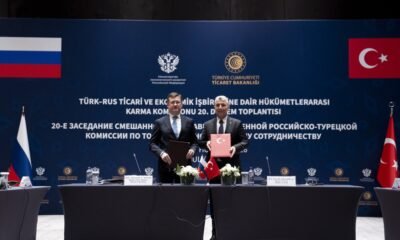
Türkiye and Russia reaffirmed on Friday their commitment to raise annual bilateral trade to $100 billion (TL 5.08 trillion), as senior officials signed a joint economic declaration in Istanbul.
Speaking at the meeting of the Turkish-Russian Intergovernmental Commission on Trade and Economic Cooperation, Trade Minister Ömer Bolat said delegations held comprehensive talks covering trade, transportation, energy and tourism.
Following the talks, Bolat and Russian Deputy Prime Minister Alexander Novak signed the joint declaration of the 20th commission meeting.
Noting that bilateral trade currently stands at $50 billion, Bolat said both sides remain committed to doubling that figure.
“Türkiye and Russia-two neighboring, friendly nations and key trading partners-will continue to advance our economic relations with growing momentum through 2027,” he added.
Novak said regular dialogue between the two governments continues to guide efforts toward the $100 billion annual trade goal.
He noted that bilateral trade has exceeded $50 billion in recent years, with Türkiye ranking second among Russia’s trading partners last year and fourth in the first nine months of 2026.
In the agro-industrial sector, mutual trade grew 12% over the first nine months of the year while Russian exports rose 17%, with Türkiye remaining the top buyer of Russian grain.
He also highlighted the opening on Thursday of Türkiye’s first maleic anhydride plant in Kocaeli’s GEBKIM industrial zone, enabling domestic paint, varnish and construction manufacturers to source the raw material locally.
On energy, Novak said Russia remains a reliable supplier of gas, oil, and petroleum products, noting that the Blue Stream and TurkStream pipelines continue operating uninterruptedly.
He added that work is underway on all four units of the Akkuyu Nuclear Power Plant, with main efforts focused on preparing the launch of the first unit.
In tourism and transport, Novak said Russian airlines carried over 6.5 million passengers between the two countries last year, while nearly 7 million Russian tourists visited Türkiye, ranking Russia first.
He also pointed to growing cooperation potential in healthcare, pharmaceuticals, digital technologies, logistics and e-commerce, alongside academic, sports and cultural exchanges.


-
 Economy3 days ago
CBRT pauses 1-week repo auctions, raises lira reserve remuneration
-
 Economy2 days ago
Türkiye, Russia extend gas supply contract, sign LNG supply deal
-
 Economy2 days ago
US reportedly pushed Venezuela, Iraq to consider leaving OPEC
-

 Sports3 days ago
Turkish clubs unite behind Beşiktaş after Georgian police violence
-
 Politics2 days ago
Türkiye elections due in 2028, could be held 1-2 months early: VP
-

 Economy2 days ago
Türkiye’s energy ambitions expand with new Africa, Libya partnerships
-
 Economy2 days ago
Türkiye, Russia reaffirm target to achieve $100B bilateral trade
-

 Lifestyle2 days ago
Ancient wonders, folk legends await in central Türkiye’s Kırşehir