
Sports
Skyrocketing costs turn 2026 World Cup into luxury experience

The 2026 FIFA World Cup was supposed to be a celebration of football on an unprecedented scale. Instead, many supporters traveling across the United States, Canada, and Mexico say they are facing a different challenge: paying for it.
With soaring ticket prices, expensive flights, inflated hotel rates and sweltering summer temperatures, fans attending the tournament are calling it the costliest World Cup in history.
Outside stadiums and fan zones, supporters described the experience as unforgettable on the field but increasingly difficult on their wallets.
At the New York New Jersey Stadium, where nearly 80,000 fans packed the stands for Brazil’s group-stage match against Morocco, supporters joked that the “World Cup fever is burning through bank accounts.” Similar complaints echoed across tournament venues as visitors grappled with rising travel expenses.
The contrast was visible elsewhere. While New York drew a near-capacity crowd, attendance at Spain’s match against Cape Verde in Atlanta fell short of the stadium’s 75,000-seat capacity, with noticeable gaps in the stands despite an announced crowd of about 65,000.
Heat adds to the challenge
The financial burden is not the only concern.
The tournament has also become one of the hottest World Cups in recent memory, with many matches being played in temperatures exceeding 30 Celsius (86 degrees Fahrenheit).
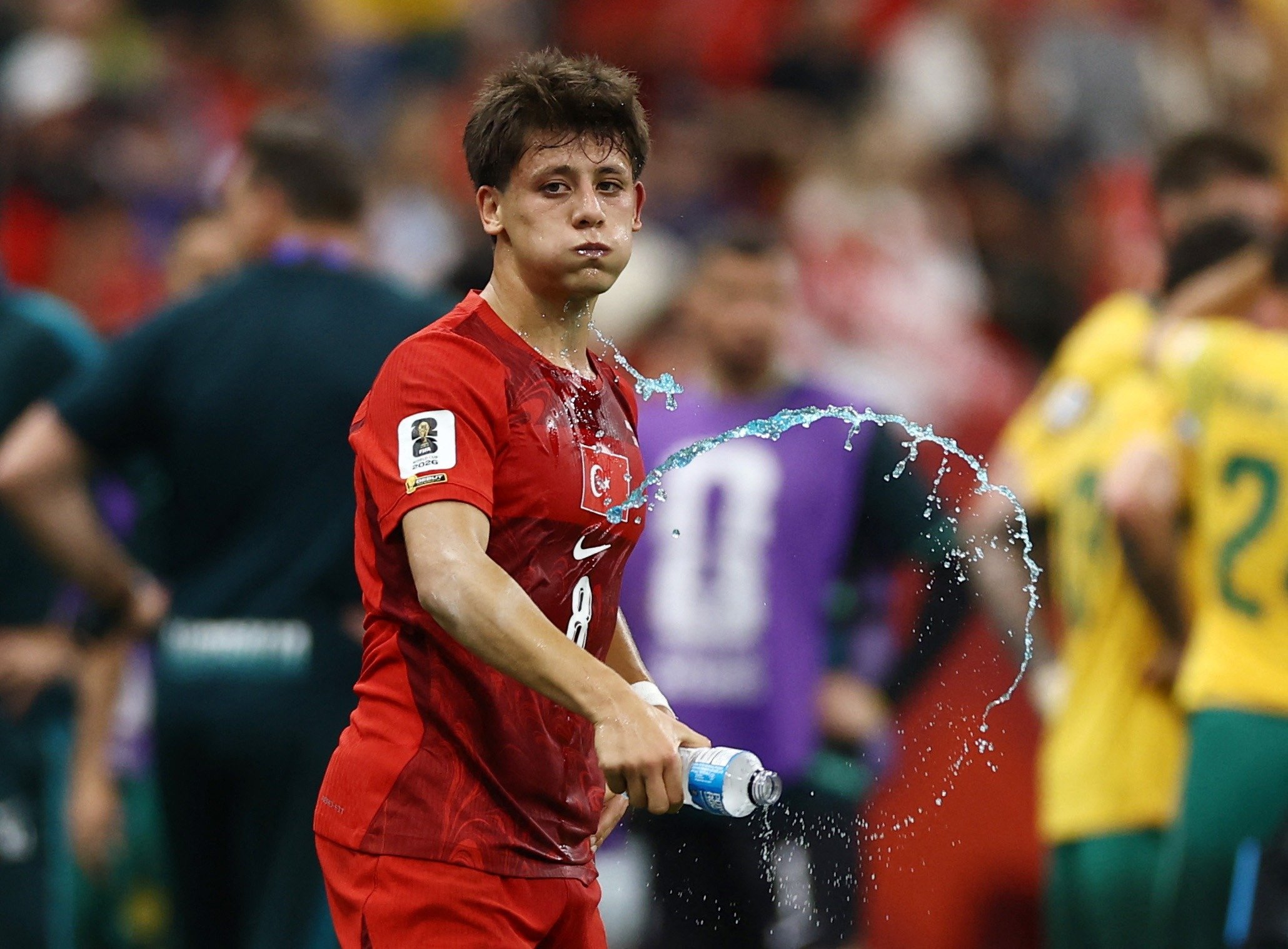
Fans gathering at outdoor viewing areas have been forced to seek shade wherever possible, relying on hats, umbrellas and cooling stations to escape the relentless summer sun.
Hotel prices surge
Accommodation costs have emerged as one of the biggest frustrations for traveling supporters.
In many host cities, hotel rates have doubled or even tripled during the tournament period. Budget travelers have found little relief, with average nightly rates at two- and three-star hotels frequently exceeding 300 euros ($340).
In major destinations such as New York, Miami, Dallas and Los Angeles, accommodation prices have reportedly risen by as much as 300% compared with normal periods.
Luxury hotels have become even less accessible, with many four- and five-star properties charging more than $500 per night. Short-term rental prices have also climbed sharply as demand continues to outstrip supply.
Expensive flights
Travel costs have also surged as fans move between the tournament’s 16 host cities.
For international visitors, the vast distances involved in a North American World Cup have created significant additional expenses.
Many participating nations are located thousands of miles from the host countries, resulting in longer journeys and higher airfare prices.
Domestic flights within the United States have also become considerably more expensive.
Industry estimates indicate increases ranging between 50 and 100% compared with last year, with routes into popular destinations such as Miami seeing some of the sharpest rises.
Ticket prices reach record levels
Nothing has sparked more criticism than the cost of match tickets.
Group-stage tickets at the 2026 World Cup average around $400, roughly five times higher than comparable prices at the 2022 tournament in Qatar, where group-stage tickets generally cost less than $100 and ranged between $11 and $220.
The increase becomes even more dramatic for marquee matches.
Opening-match tickets start at $560 and climb to $2,735, compared with a range of $55 to $618 in Qatar four years ago.
The final, scheduled for New York New Jersey Stadium, carries an even steeper premium. The cheapest ticket costs $2,030, while the most expensive reaches $6,370.
By comparison, tickets for the 2022 World Cup final ranged from $206 to $1,607.
Fans’ groups challenge FIFA
The growing frustration has attracted the attention of supporter organizations.
The Football Supporters Europe filed a complaint with the European Commission before the tournament, accusing FIFA of imposing excessive prices, unfair purchasing conditions and abusing its dominant position in the ticketing market.
The organization argued that access to World Cup tickets should be fair and transparent, particularly for supporters who may only have one opportunity in their lives to attend the tournament.
“A festival for the rich”
For fans hoping to follow their team throughout the competition, the numbers are staggering.
A supporter attending matches from the group stage through the final could spend more than $7,000 on tickets alone. Once flights and accommodation are added, the total cost can be several times higher than the expense of attending the 2022 World Cup in Qatar.
Many fans have responded with a common complaint.
“This is no longer football’s festival,” one supporter said. “It’s a festival for the rich.”
Even Donald Trump weighed in on the debate, expressing surprise at some ticket prices.
“More than $1,000 for a ticket,” Trump said. “I wouldn’t pay that.”

Protesters opposed to Ireland playing its Nations League matches against Israel disrupted Thursday’s 2-2 draw with Austria by throwing tennis balls bearing Palestinian flags onto the field.
Referee Allard Lindhout stopped play and sent the players for a hydration break after the balls landed on the pitch with Ireland leading 1-0 after 19 minutes.
“I think it kind of helped us at a good moment,” Ireland coach Heimir Hallgrimsson told broadcaster RTE. “We could have a breather and some drinks. But you’re never happy with this, but understand it and respect it.”
Troy Parrott had given Ireland the lead in the 12th minute with an impressive individual effort. Surrounded by three defenders, Parrott threaded the ball through one opponent’s legs, evaded two others and then fired it through the goalkeeper’s legs to score.
Play resumed after a four-minute interruption, but the match was briefly halted again when a man carrying a Palestinian flag ran onto the field before stewards stopped him.
Ireland ultimately surrendered its lead as Austria fought back for a 2-2 draw.
At halftime, RTE published a statement from the “Stop the Game” initiative claiming responsibility for the tennis ball action and declaring it over.
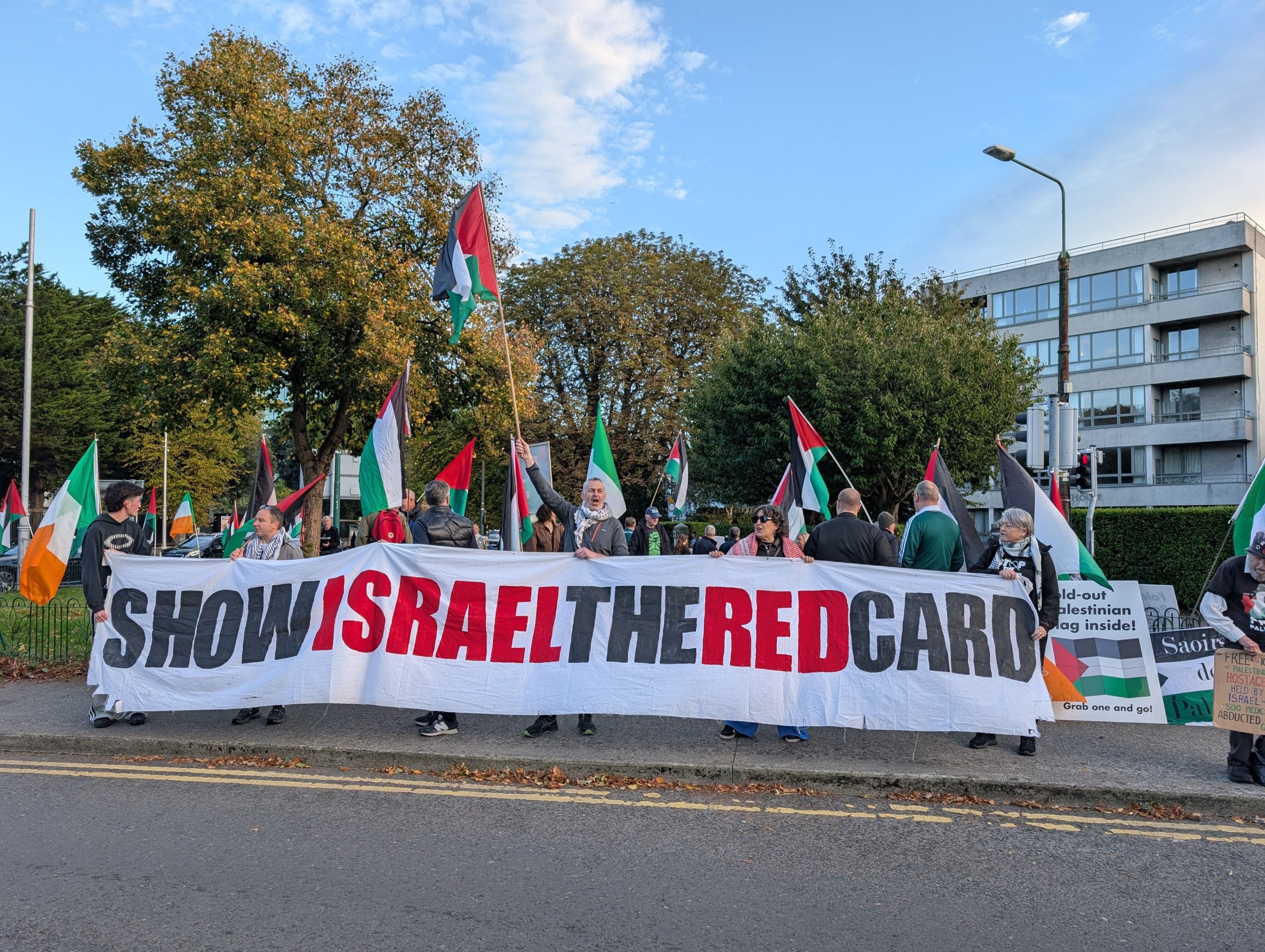
Members of the group had also gathered before the game to oppose Ireland’s matches against Israel because of Israel’s actions in Gaza. A small gathering displayed a Palestinian flag and banners in support of Ireland player Gavin Bazunu, who decided Saturday to boycott both of his team’s matches against Israel.
The Ireland-Palestine Solidarity Campaign also organized a protest outside the stadium, as well as others around the country.
They are calling for Ireland to boycott its remaining Nations League match against Israel, Ireland’s “home” game, although it is set to be played without fans in Bačka Topola, Serbia, on Sunday.
The Football Association of Ireland moved the game to a neutral venue for “operational reasons” in June following widespread calls for a boycott. It also followed the FAI’s own motion the previous November calling on UEFA to ban Israel from club and international competitions.
The “Stop the Game” initiative, which issued an open letter to the squad and Hallgrimsson on Wednesday asking them not to play Sunday’s match, has also asked the Irish government and FAI to cancel the game.
Ireland already played Israel’s “home” game in Debrecen, Hungary, last Sunday, when the Irish players wore black armbands and scored three first-half goals to win 3-0.
The players deliberated for hours Saturday on whether they should play at all after Bazunu informed the coach that morning that he wished to withdraw from both games.
FAI chief executive David Courell said the players voted and that “a significant majority” were in favor of playing. Widespread reports suggested the vote was 14-8 in favor, excluding Bazunu, who had already departed.
Bazunu, Ireland’s reserve goalkeeper, was back in the squad for Austria’s visit.
Finn Azaz, whose mother has Israeli heritage, started after being left out against Israel.
Parrott made it 2-0 before the break with a penalty, but Austria struck back in the second half through Alexander Prass and Michael Gregoritsch.
The Irish team has been coming under increasing pressure in Ireland, where affinity with Palestinians is strong, to boycott both games against Israel.
The FAI has resisted the calls, arguing that the team could face punishing sanctions from UEFA. Ireland is co-hosting the 2028 European Championship with England, Wales and Scotland.
Irish fans also threw tennis balls bearing Palestinian flags onto the field during Ireland’s friendly game against Qatar in Dublin in May.
Manchester City have lodged a comprehensive appeal against an independent commission’s finding that the club breached Premier League financial rules, extending a long-running case that could have major consequences for the club and English football.
City confirmed Friday that they submitted their appeal at 7:00 p.m. local time Thursday, one day before the deadline, challenging the commission’s findings and arguing that the ruling contains significant errors of law, principle and fact.
The club have consistently denied wrongdoing and said they remain confident in their case.
“Manchester City Football Club can confirm that at 7:00 pm (6:00 p.m. GMT) on Thursday 1st October 2026 the club lodged its comprehensive appeal against the opinion of the Premier League commission, in relation to the Premier League disciplinary matter,” City said in a statement.
“The club’s firm position is that, on multiple grounds, the opinion contains clear material errors of law, principle and fact and is unsafe.”
City added that they are “innocent of the accusations made by the Premier League” and said a “comprehensive body of irrefutable evidence” exists to support their position.
The appeal follows a Sept. 29 announcement by the Premier League that an independent commission had found City guilty of more than 100 breaches of financial rules over a nine-season period.
The commission found that City had arranged what it described as “sham” commercial contracts and agreements that misrepresented arrangements with sponsors and other partners.
According to the Premier League, the schemes artificially inflated the club’s revenues and reduced their reported costs by more than 900 million pounds ($1.2 billion) during the period under investigation.
City have disputed the findings and have now formally challenged the commission’s decision.
No immediate sporting punishment
No sporting sanction has been imposed on City following the verdict, meaning the club continue to compete while the disciplinary process moves into its next stage.
That has created an unusual situation in the Premier League. City remain at the top of the standings after opening the season with five victories, while the legal dispute hangs over the competition.
Enzo Maresca’s side have opened the season with five wins from five and will resume their title campaign against Liverpool on Oct. 11.
The uncertainty has raised questions about when any punishment could be imposed, whether the appeal will alter the commission’s findings and what effect the eventual outcome could have on league tables, prize money and European qualification.
Under Premier League rules, an appeal hearing should normally take place within 12 weeks of an appeal being lodged, with a decision expected within 30 days of the hearing concluding.
But the scale of the City case could make those deadlines difficult to meet. The index to the commission’s document bundle alone ran to 750 pages.
Sports lawyer Tom Keane, a partner at Brandsmiths, said the size of the case could leave uncertainty hanging over the Premier League for months.
“It’s just the unfortunate nature of these legal proceedings, the size of them, that it’s going to take time,” Keane said.
He questioned whether the appeal could be completed within the normal timetable and suggested the process could extend beyond the current season.
Keane also argued that the appeal should be completed before a separate sanctions hearing because the appeal could potentially change the underlying findings. He estimated that legal costs could already have reached tens of millions of pounds.
Potential fallout beyond City
The consequences could extend beyond City and the Premier League’s disciplinary process.
Rival clubs are understood to be examining whether they could pursue compensation claims if they can establish financial losses resulting from City’s alleged breaches. Potential claims could involve prize money, Champions League revenue and other commercial opportunities.
Any such action would create another layer of legal complexity because clubs would have to establish a direct connection between the commission’s findings and specific financial losses.
“The City case is almost now the easy part,” Keane said. “What happens next, with clubs who believe they missed out on prize money, commercial revenue or Champions League football, is where things could become really complicated.”
He also raised the possibility of legal action involving players and agents, although the precise scope of any such claims remains uncertain.
The Premier League have yet to announce sanctions against City, and any consequences remain dependent on the outcome of the appeal and subsequent disciplinary proceedings.
Government scrutiny
The fallout has also reached Westminster.
Meg Hillier, chair of the British Parliament’s Treasury Committee, wrote to HM Revenue and Customs seeking information about whether the tax authority was examining the commission’s findings and their potential tax implications.
Hillier asked whether HMRC had received the commission’s findings, whether it had sought an unredacted version of the report and what assessment it had made of possible tax consequences.
City’s principal sponsor, Etihad Airways, have also said they are seeking legal advice after rejecting findings concerning commercial arrangements referenced in the case.
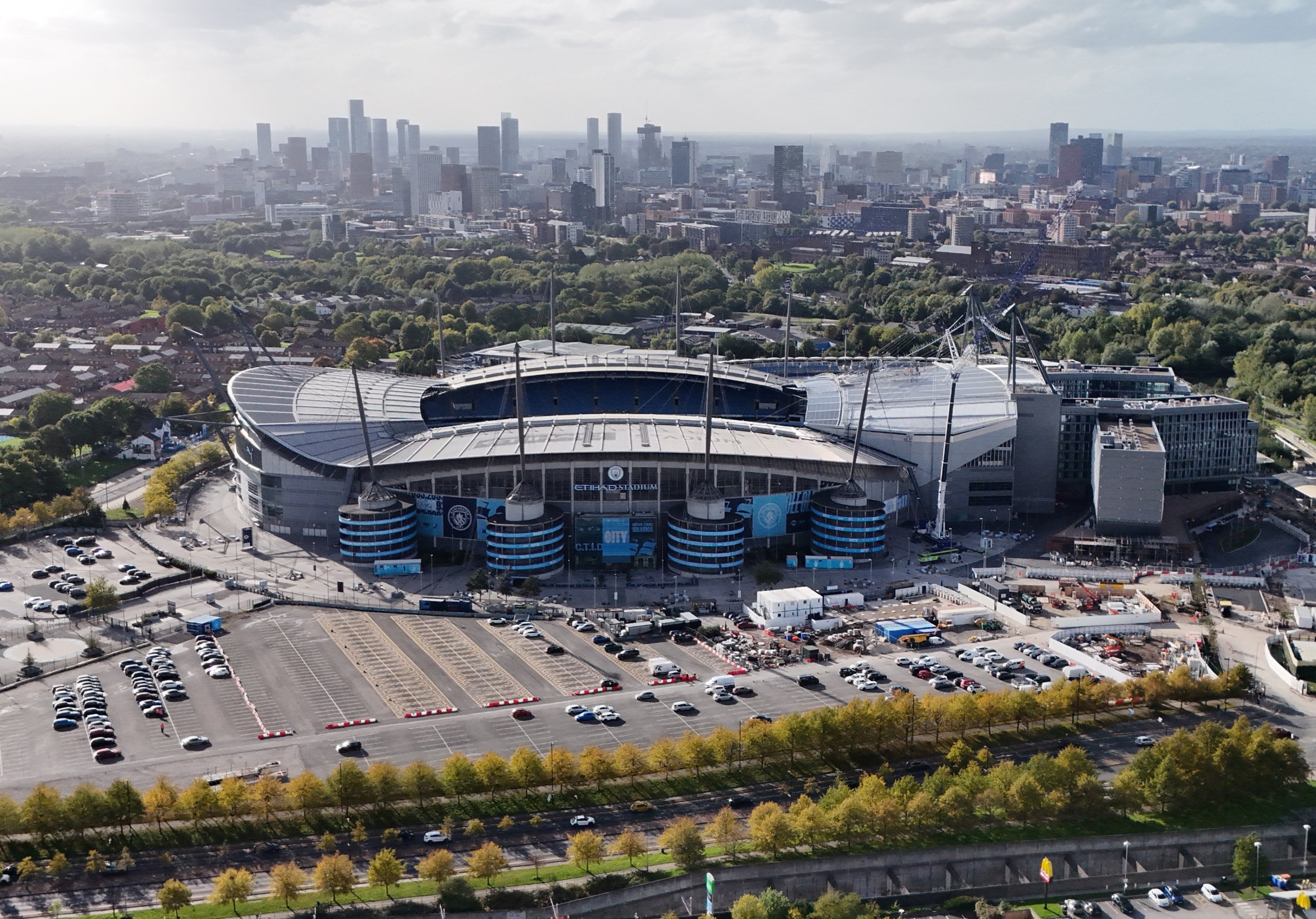
The dispute has meanwhile prompted political debate over City’s Abu Dhabi ownership.
British Prime Minister Andy Burnham, the former mayor of Greater Manchester, said he would be concerned if the case resulted in City’s Emirati owners leaving the club, pointing to their investment in Manchester.
Downing Street subsequently emphasized that City are not above the rules.
A No. 10 spokesperson said the initial judgment was serious and that “there can’t be any suggestion that anyone is above the rules.”
The spokesperson added that the independent process must be allowed to continue and that, where wrongdoing is established, those responsible should face the appropriate consequences.
A new chapter
The commission’s verdict followed a Premier League investigation into financial information covering nine seasons.
The findings have put renewed scrutiny on a period in which City developed into one of the dominant teams in English football, winning multiple Premier League titles and becoming a major force in European competition.
Their achievements remain unaffected on the field for now, but questions about the regulatory consequences are unlikely to disappear while the appeal is pending.
City’s decision to challenge the ruling means the central dispute is far from over.
The club insist the commission made fundamental mistakes and say they possess evidence capable of disproving the accusations.
The Premier League, meanwhile, stand behind the commission’s findings that City breached financial rules and failed to cooperate fully with the investigation.
UEFA is continuing its investigation into Barcelona in the long-running Negreira case after receiving a substantial dossier of documents from Real Madrid, adding another chapter to the bitter rivalry between the Spanish giants.
UEFA confirmed Thursday that its Ethics and Disciplinary Inspectors had received the material submitted by Real Madrid and would assess it as part of the investigation that has been ongoing since 2023.
“UEFA can confirm that it has received from Real Madrid CF a substantial amount of documents related to the ongoing investigation into FC Barcelona,” European football’s governing body said.
The documents concern Barcelona’s payments to companies linked to Jose Maria Enriquez Negreira, the former vice president of the Technical Committee of Referees of the Royal Spanish Football Federation.
UEFA stressed that the material would be considered within its existing investigation. Barcelona subsequently said the announcement did not represent the opening or reopening of a disciplinary case, noting that the original proceedings had never been closed.
The latest development follows months of renewed pressure from Real Madrid, which has repeatedly urged UEFA to examine the case and has submitted additional material to the governing body.
Madrid call for urgency
Real Madrid said its complaint contained extensive documentation and evidence concerning what it described as serious events that affected confidence in the refereeing system and the integrity of competition.
The club called on UEFA to proceed with the investigation with the “utmost urgency” and continue the process through to its conclusion.
“Once UEFA has this documentation, the investigation must proceed with the utmost urgency until its full conclusion,” Real Madrid said, adding that it would continue cooperating with the European governing body.
Spanish media have reported that the material runs to tens of thousands of pages, with AS reporting a dossier of about 50,000 pages. That figure has not been independently confirmed by UEFA in its statement.
Real Madrid has been involved in the Spanish proceedings as a private prosecutor and has maintained that the payments made by Barcelona to companies associated with Negreira warrant extensive scrutiny.
The club also submitted a written statement to UEFA in June, saying it had evidence it believed reinforced concerns about prolonged payments to Negreira.
Barcelona refute
Barcelona rejected descriptions of the latest development as the reopening of a UEFA investigation.
The club said UEFA had not opened new proceedings and that the investigation began in 2023 with the appointment of two inspectors. Barcelona said it had complied with their requests and that the inspectors would now determine what, if any, action should follow from Real Madrid’s documentation.
Barcelona also said it had not received any new request from UEFA or been formally presented with Real Madrid’s complaint as of Thursday.
The club reiterated that the UEFA process remains connected to the criminal proceedings in Spain and said it has continued to obtain UEFA licenses and participate in European competitions since the investigation began.
Barcelona has consistently denied wrongdoing, saying the payments were for technical services, including reports and advice concerning refereeing and players. The club has previously maintained that documentation exists to support the services it says were provided.
Back to 2023
UEFA appointed Ethics and Disciplinary Inspectors on March 23, 2023, to investigate a potential violation of its legal framework by Barcelona in connection with the Negreira case.
The case concerns payments made by Barcelona between 2001 and 2018 to companies linked to Negreira, who was a senior figure within Spain’s refereeing structure during much of that period.
The total value of the payments has been reported differently depending on which transactions and accounting periods are included, with figures generally cited at more than 7 million euros ($7.9 million) and around 8.4 million euros.
Barcelona has said the payments were connected to legitimate consultancy and refereeing-related services. Prosecutors and critics have questioned why a club maintained such a long-running financial relationship with a person who held a senior position within Spain’s refereeing system.
UEFA’s investigation was already active when Barcelona entered the 2023-24 Champions League. The club was provisionally admitted to UEFA competitions while the inspectors were instructed to continue and finalize their work.
The European governing body has yet to announce a disciplinary decision against Barcelona in the case.
Spanish case remains separate
The UEFA process is running alongside the criminal investigation in Spain, where the Negreira case has remained in the evidence-gathering phase.
A Spanish court rejected an initial bribery allegation in 2024 after determining that Negreira did not meet the legal definition of a public official required for that charge. Other potential offenses connected to the case have continued to be examined.
The central dispute remains whether Barcelona’s payments represented legitimate refereeing consultancy or were connected to an improper effort to influence the refereeing system.
No court has established that Barcelona fixed matches as a result of the payments.
Cristiano Ronaldo left Portugal’s training camp on Wednesday, hours after coach Jorge Jesus said the veteran forward would not start Thursday’s Nations League game against Denmark.
The 41-year-old Ronaldo said he would reveal the reasons for his departure “in time,” promising to tell the Portuguese public “the truth about the reasons” behind his decision.
“Following the national team coach’s news conference, and after a conversation with the president of the Portuguese football federation, I decided to leave the national team’s training camp,” Ronaldo said in an Instagram post, adding that he had always “dedicated” himself to the national team.
“Now is the time to wish good luck to Portugal and to all my teammates, without exception,” he added.
The Portuguese Football Federation confirmed that Ronaldo had left the training camp but provided no further details. It said preparations for the Denmark match would continue with the remaining 24 players in the squad.
“The entire delegation remains fully focused on the national team’s upcoming fixtures and on achieving our goals,” the federation said.
Jesus said at the pregame news conference that he was not planning to start Ronaldo but dismissed the notion that there was a feud between the pair.
Jesus said every player knows the coach makes the decisions and that Ronaldo told him he would abide by whatever choices he made.
The coach added that the “rules are the same for everyone” and that Gonçalo Ramos would start up front against Denmark if everything went to plan.
“I don’t know what’s going to happen in the game,” Jesus said. “If we need him to play at some point, he’ll play. If not, he won’t.”
Ronaldo, the all-time leading scorer in men’s international football with 146 goals and pursuing the milestone of 1,000 career goals, did not play Sunday in Portugal’s 2-1 win over Norway. He has not trained with the rest of the group since, sparking widespread rumors about a possible feud with Jesus.
Jesus had said Al-Nassr forward Ronaldo would train normally with the rest of the squad on Wednesday, but the player left the training camp after the coach’s news conference.
Ronaldo, who has 979 career goals, said recently that this Saudi Pro League season is likely to be the last of his professional career.
Earlier this year, he said the 2026 World Cup would be the last of his career but did not specify when he would stop playing for Portugal.
Jesus, who worked with Ronaldo for about a year in Saudi Arabia, said the player did not refuse to train after being left on the bench against Norway.
“It seems like there was an issue between us, but there was no issue,” Jesus said. “I’m the one who makes the decisions and everybody knows that.”
Jesus acknowledged that he had told Ronaldo he would likely play against Norway but changed his mind because of the circumstances of the match.
He said it was a mistake to send Ronaldo to warm up for as long as he did and then not use him. Jesus added that “any player” would be upset about that.
But Jesus did not apologize for telling Ronaldo that he was likely to play.
“I can promise whatever I want, I’m the coach,” Jesus said. “No player will ever make a decision for me.”
Jesus said, though, that someone with Ronaldo’s stature deserved a different type of attention from coaches “because of his career and history in football.”
Jesus, who took over the squad from Roberto Martínez after the World Cup, said he ended up being “obligated” to have a meeting with Ronaldo because of the noise created in Portugal over the situation.
But he maintained there was no “Ronaldo case” to talk about and nothing to resolve between him and the player because nothing was wrong.
Jesus said it was normal that federation president Pedro Proença also met with the pair.
“We had to talk, the three of us, but I had already talked with Chris and the president didn’t have to solve anything because there was nothing to solve,” Jesus said.
Ronaldo started Portugal’s 1-0 win over Wales last Thursday but was substituted in the 67th minute. On Tuesday, he posted a photo on Instagram of himself wearing the national team kit, accompanied by the country’s flag and a heart emoji.
Portugal leads Group A4 of the Nations League with six points from two matches, three points ahead of Denmark and Norway. Wales is last with no points.
Portugal also hosts Norway on Sunday.
It was not immediately clear whether Ronaldo’s departure would extend beyond the current international break.
Wednesday’s news comes just as Ronaldo’s longtime rival, Lionel Messi, is set for his farewell match with Argentina next week.
Konyaspor and the Palestine national team drew 2-2 Wednesday in a friendly match in Konya that carried significance far beyond the scoreline, with tributes to Palestinians killed during the conflict and a symbolic early ending at 89 minutes, 59 seconds.
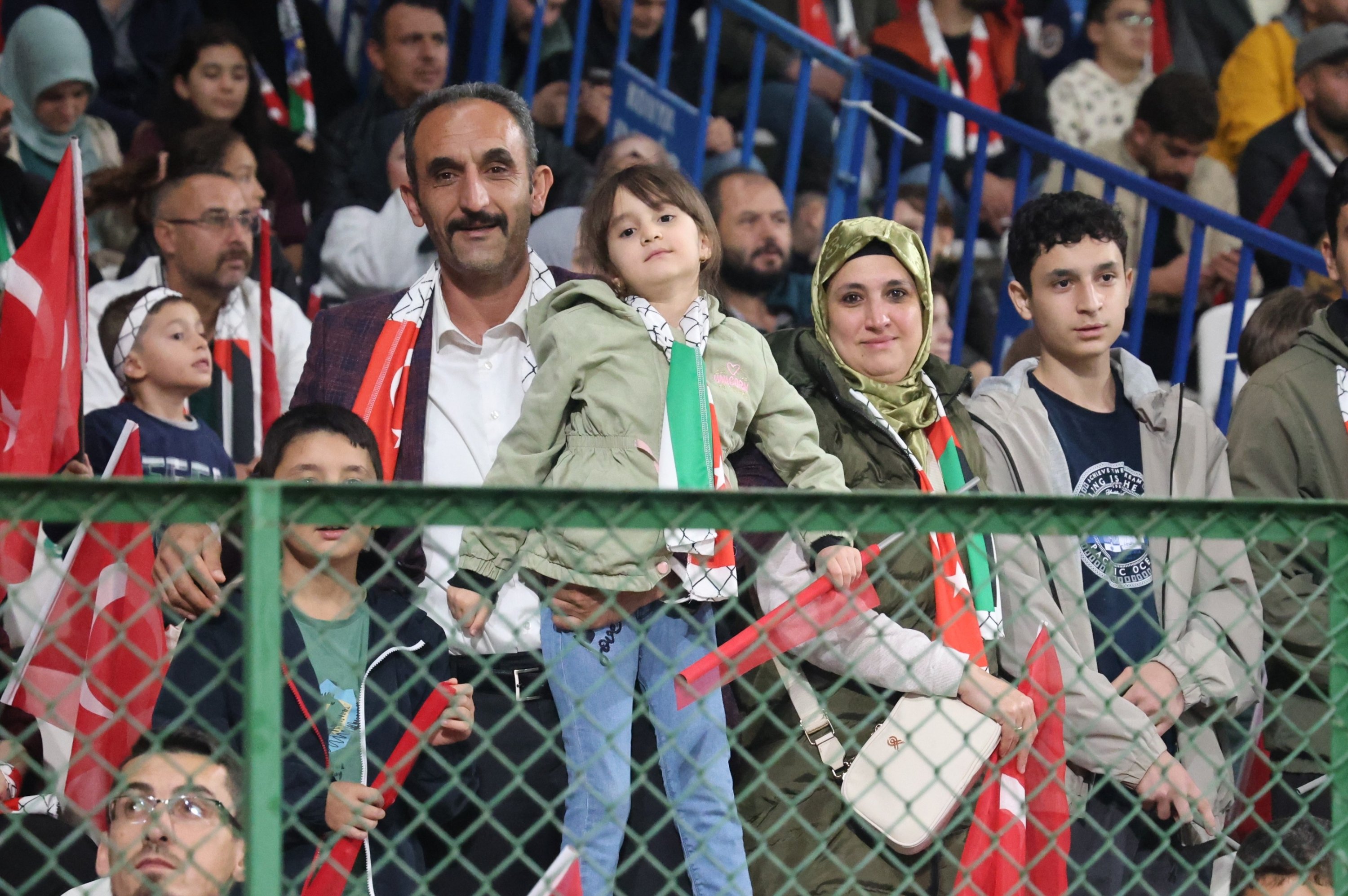
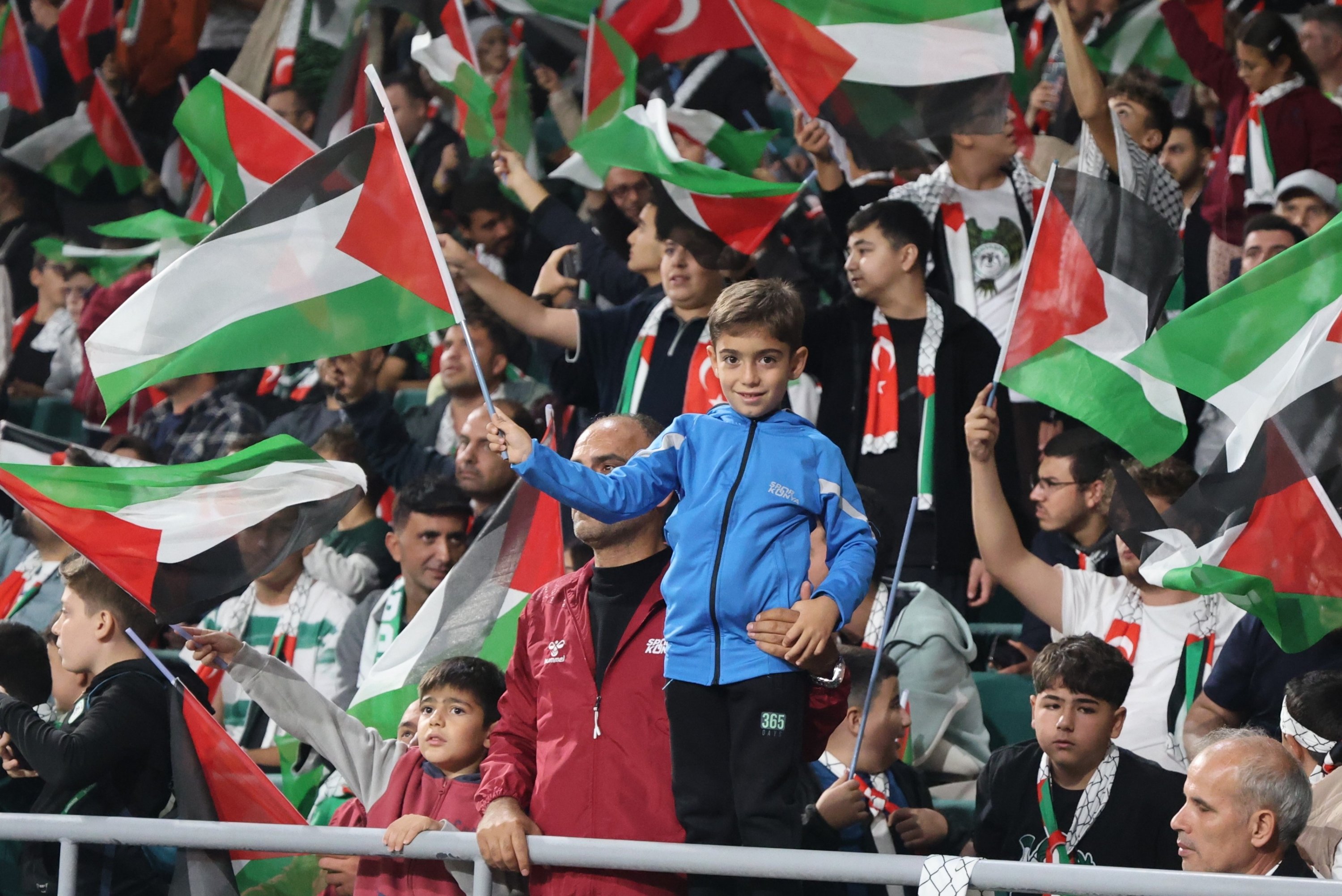
The match at MEDAŞ Konya Büyükşehir Stadium was played as part of Palestine Day events in Konya, with Konyaspor fans filling the stands and displaying messages of solidarity with the Palestinian people.
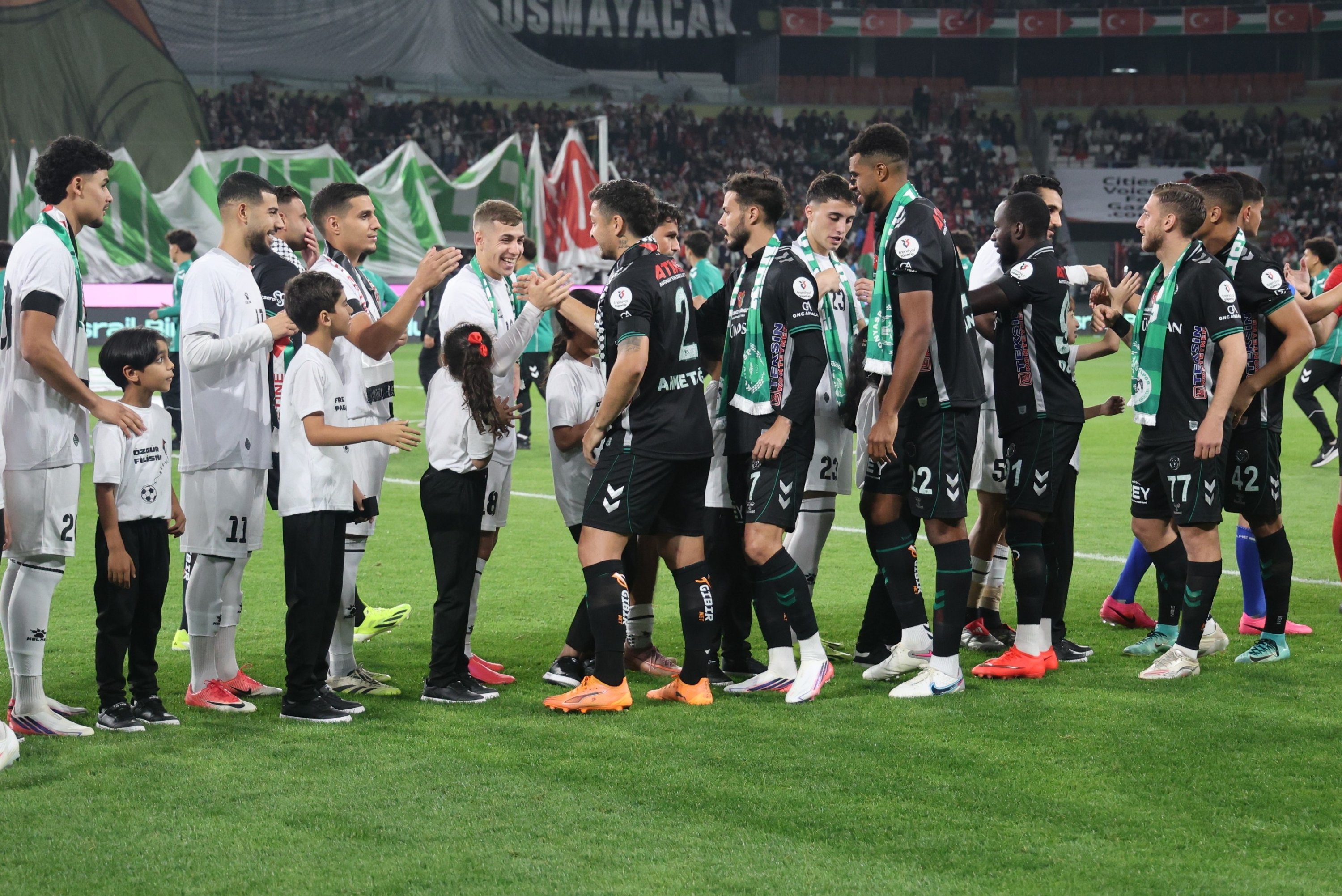
The home team took the lead in the second minute through Melih İbrahimoğlu, but Palestine forward Mohammed Sandouqa quickly turned the match around with goals in the 12th and 25th minutes.
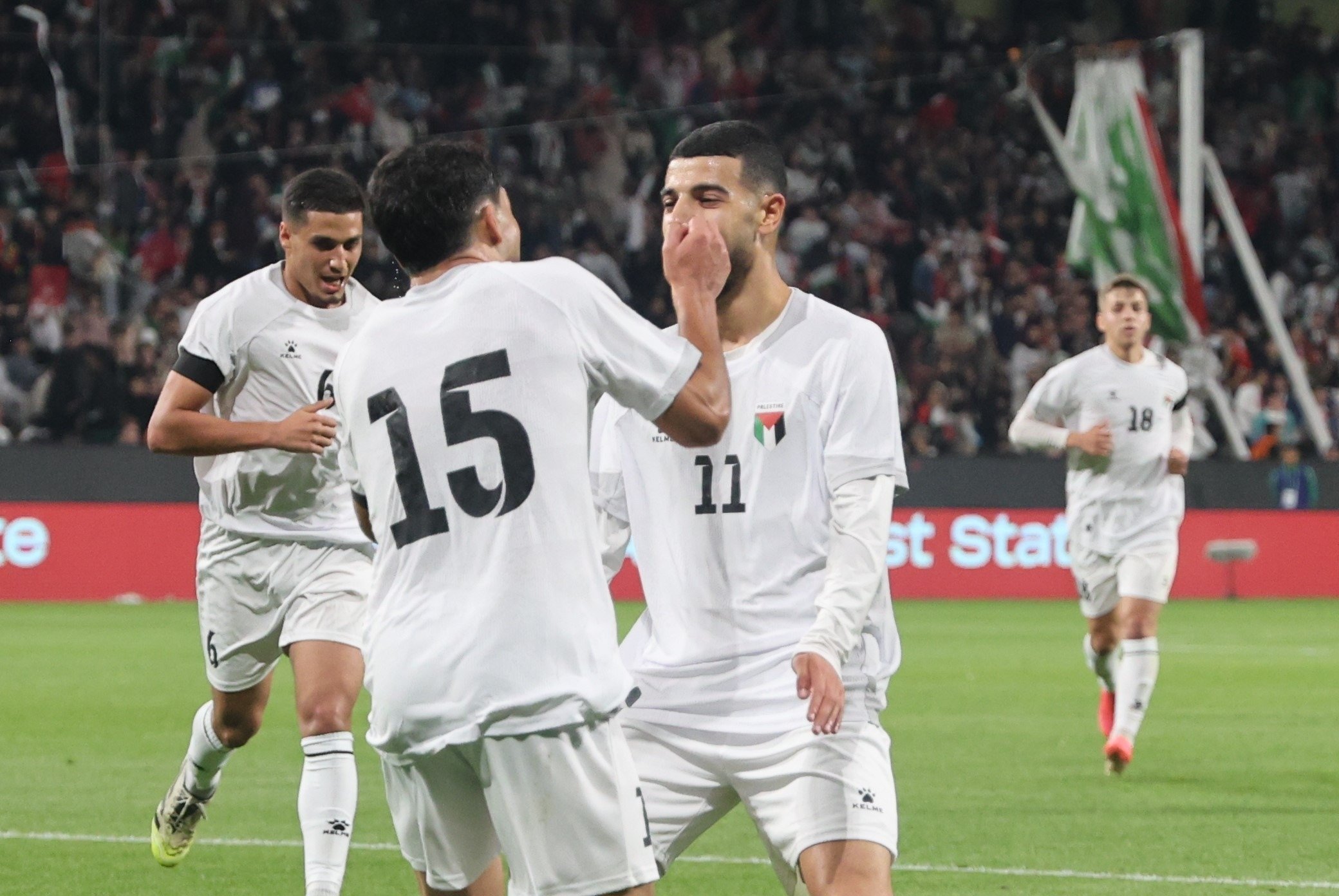
Mustafa Muhammed restored parity for Konyaspor in the 28th minute, leaving the teams level at halftime. Neither side could find a winner in the second half.
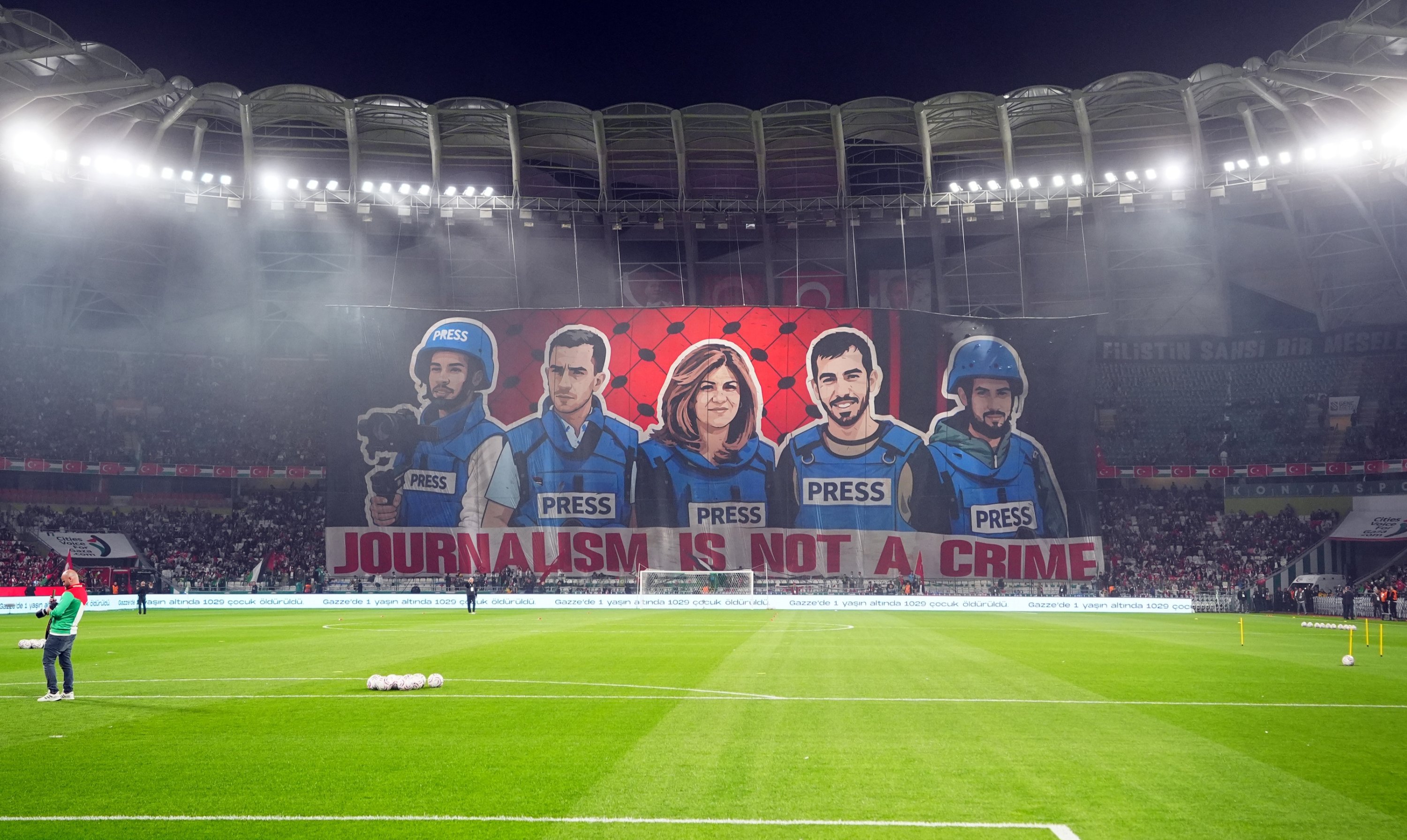
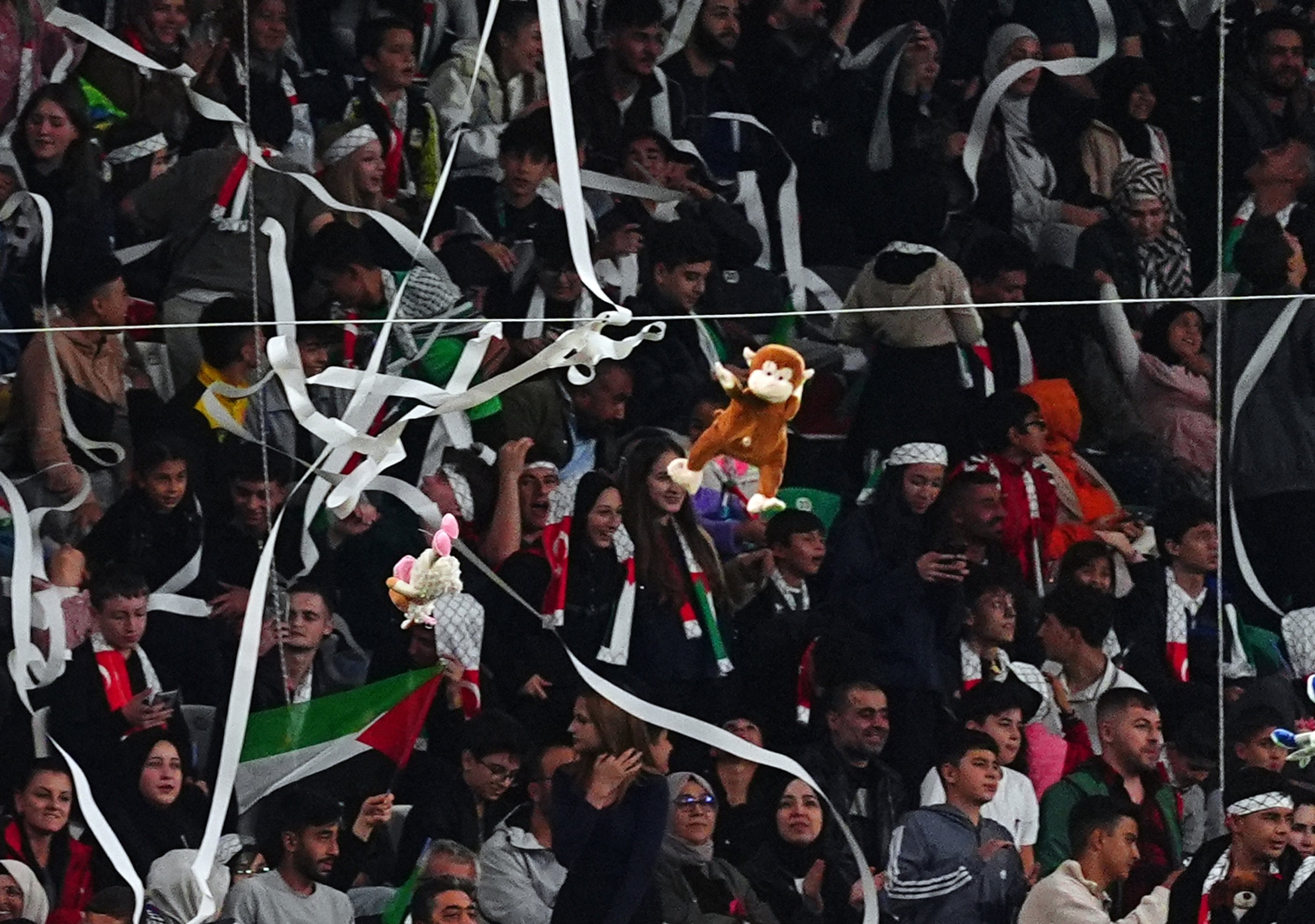
The match was interrupted around the 10th minute, when the stadium lights were turned off and a video showing the names of children killed in Israeli attacks since Oct. 7, 2023, was shown on the stadium screens.
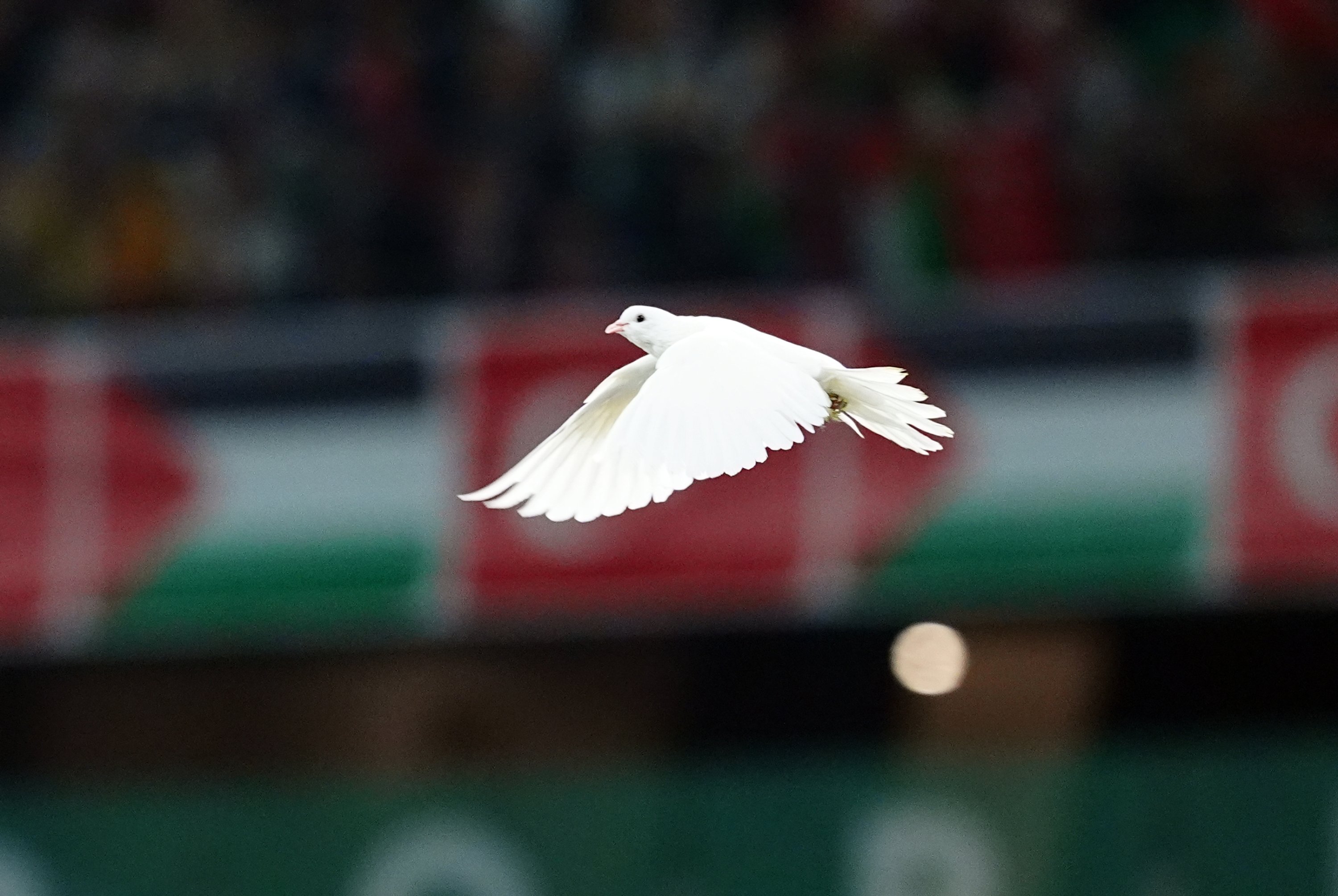
Fans applauded both teams and some threw stuffed toys onto the field during the tribute. The stadium also featured messages in Turkish and English expressing solidarity with Palestine and drawing attention to the humanitarian situation in Gaza.
Konyaspor supporters prepared a large choreography before kickoff that read, “When children are sleeping, be silent, not when they are dying.”
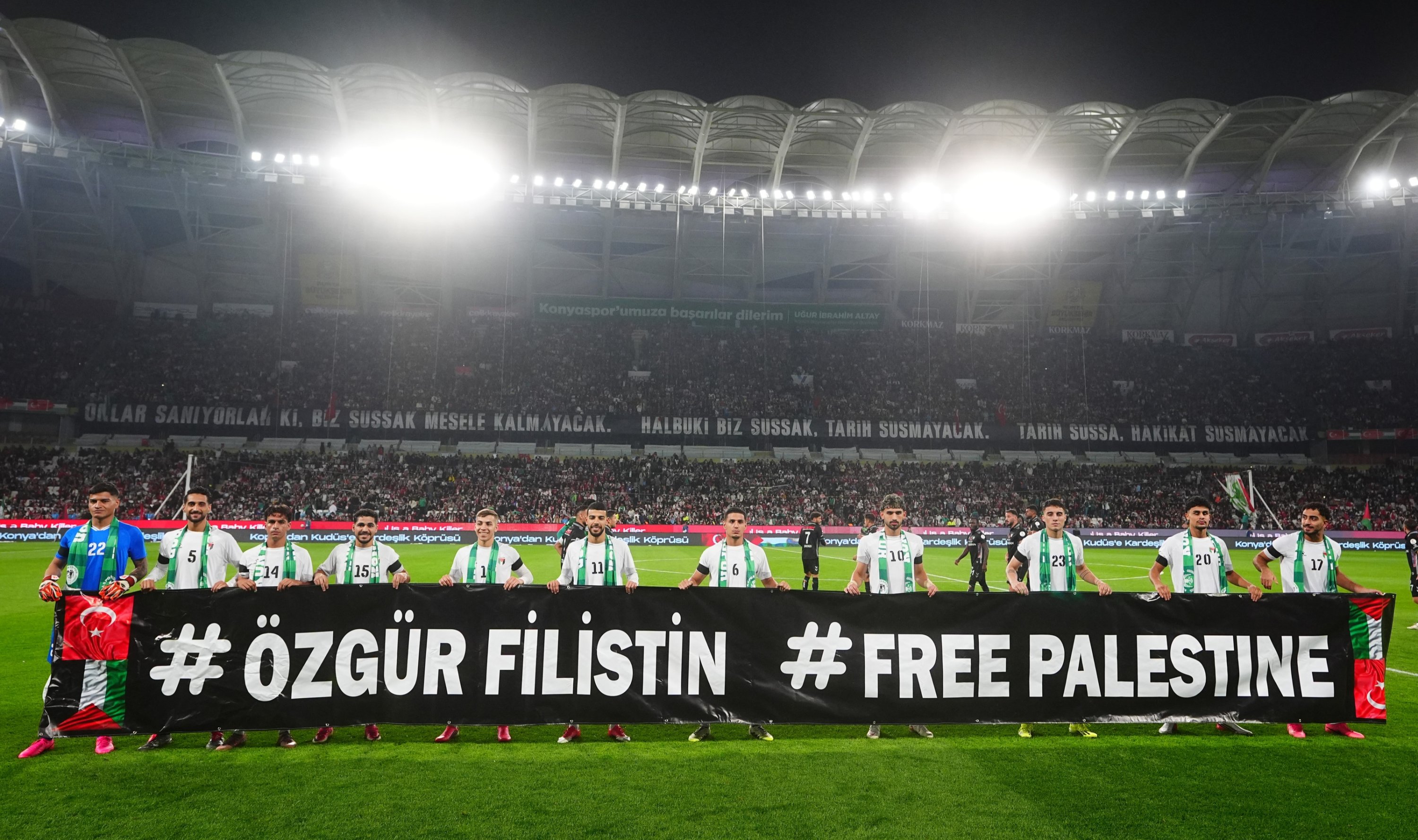
The match also included a tribute to members of the Palestinian sports community who, according to figures cited during the event, have been killed since the start of the conflict. At the 10-minute, 14-second mark, the stadium lights were again turned off as part of the commemoration.
The most symbolic moment came at the end.
With the clock approaching the 90th minute, an announcement declared that the match was being ended at 89:59 as a reference to unfinished lives and hopes in Palestine.
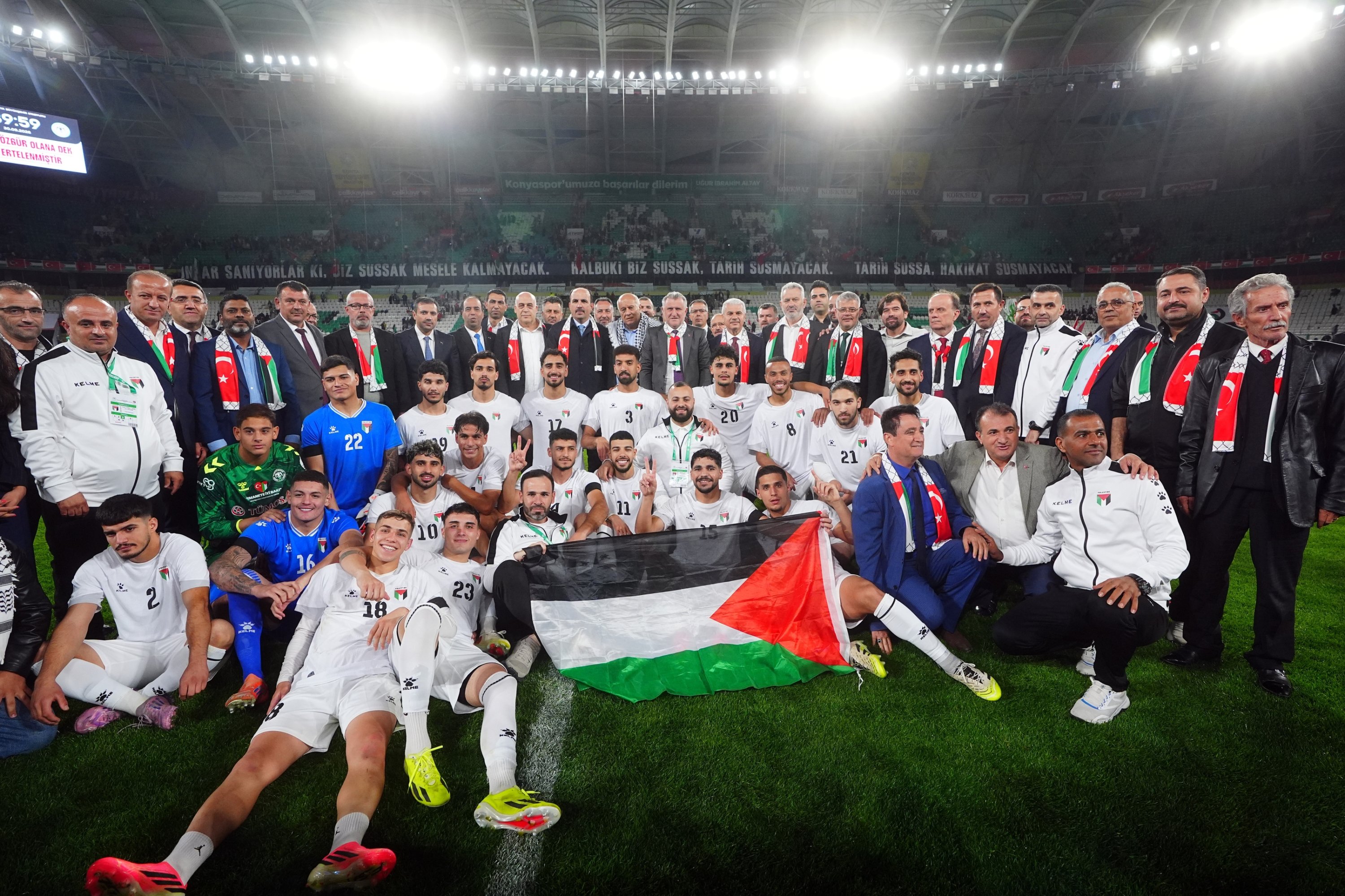
“Until Palestine is free, the match has been postponed,” the announcement said, explaining that the game would not complete its full 90 minutes as a reminder of lives, dreams and childhoods left unfinished.
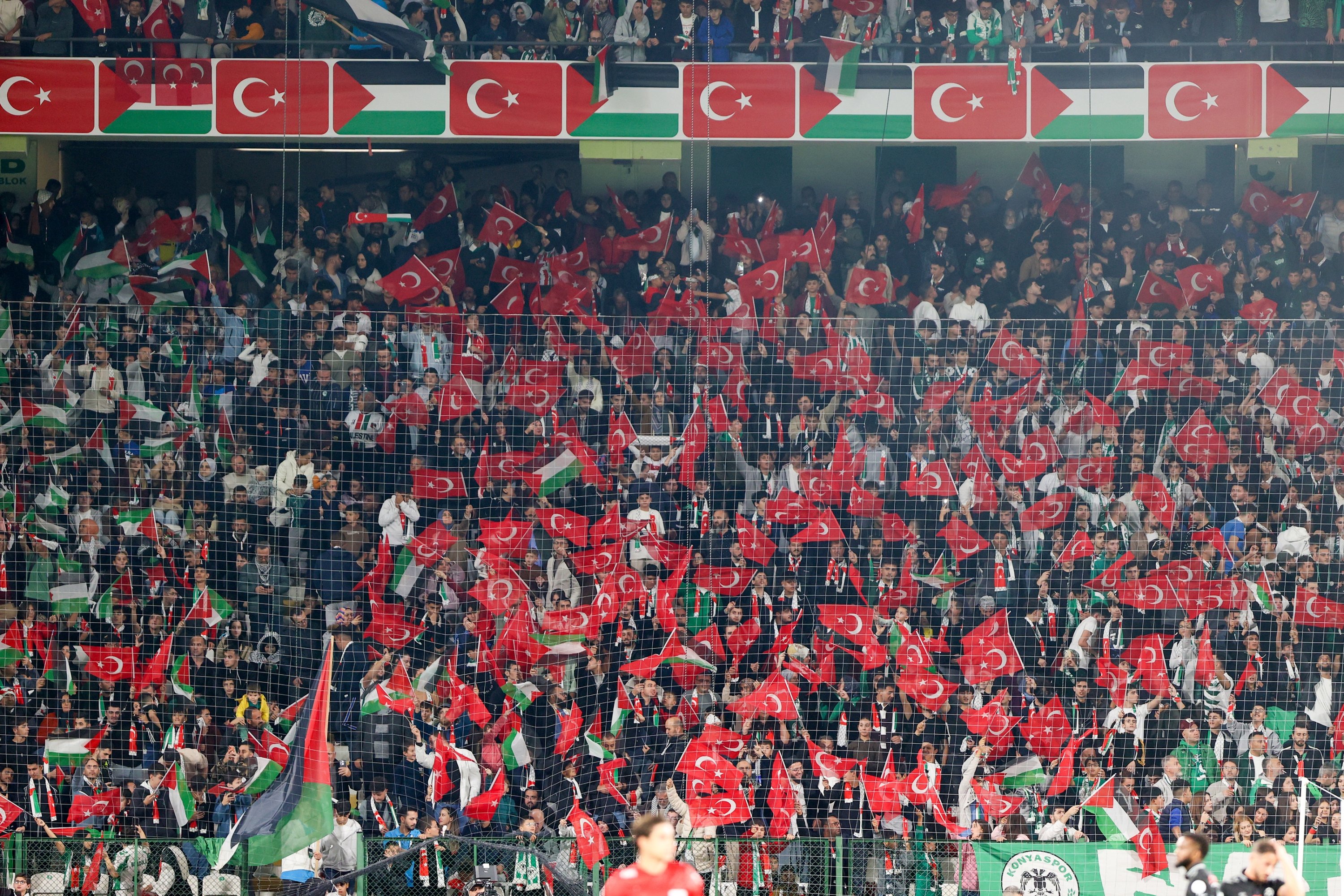
The final whistle brought an emotional response from the Palestinian players and the crowd.
Türkiye’s Youth and Sports Minister Osman Aşkın Bak, Konya Gov. Ibrahim Akın, Konya Mayor Uğur Ibrahim Altay and other officials met the Palestine players on the field and presented them with flowers. Some Palestinian players were visibly emotional as they received the reception.
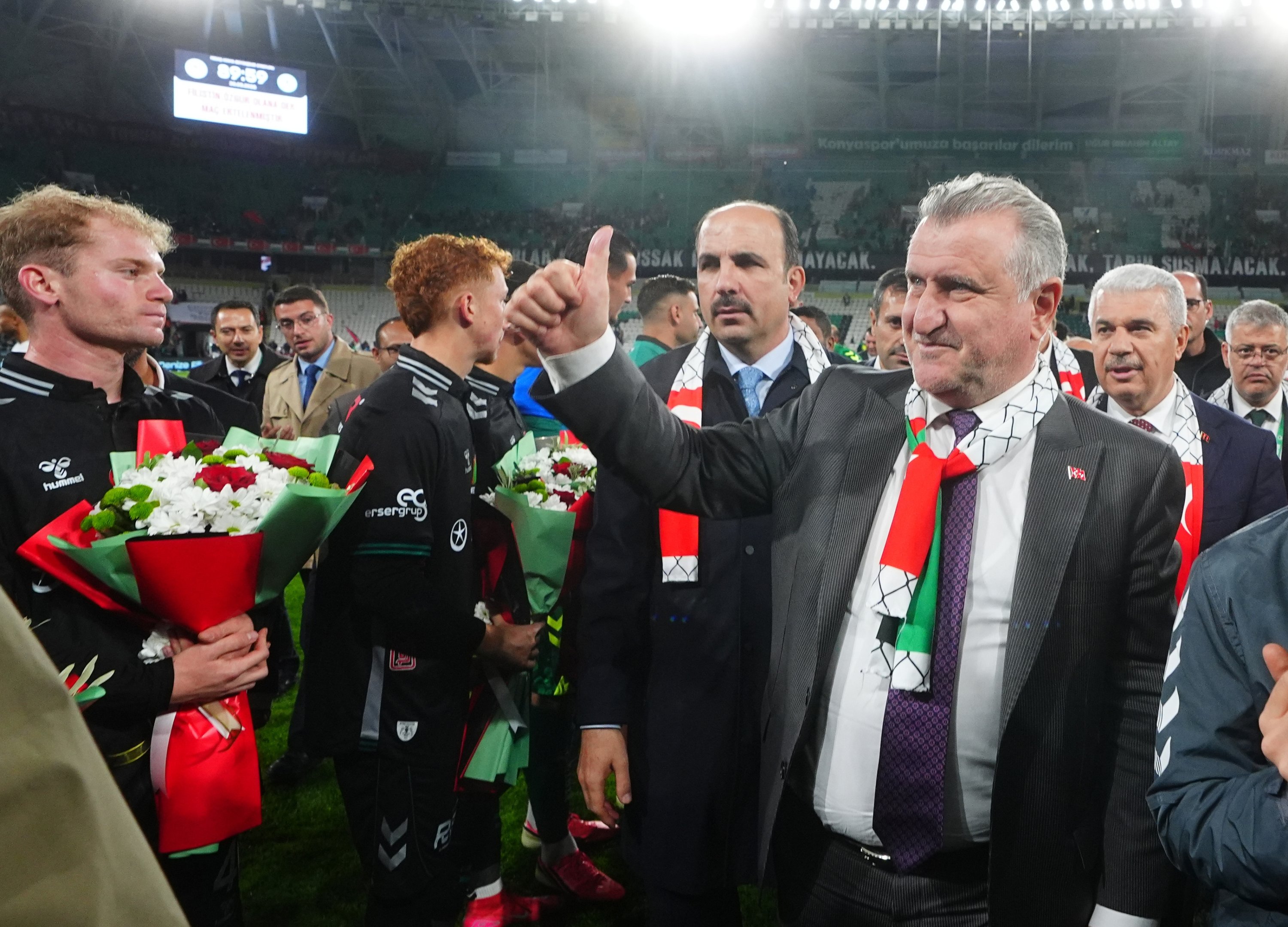
Palestine coach Ibrahim Halil said the team experienced powerful emotions during the visit to Konya and expressed gratitude for the support shown by the Turkish public.
“The Palestine cause is for honorable people,” Halil said. “We will continue our struggle until Palestine gains its freedom.”
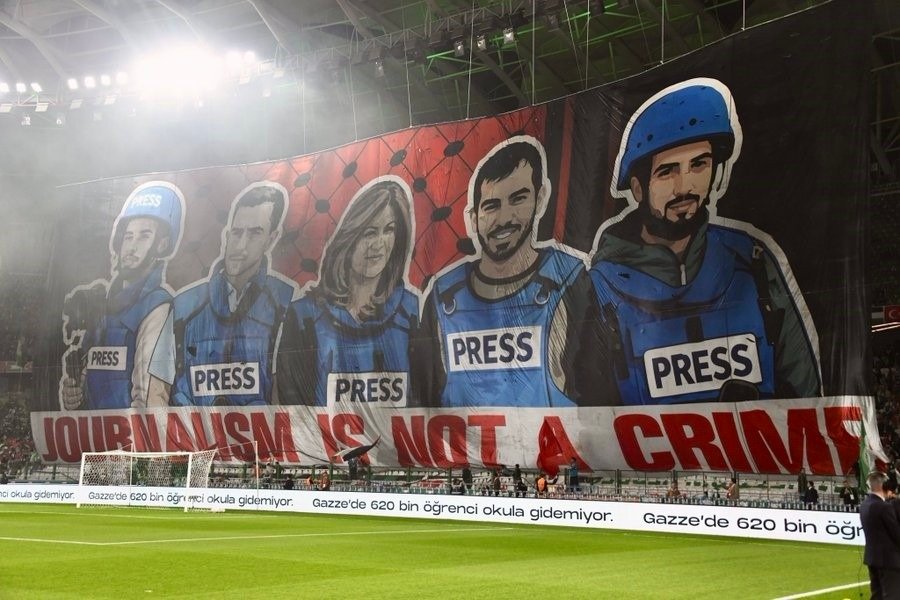
Halil also praised the atmosphere inside the stadium and said the reception in Konya had made the Palestinian delegation feel proud and welcomed.
Konyaspor coach İlhan Palut said the match represented much more than a football game and praised the Palestinian players for continuing to train, prepare for matches and pursue their sporting ambitions despite the circumstances facing their country.
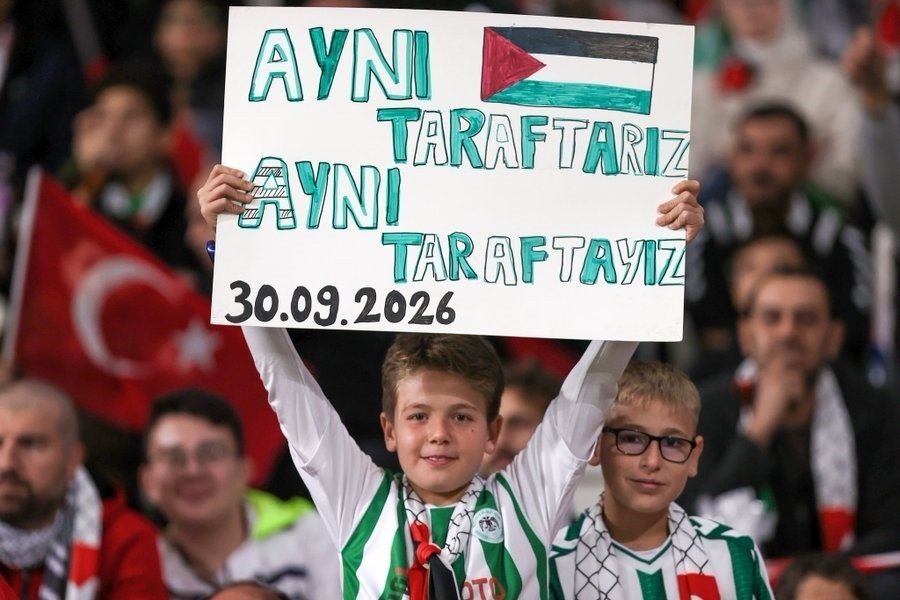
“It is a great achievement for them to be able to function as a football team, train, prepare for matches and attend camps while living through this process,” Palut said.
Palut also highlighted the response of Konyaspor supporters when Palestine scored.
“The excitement that began with the development of the attack and the genuine celebration after the goal were, in my opinion, the most meaningful seconds of the day,” he said.
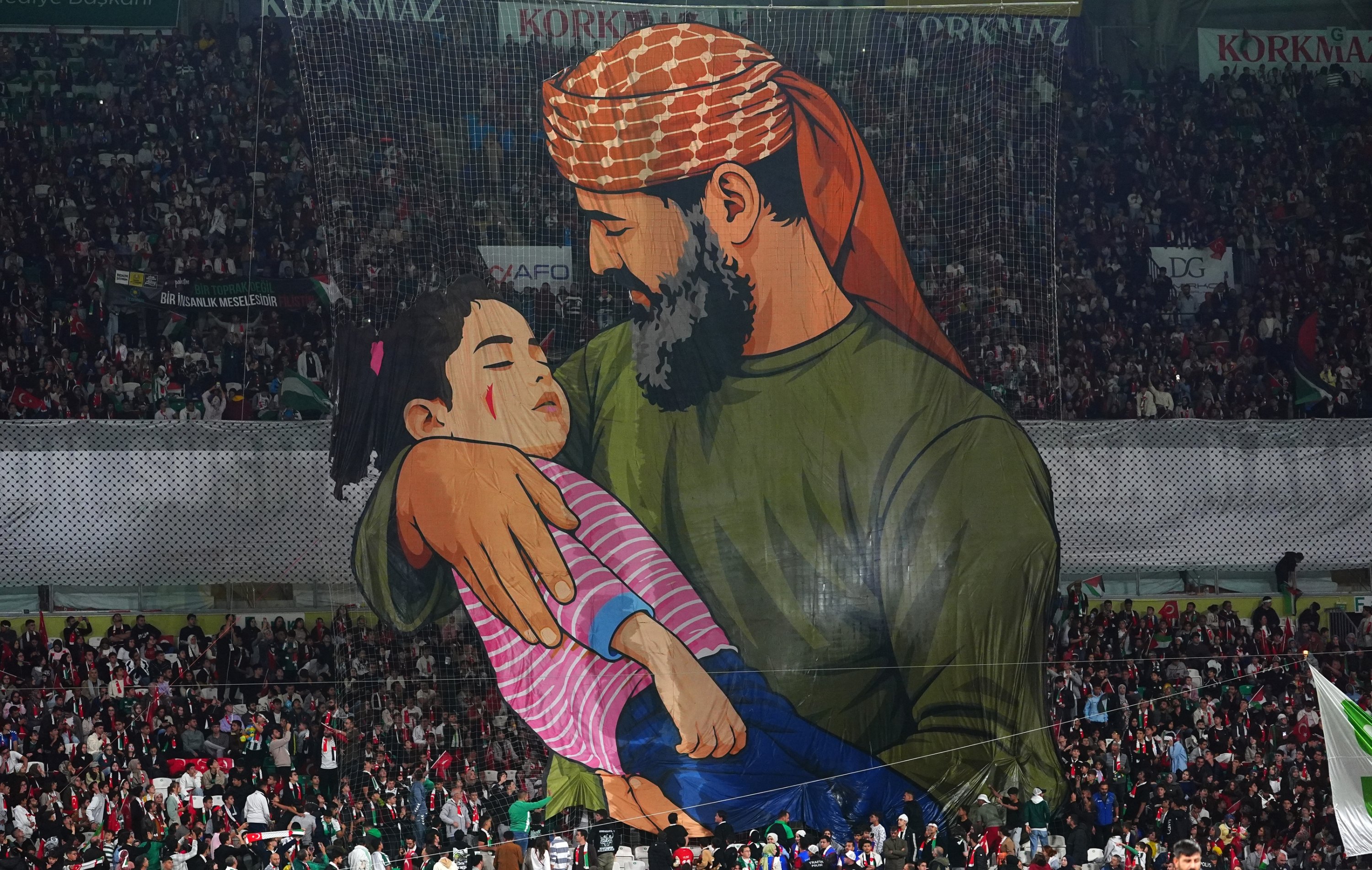
The match brought together a Konyaspor lineup featuring Bahadır Güngördü, Ahmet Oğuz, Rayyan Baniya, Chidozie Awaziem, Arif Boşluk, Melih İbrahimoğlu, Ömer Çobanoğlu, Deniz Türüç, Pedrinho Gonçalves, Louka Prip and Mustafa Muhammed.
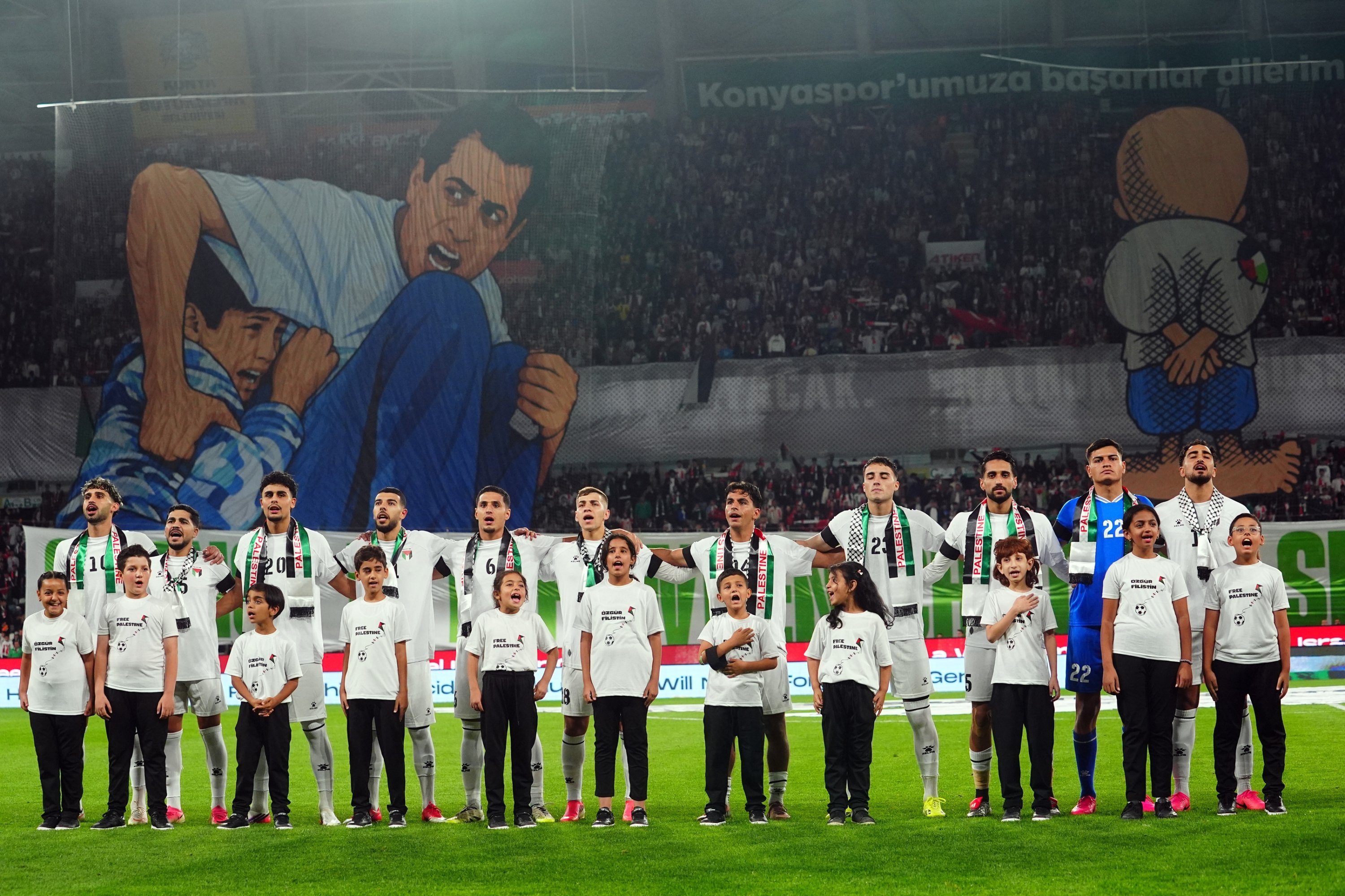
Palestine started with Martin Antonio Aras, Ali Rabei, Tareq Basem Mohammad Awawda, Omar Ali Tawfiq Badarneh, Mohammed Hasn Rajab Sandouqa, Samer Mustafa Ramdan Zubayda, Omar Mahmoud Araft Hasanan, Anas Khairaldin Mohammed Baniowda, Bakir Mahmoud, Tamer Amin Ibsais and Machur Ivan Yunes.
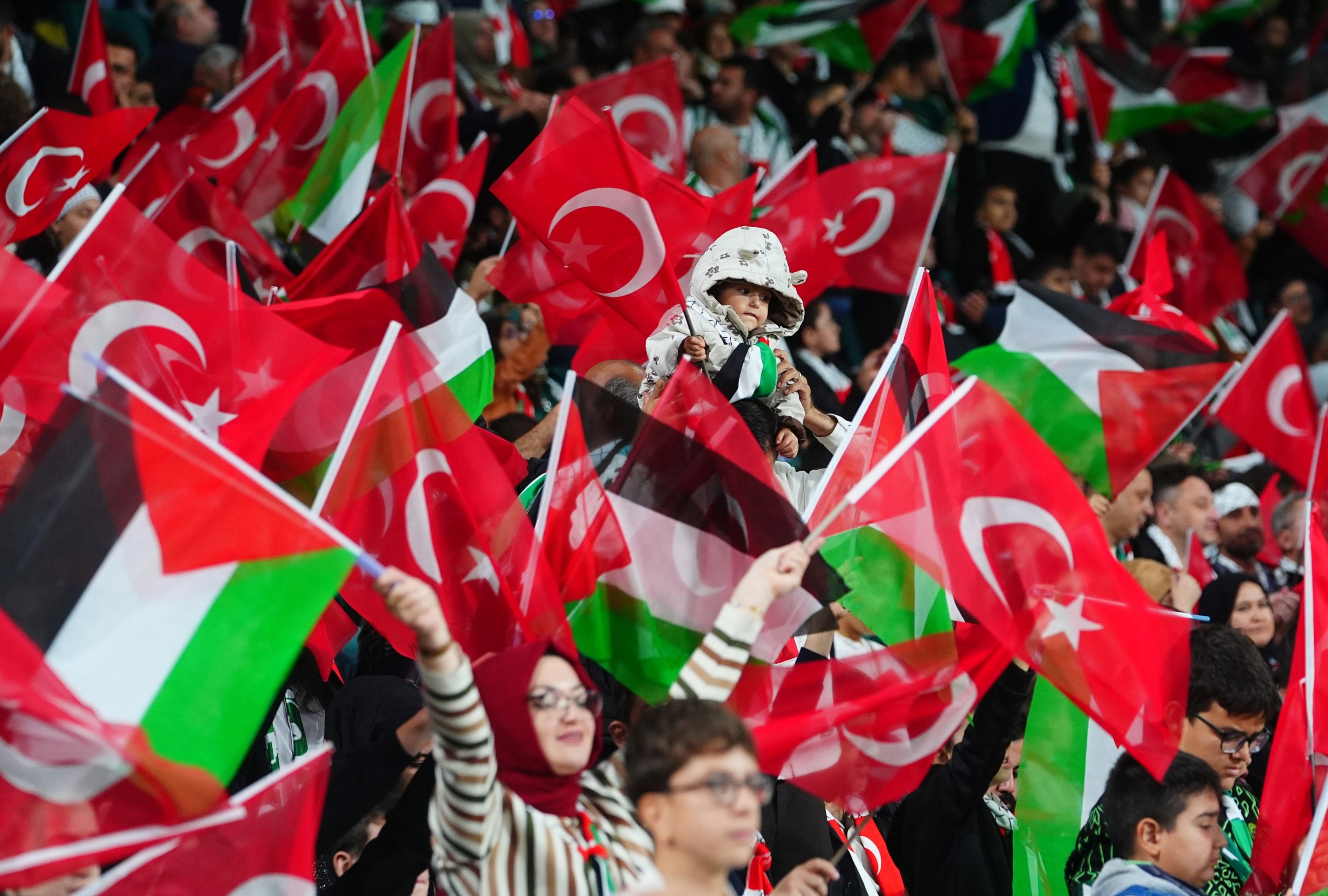
Presidential Communications Director Burhanettin Duran also described the match as an example of sport bringing people together around a shared sense of solidarity.
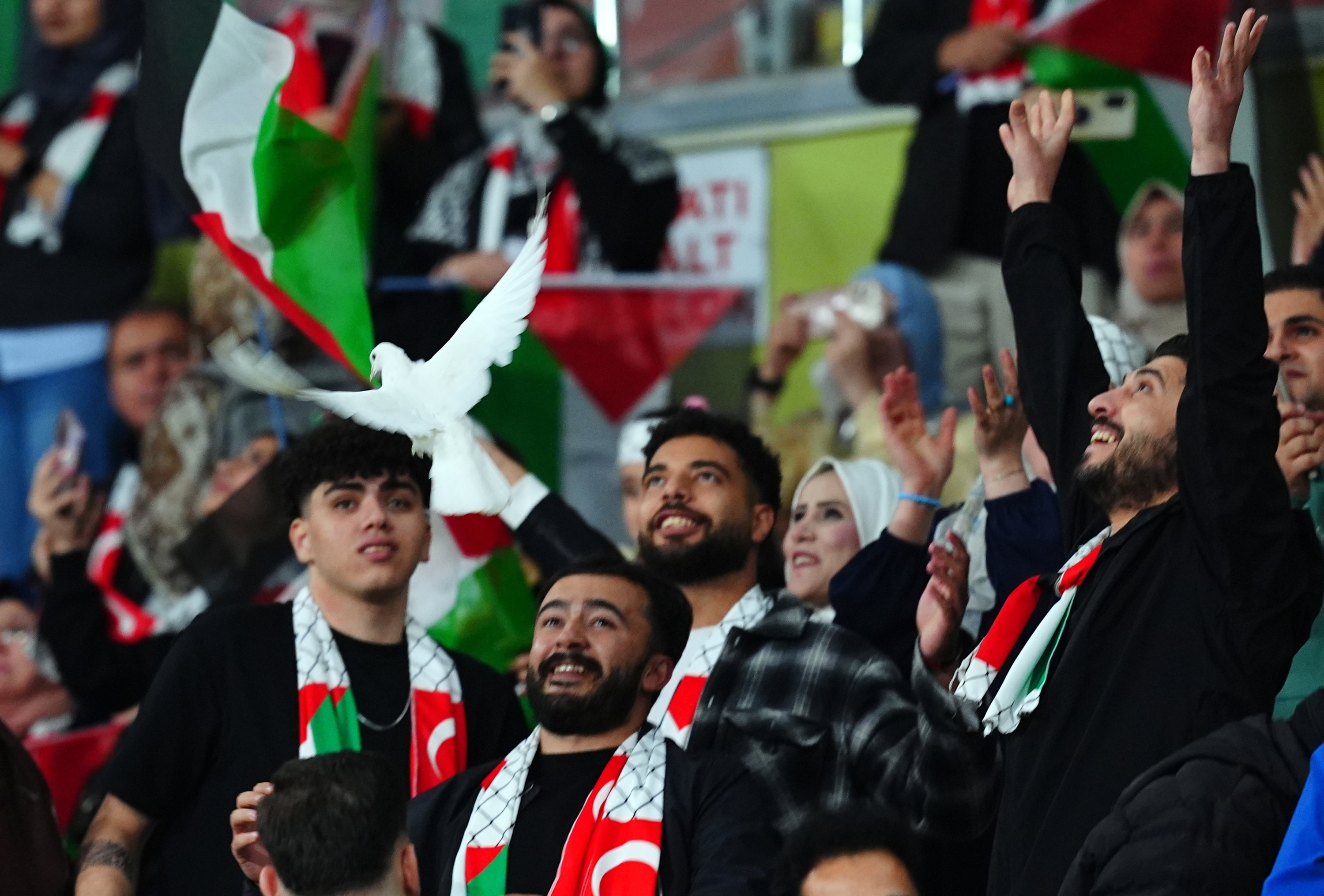
Duran said the event showed that the occasion in Konya was about more than football and that the gathering represented a gesture of friendship and support for the Palestinian people.
Türkiye will look to end a difficult start to their UEFA Nations League campaign when they face Belgium away on Friday in their third Group 1 match in League A.
The match at Maurice Dufrasne Stadium in Liege kicks off at 9:45 p.m. Türkiye time.
The other Group 1 match will see France host Italy in Paris at the same time.
France lead the group with six points after winning their opening two matches, while Belgium and Italy have three points each. Türkiye are bottom without a point after defeats to both France and Italy.
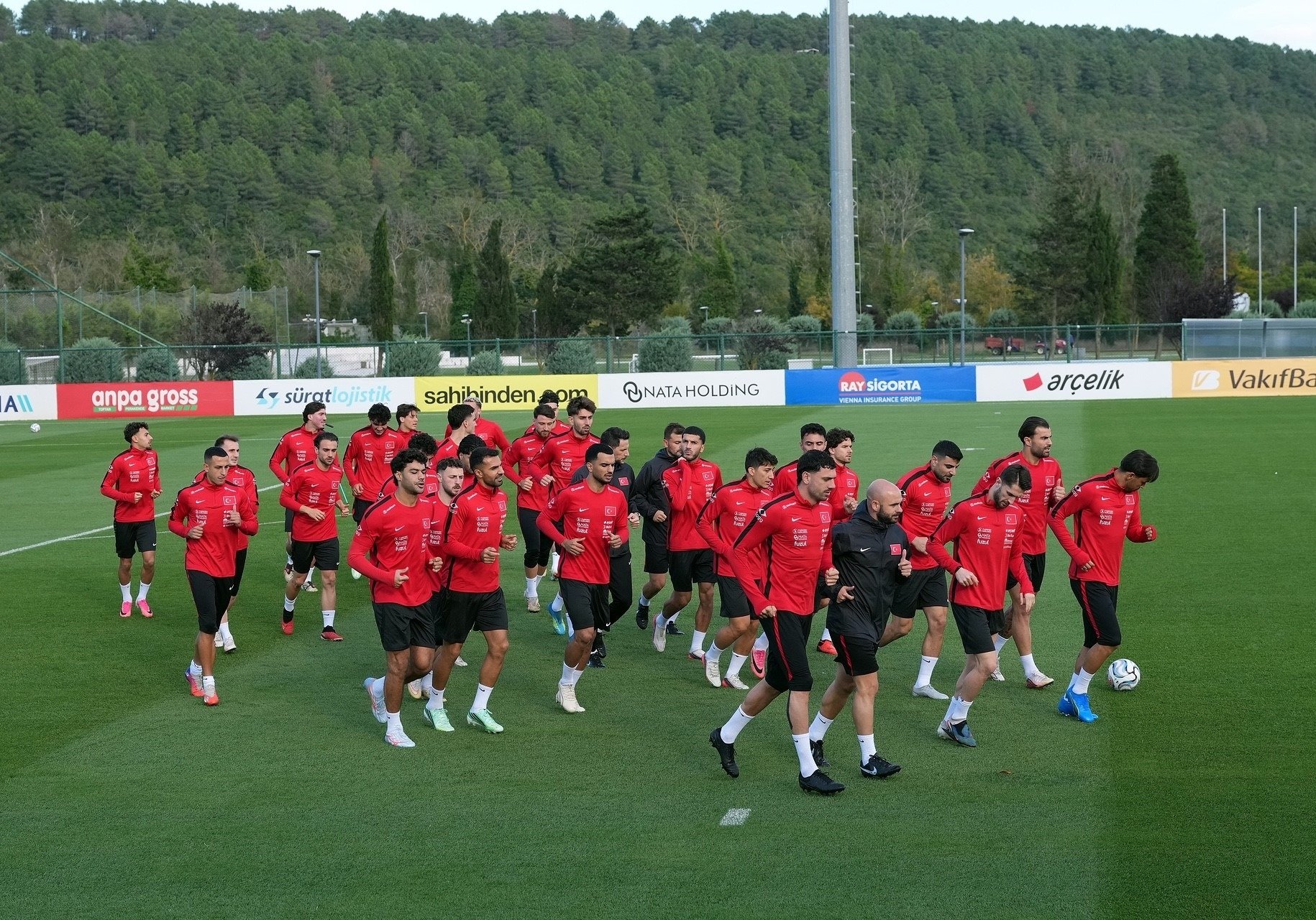
Türkiye opened their campaign with a 1-0 home loss to France in Kocaeli before suffering a 4-1 defeat against Italy in Bursa. Belgium started with a 2-0 away win over Italy but then fell 1-0 at home to France.
With the group beginning to take shape, Türkiye need a response in Liege to keep their hopes of remaining in League A on track. The Crescent-Stars were promoted from League C in the 2022-23 edition before competing in League B in 2024-25.
The team will then travel to face Italy on Oct. 5 in its fourth group match.
Kökçü out, Çakır back
Türkiye will be without Orkun Kökçü after the midfielder was removed from the squad because of a foot injury.
Kökçü experienced increased pain in his toe following the defeat to Italy in Bursa, prompting the decision to leave him out of the squad for the Belgium match.
Goalkeeper Uğurcan Çakır is available for selection after completing his suspension.
Çakır was sent off during Türkiye’s opening match against France and subsequently missed the defeat to Italy. His return provides Vincenzo Montella with another option in goal for a match in which Türkiye will be looking to shore up a defense that conceded five goals in its opening two games.
Abdülkerim Bardakcı and Ferdi Kadıoğlu are also expected to return to the starting lineup after the heavy defeat by Italy.
Real Madrid midfielder Arda Güler is again expected to be one of Türkiye’s main attacking outlets, while Barış Alper Yılmaz is set to continue in a central attacking role.
Van Bommel begins third match in charge
Belgium will play its third match under Mark van Bommel, who replaced Rudi Garcia as head coach in July following the World Cup.
Van Bommel has overseen one win and one defeat in his first two Nations League matches, including the 2-0 victory over Italy and the narrow loss to France.
Belgium have remained in League A throughout the Nations League era, with their best finish coming in the 2020-21 edition when they placed fourth.
The Red Devils have also enjoyed a relatively even historical record against Türkiye. The teams have met 11 times, with Belgium winning three, Türkiye winning three and five matches ending in draws.
Their most recent meetings came in qualifying for Euro 2012. Türkiye won 3-2 at home before the return match in Belgium ended in a 1-1 draw. Belgium have won only once in the teams’ last seven meetings.
Belgium will be without suspended attacker Diego Moreira, who picked up his second yellow card of the competition against France. Dodi Lukebakio is expected to benefit from his absence, while Kevin De Bruyne is in line for another start in an attacking role.
Romeo Lavia will be assessed after being forced off late against France, while goalkeeper Mike Penders also faces a late fitness test.
Belgium will also be without several notable players, including goalkeeper Thibaut Courtois and winger Jeremy Doku.


-
 Sports2 days ago
Türkiye aim to stop rot against Belgium in Nations League
-
 Politics2 days ago
Türkiye urges end to US-Israel-Iran war, return to talks
-
 Politics3 days ago
1 in 10 CHP-elected mayors switch to Türkiye’s ruling AK Party
-
 Politics3 days ago
Greece escalates Aegean tensions with military drill
-

 Economy2 days ago
Eurozone, Asian factories show resilience despite energy challenges
-
 Politics2 days ago
Turkish defense chief attends major joint military drills in Azerbaijan
-
 Sports2 days ago
Ronaldo walks away as Jesus rules out start against Denmark
-

 Politics2 days ago
Yemen seeks deeper cooperation with Türkiye on state rebuilding