
Politics
Ankara summit marks turning point for NATO 3.0, Türkiye’s MIA says

Türkiye’s National Intelligence Academy (MIA) has published a report describing the upcoming NATO summit in Ankara as a critical turning point for the alliance, arguing that NATO must adapt to an increasingly complex security environment shaped by great-power competition, hybrid threats and emerging technologies.
The report, titled “The Ankara Summit, NATO 3.0 Debates and Türkiye,” examines NATO’s evolving security architecture, the concept of “NATO 3.0” and Türkiye’s strategic role within the alliance ahead of the leaders’ summit.
The National Intelligence Academy, a graduate-level institution established under the National Intelligence Organization (MIT) in 2023, focuses on intelligence, national security research and postgraduate education.
According to the report released on Friday, the international security landscape has moved beyond the relatively predictable post-Cold War order toward a multipolar environment marked by heightened uncertainty and hybrid competition. It cites intensifying rivalry among major powers, China’s technological and economic rise, the Russia-Ukraine war, and the Israel-Iran conflict as developments that have fundamentally reshaped global security.
The report argues that security can no longer be defined solely in military terms, saying cyberattacks, disinformation, energy coercion and attacks on critical infrastructure have become strategic instruments of competition. It also emphasizes that societal resilience and what it describes as “cognitive security” have become integral components of national and collective defense.
Using the analytical framework of “NATO 3.0,” the report traces the alliance’s evolution from its Cold War focus on collective defense through the post-Cold War era of crisis management and out-of-area operations to a new phase centered on integrated deterrence and resilience. It notes that the term “NATO 3.0” is not an official NATO classification but an analytical concept reflecting the alliance’s changing strategic priorities.
The report says modern security now extends beyond land, sea and air to include cyberspace, outer space, the electromagnetic spectrum and the cognitive domain. It argues that collective deterrence increasingly depends on an integrated approach spanning defense industries, cyber capabilities, air and missile defense, artificial intelligence, critical infrastructure and societal resilience.
It also says NATO’s longstanding debate over burden-sharing has evolved beyond defense spending, focusing instead on which allies develop specific capabilities and assume greater responsibility during crises. As the U.S. shifts more of its strategic attention toward the Indo-Pacific, the report argues that Europe will inevitably shoulder greater responsibility for regional security.
The report describes strategic autonomy as a central element of the NATO 3.0 debate, arguing that stronger national capabilities in defense, technology, energy and critical infrastructure can reinforce the alliance if they remain interoperable with NATO planning.
The academy portrays Türkiye as a leading example of the type of ally NATO will increasingly require. It says the country has expanded its domestic defense capabilities, developed expertise in critical technologies and strengthened its ability to counter hybrid threats, allowing it to contribute greater strategic value to the alliance.
According to the report, Türkiye’s unique contribution lies in its ability to address security challenges on both NATO’s eastern and southern flanks simultaneously. It points to Ankara’s role in Black Sea security and the Montreux Convention alongside its engagement in security issues involving Syria, Iraq, Libya, the Eastern Mediterranean and the broader Middle East.
The report also highlights Türkiye’s defense industry, citing advances in unmanned aerial systems, electronic warfare, radar technologies, land and naval platforms, command-and-control systems and artificial intelligence-supported decision-making. It says these capabilities strengthen both Türkiye’s national security and NATO’s overall deterrence.
It adds that intelligence-sharing has become an increasingly important element of alliance cooperation, arguing that the MIT’s expanding operational capabilities have enhanced Türkiye’s contribution to NATO intelligence.
Looking ahead to the Ankara summit, the report says the meeting will serve not only as a forum to address current security crises but also as a defining moment for NATO’s institutional and strategic future.
It identifies defense spending, industrial production capacity, U.S.-European burden-sharing, the security priorities of NATO’s eastern and southern flanks, artificial intelligence, cybersecurity, space security and next-generation technologies as the alliance’s principal agenda items.
The report notes that NATO leaders agreed at last month’s Hague summit to raise the alliance’s defense spending benchmark to 5% of gross domestic product, but argues that the more important question is how effectively those resources are translated into military capabilities.
It also says resilience has become as important as deterrence, arguing that energy infrastructure, communications networks, financial systems, public opinion and societal psychology are now essential components of security. The report calls for NATO to adopt a “comprehensive resilience” approach as a core strategic principle.
For Türkiye, the report says hosting the summit represents more than a diplomatic event. It argues that Ankara is well positioned to help shape NATO’s evolving strategic framework by promoting a 360-degree approach to security, strengthening defense industrial cooperation, enhancing allied coordination against terrorism and contributing its experience in countering disinformation, cyber threats, irregular migration and attacks on critical infrastructure.
The report concludes that NATO’s long-term effectiveness will depend on its ability to convert higher defense spending into tangible military capabilities, redefine trans-Atlantic burden-sharing without weakening deterrence, balance the security priorities of its eastern and southern flanks, and place resilience at the center of collective defense.

President Recep Tayyip Erdoğan told Russian President Vladimir Putin on Wednesday that Türkiye remains ready to support efforts to establish direct contacts between Russia and Ukraine, stressing the importance of diplomacy aimed at finding a solution to the war.
Erdoğan and Putin discussed bilateral ties as well as regional and global issues during a phone call, Türkiye’s Directorate of Communications said in a statement.
During the call, Erdoğan emphasized the importance of ongoing efforts to ensure the safety of navigation in the Black Sea.
He said Türkiye was always ready to contribute to initiatives aimed at establishing direct contacts between Moscow and Kyiv and underlined the importance of solution-oriented diplomatic efforts, according to the statement.
The two leaders also discussed Türkiye-Russia relations and other regional and international developments, the directorate said, without providing further details.
Erdoğan also congratulated Putin on his birthday and on his party’s performance in Russia’s Duma elections.
The opposition Republican People’s Party (CHP) has alleged that vehicles, equipment and other assets worth more than TL 250 million (approximately $5.1 million) were reported to have been removed or gone missing from its provincial and district offices during the formation of the New Party (YP).
The alleged losses followed a court ruling declaring the CHP’s leadership election legally invalid, triggering a period of internal turmoil and disputes over party property.
According to findings cited by CHP officials, the vehicles and equipment were allegedly taken from party offices across Türkiye’s 81 provinces, Sabah newspaper reported.
Individual criminal complaints have been filed with prosecutors under the coordination of CHP Deputy Chair Tahsin Tarhan, seeking investigations into the missing assets.
The allegations also involve seven district headquarters previously rented by the CHP. Rental agreements were reportedly changed following arrangements with property owners, allowing the buildings to be transferred to the New Party without the CHP leadership’s knowledge.
The affected districts reportedly include Akyurt and Altındağ in Ankara.
A court ruling in a case concerning alleged irregularities at the CHP’s November 2023 convention declared the congress null and void and reinstated Kemal Kılıçdaroğlu and the previous party administration.
In late July, following escalating tensions within the party, Özel and 90 lawmakers resigned from the CHP and established the New Party.
Meanwhile, several missing CHP vehicles were reportedly located in industrial repair facilities and scrapyards. Party officials alleged that many returned vehicles had been deliberately damaged, potentially requiring millions of liras in repairs.
The whereabouts of office furniture, computers, sound systems and air conditioning units remain unknown.
CHP officials further alleged that equipment belonging to the party had been transferred to newly established New Party offices.
Turkish defense companies showcased advanced underwater systems, sonar technologies and unmanned maritime platforms in the western province of Izmir as part of the Türkiye-hosted Nusret-2026 Invitation Exercise.
The exhibition at the Port of Alsancak brought together 16 defense companies presenting technologies for underwater operations and mine countermeasures to Turkish and foreign military representatives participating in the exercise.
The Nusret-2026 Invitation Exercise is being held from Oct. 6-16 in the Gulf of Izmir and off the coast of Karadeniz Ereğli. Alongside Turkish forces, the exercise includes units from NATO’s Standing Mine Countermeasures Group 2 (SNMCMG2) and the Black Sea Mine Countermeasures Task Group (MCM Black Sea).
Havelsan presented a remotely operated underwater vehicle developed with the company’s own resources that can operate at depths of up to 300 meters (985 feet).
Zekiye Bilinç Serintuna, Havelsan’s underwater systems group leader, said the platform is equipped with sensors and systems enabling navigation and precise positioning. It can be used for military and civilian missions, including search and rescue, mine countermeasures, pipeline monitoring and ship hull inspections.
Meteksan Defense also showcased underwater acoustic technologies, including sonar systems developed for ships and submarines.
The company introduced two new products at Nusret-2026: the Submarine and Underwater Vehicle Detection System (SUVDES) and the National Synthetic Aperture Sonar System (MİLSAS).
SUVDES is designed for tasks including harbor security, protection of critical facilities and the detection of unmanned maritime vehicles.
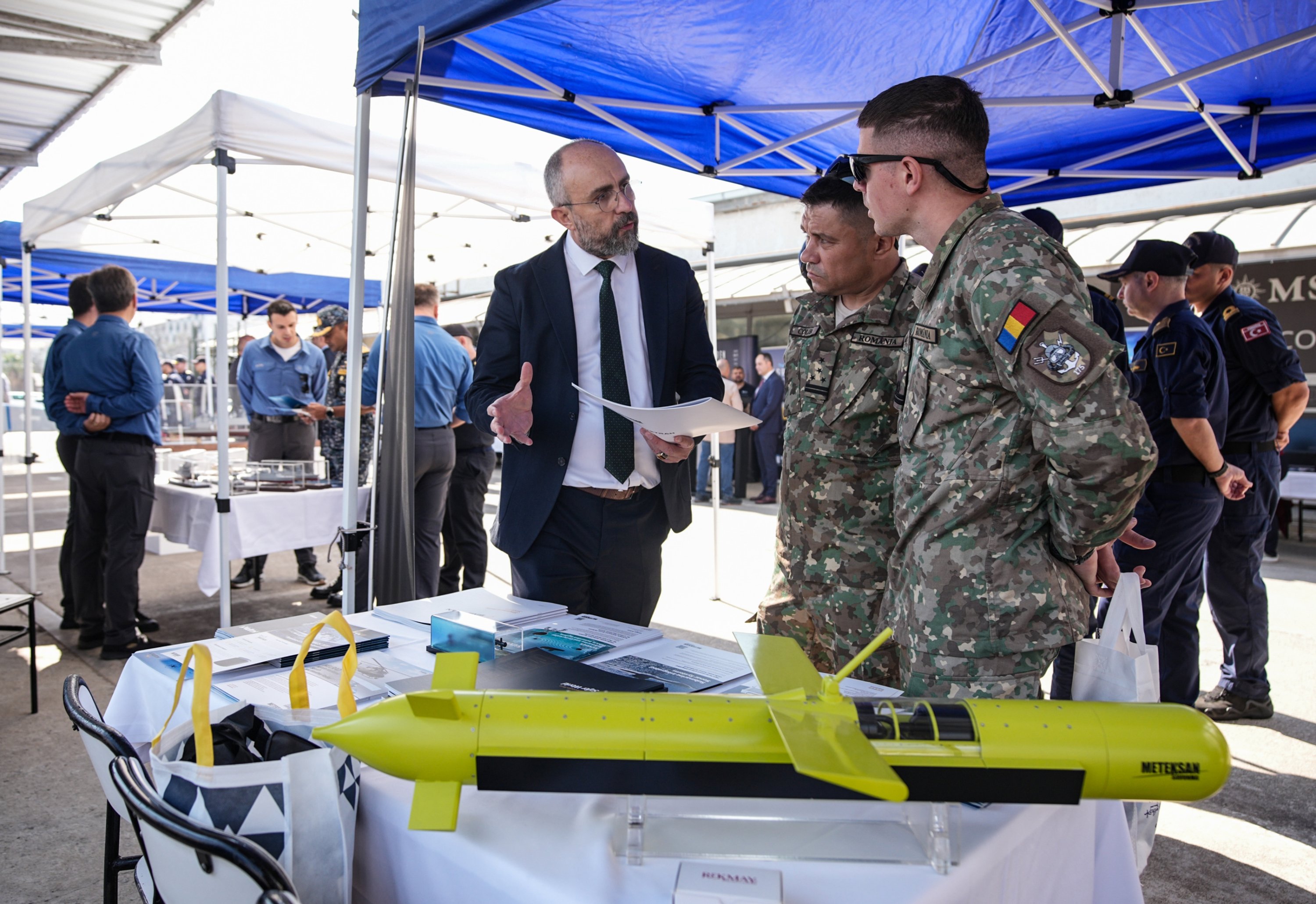
State-owned defense manufacturer MKE, meanwhile, displayed several systems developed for naval warfare.
They included the Denizhan national naval gun, the Pirana kamikaze unmanned surface vehicle and the Malaman smart bottom mine, alongside infantry rifles used by naval forces.
A total of 20 ships, five aircraft and various unmanned systems are taking part in the exercise, which focuses on mine countermeasures and maritime operations.
Interior Minister Mustafa Çiftçi will be in Athens on Thursday. Ministry sources said Wednesday that the purpose of the visit was “cooperation in fighting against transboundary crime, terrorist groups and next-generation criminal gangs.”
He is scheduled to meet Greek Minister for Migration and Asylum Thanos Plevris and Minister for Citizen Protection Michalis Chrisochoidis. Çiftçi’s talks will focus on joint steps in the above-mentioned areas.
The Turkish and Greek officials will discuss extradition of members of criminal gangs and how to enhance cooperation in this area, ministry sources also said.
Çiftçi stepped up Türkiye’s contacts with neighboring countries in the joint fight against transboundary crimes and recently paid visits to Bulgaria and Georgia to this end.
The minister last visited Athens in April for a trilateral meeting with Plevris and Bulgarian Interior Minister Emil Dechev on security-related issues affecting the three neighboring countries.
U.S. Secretary of State Marco Rubio said Wednesday that any confrontation between Türkiye and Greece over the Aegean Sea or the island of Cyprus would benefit neither country nor the U.S., stressing Washington’s commitment to preventing tensions between the two NATO allies.
Speaking in an interview with Greek newspaper Kathimerini during a visit to Athens, Rubio dismissed the prospect of a conflict between Ankara and Athens, describing such a scenario as unthinkable.
“It wouldn’t be good for anybody. It wouldn’t be good for Greece. It wouldn’t be good for Türkiye. It wouldn’t be good for the United States,” Rubio underlined, adding that Washington would not allow such a situation to develop.
Rubio also addressed the proposed Great Sea Interconnector (GSI) electricity project linking Greece, the Greek Cypriot administration and Israel, acknowledging potential obstacles and emphasizing the importance of diplomatic engagement.
He said Washington intended to use diplomatic channels to encourage solutions, arguing that sensitive disagreements were best addressed through private negotiations.
Highlighting Türkiye’s strategic importance, Rubio noted that Ankara had previously hosted negotiations between Russia and Ukraine and maintained cooperation with Washington on several regional issues.
On Türkiye’s efforts to acquire U.S.-made F-35 fighter jets, Rubio reiterated that President Donald Trump supported a potential sale but acknowledged that existing U.S. legislation remained a significant obstacle.
He said restrictions tied to Türkiye’s acquisition of Russian S-400 air defense systems must be resolved before Washington could legally proceed with the transfer.
“The issue is the S-400 system,” Rubio said, adding that the matter remained unresolved despite possible diplomatic solutions.
Türkiye was removed from the multinational F-35 program in 2019 after acquiring Russia’s S-400 air defense system, prompting U.S. sanctions despite Ankara’s role as a production partner in the fighter jet program.
The U.S. and Greece announced $4 billion (TL 196.86 billion) in military sales under the Foreign Military Sales program to support Athens’ long-term defense plans, as the two countries pledged Wednesday to strengthen security and economic cooperation.
The announcement followed the sixth round of the U.S.-Greece Strategic Dialogue in Athens, co-chaired by Rubio and Greek Foreign Minister George Gerapetritis, according to a joint statement released by the U.S. State Department.
Both sides said the sales would bolster Greece’s defense capabilities and improve military interoperability, while also pledging to explore further cooperation between their defense industries, particularly in emerging and innovative technologies.
The ruling Justice and Development Party (AK Party) admitted Cemil Tugay, mayor of Türkiye’s third-largest city, Izmir, on Wednesday. President Recep Tayyip Erdoğan presented Tugay with the party’s badge at an official ceremony in Ankara, at the party’s congress center of the party.
Tugay has recently resigned from the opposition Republican People’s Party (CHP) and met Erdoğan at the presidential complex last month. His switch marks a major turning point for the opposition, which lost a large number of mayors to the AK Party since the 2024 election. This will be the first time the AK Party will run the municipality of Izmir, a traditional stronghold of CHP, which itself lost substantial power when former chair Özgür Özel resigned and founded New Party (YP) in July.
The event Tugay attended was originally a gathering to mark the start of the new legislative year, which began last week. However, the mayor was the highlight of the event attended by a large crowd of supporters, as well as several ministers. Tugay’s switch was not fully official before the AK Party’s social media account released a video on Tuesday evening, showing flowers blossoming over a mountain of garbage, in reference to an old anthem about Izmir dedicated to Mustafa Kemal Atatürk, first president of the Republic of Türkiye and founder of the CHP.
Tugay, elected mayor in 2024 as a CHP candidate, left the opposition party in June, one month after a bitter split among supporters of reinstated chairman Kemal Kılıçdaroğlu and Özgür Özel, who was ousted after a court verdict annulling his chairmanship on charges of vote-buying in a 2023 intra-party election. Despite consecutive wins in most provinces and districts in the past two decades, where it dominated the political landscape, the AK Party found little support in the city, which is viewed as the heartland of CHP voters. The opposition supporters staged a rally against the switch on Tuesday in Izmir. Tugay has defeated AK Party lawmaker Hamza Dağ in the 2024 vote, winning 48% of the vote against Dağ’s 37%. CHP has also won 28 of Izmir’s 30 district municipalities in the same election.
CHP suffered losses of mayors since the 2024 elections as criminal investigations uncovered a vast network of corruption in most municipalities in what the AK Party called “tentacles of an octopus.” Tugay’s predecessor Tunç Soyer is also in custody in a similar investigation into corruption.
A total of 108 mayors joined the AK Party from other parties in the past two years and most are from CHP. Metropolitan municipalities of Ankara and Istanbul remained CHP domains until Ankara Mayor Mansur Yavaş resigned from the party in September, while Istanbul is governed by Nuri Aslan, an acting mayor who succeeded Ekrem Imamoğlu, the first metropolitan municipality mayor of the opposition party to be arrested on charges of corruption in 2025. Imamoğlu’s conviction may prompt a new election at the municipality. Both Yavaş and Imamoğlu were viewed as future presidential contenders of CHP. Imamoğlu was officially declared such after his arrest. Özgür Özel, who nominated Tugay in the 2024 election, claimed on Tuesday that Tugay was forced to defect to the AK Party while accusing him of treason in the same statement.
‘Here to win hearts’
Speaking at the ceremony, Tugay, accompanied by his wife Öznur on the stage, said he joined the AK Party “to be a friend of those devoted to this cause for a strong Türkiye under the leadership of our president.” “I came here with faith and trust,” he told the applause of AK Party supporters. He recalled his upbringing in Izmir as the child of a modest family and how he served his country for about 30 years as a doctor. “Then, someone I respected told me that the best way to serve the nation is through politics and I took upon this advice.” He mentioned his past as mayor of Izmir’s Karşıyaka district and how he provided services for “all residents of Izmir without discrimination.” “All residents have been a family to me,” he added. He pointed out that Izmir was a precious city of patriotic people. “It is an honor to serve this city,” he said.
Tugay also reasoned his switch to the AK Party with past remarks by Erdoğan, who repeatedly said the AK Party was “friend of the disenfranchised.” “I am engaged in politics to defend the rights of forgotten people living on the periphery of cities, forgotten poor, to defend the rights of farmers and small business owners,” Tugay said. He then quoted Sufi poet and mystic Yunus Emre: “I am not here to fight, I am here for love. Hearts are abode of my friends; I am here to win hearts.” “Under the leadership of our president and valuable support of experienced AK Party family, we embark on a journey to revive Izmir, to resolve its problems,” he said. During long reigns of CHP, Izmir was embattled with a variety of problems, particularly in garbage collection and poor infrastructure.
President Erdoğan said at the ceremony that the AK Party family was growing with new members. “Those who are fed up with the pressure of party barons doing everything in exchange for bribes, those who do not want to be subjected to obscene insults in the middle of the night, and those who seek to serve their cities in peace and harmony see the AK Party as the safest address,” Erdoğan said, in veiled remarks towards Özgür Özel, whose WhatsApp correspondence with a district mayor in Ankara, where he hurled insults over his anticipated switch to the AK Party, was made public. Özel and other top figures of the opposition were also accused of asking for bribes in return for the nomination of mayors, according to the statements of the former mayor of Antalya province, who was arrested earlier on corruption charges.
The president, who made his name in politics after his election as Istanbul mayor in 1994, noted that the AK Party was behind the revolutionary changes in municipal governance with landmark public services. “No one can compete with the AK Party’s approach to municipal governance. No one can compete with the AK Party on finding practical solutions to problems, delivering results quickly, developing projects and setting out a vision for our cities. Municipal governance may be a means of personal benefits for others, but for us, it is solely a means of serving the nation.”
Erdoğan said municipal governance could be a means for others to enrich themselves, their spouses, friends and associates, but for his party it is a position of heavy responsibility that requires serving the nation, making sacrifices and working day and night for the people, referring to the corruption scandals plaguing the opposition.
The president then turned to Tugay and said: “Welcome to the AK Party family; we are delighted to have you with us.” He said they would support Tugay in his efforts to serve Izmir, the “pearl of the Aegean,” and its residents.


-
 Economy3 days ago
Top central bankers due in Istanbul to discuss policy challenges
-
 Politics3 days ago
3 jailed in Türkiye over FETÖ-linked infiltration of MASAK data systems
-
 Politics3 days ago
Türkiye-led Nusret-2026 drills bring together multinational naval forces
-
 Politics3 days ago
Türkiye’s CHP seeks removal of mayor with divided loyalty
-
 Politics2 days ago
Türkiye condemns Israel’s deepening incursion into Syria
-
 Economy3 days ago
Türkiye says Development Road could become $80B ‘energy corridor’
-
 Economy2 days ago
Over $16B shifted into deposits amid fund exits: Turkish central bank
-
 Economy2 days ago
Türkiye sets new record for solar, wind power generation