
Economy
South Korea raises 2026 growth forecast to 3% on AI chip boom

The South Korean government lifted its 2026 growth forecast by one percentage point to 3% on Tuesday, expecting a stronger performance driven by upbeat performances from major memory chipmakers as artificial intelligence demand soars.
Record profits from semiconductor giants Samsung Electronics and SK Hynix – whose advanced memory chips are essential for the fast-evolving AI sector – have fuelled optimism over the country’s economic outlook.
The government has unveiled an ambitious economic agenda and has said it plans to invest an expected windfall from tech giants’ taxes into public projects.
“We had initially projected this year’s real economic growth rate at 2%, but we have now revised our forecast upward to 3%,” Finance Minister Koo Yun-cheol told a Cabinet meeting Tuesday.
“Although exchange rate fluctuations could affect the outcome, per capita income is projected to remain around the $40,000 mark,” Koo added.
In a presentation slide shown during the meeting, the finance ministry called the strong semiconductor market a “boon for the economic indicators.”
However, an agile policy response is needed to address “changed economic situations, including widening wealth polarization,” the slide said.
SK Hynix and Samsung are involved in a public-private investment of 800 trillion won ($540 billion) to build a chip hub in southwest South Korea – part of broader efforts to address regional inequality.
Tuesday’s Cabinet meeting also flagged high exchange rates, interest rates and consumer prices as risks amid the continuing Middle East conflict.
President Lee Jae Myung had said on Monday that higher tax revenues, thanks to AI-driven profits, were a “golden window” of opportunity to invest strategically.
The windfall will be used to establish a “future response fund” to concentrate investment in “future industries, youth, regional development, and education,” Lee said, without giving further details.
The boom has also strengthened workers’ demands for higher pay, with Samsung Electronics avoiding a major strike in May after reaching an agreement on bonuses.
Three companies dominate the market for producing advanced memory chips: U.S. giant Micron, and South Korea’s Samsung Electronics and SK Hynix.
These chips, called high-bandwidth memory (HBM), are used in AI processors alongside powerful silicon known as GPUs to generate chatbot responses or realistic images.

Iranian airlines were forced to cancel some international flights Wednesday after the U.S. tightened sanctions on Iran’s aviation industry in a new effort to cripple its economy.
Separately, Tehran later Wednesday threatened to paralyze airports in neighboring countries if they cooperate with the U.S. by disrupting Iranian flights.
U.S. Treasury Secretary Scott Bessent said Monday that all Iranian airlines would be forced to stop operating Wednesday by the threat of secondary sanctions on air services providers, seven months into the war between the U.S. and Iran.
A travel agent in Tehran told Agence France-Presse (AFP) that flights to Baghdad, Muscat, Qatar, Georgia and Azerbaijan had all been suspended, but routes to multiple other destinations remained available, including China.
The new U.S. measures came as part of an earlier threat by the Trump administration to impose “economic D-Day” on Iran in an attempt to force it into submission.
But Iran’s aviation sector has already been a target of sanctions for years, and it remains unclear what the full impact will be and which other countries will comply.
Tehran issues threat
Even after the new sanctions took effect Wednesday, a flight from Tehran operated by Mahan Air, one of Iran’s biggest carriers, landed in Guangzhou in China, according to tracking data from FlightRadar24.
China said Tuesday that it opposed the U.S. sanctions, calling them illegal. A flight to Shanghai was also due to depart Wednesday, according to Tehran’s international airport.
Some flights to Istanbul were also scheduled, though others had been canceled, the travel agent in Tehran told AFP.
“The situation is unstable and we are no longer selling tickets for the time being for fear of cancelations,” the agent said, requesting anonymity.
A Mahan flight from Kabul was also expected to arrive in Tehran. According to the website for Tehran’s international airport, other connections to Türkiye and Armenia remained possible using smaller Iranian airlines, including Varesh.
Flights to Najaf in Iraq and Dubai in the United Arab Emirates (UAE) were also scheduled.
Bessent had vowed Monday to “shut down” Iranian carriers and punish anyone doing business with them.
“If they land, you cannot provide them with fuel, you cannot provide them with landing services, you cannot sell them tickets or you will be knocked out of the dollar system,” he warned other countries.
The restrictions will further complicate the ability of Iranians to travel abroad or return to their country.
If neighbouring countries cooperate with the U.S. by stopping Iranian flights, Iran will ensure their airports cannot function, Mohsen Rezaei, secretary of Iran’s Supreme National Security Council, said Wednesday in an interview with state TV.
Pilgrims
Iranian media also reported cancelations, with the Tasnim news agency Tuesday citing a civil aviation spokesperson as saying that Baghdad and Muscat airports “will no longer accept” Iranian flights.
The agency added that “other international flights, including Istanbul, will operate as scheduled.”
According to Tasnim, Iran’s aviation authorities were in talks to reroute Baghdad flights to Najaf, a major destination for Iranian pilgrims.
On Wednesday, the agency said its correspondent in Najaf had reported Iranian flights to the city were running as normal.
It quoted a source at the airport as saying no order had been received from Iraqi authorities to halt flights.
While the Iraqi government has not publicly announced plans to enforce the ban, several sources, including a senior government official, told AFP that Baghdad would comply with the U.S. measures.
The prospect of a suspension of flights between the two countries has sparked concerns among some Iraqi travel agents.
In Najaf, home to one of the most revered Shia Muslim shrines, agent Haidar Shamaa said “most travel companies in the city depend on booking flights” to Iranian airports.
Several travel agencies said panicked clients were calling for updates and were considering switching to land routes, which would mean much longer journeys.
Chinese tech giant Alibaba unveiled plans Wednesday to expand its overseas data centers, targeting markets across Europe and the Middle East.
Hangzhou-based Alibaba is one of the frontrunners in China’s artificial intelligence industry, with its Qwen model among the world’s most downloaded AI models.
The company said it would “establish its first cloud regions” in Türkiye, Finland and the Netherlands, while “expanding its data center footprint in Malaysia, Germany, the United Arab Emirates (UAE), France and Hong Kong” over the next 12 months.
The announcement came ahead of a highly anticipated meeting between Chinese President Xi Jinping and his U.S. counterpart Donald Trump in Washington, where the two leaders are expected to discuss trade tensions, among other topics.
Beijing and Washington are locked in a tech rivalry increasingly centered on frontier industries including semiconductors, AI and robotics.
Alibaba CEO Eddie Wu said Tuesday that the company was planning to train an AI model with five to 10 trillion parameters, which would make it several times bigger than the current largest Chinese model.
Alibaba is targeting more than 20 gigawatts of global data center capacity by 2032, Wu said during the firm’s annual flagship conference in Hangzhou.
The company also unveiled a new AI chip at the conference, the Zhenwu V900 – which it said would deliver three times the performance of its predecessor, Zhenwu M890.
“It’s the most powerful AI chip in China today,” Wu said.
The Zhenwu M890 is widely believed to be two times more powerful than the chip custom-made for the Chinese market by U.S. pace-setter Nvidia, the H20.
Washington has long tried to slow China’s progress with export controls on the advanced chips needed for cutting-edge AI, blocking access to top-end U.S. semiconductors such as Nvidia’s.
Beijing’s push for technological self-reliance has also encouraged Chinese technology companies to adopt domestic chips as alternatives to foreign products.
The challenges Türkiye has encountered recently are confined to a limited segment of its capital markets and do not represent a systemic structural weakness, Vice President Cevdet Yılmaz said Wednesday.
Yılmaz said administrative and judicial measures had been taken to address the issues.
Turkish authorities acted last week to support financial stability, including measures to boost Turkish lira liquidity and ease some capital and margin requirements after some funds struggled to meet withdrawals during a stock market sell-off.
“There is no structural problem in our capital markets. We are facing some specific issues in a limited area, and once we overcome them, our capital markets will continue on their path even stronger than before,” Yılmaz said.
“All necessary administrative and legal measures have been taken in this regard, and continue to be taken.”
He was speaking at the opening of the MÜSIAD EXPO 2026 and the International Business Forum (IBF) in Istanbul, organized by the Independent Industrialists and Businessmen’s Association.
Following the volatility last week, authorities filed criminal complaints over alleged market manipulation and ordered the liquidation of 131 funds managed by seven asset managers.
Türkiye’s capital markets regulator said Wednesday that almost half a million investors hold stakes in the investment funds said to be worth more than $18 billion.
Yılmaz went on to stress what he said were strong macroeconomic fundamentals of the Turkish economy.
He cited Türkiye’s low public debt, manageable budget and current-account deficits, stronger reserves and sound banking system.
“The banking system is extremely sound, and the capital adequacy ratio is high. In short, our macroeconomic fundamentals are strong; our citizens should have no doubt about this,” Yılmaz added.
He said the country’s current-account deficit had remained below 2% of GDP in recent periods, although energy prices that have surged amid the fallout of the Iran war could push it slightly above that level this year.
He also said Türkiye’s banking sector had high capital adequacy ratios and that the country’s credit default swap (CDS) premium had declined compared with previous periods.
Volatile period for global trade
Globally, Yılmaz said trade was facing a volatile period amid geopolitical tensions, rising protectionism and the green and digital transitions.
He said the Middle East conflict was weighing on expectations for global goods and services trade in 2026, while raising logistics costs and adding inflationary pressure through commodity prices, particularly energy.
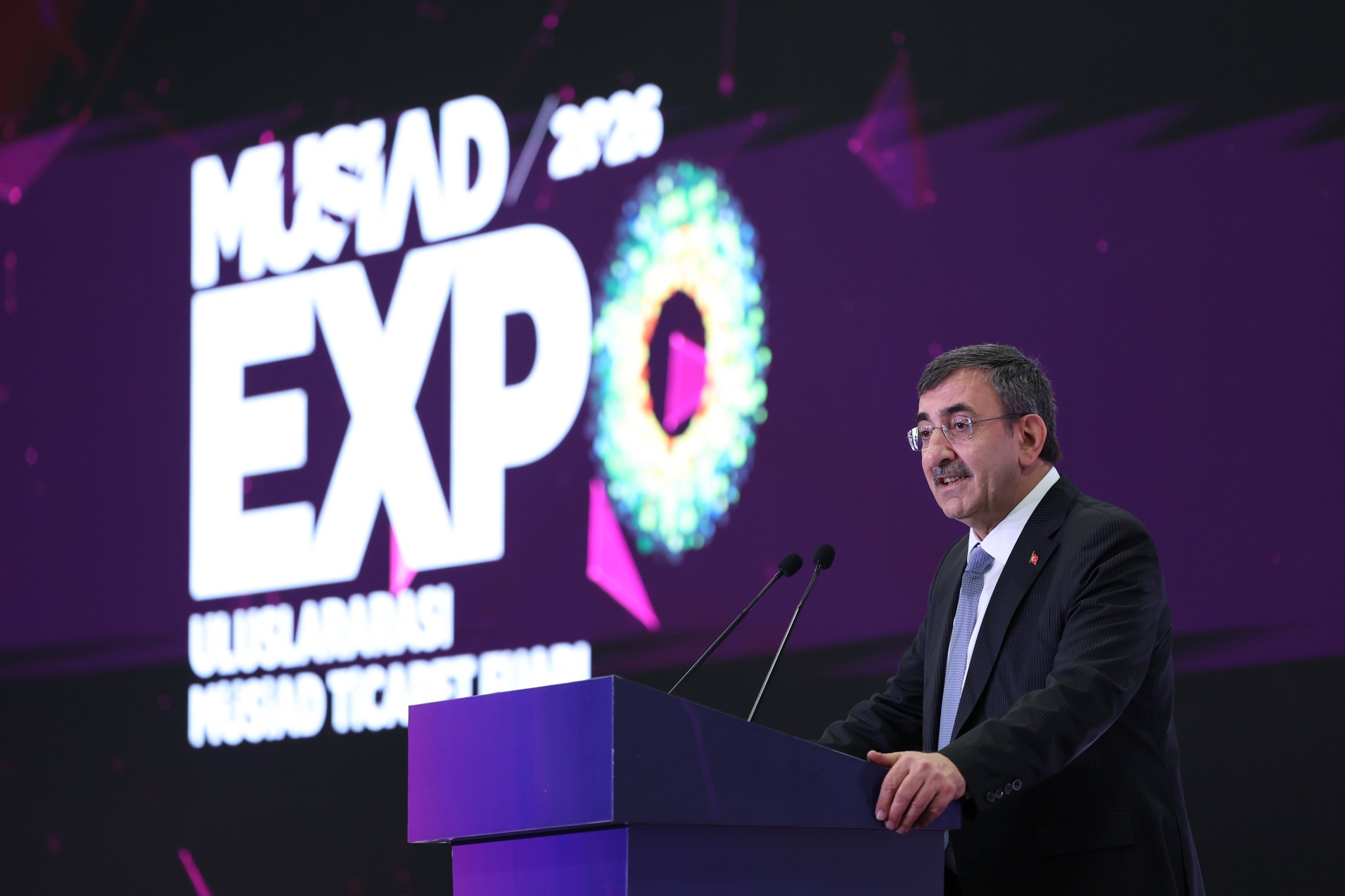
Yılmaz said Türkiye’s economy was showing a relatively positive performance thanks to its production capacity and export strength despite adverse global conditions.
He said the economy exceeded $1.6 trillion in 2025 and annualized national income surpassed $1.7 trillion in the first half of 2026. The government expects GDP to exceed $1.8 trillion by the end of the year.
Goods exports rose from $36 billion in 2002 to $273.2 billion in 2025 and reached an annualized $280 billion as of August 2026, according to Yılmaz.
Services exports increased from $14 billion in 2002 to $125 billion, while combined goods and services exports approached $400 billion in 2025, he said.
$450 billion export target
Türkiye aims to increase combined goods and services exports from around $400 billion currently to $450 billion by the end of 2029, according to the government’s Medium-Term Program (MTP).
Yılmaz said customs infrastructure, free zones and measures supporting green and circular economic transformation would also be developed to improve competitiveness.
Main markets face weaker growth
Yılmaz said Türkiye’s main export markets, particularly Europe and the Middle East and North Africa (MENA), were facing weaker growth.
He said countries accounting for more than 90% of Türkiye’s trade were expected to grow by around 1.6% this year, making 2026 a challenging year.
However, he said Türkiye’s trading partners were expected to grow faster than the global economy next year, partly due to base effects and developments related to the war.
Yılmaz said Türkiye was pursuing strategies to diversify its export markets, including efforts targeting distant markets, Islamic countries and African economies.
He also highlighted transport and logistics projects including the Development Road, Middle Corridor and Zangezur Corridor, saying Türkiye aimed to increase its role in east-west and north-south trade flows.
The government also plans to integrate ports, logistics centers, industrial zones and railway networks to strengthen Türkiye’s position as a production, logistics and trade hub, he said.
MÜSIAD EXPO kicks off
Meanwhile, the four-day MÜSIAD EXPO, which kicked off Wednesday, is a multisector trade fair bringing together producers, brands and international buyers from different industries.
Providing a meeting point for global trade professionals, the event offers participants the opportunity to build direct business connections in new markets.
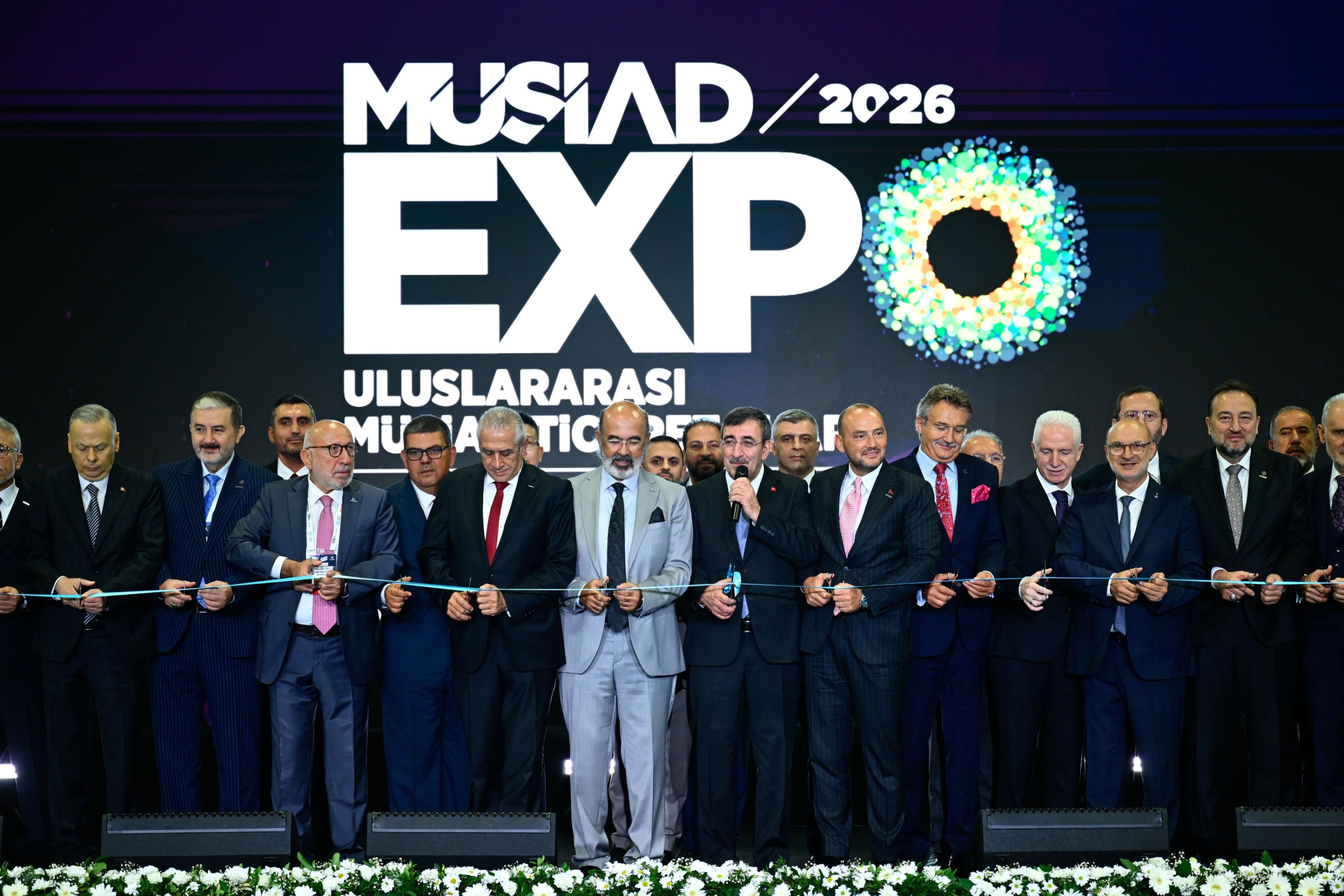
With an increasing number of participants every year, expanding sector diversity and a strong business network, MÜSIAD Expo is a trade platform that brings investors, industrialists, entrepreneurs and business representatives together.
Alongside the event, the 29th International Business Forum also began under the theme “The Transformation of Humanity and the Business World in the Age of AI.”
MÜSIAD Chair Burhan Özdemir noted that they gathered to discuss Türkiye’s determination to produce, its business ethics, and its global vision.
Özdemir reminded the audience that the first expo took place in late October 1993, and that they represented an approach centering on ethics in trade, responsibility in production, and trust in the business world.
He pointed out that the exhibition became one of the strongest trade gatherings not only in Türkiye but also in the broader region.
Organizers aim to host more than 50,000 visitors over four days at the fair, which represents 369 companies from 18 different sectors in an area of approximately 25,000 square meters.
He stressed that the main issue for them was transforming this gathering into new markets, partnerships, investments, and lasting relations of trust.
MÜSIAD expects the fair to generate at least $5 billion in trade volume.
The Organization for Economic Co-operation and Development (OECD) lifted its 2026 and 2027 inflation forecasts for Türkiye on Wednesday, while also downgrading its economic growth projections for both years.
In its latest economic outlook, the OECD raised its headline inflation forecast for Türkiye to 31.5% for 2026 from 28.4% in June, placing it above Turkish authorities’ latest projections. Its inflation projection for 2027 was also raised to 24.7% from 18.3%.
It also cut the economic growth forecast to 2.7% from 3.1% for 2026, and to 3.6% from 3.8% for 2027.
As an energy importer, Türkiye has seen high inflation in recent years, although authorities have managed to lower it significantly compared to 85.5% in late 2022 and around 70% in May 2024. Since then, helped by central bank tightening, inflation dropped to 31.5% in August.
However, amid higher global energy prices, the progress on disinflation has been somewhat limited throughout the year, which has also prompted the government to change its main forecasts.
Under the new Medium-Term Program (MTP), Turkish authorities expect inflation at 28.4% by the end of the year. It is projected to fall to 21% in 2027, 13.5% in 2028 and 9% in 2029.
While energy and fertilizer costs remain a headwind, the OECD said it expects inflation in Türkiye to keep moderating, with disinflation set to continue into 2027.
In June, the OECD had cut its 2026 growth forecast for Türkiye, citing weaker domestic demand amid high energy and commodity prices and tighter financial conditions, leaving its 2027 growth outlook unchanged.
The revisions come as the OECD slightly raised its global growth forecasts for this year, saying AI-driven investment is helping the world economy hold up better than expected, even as a more entrenched energy shock weighs on the outlook for 2027.
Türkiye plans to commission its first small modular reactor (SMR) in the first half of the 2030s as part of its broader nuclear energy strategy, Energy and Natural Resources Minister Alparslan Bayraktar said Wednesday.
Bayraktar’s remarks came a day after Ankara launched a new cooperation with the U.S. to conduct a technical study of small modular reactors and fourth-generation nuclear technologies for potential deployment in Türkiye.
The project, agreed on the sidelines of the U.N. General Assembly in New York, will be funded by the U.S. Trade and Development Agency (USTDA) in collaboration with state-owned Türkiye Nuclear Energy.
The study will assess, from technical, economic, legislative and licensing perspectives, SMR designs from four U.S. companies and five fourth-generation reactor technologies.
The agreement would also cover Central Asia and the Turkic republics, Bayraktar told a meeting with U.S. businesspeople during the Türkiye Investment Conference organized by the Foreign Economic Relations Board (DEIK) Türkiye-U.S. Business Council (TAIK).
Türkiye has industrial capacity in the nuclear sector and wants to develop capabilities on the technology side as well, he said, adding that Ankara was also exploring nuclear cooperation opportunities with Canada.
Bayraktar said the government was working on regulations that could include incentives and exemptions for companies investing in SMRs.
“Hopefully, we will see the first SMR in Türkiye in the first half of the 2030s,” Bayraktar said. “There is a global race in this area. But we have not seen a reactor yet. We want Türkiye to be at the stage where this technology takes off.”
Türkiye is months away from the planned launch of the initial reactor of its first nuclear power plant, Akkuyu. The four-reactor plant is being built by Russia’s state-owned nuclear company Rosatom in the southern Mersin province.
Akkuyu’s four reactors will have a combined installed capacity of 4,800 megawatts (MW). Once all units are operational, it is expected to supply about 10% of Türkiye’s electricity demand.
Ankara plans to construct two additional plants, one in Sinop on the Black Sea coast and one in the Thrace region.
Türkiye has accelerated talks with Canada on the projects, while also being in contact with China, Russia and South Korea.
EDF cooperation in nuclear energy
Bayraktar said France’s state-owned EDF had significant expertise in nuclear energy and that Türkiye planned to sign a cooperation agreement with the company soon.
He stressed that nuclear cooperation should not be limited to investment, saying experience-sharing in areas such as operations and safety was also important.
Bayraktar also said Türkiye expects data centers’ electricity demand to reach between 5 and 10 terawatt-hours by around 2035.
Energy infrastructure planned for Development Road
Bayraktar said energy infrastructure would be a key component of the Development Road project.
“We want to establish natural gas and oil pipelines as well as an electricity interconnection,” he said, adding that billions of dollars in annual revenues from the energy infrastructure could help finance the wider Development Road infrastructure.
He also highlighted transport electrification as critical to reducing Türkiye’s dependence on imported energy.
Türkiye will need 13 million electric vehicles and at least 1.3 million charging stations by 2035 to manage rising oil demand, Bayraktar said.
He estimated that the country would need $50 billion of investment in distribution networks and $30 billion in transmission infrastructure by 2035 to support that transition.
Critical minerals part of energy strategy
Bayraktar said Türkiye viewed mining as an integral part of its broader energy strategy, rather than as a separate sector.
He identified gold as a critical mineral for Türkiye alongside rare earth elements, noting the country’s high level of gold imports.
Türkiye is working on rare earth processing and enrichment capabilities, while state-owned Eti Maden is expected to pursue a more aggressive growth strategy in strategic minerals, he said.
“Without mining there is no industry, and without it there is no energy transition,” Bayraktar said.
Türkiye has strengthened its fight against money laundering and terrorist financing, but more is needed when it comes to tracing cross-border criminal proceeds and recovering illicit assets, the Financial Action Task Force (FATF) said in its latest assessment.
The watchdog said on Wednesday that Türkiye had improved interagency coordination, financial intelligence and international cooperation since its previous comprehensive review in 2019, while money-laundering investigations, prosecutions and convictions had risen significantly.
The FATF’s mutual evaluation of Türkiye assessed the effectiveness of the country’s measures against money laundering, countering terrorist financing and proliferation financing and the level of compliance with the FATF Recommendations, at the time of its on-site visit in November 2025.
“The assessment found that Türkiye has strengthened its defenses against illicit finance, including improving the use of financial intelligence and international cooperation for pursuing money laundering, terrorist financing and predicate offenses,” the organization said.
“However, Türkiye should further prioritize money laundering investigations and prosecutions related to certain high-risk predicate offenses, and strengthen its capacity to identify, trace and recover criminal assets located abroad,” it added.
Türkiye received no “non-compliant” ratings across FATF’s 40 technical recommendations, although it was rated “partially compliant” on two, and the watchdog said shortcomings remained in complex high-risk cases and in identifying and recovering criminal assets abroad.
Commenting on the evaluation, published on Sept. 23, the Financial Crimes Investigation Board (MASAK), operating under the Treasury and Finance Ministry, welcomed the findings and also said that effectively combating money laundering and the financing of terrorism “will continue to be among our main priorities.”
“These results constitute an important indicator of the level our country has reached and show that, through legislative efforts, institutional arrangements, and practices, our country is steadily strengthening its capacity in combating money laundering, the financing of terrorism, and the financing of the proliferation of weapons of mass destruction,” it said.
It also noted that “it has also been clearly certified by the FATF that our country does not have a strategic deficiency in the areas of anti-money laundering, related predicate offenses, combating the financing of terrorism, or combating the financing of the proliferation of weapons of mass destruction, and therefore there is no risk of being on the grey list.”
The watchdog removed Türkiye from its “grey list” in 2024.


-
 Politics3 days ago
Erdoğan leaves for UN General Assembly with Gaza in mind
-
 Economy3 days ago
AMD joins $1 trillion club as last chipmaker to cash in on AI rally
-
 Economy3 days ago
Türkiye extends funds liquidation process, freezes execs’ assets
-
 Economy2 days ago
US says all Iranian airlines to be ‘shut down’ Wednesday
-
 Politics3 days ago
Sea Wolf maritime drill begins amid tensions between Greece, Türkiye
-
 Politics2 days ago
Türkiye rejects disinformation targeting child protection operations
-
 Economy3 days ago
Europe faces Q4 jet fuel deficit despite tapping far-flung suppliers
-
 Politics3 days ago
Türkiye condemns deadly terrorist attack in Pakistan’s Kohat