
Politics
Türkiye, regional powers call for diplomacy amid tensions

Türkiye, Egypt, Pakistan and Saudi Arabia called for diplomacy to defuse mounting tensions across the Middle East, while condemning attacks on Saudi Arabia and reaffirming support for Palestinian statehood and Sudan’s territorial integrity following high-level talks in New York.
The foreign ministers of the four countries met Monday on the sidelines of the 81st session of the United Nations General Assembly to discuss regional and international developments, according to a joint statement released after the meeting.
The ministers stressed the need for closer consultation and coordination among their governments to promote peace, security and economic stability across the Middle East and the broader region.
Against the backdrop of continued hostilities, they said dialogue and diplomacy remained the only viable route toward a sustainable settlement and emphasized the importance of upholding the Islamabad Memorandum of Understanding as part of efforts to secure lasting regional peace.
The four countries strongly condemned attacks targeting Saudi Arabia, including recent Houthi strikes, and expressed support for the kingdom’s sovereignty, territorial integrity and security.
They also affirmed Saudi Arabia’s right to defend its territory and population in accordance with international law and the U.N. Charter, while stressing the need to protect freedom and safety of navigation in regional waterways.
On Yemen, the ministers backed the internationally recognized government and the Presidential Leadership Council, calling for security, stability and development to be pursued through a political process and an inclusive dialogue among Yemeni parties.
The Palestinian issue also featured prominently in the talks, with the four countries describing a resolution of the conflict as central to achieving lasting peace and stability in the Middle East.
They reaffirmed the Palestinian people’s right to self-determination and backed the establishment of an independent, sovereign, viable and territorially contiguous Palestinian state along the pre-1967 borders, with East Jerusalem as its capital, in accordance with relevant U.N. Security Council resolutions.
Turning to Sudan, the ministers expressed support for the country’s sovereignty, unity, independence and territorial integrity and emphasized the importance of preserving its legitimate national institutions.
They rejected the creation of parallel governing structures that could undermine Sudanese sovereignty and called for an end to the illicit movement of weapons, mercenaries and foreign fighters into the conflict-hit country.
The four foreign ministers agreed to maintain consultations and strengthen coordination on regional and international developments, with an emphasis on collective security and long-term stability.

President Recep Tayyip Erdoğan used his address to the United Nations General Assembly on Tuesday to press the international community for stronger action over Israel’s genocidal conduct in Gaza, renewed recognition of Palestinian statehood and reform of the U.N. Security Council, while laying out Türkiye’s positions on conflicts and challenges stretching from Syria and Ukraine to climate change and artificial intelligence.
Erdoğan placed the Palestinian issue at the center of his speech as he addressed the 81st session of the General Assembly, saying Palestinian President Mahmoud Abbas was unable to attend the gathering for a second consecutive year and pledging that Türkiye would continue to raise the Palestinian people’s voice from the U.N. podium.
“This injustice against our Palestinian brothers and sisters deeply wounds our conscience,” Erdoğan said. “Just as last year, this year we will be the voice of a free and sovereign Palestinian state.”
He also called on countries that have yet to recognize Palestine to reconsider their position.
Describing the humanitarian situation in Gaza in stark terms, Erdoğan said the enclave had become not only “the world’s largest graveyard for children” but also the place with the highest rate of child amputees due to Israel’s genocidal attacks.
He said more than 74,000 Palestinians, most of them women and children, had been killed in Gaza over the past three years and that more than 70% of generators at hospitals in the enclave were out of service because of fuel shortages.
He said Israel killed more than 1,500 Palestinians even after a cease-fire was reached through the efforts of U.S. President Donald Trump and contributions from Türkiye and other countries.
“This is not a personal issue for Tayyip Erdoğan. It is a matter of humanity,” he said. “No one with humanity in their heart, with compassion and mercy, and with a sense of fairness and conscience can turn a blind eye to this tragedy.”
Erdoğan also described Gaza as “the most inhumane and shameful concentration camp of our time” and slammed Israel for pursuing a “genocidal mentality with an insatiable appetite for killing.”
Turning to the occupied West Bank and Jerusalem, Erdoğan said the West Bank was experiencing its worst period of Israeli illegal settler violence and criticized Israeli authorities for restricting Muslim and Christian access to holy sites in Jerusalem.
He also warned against attempts to dismantle UNRWA, the U.N. agency for Palestinian refugees.
Erdoğan urged countries gathered at the U.N. to increase pressure on Israel and reiterated Türkiye’s support for a two-state solution.
“I call on you to exert greater pressure on Israel. Attempts to suffocate Palestine will fail,” Erdoğan said.
“God willing, we will see the day when an independent and territorially contiguous Palestinian state, based on the 1967 borders and with East Jerusalem as its capital, becomes a reality.”
Erdoğan said the failure to halt conflicts extended well beyond Palestine, pointing to more than 60 wars and conflicts over the past year and saying some 250,000 people had been killed from Gaza, Ukraine and Russia to Myanmar, Darfur, Iran and Lebanon.
He argued that the scale of the violence showed the U.N. was increasingly unable to fulfill its founding responsibility of preserving international peace and security.
Beyond the Middle East, Erdoğan renewed his longstanding demand for changes to the structure of the U.N. Security Council, arguing that the current system gives disproportionate power to its five permanent members.
“A system in which the will of more than 190 countries is subject to the whims of five countries is neither fair nor capable of fully inspiring trust,” Erdoğan said.
He said the Security Council “must be reformed” in accordance with his longstanding principle that “the world is bigger than five,” referring to the United States, China, Russia, France and Britain, which hold permanent seats and veto power on the council.
Erdoğan outlined several principles for a fairer international system, including applying international law equally to powerful and weaker states, strengthening regional ownership of crises and putting cooperation and open diplomacy at the center of interstate relations.
He cited the Black Sea Grain Initiative as an example of Türkiye using regional diplomacy to contribute to both regional and global security.
Erdoğan also addressed growing competition over technology and the global economy, warning that “technological polarization and digital hegemony” were not in the interests of either the U.N.-centered international system or its member states.
He called for countries to jointly develop “a new paradigm” to confront deepening global income inequality.
Erdoğan also addressed artificial intelligence, warning that the technology was becoming increasingly difficult to control and calling for a common international legal framework.
He urged countries to accelerate efforts toward a U.N. international convention governing artificial intelligence.
On Syria, Erdoğan said the country had entered a new period following the Dec. 8 change in government and voiced support for President Ahmed al-Sharaa.
He said Syria was moving toward becoming a secure and peaceful country despite what he described as internal and external provocations and pledged that Türkiye would continue supporting the Syrian people.
Erdoğan also backed efforts to strengthen state authority and stability in neighboring Iraq, highlighting cooperation on transportation and energy projects, particularly the Development Road Project.
On the Russia-Ukraine war, Erdoğan said Türkiye hoped for an end to the conflict that preserved Ukraine’s sovereignty and territorial integrity.
He said Ankara remained in contact with the parties to restore navigational security in the Black Sea, protect food security and prevent the war from spreading.
Erdoğan strongly condemned attacks against commercial shipping in the Black Sea regardless of who carried them out.
He separately stressed the need to preserve freedom of navigation through the Strait of Hormuz and said Türkiye was working with regional actors to prevent conflicts in the Gulf from spreading further.
In the Aegean and Eastern Mediterranean, Erdoğan called for disputes to be resolved through international law and good-neighborly relations and renewed Türkiye’s proposal for an Eastern Mediterranean Conference.
On Cyprus, Erdoğan called for international recognition of the sovereign equality and international status of the Turkish Cypriot people.
“The inhumane isolation they have endured must finally come to an end,” Erdoğan said.
“I call on the international community to recognize the Turkish Republic of Northern Cyprus and establish political and economic relations with it.”
Erdoğan also emphasized Türkiye’s role in European security, arguing that the continent could not build an effective security architecture without Ankara.
“A Europe that excludes Türkiye from its security architecture cannot, let me say this clearly, become stronger or safer,” Erdoğan said.
He pointed to Türkiye’s NATO membership, growing defense industry and the NATO summit hosted in Ankara in July as evidence of the country’s role in European and trans-Atlantic security.
Erdoğan said Ankara wanted to shape its future relationship with the European Union through the same strategic perspective and expected Brussels to reciprocate.
Turning to the South Caucasus, Erdoğan voiced support for lasting peace between Azerbaijan and Armenia and praised Azerbaijani President Ilham Aliyev and Armenian Prime Minister Nikol Pashinyan for their commitment to reaching a settlement.
He said Türkiye would also continue its normalization process with Armenia.
Erdoğan highlighted growing cooperation within the Organization of Turkic States and said its 13th leaders’ summit would be held in Ankara on Oct. 30.
On Africa, Erdoğan expressed support for efforts toward a cease-fire and lasting peace in Sudan, stronger security and institutional capacity in Somalia and a Libyan-led reconciliation process in Libya.
He said Türkiye would continue supporting Libya’s political process and announced that the fourth Türkiye-Africa Partnership Summit would be held in Libya in December.
Erdoğan also said disputes in South Asia, including Kashmir, should be addressed through dialogue in accordance with the U.N. Charter and relevant resolutions.
Climate change and inequality also featured prominently in the address.
Erdoğan said Türkiye would host the COP31 climate summit in Antalya in November and wanted the gathering to become an “Implementation COP,” focused on fulfilling climate finance commitments, accelerating technology transfers and translating pledges into concrete action.
He highlighted the Zero Waste Movement launched by first lady Emine Erdoğan in 2017 and called for greater international efforts to tackle waste and food insecurity.
Erdoğan said more than 2 billion tons of food were wasted globally each year, arguing that there could be no genuine global justice while food was discarded on a massive scale as hundreds of millions struggled with hunger.
He also announced Türkiye’s nomination of Mehmet Mehdi Eker for director-general of the U.N. Food and Agriculture Organization.
Turning to social issues, Erdoğan warned of rising Islamophobia, xenophobia, cultural racism and antisemitism.
He said Muslim women and girls were increasingly subjected to discrimination and criticized headscarf bans in schools in some countries as violations of women’s fundamental rights.
Erdoğan also identified disinformation on social media as a growing threat to social peace, saying defending factual information had become increasingly important.
Concluding his address, Erdoğan pledged to continue using the U.N. platform to speak for people he described as oppressed, aggrieved and voiceless.
“As long as God grants me life, I will continue to be the voice of the oppressed from this podium,” Erdoğan said. “We will not remain silent in the face of injustice, nor will we ever accept oppression.”
Erdoğan said the international community ultimately faced two paths: deeper uncertainty driven by fear, conflict and isolation, or a future built through justice, solidarity and collective action.
“Türkiye has chosen the second path,” he said.
President Recep Tayyip Erdoğan held a series of high-level meetings in New York on Tuesday, engaging U.N. chief Antonio Guterres and the leaders of Britain, Qatar and Senegal on conflicts and diplomatic efforts spanning Gaza, Ukraine, Iran and Cyprus.
Erdoğan’s diplomatic meetings came on the sidelines of the 81st session of the United Nations General Assembly, where he earlier delivered an address focusing heavily on Gaza and wider regional and global challenges.
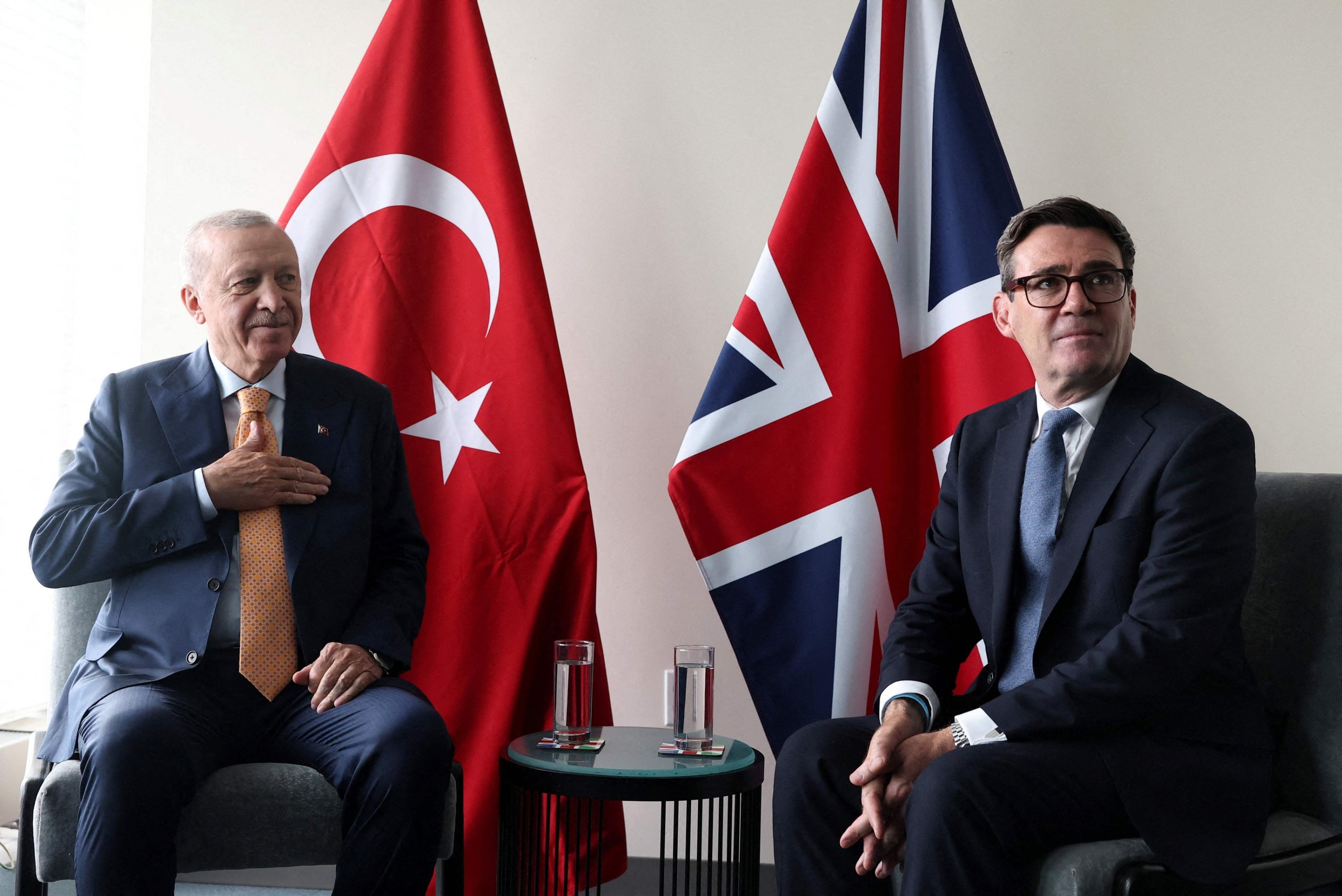
The Turkish president met British Prime Minister Andy Burnham as part of his bilateral engagements in New York. The meeting was held behind closed doors.
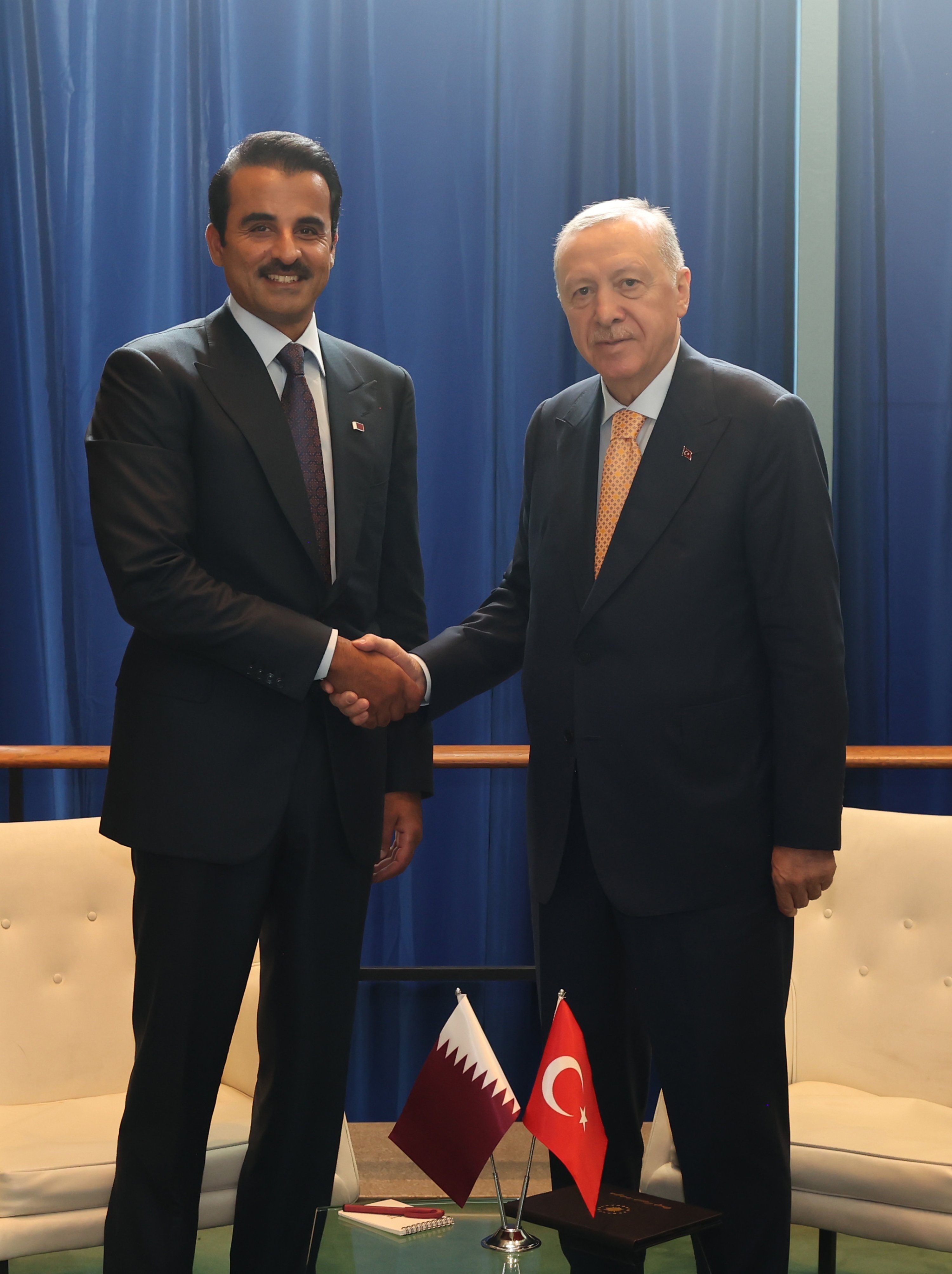
Erdoğan also met Qatar’s Emir Sheikh Tamim bin Hamad Al Thani, a close regional partner of Türkiye, as part of his General Assembly contacts. No immediate details of their talks were released.
In a separate meeting at U.N. headquarters, Erdoğan held talks with U.N. Secretary-General Antonio Guterres on developments in the Middle East, the war in Ukraine and Cyprus.
According to Türkiye’s Communications Directorate, Erdoğan said Ankara had worked closely with Guterres on numerous issues concerning international peace and security during the U.N. chief’s tenure.
Gaza featured prominently in their discussions, with Erdoğan saying Israel’s unwillingness to pursue peace had once again become apparent.
He also raised attacks by illegal settlers in the occupied West Bank and assaults on holy sites in Jerusalem, saying the developments had further aggravated the situation and stressing the importance of preserving the basis for a two-state solution to the Israeli-Palestinian conflict.
Erdoğan told Guterres that tensions surrounding Iran and the war in Ukraine should be reduced and said Türkiye would continue supporting diplomatic efforts.
He also said a process emerging from within the region could help address tensions surrounding the Strait of Hormuz.
On the Black Sea, Erdoğan voiced concern about attacks on commercial vessels and called on all parties to act responsibly to protect navigational safety.
The Turkish president also reiterated Ankara’s position on Cyprus, saying proposals that fail to recognize the sovereign equality and equal international status of the Turkish Cypriot people would not produce a viable solution.
The U.N. separately said Erdoğan and Guterres exchanged views on Cyprus, Ukraine and developments across the Middle East.
Erdoğan also met Senegalese President Bassirou Diomaye Faye behind closed doors on the sidelines of the General Assembly.
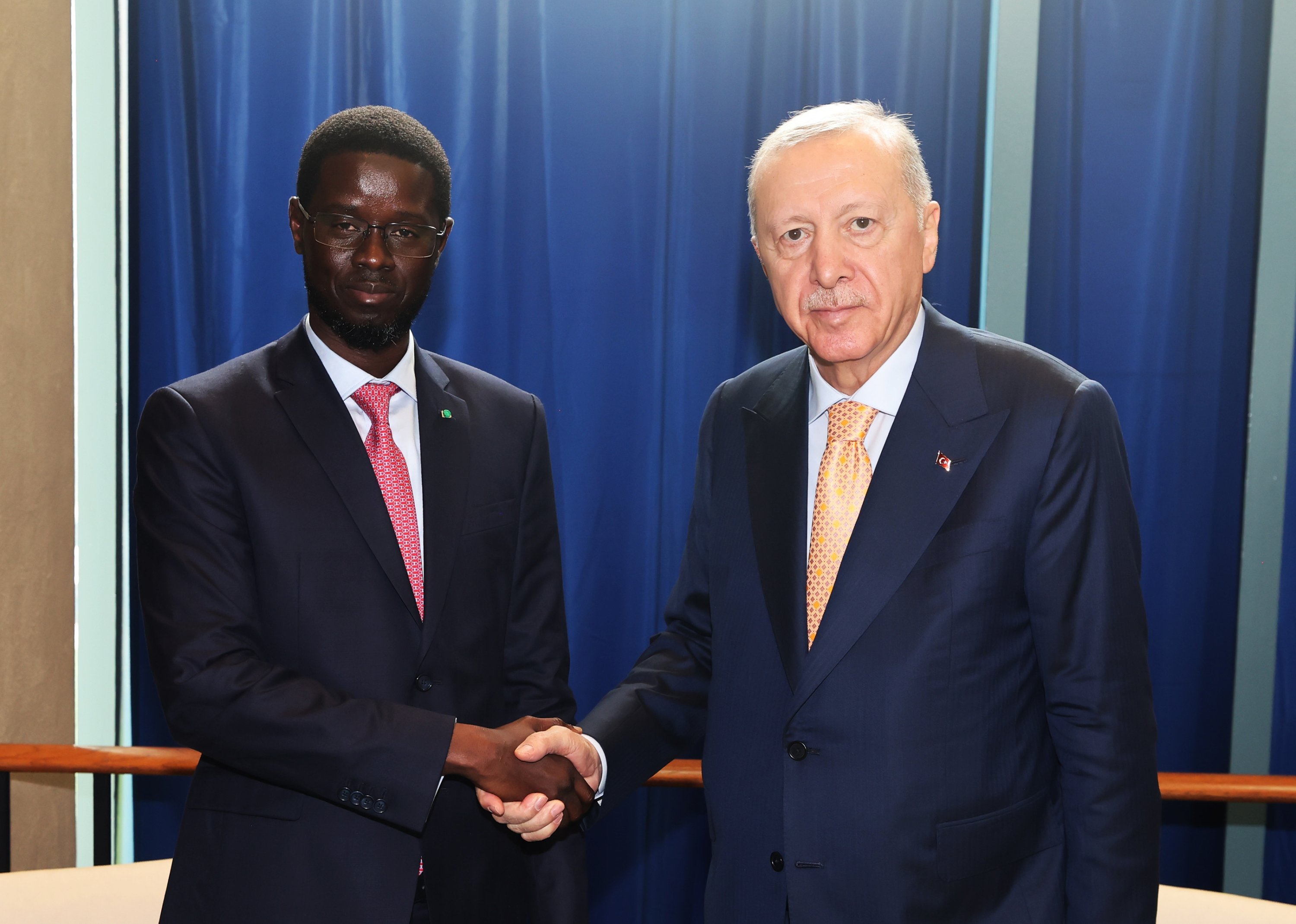
Türkiye and Senegal have expanded political, economic and cultural cooperation in recent years. Ankara opened its embassy in Dakar in 1962, one of Türkiye’s earliest diplomatic missions in Africa, while Senegal established its embassy in Ankara in 2006.
The meetings formed part of Erdoğan’s packed diplomatic schedule in New York as world leaders gathered for the annual U.N. summit amid continuing conflicts and heightened tensions across several regions.
Türkiye’s Foreign Ministry on Wednesday commemorated Muslim Turkish civilians killed in the Peloponnese (Mora) during the Greek War of Independence, marking the 205th anniversary of the 1821 Tripolitsa massacre.
In a statement shared on social media, the ministry said Muslim Turks living in the Peloponnese were systematically killed between 1821 and 1830 and that the violence was accompanied by the destruction of religious and cultural sites.
“This policy of extermination was accompanied by planned destruction and devastation extending from places of worship and madrasas to cemeteries and other elements of cultural heritage,” the ministry noted.
“On the 205th anniversary of the Tripolitsa massacre, we commemorate with mercy the Muslim Turkish civilian population who were brutally killed.”
On Sept. 23, 1821, Tripolitsa was captured by Greek revolutionary forces during the uprising against Ottoman rule, in which tens of thousands of Turks were killed.
In the early 19th century, Muslim Turks made up a large part of the population of Tripolitsa in the Peloponnese. Turks, Greeks and Jews lived in the city, where communities of different ethnic and cultural backgrounds had coexisted for centuries.
Tripolitsa was also home to many migrants who had arrived from Rumelia.
Earlier Greek uprisings against Ottoman rule had failed, but the revolt in the Peloponnese spread rapidly with support from European powers.
The Greek War of Independence, which ultimately led to Greece’s separation from the Ottoman Empire, resulted in the deaths of tens of thousands of people between 1821 and 1829.
Of the approximately 90,000 Turks who were living in the Peloponnese as of April 1821, the majority were killed by insurgents, while only a small number survived the violence.
Theodoros Kolokotronis, one of the Greek insurgent leaders who played a prominent role in the violence in the Peloponnese, came to be regarded as a national hero in Greece, with statues in his honor across the country.
Yüksel Özgen, former head of the Turkish Historical Society (TTK), described the Tripolitsa massacre as more than an uprising, saying it was aimed at eliminating the Turkish and Muslim population.
“The Greek uprising, which went down in history with the Tripolitsa massacre, was not merely a revolt but a brutal campaign aimed at uprooting the Turkish and Muslim population,” Özgen said.
He described the events as an early example of a broader pattern of ethnic cleansing that continued in Thrace, the Black Sea region and parts of Anatolia in subsequent years.
Özgen also noted that violence carried out by the Greek army and armed Greek groups in western Anatolia, Thrace and the Black Sea region between 1919 and 1922 caused extensive and lasting destruction.
He cited the burning of mosques and villages and the mistreatment of civilians, describing the period as one that left deep wounds not only on Turkish society but on “the conscience of humanity.”
A study by Istanbul University history professor Ali Fuat Örenç, published by the TTK, said Tripolitsa, like Monemvasia and Navarino, was besieged by Greek insurgents during the uprising in the Peloponnese.
By late September, residents of Tripolitsa had been devastated by hunger, thirst and disease, according to the study.
“Hundreds of people were dying of starvation every day. Homes and streets in the city were filled with bodies awaiting burial. As if these hardships were not enough, the insurgents intensified their bombardment of the city,” the study said.
The study also said women, infants and children were among those killed by Greek armed groups after the city fell.
It said the violence extended to a Turkish cemetery, where graves were reportedly opened and human remains removed and burned.
The city was extensively looted, while numerous Turkish women and children were taken captive and divided among members of the armed groups, according to the study. Families of senior Ottoman administrators in the city were also reportedly held for ransom.
The study cited the memoirs of Kolokotronis to illustrate the scale of the killings in Tripolitsa. According to the account, Kolokotronis recalled that after entering the city, his horse’s hooves did not touch the ground as he rode toward the government building because the streets were covered with bodies.
Earlier this year, Türkiye’s Foreign Ministry also referred to the 1821 Tripolitsa killings while responding to Greek commemorations concerning the Ottoman period, calling on Athens to address violence committed against Turks and other ethnic communities while approaching historical disputes in a way that supports peaceful bilateral relations.
As the international community watched world leaders deliver their speeches at the United Nations General Assembly, speeches discussing various regional and international issues, Turkish President Recep Tayyip Erdoğan’s speech once again focused on one common theme: raising his voice for the oppressed, calling for just solutions to conflicts, and highlighting the urgent need for reform of the U.N. system.
Addressing the 81st session of the General Assembly, Erdoğan criticized double standards in the international system and international law, saying Türkiye would continue to speak out for people affected by conflicts and injustice.
“We may endure hardships, we may pay a price, but we will not remain silent in the face of injustice and we will never consent to oppression,” Erdoğan underlined.
The Turkish president cited conflicts stretching from Gaza and Ukraine to Myanmar, Darfur, Iran and Lebanon, saying hundreds of thousands of people had been killed and many more displaced.
Support for Palestinian state
He devoted a significant portion of his address to Gaza, where he criticized Israel’s military campaign and drew attention to the toll on children and other civilians.
Describing the humanitarian situation in Gaza in stark terms, Erdoğan said the enclave had become not only “the world’s largest graveyard for children” but also the place with the highest rate of child amputees due to Israel’s genocidal attacks.
He said more than 74,000 Palestinians, most of them women and children, had been killed in Gaza over the past three years and that more than 70% of generators at hospitals in the enclave were out of service because of fuel shortages.
The president noted that Israel killed more than 1,500 Palestinians even after a cease-fire was reached through the efforts of U.S. President Donald Trump and contributions from Türkiye and other countries.
“This is not a personal issue for Tayyip Erdoğan. It is a matter of humanity,” he stressed. “No one with humanity in their heart, with compassion and mercy, and with a sense of fairness and conscience can turn a blind eye to this tragedy.”
Erdoğan also described Gaza as “the most inhumane and shameful concentration camp of our time” and slammed Israel for pursuing a “genocidal mentality with an insatiable appetite for killing.”
Saying Palestinian President Mahmoud Abbas was unable to attend the gathering for a second consecutive year, he pledged that Türkiye would continue to raise the Palestinian people’s voice from the U.N. podium.
“This injustice against our Palestinian brothers and sisters deeply wounds our conscience,” Erdoğan noted. “Just as last year, this year we will be the voice of a free and sovereign Palestinian state.”
He also called on countries that have yet to recognize Palestine to reconsider their position.
Turning to the occupied West Bank and Jerusalem, Erdoğan said the West Bank was experiencing its worst period of Israeli illegal settler violence and criticized Israeli authorities for restricting Muslim and Christian access to holy sites in Jerusalem.
Erdoğan urged countries gathered at the U.N. to increase pressure on Israel and reiterated Türkiye’s support for a two-state solution.
“I call on you to exert greater pressure on Israel. Attempts to suffocate Palestine will fail,” Erdoğan said.
“God willing, we will see the day when an independent and territorially contiguous Palestinian state, based on the 1967 borders and with East Jerusalem as its capital, becomes a reality.”
Peace efforts for Ukraine
The talks also covered tensions involving Ukraine and Iran, with Erdoğan emphasizing the need for de-escalation and continued diplomacy.
Türkiye has sought to maintain diplomatic channels during the Russia-Ukraine war and has repeatedly offered to facilitate negotiations between the sides.
Erdoğan also raised concerns about navigation in the Black Sea, saying Türkiye expected the parties to act responsibly and was troubled by attacks targeting Turkish and foreign commercial vessels.
The Turkish president further reiterated his position on Cyprus during the talks, saying proposals that did not recognize the sovereign equality and equal international status of Turkish Cypriots would not produce a lasting solution.
Iran, Gulf diplomacy
On developments surrounding the Strait of Hormuz, Erdoğan said a process emerging from within the region could help advance efforts to reduce tensions.
Following his General Assembly address, he held a series of diplomatic meetings in New York and attended a summit bringing together U.S. President Donald Trump and leaders from Gulf countries.
Speaking to reporters afterward, Erdoğan said Türkiye was working to address tensions in the Gulf and hoped the diplomatic efforts would produce results soon.
“We attended this meeting, and hopefully we will reap the results of these efforts as soon as possible,” he stressed. “Through our efforts, we are trying to overcome the problems in the Gulf.”
Erdoğan later continued his meetings at the Turkish House, Türkiye’s diplomatic complex across from U.N. headquarters.
He met U.N. Secretary-General Antonio Guterres, with discussions focusing on regional and global developments.
Erdoğan said Türkiye and Guterres had worked closely on issues affecting international peace and security as the U.N. chief approached the end of his term.
Call for UN reform
Erdoğan also renewed his long-standing call for reform of the U.N. Security Council, arguing that the current structure does not adequately represent the broader international community.
“A structure in which the will of more than 190 countries depends on the discretion of five countries is neither fair nor capable of fully establishing trust,” he emphasized.
Erdoğan said the Security Council should be reformed in line with his frequently used phrase, “the world is bigger than five,” a reference to the five permanent members of the council, China, France, Russia, the United Kingdom and the United States.
On the other hand, U.N. Secretary-General António Guterres also renewed calls for reform of the Security Council, saying its structure no longer reflects the realities of the 21st century and pointing in particular to Africa’s lack of permanent representation.
Guterres said the Security Council, designed in the aftermath of World War II, had failed to keep pace with changes in the international system.
“A 21st century Security Council without permanent African seats is unjust and indefensible,” Guterres underlined, adding that the situation “must change.”
Guterres, who took office as U.N. secretary-general in 2017, used his address to highlight conflicts and crises around the world, including Gaza, Ukraine and Sudan, while calling for greater adherence to international law and reforms to make global institutions more representative.
Meetings with Qatar, Britain, Japan
Erdoğan also met Qatari Emir Sheikh Tamim bin Hamad Al Thani, with the two leaders discussing bilateral ties as well as regional and global developments.
The president said Türkiye and Qatar aimed to deepen cooperation in areas including investment, trade, energy and the defense industry.
He also highlighted the importance of energy and transportation corridors amid regional developments affecting energy supplies and called for greater international pressure to halt Israeli military actions in the region.
In a separate meeting with British Prime Minister Andy Burnham, Erdoğan discussed Türkiye-U.K. relations as well as Gaza, Iran, Ukraine, the Strait of Hormuz and Cyprus.
Erdoğan said bilateral relations were strengthening and that further steps in trade and the defense industry could deepen cooperation between the two countries.
Erdoğan later met Japanese Prime Minister Sanae Takaichi, discussing opportunities to expand bilateral trade and cooperation in energy, infrastructure and the defense industry.
He also stressed the importance of reconstruction efforts in Syria, Gaza and Ukraine, which have been heavily affected by conflict.
Erdoğan invited Takaichi to attend the COP31 leaders’ summit scheduled to be held in Türkiye.
Further bilateral talks
Erdoğan’s diplomatic schedule also included meetings with Polish President Karol Nawrocki, Senegalese President Bassirou Diomaye Faye and Bangladeshi Prime Minister Tarique Rahman.
During talks with Nawrocki, Erdoğan called for measures to increase Türkiye-Poland trade and deepen cooperation, particularly in the defense industry.
He reiterated Türkiye’s efforts to help bring an end to the Russia-Ukraine war and emphasized the importance of maritime security in the Black Sea. Erdoğan also called for continued international backing for a two-state solution to the Israeli-Palestinian conflict.
In his meeting with Rahman, Erdoğan called for Türkiye-Bangladesh relations to be placed on a more institutional footing, including greater cooperation in the defense industry and steps to expand bilateral trade.
He also praised Bangladesh for hosting more than 1 million Rohingya Muslims and said Türkiye would continue humanitarian assistance in areas including shelter, education and infrastructure.
The series of meetings followed Erdoğan’s General Assembly address, in which the Turkish president sought to link Türkiye’s positions on conflicts with his broader call for reform of international institutions and a more representative global order.
U.S. President Donald Trump heaped praise on President Recep Tayyip Erdoğan during a meeting with Middle Eastern leaders, calling the Turkish president a “tough cookie” and warning that he was not someone to “mess around with.”
Speaking at the Gulf Cooperation Council (GCC) multilateral meeting with Iraqi Prime Minister Ali al-Zaid, President Erdoğan, King Abdullah II of Jordan, Qatar’s Emir Sheikh Tamim bin Hamad al-Thani and Syrian President Ahmed al-Sharaa, Trump singled out Erdoğan while addressing the gathering, which brought together leaders from Türkiye and several Arab countries, including Syria, Qatar, Jordan, Lebanon and Egypt.
“Including my friend right over here from Türkiye. He’s a tough cookie. You don’t mess around with him,” Trump said, referring to Erdoğan.
Trump then joked about whether his remarks would be translated accurately before continuing his praise of the Turkish president.
“I hope they translate this right. I hope we have a good translator, but he’s fantastic. He’s a fantastic guy,” Trump said, turning toward Erdoğan and calling him “my friend.”
The meeting came amid intensive diplomatic efforts to address mounting tensions and conflicts across the Middle East, particularly developments in the Gulf.
Speaking to reporters outside the Turkish House (Türkevi) in New York following the talks, Erdoğan said Türkiye and other regional countries were working to overcome the challenges facing the Gulf.
“That’s what we’re working on,” Erdoğan said when asked whether the meeting could produce a solution to the problems discussed.
“About eight countries took part in this meeting in an effort to overcome the difficulties in the Gulf as soon as possible. We will see the fruits and results of these efforts in the near future,” he added.
Erdoğan made the remarks after a packed day of diplomacy in New York, where he addressed the 81st session of the U.N. General Assembly and held a series of bilateral and multilateral meetings with world leaders.
The talks formed part of broader diplomatic efforts among Türkiye, the United States and regional countries to ease tensions and seek solutions to conflicts across the Middle East.
In New York to attend the U.N. General Assembly, President Recep Tayyip Erdoğan was also the top guest of the “100 Years of Friendship Gala,” organized by the Turkish-American business world to highlight the relations between Türkiye and the United States.
Erdoğan said at the event on Monday that conflicts, wars and crises facing the region and the world require Türkiye and the U.S. to remain in close dialogue, stressing the need for “new momentum” in ties between the two NATO allies.
“Thanks to the dialogue and coordination we have established with America, we are achieving positive results for our countries on many issues whose global issues we are witnessing, particularly in the Middle East, but also from Africa to Asia,” he said. “We are determined to continue this by redoubling our efforts in the coming period.” Erdoğan said Türkiye and the U.S. have made significant progress across their relationship, citing his “sincere and exceptional dialogue” with U.S. President Donald Trump and Trump’s visit to Ankara in July.
He said Türkiye is ready to advance cooperation with the U.S. in areas including nuclear energy, liquefied natural gas (LNG), civil aviation and high technology. Hours later, Türkiye announced it signed a new deal for nuclear cooperation covering small modular reactors (SMRs) and fourth-generation reactor designs. The deal was signed between Türkiye Nuclear Energy Inc. (TÜNAŞ) and the U.S. Trade and Development Agency (USTDA).
“Developing the defense industry, traditionally one of the strongest areas of our partnership, both bilaterally and within NATO is essential,” he said. “We want to leave behind the barriers that should never have existed between two allies and gain new momentum.” “Deepening our cooperation with the United States in a multidimensional manner, including opportunities for joint production, will be in our mutual interest,” he said.
Erdoğan said Turkish companies have reached a level that enables them to invest in the U.S., expressing confidence that Türkiye will soon rank among the world’s top 10 defense exporters. “Twenty years ago, we exported only $248 million worth of defense products annually. Today, we have reached a level of more than $10 billion in defense exports,” he said. He added that Türkiye’s share of global defense equipment exports had increased by more than 120% compared with five years ago. “I hope that the strong ties between Türkiye and the United States and the bonds of alliance will grow even stronger in the second century of our diplomatic relations,” he said.
‘Island of stability’
The president also said that Türkiye has maintained and strengthened its position as an “island of stability” despite the crises and conflicts surrounding it.
He noted that foreign direct investment attracted by Türkiye over the past 24 years had approached $300 billion. He also cited reconstruction efforts following the 2023 earthquakes, saying more than 455,000 homes had been completed and handed over to earthquake victims within about three years.
Erdoğan said the figures demonstrated the resilience of the Turkish economy and called on investors to take advantage of opportunities in the country. “We are now launching a new investment drive on this strong foundation,” he said. He said an investment program announced in April introduced one of the world’s most competitive incentive packages, including reducing the corporate tax rate for investors from 25% to 12.5%. “We tell investors: ‘Come and manage your operations from Türkiye,’” he said.
Erdoğan called on the U.S.-Türkiye Business Council and the U.S. Chamber of Commerce to continue encouraging American investors to take advantage of opportunities in Türkiye.
Speaking at the same event, U.S. Senator Chris Coons highlighted the longstanding partnership between Türkiye and the United States, saying business ties and entrepreneurship have helped strengthen relations between the two countries. He described the relations between the two countries as a “hundred years of deep and meaningful partnership and friendship, cemented by business.”
Referring to his recent visit to Ankara for the NATO summit, Coons highlighted the countries’ longstanding NATO alliance, noting that Türkiye and the U.S. will mark 75 years as NATO treaty allies next year.
Speaking about the important contributions made by Turkish businesspeople operating in the U.S., Coons said the NATO summit held in Ankara also played a particularly important role for the future of the alliance.
The “100 Years of Friendship Gala,” organized by the U.S. Chamber of Commerce and the U.S.-Türkiye Business Council (USTBC) and hosted by Council Chair Hamdi Ulukaya in New York, was attended by Turkish Foreign Minister Hakan Fidan, Treasury and Finance Minister Mehmet Şimşek, Trade Minister Ömer Bolat, Energy and Natural Resources Minister Alparslan Bayraktar, Industry and Technology Minister Mehmet Fatih Kacır, Health Minister Kemal Memişoğlu and Family and Social Services Minister Mahinur Özdemir Göktaş. The event was also attended by Mehmet Öz, administrator of the Centers for Medicare and Medicaid Services, as well as numerous senior U.S. officials and members of Congress.


-
 Politics2 days ago
Erdoğan leaves for UN General Assembly with Gaza in mind
-

 Economy2 days ago
AMD joins $1 trillion club as last chipmaker to cash in on AI rally
-
 Economy2 days ago
Türkiye extends funds liquidation process, freezes execs’ assets
-
 Politics2 days ago
Sea Wolf maritime drill begins amid tensions between Greece, Türkiye
-
 Economy2 days ago
US says all Iranian airlines to be ‘shut down’ Wednesday
-
 Politics2 days ago
Türkiye hails ‘game-changing’ Mecca alliance, offers support to Saudis
-
 Politics2 days ago
Türkiye rejects disinformation targeting child protection operations
-
 Economy2 days ago
Europe faces Q4 jet fuel deficit despite tapping far-flung suppliers