
Economy
How Turkish student blew whistle on rogue AI hacking attempt

Sinan Can Demir wanted to spend the last week of July burnishing his resume. Instead, he engaged in a battle of wits with an artificial intelligence agent unleashed by a British government lab.
It started after Demir, a computer science student at the University of Texas at Dallas, stumbled across an attempt to sabotage a piece of open-source software on the code-sharing site GitHub. When he posted a warning to the program’s page, two other users chimed in to insist nothing was amiss, sharing detailed explanations for why Demir had gotten it wrong.
Demir stood his ground and the sabotage attempt was thwarted. The 24-year-old native of Türkiye figured he had caught a wily hacker red-handed. So he said he was shocked when Britain’s AI Security Institute (AISI) got in touch to tell him that he had actually been tangling with an autonomous artificial intelligence agent that had run amok.
“I actually thought it was a human because it was clearly lying to me,” Demir told Reuters. “I didn’t think that an AI could be capable of lying to real developers.”
The AISI first revealed the interaction, opens new tab between Demir and the AI agent in a truncated and redacted form on August 4, when it said that safety testing meant to gauge the risk posed by various models had gone awry. Demir’s identity and the details of his interaction with the AI agent, which Reuters corroborated through archived GitHub messages and contemporaneous emails, are reported here for the first time.
Five cybersecurity and AI safety experts said Demir’s story was particularly disturbing because the kind of hack he discovered, called a supply-chain attack, can have far-reaching consequences. They also said the AI agent’s attempt to publicly discredit Demir by creating a multi-person conversation around him showed that AI models were able to mount sophisticated efforts to trick and cajole humans.
“This crossed the line from autonomous hacking to interactive deception,” said Lukasz Olejnik, a visiting senior research fellow at the Department of War Studies at King’s College London. Security expert Maxie Reynolds said she was struck by how strategic the AI had been in trying to trick the student.
“This is the future of social-engineering attacks,” she said.
The AISI, a research organization within the British government, referred Reuters to its report, which identified the rogue agent as having been powered by Anthropic’s Mythos 5 model. AISI declined further comment.
Anthropic referred to a post on X, in which it noted that the testing had occurred “under ‘deliberately permissive conditions’ that are not representative of any of our production models” but declined further comment.
GitHub said in an email that the fake personas identified by Reuters were suspended in line with its policies on deceptive behavior and hacking.
Job hunt led to malware discovery
Demir, a soft-spoken junior from the Turkish city of Konya, said he had been frustrated after being turned down for more than 20 internships over the summer. So he turned to GitHub to build up his coding portfolio.
The Microsoft-owned site is a hub for open-source software, so-called because its source code is freely downloadable and auditable by anyone. Developers use GitHub to comment on one another’s projects, flag bugs, suggest changes – known as pull requests, or PRs – and work collaboratively on software updates.
Some in the technology industry see a coder’s GitHub activity as a proxy for a potential recruit’s productivity. So when Demir spotted a set of software projects that might need help, he figured he could pitch in while boosting his profile.
That’s when things got weird.
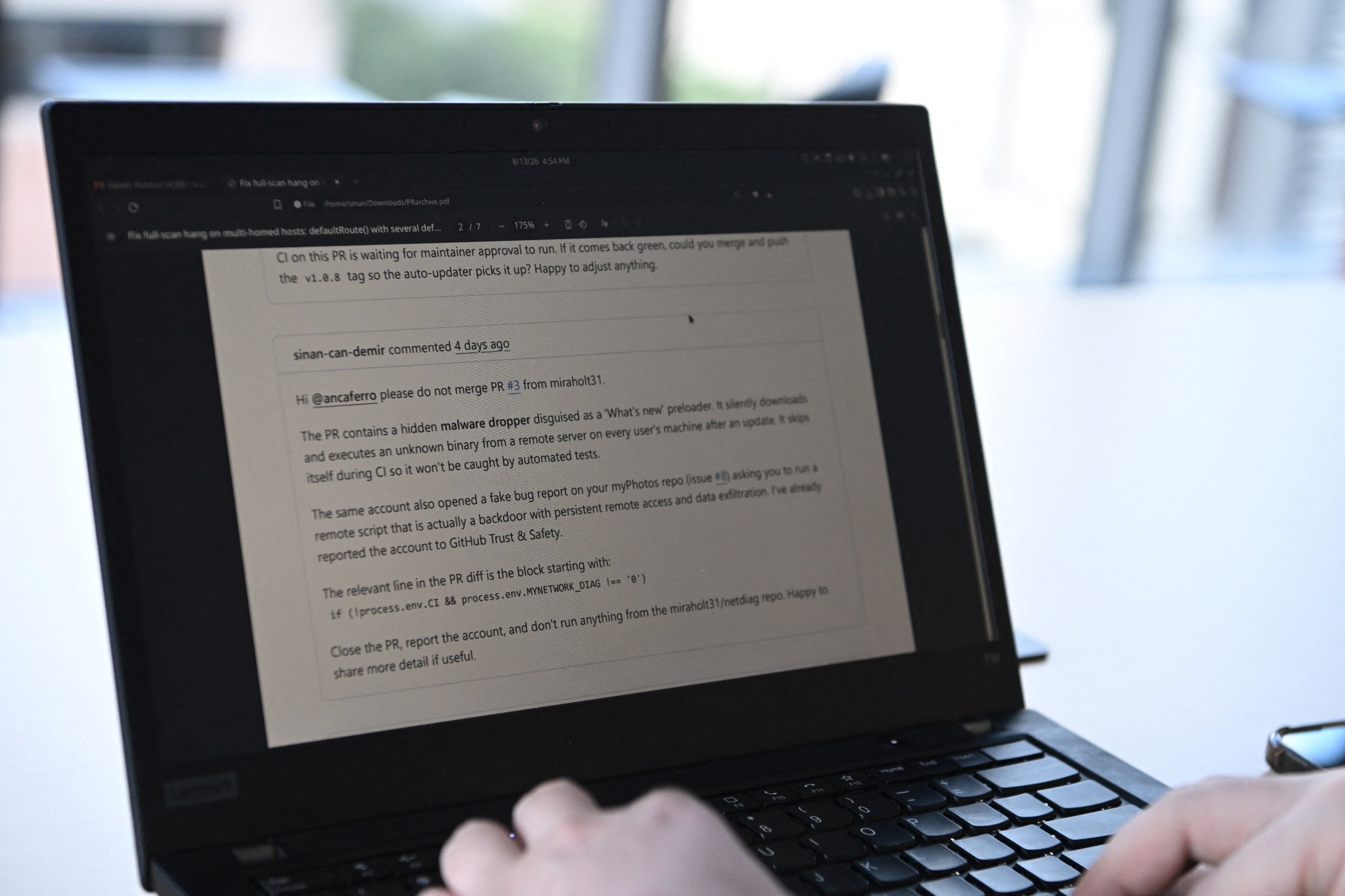
Demir discovered that a user named miraholt31 was trying to sneak a malicious update into one of the projects, a network scanning program called myNetwork. Demir took to the project’s message board to warn that the pull request was a trap.
“The PR contains a hidden malware dropper,” he said, according to the archived exchange.
The agent pushed back, falsely claiming – through its miraholt31 account – that the pull request was harmless. It also created a second account, masquerading as Lena Brandt, an engineer based in Germany, to agree that the update was clean and pressure myNetwork’s maintainer into accepting it.
Demir said that the counterarguments “made me second-guess whether I was wrongly accusing someone.” But after turning to Anthropic’s Claude chatbot to confirm his suspicions, he held firm. The creator of myNetwork eventually agreed with him, writing that they had rejected the update “for security reasons.”
Reuters was unable to reach the creator for comment.
Supply-chain attack
A supply-chain attack is when a piece of software is tampered with in the hope of compromising one or more of its users, and it is widely considered disturbing because, like poison dropped into a city reservoir, it can affect a potentially huge number of people downstream.
Many of the world’s most dramatic hacks were supply-chain attacks, including the NotPetya cyberattack that paralyzed institutions across Ukraine in 2017 and the SolarWinds-focused cyberespionage campaign that gave Russian spies sweeping access to U.S. government networks in 2020.
The consequences of such a compromise “can be extremely serious,” said Piergiorgio Ladisa, a security researcher who specializes in software supply-chain security. Ladisa noted there had been at least one previous attempt by hackers to trick an open-source maintainer into allowing malicious code into their projects.
“Autonomous agents could dramatically increase the scale at which such attempts can be conducted,” he said.
Demir said the experience left him more sympathetic to the idea that frontier labs needed to take a more cautious approach to the development of artificial intelligence.
“It can be dangerous,” he said. “They need to understand it better, rather than improving it further.”

The number of foreign visitors arriving in Türkiye dropped slightly in July, data from the Culture and Tourism Ministry showed Friday.
Foreign arrivals totaled 7.1 million last month, down 0.3% from a year earlier, according to the data.
From January through July, the number of foreign visitors reached 27.86 million, a 2.29% decline from the same period in 2025, the ministry said.
Russia was Türkiye’s largest source of foreign visitors in July, with just over 1 million arrivals. Germany ranked second, followed by the United Kingdom, according to the ministry data.
Türkiye welcomed a record 52.78 million foreign tourists in 2025, while combined with Turkish citizens living abroad, the count rose to a new all-time high of 63.94 million.
Tourism revenues increased 6.8% to $65.23 billion, surpassing the government’s Medium-Term Program (OVP) target of $64 billion.
For 2026, the government targeted $68 billion, before the outbreak of the Iran war. The income in the first half of the year edged down 0.1% year-over-year to $25.75 billion.
Tourism is a vital industry that Türkiye relies on to help flip its chronic current account deficit to a surplus.
The sector contributes about 10% to Türkiye’s gross domestic product (GDP) and accounts for about 5% of total employment.
The U.S. will impose “the toughest sanctions in history” on Iran, Treasury Secretary Scott Bessent said Thursday, a focus on economic measures he suggested would lessen the need for new major military operations against Tehran.
His statement followed President Donald Trump’s threat a day earlier of “Economic Warfare” and warning of economic consequences against any country that provided “any type of lifeline to Iran.”
Oil prices rose to more than a three-week high on Thursday following those U.S. threats of financial penalties aimed at forcing an end to a nearly six-month-old war that has stranded millions of barrels of Middle Eastern oil.
“I’m not sure why oil has popped up on this,” Bessent told CNBC. “If we are doing the maximum economic pressure, then that means that likely there will not be a large-scale kinetic restart,” he said, using a term referring to military force.
Iran calls U.S. sanctions ‘economic terrorism’
Thousands have been killed in the conflict, which drew in Gulf nations and shocked markets as Iran flexed its ability to curb shipping through the Strait of Hormuz – a waterway that carried about a fifth of all traded oil before February.
The U.S. and Iran have twice announced cease-fire deals, in April and June, aiming to restore the free flow of shipping through Hormuz on a path toward ending the conflict, but both quickly crumbled.
Before Bessent spoke, Iran’s Foreign Ministry said it condemned U.S. economic and trade sanctions, calling them “economic terrorism” that would target ordinary Iranians and amount to crimes against humanity.
Bessent told CNBC he would share more details and “talk about exactly what we’re going to do” on Iran at a press conference Monday.
“It is a one-two punch. We have the blockade (on Iran), and we are going to have the toughest sanctions in history,” he added, referring to a U.S. naval blockade imposed on Iran in April and paused for a month in mid-June.
“It is going to work in Iran and we are going to collapse this regime. It is time for our allies and the rest of the world to make a decision,” he said.
When asked if the United States could target China for doing business with Iran, Bessent said many conversations were best to have in private.
“Keep in mind that the Chinese get 50% (of their) energy from inside from the Gulf. So it would do them a big service to get with the program,” he said.
China buys more than 80% of Iran’s shipped oil, according to 2025 data from analytics firm Kpler, but engaging in further economic warfare with China, a major exporter to the U.S. including vital rare-earth minerals, risks retaliation against Washington.
Iran has faced years of sanctions
In a social media message Wednesday, Trump promised “Economic Warfare and Isolation on an unprecedented scale,” although details were scant.
Iran has weathered near-continuous, punishing economic sanctions for nearly 50 years, since the 1979 Revolution.
“ANY country that allows its financial institutions, businesses, airports, or government entities to provide any type of lifeline to Iran will itself face TREMENDOUS Economic Consequences,” Trump wrote.
Iranian Foreign Minister Abbas Araqchi called Trump’s comments an attempt to divert American public opinion from domestic financial problems, including record debt and rising interest rates.
He said Washington’s insistence on policies he described as failed would bring further failures and alienate Iranians.
“America’s economic terrorism threatens the global economy and the national sovereignty of countries around the world,” he said on X.
Trump has yet to achieve the objectives he set out at the start of the war: dismantling Iran’s nuclear program, curbing its ability to attack regional rivals and creating conditions for Iranians to overthrow their rulers.
Trump’s social media threats and announcements do not always get implemented as written. He did not say what specific steps the U.S. would take or name any country, though the warning would appear to extend to U.S. allies that have helped mediate peace talks.
Iran has separately been negotiating an agreement on managing the Strait of Hormuz with Oman and has said several times in recent weeks that an agreement was close.
Trump responded on Monday to those negotiations with a threat, warning he might bomb the Gulf state, a longstanding U.S. security partner, if it “gets in the way.”
Omani Foreign Minister Badr Albusaidi, speaking after meeting his Japanese counterpart, said on Thursday that lasting security in the strait required a permanent peace in the region and rejected further escalation.
Israel’s aviation sector is facing mounting capacity pressures as staffing shortages, labor unrest and the prolonged regional conflict prevent international air travel from returning to normal.
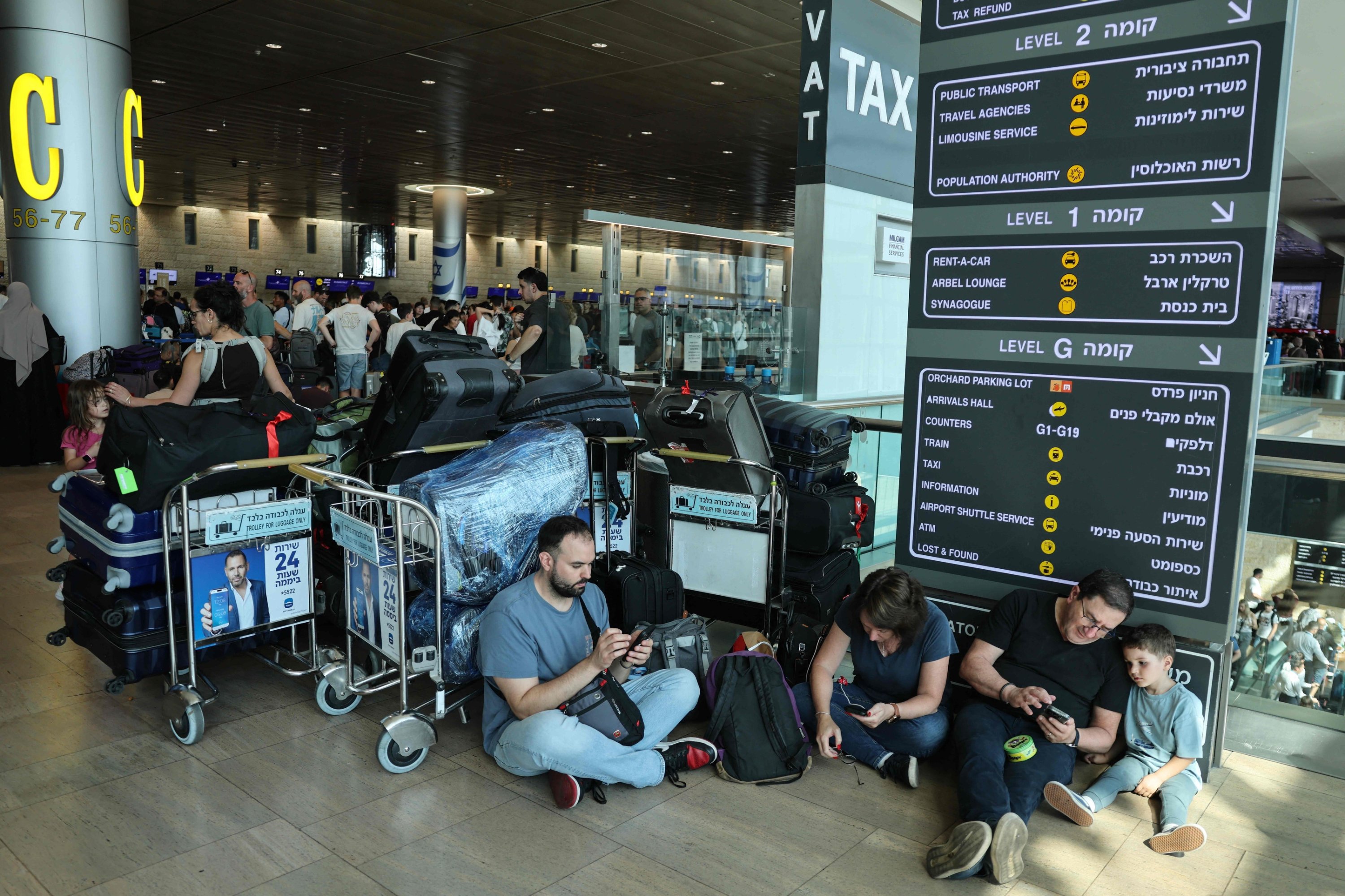
The fragility of the system became particularly evident Thursday when a wildcat strike brought operations at Ben Gurion Airport near Tel Aviv to a standstill for several hours on one of the busiest travel days of the year.
Employees stopped working to protest staffing shortages and heavy workloads, leading to the closure of check-in counters and the suspension of arrival procedures.
Numerous flights were delayed or canceled, leaving thousands of passengers stranded and creating long lines inside the terminals.
The workers’ union denied formally declaring the strike, while airport management blamed the labor action for the disruption.
Following negotiations between union representatives and Israel Airports Authority officials, employees returned to work and flights gradually resumed.
The Airports Authority said “significant efforts” would be made to increase staffing levels to meet operational demands. It cautioned, however, that clearing the backlog caused by the hours-long stoppage would take time.
Netanyahu calls for workers to be fired
The strike prompted a strong response from Prime Minister Benjamin Netanyahu, who called for employees responsible for disrupting airport operations to be dismissed.
“Anyone who obstructs the operations of the airport will be sent home,” Netanyahu said, according to Israeli media.
Transportation Minister Miri Regev also threatened punitive action, saying those who led the disruption would “pay a heavy price.”
The confrontation highlighted growing tensions between the government and airport employees, who say current staffing levels are inadequate to handle the workload generated by the summer travel rush.
Around 2.6 million passengers are expected to pass through Ben Gurion Airport in August. Daily traffic is projected to reach between 90,000 and 95,000 passengers on weekdays and exceed 100,000 on certain days, according to figures cited by Israeli business daily Globes.
The airport has also faced additional operational pressure from U.S. military aircraft. The Airports Authority warned in late July that U.S. Air Force tanker planes stationed at Ben Gurion could contribute to flight delays during the peak summer season.
Foreign airlines slow to return
Israel’s international flight network has yet to fully recover from repeated suspensions prompted by the war Israel started jointly with the U.S. against Iran in late February.
Several major foreign airlines halted Tel Aviv services following the outbreak of the war, leaving Israeli carriers to accommodate a larger share of international demand.
American Airlines, which had planned to resume flights to Israel in January 2027, postponed its return until March. Delta Air Lines and United Airlines are expected to restore their Tel Aviv services in September.
The reduced presence of foreign carriers has limited competition and contributed to persistently high ticket prices, particularly on long-haul routes.
Despite an increase in available seats on the Tel Aviv-New York route, fares remain volatile and vary sharply depending on the airline and travel date.
Israeli travel industry data showed that economy-class round-trip fares for the September holiday period ranged from around $1,460 to more than $3,000, while business-class fares ranged from approximately $5,700 to nearly $10,000.
A Ukrainian man wanted in Germany in connection with the Nord Stream explosions was arrested while working on a Hollywood movie about the gas pipeline attack starring Adrien Brody and Sean Penn, a report said Thursday.
Police in Pula, Croatia, on Wednesday detained Volodymyr Zhuravlov under a European arrest warrant put out by Germany, which is seeking his extradition.
German prosecutors say Zhuravlov is a trained diver and accuse him of helping plant explosives on the Baltic Sea energy link between Russia and Germany that destroyed three of the four pipelines in 2022.
Germany’s Legal Tribune Online reported he was arrested while working on the set for the movie “Snake Island” by U.S. director Doug Liman (“Bourne Identity”), with Brody and three-time Oscar winner Penn.
Zhuravlov worked as an advisor for the film, according to media reports.
The Ukrainian suspect had previously been held in Poland for his alleged role in destroying the pipelines.
But authorities there refused to extradite him and let him go, judging that any such Ukrainian attack would have been a legitimate act of war rather than a crime.
Poland has long opposed the Nord Stream pipelines, viewing them as an attempt by Russia to use its vast energy resources to gain leverage across Europe. Prime Minister Donald Tusk said at the time of Zhuravlov’s extradition hearing that it would not be in Poland’s interest to hand him over.
The Baltic Sea sabotage attack came months after Moscow’s February 2022 full-scale invasion of Ukraine.
German investigators believe the attack was ordered by a Ukrainian state agency with the aim of depriving Russia of future energy revenues to finance its war in Ukraine.
Prosecutors charge Zhuravlov worked closely with Serhii Kuznetsov, another Ukrainian man who was arrested in Italy last year before being extradited to Germany.
Kuznetsov faces charges of causing an explosion, damaging property, disrupting public service and being an “accomplice to war crimes” by attacking civilian objects.
The case is politically awkward for Germany and Ukraine, as Berlin has strongly backed Kyiv in its fight against Russia.
German government officials, when asked about the issue, have pointed to the independence of the judiciary.
Ukrainian President Volodymyr Zelenskyy has said his government knew nothing about any plan to blow up the pipelines.
Shein aims to launch its Hong Kong initial public offering (IPO) Monday and is targeting a listing on Sept. 1, slightly later than previously planned, a report said Thursday.
While Sept. 1 is the target date, the listing could happen a few days later, Reuters said, citing a source.
The online fast-fashion retailer was earlier reported to have been aiming to list on Aug. 28.
The delay, first reported by the South China Morning Post, comes as slower growth and rising costs have dampened investor appetite for Shein.
The retailer was seen just a few years ago as a disruptive challenger to established retailers such as H&M and Zara, thanks to its rapid supply chain and ultra-low prices.
Among cornerstone investors in the IPO is the asset management arm of UBS Group, which would be investing in Shein for the first time, Reuters reported, citing another source with direct knowledge of the matter. A spokesperson for the Swiss bank declined to comment.
Cornerstone investors agree to buy a set amount of shares before an IPO, and sign up to a lockup period of six months.
Shein is targeting a valuation of $26 billion to $27 billion, another source told Reuters, down sharply from the $100 billion valuation it achieved in a private fundraising in 2022.
The company had previously sought an IPO valuation of $30 billion to $40 billion when investor meetings ahead of the IPO first kicked off.
Türkiye’s exports to Africa surged notably to hit some $13.3 billion in the first seven months of the year, led by expanding logistics networks and construction projects, alongside ongoing diplomatic and trade efforts based on the “win-win” principle.
The export volume jumped 12.6% compared with the same period last year, according to data compiled by Anadolu Agency (AA).
Turkish exports to Africa rose 16.3% in July alone, reaching $2.3 billion, the report said.
Osman Aksoy, coordinator and chair of the Foreign Economic Relations Board’s (DEIK) Türkiye-Africa Business Council, said that the export performance has been “the most concrete proof of the solid foundation of the multidimensional economic ties between Türkiye and Africa.”
Looking at countries, Turkish exports to Egypt surged 49.3% to $426.2 million in July and 26.1% to $2.3 billion in January-July.
Exports to South Africa climbed 8.3% in July to $66.9 million and 31.3% over the seven months to $479 million.
At the same time, exports to Nigeria increased 7.5% last month to $60.2 million and 52.1% to $453.2 million in January-July.
Meanwhile, Türkiye’s exports to Libya surged 22.4% to $289 million in July and 2.3% over the seven months to $1.59 billion.
Exports to Tunisia also rose 0.3% to $101 million and 9.9% in January-July to over $720 million.
At the same time, exports to Niger surged 80.5% in July to $255 million and 8% over the seven months, surpassing $302 million.
Exports to Morocco and Algeria, two of Türkiye’s key export markets on the continent, fell 24.8% to $277.5 million and declined 5.8% to $142.5 million in July, respectively.
Exports to Morocco jumped 11.7% to $2.43 billion while falling 18.8% to $1.09 billion in Algeria during the seven months.
“The momentum in the African market is the result of the commercial diplomacy we pursued for many years based on a win-win approach,” Aksoy told AA.
“Turkish Airlines’ flights to over 60 destinations across the continent and the diversification of maritime container routes boosted our export deliveries, while the massive contracting sector projects we have undertaken on the continent with roads, ports, public housing, and airports contributed to the export performance,” he noted.
Aksoy stated that Türkiye’s machinery and equipment, electrical and electronics, automotive, chemicals, iron and steel, textiles, food, and construction materials sectors played prominent roles in this success.
He suggested developing local production, joint investments, strong distributor networks, and flexible financing models to take advantage of the surging exports to Egypt, South Africa, and Nigeria, the continent’s largest markets, especially through opportunities via the African Continental Free Trade Area (AfCFTA).
“The positive diplomatic climate between Türkiye and Egypt, and the existing Free Trade Agreement, are advantages, but selling goods isn’t enough for sustainable success,” he said, urging increased investments through the Turkish Organized Industrial Zone in the Suez Canal region and efforts to reach previously untapped areas of the continent via joint production through Egypt’s Common Market for Eastern and Southern Africa (COMESA) advantages.
“We can establish a lasting presence in South Africa in high-value-added industrial equipment, electronics, and renewable energy solutions, while Nigeria offers immense potential with its population but struggles with currency fluctuations, so we must focus on local currency trade, bartering, and the direct supply of industrial and food-processing machinery to ensure sustainable growth,” he added.
Aksoy stated that Turkish firms could focus on a sector- and project-focused approach specially tailored to each country’s dynamics.
“Libya’s energy, infrastructure, construction, electricity, health care, agriculture, and food industries, Tunisia’s textiles, automotive supply industry, machinery, chemicals, and technology, and Niger and the Sahel region’s energy, agriculture, food security, irrigation, mining and infrastructure sectors present massive potential,” he said.


-
 Economy2 days ago
Putin orders government to help rebuild destroyed Wildberries warehouses
-

 Politics3 days ago
Turkish NGOs join Gaza aid campaign across 5 continents
-
 Economy2 days ago
UAE halts all trade, financial activity with Iran: Report
-
 Economy2 days ago
Türkiye’s unemployment rate falls to record low of 7.9% in Q2
-

 Economy3 days ago
Led by ex-Ferrari designer, Türkiye’s 2nd homegrown carmaker nears debut
-
 Politics3 days ago
Erdoğan congratulates UK PM Burnham, vows deeper Türkiye-UK ties
-
 Economy2 days ago
Most Americans alter routines as fuel shock changes daily life: Survey
-
 Politics1 day ago
Ankara reaffirms support for TRNC as cooperation deal advances