
Economy
Iraq working to expand oil exports via Türkiye, Syria, Jordan: PM

Iraq is working to expand oil exports through Türkiye’s Mediterranean port of Ceyhan and develop export routes via Syria’s Baniyas and Jordan’s Aqaba ports, Prime Minister Ali al-Zaidi said Friday.
Crude oil sales account for nearly 90% of Iraq’s revenue, but its exports have been hurt by the outbreak of the Middle East war between Iran and the United States, which choked off the Strait of Hormuz.
Iraq, an OPEC founding member, was forced to halt production in most of its oil fields during the war as reservoirs filled up.
Al-Zaidi said he wants to increase the country’s oil production to as much as 10 million barrels a day within six years.
“We are working to increase Iraq’s share within the OPEC+ framework, and we aim to reach a production of 9 to 10 million barrels per day in six years,” he told a panel in Baghdad.
Iraq recently asked OPEC to increase its production quota because of the war’s impact.
Before the conflict began, Iraq produced around four million barrels per day, and exported an average of 105 million barrels per month, mostly from its Basra oil terminal via Hormuz.
Due to the waterway disruption, it began exporting crude using tanker trucks through Syria, as well as through a pipeline to the Turkish port of Ceyhan.
“The closure of the Strait of Hormuz poses a major challenge,” said al-Zaidi.
He said Baghdad was working to increase oil exports via Ceyhan, as well as Baniyas in Syria and Aqaba in Jordan.
After a drop following the closure of the Strait of Hormuz, Iraqi oil exports recovered slightly to around 49 million barrels in July, with more than 30 million of them passing through the strait.
In the first two weeks of August, Iraq exported an average of two million barrels per day – its highest level since the start of the Middle East war.
While Baghdad relies heavily on foreign currency earnings from oil sales, authorities are seeking to diversify the country’s economy.

The German government has reached an agreement with Italy’s UniCredit on its planned takeover of Commerzbank, Finance Minister Lars Klingbeil announced Thursday, formally dropping its long-running opposition to the deal.
“The government now supports the swift continuation of proceedings and an orderly handover of control,” Klingbeil said.
The agreement removes a key hurdle for the takeover of Germany’s second-largest private bank.
UniCredit has pursued Commerzbank, valued at 41 billion euros ($45 billion), for two years in a bid to seal one of Europe’s most significant cross-border banking tie-ups.
Commerzbank and the German government initially resisted, but with UniCredit having built up a stake approaching 50%, their focus has now shifted to getting the best possible terms.
UniCredit has now obtained approval for its takeover plans from key authorities, including the European Commission, the U.S. Federal Reserve, and the European Central Bank’s banking supervisor.
Klingbeil said UniCredit had committed to measures addressing the government’s core concerns. This meant Commerzbank would remain a listed public limited company based in Frankfurt, expand its business with small and medium-sized companies, maintain an adequate capital base and take key decisions in Germany.
He further said UniCredit had made clear commitments on the bank’s presence in Germany and on the rights of Commerzbank staff. He said these were a good foundation for sustainable growth at Commerzbank.
However, he did not specifically address a pledge to avoid redundancies at Commerzbank, with employee representatives fearing thousands of job losses.
In July, Berlin had described UniCredit’s approach as “hostile” and rejected it as unacceptable.
What does agreement include?
UniCredit CEO Andrea Orcel said he welcomed Klingbeil’s support for his strategy for Commerzbank and for a swift process.
“Both create clarity and give the next phase new momentum – to the benefit of customers and employees of Commerzbank,” Orcel said.
Orcel wants to forge a European banking giant and sees potential for billions in savings from a merger. Commerzbank is expected to be merged with UniCredit’s Munich-based subsidiary HypoVereinsbank (HVB), through which the Italian bank has been operating in Germany for years.
The agreement also covers the transition on the Commerzbank supervisory board – an issue that had caused disagreement between UniCredit and Berlin.
Klingbeil said UniCredit would propose two independent members “who know both the German market and Commerzbank very well.” To date, the German government has two representatives on the supervisory board.
Orcel wants to request an extraordinary shareholders’ meeting in the first quarter of 2027 after taking control of Commerzbank. All 10 shareholder representatives are to be newly elected. Then the current board under Commerzbank chief executive Bettina Orlopp could be replaced.
Afterward, Orcel wants to implement his strategy, which includes cutting around 7,000 jobs and shrinking Commerzbank’s international network.
In a letter to Klingbeil, Orcel wrote that the commitments would lay the groundwork for the sale of the state’s stake in Commerzbank. The government holds just over 13%, after bailing out the DAX-listed group during the financial crisis.
UniCredit would “support” a government decision to sell its stake in Commerzbank, Orcel noted.
In his letter, the manager lists eight commitments.
After a merger with HVB, Frankfurt should become the headquarters, while maintaining “a significant presence” in Munich. Commerzbank and HVB should both be adequately represented on UniCredit’s board of directors.
The letter also commits to Commerzbank’s business with small and medium-sized companies and its international activities. Orcel had previously criticized Commerzbank’s international network as oversized.
UniCredit also pledges investments in Frankfurt, such as creating a competence and innovation center in Germany.
Berlin sees Orcel’s letter as an indication of a friendly takeover. The letter states that existing rules to protect Commerzbank employees should be taken into account. However, it does not guarantee that there will be no operational redundancies at Commerzbank, which has around 40,000 staff.
Klingbeil had insisted on several conditions after a meeting with Orcel in September. The Finance Ministry now considers these to be met.
The European Commission confirmed on Thursday that it was targeted by a cyberattack through the use of AI tools, although it said that it was difficult to judge the scale of the incident given that an inquiry was underway.
“I can confirm that the Commission has recently taken necessary steps in response to a detected cybercampaign,” European Commission spokesperson Thomas Regnier said at a press briefing.
“As a protective and preventive measure, we temporarily took down several applications and most of them have since been restored,” he added. “The investigation is still ongoing. We are taking any necessary steps, based on the findings as they come.”
“This was an AI-generated cybercampaign,” said Regnier.
The incident was detected on Oct. 22, and there was no evidence of any data breach affecting Commission staff as a whole, Regnier said.
He declined to say who the Commission thought was behind the attack, and said he was not aware of any ransom demand following the incident.
The attack on the Commission is the latest high-profile cyberattack, after hacks knocked out commercial refrigerators and freezers in hundreds of French supermarkets in October, ships bound for the United States in August, U.S. water treatment plants in July and the Los Angeles transit system in March.
Separately, an hours-long nationwide ground stop in the United States and outages to banking and Microsoft applications were blamed by tech experts on attempts to rapidly patch newly identified software vulnerabilities.
Politico reported earlier on Thursday that the Commission was targeted by a cyberattack which might have compromised large amounts of personal data, with several systems, including HR systems for payslips and time management and a system for medical reimbursements, taken offline during the 10-day disruption.
The Commission convened its highest-level internal crisis management body for an urgent meeting about the cyber incidents, and tech commissioner Henna Virkkunen briefed other commissioners on Wednesday, according to Politico.
Anthropic’s market value hit as high as $2.1 trillion in its Nasdaq debut on Thursday, soaring past SpaceX’s massive June launch as investors rushed to buy shares of the world’s first publicly traded frontier AI company.
The stock opened at $111.5, 34% higher than the IPO price of $83. It was last trading at $105.11.
The stellar debut caps a turbulent week for the AI sector, marked by Nvidia CEO Jensen Huang’s exit and shifts Wall Street’s spotlight onto its rival OpenAI as the industry’s next major public listing.
Strong demand for Anthropic shares amid a broader tech selloff offers hope to a sector where euphoria has somewhat cooled in recent weeks.
“I’ve looked at this whole week as a referendum on AI. Nvidia gave us a read on the buildout, and Anthropic is about to give us a read on investor appetite for the next generation of AI companies,” Jake Behan, head of capital markets at Direxion, said before the Anthropic debut.
AI technology has boosted economic growth, sparked doomsday warnings and arguably helped usher in a data-center-skeptic Democratic tsunami in the U.S. midterm elections.
Investors who once embraced the boom have turned skeptical in recent weeks over concerns that the enormous spending needed to build out the sector and the mounting debt loads may not be justified by the eventual returns.
Anthropic, too, has signaled it may tap debt markets.
“At some point in the future we’re hoping to be investment grade, and debt is an instrument that we have available to us, and we’d like to use at some point in the future,” CEO Dario Amodei told CNBC in an interview.
Industry benchmark
As the first frontier AI company to go public, Anthropic is poised to become the sector’s benchmark, with OpenAI reportedly eyeing a 2027 listing.
Anthropic sold 980 million shares at $83 each, pricing the IPO above its initial range of $70 to $78 set when it launched the road show. Its IPO proceeds could climb to as much as $93.5 billion if underwriters fully exercise their option to purchase additional shares.
Currently, the figure sits at over $107 billion, including the additional $26 billion raised through a private placement. AMD, Broadcom, Alphabet’s Google, Micron, Microsoft, Nvidia and TSMC were the investors in the private placement.
“Some of the demand may simply reflect investors not wanting to miss out on the rare opportunity to gain exposure to a leading AI company, even if its long-term profitability remains uncertain,” IPOX associate Lukas Muehlbauer said.
London-based index rebalance analytics firm Intropic estimates passive demand from index-tracking funds will account for the purchase of up to 30% of Anthropic’s shares offered by the end of the year.
Anthropic also joins the trillion-dollar club stacked with behemoths such as Microsoft, Apple and Nvidia.
The blockbuster deal is going to earn the underwriters, led by Goldman Sachs and Morgan Stanley, a $550 million fee, a regulatory filing showed.
Big payday for co-founders
Although shares can be volatile in the days following a listing, Anthropic’s IPO is set to create thousands of paper millionaires and a handful of billionaires.
Based on the IPO price, CEO Amodei and his six co-founders, who together own about 10% of the company, had stakes valued at nearly $150 billion combined, according to a Reuters calculation based on details in the filing.
More broadly, the listing is expected to create a wave of new wealth across the AI sector, rewarding everyone from early researchers and engineers to administrative staff.
Justifying price tag
Debate has intensified across global markets in recent months over whether the AI boom is veering into bubble territory, with economists, CEOs and political leaders split over its sustainability.
Much of the scrutiny has focused on circular financing arrangements. A complicated web of deals between AI companies, chipmakers, cloud providers and investors has raised questions over how much of the industry’s growth is being fueled by money circulating within the same ecosystem.
Anthropic’s breakneck growth has so far defied these concerns, but some investors have said they may wait for the initial euphoria to subside before buying.
“Anthropic is a one-trick pony. People compare it with Amazon because even Amazon lost money for several years, but Anthropic won’t have that luxury,” said Bill Gunderson, partner at GCG Advisory Partners.
“They’ve got to get to profitability soon.”
Anthropic has nearly $900 billion in computing commitments with partners including Amazon and Alphabet’s Google, underscoring how its rapid growth hinges on securing vast amounts of future computing capacity, some of which relies on financing beyond the company’s control.
Investors will be watching Anthropic’s debut and subsequent trading closely, with analysts expecting the stock to emerge as a proxy for the broader AI trade.
The company will also need to balance growth with calls to slow the development of advanced AI models. Anthropic warned in its IPO prospectus that AI could behave unpredictably and advance faster than oversight mechanisms.
Türkiye has become the first country to add an unmanned fighter jet to its military inventory, as the first Kızılelma combat aircraft has been delivered to security forces, developer Baykar announced Thursday.
Baykar said three units have entered active service after completing 600 test and training sorties. The company did not specify the delivery date or which security branch received the jets.
“Today is a historic day when a great dream becomes a reality,” President Recep Tayyip Erdoğan said.
“I believe our glorious army will achieve victory after victory with Bayraktar Kızılelma, and I hope this proud milestone brings great success,” Erdoğan wrote on Turkish social media platform NSosyal.
Designed for low radar visibility and high maneuverability, Kızılelma has a maximum takeoff weight of 8.5 tons and a 1.5-ton payload capacity housed in an internal weapons bay. It can reach a maximum speed of Mach 0.9, or 90% of the speed of sound, and remain airborne for more than three hours.
According to Baykar, Kızılelma is the first unmanned combat aircraft to shoot down an aerial target detected by its own active electronically scanned array radar using a domestically produced air-to-air missile.
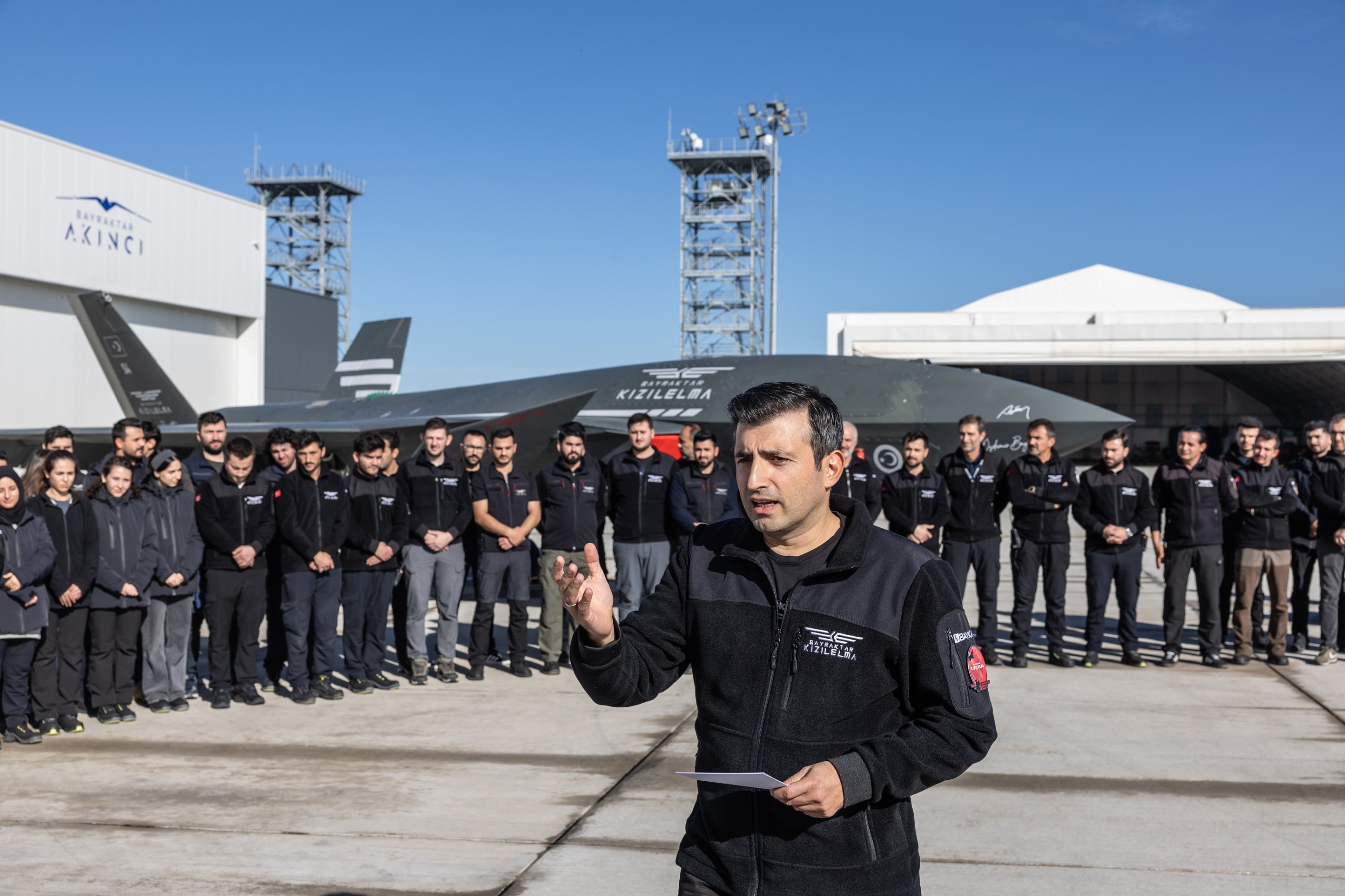
With artificial intelligence-supported autonomous formation flight and smart fleet capabilities, the aircraft is positioned to shape future aerial warfare doctrine.
“Today, we deliver to our nation the dream we set out to build 20 years ago,” Baykar said on NSosyal.
Concept images of Kızılelma were released in July 2021, and production began in March 2022. It made its maiden flight in December 2022, ahead of the company’s original 2023 target.
In April 2023, Kızılelma flew in close formation with Baykar’s Akıncı armed drone in what the company called a world first for two unmanned aircraft. It later flew alongside the crewed SoloTürk and Turkish Stars aerobatic teams at the Teknofest aerospace festival.
Testing accelerated over the past year. Kızılelma conducted firing trials with Tolun and Teber-82 munitions in October 2025, followed by the integration of the Toygun electro-optical targeting system in November.
Days later, during a test off the northern Black Sea province of Sinop, the aircraft struck a jet-powered target using the Gökdoğan beyond-visual-range air-to-air missile. The target was tracked by a radar built by Aselsan, Türkiye’s largest defense electronics firm, while the missile was developed by the state research institute TÜBITAK SAGE. Baykar said the test marked the first time an unmanned combat aircraft hit a jet-powered aerial target with a beyond-visual-range missile.
In December 2025, two Kızılelma jets flew in close formation using smart fleet autonomy to demonstrate swarm capabilities.
In March 2026, the aircraft conducted an autonomous formation flight with Italian M-346 trainer jets, a step toward crewed-uncrewed joint operations. In July, Kızılelma struck a target with a Jet-230 supersonic missile and completed its first internal-bay firing tests of Teber-82 and Tolun munitions.
Burhanettin Duran, head of Türkiye’s Communications Directorate, said Thursday’s milestone demonstrates the country’s engineering strength, technological depth and strategic vision.
“Türkiye continues to make history in the defense industry with its own means and capabilities,” he wrote on the social media platform X.
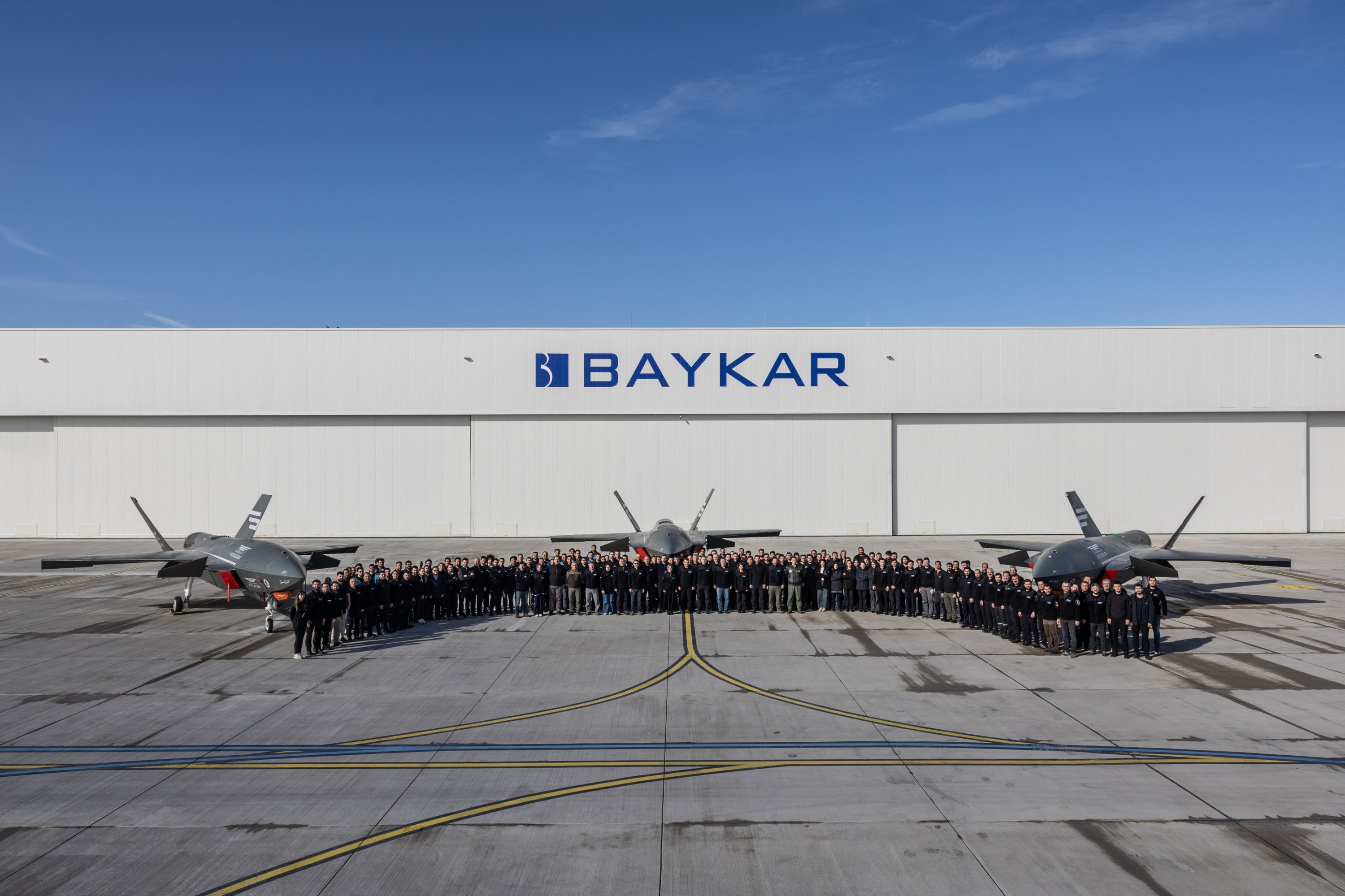
Baykar said it was the world’s largest drone exporter in 2025, posting a record $2.2 billion in sales, with exports accounting for about 90% of its revenue. The company ranked among Türkiye’s top 10 exporters across all sectors from 2023 through 2025.
It also led Türkiye’s defense and aerospace exports from 2021 to 2024, accounting for a third of the sector’s shipments in 2023 and a quarter in 2024, according to data from the Presidency of Defense Industries (SSB) and Türkiye Exporters Assembly (TIM).
To date, Baykar has signed export agreements with 40 countries for its Bayraktar TB2 and Akıncı drones. The TB2 gained international prominence for its deployment in conflicts in Syria, Libya, Nagorno-Karabakh and Ukraine.
This May, it signed the first export contract for Kızılelma with Indonesia. The deal covers the delivery of a fleet of 12 Kızılelma aircraft, starting in 2028. The agreement also includes an additional option for four more fleets.
The worst energy shock in history, paired with growing urgency around climate change, is permanently changing how the world will power homes, drive cars and fuel industries. That’s the main takeaway from a new International Energy Agency (IEA) report out Thursday.
The crisis, triggered by the Iran war, will “leave lasting marks” on the world’s energy sector, according to the Paris-based organization, founded after the 1973-74 energy crisis.
Energy-hungry nations will prioritize the security and affordability of their electricity, the report said. This is a boon for renewable technologies, like solar, and alternative technologies, like nuclear. But it is also reinforcing the case to keep coal as a backup in times of crisis.
This is especially true in coal-rich Asia, which went into energy triage when the Iran war cut off the Strait of Hormuz, a narrow passageway where around a fifth of the world’s traded oil typically flows.
The report looks “past the current turmoil to explore the range of energy futures that could emerge from today’s upheaval,” said IEA Executive Director Fatih Birol. He said the Iran war “delivered a huge shock to the system” and warned, “the longer the crisis lasts, the deeper the effects will be.”
“I don’t see any credible pathway for the energy world to return to the way it was before,” he said.
Annual United Nations climate talks, known as COP31 and hosted in Türkiye this year, are in their second and final week. Before these negotiations, the U.N. announced the world is dangerously close to missing its goal of limiting global warming to 1.5 degrees Celsius (2.7 degrees Fahrenheit) above pre-industrial temperatures.
Electrification – the process of powering homes, cars and industries with electricity – and moving away from planet-warming fossil fuels are the two big-ticket issues at this year’s climate talks.
“The future of the energy system and our climate are inextricably intertwined,” said Rachel Cleetus, climate program director at the Union of Concerned Scientists, who is at COP31.
The IEA, the world’s leading intergovernmental energy organization with more than 30 member countries, publishes World Energy Outlooks annually.
This year’s 560-page-plus report analyzes government and private data to project various future scenarios based on whether countries will continue with current policies or drastically change policies in the face of ongoing crises.
The world’s energy sector will clearly have a before and after the Iran war, experts said. In March, the IEA coordinated the emergency release of 400 million barrels of crude oil stocks to stabilize global markets.
“This crisis has exposed the price of fossil fuel dependence,” said Mohamed Adow, director of Power Shift Africa. “It’s crazy that a conflict thousands of miles away can send energy bills soaring at home.”
Conflicts, trade tensions, climate risks and cyberattacks are increasing the number of possible energy futures. The IEA said the “drive to diversify” fuel supplies will reshape the energy trade.
The Middle East will still be the world’s largest oil exporter, but nations will likely reduce dependence on the Strait of Hormuz. The IEA forecasts the amount of oil transiting the strait could go from 20 million barrels per day before the Iran war, to 8.5 million barrels in 2030, and even under 2 million barrels by 2035.
While fossil fuels still dominate national energy mixes, the IEA said renewables – led by solar – and nuclear power are the “biggest beneficiaries” of governments trying to grow domestic energy sources. But energy security concerns may lead coal-rich nations to rely on fossil fuels as a fallback option during times of crisis.
“When we look at how energy crises change the world over the long term, governments are only just beginning to get their head around just how much things will change,” said Dave Jones, co-founder of the think tank Ember.
The ongoing talks in Türkiye follow a year rattled by the Iran war’s energy shock, as well as several climate-induced disasters.
Global warming adds pressure to rising electricity demand. In what the IEA called a “striking milestone,” energy demand for cooling is overtaking energy demand for heating for the first time.
India, the world’s most populous nation, will account for more energy demand growth over the next decade than any other country or region. China, already one of the world’s most electrified economies, may see its electrification grow from 32% last year to 43% by 2035 – the highest among any major economy.
At COP31, Türkiye is pushing for the world to increase the share of electricity in total global energy consumption from roughly 21% today to 35% by 2035.
While the preference would be for this to come from renewable energy, U.N. documents on the negotiating table don’t spell this out. That means coal and other fossil fuels could be used, at least initially.
“The IEA’s latest report makes clear that the fossil energy crisis unleashed by the U.S.-Israel war on Iran has irrevocably changed the global energy system, adding to the many reasons why countries would benefit from a rapid transition to clean energy and electrification,” said Cleetus, with the Union of Concerned Scientists.
The German group Bertelsmann said Thursday it agreed to acquire Ekol Lojistik (Ekol Logistics), one of the leading logistics companies in Türkiye, via its Arvato subsidiary, thus further strengthening its position in one of the most dynamic logistics markets in the EMEA region.
“The agreed purchase price is in the mid-nine-figure range. The transaction is subject to regulatory approval,” the company said in a statement.
The acquisition would make Arvato one of the leading contract logistics providers in Türkiye.
Ekol employs roughly 4,500 people and focuses and operates primarily in the fashion, consumer electronics, and fast-moving consumer goods (FMCG).
Combined with Ekol, Arvato is expected to generate annual revenues of 460 million euros ($506 million) in the country, making Türkiye one of its five largest markets.
Arvato has operated in Türkiye since 2005 and has significantly expanded its business there in recent years.
Bertelsmann CEO Thomas Rabe called it “the largest investment in Arvato’s history.”
“The acquisition of Ekol Logistics will further accelerate our growth and strengthen our position in an attractive market,” he said.
Ekol Logistics was founded by Ahmet Musul in 1990 and has become a major logistics provider in Türkiye.
“Ekol Logistics has built a strong contract logistics business in Türkiye with deep sector expertise, an extensive operational network and a clear focus on technology and automation. Arvato brings an international platform and the ambition to further grow the business,” Musul said.
“Together, these strengths create a strong foundation to offer clients broader capabilities, greater scale, and new opportunities for growth. I am confident that once completed, the transaction is expected to create long-term value for our clients and employees alike,” he added.


-
 Economy3 days ago
JPMorgan sees upside in Türkiye, UAE stocks, turns cautious on Greece
-
 Politics2 days ago
Turkish VP to meet Uzbek leaders during 2-day visit to Tashkent
-
 Politics2 days ago
Türkiye urges nations to honor climate commitments at COP31
-

 Politics2 days ago
Türkiye’s New Party tones down newness in first convention
-

 Sports2 days ago
Türkiye relegated to Nations League B after Greece defeat Serbia
-
 Politics2 days ago
Türkiye entering historic new era led by youth, Erdoğan says
-
 Politics2 days ago
Türkiye’s top diplomat to join EU security, connectivity talks in Brussels
-
 Economy2 days ago
Erdoğan wants troubled fund liquidations completed by year-end