
Economy
Turkish central bank resumes repo auctions after nearly 6-month pause

Türkiye’s central bank resumed one-week repo auctions Monday after a nearly six-month suspension, as part of its Turkish lira liquidity management framework.
The Central Bank of the Republic of Türkiye (CBRT) announced Friday that it had decided to restart one-week repo auctions, which had been suspended on March 1 after the outbreak of the Iran war.
The CBRT offered TL1 billion ($21 million) in one-week funding at 37% Monday. In its last auction, the interest rate stood at 40.06%.
What does it mean?
One-week repo auctions are among the central bank’s main tools for managing liquidity in the banking system and meeting banks’ lira funding needs.
Under repo transactions, banks provide eligible securities as collateral to obtain Turkish lira funding from the central bank for a specified period, in this case one week.
Analysts foresaw normalization
Analysts said last month the bank was likely to pursue a gradual normalization of monetary policy in the remainder of the year before considering interest rate cuts.
The bank kept its benchmark one-week repo rate at 37% last month, leaving borrowing costs unchanged for a fourth consecutive meeting.
Policymakers thus maintained a cautious stance amid heightened geopolitical uncertainty and lingering inflation risks amid the Middle East conflict.
Economists had said the central bank would likely first unwind its temporary monetary tightening by shifting funding back toward one-week repo auctions before lowering the benchmark policy rate, provided global conditions improve.
Since the conflict started, the bank has halted an easing cycle that began in late 2024 and taken other liquidity steps.
FAST transfer limit to triple
In a separate announcement Monday, the CBRT also said it would raise transaction limits on the FAST instant payment system from Wednesday.
The maximum amount for money transfers and payments made through the “Request to Pay” service will increase threefold to TL 300,000 from TL 100,000.
The CBRT said the change reflected growing user demand for FAST and the evolving needs of the payments ecosystem.
For dynamic verified merchant payments made using FAST-TR QR codes, the transaction limit will also rise to TL 300,000 from TL 250,000.
FAST, which was launched on Jan. 8, 2021, enables instant payments around the clock and has increasingly become an alternative to cash and card payments for retail transactions.

Electric vehicle sales picked up across much of Europe in July, as high oil prices, government subsidies and the availability of more affordable models pushed more drivers to abandon combustion-engine cars, according to industry data.
EV sales have soared across Europe since the Iran war began in February and caused pain at the pump. The big question for many in the auto industry is whether consumer interest will fade if and when oil prices retreat, while a lack of public charging options remains a major concern.
“People are looking for ways to protect themselves from volatility in fuel prices, and EVs are a great way to do that,” Renault U.K. managing director Adam Wood told Reuters at the French automaker’s dealership in Letchworth, 40 miles (64 km) north of London.
“We’re at a tipping point where EVs … are part of the mainstream.”
Two years ago, just 10% of Renault’s U.K. sales were electric. By contrast, in July this year EVs made up more than 50% of the company’s orders and the Renault 5 – a revived version of the top-selling Renault model originally launched in 1972 – was last month Britain’s best-selling electric car, its original boxy shape having evolved into a more curvy design offering what Renault’s website says is a range of up to 250 miles.
Later this year, Renault will also start selling the electric Twingo, which will start at less than 20,000 pounds ($26,984) – before a possible U.K. government subsidy for which Renault hopes to qualify.
‘No chance of me going back’
Charlotte Merrell, 32, just bought an electric Renault Megane, her first EV. She said charging at home costs a little more than 1 pound versus 60 pounds for her previous combustion-engine model.
Buying an EV was “the best decision I ever made,” Merrell said. “There’s no chance of me going back.”
According to industry data, EV sales in the European Union rose 40.5% in the first half of the year versus the same period in 2025 to more than 1.2 million cars, accounting for 20.7% of all sales.
Data provided to Reuters by research group New Automotive and industry group E-Mobility Europe show EV registrations rose 13% year-over-year in July across 16 markets covering more than 90% of car sales in the EU and European Free Trade Association.
That means EVs made up 25.7% of all new car sales in those markets.
Online searches
Others have found a similar trend.
Amsterdam-based online marketplace OLX said since the Iran war began, customer enquiries for EVs had jumped across its online car marketplaces in France (84%), Romania (59%), Portugal (30%) and Poland (19%). Chinese brands known for affordable models make up a growing portion of EV listings, it said.
“People are getting far more confident around this new technology,” said OLX CEO Christian Gisy.
In a late July poll of 1,000 users by German online marketplace Carwow, 62% of respondents said switching to an EV is the best long-term response to persistently high fuel costs.
Accelerating transition
In Europe, traditional automakers and Chinese rivals alike have launched a growing number of more affordable models that are also supported by subsidies.
In the year through July, 29% of new cars in France were EVs. In July alone, EVs accounted for a record 35% of new car registrations, versus 17% the previous year, as the country’s “social leasing” EV subsidies program for lower-income car buyers kicked in.
Marie-Laure Nivot, head of automotive market analysis at research firm AAA DATA, said the program “creates an environment that accelerates the transition” to EVs.
Different trends, EV obstacles
It’s a somewhat different picture in the U.S., where the Trump administration killed a federal EV tax break last year. So although second-quarter EV sales rose 15% versus the first quarter, they fell more than 20% year-over-year.
Cox Automotive projects U.S. EV sales will fall 23% this year versus 2025, for a market share of just 6.2%, also reflecting a lack of affordable models.
A dearth of public charging remains an obstacle to EV ownership for millions of Europeans who live in apartments, an issue that needs to be addressed for sales to keep growing, Ian Henry of consultancy AutoAnalysis said.
“We could be near a saturation point because there are people who might want to go electric, but can’t.”
Tesla is recalling nearly 3 million cars in China over interior door handles that could hinder a person’s ability to exit the vehicle during an emergency, Beijing’s national market watchdog said.
Eight Chinese carmakers also filed recalls over similar safety risks, China’s State Administration for Market Regulation (SAMR) announced on Friday.
Some recalls were effective immediately, while others began over the weekend and on Monday.
Tesla’s recall involves 2.9 million domestically-made units of its Model 3 and Model Y electric cars and begins on Sept. 25.
The U.S. carmaker – which operates a huge factory in Shanghai – is also recalling around 46,000 imported units of its Model 3, Model X and Model S cars, the SAMR announcement said.
The recalled cars have inner emergency mechanical handles “similar in color to the interior, making them difficult to identify and operate” in emergencies, the watchdog said.
In Tesla’s Model 3, for example, passengers must reach into a compartment inside the door pocket and find a release cable to manually open the rear door, according to the company’s website.
“In extreme situations such as severe collisions causing the vehicle’s low-voltage system to fail, (the handles) may affect passengers’ ability to quickly open car doors for escape and rescue operations outside the vehicle,” SAMR said.
SAMR said Tesla was separately recalling 2.7 million domestically-made Model 3 and Model Y EVs over issues with monitoring systems while a driver is using steering assist functions.
It was not clear whether some Teslas were counted in both recalls.
Chinese EV makers including Xiaomi, XPeng, Geely, Chery and Leapmotor are also recalling cars with handles that blend in with their interior.
Xiaomi began recalling around 390,000 units of its 2024 SU7 series on Friday, and XPeng started recalling nearly 265,000 cars on Saturday.
Beijing-based BAIC BluePark, a subsidiary of state-owned automaker BAIC, on Saturday began recalling around 46,000 Arcfox Kaola EVs over a “lack of dedicated text prompts” near the emergency mechanism on its right rear sliding door.
Beginning on Monday, Geely is recalling around 92,000 cars from its luxury brand Zeekr.
Companies offered to attach warning labels near the handles for free, and some said they would remotely upgrade software involving lowering windows after a crash.
Safety concerns have risen in China recently over sleek car designs that are prone to losing operability in the event of a crash.
The mass recalls are in line with China’s plan to ban hidden door handles on cars from Jan. 1, 2027, local media reports said.
Those rules, announced in February by the Ministry of Industry and Information Technology, will require door handles to have both interior and exterior mechanical releases.
Electronic door handles were introduced with Tesla’s 2012 launch of the Model S, later becoming popular with Chinese EV brands prioritizing high-tech features.
Folding into the body of the car, such door handles provide a slight boost to efficiency by reducing drag while the vehicle is in motion.
As China and Türkiye mark the 55th anniversary of diplomatic relations, the partnership is evolving from one centered on trade into a broader strategic relationship driven by infrastructure, green technology, digital transformation and closer political coordination, a Chinese expert said.
“Today, China-Türkiye relations are not merely transactional; they are strategic and structural,” said Hou Na, an anchor of state-owned Chinese broadcaster CGTN, in an exclusive interview with Daily Sabah.
China is one of Türkiye’s largest trading partners, with bilateral trade increasing fortyfold over the past two decades, Hou said. Yet the relationship is increasingly moving beyond a simple exchange of goods toward deeper economic interdependence, with the two countries expanding co-investment in infrastructure, clean energy and advanced manufacturing, from battery production lines to grid-scale energy storage projects.
The evolution of China-Türkiye relations from a traditional trade mindset toward co-investment could be seen as both a result and a reflection of the convergence of the two countries’ development visions. “The synergy between China’s Belt and Road Initiative (BRI) and Türkiye’s Middle Corridor is not just a diplomatic talking point,” Hou said. “It is being operationalized through transport corridors, logistics hubs and enhanced rail-sea connectivity.”
The connection is rooted in the two initiatives’ shared focus on linking Asian and European markets. The Trans-Caspian East-West-Middle Corridor, known as the Middle Corridor, is a multimodal trade route running from China through Central Asia and the Caspian Sea, then through Azerbaijan, Georgia and Türkiye to Europe, according to information obtained from Türkiye’s Ministry of Foreign Affairs. The ministry describes it as a key component of efforts to revitalize the ancient Silk Road. The corridor is seen as complementary to China’s Belt and Road Initiative, which seeks to strengthen connectivity between East and West.
For Hou, that alignment reflects a shared belief that connectivity itself can be an engine of prosperity.
Toward deeper ties
However, economic ties tell only part of the story. While co-investment is bringing the two economies closer, lasting partnerships are ultimately built not only through trade and investment, but also through mutual understanding between societies. The social dimension of the relationship is already taking shape in several areas, from tourism and education to cultural exchange, Hou said. Yet she believes these connections have significant room to deepen.
Tourism offers one of the most visible areas for closer interaction. Turkish Airlines (THY) has expanded its China schedule, with its Istanbul-Shanghai route operating up to 11 weekly flights during the peak season, Hou said. Beyond connecting two destinations, she said, these flights bring together businesspeople, students and first-time visitors, “who return home as informal ambassadors.”
Education and academic exchange offer another, potentially longer-lasting, channel for mutual understanding. More Turkish students are studying at Chinese universities, while interest in Mandarin and China studies is growing in Türkiye, Hou said. At the same time, Chinese students are drawn to Türkiye’s rich history and its role as a crossroads of civilizations. Such exchanges, she argued, “weave a fabric of long-term understanding” that cannot be built through government programs alone.
“Culturally, both nations represent ancient civilizations with deep reservoirs of art, philosophy and craftsmanship,” Hou said. For her, that shared heritage offers a foundation for dialogue that extends beyond formal diplomacy. Recent efforts to promote Chinese governance literature in Ankara, including an event attended by senior Turkish officials, are one example of this growing intellectual exchange.
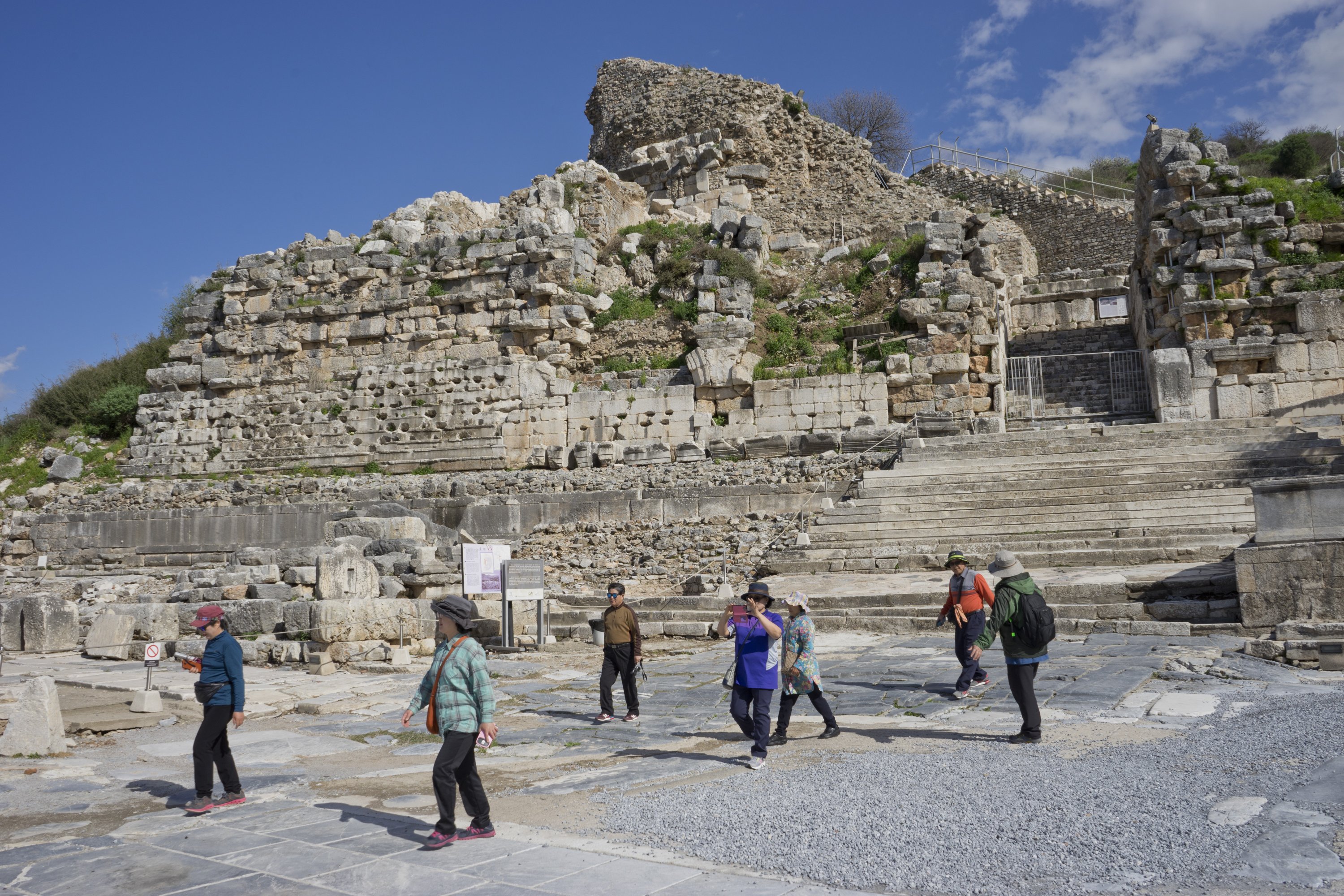
Still, Hou believes the relationship could reach further into the lives of people in both countries. More co-produced documentaries, joint reporting projects and other forms of storytelling, she said, could help people in China and Türkiye see each other beyond politics and gain a better understanding of everyday life in the other country.
That broader understanding, Hou suggested, would also require looking beyond the countries’ major political and economic centers. While China-Türkiye relations are often viewed through Beijing-Ankara or Istanbul-Shanghai ties, second-tier cities could develop their own connections through culture, sports and gastronomy. Chengdu and Izmir or Xi’an and Bursa, could offer examples of how such links might grow at the local level.
Such connections could extend to younger generations as well, whose lives are increasingly shaped by digital platforms. Virtual exchange programs, hackathons and startup competitions between Chinese and Turkish universities could give young people new ways to connect, collaborate and build relationships across borders, Hou said.
For all the weight carried by trade, investment and diplomacy, Hou believes the relationship is ultimately sustained by something less tangible: human connections. As she put it, “If trade builds the skeleton of our relationship, then people-to-people ties are the blood and tissue that keep it alive.”
Looking ahead
From the movement of goods and capital to the movement of people and ideas, China-Türkiye relations have steadily expanded into new territory. But that expansion is unfolding against a global landscape that is becoming more complex and uncertain. For Hou, sustaining the momentum will depend on keeping three elements in balance: political trust, practical cooperation and cultural empathy.
Economically, the relationship is likely to be shaped by two forces already transforming economies around the world: the green transition and digital transformation. Türkiye’s carbon- neutrality goals and China’s expertise in solar, wind and battery technologies could open new avenues for cooperation. “The joint ventures we are seeing today in lithium battery production and energy storage are just the beginning,” she said. “I expect to see cooperation expand into electric vehicle supply chains, smart grids and even joint R&D in critical minerals.”
Connectivity, meanwhile, is likely to move beyond infrastructure itself. As the alignment between the Middle Corridor and the Belt and Road Initiative develops, Hou expects greater focus on logistics and trade facilitation, including digital customs platforms and standardized rail tariffs.
Beyond the bilateral relationship itself lies a changing world. As the international landscape grows more complex and unpredictable, Hou sees “strategic patience and multilateral coordination” as increasingly important. “Whether it is within the G-20, the Shanghai Cooperation Organization, or the U.N., China and Türkiye share an interest in a rules-based order that reflects the realities of the 21st century – not the 20th,” she said.
The challenge now is making those strands work together. Economic cooperation can create local employment and training opportunities, helping build social acceptance. Cultural exchanges can bring business communities closer to the human context of their deals, while political dialogue can keep the relationship oriented toward “a long-term partnership, not a tactical alignment.”
If these elements continue to complement one another, Hou believes “The next decade will not just be a continuation of the past 55 years. It will be a qualitative leap forward.”
Trade tensions between the U.S. and Canada escalated over the weekend as Canadian Prime Minister Mark Carney announced retaliatory tariffs on Saturday, after walking away from what he termed as a “bad deal” in a deepening rift between the longtime allies.
Negotiations between the neighboring countries broke down on Friday in Washington, putting into force new 50% U.S. tariffs impacting about $20 billion worth of goods, or 5.5% of Canadian exports to the U.S.
Impacted products range from hockey sticks to cement.
“You’re at war when you get attacked. We got attacked,” Carney said.
U.S. President Donald Trump hit back at Canada on Sunday, saying, “Canada wants the benefits of being a State, without being one!!!”
“They have also charged our great farmers, for many years, massive amounts of Tariffs. No more!!!” Trump added in a post on Truth Social.
New Canadian tariffs will notably target the U.S. steel and dairy industries and are set to take effect on Sept. 8. More details would come next week, Carney said.
Trump had previously said Washington “should be able to have a deal with Canada,” citing his “good relationship” with Carney.
However, on Saturday, Canada’s prime minister said that Trump set conditions that were ultimately unacceptable, even though earlier talks had been positive.
“In recent days, the United States proposed new terms that were uneconomic, unfair and undermined the net benefits for Canada, and called into question the reliability of any deal,” Carney said in Ottawa.
“We cannot accept what they’ve offered, and we will not give what they’ve asked.”
U.S. Trade Representative (USTR) Jamieson Greer told the New York Times (NYT) on Saturday that the U.S. had offered to reduce its tariffs on steel, aluminum and autos, as well as eliminate a recently imposed tariff on Canadian lumber.
Greer said those measures would have given Canada “the most preferential treatment of any trading partner,” according to the Times.
Greer told Fox News on Saturday that Washington was “moving forward with measures that respond to Canadian retaliation.”
He said no new talks were planned with Canadian negotiators.
A senior U.S. official characterized this week’s talks in Washington as candid and not acrimonious.
‘Significant pressure’
Canada has been seeking relief from Trump’s tariffs on autos, steel and aluminum, which have battered the country’s economy, forced job losses and strained what was once an iron-clad trade relationship.
The White House had alleged “discriminatory treatment” by Canada against U.S. alcohol, automobile and dairy products in introducing the duties.
They were originally set to take effect on Wednesday, before Trump issued a three-day reprieve citing progress in talks.
Carney said one reason the deal collapsed was that U.S. negotiators – at the eleventh hour – were introducing restrictions on Canadian trade deals with other countries.
U.S. negotiators also made unacceptable “threats” to the French language and “Quebec culture,” he said, referring to the French-speaking province in eastern Canada.
The escalating trade war was met with anger by Democratic lawmakers and governors from border states, including Minnesota, New York and Washington, who blamed Trump for triggering chaos that will raise costs on U.S. businesses and families.
“Needlessly picking fights with our allies and raising prices here at home. That’s Trump’s economic policy in a nutshell,” New York Governor Kathy Hochul posted on X.
Beyond the latest tariffs, the U.S. and Canada still have to agree on revisions to the North American free trade agreement, or USMCA, which Trump declined to renew in its current form.
Trump’s threats to make Canada the 51st U.S. state have also antagonized Canadians.
Lunch money
Carney has repeatedly said relations with the U.S. have been forever altered, and that Canada must reduce reliance on its southern neighbor, which currently accounts for roughly 70% of Canadian exports.
“We’ve been under no illusions. We recognized from the start that America has changed,” Carney said Saturday. “We recognize that sometimes, its signature was written in pencil.”
Carney spoke with provincial leaders to outline next steps.
One of them, Ontario Premier Doug Ford, said Canadians must remain united.
Trump “can’t be trusted, simple as that,” Ford told reporters.
“President Trump is the type of person who would steal your lunch money.”
The Business Roundtable, a group of 200 chief executives of leading U.S. corporations, warned the new tariffs “risk raising costs for American businesses and families,” and urged both governments to resume negotiations.
The United States imposed 50% tariffs on about $20 billion worth of Canadian goods Saturday after days of negotiations between the two longtime allies broke down, escalating tensions between President Donald Trump and Canadian Prime Minister Mark Carney.
The new duties, which took effect shortly after midnight, represent just over 5% of Canada’s exports to the United States. They target a range of products, including cement, furniture, clothing, fishing equipment and hockey gear, while adding to existing U.S. tariffs on Canadian steel, aluminum, lumber and automobiles.
The economic impact of the latest measures may be limited compared with broader U.S.-Canada trade, but the political consequences could be more significant. The dispute threatens to complicate negotiations over the future of the United States-Mexico-Canada Agreement, the North American trade pact that has underpinned billions of dollars in cross-border commerce.
Carney said Canada had suspended trade negotiations with Washington after the United States made last-minute changes to its proposed terms.
“I have decided to suspend trade negotiations with the U.S. and have directed Canada’s negotiators to return to Ottawa,” Carney said in a statement.
He said Canadian negotiators had worked “in good faith” to protect the country’s interests but argued that the final U.S. demands were unfair and economically damaging.
Canada will respond with matching tariffs, Carney said, promising to retaliate “dollar for dollar” against the new U.S. duties.
The breakdown came after three days of talks in Washington between Canadian Trade Minister Dominic LeBlanc and U.S. Trade Representative Jamieson Greer. Just hours before the tariffs took effect, the two sides appeared close to an agreement that could have reduced duties on Canadian steel, aluminum and automobiles and potentially restored American alcohol products to Canadian liquor stores.
But the deal fell apart at the final stage.
“Tonight, Canada declined to finalize the trade deal under the terms agreed earlier this week,” Greer said during a White House briefing.
Greer described the collapse as a missed opportunity for Canada to strengthen its economic relationship with the United States, which he called the fastest-growing economy in the Group of Seven.
A senior Trump administration official said the U.S. proposal would have given Canada a more favorable tariff position than any other major exporter to the United States. The official said Ottawa nevertheless sought further concessions on steel, aluminum, automobiles and softwood lumber.
No additional negotiations were scheduled as the tariffs took effect.
A new breach in North American trade
The latest duties are particularly significant because some of the affected Canadian products had previously benefited from preferential treatment under the United States-Mexico-Canada Agreement.
Richard Ouellet, a professor of international economic law at Quebec’s Laval University, described the development as a breach in the protection provided by the trade agreement.
“Until now, the USMCA acted as kind of a shield. The Americans are opening a breach,” Ouellet said.
Trump declined to renew the USMCA on July 1, leaving the agreement subject to annual reviews and adding uncertainty to the future of North American trade.
The latest tariffs cover about $20 billion in Canadian goods, including products such as hockey sticks and cement. While that represents only a small portion of Canada’s overall exports to the United States, the duties expose several already vulnerable industries to higher costs, weaker demand and possible job losses.
Previous U.S. tariffs on steel, aluminum, lumber and automobiles have already weighed heavily on Canadian manufacturers and workers. The effects, however, have largely remained concentrated in those sectors.
Royal Bank of Canada has said the latest 50% tariffs are unlikely to significantly alter Canada’s broader economic growth because they affect a relatively small share of total trade. About 80% of Canadian goods would still enter the United States without tariffs, according to the bank.
Still, the move underscores Canada’s deep dependence on its southern neighbor.
Canada looks beyond the U.S.
About 70% of Canada’s exports go to the United States, making the country exceptionally vulnerable to changes in American trade policy.
Carney has made reducing that dependence a central part of his economic strategy since taking office in March 2025. His government has pursued new markets overseas, sought to remove barriers to trade between Canadian provinces and promoted major infrastructure and resource projects at home.
“Canada has what the world wants,” Carney said after the trade talks collapsed. “We will not allow any nation to determine our future.”
Carney has traveled to China, India and Saudi Arabia while strengthening ties with European countries in an effort to broaden Canada’s economic partnerships.
Canada reached a preliminary agreement with China in January covering imports of electric vehicles, while relations with Europe have also deepened. In July, Ottawa selected German defense company TKMS to build a new fleet of submarines for the Canadian navy.
The Canadian government has also pointed to signs that exporters are already adapting to U.S. protectionism by finding customers elsewhere.
According to a report from Canada’s international trade minister, the value of Canadian exports to non-U.S. markets rose 11% in 2025 and at one point reached 33% of total exports, the highest level in more than four decades.
Turning inward
Carney is also betting that Canada can reduce its exposure to U.S. trade pressures by strengthening its own domestic market.
One of his government’s early initiatives was legislation aimed at reducing barriers to trade between Canada’s provinces and territories. Although provincial governments have been reluctant to eliminate some of their own restrictions, economists say domestic commerce has gained renewed attention as the trade dispute with Washington has intensified.
Carney has also established a Major Projects Office designed to speed up approvals for major infrastructure and resource developments.
The government has promoted port expansions in Montreal and Vancouver, new mines focused on critical minerals and a proposed oil pipeline linking Alberta to the Pacific coast.
Ottawa has unveiled plans for roughly 115 billion Canadian dollars ($83 billion) in infrastructure spending and an additional 82 billion Canadian dollars for defense over the coming years.
Those investments could help create new markets and strengthen domestic economic capacity, but replacing the scale of the U.S. market will not be easy.
Türkiye’s growing naval capabilities, domestically developed defense technologies and next-generation unmanned systems are on display at the specialized, maritime-focused leg of the country’s biggest aerospace and technology festival.
The four-day Teknofest Blue Homeland at the Gölcük Naval Shipyard Command in the northwestern Kocaeli province began on Thursday and runs through Sunday.
It is bringing together naval platforms, submarines, aircraft, missile and air defense systems, unmanned vehicles and underwater technologies, while also allowing young participants to compete in maritime technology contests.
Organized under the coordination of the National Defense Ministry and the Turkish Technology Team Foundation, or the T3 Foundation, the event has drawn significant interest from visitors seeking to see Türkiye’s naval capabilities and defense technologies up close.
The opening ceremony on Thursday was attended by National Defense Minister Yaşar Güler, Chief of General Staff Gen. Selçuk Bayraktaroğlu, Naval Forces Commander Adm. Ercüment Tatlıoğlu, Defense Industries Presidency (SSB) head Haluk Görgün, force commanders and defense industry representatives.
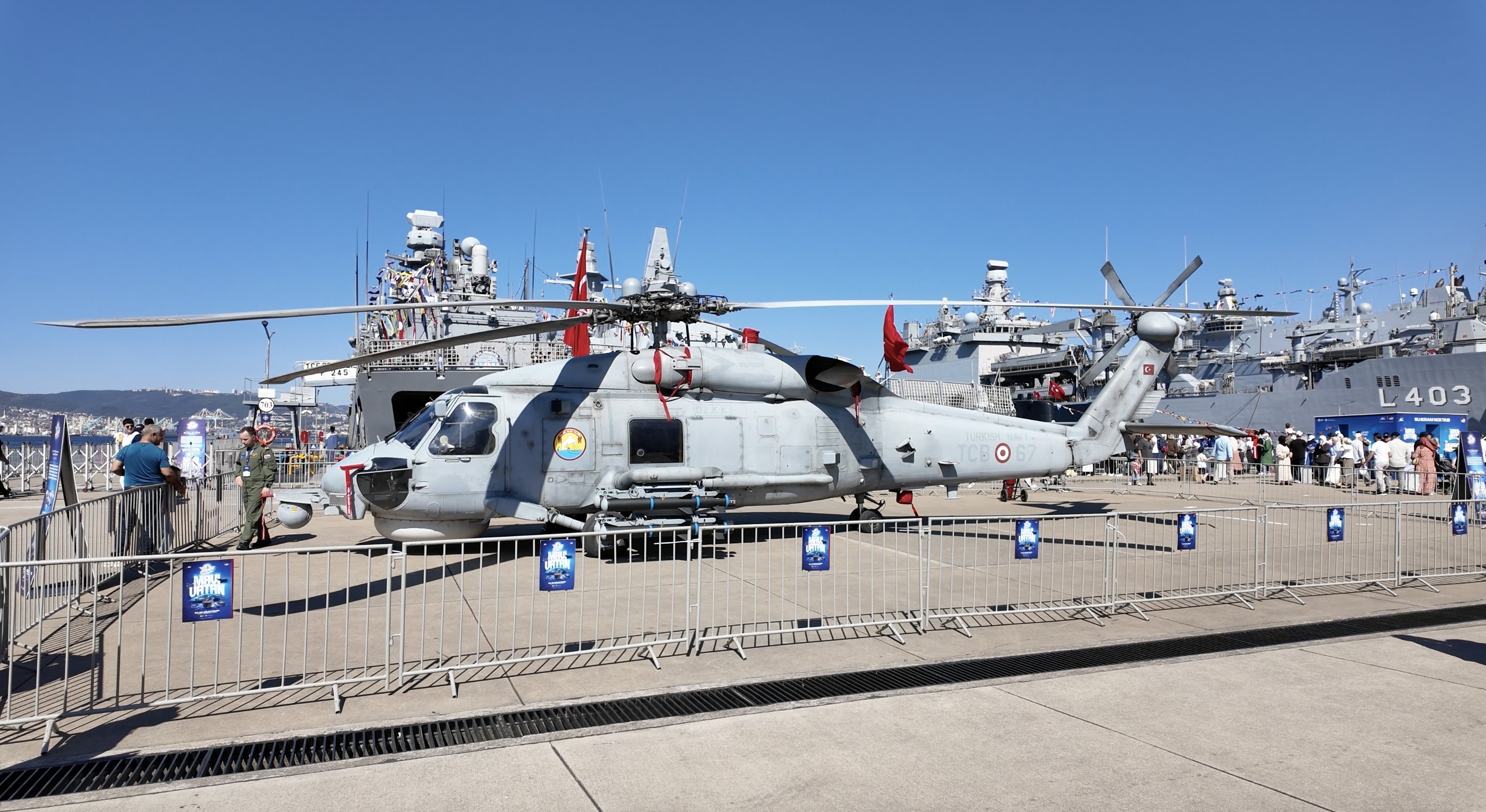
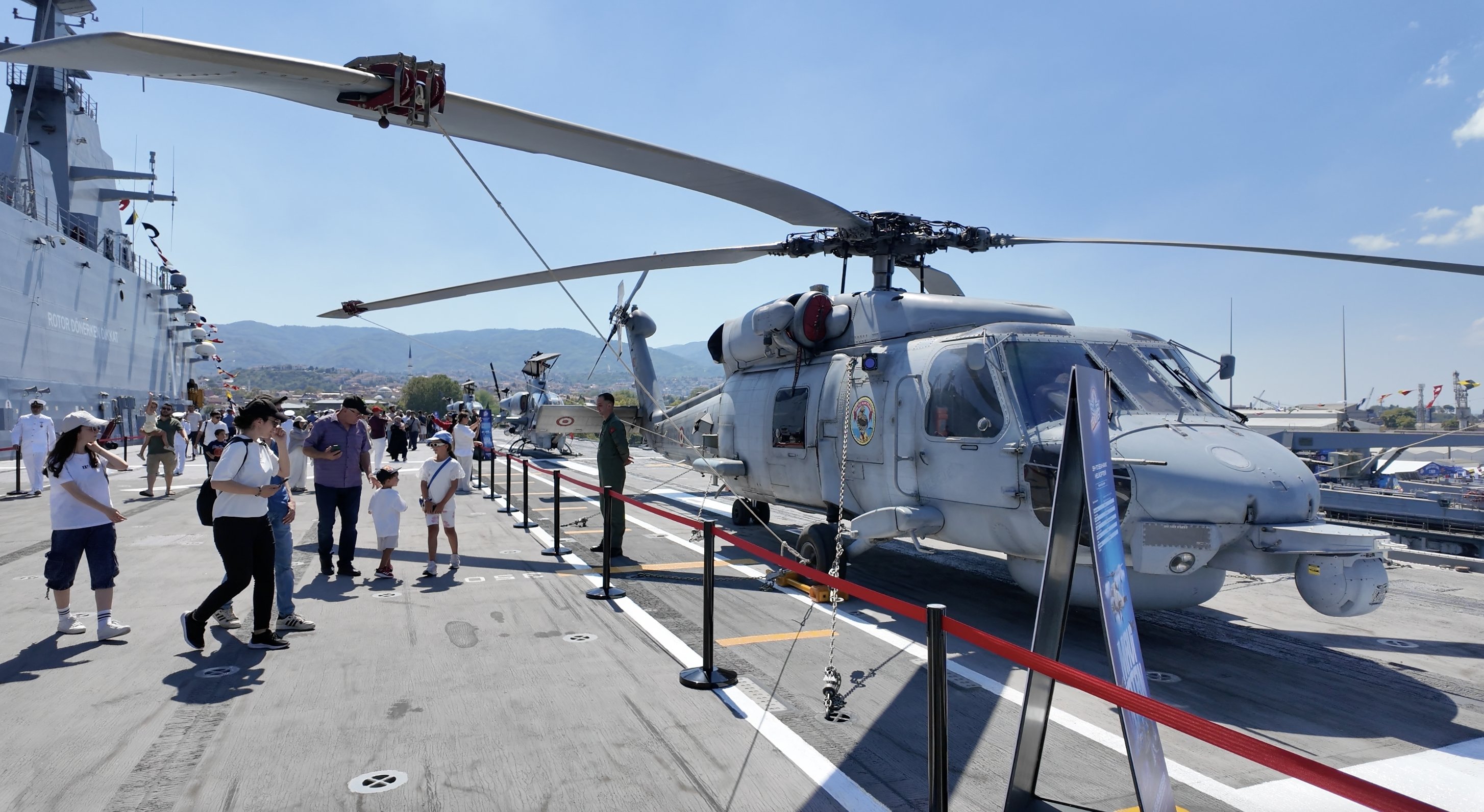
The event is showcasing 37 naval assets and platforms from different classes, including vessels currently serving in the Turkish Navy.
Among the most prominent platforms on display are Türkiye’s largest military ship, the TCG Anadolu; the TCG Istanbul; TCG Barbaros; TCG Salihreis; TCG Turgutreis; TCG Kemalreis; TCG Oruçreis; TCG Burgazada; and the TCG Derya.
Other naval assets include minehunters, patrol vessels, amphibious ships and support platforms, offering visitors a broad view of the Turkish Navy’s operational structure.
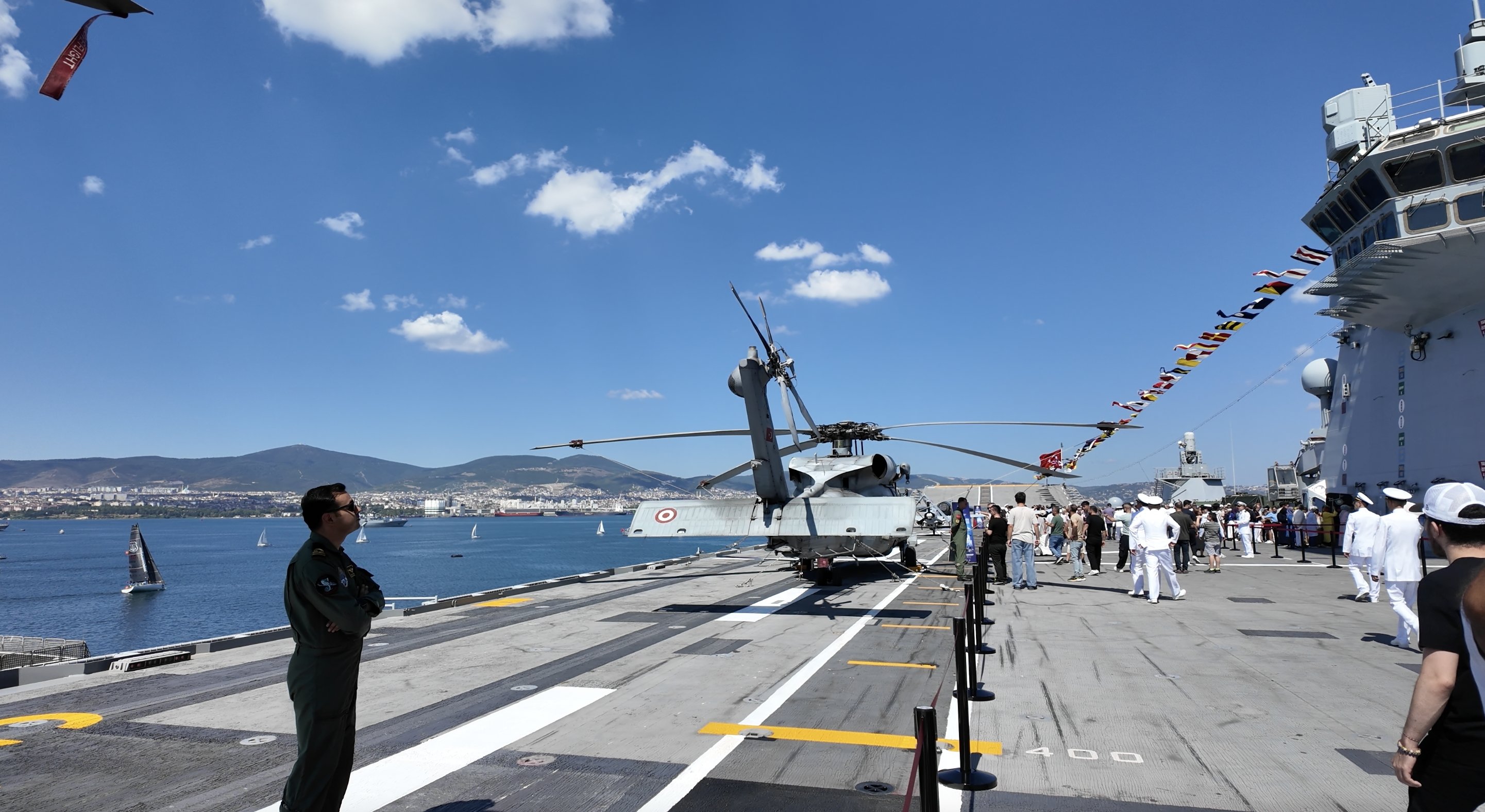
The TCG Anadolu has emerged as one of the main attractions at the festival, giving visitors the opportunity to tour parts of the ship and see its flight deck, hangar and mission areas.
The festival also brings together Türkiye’s maritime heritage and its future naval capabilities. The historic Savarona and the museum ship Yavuz are being displayed alongside modern warships and submarines.
MILDEN highlights Türkiye’s submarine ambitions
One of the most closely watched exhibits is the first test block of Türkiye’s National Submarine, known as MILDEN, which represents a major step in the country’s effort to develop an indigenous submarine.
The submarine is planned to be more than 80 meters long, with a displacement of about 2,700 tons and an endurance of more than 50 days.
MILDEN is expected to undertake missions including anti-surface and anti-submarine warfare, reconnaissance and surveillance, mine-laying, special operations and support for task groups.
The submarine is planned to be built at the Gölcük Naval Shipyard Command, with additional infrastructure being developed to support the program.
The MILDEN display offers visitors a glimpse into one of Türkiye’s most ambitious naval development projects as Ankara seeks to expand its ability to design and build complex military platforms domestically.
Unmanned systems take center stage
Unmanned maritime and underwater systems are another major focus of the festival.
Türkiye’s defense industry has brought a range of unmanned surface vehicles, or USVs, to Gölcük, including the ULAQ developed by Ares Shipyard and Meteksan, Havelsan’s Sancar, Aselsan’s Marlin and Dearsan Shipyard’s Salvo.
The systems demonstrate the growing role of unmanned platforms in reconnaissance, surveillance and combat missions, while reducing the risks faced by personnel during operations.
Young engineers and students are also competing in the event’s Unmanned Underwater Systems, Underwater Rocket and Unmanned Surface Vehicle competitions.
The Underwater Rocket Competition drew applications from 243 teams, with 16 finalist teams advancing to the final stage at Gölcük, where they are testing their systems under real-world conditions.
The competition challenges participants to demonstrate underwater movement, navigation, stabilization and mission capabilities, highlighting the festival’s focus on developing a new generation of engineers specializing in maritime and defense technologies.
Steel Dome and missile systems
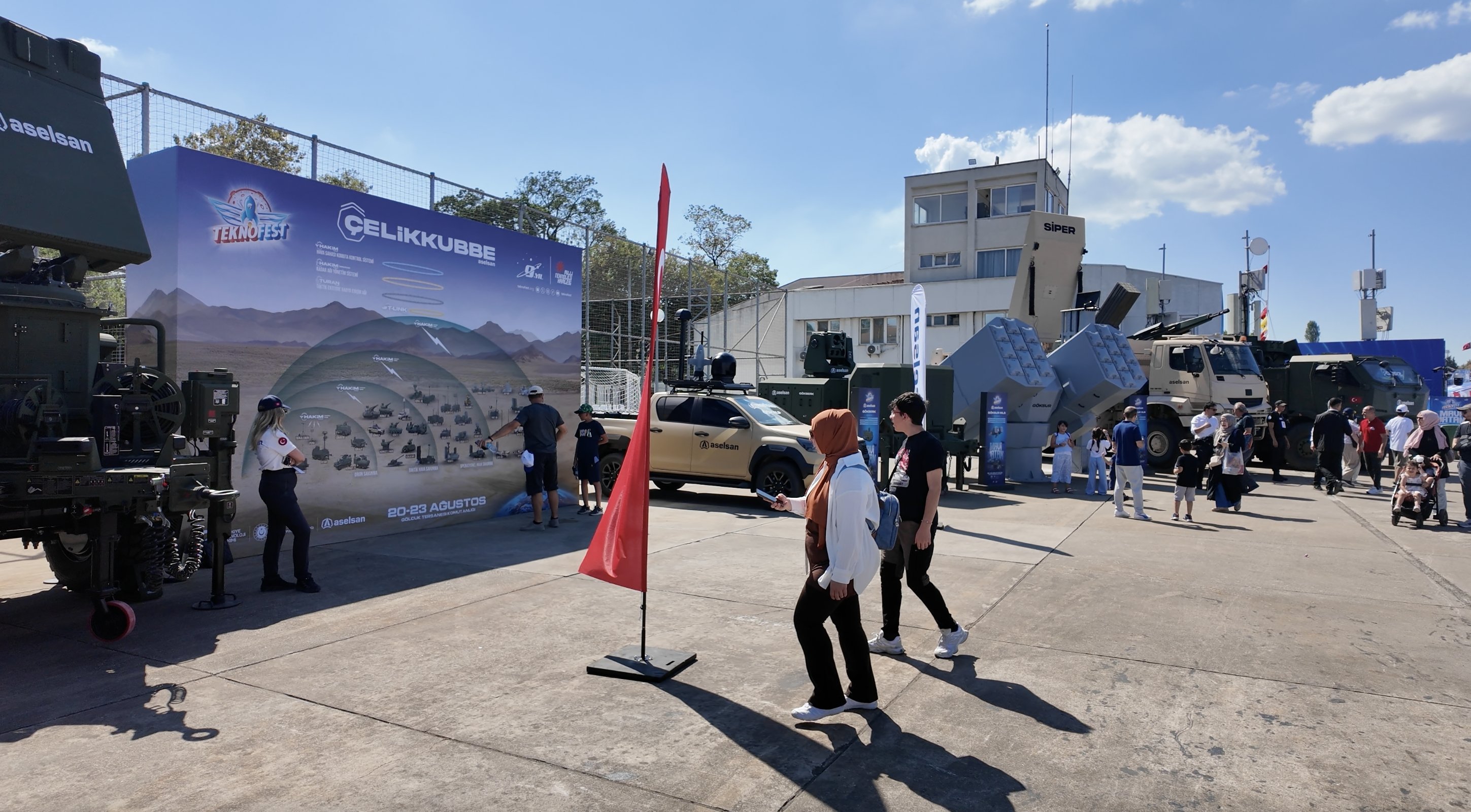
Türkiye’s multilayered air defense architecture, known as Steel Dome, is also among the major defense exhibits at the festival.
The display includes Aselsan’s Gurz, Korkut and Goksungur systems, alongside the Siper and Hisar air defense systems developed through cooperation between Aselsan and Roketsan.
Roketsan’s Tayfun ballistic missile, as well as the K+, KMC and Pusu systems, are also being presented to visitors.
Other domestically developed weapons and defense systems highlighted at the event include the Turkish Navy’s Atmaca anti-ship missile, the Akya heavy torpedo and the Malaman smart naval mine.
The range of systems on display underscores the increasingly integrated nature of Türkiye’s defense industry, spanning naval platforms, missiles, air defense, unmanned vehicles and sensor technologies.
Türkiye building more than 50 warships simultaneously
Speaking at the opening ceremony Thursday, Naval Forces Commander Adm. Tatlıoğlu said Türkiye is currently building more than 50 warships simultaneously for both domestic and foreign customers.
“Today, we are building 37 warships for the Turkish Naval Forces and 24 for foreign countries, more than 50 warships simultaneously,” Tatlıoğlu said.
He also emphasized the strategic importance of maintaining a strong navy for Türkiye, citing the country’s geographic position and maritime interests.
Minister Güler similarly stressed Türkiye’s efforts to further strengthen the capabilities of its armed forces, including the navy.
He said the Turkish Navy continues to serve as an effective and deterrent force protecting the country’s maritime rights and interests, highlighting its personnel, modern force structure, domestically produced ships and submarines, unmanned systems and advancing technological capabilities.
Warships and air power
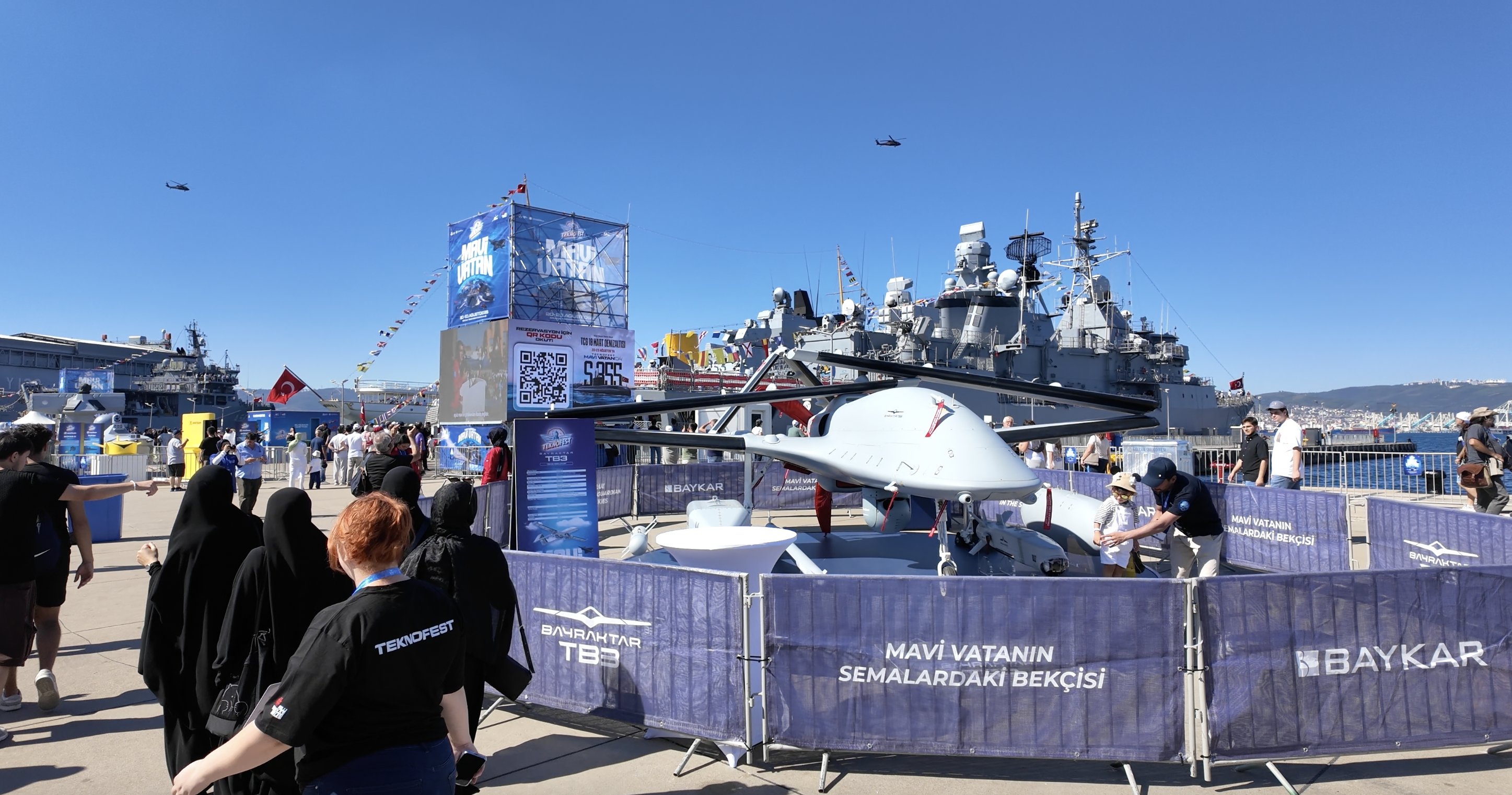
The maritime-focused festival also extends into the air. Baykar’s Bayraktar TB2 and TB3 unmanned combat drones are among the aircraft being showcased, alongside Aselsan’s Aselbuoy and Aselbuoy Pod systems.
The Turkish Navy’s Sikorsky SH-70 Seahawk helicopter and the Turkish Armed Forces’ Bell AH-1W attack helicopter are also on display.
The festival is hosting daily air and maritime demonstrations, including performances by the Turkish Navy’s elite Underwater Attack, or SAT, and Underwater Defense, or SAS, units.
Visitors can watch tactical demonstrations as well as naval and aerial shows designed to showcase the operational capabilities of Türkiye’s armed forces.
Technology meets maritime culture
Beyond military platforms and defense systems, Teknofest Blue Homeland also incorporates maritime culture, science and sports into its program.
The schedule includes the Blue Homeland Sailing Parade, swimming, rowing and dragon boat races, science activities and technology demonstrations.
The festival also aims to introduce younger visitors to maritime technologies through interactive activities and exhibits, while giving students and technology enthusiasts access to military platforms not normally open to the public, showcasing Türkiye’s efforts to build a more self-reliant maritime defense ecosystem.


-
 Economy3 days ago
Türkiye taps 6.7 bcm of gas 6 years after Black Sea discovery
-

 Sports3 days ago
Galatasaray sign Russian wunderkind Batrakov from Lokomotiv Moscow
-

 Sports3 days ago
Football’s big names flock to Turkish Süper Lig. But why?
-

 Sports2 days ago
Hull roar back into Premier League with 2-0 rout of Man Utd
-

 Economy3 days ago
Foreign arrivals in Türkiye fall slightly in July, Russians top list
-
 Economy2 days ago
US imposes 50% tariffs on Canadian goods as trade talks collapse
-

 Sports3 days ago
FIFA powerhouses mull historic no-confidence vote against Infantino
-

 Sports2 days ago
Top 10 greatest sports rivalries in world, ranked