
Politics
Erdoğan underlines end of coup era, stresses nation’s strong will

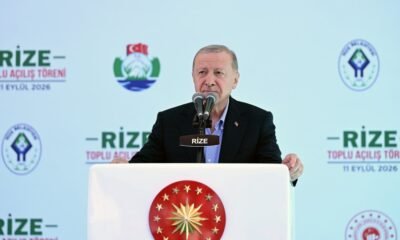
Samsun was the second stop on President Recep Tayyip Erdoğan’s Black Sea tour, which started with a visit to his hometown in the province of Rize. As he addressed a large crowd at the inauguration of a massive hospital complex Sunday, Erdoğan also touched on the anniversary of the Sept. 12, 1980, coup and described it as the source of most of the problems Türkiye faces today. The president, who has weathered multiple direct and indirect coup attempts himself, vowed that the era of coups would not return.
“During the 1980 coup, they sent people to the gallows ostensibly to restore justice,” Erdoğan said in his speech. The coup by a military junta led by Chief of General Staff Kenan Evren was justified by the same junta as a response to the political turmoil of the late 1970s, when politically motivated murders were commonplace. It was only during Erdoğan’s tenure, and long after he left his post, that Evren was tried and sentenced along with his top aide, Tahsin Şahinkaya, only to die of old age within days of the landmark verdict against the putschists.
“We lost very young people. The Sept. 12 coup inflicted deep wounds on the hearts of the nation. It also dealt a blow to Türkiye’s growth. People were condemned to economic decline and poverty,” Erdoğan recalled.
“On Nov. 3, 2002, the nation said it was enough,” Erdoğan added, referring to the first election won by his Justice and Development Party (AK Party). “The dirty hands reaching out to the people’s will are broken. The era of coups in Türkiye is over, and this nation will not allow it to return,” Erdoğan said.
The president led the nation in a successful unarmed resistance against the putschists of the Gülenist Terror Group (FETÖ) during the July 15, 2016, coup attempt. It was the first public resistance against a coup in the brief history of the Republic of Türkiye, which has been stained by multiple coups, coup attempts and ultimatums issued to elected governments by the powerful military.
“We won’t allow the people’s will to be stained again. We are authorized by the nation and will safeguard its will at all costs,” Erdoğan also said.
The National Security Council, composed of Evren and the commanders of the armed forces, assumed control of the country, dissolved Parliament and ushered in a period of sweeping political repression in September 1980.
Hundreds of people faced death sentences in military courts established after the coup.
During the period, about 650,000 people were detained, 230,000 were tried in 210,000 cases, and prosecutors sought the death penalty for more than 7,000 people.
The 1980 coup was not the last one to shake Türkiye, as military tutelage made its presence felt in Turkish politics for years to come. In 1997, it reared its ugly head again in the so-called “postmodern coup,” a bloodless attempt that forced the collapse of the government after a military ultimatum targeting Necmettin Erbakan, who was also a victim of the 1980 coup. But finally, in 2012, Türkiye managed to put the two surviving coup leaders, Kenan Evren and Tahsin Şahinkaya, on trial. Both men were too ill to attend but gave brief statements to the court through a video link from their hospital beds.
During the proceedings, Evren refused to answer questions from prosecutors, maintaining that the court had no right to put him on trial. He made a brief statement saying the military was forced to intervene and introduce a “new constitutional order to bring peace and calm.”
“The Sept. 12 movement was a historic event,” he said. “Historic events cannot be put on trial. They are examined scientifically.”
“The great Turkish nation did not deserve to live through the (1970s) events,” he testified. “We did what was right at the time, and if it happened today, we would carry out a military coup again,” he said.
Eventually, both men were sentenced to life imprisonment and stripped of their military titles. But both died in quick succession due to illnesses stemming from old age while an appeals process initiated by their lawyers was underway.

The opposition New Party (YP) leader Özgür Özel angered the ruling Justice and Development Party (AK Party) over his remarks about a by-election in Istanbul’s Üsküdar district, a former stronghold that the AK Party took back from Özel’s former party, the Republican People’s Party (CHP). At a rally against the by-election results in Üsküdar earlier this month, Özel claimed that Istanbul Governor Davut Gül “worked for the AK Party” by rescheduling the by-election and limiting access to the municipal building during the vote.
In a social media post on Sunday, Çelik said Özel “cannot cover up his own political failure and intra-party crises by attacking state organs and judicial proceedings.”
Dündar Ziya Gültekin, a municipal council member from the AK Party, was elected acting mayor of Istanbul’s Üsküdar district in a rerun vote Tuesday following a court decision suspending the previous election. That earlier election stemmed from a vacancy at the top post of the municipality after CHP Mayor Sinem Dedetaş was arrested on charges of municipal corruption. The YP obstructed the first election by violating election regulations, according to the AK Party, while the YP claimed that its candidate faced obstruction in the second vote, citing the detention of council members on corruption charges before the second election.
Çelik condemned Özel’s remarks, in which he said that the governor and other bureaucrats would “be held accountable one day.” “Targeting a governor for your own political calculations contradicts the culture of democracy,” Çelik said.
Governor Gül, meanwhile, issued a statement in response to Özel’s allegations. The appointed governor underlined that his duty went beyond political feuds and that he could not intervene in any political race in his capacity. The governor detailed the election process and said the scheduling of the election was the result of ongoing judicial proceedings, citing an appeal to the court to postpone the election. Gül also denied that the ban on people other than municipal assembly members entering the voting venue was “arbitrary or political,” saying it stemmed from criminal complaints by some assembly members who said they faced threats and pressure from YP’s local branch officials not to vote for the AK Party candidate. “The prosecutor’s office requested the ban so that the election would be held in a safe environment without intervention (by third parties),” he said.
President Recep Tayyip Erdoğan has a busy schedule this month and next. He is expected to attend the United Nations General Assembly in New York, host leaders of the Organization of Turkic States (OTS) in October and meet top officials at the COP31 summit in the southern city of Antalya in November. Before and after these events, Erdoğan may make a much-anticipated visit to Syria, his first since the Assad regime collapsed in 2024.
Foreign Minister Hakan Fidan was in Damascus on Sunday and, among other matters, revealed that he discussed the details of the planned visit with his counterpart, Asaad al-Shaibani. Erdoğan himself has signaled in earlier speeches that he may visit Syria “inşallah” (Allah willing).
Erdoğan was reportedly expected to visit Syria in spring 2026, but the plan was shelved after the outbreak of the U.S.-Israel-Iran war. Based on his busy schedule, the visit may be pushed further and could coincide with the anniversary of the Syrian revolution in December. Regardless, the visit will be historic and cement Türkiye’s strong support for the al-Sharaa administration.
It has been 16 years since a sitting Turkish president visited Damascus, and although Erdoğan was on good terms with Bashar Assad early in his tenure, the civil war and the oppression of civilians completely changed his approach to the Baathist regime. Türkiye sided with the opposition, and when its security was threatened in the lawless environment of the civil war in its southern neighbor, it launched multiple cross-border military operations to clear northern Syria of terrorist groups.
The Turkish president’s visit will likely be heavy on symbolism, something that came up earlier during Fidan’s inaugural visit to Syria after the fall of the Assad regime, when he was photographed sipping tea at Mount Qasioun with President Ahmed al-Sharaa. It remains to be seen whether Erdoğan will visit the same spot, which was once a banned site for Syrians and a location where the Baathist regime’s brutal military units were deployed.
Erdoğan’s visit, on the other hand, will also go beyond mere symbolism, which could include prayers at Damascus’ landmark Umayyad Mosque, as there are many matters to discuss and many reasons for Türkiye to celebrate in post-Assad Syria. These include new steps to boost economic and security cooperation and an opportunity to demonstrate a changing regional order, with stronger Turkish-Syrian cooperation in a region where Israel has freely engaged in an expansionist campaign for the past three years.
Al-Sharaa, on the other hand, has met Erdoğan multiple times since their first meeting two months after the revolution, when al-Sharaa met the Turkish president as Syria’s new leader. Most recently, he was a guest at the NATO summit held in Ankara in July.
Possible agenda
Among other things, Erdoğan’s visit is expected to focus on dissolving the SDF, also known as the YPG. The Syrian wing of the terrorist group PKK, which has killed thousands of people in Türkiye since the 1980s, finally bowed to demands from Damascus for integration into the security forces of the new Syria. Erdoğan has repeatedly pushed for the SDF’s alignment with Damascus, in a bid to minimize the security threat it poses to Türkiye and promote a united Syria in the postwar period.
YPG integration is still underway and is moving forward at a faster pace than in the period immediately after a 2025 deal was signed between the group’s leader, Ferhat Abdi Şahin, and President al-Sharaa. Türkiye itself is pursuing a similar plan to end the PKK, though it differs in terms of integration. The full dissolution of the YPG would complement the terror-free Türkiye initiative, which involves the disarmament of the PKK and the subsequent deferral of sentencing for PKK members.
In terms of the economy, Türkiye may announce new business deals with Syria. The postwar country, where infrastructure was razed to the ground in many places, has begun attracting investments and reconstruction deals. Türkiye is already a key player among global contractors and has extensive experience in infrastructure construction. Within months of the revolution, Damascus and Ankara signed deals to increase bilateral trade and establish a Joint Economic and Trade Commission (JETCO).
With Erdoğan’s visit, the two countries may also reaffirm their opposition to Israel’s expansionism, which also targets Syria. Israeli Prime Minister Benjamin Netanyahu visited Mount Hermon on the Syrian side of the Israeli-Syrian border earlier this month, one of several instances of what Syria and its allies consider illegal incursions into Syrian territory. His visit sparked outrage among Syria’s allies, including Türkiye.
Türkiye was also disturbed by Netanyahu’s attempt to portray an attack on Syria’s Abu al-Duhur airport as an effort to curb the Turkish footprint in Syria, claiming that Turkish troops could potentially be deployed at the site. Ankara has repeatedly accused Israel of attempting to destabilize Syria, both through direct attacks and through proxy forces opposing the al-Sharaa administration.
The Turkish president’s visit will be a show of force and unity between Türkiye and Syria against greater Israeli designs in the region. Türkiye is concerned about Israel’s alliance with historic foes of the country, such as Greece.
Overall, Erdoğan’s trip to Syria will cap the increasing Turkish engagement with a neighbor that shares a border of more than 900 kilometers (559 miles) with Türkiye, from hosting the largest number of refugees fleeing the civil war for years to supporting Syrian opposition forces during Assad’s rule. Thus, it could be yet another addition to Türkiye’s rising status as a major power broker in the region after years of being a mere observer.
Foreign Minister Hakan Fidan will travel to Azerbaijan on Sept. 15-16 for high-level talks focused on bilateral ties, trade, energy and transportation cooperation, as well as regional and global developments, ministry sources said Monday.
During the visit, Fidan is expected to hold bilateral and delegation-level talks with Azerbaijani Foreign Minister Jeyhun Bayramov, meet Defense Minister Zakir Hasanov and be received by President Ilham Aliyev.
According to sources, the talks are expected to underline satisfaction with the progress in Türkiye-Azerbaijan relations, which were elevated to the level of an alliance with the signing of the Shusha Declaration in 2021.
Regional peace efforts will be a key item on the agenda. Fidan is expected to announce that a historic opportunity has emerged to establish lasting peace between Azerbaijan and Armenia, while reiterating Türkiye’s support for establishing good-neighborly relations between the two countries.
Ankara has welcomed recent progress between Baku and Yerevan and supports efforts to improve infrastructure, restore energy and trade routes and strengthen regional connectivity in Karabakh.
The Turkish minister is also expected to emphasize the need to intensify efforts toward reaching the $15 billion bilateral trade target set by the presidents of the two countries.
Trade between Türkiye and Azerbaijan totaled $7.08 billion in 2025. Around 5,800 Turkish companies currently operate in Azerbaijan, making Türkiye the country with the largest number of foreign-invested companies there, while more than 2,600 Azerbaijani-funded companies operate in Türkiye.
Türkiye’s direct investments in Azerbaijan, including those made through third countries, have exceeded $17.9 billion, while Azerbaijani investments in Türkiye have reached $20.3 billion.
Energy and transportation projects are also expected to feature prominently in Fidan’s meetings, alongside ongoing cooperation between the two allies in the defense industry, security and military fields.
The two sides are also expected to review cooperation within multilateral organizations, particularly the Organization of Turkic States (OTS), and discuss the upcoming 13th OTS summit and COP31, both of which Türkiye is set to host.
Türkiye was the first country to recognize Azerbaijan after it declared independence in 1991. Bilateral ties, often described by officials with the phrase “one nation, two states,” have expanded across political, economic, defense, energy and cultural fields.
The two countries established a High-Level Strategic Cooperation Council in 2010, while the Shusha Declaration signed on June 15, 2021, formally elevated relations to an allied level.
The declaration is a testament to the comprehensive cooperation that will be maintained in all strategic fields, particularly national security. It envisions reinforcing partnership in many fields, from the military and defense industry to energy and transportation, from the economy to humanitarian relations. More importantly, the declaration affirmed joint action against threats and attacks against the independence, sovereignty, territorial integrity and border security of either country.
President Recep Tayyip Erdoğan last visited Azerbaijan in November 2025 for Victory Day commemorations in Baku, while Aliyev traveled to Türkiye in April for the Antalya Diplomacy Forum. The two leaders most recently met on Sept. 1 on the sidelines of the Shanghai Cooperation Organization summit in Bishkek.
Once the opposition’s only hope of beating incumbent President Recep Tayyip Erdoğan, Kemal Kılıçdaroğlu, the presidential candidate of a six-party alliance in 2023, fell far from leading the opposition. His fortunes vastly improved, though, as the former leader of the opposition Republican People’s Party (CHP) was reinstated to his post. Now, he aspires to restore the party to its heyday as the main opposition.
Turkish media outlets reported that the veteran politician will hit the road in October, seeking to reach out to the party’s dwindling supporters after the party split in July, when Kılıçdaroğlu’s successor, Özgür Özel, left to establish the New Party (YP).
Kılıçdaroğlu aims to restructure the CHP, whose leadership was taken over by Özel after a 2023 intraparty election, ahead of a planned congress. When Kılıçdaroğlu began his ambitious campaign to “cleanse” the CHP of corruption allegedly linked to Özel’s associates, including mayors arrested on bribery charges, he was branded a “traitor” by the Özel camp, which also claimed that Kılıçdaroğlu would not even go out for fear of being booed. Kılıçdaroğlu made a few field trips over the summer and managed to attract crowds, but it may take more than that to keep the CHP intact after the YP grabbed the coveted title of “main opposition” by transferring most of the CHP’s lawmakers.
Apart from a few instances, Kılıçdaroğlu has not faced a dire reaction, and in some cases, the events he attended drew large crowds. Encouraged by this, the party launched a timetable for a congress and started appointing new names to local branches.
In October, Kılıçdaroğlu is expected to visit Istanbul and the southeastern provinces of Diyarbakır and Şırnak. Like Özel, he is expected to focus on economic issues during his revival campaign, a favorite subject of Özel in his efforts to bring the opposition to power.
In predominantly Kurdish Diyarbakır, Kılıçdaroğlu is expected to hold talks with locals on terror-free Türkiye, an initiative backed by the government to end the PKK’s campaign of terrorism, which has long exploited the Kurdish community under the guise of fighting for so-called Kurdish self-rule in the southeast.
A mayor problem
After Özel’s departure, the CHP also lost several mayors to the YP, while Ankara Mayor Mansur Yavaş remained. Yavaş, a possible contender for a future presidential race, is an influential figure for a party that has been reduced to a pale shade of its former self in recent months.
Yavaş, however, may leave the party soon, according to unconfirmed reports. The mayor’s meeting with President Recep Tayyip Erdoğan last week triggered rumors and outrage among opposition supporters who believe he may collude with the opposition’s main rival. Yavaş denied the claims, while Özel said he had been notified of the unprecedented meeting beforehand.
Yet, Yavaş’s political future remains ambiguous. Media reports say Yavaş may leave the party by the end of September. A report by broadcaster A Haber says Yavaş will be invited to a meeting of CHP mayors at the end of this month and may skip the meeting. This, in turn, will likely prompt disciplinary proceedings against Yavaş, who has remained on good terms with both the YP and CHP after the split.
A Haber reported that some CHP lawmakers lobbied for Yavaş’s expulsion from the party due to his ambiguous loyalty and that Yavaş may resign before disciplinary action is launched.
A saga of resilience of the Turkish nation, the Battle of Sakarya is vividly remembered 105 years later. The 1921 victory over occupying Greek forces was commemorated on Sunday with a message from President Recep Tayyip Erdoğan, who highlighted how Türkiye remained strong against its enemies.
The battle, which pitted Turkish forces under the command of the Republic’s founder, Mustafa Kemal Atatürk, against the Greek invaders, is hailed as the penultimate push to drive out occupying forces from post-World War I Türkiye. It put an end to Greece’s ambition to capture Ankara, the future capital of the country, and forced Türkiye’s western neighbor to accelerate its retreat to the west.
Fought mainly in Polatlı, now a district of Ankara, the battle drew its name from the Sakarya River, which stretches from the northwest to the capital’s borders. “There is no line of defense, there is a field of defense, and this field is the entire homeland,” Atatürk had famously told the army before the battle, ordering troops to fight to the death, “even if you see other units falling next to you.”
The Battle of Sakarya began Aug. 23 on the banks of the Sakarya River and concluded Sept. 13, 1921, stopping the Greek advance. It was preceded by another battle in the west that had forced Turkish troops to retreat. The Turkish retreat to the east of the Sakarya River had fueled a debate in the fledgling Parliament of post-Ottoman Türkiye and dampened public morale. Seeking a firm response against the Greeks, Parliament appointed Atatürk as the commander of the army that would counter the Greek advance. Atatürk mobilized the public by issuing a series of orders calling on the nation to donate whatever they had to the army, from guns to food.
The strengthened Turkish side confronted the Greek forces south of the Sakarya front on Aug. 23, and the battle line sprawled across an area about 100 kilometers long (62 miles). Though exact figures are not known, some 14,000 soldiers died on the Turkish side, while Greek forces suffered similar losses. The battle was one of the bloodiest in the war, and Turkish forces rarely gave up the fight apart from brief retreats, despite the nation’s exhaustion from World War I. The battlefield moved to Ankara’s Haymana district in September, but the Greek offensive failed once again. Turkish forces drove the Greeks back to their defensive lines, and on Sept. 13, the entire Greek army was compelled to withdraw. One year later, again in August, Turkish forces won the last battle, the Battle of Dumlupınar, against the Greek invaders.
The victory brought Mustafa Kemal, who then held the title of Pasha, the rank of Field Marshal and the title of Ghazi, awarded by Parliament.
In his message marking the anniversary, President Erdoğan said the Battle of Sakarya, one of the greatest victories in the Turkish nation’s centuries-long struggle for independence, demonstrated the extent of the sacrifices and efforts the nation was prepared to make for its freedom and independence. Erdoğan emphasized that the Turkish nation, which showed the entire world that it could remain united even amid scarcity and under the most difficult conditions, achieved a victory at the Battle of Sakarya that would go down in the history of warfare.
“The Victory of Sakarya, which gave the nation great self-confidence on the road to the establishment of the Republic of Türkiye, once again impressed upon the minds of enemy nations that Anatolia is the Turkish homeland. Drawing strength and determination from the glorious victories of our past and the rich civilization bequeathed to us by our ancestors, we will preserve our state forever and protect every inch of our homeland, whatever the cost may be. Without compromising the bloodshed of our martyrs who fell in making Anatolia our homeland, from Malazgirt to Sakarya, we will defend the rights of our beloved nation and work with all our strength to achieve our goals.
“On this occasion, I once again pray for Allah’s mercy upon all our martyrs who did not hesitate to sacrifice their lives to protect our freedom and independence and our sacred homeland. On the anniversary of the Victory of Sakarya, I commemorate with mercy and gratitude all the heroes of the War of Independence, particularly Gazi Mustafa Kemal, and extend my heartfelt greetings to all our citizens,” Erdoğan said in a written statement.
For Greece, it was part of a sequence of incidents and defeats that effectively ended its Megali Idea, a Greek nationalist concept of annexing lands where ancient Greeks lived to 20th-century Greece. Encouraged by the Ottoman Empire’s defeat in World War I and spurred by the Entente Powers’ greenlighting of a campaign into Anatolia, Greek forces managed to capture several locations in western Türkiye, most significantly Izmir on the Aegean coast.
The 1920 Treaty of Sevres, which was not recognized by the nationalist forces led by Atatürk, further paved the way for Greek advances into central Türkiye, with the ultimate purpose of capturing Ankara, the capital of Atatürk-led forces.
Today, the Battle of Sakarya is remembered in Greece as part of the “Asia Minor Catastrophe,” a series of developments that eventually forced Greece to sign the Armistice of Mudanya in 1922, which ended the Turkish-Greek conflict in the wake of World War I.
Foreign Minister Hakan Fidan discussed recent attacks against Saudi Arabia and broader regional developments in a phone call with his Saudi counterpart, a Turkish diplomatic source said Friday.
Saudi Arabia said Friday it had temporarily shut its East-West Pipeline as a precaution after multiple attacks in the Riyadh and Medina regions a day earlier injured several people.
Emergency and technical teams were deployed to secure the pipeline and assess its safety, while authorities did not identify those responsible or disclose the nature of the attacks. No group has claimed responsibility.
Last month, NATO member Türkiye, Saudi Arabia and Pakistan signed a joint defense agreement that includes a mutual defense clause similar to NATO’s Article 5.


-
 Economy1 day ago
‘This is the test’: All eyes turn to Fed as rate hike probable
-

 Politics3 days ago
Prison walls, survivor accounts keep memory of 1980 coup alive in Türkiye
-

 Sports3 days ago
Fenerbahçe confirm Kartal to remain coach after resignation drama
-

 Economy3 days ago
Türkiye-Azerbaijan-Georgia-Bulgaria power link deal could be signed in November
-

 Economy3 days ago
What are 8 factors Türkiye counts on to unlock disinflation
-
 Politics1 day ago
Turkish police detain 20 in FETÖ infiltration raids in 6 provinces
-
 Politics1 day ago
Erdoğan vows to shield Türkiye from regional turmoil
-
 Economy1 day ago
US-Canada trade war reshapes Canadian supermarket shelves