
Economy
Potential Merz successor visits Türkiye with large business group

The premier of Germany’s most populous state has called for a “new chapter” in relations with Türkiye as he kicked off a three-day trip to the country Monday.
Hendrik Wüst, the conservative leader of North Rhine-Westphalia who is widely seen as a potential successor to the under-pressure Chancellor Friedrich Merz, left Dusseldorf for Ankara early Monday with a large delegation, including a high-profile business group.
Wüst was received by President Recep Tayyip Erdoğan shortly after his arrival.
The trip is intended to mark the 65th anniversary of the 1961 recruitment agreement that allowed “guest workers” from Türkiye to work in West Germany. An estimated 3 million of Turkish origin now live in Germany, according to the Federal Statistical Office, with just over half having German nationality.
Wüst noted that one-third of people of Turkish origin in Germany live in North Rhine-Westphalia. “They are naturally part of our state,” said Wüst, the first premier of the state to make an official visit to Türkiye.
The 51-year-old has consistently dismissed speculation about a challenge for the chancellor’s office.
“I want to remain premier of North Rhine-Westphalia,” Wüst told broadcaster ZDF on the eve of his departure, pledging to “get the federal government firing on all cylinders again.”
In Ankara on Monday, Wüst was due to visit a plant belonging to Dusseldorf-based company Henkel and then the mausoleum of Mustafa Kemal Atatürk, the founder of modern Türkiye. A meeting with Turkish business figures was planned for the evening.
On Tuesday, Wüst will hold political talks in the capital before traveling on to Istanbul, where a business conference is scheduled along with the presentation of a prize for tolerance and reconciliation between cultures to former Germany football captain Ilkay Gündoğan.
Ahead of his departure, Wüst said he wants to “focus on the positive for stronger cooperation in future” and argued that critical questions and issues could be raised more easily within a strong and close partnership.
“No [German] region is as closely linked to Türkiye, socially and economically, as North Rhine-Westphalia,” he said.
Trade relations
The annual trade volume between the state and Türkiye stands between 10 billion ($11.38 billion) and 12 billion euros, accounting for around 20% of total German-Turkish trade.
Wüst said there was scope to increase the figure, while calling for further development of the EU-Türkiye Customs Union, including effective mechanisms for resolving legal disputes.
“The Customs Union should be further developed, and we need well-functioning mechanisms for legal disputes so that both countries can benefit more from it,” he said, according to a Turkish transcript of remarks reported by Anadolu Agency (AA).
According to the state government, more than 1,200 Turkish companies operate in North Rhine-Westphalia.
Last year, one in three flights from Germany to Türkiye took off from an airport in North Rhine-Westphalia.
Wüst said discussions about people of Turkish origin in Germany often focused too heavily on integration problems and shortcomings, arguing that the potential created by the Turkish-German community should receive greater attention.
“We should have a discussion about opportunities,” he said, describing the community as a natural bridge between Türkiye and Germany.
Wüst said the state’s industrial history would not have been possible without workers who arrived from Türkiye, Italy, Spain, Portugal, Poland and other countries.
“We should build on this legacy and create a new common economic miracle,” he said, according to a Turkish transcript of remarks reported by Anadolu Agency (AA).
He highlighted the contribution of people of Turkish origin to the mining and industrial sectors as well as to Germany’s postwar reconstruction and energy infrastructure.
Wüst also said the descendants of those workers now occupy positions of responsibility across German society, citing Federal Office for the Protection of the Constitution President Sinan Selen, State Minister at the Foreign Ministry Serap Güler and Gonca Türkeli-Dehnert, a senior official in his own state government.
Visa barriers seen as disadvantage
Wüst said difficulties faced by Turkish businesspeople seeking German visas were also creating an economic disadvantage for North Rhine-Westphalia.
He said some businesspeople were obtaining visas from other countries and then traveling to Germany, adding that this was not how the system should work.
“We have to achieve better results on this,” Wüst said, adding that the state government was prepared to work with municipalities while also calling for better functioning of the process at Germany’s Foreign Ministry.
He said Türkiye had recorded significant growth in recent years and that this was positive for both sides. North Rhine-Westphalia was open to investment from Türkiye, he added.
“Germany and North Rhine-Westphalia are a very safe place for foreign investment,” Wüst said, adding that Turkish companies were accompanying his delegation to explore investment opportunities.

U.S. President Donald Trump announced on Monday plans to build a multi-billion-dollar steel mill in the Midwest state of Iowa, handing the administration a marquee manufacturing investment ahead of November’s midterm elections.
Trump unveiled the project at the White House with executives from Mesabi Metallics, which recently opened Minnesota’s first new iron ore mine in 50 years.
A White House official said the plant investment would amount to $15 billion. The planned plant was also described as “the largest ever” in U.S. history.
The announcement comes as Trump seeks to bolster his economic record ahead of November’s election, with his approval rating plummeting to all-time lows as the Republican Party confronts voter concerns about inflation and the cost of living.
Trump has made tariffs and a revival of U.S. manufacturing central to his economic agenda, arguing that higher barriers to imports will drive investment and jobs back to the United States.
But Republicans are in the midst of several competitive elections in Iowa, a once-swingy state that has more consistently voted for Trump’s party in recent years. Polling this cycle shows a tight race for a seat in the U.S. Senate, as well as its gubernatorial race, where the Democratic candidate, Rob Sand, has led most polls.
The potential $15 billion steel project gives Trump a high-profile investment to tout as he makes that case to voters. It also comes as the administration faces pressure to show that its policies imposing broad tariffs on U.S. imports can deliver industrial gains without fueling inflation.
“This is a tremendous investment,” Trump said in the White House’s Oval Office. “Our steel industry is roaring back to life.”
New jobs expected
Global steel markets have been sluggish in recent months due in part to overcapacity, particularly in China, and lackluster demand. In the U.S., however, steel prices have been higher because of trade barriers, boosting the appeal of domestic projects despite their high construction costs.
Trump imposed a 25% tariff on most imported steel during his first term, a levy that his successor, Democrat Joe Biden, largely kept in place.
The new project will be fully vertically integrated, with Mesabi using iron ore from its Minnesota mine to produce steel in Iowa. The first phase will produce 7.5 million tons of steel annually, with the plant eventually expected to reach 10 million tons, which the White House described as the largest steel plant in U.S. history.
The Wall Street Journal first reported the announcement.
The Mesabi steel project would use iron ore extracted from the company’s mine in Nashwauk, Minnesota, roughly 250 miles from the Iowa border.
Indian conglomerate Essar Group owns Mesabi and has invested more than $2.5 billion in the Minnesota mine.
Earlier this month, the U.S. Export-Import Bank said it would finance $10 billion for the mine’s expansion, and the bank’s chair, John Jovanovic, visited the site.
The Minnesota mine is expected to create about 350 jobs, while the Iowa steel plant is expected to create at least 1,750 permanent jobs, a White House official said. The first phase is also expected to support 5,000 to 6,000 construction jobs.
It was not immediately clear why Mesabi aims to build a steel mill in Iowa using iron ore extracted from Minnesota.
The company was not immediately available to comment.
Power can be a major cost for steel producers, and commercial electricity prices in Iowa are marginally lower than in Minnesota.
The first phase of the project is expected to generate $95 billion in total economic impact during construction and its first 10 years of operation, according to the White House. First steel production is expected in 2030.
Senior public- and private-sector representatives from Türkiye and the United Arab Emirates (UAE) gathered Monday to explore investment and cooperation opportunities in logistics, transport infrastructure and supply chains.
Officials said the UAE-Türkiye Logistics and Infrastructure Forum in Istanbul sought to strengthen cooperation between the two countries in logistics, transport infrastructure, supply chains and industrial investment.
It also aimed at developing concrete investment and trade opportunities along the Middle Corridor, which connects Europe, the South Caucasus and Central Asia with the Gulf region.
Speaking at the opening, UAE Ambassador to Türkiye Saeed Thani Al Dhaheri said the forum was organized to bring major companies to identify investment opportunities along the Middle Corridor and the Development Road project, while assessing logistics capabilities in Türkiye and the UAE.
The Middle Corridor, officially known as the Trans-Caspian International Transport Route (TITR), is a multimodal land-and-sea trade network connecting China and Central Asia to Europe. Türkiye is a key transit hub in the corridor.
Unveiled in May 2023, the Development Road is a $20 billion regional infrastructure initiative designed to facilitate the transport of goods from the Gulf to Europe via the Grand Faw Port in Basra in southern Iraq. The port would be linked to Türkiye and subsequently to Europe through an extensive network of railways and highways.
In April 2024, Türkiye, Iraq, the UAE and Qatar signed a memorandum of understanding (MoU) for joint cooperation on the project.
“We do not view the Middle Corridor and the Development Route as two competing routes or as alternatives to one another,” said Al Dhaheri, adding that they differ in terms of their directions and the cargo bases they serve.
“Both routes converge in Türkiye and both extend to Europe. This is, by its very nature, a complementary intersection,” he noted.
“The capabilities of Türkiye and those of the United Arab Emirates come together in a natural and complementary way.”
Al Dhaheri also highlighted the growth in bilateral economic ties. Non-oil trade between the two countries surpassed the $40 billion target ahead of schedule, reaching $45.2 billion in 2025.
“This figure represents a 15.5% increase in just one year and is approximately three times the 2022 level,” said the ambassador.
Al Dhaheri attributed the strengthening of ties to high-level contacts between UAE President Sheikh Mohammed bin Zayed Al Nahyan and Turkish President Recep Tayyip Erdoğan, as well as meetings and reciprocal visits under the countries’ High-Level Strategic Committee.
Also addressing the event, Ali Kamil Özmen, head of the public-private partnership department at the Presidential Investment Office, said Türkiye is supporting its goal of becoming a hub through substantial infrastructure investments.
In a global environment where some trade routes have become unstable due to regional and international geopolitical developments, Özmen said the importance of alternative east-west corridors has become even more evident.
The Middle Corridor, with Türkiye at its center, offers a significant time advantage and resilience by reducing transit times from China to Europe to just 18 days, he added.
The Middle Corridor is becoming part of a broader regional connectivity network, supported by $7.8 billion in infrastructure investments by Türkiye and $20 billion in Iraq.
Travelers could be stuck paying high airfares even if oil and jet fuel prices fall, major U.S. airlines and industry analysts say.
The price of jet fuel shot up after the Iran war began and retreated sharply in the spring before surging again as the summer went on. Such fluctuations make it harder for airlines to plan ahead and give them a reason to be cautious about lowering ticket prices, according to Brett House, an economist who teaches at Columbia Business School.
Jet fuel has risen even faster than oil during the war, reflecting both higher crude prices and tight supplies of the refined fuel that is one of airlines’ largest operating expenses. Carriers cut some less profitable flights and raised fares and baggage fees, although major U.S. airlines said higher passenger revenue initially covered only part of their soaring fuel costs.
Airfares haven’t moved in lockstep with fuel prices, however. The Argus U.S. Jet Fuel Index plunged from an early April peak of $4.88 a gallon to a wartime low of $2.70 in June, but average fares remained elevated.
The average fare, not including optional fees for services such as checked bags and seat selection, rose from $405 in the last three months of 2025 to $428 in the first quarter of this year and to $436 in the April-June period, according to the Bureau of Transportation Statistics.
Part of the disconnect between fuel prices and airfares comes down to timing, House said. Airlines typically decide several months in advance how many flights to operate and seats to offer, factoring in expected fuel costs and other expenses. They begin selling tickets even earlier. While prices for seats on the same flight can change repeatedly, airlines can’t charge more for seats already sold if fuel prices suddenly spike, he explained.
“It’s not just the level of fuel costs that is a problem or a challenge for airlines,” House said. “It’s also the volatility.”
There are few signs of relief so far for travelers as airlines adjust their schedules and prices for the remainder of the year. In August, U.S. airfares were 23% higher than a year earlier, according to the Labor Department. Jet fuel prices kept climbing this month, reaching $4.53 a gallon on Sept. 17, according to the Argus index.
At $4.30 a gallon Friday, the average price across the four U.S. markets the index tracks remained nearly twice the 2025 average. Travelers shopping for holiday flights already are encountering the highest airfares in a decade, travel-booking company Hopper said in a report published the same day.
The company, which tracks fares available in flight searches, estimated that during the previous week, a round-trip domestic fare averaged $402 for Thanksgiving travel and $452 for Christmas, 31% and 23% more than last year.
And the pressure on airlines and travelers isn’t limited to the United States. Globally, jet fuel averaged about $99 a barrel on Feb. 27, the day before the war began , according to the International Air Transport Association’s Jet Fuel Price Monitor.
Prices more than doubled to $209 by early April, fell for nearly three months and reached $195 a barrel in mid-September following their renewed ascent, IATA said, citing data from S&P Global Energy Platts.
Fuel prices can swing overnight, but airfares decline more slowly
The renewed pressure on jet fuel prices stems from many of the same disruptions that have sent diesel prices soaring.
Fighting has curtailed refinery production and fuel exports from the Middle East, while Ukrainian strikes have damaged Russian refineries. Because diesel and jet fuel are closely related products that compete for refinery output, shortages of one can put additional pressure on the price and availability of the other.
IATA expects fuel to account for nearly one-third of airline operating expenses this year, up from about a quarter in 2025.
By the time fuel prices jumped again, about 35% of United’s tickets for the final three months of the year were already booked and the airline could not increase those fares retroactively, Chief Financial Officer Mike Leskinen said. The airline expects to recover its higher fuel costs through revenue, but not immediately, he said.
Speaking about the rising price of jet fuel at a Sept. 16 investor conference, Leskinen said, “I don’t actually care if it stays high. I just need it to stabilize.”
The time it takes airlines to recoup their costs means travelers may keep paying for a fuel spike even as prices come down. Jet fuel prices need to fall and stay down for airfares to decline on a sustained basis, said Stephen Treanor, a finance professor at California State University, Chico, who has studied airlines’ exposure to fuel price risk.
The speed with which jet fuel prices rose recently has complicated the forecasts of U.S. airlines. As recently as Sept. 10, JetBlue raised its expected average fuel price for the July-September period to $3.96 a gallon. Prices continued climbing afterward, with the Argus U.S. Jet Fuel Index reaching $4.53 a gallon a week later and remaining above $4.25 with just days left in the quarter.
Every penny per gallon adds about $10 million to American Airlines’ quarterly fuel bill, Chief Financial Officer Devon May said. Speaking at the same investor conference this month, May said the latest increases would boost the airline’s fourth-quarter fuel costs by about $1 billion.
American, United and Southwest Airlines have said they are pruning their flight schedules further, particularly on less-profitable routes, due to higher fuel costs. United, for example, pulled some December flights and warned of further cuts in 2027 if fuel remains expensive. American said it expected to grow more slowly next year than it anticipated a few months ago.
Travelers who buy tickets at the last minute are paying a price. The average same-day fare for a one-way domestic Allegiant Air flight jumped 21% in a week, to $280 on Sept. 18, according to a Deutsche Bank analysis of flight pricing. The comparable price for a same-day American Airlines fare was $463, up 6%.
For travelers holding out for cheaper fares, the wait could outlast the war itself.
“The likelihood that fuel surcharges are going to be rolled back and airfares are going to be brought down is very low over the next few months,” House said.
Corporate donors to U.S. President Donald Trump’s ballroom and participants in business deals brokered by Trump family members are expected to be among the first targets of investigations if Democrats take control of the House or Senate in November’s midterm elections, a report said Monday.
Control of either chamber would give Democrats subpoena power and funding to bolster investigative staff, enabling them to launch probes as early as February and potentially triggering lengthy legal battles that would place the Trump family business empire squarely in the spotlight.
That’s according to a Reuters report, citing multiple Capitol Hill staffers, lawmakers and attorneys.
The investigations could dominate the second half of Trump’s term after two years of dealmaking in which the Trump family expanded into crypto, drones, artificial intelligence and prediction markets, while the president’s personal wealth grew by an estimated $2.2 billion.
“I don’t think the Democrats are going to have patience. They’re going to expect documents pretty quickly. You’re not going to play the old run-out-the-clock game,” said Ashley Callen, a lawyer with law firm Jenner & Block who was previously general counsel to Republican House Speaker Mike Johnson.
U.S. House of Representatives Democratic Leader Hakeem Jeffries of New York told reporters on September 17: “We’re going to hold the crooks accountable, beginning on day one.”
The Trump administration criticized the potential for investigations. “Democrats have no agenda to improve the lives of the American people, just plans to obstruct and baselessly target President Trump’s commonsense agenda,” White House spokesperson Olivia Wales said in an emailed statement to Reuters.
Corporations are a ripe target for investigations because, unlike the White House, they cannot claim their activities are protected by executive privilege.
Of particular interest are Trump-linked crypto firms and Donald Trump Jr.’s venture capital firm, 1789 Capital, according to Democratic Representative Jamie Raskin of Maryland and Democratic Senator Richard Blumenthal of Connecticut, although both cautioned there is no definitive list of targets yet.
Companies with ties to Trump and his family are conducting urgent preparations, including hiring lawyers for internal audits and crisis communications firms for public outreach, according to interviews with corporate counsels, crisis management specialists, congressional staff and lawmakers.
Democratic Senator Sheldon Whitehouse of Rhode Island unveiled a report on Thursday, saying oil and gas companies won tax breaks, subsidies and looser environmental regulations after Trump asked them for $1 billion in donations during his 2024 presidential campaign, adding yet another potential avenue for investigation.
Focus on Trump family
Adam Schiff, Democratic senator from California, sent a warning to companies not to delete any records related to transactions with Trump and his administration.
“We can make life very difficult for the administration if you abuse legitimate oversight requests of Congress,” Schiff said in an interview, citing Congress’ power over funding for agencies.
Among transactions Schiff is focused on is the proposed sale of a portion of Yosemite National Park to a private developer with ties to Republican campaign committees. “In this administration everything is for sale, including our most precious gems like Yosemite,” he said.
But the prime target for Democrats appears to be the Trump family – especially Donald Jr., who has entered into a flurry of business deals since his father won office in November 2024.
“The First Family has been making money hand over fist,” said Schiff.
Trump son-in-law Jared Kushner “is a corporate executive that we absolutely will need to talk to,” said Raskin, who could become chair of the powerful Judiciary Committee if Democrats take control of the House.
He said Kushner has not responded to two letters inquiring about his private equity firm Affinity Partners’ dealings with Middle East “oil monarchies and governments” while he also represents the United States in diplomatic negotiations.
Raskin pointed to deals Kushner secured with Saudi Arabia, Qatar and the United Arab Emirates (UAE) while serving as a presidential envoy. “That’s an outrageous conflict of interest,” he said.
Kushner is a U.S. special envoy for peace but not a government employee. Federal employees are subject to rules prohibiting them from engaging in activities that could affect them financially.
Chad Mizelle, a lawyer for Kushner, said in a statement that allegations against him are false. “And to date, no one – not even Jared’s critics – has identified a single applicable rule or regulation he has violated,” Mizelle said.
Raskin also singled out a $620 million Pentagon loan to rare-earth startup Vulcan Elements announced some three months after an investment by Don Jr.’s 1789 venture fund.
“He seems to have a clairvoyant sensibility of exactly who is going to get government contracts and who is going to get favorable government regulatory treatment in the Trump administration,” Raskin said.
In a statement to Reuters, a Vulcan spokesperson said the company “did not ask or solicit its investors to facilitate the Pentagon loan” and that it would continue to engage with Congress in “good faith.”
1789 Capital hired top law firm Quinn Emanuel to handle congressional investigations and is already signaling its intention to rebuff Democratic inquiries.
“1789 Capital welcomes legitimate congressional oversight,” it said in a response to Congress dated Sept. 9, “but it has no intention of being held hostage to political gamesmanship.”
In a statement to Reuters, a 1789 spokesperson said “Rep. Raskin has offered no proof of wrongdoing, only politically motivated accusations,” adding that his letter demonstrated “a troubling lack of financial literacy.”
Jeopardy for corporate executives
Republican Senator Kevin Cramer of North Dakota dismissed the need for such investigations and said Democrats could face a backlash from voters by “fixating and obsessing on Donald Trump and his personal life and his dealings, rather than on the things that matter to the American people.”
But some Republicans may join Democrats’ efforts. Freshman Republican Senator John Curtis of Utah called for Don Jr. to be investigated for allowing a Russian oligarch to pay for his wedding parties in the Bahamas.
Firms will have to decide whether to quickly comply with investigations, which could incur Trump’s wrath, some of the lawyers said. A failure to cooperate with Congress could result in legal jeopardy for executives and possible consumer blowback.
“There is the reputational risk always with any congressional investigation,” said Kevin Edgar, a BakerHostetler law partner and former congressional aide.
One lawyer, who requested anonymity to protect clients, said an ideal outcome could actually be being sued by the White House to stop them from producing information on the grounds of executive privilege. “It gives them the ability to say: Mom and dad tell me what to do,” the attorney said.
Some companies were already referring requests for information to the White House.
In a previously unreported July 1 letter reported by Reuters, ballroom contractor Clark Construction responded to a request about “ballooning costs” from Blumenthal by saying the terms of the deal required all information to come from the White House.
Blumenthal, who is in line to chair an investigations panel, said: “We will use our subpoena power, absolutely,” if Democrats win control of the Senate in November.
Türkiye began Monday deliveries of its domestically developed and redesigned Hürkuş advanced trainer aircraft to the Turkish Air Forces Command, with the first planes entering service following the completion of acceptance tests.
A total of 55 Hürkuş II aircraft are planned to be delivered through 2028, including 12 that are scheduled for delivery by the end of this year, according to Haluk Görgün, head of Türkiye’s Presidency of Defense Industries (SSB).
The first two aircraft of the substantially redesigned version of the original Hürkuş variant were formally handed over at a ceremony at Turkish Aerospace Industries’ (TAI) facilities in Kahramankazan, Ankara.
“This is a historic day for Turkish aviation,” Görgün said at the ceremony, adding that Türkiye had, for the first time, entrusted a domestically developed manned aircraft to its own pilots.
With its modern avionics, performance and maneuverability, Hürkuş II is expected to help develop the flight skills of trainee pilots while providing a common training foundation for Türkiye’s next generation of locally developed combat aircraft.
The aircraft features a wingspan of 10.8 meters, has a maximum takeoff weight of 3.3 metric tons, a service ceiling of 39,270 feet, a maximum range of 1,190 km and a maximum cruise speed of 533 kilometers per hour. Equipped with an anti-G system, the aircraft can fly upside down for 30 seconds.
“We confidently say that we have built the best aircraft in its class,” Görgün said, referring to the flight performance and engineering capabilities.
Designed to support Hürjet, Kaan training
The Hürkuş’s cockpit and avionics architecture were designed to be compatible with other domestically developed aircraft, including the Hürjet advanced trainer and fifth-generation Kaan fighter jet, Görgün said.
The common architecture is intended to make the transition easier for pilots moving to more advanced platforms.
The project has also helped build Türkiye’s engineering capabilities in the design, development, testing and integration of manned aircraft, Görgün said.
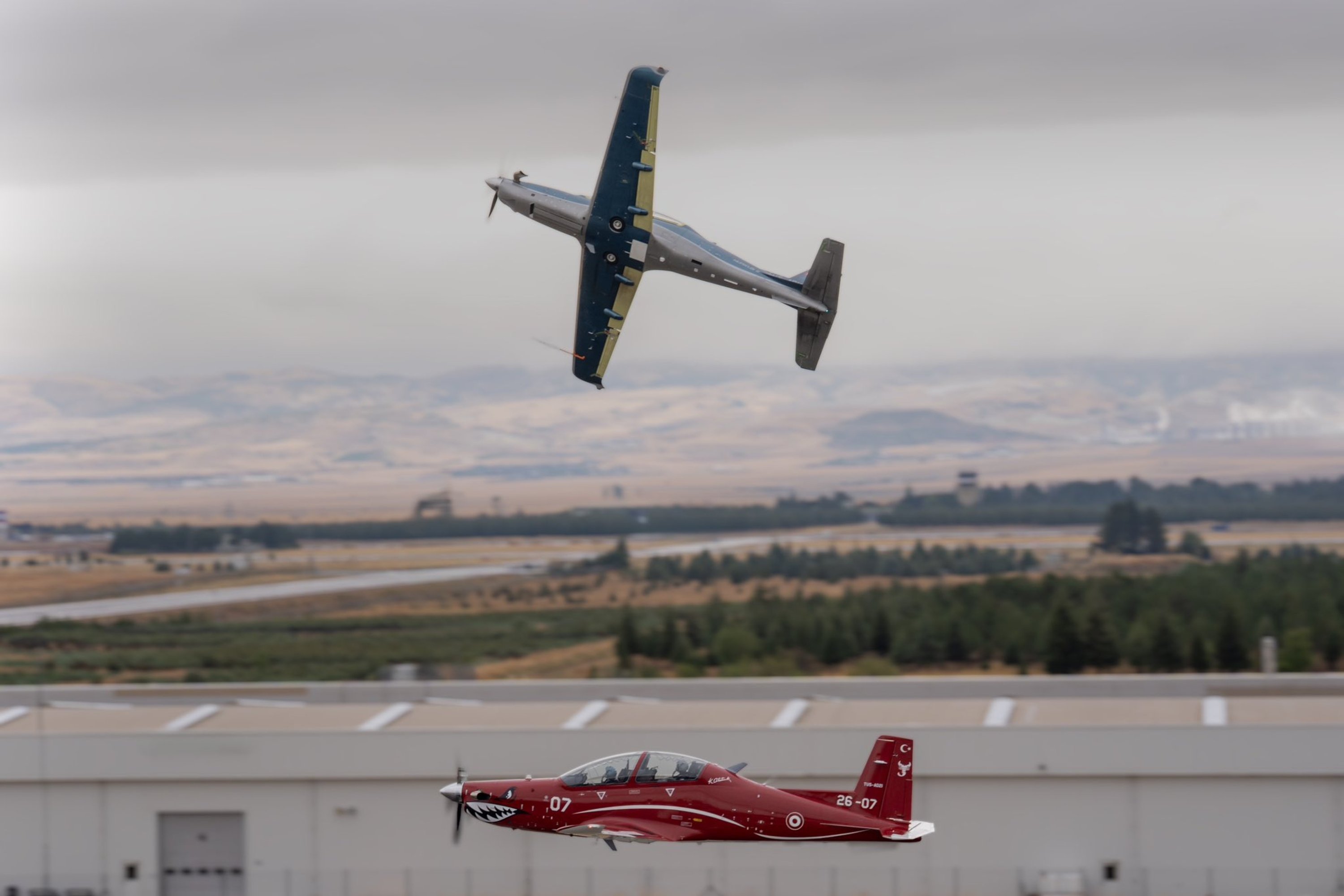
He said approximately 23,000 hours of testing were carried out during the Hürkuş development process, including ground, laboratory and system-integration work.
The aircraft received military type certification to international standards on Sept. 9, Görgün said.
Export ambitions
Alongside basic pilot training, Hürkuş can also perform light-attack and close-air-support missions, making it a multipurpose platform for international markets, Görgün said.
Several countries from different regions have already expressed interest in the aircraft, he added, citing demand for hundreds of planes in the basic trainer market.
“We will soon start sharing export news about Hürkuş,” Görgün said, without identifying potential customers.
The aircraft is being produced with a localization rate approaching 80%, with Turkish Aerospace Industries as the prime contractor and contributions from companies including Aselsan and Havelsan.
Görgün said the use of domestically developed subsystems and software would also facilitate the integration of Turkish-made munitions.
Order increased
The Hürkuş procurement program initially covered 15 aircraft but was expanded by 40 additional aircraft to a total of 55, Görgün said.
“We plan to see Hürkuş fleets in the Turkish Air Force in 2027 and to have all 55 aircraft in the Air Force inventory by the end of 2028,” he said.
TAI CEO Mehmet Demiroğlu described the aircraft as a milestone for Türkiye’s fixed-wing aviation capabilities, saying engineering expertise gained through Hürkuş had been transferred to subsequent projects including Hürjet and Kaan.
Air Force Commander Gen. Rafet Dalkıran said Hürkuş II would play an important role in pilot training and provide a foundation for the training and operational integration of domestically developed aircraft.
Chip giant Nvidia announced Monday that it authorized $150 billion in share buybacks, setting a new record, as the company continues to ride strong on the AI boom.
Combined with previously authorized amounts, the company’s overall buyback program now totals $235 billion, which Nvidia expects to complete by the end of its fiscal year 2028 in January.
The announcement far surpasses Apple’s previous record of $110 billion, authorized in 2024.
A stock buyback is when a company uses cash to buy back its own shares from investors, reducing the total number of shares outstanding, typically boosting the stock price.
Markets received the news positively. Nvidia now stands as the world’s most valuable company at roughly $5.6 trillion, a commanding lead over second-place Apple at $4.9 trillion.
Its shares rose more than 3% at market opening.
The company is also using its cash to invest in AI companies and providing loans to its major customers, strengthening its commanding position in the industry.


-

 Sports3 days ago
Busenaz Sürmeneli wins 2nd straight European boxing gold
-

 Sports2 days ago
Mercedes’ Russell holds off Verstappen to bag Azerbaijan GP win
-

 Sports2 days ago
Every Formula One world champion from 1950 through 2025
-

 Sports2 days ago
Man City found guilty of 114 of 115 alleged financial breaches
-
 Economy2 days ago
Erdoğan touts Türkiye’s export surge as MÜSİAD EXPO wraps up
-
 Politics1 day ago
Mecca defense pact brings military chiefs together in Saudi Arabia
-
 Politics1 day ago
Türkiye pursues dialogue, diplomacy at UN General Assembly
-

 Economy1 day ago
Türkiye bolsters ‘agro diplomacy’ to minimize impact of geopolitical risks