
Economy
Who pays for $1B riots? Europe looks to parents, social media

In France, the bill for a riot could soon be paid from a family’s housing aid. And some people in a violent crowd could be made to pay for windows they never broke.
France’s Senate approved the measure 229-105 this week, less than two weeks after cost-of-living protests spiraled into the country’s worst unrest in years, leading to estimated damage of over 1 billion euros ($1.1 billion). In one weekend, police arrested nearly 2,400 people; authorities say thousands of shops were looted or damaged. Fire gutted Limoges’ 19th-century city hall.
France is not alone: Across Western Europe, governments are reaching past the rioters – to their parents, and to the apps that carry the call to the streets.
And it may not be over. Spanish fact-checker Maldita.es has found calls for Halloween protests in 46 cities in at least nine European countries. Some urge looting.

Officials say the aim is to prevent the next riot and pay for the last. Critics warn that widening responsibility could punish people who committed no violence and make others afraid to protest.
‘Rioters pay’
In France, anyone who knowingly joins a group preparing violence could be made to pay up to 10,000 euros for what others destroy. So could anyone who knowingly stays after police order a violent crowd to disperse, for damage done afterward.
Collecting is the hard part, a Senate report says: Offenders often have little money, or income the law protects from seizure.
The bill would open another source: money the state pays to help families live.

French law already generally holds parents liable for damage caused by their children under 18. Under the bill, once a court ruling is final, the money could be deducted from family allowances and housing aid. Senators added the RSA, France’s minimum-income benefit, worth up to about 650 euros a month for a single person, and even the back-to-school allowance families get for supplies. A minimum amount would remain protected for living expenses.
Communist Senator Fabien Gay cited monthly deductions of 57 euros from a household receiving RSA. At that rate, repaying 10,000 euros would take nearly 15 years.
Supporters say victims deserve compensation and taxpayers shouldn’t carry the cost. One large shop window can cost tens of thousands of euros to replace. After riots in 2023, insurers paid 793 million euros on 16,400 claims, according to France Assureurs, the insurers’ federation.
Human rights groups urged lawmakers to reject the bill, warning it could discourage peaceful protests and hurt families who depend on benefits.

Seizing those payments “could have disastrous consequences for the poorest,” Nathalie Godard of Amnesty International France said in a statement.
The far right backed the bill in the conservative-led Senate. Next comes the National Assembly, where no bloc has a majority.
Seizing rioters’ benefits was long an idea of Marine Le Pen, leader of the far-right National Rally party. Now the government has made it its own, and she leads the polls for next spring’s presidential election.
French word travels border
French students call a protest that shuts their school a “blocus,” or blockade. In Barcelona, it became a hashtag.
TikTok posts under the tag called people to Catalonia Square on Saturday, Oct. 24, and QR codes sent them to WhatsApp or Telegram channels, Catalonia’s interior chief, Nuria Parlon, told Cadena SER radio.
On paper, it was a protest over education. There was no route, Parlon said. No banners. No manifesto. Just groups of 10 to 15 young men looting stores, burning trash containers and smashing bus stops.
When police arrived, the looters scattered, said an Associated Press (AP) journalist who was at the scene.
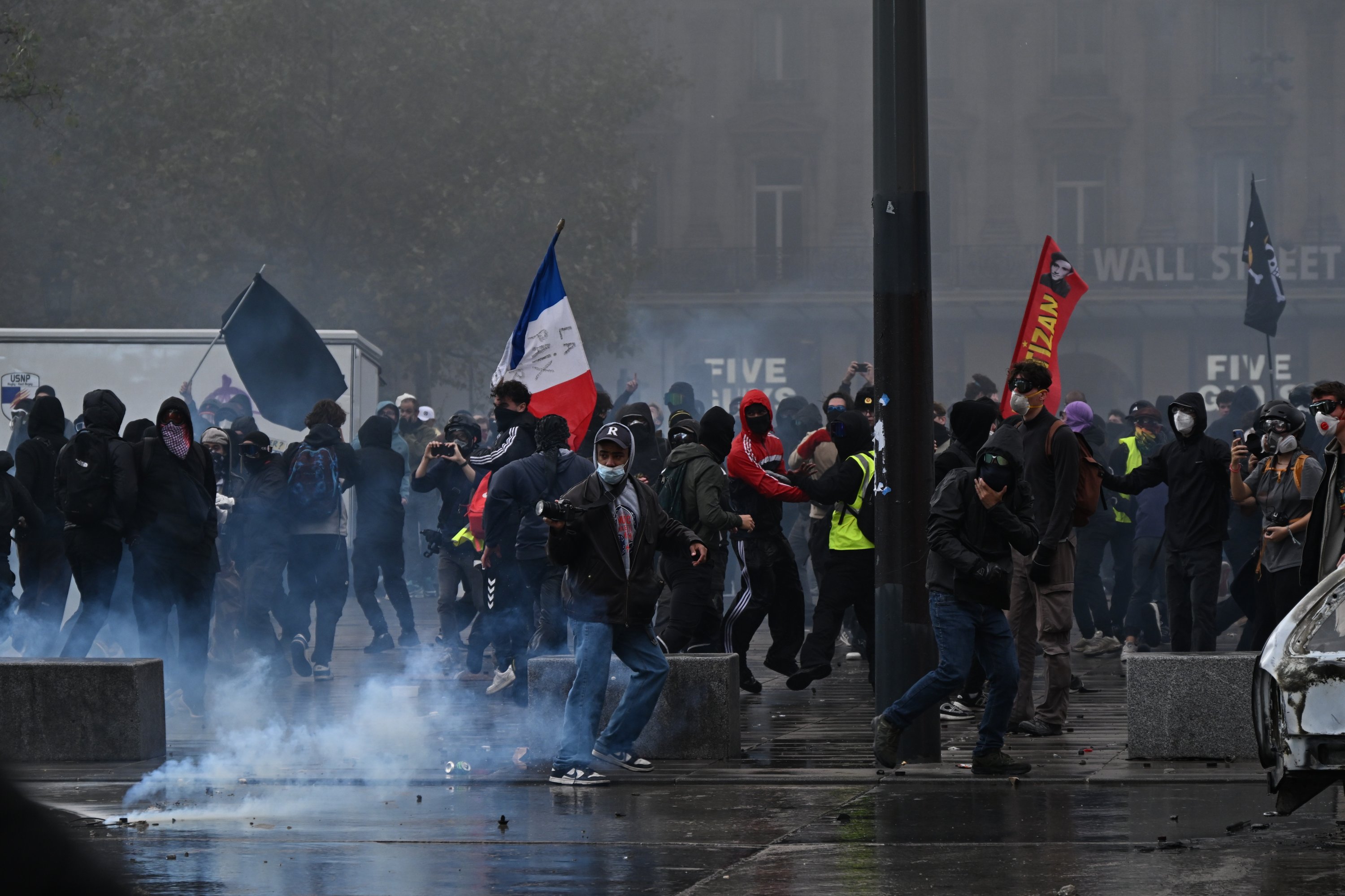
Police reported 130 arrests, including 76 minors, according to Spanish news agency EFE.
Some TikTok accounts promoting the gatherings disappeared, while others advertised new Halloween protests, Maldita.es reported. In one Telegram group, messages urged people to wear masks and gloves and wait to be told of a shop “without police.”
‘You break it, you pay’
In Italy, the argument starts with another family. “Behind that shop window there is a family that has invested a lifetime of sacrifices,” Premier Giorgia Meloni said Oct. 20, announcing a security decree after looting in Milan.
Her principle fits in three Italian words: “Chi rompe paga” – you break it, you pay. “And if the one who breaks it is a minor,” she said, “their parents pay.”
Parents now face fines of up to 1,000 euros, doubled for a repeat offense, unless they prove they couldn’t have stopped their child. They can be made to pay for damage.
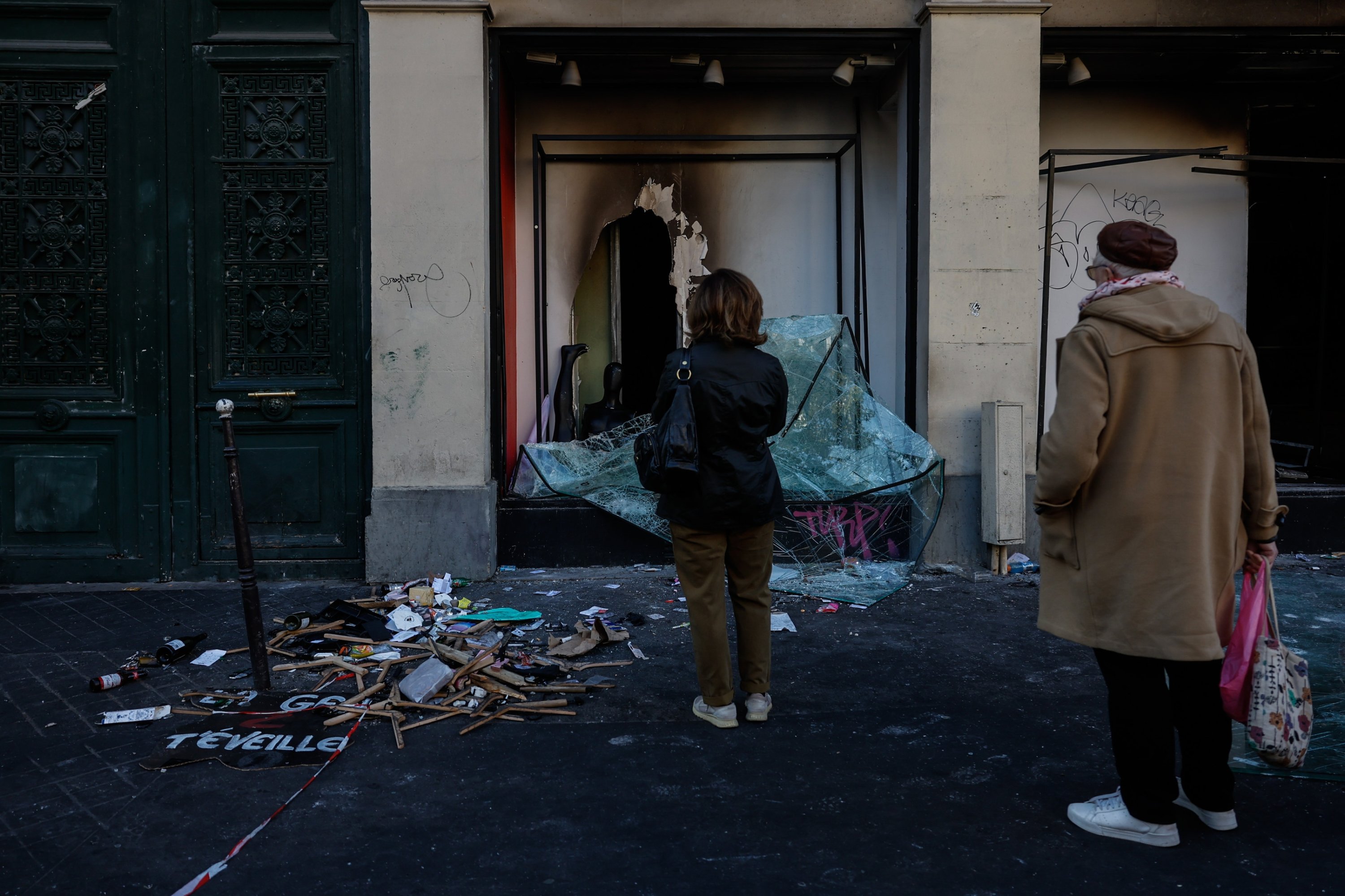
Holding parents accountable may help, said Claudio Bertolotti, director of START InSight, a security research firm, but “fines alone are unlikely to deter teenagers driven by peer pressure or a desire for group recognition.”
Organizing protest violence, even online, now carries four to 12 years in prison.
Before window breaks
Telegram and WhatsApp “must shut down such channels when they incite violence,” Parlon said.
Telegram spokesperson Remi Vaughn told the AP the company supports peaceful speech and protest, but “calls for violence, vandalism and theft are explicitly forbidden and are removed whenever discovered.”
He said Telegram had removed such calls linked to protests in Madrid.
TikTok and Meta, which owns WhatsApp, did not respond to requests for comment.
Telegram closed a Barcelona group promoting Halloween looting, but a replacement drew more than 2,000 members, Spanish media reported.

The French bill would let authorities demand removal of certain illegal calls to violence or looting without prior court approval. If they stay up 24 hours, they could order the web addresses blocked. Those decisions could be challenged in court.
The United States is going the other way. Its law generally shields platforms from civil liability for users’ posts, and the Trump administration calls Europe’s rules censorship.
Britain shows the limits of takedowns. After three girls were killed in Southport in 2024, false claims spread online and riots followed. A parliamentary committee found that algorithms amplified harmful material, much of it legal.
Under France’s bill, money meant to house and raise children could help pay for a looted shop.
Türkiye will lower the annual electricity consumption threshold for households to qualify for the subsidized national tariff to 3,000 kilowatt-hours (kWh) in 2027, the country’s energy regulator said Friday.
Türkiye has subsidized electricity usage for years, and government officials have repeatedly said that households have cheaper energy than in neighboring countries.
Over the last three years, it has been transitioning to a more targeted system, prioritizing low-consumption households while gradually reducing support for higher users.
The annual electricity consumption threshold was set at 5,000 kWh for 2025 and 4,000 kWh for 2026.
The new move is expected to shift around 6.5 million households to a higher-cost tariff, the Energy Market Regulatory Authority (EPDK) said.
The new limit, equivalent to an average monthly consumption of 250 kWh, will take effect on Jan. 1, 2027. At that level of consumption, the average monthly electricity bill is estimated at around TL 820 ($16.42).
The change is expected to affect 14.7% of Türkiye’s 44.2 million residential electricity subscribers. They will be classified as high-consumption users and charged under the final resource supply tariff rather than the subsidized national tariff.
The system was introduced in 2018 and had remained high for years, enabling all household subscribers to qualify as low-consumption users.
No change for agricultural, industrial users
The new threshold will not apply to agricultural consumers, while the existing annual limit of 15,000 kWh will remain unchanged for industrial users, public and private services and lighting subscribers, the EPDK said.
Certain residential subscribers will also be exempt, including mosques and other places of worship, associations, families of martyrs, veterans and disabled veterans.
The exemptions also cover village drinking-water facilities, temporary accommodation centers operated by the Disaster and Emergency Management Authority (AFAD), and consumers who rely on electrically powered dialysis support units, respirators and similar life-support devices.
EPDK said the decision does not involve any change to electricity prices under the national tariff itself.
2026 consumption will count
Although the new arrangement takes effect in the new year, household electricity use throughout 2026 will also be taken into account when determining which subscribers move to the higher tariff.
Under the transition schedule, households that first exceed the 3,000 kWh annual threshold in October 2026 will be switched to the new tariff from Jan. 1, 2027. Those reaching the limit in December will move to the higher tariff from March 1, 2027.
Households that remain below the threshold in 2026 but exceed 3,000 kWh in June 2027 will be transferred to the higher tariff from Sept. 1, 2027.
As a result, the change will take into account electricity consumption recorded both in 2026 and in 2027.

Türkiye’s tourism revenues reached a record high for both the third quarter and the first nine months of the year, Culture and Tourism Minister Mehmet Nuri Ersoy said Friday.
Income rose 5% year-over-year to $25.5 billion (TL 1.28 trillion) in the July-September period, while it climbed 2.4% to nearly $51.3 billion in the first nine months, Ersoy told a news conference on the sector’s performance.
Ersoy said Türkiye was on track to generate more than $65 billion in full-year tourism revenues.
“Longer-than-expected average stays and higher overnight spending have boosted tourism revenues,” he noted.
The number of visitors fell 1% year-over-year to 23.37 million in the third quarter, while total arrivals reached 49.13 million in the January-September period, the Turkish Statistical Institute (TurkStat) data showed.
Separately, data from the Tourism Ministry showed that the number of foreign visitors rose 0.4% year-over-year to 6.11 million in September. However, foreign arrivals fell 1.52% to 40.93 million in the first nine months of the year.
Russians accounted for the largest group of foreign visitors in September, with 979,647 arrivals, followed by visitors from Germany, Britain, Iran and Poland.
Revenue generated directly from visitors amounted to $25.29 billion in the July-September quarter, while transit passenger income contributed $231.96 million, the TurkStat data showed.
Turkish citizens residing abroad accounted for 14% of total revenue.
Individual expenditures made up $17.1 billion of the total, while package tour spending stood at $8.2 billion.
Average visitor stays stood at 10.34 nights in the first nine months and 10.69 nights in the third quarter.
Average spending per night rose 4.6% year-over-year to $107.70 in the nine months, with foreign tourists spending an average of $119.90.
Tourism expenditure, consisting of spending by Turkish residents traveling abroad, surged 22.6% year-over-year to over $3 billion in the third quarter.
Individual spending totaled $2.57 billion, while package tour expenses accounted for $467.64 million.
The number of Turkish residents traveling abroad increased 24.2% year-over-year to 4.2 million, with an average expenditure of $723 per person.
Warning of risks
Ersoy said average visitor stays continued to exceed expectations, but warned of risks to the sector in the final quarter, including a possible escalation of the Iran war and its spillover into Saudi Arabia, as well as an increase in drone attacks on cities amid the Russia-Ukraine war.
He noted that regional conflicts, airspace restrictions and rising energy prices have driven up aviation costs and pressured international travel demand throughout the year.
“While all these negative developments are occurring in our region, Türkiye stands out as an island of stability through its strong state structure, diplomatic capacity and efforts for peace and stability led by our president,” Ersoy said.
“When activity slows in one market, we can intensify our efforts in other markets and replan our promotional and marketing activities according to developments,” he added.
Looking ahead, Ersoy stated that Türkiye will intensify efforts in high-growth-potential markets, including the U.S., Canada, Asia, Africa and Australia, while expanding direct flight capacity in partnership with Turkish Airlines and tour operators.
He also emphasized that the ministry will make more effective use of data and artificial intelligence (AI) applications to monitor market demand, visitor preferences and campaign results.
Türkiye welcomed a record 52.78 million foreign tourists last year, according to official data. Combined with Turkish citizens living abroad, the count rose to a new all-time high of 63.94 million.
In 2025, revenues increased by 6.8% from the previous year to a record $65.2 billion, surpassing the government’s Medium-Term Program (OVP) target of $64 billion. Before the Iran war began, the target for this year was $68 billion.
Lower revenues could add to Türkiye’s current account deficit, which is already under pressure from soaring energy prices due to the fallout from the Iran war.
The war has hurt demand for travel to Türkiye’s historic sites and Mediterranean beaches.
Tourism is a vital industry that Türkiye relies on to help flip its chronic current account deficit to a surplus.
The sector contributes about 10% to Türkiye’s gross domestic product (GDP) and accounts for about 5% of total employment.
Doğuş Otomotiv said Friday it had signed a letter of intent with Volkswagen to evaluate options for producing the German automaker’s passenger cars in Türkiye.
The automotive distributor, which is Türkiye’s longtime importer of Volkswagen cars, announced the step in a filing with the Public Disclosure Platform (KAP).
“A letter of intent has been signed between our company and Volkswagen Group companies regarding the evaluation of options for producing Volkswagen-brand passenger cars in Türkiye,” the filing said.
The move does not mean Volkswagen will begin producing in Türkiye. It is a preliminary step toward assessing production possibilities, and whether a final decision on production will follow will become clear later.
Volkswagen had abandoned plans for a factory in Türkiye in 2020, citing the COVID-19 pandemic and global economic developments.
The partnership aims to offer value-added products suited to new technologies in the Turkish market and contribute to growth in the Turkish auto industry, Doğuş said.
A serious passenger car production partnership could have a significant long-term impact on Doğuş, Ata Yatırım analyst Cemal Demirtaş said
The company did not say where production could take place, which Volkswagen models it might cover, how large an investment would be involved, or what the timeline might be.
Shares of Doğuş Otomotiv rose 10% in morning trade, on track for their biggest one-day jump since May 2025.
Volkswagen is suspending development work on the all-electric Golf at its Wolfsburg headquarters, as sweeping cost cuts at the embattled automaker reach one of its flagship future models.
“I know what the Golf means for Volkswagen and for Wolfsburg. That’s why this decision was really not an easy one for us,” said Thomas Schaefer, CEO of the German group’s volume brands, in a memo reported by Reuters on Friday.
“We simply can’t afford this work right now,” he added.
The move highlights the financial pressure facing Europe’s biggest carmaker as it pushes ahead with plans to cut 100,000 jobs and close up to four German plants.
Volkswagen on Thursday reported its largest quarterly loss in more than a decade and renewed calls for stakeholders, including powerful labor unions, to back the restructuring program.
Wolfsburg, a towering plant in the group’s industrial heartland of Lower Saxony and a symbol of Germany’s automaking heritage, faces a 300 million euro ($336 million) shortfall against its cost-cutting target, according to the memo.
The plant is not among those threatened with closure, but Volkswagen’s German operations are under growing pressure to reduce costs.
Tensions have escalated with union IG Metall, which is considering strikes from Jan. 1.
Workers’ anger has also been fueled by a decision at the group’s Audi brand to invest $4 billion in a new U.S. plant, announced at a campaign event for President Donald Trump before receiving board approval.
Volkswagen’s works council said suspending development work on the ID. Golf would not delay the model’s launch and pledged to make up the lost time.
“However, the freeze on spending for preliminary work on the ID. Golf is yet another sign of how strained the group’s financial situation is,” the works council said in an emailed statement shared with Reuters.
The ID. Golf is one of the first vehicles planned for Volkswagen’s next-generation SSP software architecture, a group-wide platform designed to reduce complexity and lower production costs.
Already delayed from an original 2026 launch target, the platform is central to Volkswagen’s efforts to build more competitive EVs as Chinese rivals expand in Europe.
The eurozone economy grew faster than predicted last quarter, displaying exceptional resilience to headwinds from expensive energy, even as surging borrowing costs and rapid inflation cloud the outlook.
The eurozone economy has beaten most estimates this year, expanding steadily on the back of robust investment and consumption, confounding expectations for a downturn as energy price rises sap incomes.
The economies of the 21 nations sharing the euro grew by 0.4% in the third quarter, a slowdown from an exceptionally strong 0.6% three months earlier, but far above expectations for 0.2% in a Reuters poll of economists.
Compared with a year earlier, the bloc’s economy grew by 1.3%, beating expectations for 1.1%, as heavy spending on AI, defense and infrastructure boosted investment, robust foreign demand helped industry, and households kept on spending, reducing their already high savings rate.
Among the eurozone’s biggest economies, Germany expanded by 0.2% on the quarter, Spain and the Netherlands by 0.6%, while Italy was unchanged and the French economy contracted by 0.1%.
While the bloc’s growth rate is less than half of the expansion produced by the United States, the figure far exceeds the gloomy projections made after the start of the Iran war.
Europe is a net energy importer and oil price surges immediately reduce growth, compress corporate margins and worsen the bloc’s terms of trade.
Strength may not last
This strength may not last, however.
The European Central Bank (ECB) has warned that the balance of risks is tilted towards weaker readings as the recent surge in borrowing costs is bound to weaken the bloc.
Indeed, German borrowing costs – the bloc’s benchmark – surged to their highest in decades this month, partly mirroring similar moves in U.S. markets and partly on investor unease about debt sustainability around the world.
Meanwhile, the premium that eurozone countries need to pay to borrow has jumped, particularly for France, as investors doubt it will sort out its finances before next year’s presidential election.
Inflation is likely to add to this pain.
Price growth accelerated in most of the eurozone’s biggest countries this month, suggesting that annual inflation for the bloc as a whole could jump to 3.9% or above, far above the ECB’s 2% target.
Such a figure would solidify already widespread bets for another rate hike in December, a move that would further dampen growth.
An ECB survey published on Friday showed a big rise in inflation expectations and suggested that the rate of price growth may not return to target until 2028.
Fabio Panetta, Italy’s central bank governor, said further increases in policy rates could be needed.
Still, data suggest that high inflation is not yet generating dangerous second-round effects, likely because the labour market is relatively soft.
Unemployment was steady at 6.5% in August but has been inching up for most of the past year and now stands well above the record-low 6.2% hit in late 2024.
Hackers stole $6.3 billion from Binance, the world’s biggest cryptocurrency exchange, in a record theft that analysts pinned on North Korea and said could shake faith in digital assets.
Cryptocurrency prices fell on the news, while Binance halted withdrawals and said it would cover the losses. About half of the stolen assets were quickly frozen by stablecoin issuers such as Tether, Circle and the Trump-backed World Liberty Financial.
The bulk of the heist unfolded in around 20 minutes beginning late on Thursday and bore similarities to previous large attacks blamed on North Korea, according to US blockchain analysis firms TRM Labs and Chainalysis.
TRM said the attackers were able to order wallets that Binance uses to empty into hacker-controlled wallets, mirroring a 2025 heist at crypto exchange Bybit, which the US Federal Bureau of Investigation had attributed to Pyongyang.
“TRM attributes the attack to … North Korea’s elite hacking unit,” the firm said in an analysis of the hack posted to its website. Both TRM and Chainalysis said they were highly confident North Korea was responsible.
‘Biggest hack in history’
North Korea has for years used state-linked cyber units for espionage, financial theft and revenue, according to U.S. and South Korean authorities as well as cybersecurity experts.
North Korea routinely denies that.
Binance said user funds were safe and that it was working with partners to freeze some of the affected assets, with about $3 billion located so far. It expects to resume withdrawal services in the next 48 hours.
It did not mention the status of the remaining $3.3 billion.
“Your money is safe and we’re covering every loss,” co-CEO Richard Teng said on the social media platform X. “Our investigation has not attributed responsibility to any individual.”
“It’s the biggest hack in history,” Aravind Srinivasan at market maker GSR said as crypto prices fell broadly.
Bitcoin hit a six-week low of $76,368 and ether fell more than 3% to a two-month low of $2,178 before markets stabilized.
BNB, a token originally launched as Binance Coin that can be used to pay Binance fees, was down 5% over the past 24 hours at $709.70, according to CoinGecko, while shaky confidence hit listed crypto exchange shares.
Shares in crypto exchange Coinbase Global, which said it was unaffected, slid 4.8%, while those of bitcoin buyer Strategy fell nearly 6% in extended U.S. trading.
Compromised laptop
An initial investigation suggested the breach may have started with a hacked laptop belonging to one of Binance’s engineers, which let an attacker gain access to one of its systems and make unauthorized withdrawals, Binance said.
“Our security team is tracing the full attack path through the compromised computer which may be the entry point of the incident,” Binance said.
Mark Karpeles, former chief of defunct Tokyo-based bitcoin exchange Mt Gox, which collapsed a dozen years ago after $500 million in bitcoin was stolen, said attackers probably accessed private keys for at least two Binance wallets.
“Binance appears to have split its assets across multiple systems, ensuring a hack can only affect a part of the assets, but even so a single hack is a large loss,” he said.
Beyond the potential loss of assets, the security breach was likely to have wider ramifications for crypto, which had already been under pressure due to higher U.S. interest rates and softer demand from exchange-traded fund buyers, analysts said.
“It may further dampen risk appetite and prompt investors to reassess the safety of assets held on centralised exchanges,” said Tim Sun, senior researcher at HashKey Group, based in Hong Kong.
Hack size tops Binance secure asset fund
Binance, which allows users to buy, sell and trade digital assets, has 335 million registered users globally and had about $162.8 billion in assets under custody as of the exchange’s 2025 annual report.
The crypto exchange runs a secure asset fund for users, which is a $1 billion reserve held entirely in bitcoin that is intended to protect user assets in cases of security breaches, according to its website.
Co-CEO Teng said that “and company funds” will cover losses.
Stablecoin issuer Tether said it had frozen nearly $1.57 billion in assets linked to the incident, while Circle froze more than $800 million.
World Liberty Financial said it worked with custodian BitGo to freeze funds, and Binance co-founder Yi He said $27 million in stablecoins and about $2 million worth of World Liberty tokens had been frozen. Crypto firm Ripple also froze roughly $200 million in funds, Yi said.
The incident adds to a string of crypto thefts. Last year, attackers stole $2.9 billion worth of cryptocurrency across nearly 150 attacks, according to researchers at TRM Labs.
In September, cryptocurrency exchange Bitget said roughly $350 million in crypto had been stolen from its platform, underscoring the industry’s vulnerability to hackers.


-
 Economy3 days ago
Canada, UAE sign major trade deal amid tensions with US
-

 Politics2 days ago
Türkiye confirms hosting Libya east-west reunification talks
-

 Politics2 days ago
Turkish opposition CHP confirms it will field candidate in next election
-

 Politics2 days ago
Turkish main opposition holds primaries to cement Özel’s rule
-

 Politics2 days ago
President Erdoğan hosts MHP leader to discuss key political issues
-
 Politics2 days ago
Erdoğan, Macron discuss UN leadership, bilateral ties in call
-

 Economy3 days ago
French consumer sentiment hits 2013 low amid protests
-

 Politics3 days ago
Türkiye rejects claims of policy shift on Aegean, East Med