
Politics
Erdoğan calls for Turkic unity to usher in ‘Century of Türkiye’

President Recep Tayyip Erdoğan on Thursday called for stronger unity across the Turkic world, saying solidarity, mutual respect and brotherhood would help usher in a new era he described as the “Century of Türkiye.”
“I sincerely believe that, as the Turkic world, we will strive to make the coming period the Turkish Century through full solidarity, mutual respect and brotherhood,” Erdoğan said at a dinner reception for leaders of the Organization of Turkic States (OTS) in Ankara.
The reception came as Ankara hosted the OTS’ 13th summit on Thursday and Friday under the theme Turkic Century: Unity in Language, Thought and Deed. The summit is expected to address regional cooperation, strengthen solidarity among member states and advance the Turkic World Vision 2040.
Established in 2009, the OTS includes Türkiye, Azerbaijan, Kazakhstan, Uzbekistan and Kyrgyzstan as members, while Turkmenistan, Hungary, the Turkish Republic of Northern Cyprus (TRNC) and the Economic Cooperation Organization hold observer status.
Erdoğan also marked Türkiye’s Republic Day, saying he was excited to celebrate the occasion alongside what he called the organization’s “family council.”
“The Republic of Türkiye, the common achievement and shared roof of 86 million people, continues to move from success to success with its major gains in every field,” he said.
He said Türkiye was determined to overcome those seeking to obstruct its goals, drawing a parallel with the republic’s founding 103 years ago.
“Just as the founding will of our republic brought seven powers to their knees 103 years ago and liberated this homeland from occupation, we are equally determined to eliminate those seeking to stand between us and our goals,” Erdoğan said.
“As a nation, we once again pledge to work with all our strength to raise the Republic of Türkiye, which we established under extremely difficult conditions and at great cost, above the level of contemporary civilizations,” he added.
Erdoğan concluded by wishing a happy Republic Day and expressing hope for lasting “unity and solidarity” among Turkic states.

Türkiye aims to strengthen the Turkic world’s resilience against disinformation and increase its international visibility through closer media cooperation, Vice President Cevdet Yılmaz said Friday, as Ankara prepared to assume the rotating chairmanship of the Organization of Turkic States (OTS).
Speaking at the Turkic World Dialogue Forum, organized by Türkiye’s Communications Directorate under the theme “From Ideas to Dialogue, Forward,” Yılmaz emphasized the importance of strengthening cooperation in strategic communication, digital transformation and cultural integration.
“We aim to increase the Turkic world’s resilience against disinformation and its international visibility,” Yılmaz said.
The forum, attended by Presidential Communications Director Burhanettin Duran, was held alongside the 13th OTS Summit in Ankara.
Yılmaz described the Turkic world as a community united by centuries of shared history, language and cultural heritage, saying cooperation among Turkic nations had expanded significantly over the past 35 years.
He said Türkiye would use its OTS chairpersonship, taken over from Azerbaijan, to translate existing institutional cooperation into tangible benefits for regional stability, development and prosperity.
Media cooperation
Yılmaz warned that disinformation, manipulation and misleading content could undermine public trust and international relations despite the growing accessibility of information through digital platforms.
He said countries’ international influence increasingly depended not only on economic and military capabilities but also on their ability to produce reliable information and communicate their perspectives globally.
Highlighting existing OTS mechanisms, Yılmaz cited regular meetings of ministers responsible for media and information, the Media Coordination Committee and the Union of Turkic News Agencies, established in 2023.
He also pointed to an action plan adopted at the 2025 meeting of media and information ministers in Baku as a framework for expanding joint initiatives.
Yılmaz said these mechanisms would be used more effectively to counter disinformation and strengthen the international presence of Turkic nations.
Common alphabet
Yılmaz also highlighted the adoption of guidelines for using the 34-letter Common Turkic Alphabet in Astana in June, describing the initiative as an important step toward strengthening linguistic and cultural ties.
He said the common alphabet would facilitate communication among Turkic peoples and support efforts to preserve their shared cultural heritage.
Meanwhile, Duran stressed the importance of developing high-quality digital content in Turkic languages to ensure artificial intelligence systems reflect the region’s own historical and cultural perspectives.
“We must produce quality content in our own languages and from our own sources and ensure that artificial intelligence models are also fed by our data,” Duran said.
He warned that without stronger digital representation, narratives about the Turkic world could increasingly be shaped by external sources.
Duran also emphasized the region’s growing geopolitical importance, citing energy corridors stretching from the Caspian Sea to the Mediterranean and Europe, alongside the Middle Corridor’s transportation infrastructure.
Speaking at a separate panel on parliamentary diplomacy, Turkish lawmaker Fuat Oktay called for stronger institutional cooperation and joint projects among Turkic countries.
Oktay said the Turkic world represented a population of approximately 250 million, an economy exceeding $2.5 trillion and foreign trade approaching $1 trillion.
He stressed that the region’s strategic geographical position, young population and economic resources offered significant opportunities for deeper integration.
Yılmaz also reaffirmed Türkiye’s commitment to advancing the OTS Turkic World Vision 2040, which outlines long-term cooperation in political coordination, economic connectivity, science, technology, culture and youth development.
President Recep Tayyip Erdoğan on Friday emphasized the shared heritage and common future of Turkic nations as he addressed the 13th summit of the Organization of Turkic States (OTS) in Ankara.
“The family photo we took yesterday and today symbolizes both our loyalty to our past and our determination to build our common future together,” Erdoğan said during the meeting of the OTS Council of Heads of State.
Addressing the OTS Council of Heads of State at the Presidential Complex, the president emphasized the importance of solidarity among member and observer states, describing their shared historical and cultural ties as the foundation for building a common future.
“There is no room for division, separation or discord in the family photo of the Turkic world. We are all one, we stand together, and, God willing, we will remain brothers forever,” he stressed.
The summit, hosted by Erdoğan under the theme “Turkic Century: Unity in Language, Thought and Action,” brought together leaders and senior officials from member and observer states to strengthen cooperation across the Turkic world.
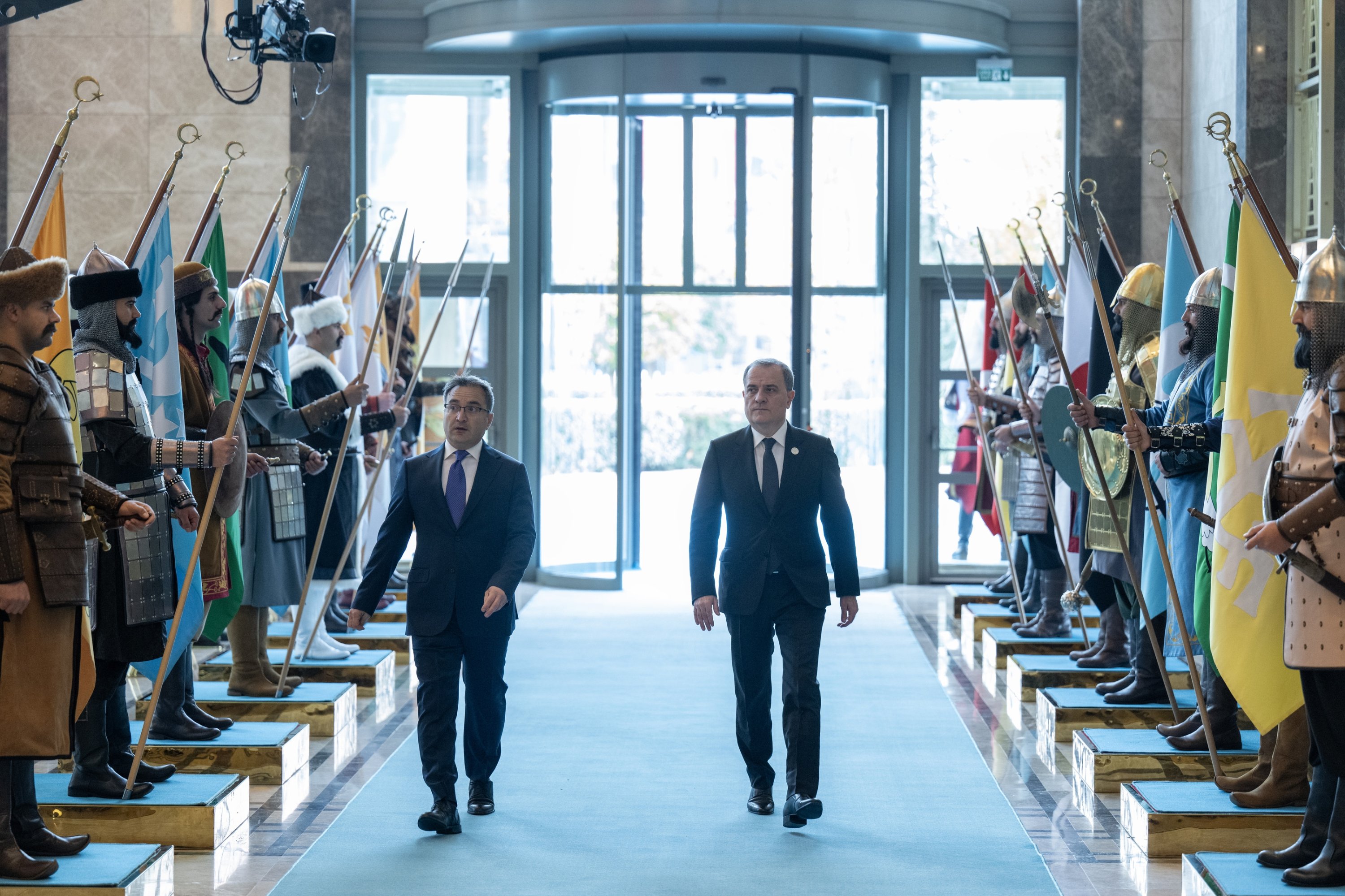
Ahead of the meeting, Erdoğan welcomed visiting leaders at the Presidential Complex, where participants gathered for a traditional family photo.
The gathering included Kazakh President Kassym-Jomart Tokayev, Uzbek President Shavkat Mirziyoyev, Kyrgyz President Sadyr Japarov and Azerbaijani Foreign Minister Jeyhun Bayramov.
Turkmen President Serdar Berdimuhamedov and Turkish Republic of Northern Cyprus (TRNC) President Tufan Erhürman attended as representatives of observer states, alongside OTS Secretary-General Kubanychbek Omuraliev.
The leaders were welcomed with a ceremonial display featuring flags representing 16 historical Turkic states, military personnel and soldiers dressed in traditional Ottoman Janissary uniforms.
Erdoğan thanked participating leaders for joining Türkiye’s celebrations marking the 103rd anniversary of the republic on Thursday.
Priorities for OTS chairmanship
Erdoğan announced that Türkiye was taking over the organization’s rotating chairmanship from Azerbaijan, pledging to translate existing institutional cooperation into concrete achievements.
He outlined priorities including promoting a common language, strengthening cultural and sporting exchanges, facilitating travel between member states and supporting women’s participation in society.
The president expressed hope that cooperation with the Turkish Republic of Northern Cyprus (TRNC) would increase and reiterated Türkiye’s support for Turkmenistan’s eventual full membership in the organization.
Türkiye regards its new chairmanship as both a significant responsibility and a valuable trust, Erdoğan noted.
Regional peace, cooperation
Turning to regional developments, Erdoğan reiterated Türkiye’s support for normalization efforts between Azerbaijan and Armenia, emphasizing that lasting peace in the South Caucasus would create opportunities across the Turkic world.
He also called for diplomatic solutions to rising tensions involving Iran, warning that regional conflicts carry serious consequences for international trade, energy markets and economic stability.
On Palestine, Erdoğan urged Turkic states to intensify their efforts to facilitate humanitarian assistance to Gaza and support reconstruction.
He reaffirmed Türkiye’s commitment to an independent, sovereign Palestinian state based on the 1967 borders, with East Jerusalem as its capital.
Erdoğan identified the Trans-Caspian East-West Middle Corridor as a strategic transportation route capable of strengthening trade and economic connectivity between Asia and Europe.
He said Turkic nations could develop into a major center for trade, transportation and energy by expanding cooperation and leveraging their geographic advantages.
Highlighting cybersecurity as a critical component of national security, Erdoğan called for the swift conclusion of a cybersecurity cooperation agreement.
The Turkish president also emphasized accelerating a joint satellite project, establishing a shared digital trade platform and developing a large Turkic language model covering the Oghuz, Kipchak and Karluk language groups.
Türkiye would prioritize implementing an artificial intelligence and digital development action plan during its chairmanship, he said.
Erdoğan also underlined the importance of finalizing the organization’s 2027-2031 strategy and the Strategic Partnership and Eternal Friendship Agreement.
Turkic leaders push for closer ties
Emphasizing the shared history, cultural heritage and traditions of Turkic nations, Turkmen President Serdar Berdimuhamedov said preserving these common values and passing them on to future generations remained a collective responsibility.
He described the OTS as an important platform for strengthening mutual trust, expanding relations and promoting practical cooperation among Turkic countries.
“Turkic states possess vast economic potential. To make effective use of these opportunities, it is necessary to further develop cooperation in energy, transportation, communications, industry, agriculture, construction, textiles, raw material processing and other sectors of the economy,” Berdimuhamedov said.
He also called for greater mutual investment, stronger ties between entrepreneurs and favorable conditions for implementing joint production projects.
Kazakh President Kassym-Jomart Tokayev also emphasized the importance of strengthening cooperation among Turkic nations and expanding the organization’s international standing.
“Our organization is highly important, and to enhance its prestige, we need to take the necessary steps to ensure Russia joins as an observer,” Tokayev said.
“Russia, as a major power, has maintained close ties with the Turkic world for centuries,” he added.
Tokayev described the OTS as a unique organization rooted in shared historical and cultural ties, saying cooperation among Turkic countries demonstrated the growing strength and unity of the Turkic world.
“The Turkic world is demonstrating its strength. Turkic peoples are coming together in harmony and taking solid steps forward,” he noted.
Referring to the vision of a “Turkic Century,” Tokayev stressed that unity remained essential to achieving common objectives.
He recalled a conference held in Baku a century ago, where intellectuals from Turkic nations gathered to promote their shared cultural heritage and strengthen ties.
Tokayev said Turkic countries were continuing that legacy by advancing solidarity and cooperation through the organization.
He also thanked Erdoğan for Türkiye’s hospitality and its role in hosting the summit.
Meanwhile, Kyrgyz President Sadyr Japarov praised Türkiye’s political, economic, military and technological achievements, saying the country had strengthened its international standing under Erdoğan’s leadership.
“Under your visionary leadership, Türkiye continues to enhance its international reputation by achieving major successes in political, economic, military, technological and other fields,” Japarov said.
He also welcomed Türkiye’s diplomatic initiatives aimed at establishing lasting peace in the Middle East, acknowledging Ankara’s active role in regional peace efforts.
Japarov congratulated Erdoğan and the Turkish people on Republic Day, extending his best wishes to the country.
Moreover, Azerbaijani Foreign Minister Jeyhun Bayramov emphasized the importance of lasting peace with Armenia and expanding regional economic cooperation.
Bayramov highlighted transportation and energy connectivity, including the Middle Corridor and Zangezur Corridor, as priorities for strengthening trade and investment.
He also referred to a 2027 road map for defense industry cooperation, covering joint production and technological collaboration.
Uzbek President Shavkat Mirziyoyev further proposed launching 100 strategic investment and industrial projects among Turkic states, calling for deeper economic integration, stronger transportation links and expanded cooperation with international partners.
“The organization’s international influence and prestige also depend on its ability to develop open and mutually beneficial relations with external partners,” Mirziyoyev said.
He proposed launching cooperation with third countries under an “OTS Plus” format, beginning with sectoral ministerial meetings focused on implementing concrete projects in trade, transportation, investment and other priority areas.
Mirziyoyev also called for deeper technological cooperation and stronger industrial partnerships to help Turkic countries jointly enter global markets.
“As a concrete step, I propose adopting a program covering 100 strategic joint investment and industrial projects across the Turkic world,” he said.
He stressed the importance of directing resources from the Turkic Investment Fund and international financial institutions toward financing the proposed projects.
The Uzbek leader also suggested creating a digital platform to facilitate the electronic exchange of legal assistance requests and documents between relevant authorities.
TRNC calls for ending isolation
Turkish Republic of Northern Cyprus President Tufan Erhürman called for stronger international engagement with Turkish Cypriots, criticizing restrictions affecting their participation in cultural, sporting, educational and economic activities.
Erhürman said international isolation continued to undermine the Turkish Cypriot community’s development and opportunities for direct engagement with the wider world.
He highlighted recent correspondence from the United Nations and European Commission concerning Turkish Cypriot participation in international activities.
Erhürman stressed that greater international integration and efforts toward a comprehensive settlement on Cyprus should reinforce rather than undermine each other.
He reaffirmed the TRNC’s commitment to working closely with Türkiye toward a fair and lasting settlement on the island.
“We will continue working toward a just and lasting solution on the island in close consultation and cooperation with the Republic of Türkiye,” he said.
Following remarks by visiting heads of state and officials, the joint declaration of the 13th OTS Council of Heads of State Summit was signed.
The summit also marked a leadership transition within the organization, with Erdoğan thanking outgoing Secretary-General Kubanychbek Omuraliev for his service since 2022 and welcoming incoming Secretary-General Mirvahid Azimov.
This month will likely be remembered as a key period in Turkish-Libyan relations. First, Libya’s House of Representatives approved a long-dormant memorandum of understanding on maritime jurisdiction and then came a critical meeting apparently kept under wraps for the reunification of Libya’s eastern and western administrations.
Overall, it appears that Türkiye’s diplomatic efforts are paying off, and doubly so: strengthening the country’s clout in the Mediterranean at a time its adversaries (including former ones such as Greece, with which Ankara hopes to mend ties) make their moves with new alliances and reinvigorating ties with North Africa, where post-Moammar Gadhafi Libya is still a key actor despite factions at odds.
On Oct. 20, Libya’s House of Representatives greenlit a maritime jurisdiction agreement with Türkiye, which has been awaiting approval since it was signed in 2019. Last Friday, media reports revealed that the eastern and western administrations in Libya sent delegates to Ankara for talks on a possible reunification. A senior Turkish official told Agence France-Presse (AFP) on Wednesday that talks have not produced an immediate result yet, but discussions focused on military reunification, with talks on political unity expected to follow in the future. Still, it is a beginning facilitated by Ankara, which rose to prominence in the last decade as a key power broker and mediator in its region and beyond.
Answering Daily Sabah’s questions about whether Libya’s House of Representatives’ decision cemented Türkiye’s influence in the region, Aylin Ünver Noi, professor of International Relations and vice rector of Beykoz University, said that the approval process made an important contribution.
“We are also seeing a process come to the fore that aligns with Türkiye’s interests in the region and reflects what Türkiye wants to achieve. However, there is something else worth keeping in mind. Türkiye has a policy regarding gas exploration and extraction activities in the Eastern Mediterranean and, more broadly, across the entire Mediterranean basin. It is trying to manage this process through bilateral relations, but at the same time, it has consistently maintained the same position from the very beginning. Türkiye says it is open to dialogue with all the countries that share maritime boundaries in the region,” she said.
Greece has long opposed the memorandum, fearing that Türkiye could gain greater influence in the Mediterranean. Athens views Türkiye as a historic rival, even as Ankara pursues rapprochement with Greece, and the deal could further complicate the maritime dispute between the two countries in the Aegean Sea.
Türkiye and Greece compete for rights in the vast sea. Soon after the deal was approved, Türkiye announced a navigational telex (Navtex) in the Mediterranean (a notice containing navigational and maritime safety warnings), citing work on a natural gas pipeline project between Türkiye and the Turkish Republic of Northern Cyprus (TRNC) until late December. Like the France-led project, the gas pipeline will be a lifeline for the TRNC, which has been isolated from the international community, which refuses to recognize its sovereignty. The pipeline will connect Türkiye’s Mersin to the TRNC’s Girne (Kyrenia), covering a distance of about 101 kilometers (63 miles), including a 4-kilometer pipeline across land.
The Türkiye-Libya deal also drew the ire of the European Union, which counts Greece and the Greek Cypriot administration among its members.
If Ankara were able to implement the agreement, Türkiye could gain access to large, undiscovered gas deposits, but the deal covers a vast area claimed by Greece.
Noi said Türkiye sought to de-escalate tensions in the Med, with President Recep Tayyip Erdoğan even offering a meeting in Antalya to resolve the issue, referring to the Turkish leader’s proposal to find a formula safeguarding the interests of every littoral country.
“This position has not changed. Türkiye continues to pursue it. In his latest statement, the president also said that Türkiye is not trying to do anything against anyone. Rather, it is working toward arrangements that would allow everyone to benefit and produce a win-win outcome,” she said, referring to the president’s remarks after a Cabinet meeting earlier this week.
“But that does not mean Türkiye would accept a situation in which some countries gain disproportionately while others are deprived of their rights. In other words, Türkiye wants these partnerships, but it also wants the process to be managed in a way that prevents any country from pursuing maximalist claims at the expense of others. Türkiye wants everyone to be included and no party to be excluded,” she added.
She said Türkiye in the past was excluded from forums on the Eastern Mediterranean. “It was treated as though it had no coastline in the Eastern Mediterranean and no legitimate rights or interests in the region. Today, however, we see that these agreements have set a different process in motion, with Türkiye also beginning to normalize bilateral relations with certain countries. But this does not mean that the president is pursuing this process against anyone. Rather, the message is that Türkiye is not doing this to target others, but to ensure that no one is allowed to undermine its rights,” she also stated.
Erdoğan on Monday underlined that opposition to the Libya memorandum, particularly by the European Union, had no legitimate basis. In his address after the Cabinet meeting, the president stressed Türkiye’s policy on the Eastern Mediterranean was very clear, and they had no intention “to score a goal against anyone.”
“We are only occupied with preserving our maritime jurisdiction, rights and interests. We advocate for a peaceful approach to resolve disputes, engaging in dialogue with all littoral countries. We expect all actors, the European Union in particular, to demonstrate the same constructive will,” Erdoğan said.
He noted that the aggressive discourse benefited no one. “Even if it means paying a price, we never hesitate in doing the right thing for Türkiye, for the Turkish nation. I remind those trying to exclude Türkiye from the Eastern Mediterranean to respect the joint will of Türkiye and Libya,” he added.
Reunifying Libya
Another interest for Türkiye in Libya is ensuring political stability, as Ankara stands to gain from finding a new partner in Africa where, under the leadership of Erdoğan, it has significantly enhanced relations through its “Africa opening” policy.
Since last year, dialogue between Ankara and rival groups in Libya has increased as the country reached out to Khalifa Haftar, with whom it once had tensions. Haftar’s son, Saddam Haftar, who holds a prominent military position, and Turkish officials have held frequent talks in recent months.
Noi said that since the Arab Spring, Türkiye has had to contend with a situation shaped by the consequences of those uprisings. “They gave rise to problems such as civil wars and failed states in many parts of the region. This triggered a process that undermined the stability of those countries and negatively affected their relations with other nations. Countries that are divided and governed by different groups or rival leaderships also face another disadvantage: external powers can support different factions, further destabilizing these countries and undermining peace and development. From the very beginning of the Arab Spring, Türkiye has opposed the fragmentation of countries and the emergence of failed states, whether in Syria or Libya. On the contrary, it has consistently emphasized principles such as territorial integrity and independence,” she said.
“The same applies to Libya. Bringing the two opposing sides together would strengthen Libya as a unified country. This is something Türkiye wants, both in terms of regional stability and the development of its bilateral relations. However, Türkiye’s role must not be destabilizing; on the contrary, its support has always been aimed at promoting stability,” she added.
Noi noted that Türkiye played a significant role in mediation efforts in recent years, and these efforts were institutionalized within the Foreign Ministry, which established a directorate-general for mediation.
“Türkiye has made considerable progress in this field, with successful initiatives in various parts of the world, including mediation efforts across the African continent. Therefore, Türkiye may have taken an important step in Libya by helping bring together groups that have been at odds within the country. Türkiye has already pursued a similar approach in Syria, as you know. It supports a unified Syria and wants groups pursuing separatist aims to be reintegrated into the country. Türkiye has never sought the division, fragmentation or weakening of its neighbors or other countries in the region. Instead, it has wanted them to remain unified, strong and capable of contributing to regional stability. This would be an important development both for bilateral relations and for the future and survival of the country concerned. That is what Türkiye hopes to achieve. We have already seen progress in this direction in recent days,” she said.
The Council of Foreign Ministers of the Organization of Turkic States (OTS) convened in Ankara on Thursday as part of the organization’s 13th summit.
The meeting, hosted by Foreign Minister Hakan Fidan, began at the Presidential Complex in the Turkish capital.
The gathering brought together Azerbaijani Foreign Minister Jeyhun Bayramov, Kazakh Foreign Minister Mukhtar Tileuberdi, Kyrgyz Foreign Minister Jeenbek Kulubaev, Uzbek Foreign Minister Bakhtiyor Saidov and Turkish Republic of Northern Cyprus (TRNC) Foreign Minister Tahsin Ertuğruloğlu.
Turkmenistan was represented by its ambassador to Ankara, Mekan Ishanguliyev, while OTS Secretary-General Kubanychbek Omuraliev also attended the meeting.
Fidan welcomed the participating officials before they posed for a family photo.
Held as part of the 13th Organization of Turkic States (OTS) summit in Ankara on Oct. 29-30, the meeting marks the fifth gathering of the OTS Council of Foreign Ministers this year, including one formal and four informal meetings.
Representatives from the OTS Council of Elders, the Parliamentary Assembly of Turkic States (TURKPA), the International Organization of Turkic Culture (TURKSOY), the Turkic Academy, the Turkic Culture and Heritage Foundation, the Turkic Investment Fund and the Union of Turkic Chambers of Commerce and Industry also participated.
Ankara Declaration
During the meeting, ministers reviewed the agenda for the 13th OTS summit and draft documents to be submitted to the Council of Heads of State for consideration and approval.
Discussions focused on the draft Ankara Declaration and proposed decisions aimed at expanding cooperation and strengthening the organization’s institutional structure.
Omuraliev briefed participants on progress made during Azerbaijan’s chairpersonship and the activities of the OTS secretariat, noting that cooperation among member and observer states now spans more than 65 areas.
The ministers also reviewed documents concerning the Alisher Navoi International Prize for Contributions to the Unity of the Turkic World, along with the proposed 2027 budgets of the OTS Secretariat and the Turkic Academy.
Participants exchanged views on regional and international developments and discussed priorities for future cooperation within the organization.
The ministers also thanked Omuraliev, whose term is nearing its end, for his contributions to the organization’s institutional development and efforts to strengthen cooperation among Turkic states.
The summit took place under the theme “Turkic Century: Unity in Language, Thought and Action,” inspired by Erdoğan’s vision of the “Century of the Turkic World” and the motto of Turkic intellectual Ismail Gasprinski.
U.S. President Donald Trump called President Recep Tayyip Erdoğan on Thursday as he hosted a Republic Day dinner attended by fellow Turkic leaders, with the two discussing the upcoming summit of the Organization of Turkic States (OTS) in Ankara.
During the phone call, Erdoğan conveyed greetings from the leaders attending the dinner, held as Türkiye marked the 103rd anniversary of the founding of the republic on Oct. 29, according to a statement made by the Communications Directorate.
Erdoğan told Trump that Ankara would host the 13th Summit of Heads of State and Government of the OTS, where participating leaders are expected to adopt decisions aimed at strengthening the organization’s role in regional cooperation.
He highlighted the organization’s growing importance as a pillar of stability and security in Central Asia, representing a combined population of more than 200 million people.
Trump, for his part, extended his best wishes to Erdoğan for the upcoming OTS summit.
This was the second correspondence between the two leaders in less than 24 hours.
On Wednesday, Erdoğan told Trump that Türkiye was working toward a diplomatic resolution to tensions in the Strait of Hormuz and Yemen, as Ankara closely monitors developments in the region, the Communications Directorate said.
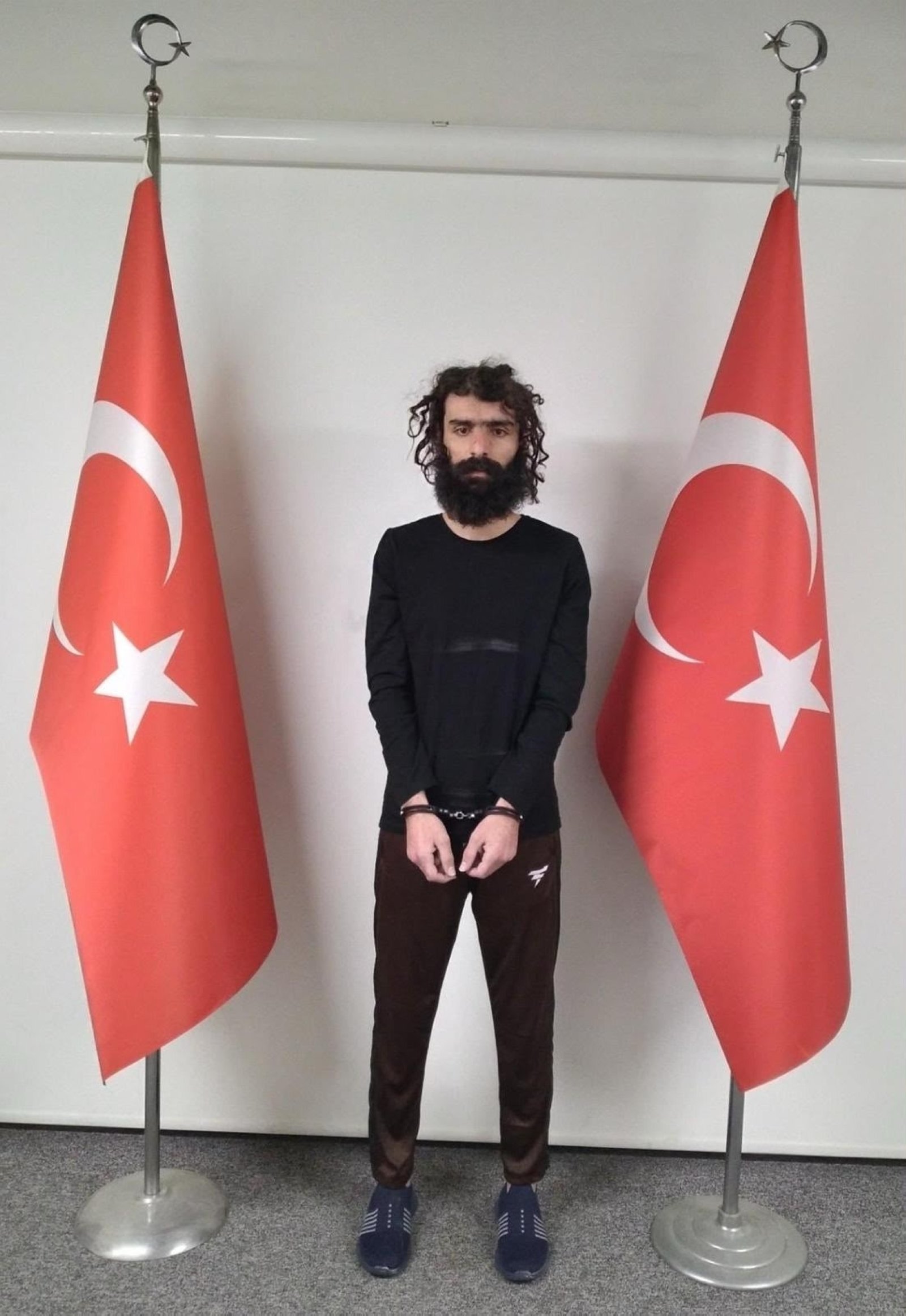
Türkiye’s National Intelligence Organization (MIT) captured a suspected member of the Daesh terrorist group’s Afghanistan-based affiliate in the Afghanistan-Pakistan region and brought him back to Türkiye, security sources said Friday.
The suspect, identified as Uğur Bahadır, who used the code name “Abdullah,” was allegedly operating within Daesh’s Khorasan Province (ISKP) and carrying out assignments at several terrorist training camps in the region.
According to intelligence gathered by MIT, Bahadır traveled from Türkiye to the Afghanistan-Pakistan region in 2024 and joined the terrorist group, where he underwent training and performed various operational duties.
Following intelligence-gathering efforts, MIT launched an operation targeting Bahadır, capturing him in the Afghanistan-Pakistan region before transferring him to Türkiye.
During questioning, Bahadır reportedly provided information about the group’s recruitment activities, training programs, operational assignments and organizational structure in the region.
He also disclosed details of his connections with Özgür Altun, a Daesh operative known by the code name “Abu Yasir al-Turki,” who allegedly coordinated the transfer of recruits from Türkiye to the Afghanistan-Pakistan region.
Altun, who was captured in early 2025, had played an active role in facilitating the movement of Daesh members from Türkiye to the region and carrying out assignments on behalf of the terrorist group.
Bahadır was also reportedly associated with Ahmet Kazancı, another Daesh operative known by the aliases “Abu Ubeyde” and “Abu Ibrahim,” who was captured in early 2026.
Kazancı had been operating within Daesh’s media unit, a propaganda branch for the group.
According to the intelligence findings, the operation helped disrupt Daesh’s alleged plans to carry out attacks targeting Türkiye, expose its recruitment networks and uncover details of its planned activities.


-
 Politics3 days ago
Türkiye confirms hosting Libya east-west reunification talks
-

 Economy3 days ago
Iran war costs US taxpayers $47.1 billion
-
 Economy2 days ago
Türkiye’s annualized exports hit record $409.1B as economy transforms
-
 Politics2 days ago
Türkiye, Bulgaria, Romania reaffirm Black Sea security commitment
-
 Economy2 days ago
EU, Canada explore unprecedented associate membership deal
-
 Politics2 days ago
Erdoğan urges diplomacy over Hormuz, Yemen tensions in Trump call
-

 Sports2 days ago
Mbappe apology over Mao remarks fails to put China row to bed
-

 Sports2 days ago
Turkish speedsters Öncü, Erbay gear up for key season finales