
Economy
Inside biggest heist in crypto history that unfolded in 20 minutes

The world’s largest cryptocurrency exchange, Binance, has been hit by a cyberattack that affected an estimated $6.3 billion in funds, in a record digital asset theft.
Here’s what we know so far:
What happened?
About $6.3 billion of cryptocurrencies were drained from wallets that Binance uses to process transactions, according to the exchange and expert analysis of blockchain records.
Binance said in a statement on the social media platform X that it initially thought the attack involved a compromised laptop. “However, our subsequent investigation has uncovered additional points of breach,” it added, without elaborating.
The exchange operates a secure asset fund for users, a $1 billion bitcoin reserve designed to protect customers in the event of a security breach, according to its website.
Co-CEO Richard Teng said losses would be covered by the fund and company resources.
According to U.S. blockchain analytics firm TRM Labs, the attackers compromised Binance’s “signing infrastructure,” which authorizes transactions, allowing them to issue instructions that emptied the affected wallets.
The bulk of the heist unfolded in about 20 minutes, blockchain records show, beginning shortly after 2000 GMT on Thursday.
Once the funds were moved, the attackers raced to shift them beyond the reach of Binance counterparties and stablecoin issuers, which have frozen roughly half of the stolen assets.
An unusual feature of some cryptocurrencies, including major stablecoins such as Tether’s USDT and Circle’s USDC, is that their issuers can freeze them remotely.
“In layman’s terms, the attacker may not have stolen the vault key, they may have hijacked the system that tells the vault to release money,” said Joshua Chu, a Hong Kong lawyer who works on crypto cases.
Who is behind it?
Several U.S. blockchain analysis firms said the attack bears similarities to previous operations attributed to North Korean hackers.
Teng said Binance’s investigation had not yet identified the attackers, while North Korea routinely denies involvement in cyberattacks and cryptocurrency thefts.
TRM said the breach shared characteristics with last year’s attack on crypto exchange Bybit, which the FBI attributed to North Korean hackers. The firm said it was highly confident the same group was behind the Binance theft.
Chainalysis said funds stolen in an attack last month on Bitget were being mixed with proceeds from the Binance breach.
Where’s money?
About half the stolen assets were stablecoins that have since been frozen by issuers including Tether, Circle, Ripple and World Liberty Financial, the Trump family’s crypto venture.
That doesn’t mean the coins will be returned to Binance, but it significantly limits the attackers’ ability to convert them into cash.
TRM said some of the funds had already been posted as collateral to borrow ether and estimated that about $2.4 billion worth of bitcoin and ether is beyond reach.
“No company issues bitcoin or ether and no company can freeze either one,” said Patrick Tan, general counsel of ChainArgos, a blockchain intelligence firm in Singapore.
“The bitcoin and ether can be stopped only if the attacker sends them to a crypto-asset exchange or broker that is able and willing to freeze them, or if law enforcement obtains the private keys.”
Market participants said the attackers would likely mix the stolen coins with other assets or use lesser-known coins and exchanges to try to move the proceeds.
“The more time passes, the less likely they will be able to fold those funds into other exchanges or payment providers – they essentially get blacklisted,” said Bernardo Brites, CEO of Trace Finance, a stablecoin infrastructure company.
“In reality a lot of the proceeds of hacks … (can only be laundered) in the first few hours, but after that happens, you have a lot of different players who know those are marked funds … and they usually sit there for years.”
What next?
The theft is the latest in a series of major digital asset breaches. Attackers stole $2.9 billion of cryptocurrency across nearly 150 incidents last year, according to TRM Labs.
The attack has also rattled confidence in the sector. Cryptocurrencies fell on Friday and the total market value of stablecoins declined, suggesting investors were pulling money from digital assets.

Britain’s competition watchdog Friday launched an investigation into whether Meta was imposing “exploitative” new terms allowing it to use media content for its own products, including AI, without giving publishers adequate choice.
The probe will examine whether the “terms and conditions” from the U.S. technology giant “unfairly harm news publishers and other content businesses,” the Competition and Markets Authority said in a statement.
The CMA said the new terms, which the Facebook and Instagram parent had planned to introduce on Nov. 20 before putting it on hold, could amount to an abuse of its dominant position in the market.
The watchdog will determine whether “Meta is abusing a dominant position by imposing exploitative terms on publishers and advertisers.”
Meta’s new terms could allow it to access and use content from news publishers’ websites to develop and provide its own products, including its AI features.
A Meta spokesperson said “we’ve already committed not to change our terms without consulting publishers and other stakeholders.”
“We welcome the opportunity to explain our approach to the CMA,” they added.
Thousands of U.K. businesses rely on Meta to reach customers and audiences, meaning an unfair imposition of the new terms could breach competition law.
“We’ve heard concerns from news publishers and other businesses and are acting swiftly to investigate whether Meta’s proposed changes may breach competition law,” said CMA chief executive Sarah Cardell.
A Norwegian court this week temporarily banned Meta from enforcing the new user terms after ten media outlets argued it would threaten their rights to their content.
Türkiye has begun paying interim amounts to investors in funds that are being liquidated following a scandal last month, media reports said Friday.
About TL 29.3 billion (around $590 million) was set to be deposited into fund holders’ accounts as of Friday, private broadcasters CNBC-e and Bloomberg HT said.
The payments cover 235,705 investors in seven funds run by three portfolio management companies: Atlas, Pusula and Tera.
The payments follow a law that Parliament passed this month and that establishes a framework for repayments, with payments adjusted for inflation and interim payouts of up to TL 1 million.
The scandal in September prompted authorities to order the liquidation of more than 130 investment funds that authorities suspect were manipulated and inflated in price.
Nearly half a million investors held stakes in the funds. Prosecutors have arrested more than 80 people in the investigation into suspected market manipulation.
Reports on Friday said seven funds were being wound down under the “extraordinary” liquidation procedure created for the cases of the three companies.
Interim payments were to begin with money market funds and proceed from the smallest unit holder to the largest. The order is meant to ensure the greatest possible number of investors receive payments.
Under “ordinary” liquidation, TL 68 billion was paid to 63,759 investors in 93 funds run by A1 Capital, Bulls, Pardus and Hedef Portföy, the report said.
Adding the new payments, TL 97.3 billion has been paid or is due across all liquidations to 299,464 investors in 100 funds.
Türkiye will lower the annual electricity consumption threshold for households to qualify for the subsidized national tariff to 3,000 kilowatt-hours (kWh) in 2027, the country’s energy regulator said Friday.
Türkiye has subsidized electricity usage for years, and government officials have repeatedly said that households have cheaper energy than in neighboring countries.
Over the last three years, it has been transitioning to a more targeted system, prioritizing low-consumption households while gradually reducing support for higher users.
The annual electricity consumption threshold was set at 5,000 kWh for 2025 and 4,000 kWh for 2026.
The new move is expected to shift around 6.5 million households to a higher-cost tariff, the Energy Market Regulatory Authority (EPDK) said.
The new limit, equivalent to an average monthly consumption of 250 kWh, will take effect on Jan. 1, 2027. At that level of consumption, the average monthly electricity bill is estimated at around TL 820 ($16.42).
The change is expected to affect 14.7% of Türkiye’s 44.2 million residential electricity subscribers. They will be classified as high-consumption users and charged under the final resource supply tariff rather than the subsidized national tariff.
The system was introduced in 2018 and had remained high for years, enabling all household subscribers to qualify as low-consumption users.
No change for agricultural, industrial users
The new threshold will not apply to agricultural consumers, while the existing annual limit of 15,000 kWh will remain unchanged for industrial users, public and private services and lighting subscribers, the EPDK said.
Certain residential subscribers will also be exempt, including mosques and other places of worship, associations, families of martyrs, veterans and disabled veterans.
The exemptions also cover village drinking-water facilities, temporary accommodation centers operated by the Disaster and Emergency Management Authority (AFAD), and consumers who rely on electrically powered dialysis support units, respirators and similar life-support devices.
EPDK said the decision does not involve any change to electricity prices under the national tariff itself.
2026 consumption will count
Although the new arrangement takes effect in the new year, household electricity use throughout 2026 will also be taken into account when determining which subscribers move to the higher tariff.
Under the transition schedule, households that first exceed the 3,000 kWh annual threshold in October 2026 will be switched to the new tariff from Jan. 1, 2027. Those reaching the limit in December will move to the higher tariff from March 1, 2027.
Households that remain below the threshold in 2026 but exceed 3,000 kWh in June 2027 will be transferred to the higher tariff from Sept. 1, 2027.
As a result, the change will take into account electricity consumption recorded both in 2026 and in 2027.
In France, the bill for a riot could soon be paid from a family’s housing aid. And some people in a violent crowd could be made to pay for windows they never broke.
France’s Senate approved the measure 229-105 this week, less than two weeks after cost-of-living protests spiraled into the country’s worst unrest in years, leading to estimated damage of over 1 billion euros ($1.1 billion). In one weekend, police arrested nearly 2,400 people; authorities say thousands of shops were looted or damaged. Fire gutted Limoges’ 19th-century city hall.
France is not alone: Across Western Europe, governments are reaching past the rioters – to their parents, and to the apps that carry the call to the streets.
And it may not be over. Spanish fact-checker Maldita.es has found calls for Halloween protests in 46 cities in at least nine European countries. Some urge looting.
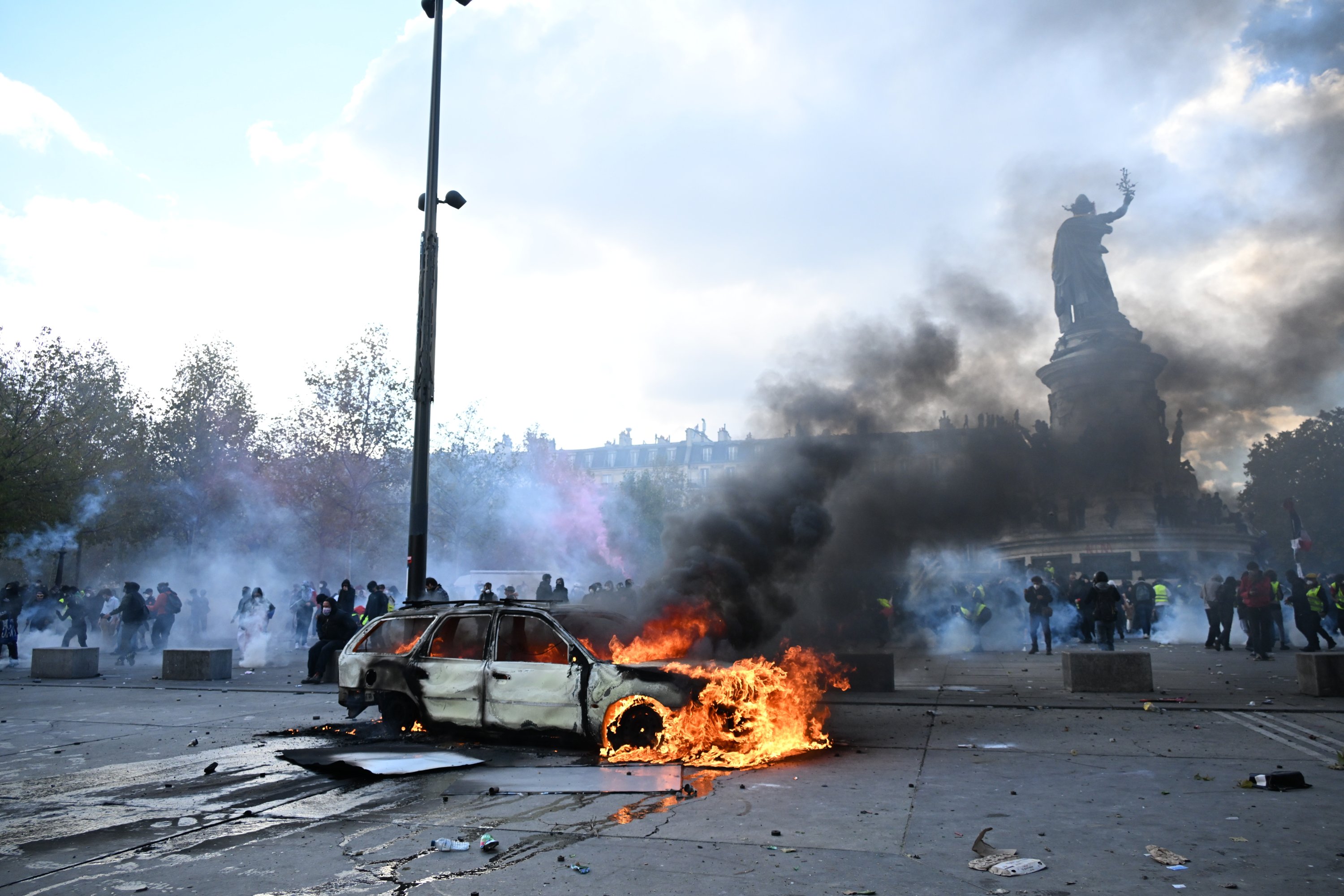
Officials say the aim is to prevent the next riot and pay for the last. Critics warn that widening responsibility could punish people who committed no violence and make others afraid to protest.
‘Rioters pay’
In France, anyone who knowingly joins a group preparing violence could be made to pay up to 10,000 euros for what others destroy. So could anyone who knowingly stays after police order a violent crowd to disperse, for damage done afterward.
Collecting is the hard part, a Senate report says: Offenders often have little money, or income the law protects from seizure.
The bill would open another source: money the state pays to help families live.

French law already generally holds parents liable for damage caused by their children under 18. Under the bill, once a court ruling is final, the money could be deducted from family allowances and housing aid. Senators added the RSA, France’s minimum-income benefit, worth up to about 650 euros a month for a single person, and even the back-to-school allowance families get for supplies. A minimum amount would remain protected for living expenses.
Communist Senator Fabien Gay cited monthly deductions of 57 euros from a household receiving RSA. At that rate, repaying 10,000 euros would take nearly 15 years.
Supporters say victims deserve compensation and taxpayers shouldn’t carry the cost. One large shop window can cost tens of thousands of euros to replace. After riots in 2023, insurers paid 793 million euros on 16,400 claims, according to France Assureurs, the insurers’ federation.
Human rights groups urged lawmakers to reject the bill, warning it could discourage peaceful protests and hurt families who depend on benefits.

Seizing those payments “could have disastrous consequences for the poorest,” Nathalie Godard of Amnesty International France said in a statement.
The far right backed the bill in the conservative-led Senate. Next comes the National Assembly, where no bloc has a majority.
Seizing rioters’ benefits was long an idea of Marine Le Pen, leader of the far-right National Rally party. Now the government has made it its own, and she leads the polls for next spring’s presidential election.
French word travels border
French students call a protest that shuts their school a “blocus,” or blockade. In Barcelona, it became a hashtag.
TikTok posts under the tag called people to Catalonia Square on Saturday, Oct. 24, and QR codes sent them to WhatsApp or Telegram channels, Catalonia’s interior chief, Nuria Parlon, told Cadena SER radio.
On paper, it was a protest over education. There was no route, Parlon said. No banners. No manifesto. Just groups of 10 to 15 young men looting stores, burning trash containers and smashing bus stops.
When police arrived, the looters scattered, said an Associated Press (AP) journalist who was at the scene.
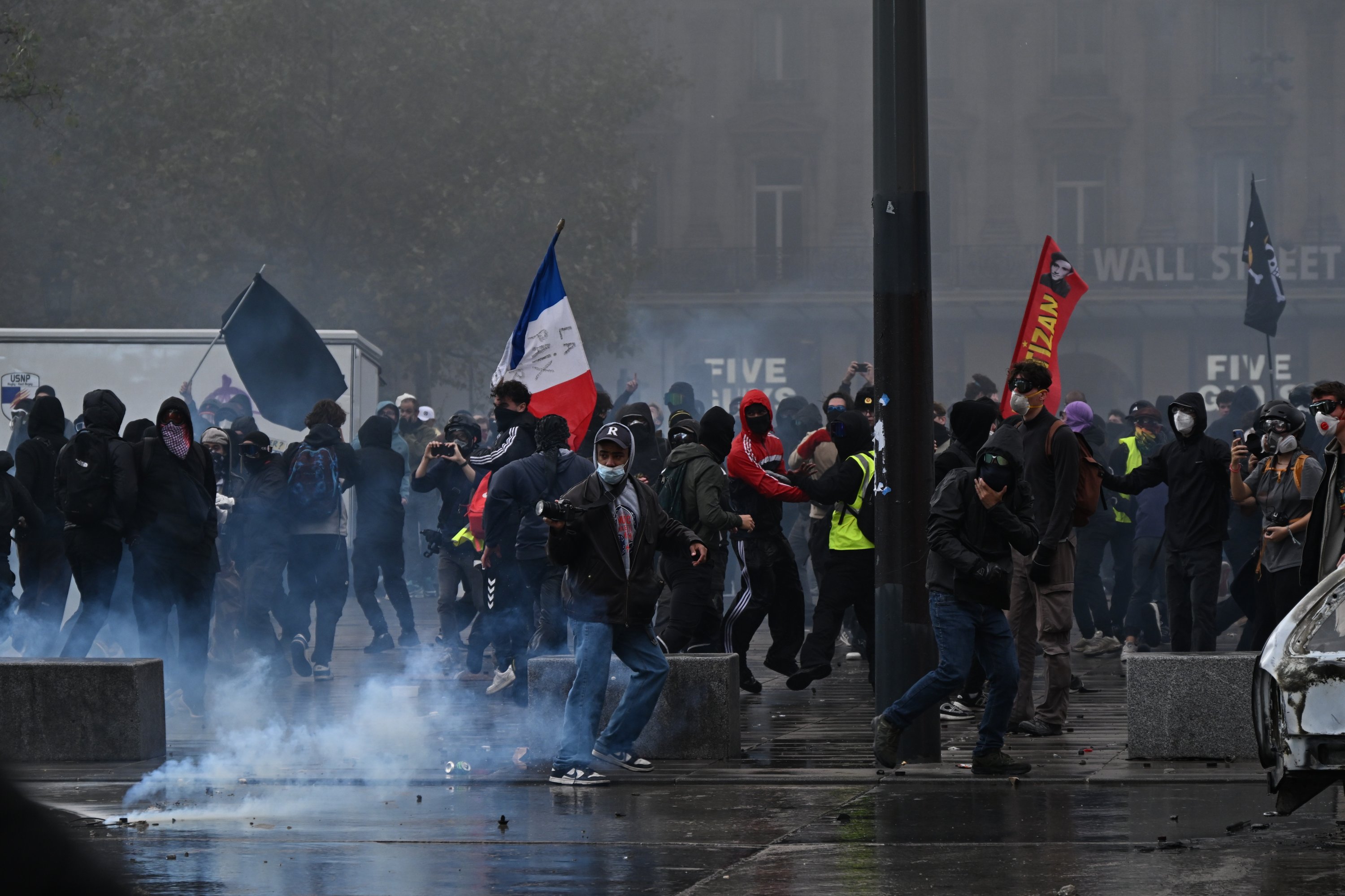
Police reported 130 arrests, including 76 minors, according to Spanish news agency EFE.
Some TikTok accounts promoting the gatherings disappeared, while others advertised new Halloween protests, Maldita.es reported. In one Telegram group, messages urged people to wear masks and gloves and wait to be told of a shop “without police.”
‘You break it, you pay’
In Italy, the argument starts with another family. “Behind that shop window there is a family that has invested a lifetime of sacrifices,” Premier Giorgia Meloni said Oct. 20, announcing a security decree after looting in Milan.
Her principle fits in three Italian words: “Chi rompe paga” – you break it, you pay. “And if the one who breaks it is a minor,” she said, “their parents pay.”
Parents now face fines of up to 1,000 euros, doubled for a repeat offense, unless they prove they couldn’t have stopped their child. They can be made to pay for damage.
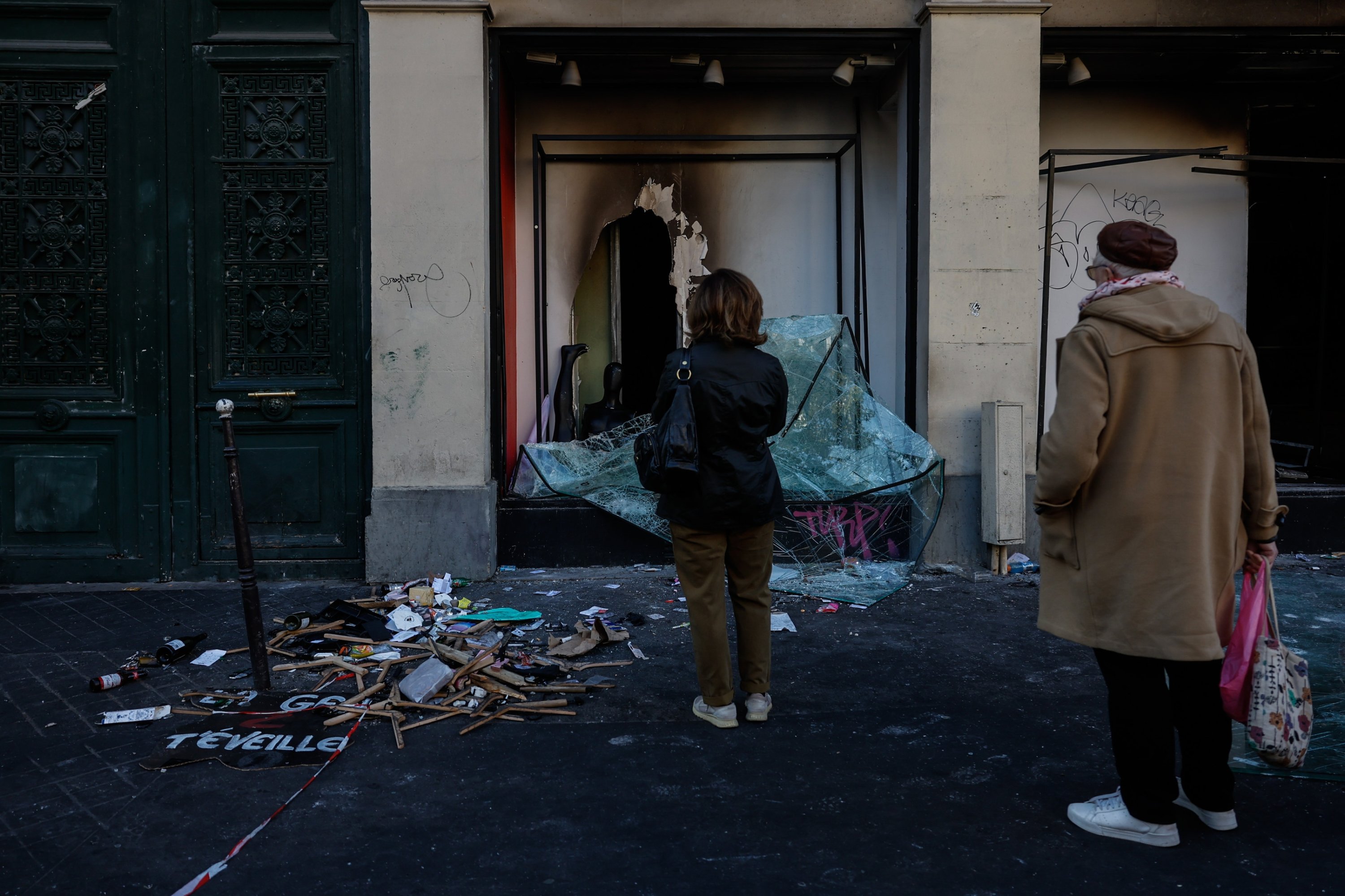
Holding parents accountable may help, said Claudio Bertolotti, director of START InSight, a security research firm, but “fines alone are unlikely to deter teenagers driven by peer pressure or a desire for group recognition.”
Organizing protest violence, even online, now carries four to 12 years in prison.
Before window breaks
Telegram and WhatsApp “must shut down such channels when they incite violence,” Parlon said.
Telegram spokesperson Remi Vaughn told the AP the company supports peaceful speech and protest, but “calls for violence, vandalism and theft are explicitly forbidden and are removed whenever discovered.”
He said Telegram had removed such calls linked to protests in Madrid.
TikTok and Meta, which owns WhatsApp, did not respond to requests for comment.
Telegram closed a Barcelona group promoting Halloween looting, but a replacement drew more than 2,000 members, Spanish media reported.

The French bill would let authorities demand removal of certain illegal calls to violence or looting without prior court approval. If they stay up 24 hours, they could order the web addresses blocked. Those decisions could be challenged in court.
The United States is going the other way. Its law generally shields platforms from civil liability for users’ posts, and the Trump administration calls Europe’s rules censorship.
Britain shows the limits of takedowns. After three girls were killed in Southport in 2024, false claims spread online and riots followed. A parliamentary committee found that algorithms amplified harmful material, much of it legal.
Under France’s bill, money meant to house and raise children could help pay for a looted shop.
Türkiye’s tourism revenues reached a record high for both the third quarter and the first nine months of the year, Culture and Tourism Minister Mehmet Nuri Ersoy said Friday.
Income rose 5% year-over-year to $25.5 billion (TL 1.28 trillion) in the July-September period, while it climbed 2.4% to nearly $51.3 billion in the first nine months, Ersoy told a news conference on the sector’s performance.
Ersoy said Türkiye was on track to generate more than $65 billion in full-year tourism revenues.
“Longer-than-expected average stays and higher overnight spending have boosted tourism revenues,” he noted.
The number of visitors fell 1% year-over-year to 23.37 million in the third quarter, while total arrivals reached 49.13 million in the January-September period, the Turkish Statistical Institute (TurkStat) data showed.
Separately, data from the Tourism Ministry showed that the number of foreign visitors rose 0.4% year-over-year to 6.11 million in September. However, foreign arrivals fell 1.52% to 40.93 million in the first nine months of the year.
Russians accounted for the largest group of foreign visitors in September, with 979,647 arrivals, followed by visitors from Germany, Britain, Iran and Poland.
Revenue generated directly from visitors amounted to $25.29 billion in the July-September quarter, while transit passenger income contributed $231.96 million, the TurkStat data showed.
Turkish citizens residing abroad accounted for 14% of total revenue.
Individual expenditures made up $17.1 billion of the total, while package tour spending stood at $8.2 billion.
Average visitor stays stood at 10.34 nights in the first nine months and 10.69 nights in the third quarter.
Average spending per night rose 4.6% year-over-year to $107.70 in the nine months, with foreign tourists spending an average of $119.90.
Tourism expenditure, consisting of spending by Turkish residents traveling abroad, surged 22.6% year-over-year to over $3 billion in the third quarter.
Individual spending totaled $2.57 billion, while package tour expenses accounted for $467.64 million.
The number of Turkish residents traveling abroad increased 24.2% year-over-year to 4.2 million, with an average expenditure of $723 per person.
Warning of risks
Ersoy said average visitor stays continued to exceed expectations, but warned of risks to the sector in the final quarter, including a possible escalation of the Iran war and its spillover into Saudi Arabia, as well as an increase in drone attacks on cities amid the Russia-Ukraine war.
He noted that regional conflicts, airspace restrictions and rising energy prices have driven up aviation costs and pressured international travel demand throughout the year.
“While all these negative developments are occurring in our region, Türkiye stands out as an island of stability through its strong state structure, diplomatic capacity and efforts for peace and stability led by our president,” Ersoy said.
“When activity slows in one market, we can intensify our efforts in other markets and replan our promotional and marketing activities according to developments,” he added.
Looking ahead, Ersoy stated that Türkiye will intensify efforts in high-growth-potential markets, including the U.S., Canada, Asia, Africa and Australia, while expanding direct flight capacity in partnership with Turkish Airlines and tour operators.
He also emphasized that the ministry will make more effective use of data and artificial intelligence (AI) applications to monitor market demand, visitor preferences and campaign results.
Türkiye welcomed a record 52.78 million foreign tourists last year, according to official data. Combined with Turkish citizens living abroad, the count rose to a new all-time high of 63.94 million.
In 2025, revenues increased by 6.8% from the previous year to a record $65.2 billion, surpassing the government’s Medium-Term Program (OVP) target of $64 billion. Before the Iran war began, the target for this year was $68 billion.
Lower revenues could add to Türkiye’s current account deficit, which is already under pressure from soaring energy prices due to the fallout from the Iran war.
The war has hurt demand for travel to Türkiye’s historic sites and Mediterranean beaches.
Tourism is a vital industry that Türkiye relies on to help flip its chronic current account deficit to a surplus.
The sector contributes about 10% to Türkiye’s gross domestic product (GDP) and accounts for about 5% of total employment.
Doğuş Otomotiv said Friday it had signed a letter of intent with Volkswagen to evaluate options for producing the German automaker’s passenger cars in Türkiye.
The automotive distributor, which is Türkiye’s longtime importer of Volkswagen cars, announced the step in a filing with the Public Disclosure Platform (KAP).
“A letter of intent has been signed between our company and Volkswagen Group companies regarding the evaluation of options for producing Volkswagen-brand passenger cars in Türkiye,” the filing said.
The move does not mean Volkswagen will begin producing in Türkiye. It is a preliminary step toward assessing production possibilities, and whether a final decision on production will follow will become clear later.
Volkswagen had abandoned plans for a factory in Türkiye in 2020, citing the COVID-19 pandemic and global economic developments.
The partnership aims to offer value-added products suited to new technologies in the Turkish market and contribute to growth in the Turkish auto industry, Doğuş said.
A serious passenger car production partnership could have a significant long-term impact on Doğuş, Ata Yatırım analyst Cemal Demirtaş said
The company did not say where production could take place, which Volkswagen models it might cover, how large an investment would be involved, or what the timeline might be.
Shares of Doğuş Otomotiv rose 10% in morning trade, on track for their biggest one-day jump since May 2025.


-

 Politics2 days ago
Türkiye confirms hosting Libya east-west reunification talks
-

 Politics3 days ago
Turkish opposition CHP confirms it will field candidate in next election
-

 Politics2 days ago
Turkish main opposition holds primaries to cement Özel’s rule
-

 Politics2 days ago
President Erdoğan hosts MHP leader to discuss key political issues
-

 Politics2 days ago
Erdoğan, Macron discuss UN leadership, bilateral ties in call
-

 Economy2 days ago
Türkiye’s trade deficit narrows to $5.2 billion in September
-

 Economy3 days ago
UK finance chief seeks to steer economy with low-key budget
-
 Economy2 days ago
Fed holds interest rates steady ahead of US midterm elections