
Politics
Türkiye prepares to mark anniversary of victory against coup bid

July 15 Democracy and National Unity Day will be marked for the ninth time on Tuesday. It is an occasion to remember the resistance to the 2016 coup attempt and celebrate democracy’s prevalence against military takeovers.
The day will be observed through nationwide events, from exhibitions to solemn commemorations. President Recep Tayyip Erdoğan, the primary target of the putschists who led military infiltrators of the Gülenist Terror Group (FETÖ), is scheduled to attend a commemoration ceremony at the site of the Special Operations Command of Turkish police in Ankara. The complex was heavily bombarded by putschists during the coup attempt, and 44 people inside were killed.
The Presidency’s Directorate of Communications will organize various events under the theme of “Name of Victory: Türkiye” to mark the day, highlighting unwavering resistance against putschists by the unarmed public and security forces opposing FETÖ’s military infiltrators at the cost of their lives. Between July 14 and July 18, the directorate will give a tour of the Presidential Complex and Parliament, two main targets of the putschists, to some 200 journalists from across Türkiye and the world. The commemoration will also include visits to museums in Ankara and Istanbul dedicated to victims of the coup and past coups in the country.
The coup attempt unfolded almost simultaneously across Türkiye on the evening of July 15, 2016, and was suppressed by noon the next day. Erdoğan, who narrowly avoided an assassination attempt by putschists while he was on vacation in southwestern Türkiye, traveled to Istanbul secretly. During and after his trip to the city, he issued several messages through video phone calls to TVs, mobilizing the nation to “reclaim democracy.” After his calls, more people took to the streets, braving heavily armed putschists. Unarmed people blocked the roads against tanks and legions of pro-FETÖ troops. Gunfire by putschists killed 253 people, while 2,740 others were injured.
For decades, FETÖ had secretly infiltrated state institutions, including the army. It sought to overthrow the government and conspired against top officials, from sham investigations to a plot targeting then intelligence chief Hakan Fidan. It also conducted two notorious coup attempts in December 2013 that targeted people close to the government, including an incident where pro-FETÖ officials stopped trucks belonging to the intelligence agency in a bid to portray the government in a negative light.
Their efforts repeatedly failed, and the government moved to weed out military officers linked to the group from the army in 2016. Upon learning the plans, FETÖ turned to mobilizing its infiltrators in the army to seize power.
On March 19, 2016, FETÖ ringleader Fetullah Gülen appeared on camera in a khaki robe – a color long interpreted by followers as a military signal, urging sleeper cells in uniform to move against the state in a cryptic speech. From December 2015 onward, senior civilian operatives of FETÖ were shuttled between Türkiye and the U.S. to receive Gülen’s blessing for the plot, as investigations after the coup attempt found out.
Days before the coup attempt, the masterminds of the attempt held a two-day meeting in Ankara. In attendance were Adil Öksüz, a civilian who is accused of orchestrating the plot, and several generals.
On July 11, Öksüz and another “civilian handler,” Kemal Batmaz, flew to the U.S., presenting their plan to Gülen at his Pennsylvania compound. Two days later, they returned, setting 3 a.m. on July 16 as the hour that the coup would be launched.
Hours before the launch, a FETÖ‑linked army major was assigned to visit the headquarters of the National Intelligence Organization (MIT), revealing a scheme to kidnap intelligence chief Hakan Fidan. MIT alerted then‑Deputy Chief of General Staff Yaşar Güler, who informed Chief of General Staff Hulusi Akar. Akar ordered all aircraft to return to base and closed national airspace. Tanks at Etimesgut Armored School in Ankara were confined to barracks, while Land Forces Commander Gen. Salih Zeki Çolak rushed to the Army Aviation Command to halt helicopter sorties. The putschists panicked, rescheduling the timetable of the coup to 8:30 p.m. on July 15.
At General Staff headquarters, putschist Maj. Gen. Mehmet Dişli confronted Akar, demanding he endorse a takeover. When Akar refused, Dişli’s team, including aide Lt. Col. Levent Türkkan, physically restrained Akar. Sgt. Maj. Bülent Aydın, a member of Çolak’s detail, became the first martyr when he resisted the assailants.
In the meantime, F‑16s roared low over the capital while putschist troops blocked the Bosporus and Fatih Sultan Mehmet bridges in Istanbul. As the coup attempt was unfolding in a live broadcast, people were confused about the nature of the military’s unprecedented movement. It was only after the country’s leaders, including Prime Minister Binali Yıldırım, announced that a coup attempt was underway that the general public became aware of FETÖ’s actions. Before that, several people had already rushed to the bridges to confront the troops and urge them to return to their bases.
At 12:24 a.m. on July 16, President Erdoğan spoke to broadcaster CNN Türk via FaceTime, urging citizens to “fill the squares.” The public response proved decisive to quell the coup, but not before sacrifices. Minutes later, jets controlled by putschist officers struck police headquarters in Ankara.
The coup attempt took another turn thanks to the heroics of Ömer Halisdemir, a non-commissioned officer stationed at the headquarters of the Special Forces Command of the Turkish army. Special Forces, an elite military unit, was key to the success of the coup. When putschist Gen. Semih Terzi tried to capture it, Halisdemir shot him dead at the entrance of the headquarters, before Terzi’s entourage sprayed him with bullets. Halisdemir died at the scene, while Terzi succumbed to his wounds moments later.
About one hour later, the putschists dropped bombs on Parliament. Lawmakers braving gunfire had arrived at Parliament earlier and declared a message of opposition to the putschists. Elsewhere, putschists seized public broadcaster TRT and forced a presenter at gunpoint to announce that their “Peace At Home Council” had seized power in Türkiye. Anti-junta public and police officers later managed to seize the broadcaster’s offices back from the putschists.
In the early hours of July 16, prosecutors started issuing arrest warrants for putschists. But they continued their attacks. In the morning of July 16, they launched an airstrike on a crowd gathered to protect the Presidential Complex against putschists, killing 15 people. Around the same time, resistance grew, and finally, security forces liberated Akıncı, a military base that served as the headquarters of the putschists, from FETÖ infiltrators. Twenty-one hours after it started, the coup attempt was declared over.
Defending the country
Mustafa Çalışkan, deputy head of the Turkish National Police, was the police chief of Istanbul at the time of the coup attempt. He spoke about that night and its aftermath ahead of the coup attempt’s anniversary. “It was a day when we defended our country. You can’t think about anything else while doing your job,” he told Ihlas News Agency (IHA).
Çalışkan was coordinating a usual citywide security operation against other crimes when he and other police officers noticed something unusual.
“Calls began coming in saying that soldiers were setting up checkpoints on the Bosporus Bridge,” he recounted. “Then a final call came in – police officers were being disarmed. That’s when I realized this was an extraordinary situation.”
Çalışkan issued his first command: No officer was to surrender their weapon, and if needed, they were to use them. He and his team headed directly to the bridge.
“Our order was clear: not a single step backward. We would act within the framework of the law,” he said.
Çalışkan said the moment they arrived on the bridge, they recognized what was unfolding as a full-scale coup attempt orchestrated by FETÖ.
“We gave all the necessary orders. Those violating the law, whoever they were, would be detained.”
According to Çalışkan, armed confrontations took place in 27 different locations across Istanbul. “In all 39 districts, our local chiefs were on duty. Our forces battled against putschist soldiers who had been given orders to shoot.”
Çalışkan noted that around 5,000 officers were on active duty that night as part of an unrelated operation.
“We had units stationed all across the city. From that moment until 7 a.m., an unbelievable fight took place. I gave the order to die multiple times to my officers.”
He described a pivotal moment when President Erdoğan asked about the situation at Atatürk Airport, which had been taken over by coup plotters. Çalışkan promised to retake the control tower within 20 minutes.
“I called our Special Operations and Airport Branch chiefs and told them: ‘Friends, die if necessary, kill if necessary, but I want to hear in 15 minutes that the tower has been taken back.’ I gave similar orders throughout the night,” he added.
Reflecting on the uncertainty of the night, Çalışkan said he didn’t think about the consequences.
“I knew that by morning, I might be hailed a hero or I might be executed. That’s how coups work. If they succeed, everything changes. But Allah didn’t allow that to happen. We were sincere, and Allah rewarded that.”
Such was the intensity of the moment, Çalışkan said, that for nearly five hours he didn’t even think of his own family.
“Bullets were raining down on us, tanks were firing, helicopters were overhead. It was a war zone. I only remembered my family hours later. It was a defense of the homeland where you forgot everything.”
Çalışkan recalled that Erdoğan’s call for people to resist the putschists gave him hope. “Seeing the nation stand united and the state respond firmly gave us peace of mind.”
Çalışkan said he personally witnessed harrowing scenes. “One of my guards was martyred in front of me, another seriously wounded. I saw dozens of civilians lose their lives.”
He described how he climbed on top of a vehicle, fully aware he was becoming an open target, just to address the crowd and lead them without putting them in harm’s way. “I told them I was wearing a bulletproof vest and that I was the police chief. I asked them to move behind me. The people shouted back, ‘Protect our chief!’ and shielded me with their own bodies. Some of those people were martyred. Others were severely injured.”
Despite the chaos, Çalışkan emphasized the professionalism of the police force: “We were always mindful that we would work with the same institutions the next day. Everyone we detained was a guest in our custody until brought before prosecutors. We collected all the evidence and made lawful arrests. Looking back, there wasn’t a single act we regret and that preserved trust between the police and military.”
Çalışkan credited the coup’s failure to President Erdoğan’s leadership and the people’s resolve.
“Had the president been late, or something happened to him, we would’ve faced great difficulties. But he took control at the right moment. The people stood up for their democracy and homeland. So did the police and other institutions. The result was an example to the world.”
Referring to recent failed coups around the world, Çalışkan said: “Over the last decade, more than 10 coup attempts globally have failed. Türkiye was the one that set that precedent. Our president, our nation and our state showed that coups can be defeated. July 15 was a rebirth, a moment of reckoning and renewal.”
Turkish Cypriot Foreign Minister Tahsin Ertuğruloğlu voiced concern over Israel’s growing presence in the Greek Cypriot-administered south, saying expanding military ties could undermine security on the divided island.
Ertuğruloğlu made the remarks during a meeting with Turkish journalists in Washington, D.C., as part of his U.S. visit following the U.N. General Assembly meetings.
Responding to a question about the impact of the Greek Cypriot administration’s growing military ties with Israel and other countries on security on the island, Ertuğruloğlu said Turkish Cypriot authorities were concerned about Israel’s increasing involvement.
“We are, of course, not pleased with Israel becoming so influential in southern Cyprus,” he stated, “This is a relationship that puts the island’s security at risk.”
He also criticized the Greek Cypriot administration’s military cooperation with France, U.S. arms sales and military training, as well as British policies involving its bases on the island.
Ertuğruloğlu said such developments risked disrupting stability but argued that Türkiye had taken necessary measures to preserve the military balance.
He emphasized that Turkish Cypriots remained confident about their security despite regional tensions, citing the presence of Turkish forces on the island and Türkiye’s role as a guarantor.
Two-state position unchanged
Ertuğruloğlu further noted the Turkish Republic of Northern Cyprus (TRNC) would maintain its current foreign policy position on the future of the Cyprus issue, reiterating its call for two sovereign, equal states with equal international status.
“The point we have reached in foreign policy is final: two sovereign, equal states with equal international status,” he said. “There is no option of establishing a new partnership with the Greek Cypriots. That is over.”
He underlined that Turkish Cypriots had previously attempted to establish a partnership with Greek Cypriots, referring to the establishment of the Republic of Cyprus in 1960 and the intercommunal violence that began in 1963.
Ertuğruloğlu argued that the Greek Cypriot side’s approach to the Cyprus dispute had not changed and said the international community’s policies encouraged it.
He also pointed to military cooperation between the Greek Cypriot administration and Israel, as well as the expected participation of U.S., British and French military personnel in anniversary ceremonies in southern Cyprus.
Ertuğruloğlu said future relations on the island could instead be based on good, neighborly ties between the two states.
“There can now be neighborly relations on the island,” he said.

President Recep Tayyip Erdoğan met with Izmir Mayor Cemil Tugay, who resigned from the main opposition Republican People’s Party (CHP) in June, at the Presidential Complex in Ankara on Wednesday.
“We informed the president about important issues on Izmir’s agenda and our projects for the city’s future,” Tugay noted in a written statement, thanking Erdoğan for the meeting and his interest in Izmir.
The meeting comes amid speculation over Tugay’s political future following his departure from the CHP.
Tugay resigned from the party on June 18 amid turmoil following a court ruling concerning the CHP leadership and said he would continue serving as Izmir mayor as an independent.
His departure left Türkiye’s third-largest city with a mayor who was not a CHP member for the first time in more than two decades.
Since his resignation, Turkish media reports have speculated that Tugay could join the ruling Justice and Development Party (AK Party).
AK Party Izmir lawmaker Mehmet Kasapoğlu, responding to the speculation, said the party would neither attempt to force political developments nor “close the door” on trends emerging naturally in politics.
Erdoğan’s meeting with Tugay follows a Sept. 9 meeting with Ankara Mayor Mansur Yavaş, who later announced his resignation from the CHP and said he would continue his political career as an independent.
Morning raids on Thursday netted Mersin Metropolitan Municipality Mayor Vahap Seçer, along with the mayors of the Yenişehir and Mezitli districts in the province.
Authorities announced that a total of 59 suspects were detained in an investigation into corruption in the municipalities.
Seçer, Yenişehir Mayor Abdullah Özyiğit and Mezitli Mayor Ahmet Serkan Tuncer are all members of the opposition Republican People’s Party (CHP), whose new chair, Kemal Kılıçdaroğlu, has pledged to cleanse the party of corruption after taking office last May.
The investigation into Mersin municipality, a city of about 2 million people, found that violations of regulations in 13 public tenders and 63 acquisitions organized by the municipality resulted in a public loss of more than TL 330 million ($6.73 million). Suspects linked to Mezitli Municipality caused a public loss of more than TL 1.1 billion, investigators discovered, again through rigged public tenders and acquisitions, while the figure was TL 105 million at Yenişehir Municipality.
A similar scheme was discovered in most municipalities that faced investigations in the past two years, and almost all of them were run by CHP mayors. In other investigations, prosecutors have accused defendants, including mayors and senior municipal bureaucrats, of running criminal organizations that thrived on bribes in exchange for zoning and building permits, awarding lucrative tenders to businesspeople in exchange for advance payments in violation of tender laws and holding companies hostage over payments for their services, releasing the payments only after the companies paid additional money to the municipalities.
Authorities said Tuncer also faced a separate investigation over allegations that he ordered armed attacks on people with whom he was involved in a feud, as well as on a local office of the New Party (YP), which was founded last July by former CHP chair Özgür Özel, and the offices of a media company.
The CHP seeks to restore its image, tarnished by the arrest of mayors on corruption charges. As promised by Kılıçdaroğlu, the “cleansing process” will now involve preemptive steps to prevent future cases, according to a recent report by Sabah newspaper. Starting next year, the party will introduce a “performance monitoring system” for its mayors, which will serve as a benchmark to assess whether they comply with the CHP’s predetermined criteria.
With this move, the mayors’ past and future performance will come under scrutiny. They will be assessed based on how many criteria they have met, and at the end of the process, they will be given a “report card.”
The mayors will undergo reviews in a number of areas, including project management, financial management, human resources management and public relations. The flow of funds in municipalities, investments and the allocation of tenders are also expected to be examined comprehensively.
Mayors whose activities are deemed suspicious, who fail to meet the established criteria or are found to have performed poorly will not be nominated in the next election. Throughout the process, the main focus will be on clean politics and financial transparency.
All of the mayors who remain under the CHP umbrella are individuals who were nominated in the last local elections during Özgür Özel’s tenure as party chairperson. The party leadership also plans to hold a meeting of mayors shortly to strengthen central authority and discuss steps to be taken for the coming year.
Defense Minister Yaşar Güler attended the Distinguished Observer Day of the Unity of Strength-2026 military exercise in Azerbaijan on Thursday, alongside senior commanders from the Turkish Armed Forces (TSK).
The exercise, hosted by Azerbaijan with the participation of Türkiye and Uzbekistan, is aimed at improving coordination and joint operational capabilities among the three countries’ armed forces.
Güler visited the exercise area in Shusha with Chief of General Staff Gen. Selçuk Bayraktaroğlu, Navy Commander Adm. Ercüment Tatlıoğlu, Land Forces Commander Gen. Metin Tokel and Air Force Commander Gen. Rafet Dalkıran.
Güler and Azerbaijani Defense Minister Zakir Hasanov also inspected weapons, ammunition and military technologies displayed and used during the exercise.
Türkiye’s Defense Ministry said Turkish and Azerbaijani air forces struck simulated ground targets on their first attempts during the drills. The ministry also said troops conducted urban warfare training as part of the exercise.
According to the ministry, participating units trained under challenging scenarios designed to improve coordination, speed and their ability to conduct joint operations.
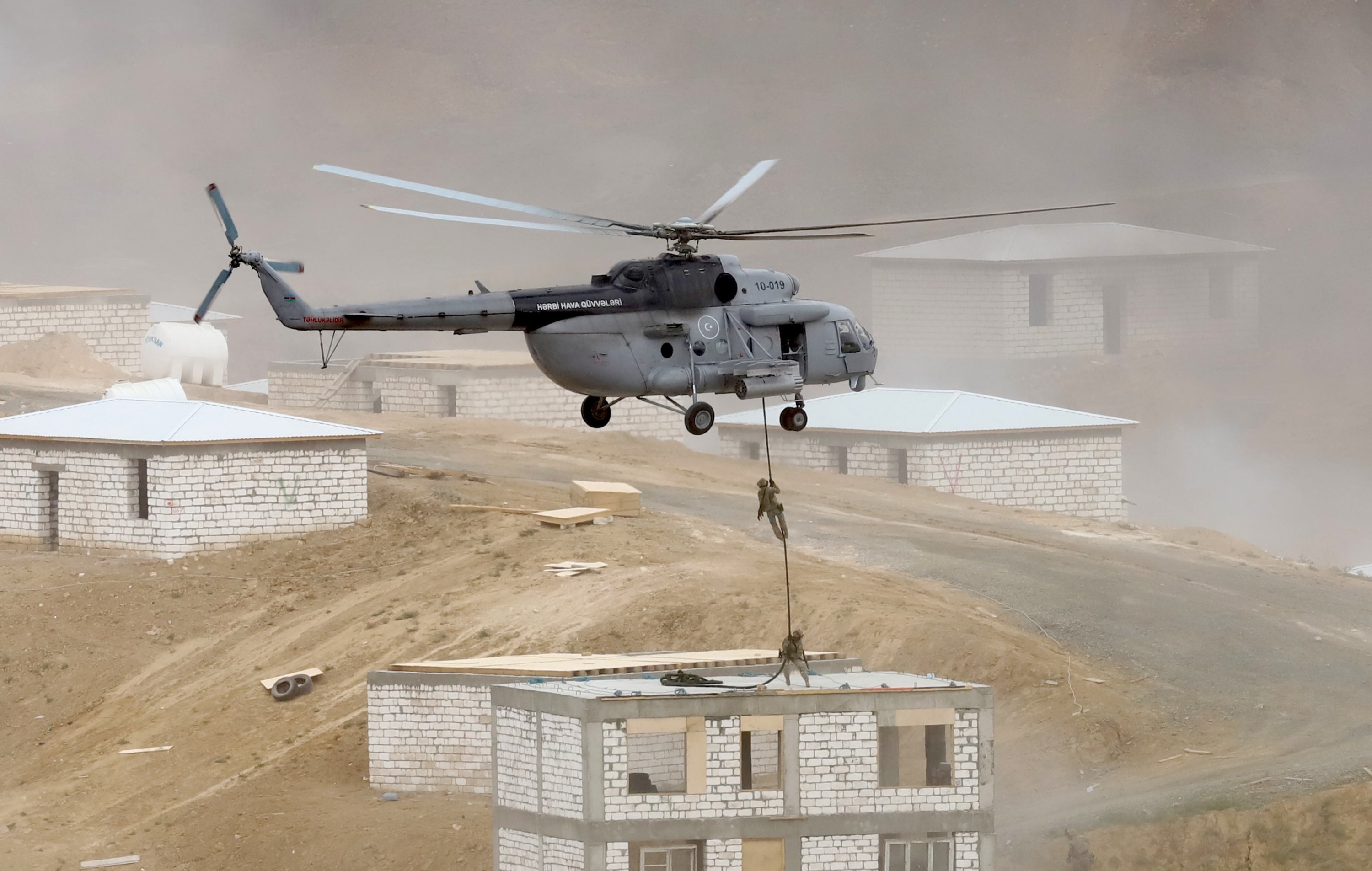
More than 3,500 military personnel from Türkiye, Azerbaijan and Uzbekistan have taken part in the joint exercises, which began Sept. 21, according to Azerbaijan’s Defense Ministry, noting the drills marked the first military exercise of this scale to include territories retaken by Azerbaijan.
More than 130 unmanned aerial vehicles, 70 armored vehicles, 90 artillery systems and 20 aircraft are participating in the exercise, along with more than 30 electronic warfare, reconnaissance and surveillance systems. The drills also involve more than 15 air defense systems, eight sets of engineering equipment and more than 20 naval vessels, the ministry said.
The Kremlin said Wednesday that work was underway on the possible transfer of Türkiye’s Russian-made S-400 air defense systems to a third country, a move that could help address a longstanding dispute between Ankara and Washington over Türkiye’s participation in the F-35 fighter jet program.
Kremlin spokesperson Dmitry Peskov said the issue was “on the agenda” and that discussions were taking place.
“Relevant work is being done, and appropriate contacts are taking place,” Peskov noted when asked about the possibility of transferring the systems.
His comments came after Russian Foreign Minister Sergei Lavrov said Moscow could consider allowing the S-400 systems to be transferred to another country.
Lavrov said any recipient would need to act responsibly and maintain friendly relations with Russia, adding that Moscow would consider such a transfer if a request were made.
Türkiye agreed to purchase the S-400 air defense system from Russia in 2017 and acquired the system in 2019.
The acquisition drew criticism from the United States and other NATO allies, which argued that operating the Russian system posed risks to NATO defense systems and the F-35 program.
Washington subsequently removed Türkiye from the F-35 program and imposed sanctions under the Countering America’s Adversaries Through Sanctions Act (CAATSA).
Ankara has long sought to resolve the dispute and return to the F-35 program. Yet, U.S. President Donald Trump said he was considering allowing Türkiye to rejoin the F-35 program at the NATO summit in Ankara in July.
Speaking alongside President Recep Tayyip Erdoğan at the Presidential Complex after arriving in Ankara for the summit, Trump said the time had come to remove sanctions that have strained relations between the two NATO allies.
“We’re going to lift the sanctions,” Trump said. “We don’t want to sanction our friends. I don’t want to choke my friend with sanctions.”
Calling Türkiye a militarily powerful country under Erdoğan’s leadership, Trump remarked that relations between Washington and Ankara were at their strongest point in years.
Yemen is seeking to expand cooperation with Türkiye to rebuild state institutions and improve essential public services as the war-torn country grapples with persistent security and humanitarian challenges, Foreign Minister Afrah al-Zouba said.
Al-Zouba made the remarks during a meeting with Türkiye’s Ambassador to Riyadh, Emrullah Işler, Yemen’s official SABA news agency reported.
The two officials discussed recent developments in Yemen and the wider region, as well as ways to strengthen bilateral relations and broaden cooperation.
Al-Zouba praised Türkiye’s support for Yemen and its internationally recognized government, including Ankara’s backing for the Presidential Leadership Council.
She stressed the importance of strengthening political and diplomatic coordination between Türkiye and Yemen amid regional and international developments, saying closer ties could support efforts to rebuild state institutions and bolster regional security and stability.
The Yemeni government is particularly interested in expanding cooperation with Türkiye in strengthening state institutions and improving basic services to help ease hardships facing the population, al-Zouba said.
The foreign minister also raised the impact of Houthi attacks on security in Yemen and the wider region, including threats to international trade and maritime traffic in the Red Sea and the Bab el-Mandeb Strait.
She warned that indiscriminate missile launches by the Houthis posed growing risks to civil aviation and international air travel, saying weapons that fail to distinguish between civilian and military targets endanger passenger aircraft and civilian lives.
Işler, for his part, reiterated Türkiye’s support for the Yemeni government and for Yemen’s security, unity, sovereignty and territorial integrity.
He also reaffirmed Ankara’s commitment to expanding bilateral cooperation and supporting the Yemeni government’s efforts to rebuild state institutions and restore security and stability.


-
 Sports3 days ago
Türkiye slip to 31st in FIFA rankings after Nations League defeats
-
 Politics3 days ago
Iraq says talks underway for withdrawal of Turkish troops
-
 Sports3 days ago
Manchester City stare down barrel after reported guilty verdict
-
 Sports3 days ago
Turkish football refereeing rocked by probe as MHK chief detained
-
 Lifestyle3 days ago
Nature, history, heritage come together aboard Karaelmas Express
-
 Politics3 days ago
Turkish security forces target Daesh network in coordinated raids
-
 Economy3 days ago
Spain eyes ban on evictions until 2030 amid housing protest pressure
-
 Politics3 days ago
Turkish diplomat Güllüoğlu appointed to senior UN posts