
Economy
US tells European allies to release diesel stocks ‘immediately’

The United States on Thursday told its European allies to help lower global diesel prices by releasing strategic reserves “immediately,” with EU member states due to discuss the crisis on Friday.
Reports said the Trump administration had told Germany and France in particular to draw down emergency diesel inventories to help ease soaring global fuel prices or face a potential U.S. diesel export ban.
“Our European partners should accelerate delivery on their existing commitments and make additional supplies immediately available to address ongoing disruptions,” U.S. Treasury Secretary Scott Bessent said in a post on social media.
EU member states will meet with the European Commission Friday to discuss a coordinated response to soaring fuel prices, a Commission spokesperson said.
Washington is piling on pressure to get European help with fuel costs, with U.S. President Donald Trump on Wednesday floating the possibility of banning diesel exports.
High energy costs loom as a threat to Trump’s Republican Party in next month’s midterm elections.
Europe’s relationship with Washington has soured under Trump due to tariff disputes and disagreements over military spending.
For the EU, releasing more stocks would represent a dilemma as it needs to balance the need to bring down fuel prices at home with maintaining high stocks for a possible worsening of the fuel crisis should Trump and Iran not reach a peace deal.
“It is in Europe’s best interest to work with the United States as we pursue multiple pathways to boost the supply of refined products and lower costs for consumers,” a U.S. official told Agence France-Presse (AFP).
At G-20 trade ministers’ meeting in Milwaukee, U.S. Trade Representative Jamieson Greer struck a conciliatory tone, saying there was an “eagerness on both sides to work together” on the diesel issue.
And Trump told reporters in Texas on Thursday that he “may” ask European countries to release diesel reserves.
Europe has become increasingly dependent on U.S. fuel after banning Russian imports over Russia’s invasion of Ukraine and after the U.S.-Israeli war against Iran disrupted supplies from the Middle East.
‘Unexpected’
EU trade chief Maros Sefcovic told reporters Thursday that any move by the U.S. to ban diesel exports would be “unexpected for Europeans.”
He spoke on the sidelines of the two-day G-20 talks, after meeting with Greer.
Sefcovic told reporters that he did not go into details with Greer on energy exports.
But the transatlantic partners “decided to stay in close touch to avoid any surprises here,” he said.
“It would have very dramatic consequences for our economic performance,” Sefcovic said of any potential diesel export ban.
France’s minister delegate for international trade, Nicolas Forissier, told AFP in Milwaukee: “I can’t imagine that there will be a ban.”
He stressed the importance of diesel to the United States and European countries, adding both sides will “try to find solutions.”
“In France, we’ll try to find balanced solutions all over the world,” Forissier added. “If not with the Americans, it will be with other countries.”
U.S. Energy Secretary Chris Wright said Wednesday that the world would “hear announcements from our friends in Europe” to push diesel prices down.
Asked about a release from strategic reserves, the French presidency said no such demand had been made when Emmanuel Macron and Trump met on the sidelines of the U.N. General Assembly last week.
Macron would also soon convene a video meeting of G-7 leaders “to make progress on the various levers that can be used to address the rising fuel prices… including coordination on releasing reserves.”
Macron announced on Sept. 18 a plan for such a meeting. The G-7 gathering is expected in mid-October, according to Macron’s press office.
Average U.S. diesel prices have surged more than 70% to $6.39 a gallon since the start of the Iran war, according to AAA motor club data.
Fuel prices have caused living costs to soar, leaving Trump’s Republican Party fearing it could lose control of Congress in November’s midterm elections.

Long overlooked by its NATO allies, Türkiye’s defense industry has now found its place at the military alliance’s top table, propelled by an ambitious, top-down government strategy.
Turkish arms manufacturers saw their turnover increase 15-fold between 2002 and 2023, specialist defense website TurDef says, while exports rose from around $800 million in 2010 to $7.1 billion in 2024.
“Ten years ago, when we spoke about the Turkish defense industry, people would laugh. Not anymore,” says TurDef founder Özgür Ekşi.
“Türkiye designs, develops and produces a large part of its own defense equipment,” says retired French brigadier general Patrice Moyeuvre, head of defense and security at Advantis consultancy.
“Its efforts have paid off and this can be seen, in particular in its export success,” he told Agence France-Presse (AFP).
For much of the past two decades, Ankara has expressed frustration over its Western allies’ failure to provide adequate defense systems against missile threats despite Türkiye being a NATO member.
Years of investment have helped it evolve from a country heavily reliant on foreign defense systems to one where domestically developed platforms meet almost all of its needs.
The transformation since the early 2000s has driven the development of a broad range of homegrown air, land and naval platforms, reducing foreign dependency from around 80% to below 20% today.
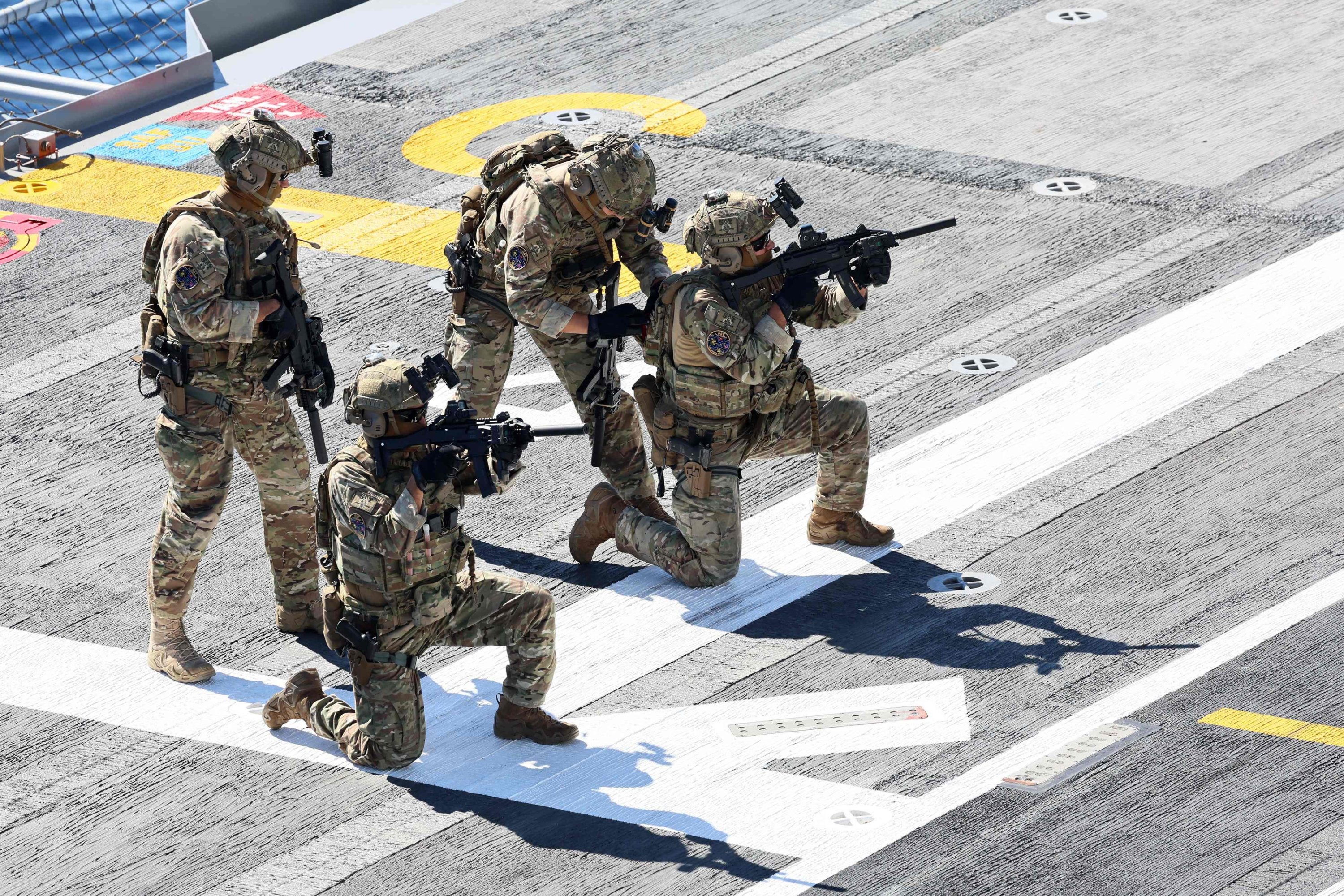
Türkiye has established firms that have gone on to become giants: drone powerhouse Baykar, defense electronics giant Aselsan; defense software and systems expert Havelsan; aerospace manufacturer TAI; missile and rocket manufacturer Roketsan and others.
‘Versatility’
In 2004, Ankara stopped buying off-the-shelf systems from abroad and brought weapons development in-house, placing the entire sector under its Presidency of Defense Industries (SSB) that reports directly to the president.
“Given Türkiye’s geostrategic location … the imperative for a coherent and forward-looking national strategy is clear,” says Uğur Tarçın, a professor at Istanbul’s Marmara University.
Over the past decade, Ankara has “exported 230 different types of defense products to 185 countries” – an achievement which “reflects both the versatility and competitiveness” of its capabilities, he said.
Drones produced by Baykar and TAI are now ubiquitous across modern-day battlefields.
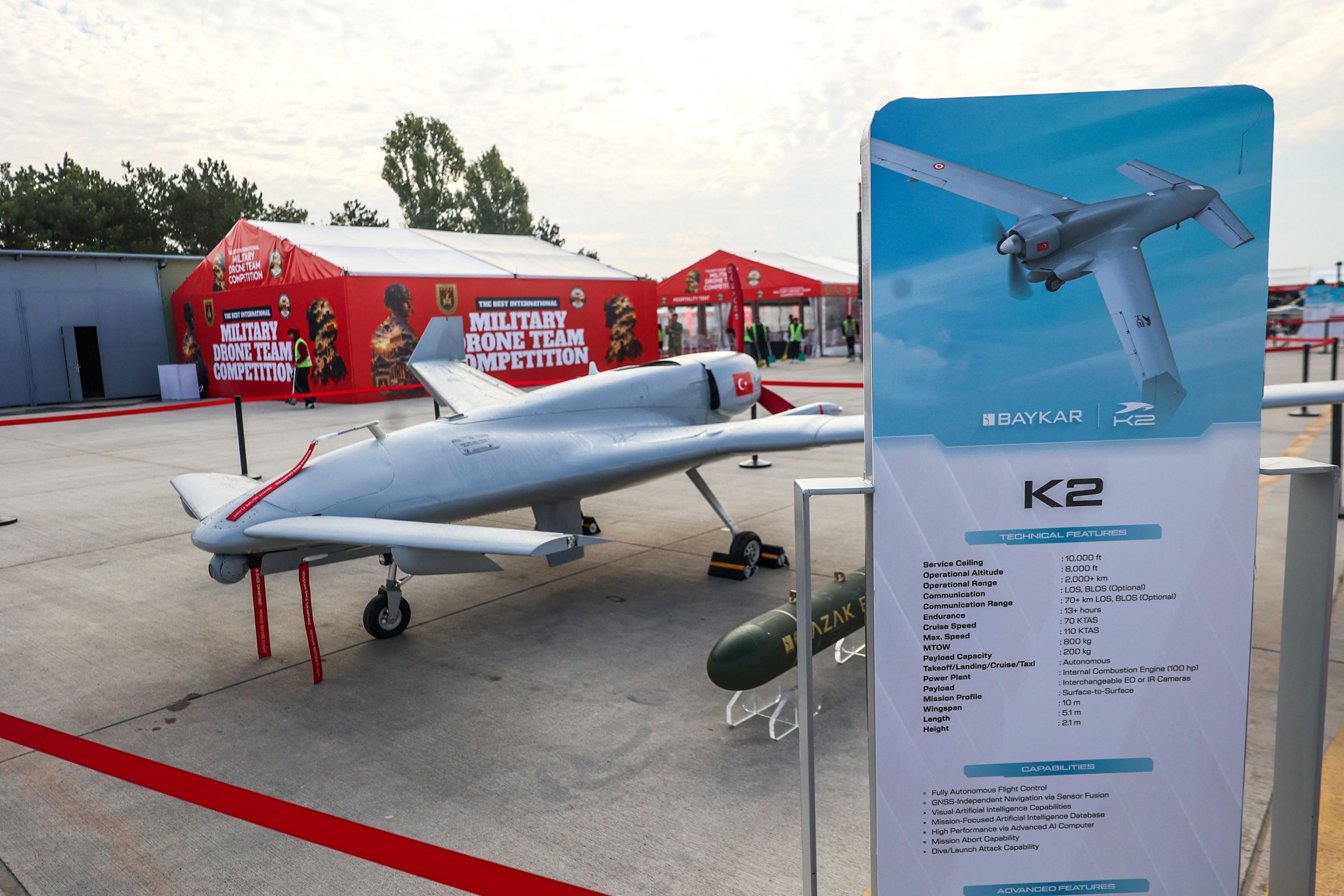
“We’ve made huge leaps in terms of in-house developed products,” said a Turkish industrialist who agreed to speak on condition of anonymity.
“We needed to develop different mechanisms for the war against PKK, in particular in surveillance,” he said, referring to the terrorist group.
“We could not get help from abroad and could not get it from fighter jets. So, we started to develop drones.”
‘Now supplier of choice’
For the past three years, Türkiye has seen orders pouring in, becoming the world’s 11th largest arms exporter, says Tarçın.
“Particularly notable has been its investment in and testing of advanced systems, including surface-to-air and air-to-surface missiles, drones, and the command networks that enable them to operate,” analyst Tom Barton with London-based intelligence firm Janes told AFP.
“Türkiye is now seen as a supplier of choice, competing with European and U.S. companies, especially for Middle Eastern and Asian customers.”
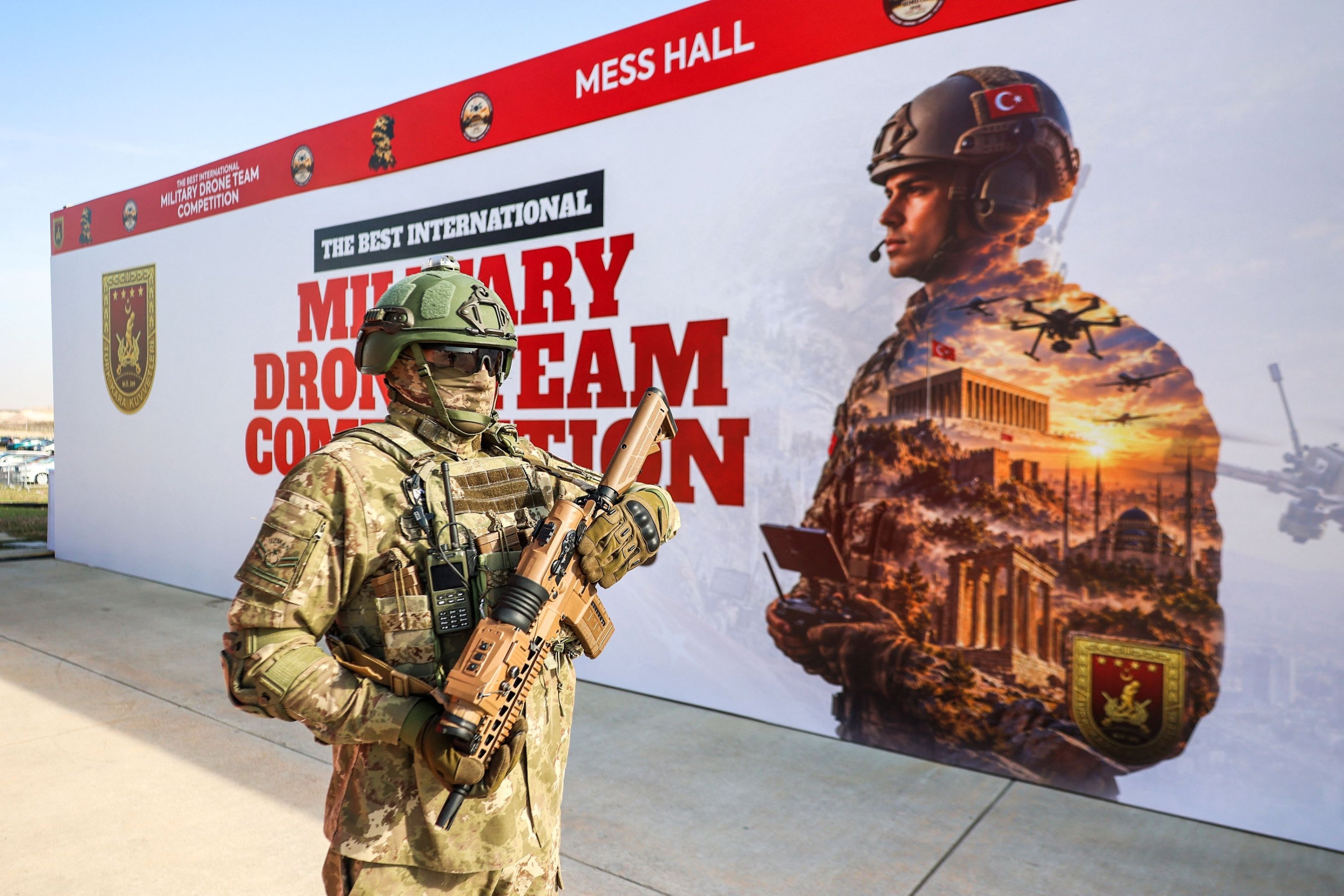
Aselsan just marked its 51st birthday by destroying a swarm of drones with its new high-power electromagnetic Ejderha system – “the world’s first system to successfully neutralize 51 drones with a single push of a button, without firing a missile or using any ammunition,” its CEO Ahmet Akyol said.
Türkiye’s new position is reflected in its hosting of a NATO summit this past July, and of NATO Edge this week, focusing on the alliance’s critical technology and digital weaponry.
For President Recep Tayyip Erdoğan, Türkiye’s independence is the cornerstone of his foreign policy, whether speaking with Washington, Kyiv, Moscow or Tehran.
Consumer confidence in Türkiye rebounded in November, rising 2.4% from the previous month as household expectations improved, official data showed Friday.
The consumer confidence index increased to 86.8 from 84.8 in October, according to figures released by the Turkish Statistical Institute (TurkStat).
The recovery followed a 7.7% decline in October to the lowest level in nine months.
The index also exceeded the 85.0 recorded in November 2025.
Households’ expectations for their financial situation over the next 12 months improved, with the corresponding sub-index rising 3.4% month-on-month.
The sub-index measuring expectations for the general economic situation over the same period increased 2.9%.
Meanwhile, assessments of households’ current financial situation edged up 0.04% from October.
Expectations for spending on durable goods over the next 12 months also improved, with the relevant indicator rising 2.5%.
The consumer confidence index is calculated through a monthly survey conducted jointly by TurkStat and the Central Bank of the Republic of Türkiye (CBRT).
The index measures consumers’ assessments of current economic conditions and their expectations for the near future.
It ranges from zero to 200, with readings below 100 indicating a pessimistic outlook.
Schengen diplomatic missions in Türkiye have established a dedicated working group to address persistent bottlenecks related to visa procedures for Turkish citizens, as Ankara called on the European Union to review the current practices, reports said Thursday.
The working group was formed following a meeting of the Local Schengen Cooperation (LSC) group in Ankara on Wednesday, public broadcaster TRT Haber and private outlet NTV said.
The meeting was attended by Turkish Foreign Ministry officials, representatives of Schengen countries, the EU Delegation to Türkiye and European Commission officials, the reports said.
The meeting, which regularly reviews Schengen visa procedures and related data, was held for the first time with the participation of both Turkish Foreign Ministry and European Commission representatives.
For years, Türkiye has criticized the EU’s visa system over appointment shortages, lengthy processing times and extensive documentation requirements.
During Wednesday’s talks, the Turkish delegation pointed to the high level of integration between Türkiye and the EU across multiple sectors and pressed for practical fixes, the reports said.
Its demands included making visa appointments more accessible, shortening application processing times, reducing the number of required documents and facilitating applications by travelers who have previously received Schengen visas.
Ankara also called for wider implementation of the EU’s visa cascade system, which allows eligible applicants to obtain multiple-entry visas with progressively longer validity periods.
Turkish truck drivers, trade access
Türkiye stressed the need to ensure uninterrupted access to the Schengen area for Turkish truck drivers to prevent disruptions to trade with the EU. It also called for solutions to restrictions on the length of their stays in the bloc.
Foreign Ministry officials said difficulties in securing appointments had contributed to the emergence of fraudulent consultancy firms offering to arrange visa applications and appointments, according to the reports.
They said joint operations had been conducted against such networks in cooperation with the justice, trade and interior ministries, with judicial proceedings initiated against numerous individuals.
The Turkish side also reported a significant decline over the past two years in visa difficulties faced by students admitted to universities in EU countries.
Officials said the Foreign Ministry had received only a limited number of individual complaints on the issue in 2026, adding that contacts with relevant authorities were continuing to resolve the remaining cases.
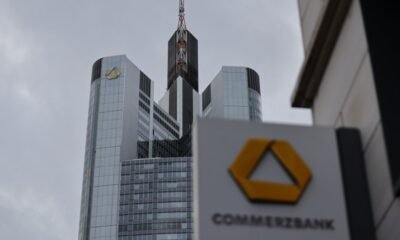
The German government has reached an agreement with Italy’s UniCredit on its planned takeover of Commerzbank, Finance Minister Lars Klingbeil announced Thursday, formally dropping its long-running opposition to the deal.
“The government now supports the swift continuation of proceedings and an orderly handover of control,” Klingbeil said.
The agreement removes a key hurdle for the takeover of Germany’s second-largest private bank.
UniCredit has pursued Commerzbank, valued at 41 billion euros ($45 billion), for two years in a bid to seal one of Europe’s most significant cross-border banking tie-ups.
Commerzbank and the German government initially resisted, but with UniCredit having built up a stake approaching 50%, their focus has now shifted to getting the best possible terms.
UniCredit has now obtained approval for its takeover plans from key authorities, including the European Commission, the U.S. Federal Reserve, and the European Central Bank’s banking supervisor.
Klingbeil said UniCredit had committed to measures addressing the government’s core concerns. This meant Commerzbank would remain a listed public limited company based in Frankfurt, expand its business with small and medium-sized companies, maintain an adequate capital base and take key decisions in Germany.
He further said UniCredit had made clear commitments on the bank’s presence in Germany and on the rights of Commerzbank staff. He said these were a good foundation for sustainable growth at Commerzbank.
However, he did not specifically address a pledge to avoid redundancies at Commerzbank, with employee representatives fearing thousands of job losses.
In July, Berlin had described UniCredit’s approach as “hostile” and rejected it as unacceptable.
What does agreement include?
UniCredit CEO Andrea Orcel said he welcomed Klingbeil’s support for his strategy for Commerzbank and for a swift process.
“Both create clarity and give the next phase new momentum – to the benefit of customers and employees of Commerzbank,” Orcel said.
Orcel wants to forge a European banking giant and sees potential for billions in savings from a merger. Commerzbank is expected to be merged with UniCredit’s Munich-based subsidiary HypoVereinsbank (HVB), through which the Italian bank has been operating in Germany for years.
The agreement also covers the transition on the Commerzbank supervisory board – an issue that had caused disagreement between UniCredit and Berlin.
Klingbeil said UniCredit would propose two independent members “who know both the German market and Commerzbank very well.” To date, the German government has two representatives on the supervisory board.
Orcel wants to request an extraordinary shareholders’ meeting in the first quarter of 2027 after taking control of Commerzbank. All 10 shareholder representatives are to be newly elected. Then the current board under Commerzbank chief executive Bettina Orlopp could be replaced.
Afterward, Orcel wants to implement his strategy, which includes cutting around 7,000 jobs and shrinking Commerzbank’s international network.
In a letter to Klingbeil, Orcel wrote that the commitments would lay the groundwork for the sale of the state’s stake in Commerzbank. The government holds just over 13%, after bailing out the DAX-listed group during the financial crisis.
UniCredit would “support” a government decision to sell its stake in Commerzbank, Orcel noted.
In his letter, the manager lists eight commitments.
After a merger with HVB, Frankfurt should become the headquarters, while maintaining “a significant presence” in Munich. Commerzbank and HVB should both be adequately represented on UniCredit’s board of directors.
The letter also commits to Commerzbank’s business with small and medium-sized companies and its international activities. Orcel had previously criticized Commerzbank’s international network as oversized.
UniCredit also pledges investments in Frankfurt, such as creating a competence and innovation center in Germany.
Berlin sees Orcel’s letter as an indication of a friendly takeover. The letter states that existing rules to protect Commerzbank employees should be taken into account. However, it does not guarantee that there will be no operational redundancies at Commerzbank, which has around 40,000 staff.
Klingbeil had insisted on several conditions after a meeting with Orcel in September. The Finance Ministry now considers these to be met.
The European Commission confirmed on Thursday that it was targeted by a cyberattack through the use of AI tools, although it said that it was difficult to judge the scale of the incident given that an inquiry was underway.
“I can confirm that the Commission has recently taken necessary steps in response to a detected cybercampaign,” European Commission spokesperson Thomas Regnier said at a press briefing.
“As a protective and preventive measure, we temporarily took down several applications and most of them have since been restored,” he added. “The investigation is still ongoing. We are taking any necessary steps, based on the findings as they come.”
“This was an AI-generated cybercampaign,” said Regnier.
The incident was detected on Oct. 22, and there was no evidence of any data breach affecting Commission staff as a whole, Regnier said.
He declined to say who the Commission thought was behind the attack, and said he was not aware of any ransom demand following the incident.
The attack on the Commission is the latest high-profile cyberattack, after hacks knocked out commercial refrigerators and freezers in hundreds of French supermarkets in October, ships bound for the United States in August, U.S. water treatment plants in July and the Los Angeles transit system in March.
Separately, an hours-long nationwide ground stop in the United States and outages to banking and Microsoft applications were blamed by tech experts on attempts to rapidly patch newly identified software vulnerabilities.
Politico reported earlier on Thursday that the Commission was targeted by a cyberattack which might have compromised large amounts of personal data, with several systems, including HR systems for payslips and time management and a system for medical reimbursements, taken offline during the 10-day disruption.
The Commission convened its highest-level internal crisis management body for an urgent meeting about the cyber incidents, and tech commissioner Henna Virkkunen briefed other commissioners on Wednesday, according to Politico.
Anthropic’s market value hit as high as $2.1 trillion in its Nasdaq debut on Thursday, soaring past SpaceX’s massive June launch as investors rushed to buy shares of the world’s first publicly traded frontier AI company.
The stock opened at $111.5, 34% higher than the IPO price of $83. It was last trading at $105.11.
The stellar debut caps a turbulent week for the AI sector, marked by Nvidia CEO Jensen Huang’s exit and shifts Wall Street’s spotlight onto its rival OpenAI as the industry’s next major public listing.
Strong demand for Anthropic shares amid a broader tech selloff offers hope to a sector where euphoria has somewhat cooled in recent weeks.
“I’ve looked at this whole week as a referendum on AI. Nvidia gave us a read on the buildout, and Anthropic is about to give us a read on investor appetite for the next generation of AI companies,” Jake Behan, head of capital markets at Direxion, said before the Anthropic debut.
AI technology has boosted economic growth, sparked doomsday warnings and arguably helped usher in a data-center-skeptic Democratic tsunami in the U.S. midterm elections.
Investors who once embraced the boom have turned skeptical in recent weeks over concerns that the enormous spending needed to build out the sector and the mounting debt loads may not be justified by the eventual returns.
Anthropic, too, has signaled it may tap debt markets.
“At some point in the future we’re hoping to be investment grade, and debt is an instrument that we have available to us, and we’d like to use at some point in the future,” CEO Dario Amodei told CNBC in an interview.
Industry benchmark
As the first frontier AI company to go public, Anthropic is poised to become the sector’s benchmark, with OpenAI reportedly eyeing a 2027 listing.
Anthropic sold 980 million shares at $83 each, pricing the IPO above its initial range of $70 to $78 set when it launched the road show. Its IPO proceeds could climb to as much as $93.5 billion if underwriters fully exercise their option to purchase additional shares.
Currently, the figure sits at over $107 billion, including the additional $26 billion raised through a private placement. AMD, Broadcom, Alphabet’s Google, Micron, Microsoft, Nvidia and TSMC were the investors in the private placement.
“Some of the demand may simply reflect investors not wanting to miss out on the rare opportunity to gain exposure to a leading AI company, even if its long-term profitability remains uncertain,” IPOX associate Lukas Muehlbauer said.
London-based index rebalance analytics firm Intropic estimates passive demand from index-tracking funds will account for the purchase of up to 30% of Anthropic’s shares offered by the end of the year.
Anthropic also joins the trillion-dollar club stacked with behemoths such as Microsoft, Apple and Nvidia.
The blockbuster deal is going to earn the underwriters, led by Goldman Sachs and Morgan Stanley, a $550 million fee, a regulatory filing showed.
Big payday for co-founders
Although shares can be volatile in the days following a listing, Anthropic’s IPO is set to create thousands of paper millionaires and a handful of billionaires.
Based on the IPO price, CEO Amodei and his six co-founders, who together own about 10% of the company, had stakes valued at nearly $150 billion combined, according to a Reuters calculation based on details in the filing.
More broadly, the listing is expected to create a wave of new wealth across the AI sector, rewarding everyone from early researchers and engineers to administrative staff.
Justifying price tag
Debate has intensified across global markets in recent months over whether the AI boom is veering into bubble territory, with economists, CEOs and political leaders split over its sustainability.
Much of the scrutiny has focused on circular financing arrangements. A complicated web of deals between AI companies, chipmakers, cloud providers and investors has raised questions over how much of the industry’s growth is being fueled by money circulating within the same ecosystem.
Anthropic’s breakneck growth has so far defied these concerns, but some investors have said they may wait for the initial euphoria to subside before buying.
“Anthropic is a one-trick pony. People compare it with Amazon because even Amazon lost money for several years, but Anthropic won’t have that luxury,” said Bill Gunderson, partner at GCG Advisory Partners.
“They’ve got to get to profitability soon.”
Anthropic has nearly $900 billion in computing commitments with partners including Amazon and Alphabet’s Google, underscoring how its rapid growth hinges on securing vast amounts of future computing capacity, some of which relies on financing beyond the company’s control.
Investors will be watching Anthropic’s debut and subsequent trading closely, with analysts expecting the stock to emerge as a proxy for the broader AI trade.
The company will also need to balance growth with calls to slow the development of advanced AI models. Anthropic warned in its IPO prospectus that AI could behave unpredictably and advance faster than oversight mechanisms.


-
 Politics2 days ago
Turkish VP to meet Uzbek leaders during 2-day visit to Tashkent
-

 Sports3 days ago
Türkiye relegated to Nations League B after Greece defeat Serbia
-
 Politics24 hours ago
Türkiye’s Parliament to set rules for terror-free commission
-
 Economy2 days ago
Most investors in troubled funds received interim payments: Erdoğan
-
 Politics3 days ago
Türkiye entering historic new era led by youth, Erdoğan says
-

 Politics1 day ago
Türkiye uncovers FETÖ aid network, traces $531,000 in crypto transfers
-
 Economy3 days ago
Iraq resumes oil pumping for export purposes via pipeline to Türkiye
-
 Economy15 hours ago
Germany, UniCredit reach agreement on Commerzbank takeover