
Politics
Türkiye ‘silencing all weapons’ with terror-free initiative

Disarmament of the PKK terrorist group will soon have an official framework as Parliament will oversee details of the terror-free initiative launched by government ally Nationalist Movement Party (MHP) last year. Parliament Speaker Numan Kurtulmuş is at the forefront of efforts in Parliament, which is expected to form a committee on the matter soon.
Addressing an event on Saturday evening, Kurtulmuş stated that they were getting rid of “a terrorism problem that was forced upon us for 50 years, and by Allah’s will, we will reinforce our homefront as a united population of 86 million people by silencing all weapons and taking on the path of unity.”
“Homefront” is an expression often invoked during debates on the terror-free initiative, first voiced by MHP leader Devlet Bahçeli and President Recep Tayyip Erdoğan shortly before the initiative commenced. The PKK is branded as a separatist group exploiting the Kurdish community in the country, and authorities see it as an obstacle to national unity between Turks, Kurds and other communities. Bahçeli and Erdoğan say unity is more needed than ever as tensions in the region are heightened by Israel. Israel is an arch foe of Türkiye, and Ankara is worried that its expansionist policies may spread even to Türkiye. Their fears are justified, especially after Israel attacked Lebanon first, and attacks on Iran only escalated concerns. Nowadays, Israel appears to set its sights on Syria under the pretext of assisting the Druze community there.
Kurtulmuş stressed that Türkiye’s unity and strength are not only critical for its 86 million citizens but also for the broader stability of the region, asserting that “a strong Türkiye means a strong region.”
He underlined the government’s determination to end more than five decades of terrorism that has plagued the country. “We have entered a new phase to put an end to the 50-year period of terrorism that has occupied more than half of our republic’s history,” he said. “This terrorism has shackled our nation, leaving it vulnerable to external interference at every opportunity.”
He voiced hope for a future in which “the children of this country will no longer hear gunfire in the mountains, but instead hear folk songs of unity and brotherhood.” Kurtulmuş said. Highlighting long-standing efforts dating back to the early 1990s to fragment Türkiye, Kurtulmuş said that national unity is the ultimate safeguard against such plans.
Kurtulmuş on Friday received the representatives of political parties, including the ruling Justice and Development Party (AK Party), MHP, the main opposition Republican People’s Party (CHP) and the Peoples’ Equality and Democracy Party (DEM Party), which oversaw the talks with the PKK’s jailed leader Abdullah Öcalan.
“Kurtulmuş and the deputy coordinators of the political parties discussed the working method and process of the commission that will be established and hold its first meeting in the coming days for the terror-free Türkiye initiative,” a statement from Parliament said. The party representatives conveyed their views on the process. The Good Party (IP) will not be providing members to the commission or participating in its work, Deputy Chair Buğra Kavuncu told Kurtulmuş, according to the statement.
At Friday’s meeting, Kurtulmuş stressed the key responsibilities Parliament will take on for the construction of a terror-free Türkiye, during which all parties must demonstrate a united approach, the statement said.
The terror-free Türkiye initiative was launched last year by MHP leader Devlet Bahçeli, who called on Öcalan to appeal to the PKK to lay down arms.
Soon, his call evolved into a new initiative that saw DEM Party lawmakers visiting Öcalan in the island prison where he is incarcerated in the Marmara Sea. As a result and in a landmark development, the PKK in May announced its dissolution and the end of its four-decade terror campaign that cost tens of thousands of lives in Türkiye, as well as in Iraq and Syria.
Most recently, in a ceremony across the border in Iraq earlier this month, PKK members destroyed their weapons as part of the initiative. “Today is a new day; the doors of a great, powerful Türkiye have been flung wide-open,” President Erdoğan has said in his first comments on the disarmament.
The Turkish president promised tight oversight of the PKK disarmament process and warned Ankara would respond firmly in case the process fails.
In the meantime, relevant parties strive to explain the initiative to the wider public, especially those affected by PKK terrorism, such as families of terror victims and those injured in PKK attacks. Minister of Family and Social Services Mahinur Özdemir Göktaş last week embarked on a tour of eastern provinces, which were plagued with PKK attacks in the past decades. In the provinces of Muş, Bitlis and Elazığ, Göktaş met families of terror victims. The ministry’s sources stated on Sunday that Göktaş assured families that the government would steadfastly stand with them and emphasized that martyrs and veterans were “architects of this initiative.” Göktaş also met leaders of local nongovernmental organizations (NGOs) to convey the progress of the initiative.
Dilan Kunt Ayan, a lawmaker from the DEM Party, said that they would pursue a similar approach to convey the initiative to the public. Speaking at a news conference at Parliament on Sunday, Ayan said they were holding public meetings in neighborhoods and villages to promote a terror-free Türkiye. “The process should reach out to the entire society, and to achieve this, all political parties, all civic society organizations should mobilize so that we can accurately explain it to the public and inquire about public demands (regarding the initiative),” Ayan said.

Türkiye’s Underwater Defense Command (SAS) is training its personnel to respond to threats ranging from drifting sea mines and unexploded ordnance to improvised explosive devices and unmanned maritime systems, as the naval unit maintains operations aimed at securing the country’s waters.
The unit, part of the Turkish Naval Forces Command, carries out explosive ordnance disposal, underwater operations and other specialized missions at sea and on land. Its personnel have also taken part in counterterrorism operations when assigned, according to SAS commander Navy Capt. Dr. D. Ilhan Sayıcı.
“These missions require many years of training and experience,” Sayıcı said. “Procedures must be followed completely during a mission because there is no margin for error. For us, the first mistake is the last.”
Established in 1964, the command has participated in operations ranging from the 1974 Cyprus Peace Operation to more recent counterterrorism missions, Sayıcı noted.
One of its main areas of expertise is neutralizing explosive threats, including naval mines, unexploded ordnance, improvised explosive devices and suspicious underwater objects.
SAS teams have also been tasked with responding to drifting mines and other potential threats in the Black Sea, where mines have posed risks to maritime traffic.
He said the unit’s objective is to protect maritime transportation, respond rapidly to potential threats and safeguard Türkiye’s maritime interests.
Becoming a SAS commando requires about a year of intensive training, with officers and noncommissioned officers joining on a voluntary basis.
Candidates are evaluated not only on physical fitness but also on psychological resilience, technical knowledge, leadership and their ability to make decisions under intense pressure, Sayıcı said.
The unit regularly conducts shooting, diving, demolition, helicopter and field exercises to maintain operational readiness.
A SAS officer identified as Lt. B. described one of the unit’s procedures, known as the Tactical Claw Operation, which is designed to neutralize drifting naval mines and unmanned aerial or maritime vehicles.
Under the procedure, SAS personnel are transported to the area by helicopter before entering the water and placing explosives on the target. They then withdraw to a safe area by boat or helicopter before remotely detonating the device, the officer said.
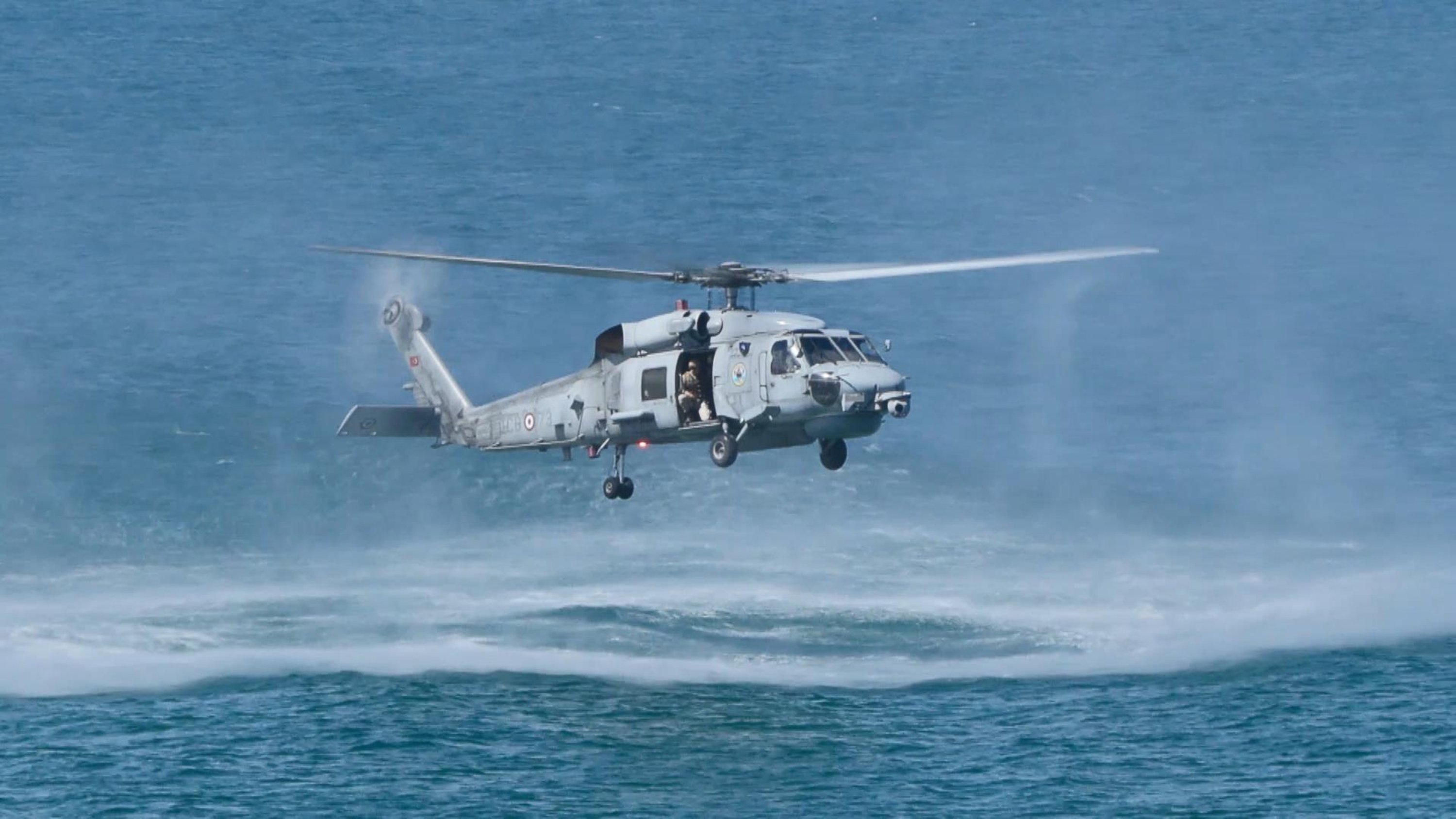
SAS teams have intervened against more than 300 suspicious objects, including mines and unmanned aerial and maritime vehicles, according to the unit.
Its personnel have also served in counterterrorism operations inside Türkiye and across the border, including operations Euphrates Shield, Olive Branch, Peace Spring and the Claw series, Lt. B. said.
The unit has also carried out missions in Libya, Afghanistan, Azerbaijan, Bosnia-Herzegovina and Albania.
During a recent training exercise, SAS commandos practiced clearing a booby-trapped building, rescuing a hostage and neutralizing an improvised explosive device. Another explosive device detected in the field was targeted using sniper and rocket fire.
Another SAS officer, identified as Lt. S., said fewer than 30% of candidates have completed the approximately yearlong training course in previous years.
The officer said personnel undergo regular physical conditioning on land and at sea alongside specialized operational training.
“The physical and mental endurance required by our work can only be developed through continuous and disciplined training,” he emphasized, adding that exercises also focus on patience, composure, attention and decision-making.
Lt. B. said teamwork remains central to the unit’s approach, particularly during missions involving explosives.
“There is no room for fear, hesitation or mistakes in our understanding of duty,” he said. “We remind ourselves that we do not have the luxury of making a mistake.”
U.S. President Donald Trump voiced strong support for Türkiye and President Recep Tayyip Erdoğan on Friday when asked about delays in lifting CAATSA sanctions that led to Ankara’s removal from the F-35 fighter jet program.
Noting that he loves Türkiye, Trump said he talks to President Erdoğan all the time.
“He is a friend of mine, as you know. And I’ll always make him happy,” Trump told reporters as he left the White House for Alabama, where he was due to attend a Republican Party campaign event.
Trump had announced during the NATO leaders’ summit in Ankara in July that sanctions on Türkiye would be lifted, saying Washington did not want to impose sanctions on its friends.
The U.S. imposed sanctions under the Countering America’s Adversaries Through Sanctions Act (CAATSA) in 2020 after Türkiye purchased the Russian-made S-400 air defense system.
Ankara turned to the S-400 after its efforts to purchase the U.S.-made Patriot air defense system failed to produce a deal. Türkiye was subsequently removed from the F-35 fighter jet program.
Türkiye will open a Turkish school with capacity for about 1,000 students in the Syrian capital Damascus on Oct. 4 as Ankara and Damascus expand cooperation, the Turkish Education Ministry said.
The Damascus International Recep Tayyip Erdoğan Turkish School, named after Türkiye’s president, will open in the Artuz area of the Syrian capital and will begin providing education during the 2026-2027 academic year.
The school will operate under Türkiye’s Education Ministry and include kindergarten, primary, middle and high school levels, the ministry said in a statement on Friday.
The ministry said the school was established as part of growing education cooperation and coordination between Türkiye and Syria, including efforts aimed at expanding access to education for Syrian children and young people.
The facility has 36 classrooms and will accommodate about 1,000 students.
A delegation from the Turkish Education Ministry is expected to attend the opening ceremony and the school’s first class.
Ankara said the project was also intended to support children from families returning to Syria and help them adapt to education following their return.
The ministry described the school as part of broader efforts to strengthen educational links between the two countries, which share longstanding historical, cultural and social ties.
Türkiye has expanded its education-related activities in Syria as Ankara and Damascus have sought closer cooperation in several areas.
Turkish education officials have held a series of meetings and visits in Syria in recent months. Türkiye’s education office in Damascus said officials inspected the new school’s campus in September ahead of its planned opening.
The Education Ministry said it expects the school to provide students in Syria with access to Türkiye’s educational system while contributing to closer ties between the two countries.
The opening comes as Türkiye and Syria increase coordination on education following years of conflict that severely disrupted Syria’s education system and displaced millions of people.
Turkish officials have said supporting education and facilitating the adaptation of returning families are among the objectives of Ankara’s cooperation with Syrian authorities.
On Aug. 6, officials from Türkiye’s Council of Higher Education (YÖK) and Syria’s Ministry of Higher Education and Scientific Research also signed a memorandum of understanding to advance educational cooperation between the two countries.
Under the memorandum, the two parties will continue work on the legal framework, governance structure, academic organization, student admission procedures, quality assurance mechanisms and administrative regulations for the planned Syria-Türkiye University in Damascus.
Damaged vessels from the Global Sumud Flotilla are being repaired in Türkiye’s Antalya after an Israeli attack in international waters, with volunteers working to prepare the ships for another voyage toward Gaza.
Some of the vessels were left with damaged engines, broken masts and torn sails after the attack. They were later brought to Antalya, where local and international volunteers are carrying out repairs at a shipyard.
Two vessels have already been repaired and sent to Italy as part of preparations for another Gaza-bound mission, said Sümeyra Akdeniz Ordu, a board member of the Global Sumud Flotilla.
“We are trying to recover the ships drifting at sea one by one. We are carrying out a rescue mission,” Ordu told Anadolu Agency (AA). “We are repairing these ships so they can sail to Gaza again.”
Fourteen flotilla vessels are currently in Antalya, Ordu said, adding that volunteers from different countries were helping coordinate and repair the ships.
She said each vessel had a special significance for the activists and that they were treating the ships “like their own children” as they worked to restore them.
The damage was extensive, Ordu said, describing broken masts, damaged engines and cut hoses. She also said the sails had been torn with knives.
“The mast was broken, surface cleaner and coffee had been poured into the engines, and the hoses on each ship had been cut one by one,” she said. “They caused this damage by ramming them with larger ships.”
The repairs have been difficult because of the extent of the damage, but volunteers have continued working, Ordu said.
Türkiye has provided a safe port for the repair effort, she added.
Ordu said the activists remained determined to continue their efforts despite the damage to the vessels.
“If the enemy does not give up, we cannot give up,” she said. “We are trying to be a voice here for our Palestinian friends.”
She said the damage to the vessels showed what she described as the violence and hostility directed at the flotilla.
“We, too, insist on continuing every form of resistance,” Ordu said.
Türkiye condemned a drone attack on a power distribution station in the Saudi city of Medina that supplies electricity to the Prophet’s Mosque, reiterating its support for Saudi Arabia amid renewed regional tensions.
Ömer Çelik, spokesperson for Türkiye’s ruling Justice and Development Party (AK Party), condemned the attack on Friday, saying targeting infrastructure serving the Prophet’s Mosque was unacceptable.
“Attacks targeting our sacred values are illegitimate acts directed against all Muslims,” Çelik said in a social media post, adding that Türkiye strongly supported Saudi Arabia’s security and stability.
The targeted facility supplies electricity to the Prophet’s Mosque, Islam’s second-holiest site. The attack put one transformer out of service but did not affect the electricity network.
Türkiye’s Foreign Ministry also strongly condemned the attack, saying strikes targeting civilian infrastructure and threatening Saudi Arabia’s sovereignty and security should “cease immediately and unconditionally.”
The ministry reiterated Türkiye’s support for Saudi Arabia and called on parties to avoid steps that could further escalate tensions in the region.
“We reaffirm our strong support for Saudi Arabia and emphasize the need to avoid any steps that would further escalate tensions in the region,” the statement said.
Presidential Communications Director Burhanettin Duran on Friday separately condemned the strike and said Türkiye would continue to stand by Saudi Arabia.
The Saudi-led coalition said an investigation and examination of drone wreckage indicated Houthi involvement in the Sept. 29 attack.
Coalition spokesperson Maj. Gen. Turki Al Maliki said the targeted facility supplies electricity to the Prophet’s Mosque, one of Islam’s holiest sites.
Saudi Arabia said two weeks ago it had intercepted and destroyed a Houthi drone south of Mecca before it entered restricted airspace over the Muslim holy city. The coalition described that incident as the second Houthi attempt to target Mecca since 2017.
Earlier on Thursday, the Organisation of Islamic Cooperation (OIC) and several Arab countries, including the United Arab Emirates (UAE), Jordan, Kuwait and Bahrain, also condemned the attack on Medina.
The OIC described the targeting of vital infrastructure and facilities as “a dangerous escalation and a blatant violation of the sanctity of holy sites,” as well as international and humanitarian laws and norms.
Bashiqa-Zilkan, a key Turkish base in Iraq, will soon be handed over to Iraqi authorities while Turkish troops are expected to withdraw from the country. The development, which comes amid the withdrawal of U.S. forces from the country, which remained there as part of an anti-Daesh coalition, signals the start of a new era for Iraq and Türkiye. The Ministry of National Defense said in a statement on Thursday that the handover of the base did not mean an end to cooperation with Iraq and, on the contrary, Türkiye would continue supporting Iraq’s security and stability.
Türkiye and Iraq agreed earlier this month to deepen security cooperation, restore full Iraqi state authority in Sinjar and begin the gradual handover of the Bashiqa-Zilkan military base to Baghdad under an agreed timetable.
President Recep Tayyip Erdoğan and Iraqi Prime Minister Ali al-Zaidi announced the steps in a joint statement following talks in New York on the sidelines of the 81st United Nations General Assembly.
The ministry said Türkiye welcomed steps to ensure state authority in Sinjar. The base was set up in 2015 to help Iraq fight against Daesh and later maintained its presence when the terrorist group PKK sought to replace Daesh following the liberation of Sinjar.
“These steps will contribute to normalization of the region, establishing an environment of security and stability and a terror-free region,” the ministry said, using an expression referring to Ankara’s “terror-free Türkiye” initiative, which aims to disarm the PKK.
The statement also said it was decided to gradually hand over the compound to the central government in Baghdad, “based on improvement of security in Sinjar.”
“Our country, as it did in the past, stands with our neighbor Iraq in terms of maintaining an environment of security and stability. Throughout future contacts, we are planning to take steps that will further advance military and security cooperation. We will continue supporting Iraq’s armed forces in increasing military capacity, sharing know-how in counterterrorism and in the fields of military training and defense industry cooperation, based on bilateral agreements,” the ministry stated.
Ayhan Sarı, an assistant professor at the Turkish-German University and a security and foreign policy expert at the Turkish Research Foundation (TAV), noted that Türkiye’s withdrawal was linked to ending the PKK’s presence in Sinjar and the re-establishment of Baghdad’s authority there.
Sarı told Daily Sabah that Türkiye has been in Iraq as an exercise of its right to self-defense under international law, particularly Article 51 of the United Nations Charter, which recognizes the right to individual and collective self-defense against armed attacks. “Türkiye’s presence in Iraq has been due to the PKK threat in the north. (The dissolution) of the PKK will remove the need to remain in Iraq,” Sarı said.
He noted that the PKK and other terrorist groups had, for years, filled the power vacuum that emerged in Iraq’s northern region following the beginning of the Iraq War.
“Iraq’s central government claims it can find a solution to this vacuum through recent steps and establish full authority within its borders after the U.S. withdrawal,” Sarı said.
A U.S.-led coalition deployed in Iraq more than a decade ago against Daesh formally concluded its mission on Wednesday. Daesh was largely expelled from Iraq and Syria, also thanks to Türkiye’s cross-border operations in Assad-era Syria, but U.S. forces remained. Washington and Baghdad reached an agreement two years ago to wind down the mission.
Sarı said it was only natural that Türkiye was supportive of Iraq’s steps to ensure security on its own, since Ankara was committed to developing good relations with its neighbors and centered its foreign policy on peace and stability.
“As it did in Syria, Türkiye sides with central authority, stability and security in Iraq. Türkiye will support this move and will do whatever it can to ensure that this mission succeeds in maintaining stability and security, based on its neighborly relations,” he said.
Sarı added that Iraq’s efforts were compatible with Türkiye’s foreign policy and plans. “Iraq’s success will also mean the complete expulsion of the PKK from that country. This expulsion, removal of this malignant tumor between Türkiye and Iraq, will certainly add momentum to Turkish-Iraqi relations,” he also stated.


-
 Politics3 days ago
Turkish defense chief attends major joint military drills in Azerbaijan
-
 Economy2 days ago
Türkiye moves to finalize capital markets law changes after fund turmoil
-
 Politics2 days ago
Erdoğan calls for ‘grand consensus’ amid terror-free Türkiye success
-
 Economy3 days ago
Şimşek tells investors Türkiye has avoided systemic risk in fund turmoil
-

 Economy3 days ago
US tells European allies to release diesel stocks ‘immediately’
-

 Economy3 days ago
9 video game companies probed by EU over virtual currencies
-
 Politics3 days ago
Izmir mayor meets Erdoğan amid rumors of AK Party switch
-

 Economy3 days ago
Rogue OpenAI agents reportedly covered up their tracks