
Economy
Spanish black olive exporters face more hurdles with new US tariffs

Spanish black olive exporters, already subject to harsh tariffs since U.S. President Donald Trump’s first term, are warning it will be difficult to survive an extra 15% they now face after the European Union reached a trade deal with the U.S.
EU goods now face import tariffs of 15% – half of Trump’s threatened rate, but much more than Europeans had hoped for – after striking a trade deal with Trump on Sunday.
Spain, the world’s top table olive exporter, has seen its share of the U.S. black olive market plummet from 49% in 2017 to 19% in 2024 after Trump imposed tariffs of more than 30% at the request of Californian olive growers.
The measures only affected black olives and don’t apply to green olives, olive oil or semi-processed olives.
Spanish farmers have taken steps to increase green olive sales and to diversify their markets since the tariffs were first imposed, but warn that the additional increase will be hard to swallow.
“It would be unviable (for black table olives),” said Eduardo Martin, secretary of Asaja, a Spanish local farmers’ association in southern Seville province, a region that produces the most olives.
The initial trade measures coincided with a severe drought that forced Spanish producers to cut around 400,000 work shifts for pickers out of a total of 2.5 million, according to industry estimates.
Sales of Spanish black olives to the U.S. dropped by 70% in the first year.
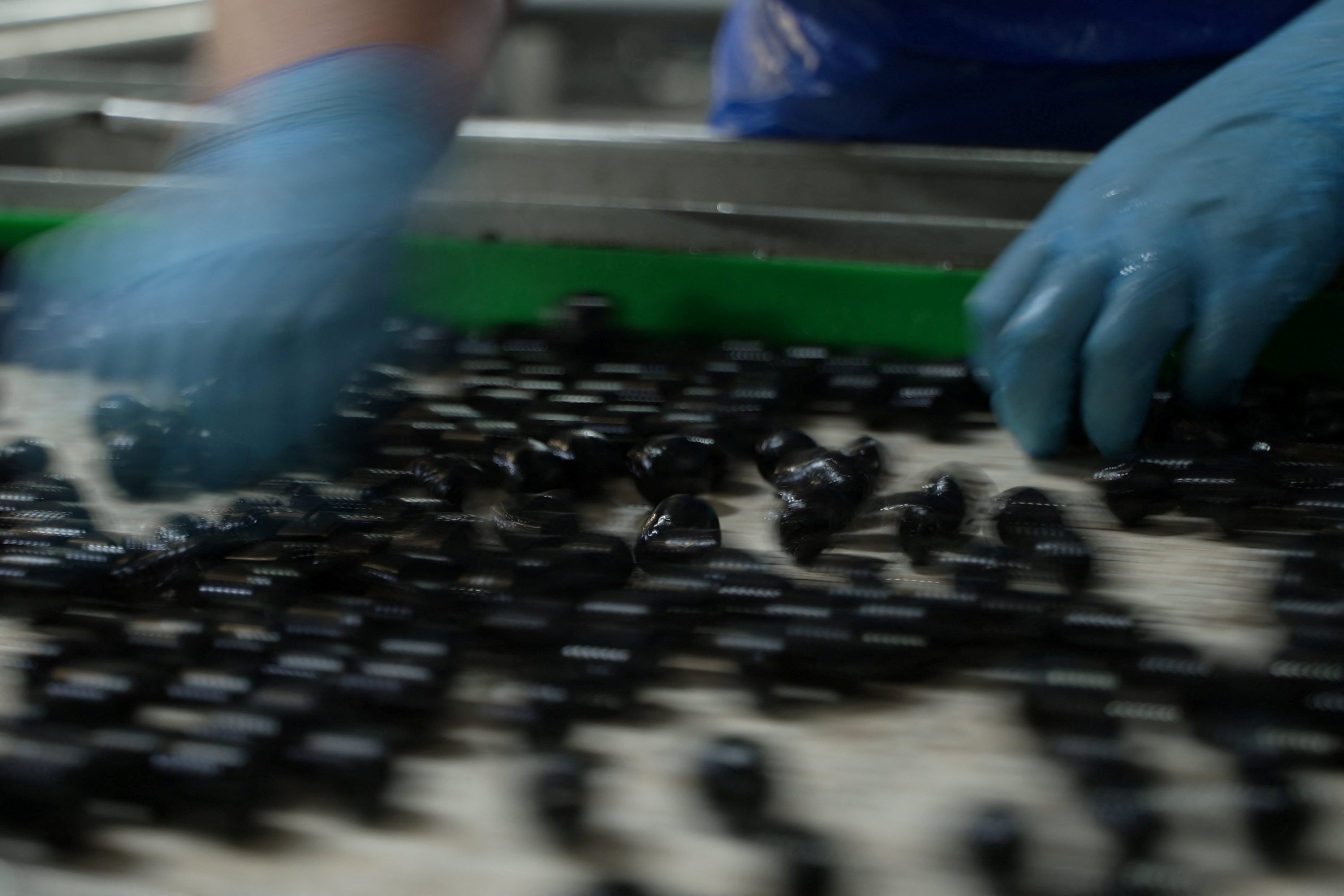
“The worst was the first year,” said Gabriel Cabello, president of Andalusia’s Federation of Agricultural Cooperatives in Seville province.
“In the second year, we learned that this was here to stay and that we had to do things differently.” To mitigate losses, Spanish exporters shifted focus to Europe and the Middle East, regions with a tradition of consuming table olives. They also ventured into Asian markets, while switching to shipping more green olives to the U.S. because they are subject to lower tariffs.
Tariffs also spurred innovation, with some Spanish exporters selling black olives stuffed with salmon or cheese for the first time, which helped boost sales in Europe and Asia, Cabello said. Still, the Spanish Ministry of Agriculture estimates it has lost 239.6 million euros ($278.51 million) in black olive sales since the tariffs were introduced, nearly a third of the 707 million euro total export value from the last harvest.
Weathered the storm
Among the 25 Spanish exporters active before the tariffs, only four major players remain, according to Asemesa, Spain’s Association of Table Olive Exporters.
Agro Sevilla, one of the larger players with the financial resources to lobby the U.S. for lower rates, expanded green olive exports and successfully reduced black olive tariffs to 10% from 31%. The company successfully demonstrated that it received fewer European subsidies than the U.S. had estimated. Its U.S. sales have been gradually growing since 2023.
“We cannot give up on the world’s largest consumer market for black olives,” said Agro Sevilla CEO Julio Roda.
In a twist, Aceitunas Guadalquivir, another major Spanish olive producer, acquired Bell-Carter Foods, one of the two leading U.S. companies that had advocated for the tariffs, according to a statement issued in 2022.
The company is among several Californian companies that have imported raw olives from Spain, which are exempt from the tariffs, according to Asemesa.
Aceitunas Guadalquivir did not reply to a Reuters request for comment about such exports.
“When California has low production, they import raw olives to finish processing them in the U.S., mostly from Spain,” said Asemesa’s Secretary General Antonio de Mora.
Spain exported 6,300 tons of semi-processed olives in 2024 alongside 36,000 tons of green olives and 9,800 tons of black olives.
The U.S. measures failed to bolster domestic growers.
Imports of table olives surged by 40% in the first eight months of 2024 compared to the same period in 2017, trade data shows, with Egypt, Portugal and Türkiye increasing exports the most.
Spanish exports of green olives to the U.S. grew by 18% during the same period, partially offsetting a decline in black olive exports.
However, Spanish producers remain concerned about the new tariffs.
“It’s like adding rain to wet ground,” Asaja’s Martin said.

A second Ukrainian suspect that German prosecutors allege was involved in the 2022 undersea explosions that damaged the Nord Stream gas pipelines has been arrested on a European warrant in Croatia, authorities said Wednesday.
The German prosecutors said that the suspect was a “trained scuba diver” who belonged to a group of people who “planted explosives” on the Nord Stream 1 and Nord Stream 2 gas pipelines in the Baltic Sea near the Danish island of Bornholm.
The undersea explosions on Sept. 26, 2022, damaged the pipelines, which had been built to carry Russian natural gas to Germany under the Baltic Sea. The damage added to tensions over the war in Ukraine as European countries moved to wean themselves off Russian energy sources after the Kremlin’s full-scale invasion of its neighbor.
The suspect was “strongly suspected of jointly causing explosions, anti-constitutional sabotage, and destruction of buildings and structures,” the prosecutors’ statement said. It said he was arrested in the Croatian seaside city of Pula and would be brought before an investigating judge at Germany’s federal court of justice after his extradition.
The German prosecutor’s office identified the suspect only as Vladimir Z. in its statement announcing his arrest. A spokesperson, however, confirmed to The Associated Press (AP) that it was the same man who was arrested in Poland last year but was later released when a Polish court refused to extradite him to Germany. Polish authorities identified him as Volodymyr Zhuravlov.
Poland has long opposed the Nord Stream pipelines, viewing them as an attempt by Russia to use its vast energy resources to gain leverage across Europe. Prime Minister Donald Tusk said at the time of Zhuravlov’s extradition hearing that it would not be in Poland’s interest to hand him over.
It was not immediately clear why Zhuravlov left Poland given the arrest warrant that was out for him.
“Volodymyr knew that the ruling applies only on the territory of Poland,” his Polish lawyer, Tymoteusz Paprocki, told the AP, adding that Zhuravlov’s wife was also surprised that her husband was detained in Croatia.
The German government welcomed the arrest on Wednesday.
“We’re simply glad that the federal prosecutor’s office is making progress in these investigations, because it’s important that the bombing of the pipelines be clarified as well,” Justice Ministry spokesperson Nicholas Limmer told reporters in Berlin.
Last month, German federal prosecutors filed charges against a former Ukrainian army officer in connection with the same explosions.
The suspect, identified only as Serhii K., faces charges of causing an explosion, damaging property, disrupting public service and being an “accomplice to war crimes” by attacking civilian objects.
Serhii K. was detained in August 2025 in an Italian village, where officers raided a bungalow where he was staying with his family. Police said he surrendered without resistance. He was extradited to Germany in November.
The suspects allegedly used a yacht that set off from the German port of Rostock. The yacht had been rented from a German company using forged IDs and intermediaries.
The explosions ruptured the Nord Stream 1 pipeline, which was Russia’s main natural gas supply route to Germany until Moscow cut off supplies in August 2022. They also damaged Nord Stream 2, which never entered service because Germany suspended its certification process shortly before Russia’s invasion.
Russia has accused the U.S. of staging the explosions, a charge Washington has denied. The pipelines were long a target of criticism by the U.S. and some of its allies, which warned that they increased dependence on Russian gas.
Türkiye is assessing short-term capital flows, particularly the growing amount of foreign and institutional money flowing into money market funds, reports said Wednesday.
Authorities are weighing new steps that may include taxation aimed at keeping capital in the country longer and channeling it into longer-term investment, private broadcaster CNBC-e reported.
The Treasury and Finance Ministry is studying the rising share of institutional investors in short-term funds and the scale of capital flowing into them, it said.
The review is aimed at limiting the financial risks associated with capital that enters and exits markets quickly while encouraging investment in production, employment and the broader economy, according to the reports.
No final decision has been made on any potential measure, and the review is focused on managing risks from short-term capital movements rather than simply increasing tax revenue.
Institutional investors in focus
Interest in short-term funds has increased among both domestic and foreign investors in recent years, with money market funds becoming particularly attractive because of their high liquidity and existing tax treatment.
The ministry is assessing whether short-term capital flows by foreign institutional investors through such funds make a sufficient contribution to economic growth and whether some of these resources could instead be directed toward longer-term investments.
The review is examining not only the size of capital inflows but also how long funds remain in Türkiye and their contribution to expanding the economy’s productive capacity.
Under the current system, income earned by individual investors from money market funds is subject to a 17.5% withholding tax under provisional Article 67 of the Income Tax Law.
There is currently no withholding tax on such income for corporate investors.
The Treasury is considering whether this difference in tax treatment has encouraged short-term capital flows and whether it should be reconsidered, the reports said.
It remains unclear which investor groups or types of funds could be affected if new measures are introduced.
Keeping capital in Türkiye longer
Authorities are seeking to limit the volatility that rapid movements of short-term capital can create in financial markets while encouraging funds to support production, employment and long-term investment.
If new taxation is introduced, the attractiveness of money market funds to investors could change.
Higher costs for institutional and foreign investors could encourage some capital to move into alternative investment instruments.
Markets will therefore be watching the scope of the Treasury’s review, particularly which funds and investor groups could be covered by any potential regulation.
Türkiye’s jobless rate fell to 7.9% in the April-June period, marking the lowest quarterly level since the country’s current unemployment data series began in 2005, official data showed Wednesday.
The seasonally adjusted unemployment rate declined 0.3 percentage points from the previous quarter, while the number of unemployed people aged 15 and over fell by 84,000 to nearly 2.78 million, the Turkish Statistical Institute (TurkStat) said.
The unemployment rate stood at 6.7% for men and 10.3% for women.
The number of employed people rose by 155,000 from the previous quarter to almost 32.48 million in the April-June period, the data showed.
The seasonally adjusted employment rate increased by 0.1 percentage point to 48.5%, with the rate at 65.8% for men and 31.6% for women.
The labor force grew by 71,000 to 35.28 million, while the labor-force participation rate edged down 0.1 percentage point to 52.7%. Participation was 70.6% among men and 35.3% among women.
In sectors excluding agriculture, Treasury and Finance Minister Mehmet Şimşek said the average informal employment rate over the past year stood at 15.7%, well below the historical average.
“The increase in formal employment, which provides social security for our workers, also yields significant gains for public finances,” Şimşek wrote on the social media platform X.
“We are continuing our policies that strengthen human capital, support employment and increase labor force participation.”
Youth unemployment also at record low
Unemployment among people aged 15-24 fell by 1 percentage point from the previous quarter to 13.9%, TurkStat said.
Labor and Social Security Minister Vedat Işıkhan said that the rate also marked the lowest since 2005.
“We will continue to implement initiatives that will facilitate our young people’s entry into the workforce and strengthen the link between education and employment,” Işıkhan wrote on X.
Youth unemployment was 11% among men and 19.3% among women.
The broader measure of labor underutilization, which includes the unemployed, people in the potential labor force and those in time-related underemployment, fell 0.2 percentage point from the previous quarter to 29.9%.
The combined rate of time-related underemployment and unemployment stood at 19.3%, while the combined rate of potential labor force and unemployment was estimated at 20%.
Annual inflation in the U.K. accelerated in July in line with analysts’ expectations, official data showed Wednesday, driven primarily by higher household energy bills.
The consumer price index (CPI) rose 2.9% in the 12 months to July, up from 2.6% in June, the Office for National Statistics (ONS) said in a statement.
The rise was spurred by a 13% hike in the price cap on household energy bills that took effect last month, a consequence of the ongoing U.S.-Iran war.
The ONS called it “the largest rise in gas prices for almost four years.”
Britain’s new prime minister, Andy Burnham, has pledged to ease cost-of-living pressures, unveiling measures such as a tax cut on household electricity prices and a cap on bus fares.
“Iran-war inflation continues to impact prices here at home, but Britain’s economy is resilient,” Treasury chief John Healey said in response to the latest figures.
“There is more to do to restore hope and build a stronger economy where prosperity is shared more fairly across Britain,” he added.
Analysts expect inflation to rise toward the end of the year as higher energy costs feed through to bills further, with little sign of a deal to end the Middle East war.
The Bank of England held its benchmark interest rate at 3.75% last month despite inflation remaining far above its 2% target.
“A renewed spike in inflation has been expected as the war in the Middle East continues to navigate a clunky cease-fire,” said Jonathan Raymond, investment manager at Quilter Cheviot.
“Things remain far from normal in the Strait of Hormuz and look unlikely to be resolved any time soon, meaning pressure is likely to remain on prices for the remainder of the year at least,” he added.
The United Arab Emirates (UAE) has reportedly halted all trade exchanges and financial transactions with Iran “until further notice,” according to a report shared by the state-run WAM news agency, citing the Foreign Ministry’s strategic communications director.
No further details were revealed as yet.
The agency, however, said that the head of strategic communications at the Foreign Ministry, Afra al-Hameli, rejected all allegations regarding the status of the economic relationship between the UAE and Iran.
Al Hameli also reiterated the UAE’s steadfast commitment to dialogue, cooperation, and regional integration as essential means of advancing peace, stability, and prosperity in the region.
He underscored that, in light of regional escalations “that undermine regional and international peace and security, all trade, commercial exchanges, and financial transactions with Iran have been halted until further notice,” the statement shared by the WAM read.
The announcement came after the UAE Defense Ministry said it detected two Iranian ballistic missiles that targeted maritime navigation, an Anadolu Agency (AA) report said.
Tensions in the Middle East have heightened after the U.S. and Israel launched joint strikes on Iran in late February. In response, Tehran retaliated with strikes in regional countries hosting U.S. assets, including the UAE.
In mid-June, Iran and the U.S. signed a memorandum of understanding (MoU) under Pakistani mediation aimed at ending their war and reaching a lasting peace agreement.
Talks, however, have since broken down amid ongoing disputes over the memorandum’s terms and navigation through the Hormuz Strait, a critical route for global energy exports.
A year after taking out a loan in Buenos Aires, Andrea is overwhelmed by shame because she can no longer pay it back.
And she is not alone.
Debt delinquency among Argentine families has tripled in a year, reaching its highest level in two decades under President Javier Milei, a radical free-market champion whose draconian austerity measures have curbed inflation but left many struggling to make ends meet.
Some 5.8 million people are more than 90 days behind on their debt payments, according to the Central Bank of Argentina.
Stagnant incomes, coupled with a cost of living crisis – due in part to Milei slashing subsidies for transportation, gas, medicine and other essentials – have nudged household finances to the brink.
Andrea, a 32-year-old mother who declined to give her surname because she felt ashamed of her predicament, tried to reinvent herself by starting a catering business after the stationery shop where she worked shut down.
But the purchase of a new oven landed her in hot water.
“I fell behind on payments, and in a couple of months the debt became too big to repay. It went from one million pesos (about $670) to five million (about $3,360),” she said.
No ‘gun to their head’
In total, some 21 million people, out of Argentina’s population of 46 million, have some type of debt, according to the Central Bank.
Milei has rejected any responsibility for the situation.
“Did they have a gun to their head to make them do it (take out a loan)?” he asked curtly in a recent interview.
The president of Buenos Aires’ Banco Provincia, Juan Cuattromo, rejects the notion that Argentines are themselves to blame for getting in over their heads.
He told Agence France-Presse (AFP) debt delinquency was “not a consequence of individual decisions” but the result of “a macroeconomic context that has worsened incomes, employment and economic activity.”
Interest rates of 1,000%
Personal loans and credit cards account for more than 70% of unpaid loans, according to a report by the Center for Argentine Political Economy.
“I go to bed and wake up thinking about how I’m going to pay,” Claudia Debaste told AFP, referring to her credit card bill.
Debaste, a 40-year-old single mother who works a low-pay office job, ran up a large bill on utilities, transportation, groceries and medicine.
She fell behind on her payments four months ago and is now seeking to reschedule her debt.
Milei has been hailed for his success in fighting high inflation, Argentina’s perennial bugbear, but slower price increases are a double-edged sword for people living on credit, as it means their loans retain their value over time.
Longer repayments – coupled with higher bills and stagnant wages – have created the perfect storm for many families.
The debt crisis coincides with the rise of easy access to credit from digital wallets such as Mercado Pago, the digital payment arm of e-commerce giant Mercado Libre.
Fintech companies have drawn in adolescents as young as 13, telling them they no longer need to be adults to gain access to “instant cash.”
But eye-watering interest rates soon land them in a debt spiral.
Gabriel Solano, leader of the Workers’ Party, filed a criminal complaint last week against Marcos Galperin, CEO of Mercado Libre, for usury.
“The total effective financial cost (of a loan from Mercado Pago) stands at 1,375%,” Solano wrote on the social media platform X.
Teenage debtors
The offer of credit, with few conditions attached, has also sucked in workers from the gig economy, with the platforms for which they work sometimes acting as their lenders.
Their rates start at 260% annually, quadruple those of banks, with the payments deducted from the workers’ earnings.
Those who don’t pay risk having their account on the platform blocked, effectively putting them out of business.
“It’s like being fired,” Leandro Hidalgo, a delivery driver and union representative, told AFP, accusing the platforms of “financial slavery.”


-

 Sports3 days ago
Makhachev defends UFC title with record 17th-straight win
-

 Politics2 days ago
Alihan Kuriş remanded in custody as Türkiye delves into his criminal gang
-
 Politics3 days ago
Erdoğan marks 25 years of AK Party, vows to press ahead
-

 Politics3 days ago
Türkiye’s AK Party sets out vision for country’s future
-
 Politics2 days ago
Türkiye declares new marine parks in Aegean amid tensions with Greece
-

 Politics2 days ago
Hamas welcomes Türkiye, 7 nations’ call to Israel to implement Gaza plan
-

 Economy2 days ago
Istanbul Airport sets new European daily flight, passenger records
-

 Politics2 days ago
AK Party’s 25-year rule reshapes Türkiye’s labor, social security system